
Germany Plant Growth Regulators Market Size and Share
Market Overview
| Study Period | 2021 - 2031 |
|---|---|
| Forecast Data Period | 2026 - 2031 |
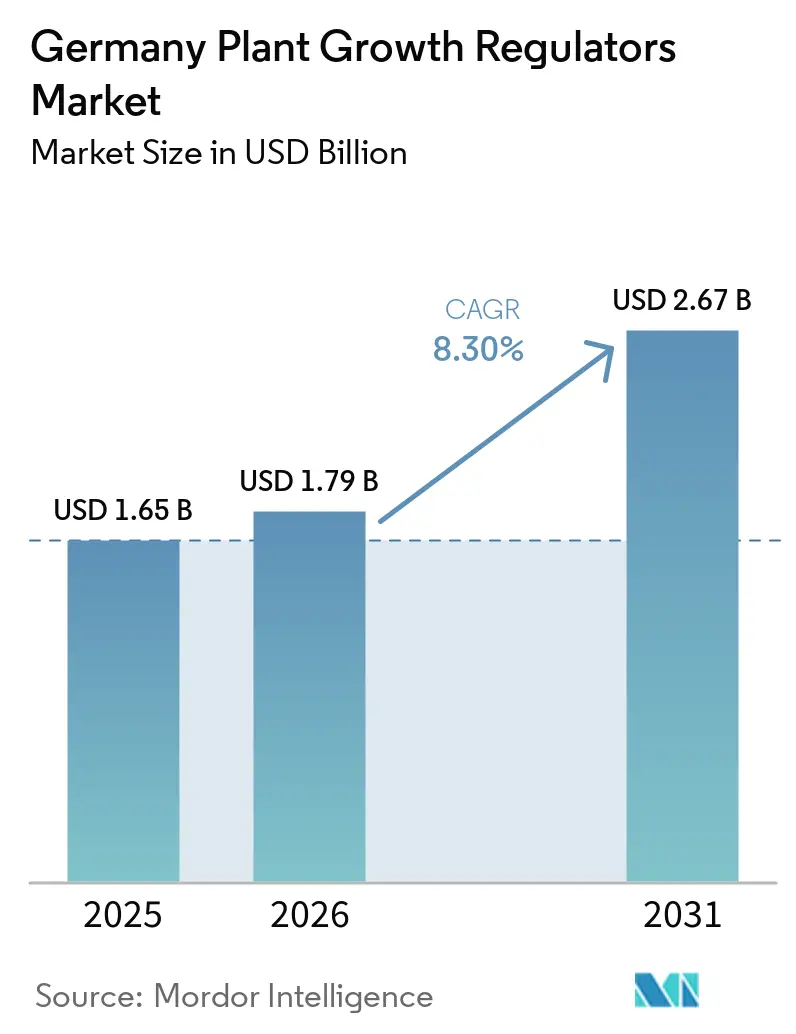
| Base Year Market Size (2025) | USD 1.65 Billion |
| Market Size (2026) | USD 1.79 Billion |
| Market Size (2031) | USD 2.67 Billion |
| Growth Rate (2026 - 2031) | 8.30 % |
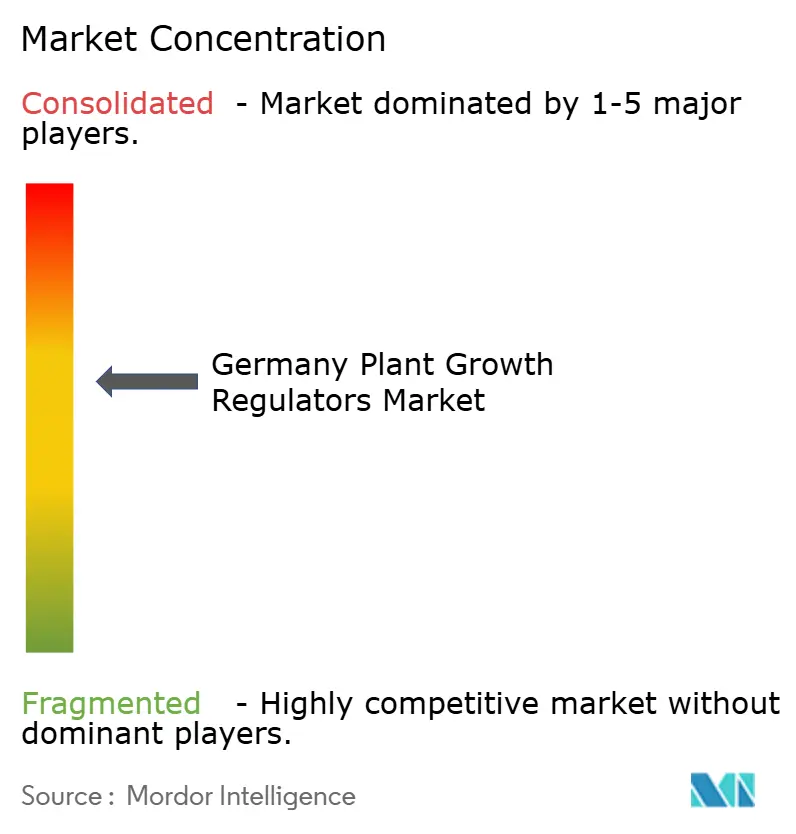
| Market Concentration | Medium |
Major Players *Disclaimer: Major Players sorted in no particular order Image © Mordor Intelligence. Reuse requires attribution under CC BY 4.0. | |
Germany Plant Growth Regulators Market Analysis by Mordor Intelligence
The Germany plant growth regulators market size is projected to increase from USD 1.65 billion in 2025 to USD 1.79 billion in 2026 and reach USD 2.67 billion by 2031, growing at a CAGR of 8.30% over 2026-2031. Demand also reflects Germany’s dense rotations and high-yield cereal systems, where lodging prevention and crop uniformity remain recurring priorities rather than occasional input decisions. The 2025 shift by the new coalition government away from binding pesticide-reduction targets eased near-term policy pressure on conventional products, even as precision application tools spread further across farms. At the same time, delayed renewals under European Union Regulation (EC) No 1107/2009 keep supply planning important, which is why the Germany plant growth regulators market is steadily moving toward broader portfolios that combine conventional active substances, biological options, and biostimulant-adjacent products.
Key Report Takeaways
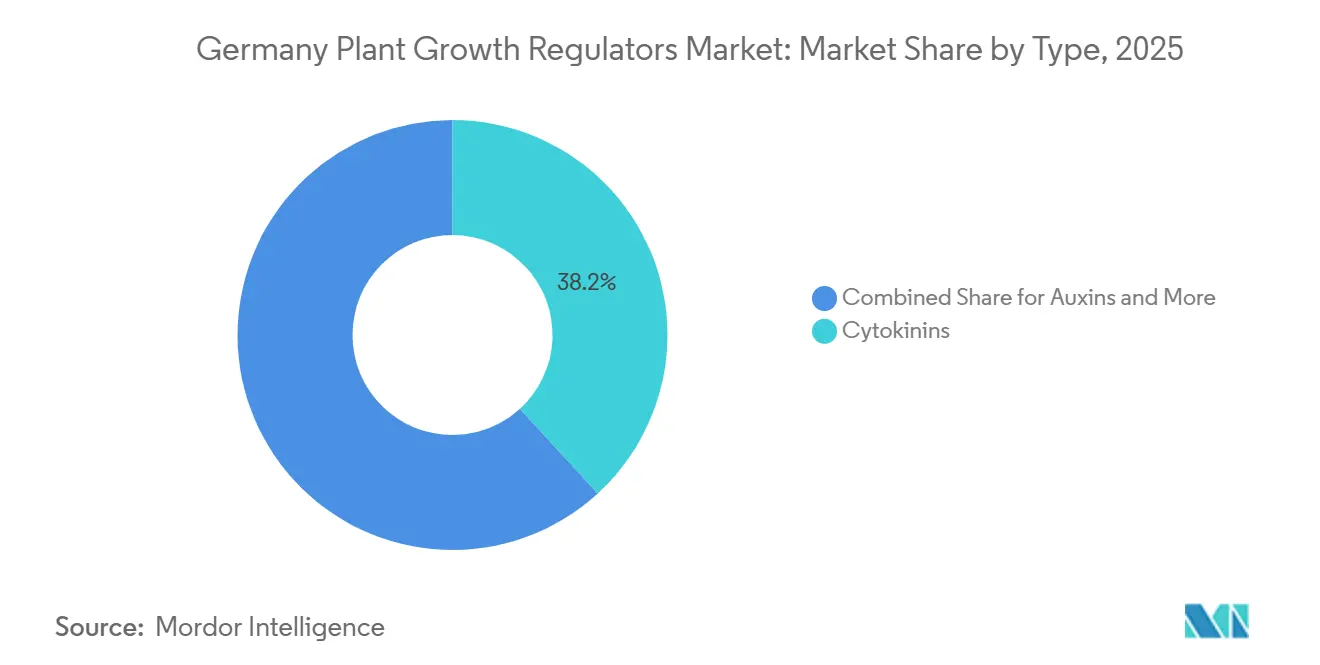
- By type, Cytokinins accounted for 38.2% of the Germany plant growth regulators market size in 2025, while the Auxins segment is the fastest with an 7.2% CAGR through 2031.
- By formulation, liquid formulations accounted for 72.4% of the Germany plant growth regulators market size in 2025, while the same segment was also the fastest with an 8.7% CAGR through 2031.
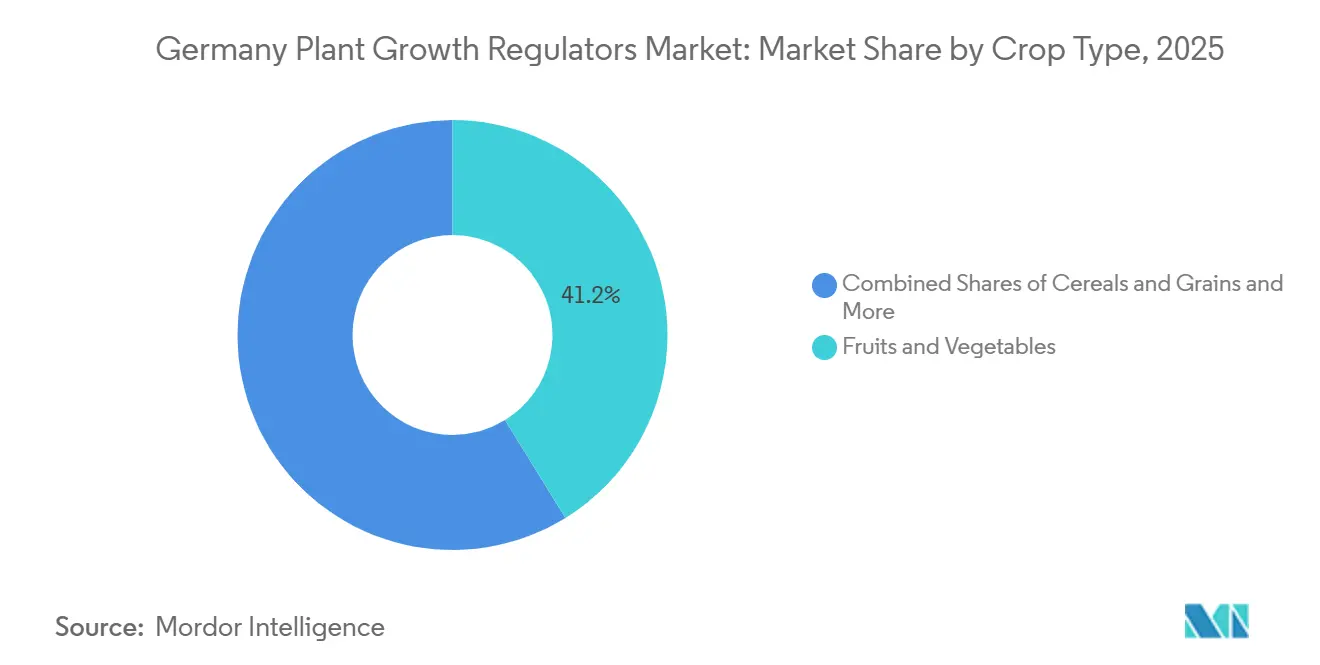
- By crop type, fruits and vegetables were the largest segment with 41.2% of the Germany plant growth regulators market share in 2025, while turf and ornamentals were the fastest segment with a projected 7.2% CAGR through 2031.
Note: Market size and forecast figures in this report are generated using Mordor Intelligence’s proprietary estimation framework, updated with the latest available data and insights as of January 2026.
Germany Plant Growth Regulators Market Trends and Insights
Drivers Impact Analysis*
| Driver | (~) % Impact on CAGR Forecast | Geographic Relevance | Impact Timeline |
|---|---|---|---|
| Expansion of high-value crop cultivation | +1.6% | National, with stronger gains in Bavaria, Lower Saxony, and Baden-Württemberg | Medium term (2-4 years) |
| Rising demand for crop yield optimization under food security pressure | +1.4% | National, with spillover into European grain trade corridors | Long term (≥ 4 years) |
| Greater focus on sustainable and resource-efficient farming | +1.2% | National, aligned with European Union Farm-to-Fork policy areas | Long term (≥ 4 years) |
| Convergence between biostimulants and growth regulators | +1.0% | National, with earlier uptake in intensive horticultural zones | Medium term (2-4 years) |
| National Action Plan for sustainable plant protection use | +0.8% | National, with implementation support in nitrate-sensitive red zones | Medium term (2-4 years) |
| Digital agriculture adoption for precision application | +0.7% | National, strongest in northern and eastern arable states | Short term (≤ 2 years) |
| Source: Mordor Intelligence | |||
Expansion of High-Value Crop Cultivation
Germany’s horticulture and permanent crop base is expanding in response to food supply goals and stronger quality premiums in domestic and export channels. The Horticulture Action Plan announced in 2025 aimed to raise domestic fruit and vegetable production to a level of self-sufficiency, which directly supports greater use of thinning, sizing, and ripening products. This trend lifts demand for gibberellins, cytokinins, ethephon, and prohexadion-calcium in crops where plant architecture and harvest timing affect both yield and price realization. It also widens the application base of the Germany plant growth regulators market beyond cereal lodging control, especially in Baden-Württemberg and Lower Saxony, where fruit output remains commercially significant. As acreage shifts toward more value-dense crops, product demand becomes broader by use case and more resilient by farm type.
Rising Demand for Crop Yield Optimization Under Food Security Pressures
Germany planted 2.86 million hectares of winter wheat and 1.21 million hectares of winter barley in 2025, which keeps demand for trinexapac-ethyl and chlormequat chloride tied to a very large treated area[1]Source: Bundesministerium für Landwirtschaft, Ernährung und Heimat, “Erntebericht 2025: Mengen und Preise,” bmel-statistik.de. Lodging prevention remains one of the clearest return-driven use cases in the Germany plant growth regulators market, especially in winter cereals. When cereal crops lodge, farms face yield loss, harvest inefficiency, and grain quality downgrades, so plant growth regulation is often maintained even as other input decisions are tightened. Lower cereal prices in 2025 increased the need to protect harvestable output, as growers sought a more predictable return per hectare. That makes the Germany plant growth regulators market more durable than input categories that are easier to postpone or reduce.
Greater Focus on Sustainable and Resource-Efficient Farming
Sustainability pressures are also supporting the Germany plant growth regulators market, especially where growers need to manage crop structure and nutrient efficiency at the same time. In nitrogen-sensitive farming systems, products that shorten internodes while preserving crop vigor help farmers stabilize yield under tighter nutrient use conditions. The Federal Office of Consumer Protection and Food Safety recommended in its 2030 authorization reform work that more attention be given to low-risk and biological active substances, which supports future product availability in this space[2]Source: Bundesamt für Verbraucherschutz und Lebensmittelsicherheit, “Plant Protection Product Authorisation 2030 Final Report,” bvl.bund.de. This regulatory direction supports a newer product layer where stress-management, nutrient efficiency, and growth-control claims start to overlap. As a result, the Germany plant growth regulators market is gaining from sustainability goals even when those same goals place tighter scrutiny on older chemistry.
Convergence Between Biostimulants and Growth Regulators
Product development is widening as biological and nutrition-linked inputs are designed to influence hormone balance, stress signaling, and crop structure without always following the same commercial path as classic plant protection products. This shift is not replacing conventional products in the Germany plant growth regulators market, but it is broadening the range of companies and product formats competing for the same agronomic budget. The Federal Office of Consumer Protection and Food Safety has already signaled support for lower-risk and biological pathways, which gives this overlap a clearer operating direction in Germany. For suppliers, this means growth can come from differentiated portfolios rather than only from additional volume in established cereal programs. For growers, it creates more choice in how to pair growth control with stress tolerance and crop nutrition.
Restraints Impact Analysis*
| Restraint | (~) % Impact on CAGR Forecast | Geographic Relevance | Impact Timeline |
|---|---|---|---|
| Stringent European Union approval framework | -1.3% | National, amplified by Germany’s historically strict review process | Long term (≥ 4 years) |
| Variable farm income and weaker commodity prices | -0.9% | National, strongest in cereal-heavy northern and eastern regions | Short term (≤ 2 years) |
| Review pressure on key synthetic active ingredients | -1.0% | National, with stronger effects on products tied to chlormequat and ethephon | Medium term (2-4 years) |
| Slow authorization of new active substances | -0.8% | National, especially for biological and novel dossiers | Long term (≥ 4 years) |
| Source: Mordor Intelligence | |||
Stringent European Union Approval Framework
The approval framework under European Union Regulation (EC) No 1107/2009 remains a structural restraint on the Germany plant growth regulators market. Germany applies this framework through the Federal Office of Consumer Protection and Food Safety, with support from the Federal Institute for Risk Assessment and the Federal Environment Agency, and the process has remained demanding in both evidence requirements and review depth[3]Source: Bundesinstitut für Risikobewertung, “Legal Basis in the Field of Plant Protection Products,” bfr.bund.de. The Federal Office of Consumer Protection and Food Safety stated in 2024 that high compliance demands and long timelines had made Germany less attractive as a central rapporteur location for new files. That slows the entry of new molecules and raises the cost of maintaining portfolios. The result is a market where regulatory access can matter as much as agronomic performance.
Variable Farm Income and Weaker Commodity Prices
Lower crop prices can reduce the speed of value growth in the Germany plant growth regulators market even when agronomic need stays in place. Under those conditions, growers usually maintain core lodging-control programs but become more selective on second passes, premium formulations, and nonessential add-ons. This shifts purchasing toward generic products and suppliers that can show consistent field performance at lower cost. It also raises pressure on companies whose German portfolios are concentrated in premium-only segments.
*Our forecasts treat driver/restraint impacts as directional, not additive. The impact forecasts reflect baseline growth, mix effects, and variable interactions.
Segment Analysis
By Type: Cytokinins Lead, Auxins Gain Through Biostimulant Convergence
Cytokinins accounted for 38.2% of the Germany plant growth regulators market in 2025. This dominance is attributed to the crop-specific requirements of Germany's fruit orchards, viticulture, and nursery plant sectors, rather than the total treated area. In apple and pear orchards located in Baden-Württemberg, the hub of Germany's commercial fruit production (Obstbau), 6-Benzyladenin (6-BA) is the standard cytokinin thinning agent. It is applied at the 10-12 mm fruitlet stage to thin excess fruits while promoting cell division in retained fruits, thereby enhancing the final fruit diameter. This dual-action benefit is unmatched by other chemical classes. Additionally, Germany's nursery plant industry supports consistent demand for cytokinins through tissue culture propagation programs and stock plant branching treatments, where cytokinin applications increase cutting yields by stimulating axillary bud break.
Auxins are the fastest-growing segment in Germany plant growth regulators market share, with a projected CAGR of 7.2% from 2026 to 2031. This growth is driven by traditional rooting applications in ornamental propagation and the increasing adoption of biostimulant-auxin convergence products. Indole-3-butyric acid (IBA)-based rooting preparations are standard in Germany's ornamental nursery and fruit tree rootstock propagation sectors, where propagation rates directly impact nursery economics. Additionally, the shift from synthetic auxin products to seaweed-derived biostimulant formulations is expanding the market. A study published in Frontiers in Horticulture (May 2024) demonstrated that Kelpak, derived from Ecklonia maxima, increased root fresh weight by 62% and root length by 75% in rose cuttings compared to untreated controls. These results approach the efficacy of synthetic treatments, highlighting the growing overlap between biostimulants and auxins, which is broadening the total addressable market for auxin-type products.



By Formulation: Liquid Formats Reinforce Dominance Through Precision-Farming Alignment
Liquid formulations accounted for 72.4% of the Germany plant growth regulators market size in 2025, making them the largest formulation segment and the preferred format for modern spray programs. Their position reflects easier tank mixing, reliable handling in mechanized systems, and a better fit with precision application equipment used on German farms. The Federal Office of Consumer Protection and Food Safety listed more than 34 authorized products containing trinexapac-ethyl in May 2026, which are predominantly offered in liquid forms, such as emulsion concentrates and related formats.
Liquid formulations were also the fastest-growing segment, with an 8.7% CAGR through 2031, as newer biological and biostimulant-adjacent products tend to enter the market in spray-ready liquid formats. Germany plant growth regulators market size for non-liquid formulations remains relevant in narrower use cases where stability, handling, or application setting matters more than broad-acre convenience. Soluble concentrates continue to hold value for high-purity horticultural applications, while water-dispersible options remain useful in ornamental and nursery settings that require consistent storage performance.
By Crop Type: Fruits and Vegetables Lead, Specialty Applications Gain Ground
Fruits and vegetables held 41.2% of the Germany plant growth regulators market share in 2025, making them the largest crop type segment despite a smaller land base than cereals. This position reflects the high treatment intensity of orchard, vineyard, and vegetable systems, where thinning, fruit sizing, ripening control, and post-harvest management all matter to commercial returns. Germany’s apple harvest exceeded 1 million metric tons in 2025 for the first time since 2022, which supported continued use of products tied to fruit development and harvest coordination in Baden-Württemberg and Lower Saxony. Potato production also supports steady use of sprout inhibitors in storage, while vineyard demand adds niche but higher-value applications in berry sizing and crop uniformity.
Germany plant growth regulators market size in cereals and grains remains substantial because this crop group covers the broadest treated area, even though fruits and vegetables were the largest by share in 2025. Winter wheat area reached 2.86 million hectares in 2025, following a strong year-on-year increase, keeping lodging-control programs central to commercial cereal production. Oilseeds and pulses add demand during crop establishment, especially in rapeseed, where growth management supports stand structure and winter hardiness. Turf and ornamentals were the fastest crop type segment with a 7.2% CAGR through 2031, supported by municipal green areas, sports turf maintenance, and nursery production of compact ornamental varieties. The crop mix gives the Germany plant growth regulators market a layered demand base where large-area cereals provide volume and specialty crops provide higher-value applications.
Geography Analysis
Germany represented the entire Germany plant growth regulators market in 2025, with demand varying considerably based on region, crop composition, and farm structure. Northern and eastern states supported the largest volume base because cereal area is concentrated there, and lodging-control programs are part of standard agronomy on many large farms. Lower Saxony and North Rhine-Westphalia also added steady demand through potato production and broader arable rotations, while Saxony-Anhalt, Brandenburg, and Mecklenburg-Vorpommern offered favorable conditions for variable-rate application on larger holdings. Bavaria remained important because it combines orchards, vegetable output, and hop cultivation.
Southern and southwestern Germany add a different layer to the Germany plant growth regulators market through vineyards, orchards, and other specialty crops. Baden-Württemberg and Rhineland-Palatinate are important for vineyard demand, where bunch structure, berry size, and ripening uniformity affect market value. Germany’s fruit and vegetable self-sufficiency remained at 30% when the 2025 Horticulture Action Plan was introduced, so policy support is likely to keep specialty-crop demand firm in these regions. Maximum residue level compliance within the European Union single market also reinforces careful application practices, which tend to favor registered and well-supported products.
Smaller states also matter because they broaden the end-use base of the Germany plant growth regulators market. Thuringia and Saxony are adding incremental demand through field vegetables, legumes, and mixed rotations where crop stand management reduces harvest losses. Saarland and Hesse support the fastest crop type segment through ornamental production and nursery activity linked to urban landscaping. North Rhine-Westphalia also remains relevant for nitrogen-efficient farming programs, where growers are seeking better crop structure under tighter nutrient conditions. Overall, regional demand in Germany is uneven, and companies with broader crop coverage are better placed than those tied to a single cereal-heavy product niche.
Competitive Landscape
The Germany plant growth regulators market is moderately concentrated at the top, with BASF SE, Bayer AG, Corteva, Inc., Nufarm Limited, and Syngenta AG forming the leading tier across broad conventional portfolios and newer biological positions. UPL Limited, Nufarm Limited, and Certis Belchim B.V. form a strong second tier that competes through generic formulations, selected specialty products, and field-level commercial support. The Federal Office of Consumer Protection and Food Safety listed more than 50 active plant growth regulator formulations in May 2026, suggesting a market that supports both price competition and product differentiation. This keeps the Germany plant growth regulators market active without making it highly fragmented. Supplier strength still depends heavily on registration depth, formulation quality, and agronomic positioning.
Competitive boundaries are widening as biological and biostimulant-adjacent products move closer to traditional growth-control uses. In March 2026, Certis Belchim B.V. and Elicit Plant announced a strategic partnership to co-develop a biostimulant solution for potato crops across European markets, demonstrating how suppliers are targeting resilience and input efficiency alongside traditional growth management. In January 2026, Certis Belchim B.V. also signed a collaboration with Moa Technology to co-develop a new amplifier molecule for next-generation crop input solutions in Europe. These moves show that mid-tier suppliers are using partnerships to build pipeline depth without carrying the full cost of internal discovery. That keeps the Germany plant growth regulators market competitive even outside the largest multinational groups.
Distribution and access to technology also shape the market. Gowan Company completed the acquisition of Ceradis in December 2025, which strengthened its European formulation and biocontrol position and may broaden its relevance in integrated crop input programs that indirectly affect growth management. Digital support is becoming more important as suppliers try to connect products with weather, field maps, and treatment timing rather than selling on chemistry alone. That favors companies that can combine registration strength with advisory depth and control over the route-to-market. Smaller distributors still matter in local delivery and specialty coverage, but margin pressure is likely to rise where generic prices continue to converge.
Germany Plant Growth Regulators Industry Leaders
BASF SE
Syngenta AG
Bayer AG
Corteva, Inc.
Nufarm Limited
- *Disclaimer: Major Players sorted in no particular order

Recent Industry Developments
- March 2026: Certis Belchim B.V. and Elicit Plant have declared a partnership to jointly develop a biostimulant solution for potato crops in Europe. The collaboration utilizes Elicit Plant’s EliTerra platform, which can reduce plant water consumption by up to 20% while improving crop resilience. Given Germany's position as a major potato producer, this initiative aims to meet the increasing demand for advanced plant health solutions.
- October 2025: Gowan Company completed the acquisition of Ceradis, a Netherlands-based crop protection formulation and biocontrol specialist. This move strengthened Gowan Company’s European presence and integrated Ceradis’s bio-mineral formulation technologies, which are relevant to integrated crop management programs in Germany and nearby markets.
- April 2025: The European Commission published Implementing Regulation (EU) 2025/787, extending approval periods for 22 active substances, including gibberellic acid. The measure signaled that renewal timelines for key actives in plant growth regulation may continue to stretch beyond original expiry dates.


Germany Plant Growth Regulators Market Report Scope
Plant Growth Regulators (PGRs) are natural or synthetic chemical compounds applied to crops to alter specific physiological processes, such as cell division, flowering, and fruit ripening. They maximize agricultural efficiency by optimizing plant height, enhancing root development, and improving overall harvest yields.
The Germany Plant Growth Regulators Market Report is segmented by type (Auxins, Cytokinin, Gibberellins, Ethylene, and Others), by formulation, including liquid, water-dispersible, emulsifiable concentrate, soluble concentrate, and powders and granules, and by crop type, including cereals and grains, fruits and vegetables, oilseeds and pulses, and turf and ornamentals. The forecasts are provided in terms of Value (USD).
| Auxins |
| Cytokinins |
| Gibberellins |
| Ethylene |
| Others |
| Liquid |
| Water-dispersible options |
| Emulsifiable concentrates |
| Soluble concentrates |
| Powders and granules |
| Cereals and grains |
| Fruits and vegetables |
| Oilseeds and pulses |
| Turf and ornamentals |
| By Type | Auxins |
| Cytokinins | |
| Gibberellins | |
| Ethylene | |
| Others | |
| By Formulation | Liquid |
| Water-dispersible options | |
| Emulsifiable concentrates | |
| Soluble concentrates | |
| Powders and granules | |
| By Crop Type | Cereals and grains |
| Fruits and vegetables | |
| Oilseeds and pulses | |
| Turf and ornamentals |


Key Questions Answered in the Report
What is the current outlook for Germany plant growth regulators demand?
The Germany plant growth regulators market was valued at USD 1.65 billion in 2025, is estimated at USD 1.79 billion in 2026, and is forecast to reach USD 2.67 billion by 2031 at an 8.30% CAGR.
Which crop group leads plant growth regulator use in Germany?
Fruits and vegetables were the largest segment with 41.2% share in 2025 because orchard, vineyard, and vegetable systems use more intensive thinning, sizing, ripening, and post-harvest treatments.
Which formulation type is most widely used in Germany?
Liquid formulations led with 72.4% share in 2025 and are also the fastest growing format, supported by precision spraying, tank-mix compatibility, and easier handling in mechanized systems.
Why are plant growth regulators important for German cereal farming?
They help manage lodging risk in wheat and barley, protect harvestable yield, and improve crop uniformity, which is especially important in a low-price environment where farmers must protect returns per hectare.
Page last updated on:





