
| Study Period | 2019 - 2030 |
| Forecast Data Period | 2025 - 2030 |
| Historical Data Period | 2019 - 2023 |
| Market Size (2025) | USD 1.42 Billion |
| Market Size (2030) | USD 2.11 Billion |
| CAGR (2025 - 2030) | 8.20% |
| Market Concentration | Low |
Major Players *Disclaimer: Major Players sorted in no particular order |
Asia-Pacific Plant Growth Regulators Market Analysis by Mordor Intelligence
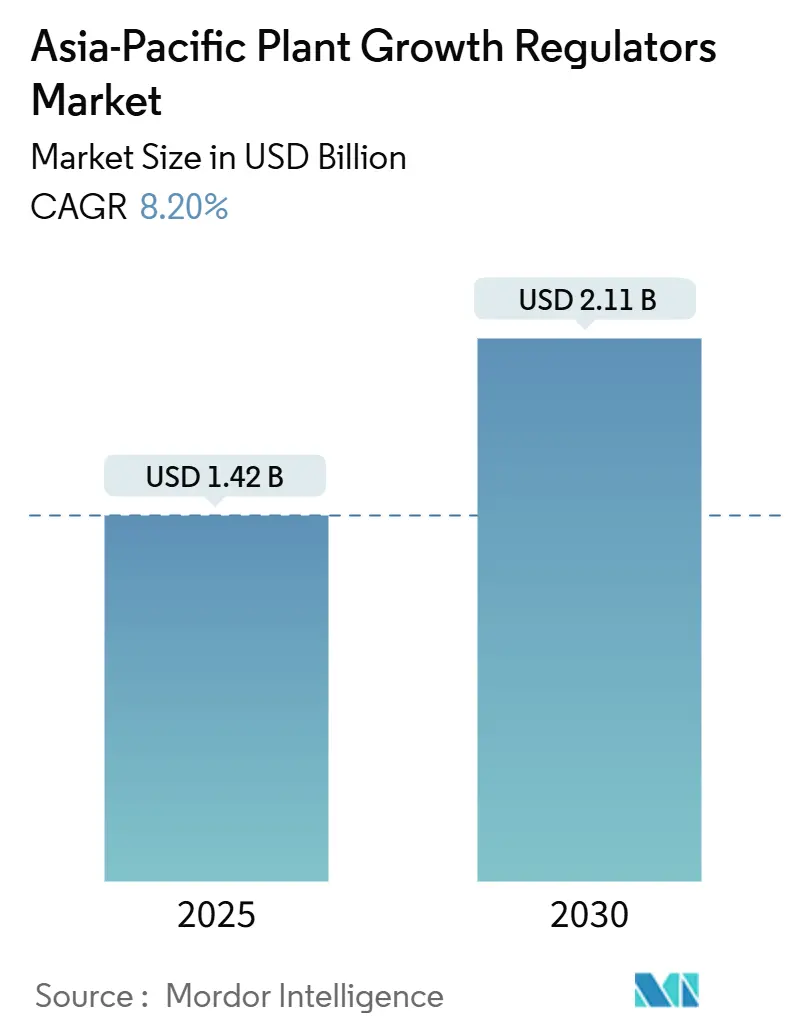
The Asia-Pacific Plant Growth Regulators Market size is estimated at USD 1.42 billion in 2025, and is expected to reach USD 2.11 billion by 2030, at a CAGR of 8.20% during the forecast period (2025-2030).
In the Asia-Pacific, rising climatic fluctuations, alongside various biotic and abiotic stresses, hinder seed germination, stunt seedling growth, and disrupt plant development. This cascade of challenges results in diminished biological and economic crop yields. For instance, the Directorate of Economics and Statistics (DES) reported that in the financial year 2023, wheat yields in India, a South Asian nation, slipped to 3.52 thousand kilograms per hectare, down from 3.53 the previous year. Yet, plant growth regulators (PGRs) emerge as a beacon of hope, adept at modulating plant responses to these stresses. This capability not only aids plant adaptation in challenging environments but also fuels the market's expansion. PGRs directly oversee the primary consequences of abiotic stresses: disturbances in growth and yield. Notable PGRs, including abscisic acid (ABA), salicylic acid (SA), ethylene (ET), and jasmonates (JAs), are instrumental in enhancing plant responses to diverse stresses.
Furthermore, in a bid to curtail dependence on chemical fertilizers and pesticides, numerous governments are championing sustainable agricultural practices. This push has spurred a notable increase in organic agricultural land across the Asia-Pacific. Consequently, there's a surging demand for both traditional plant growth regulators and bio-based, or organic, PGRs, driven by mounting environmental concerns. Highlighting this trend, the Agricultural and Processed Food Products Export Development Authority (APEDA) noted that in fiscal year 2023, India's organic farming area expanded to approximately 10.17 million hectares, a rise from 9.12 million hectares the prior year. Echoing this sentiment, the Green Food Development Center in China reported that in 2022, the nation boasted 11,621 thousand hectares of organic cropland. Given the escalating organic farming practices, heightened consumer awareness regarding health and environmental quality, and supportive government policies, the plant growth regulators market in the Asia-Pacific is poised for significant growth in the coming years.
Asia-Pacific Plant Growth Regulators Market Trends and Insights
Growing Usage in Cereals and Grains Supports the Market
With over 4.5 billion residents, the Asia-Pacific region boasts a colossal appetite for staple foods, including rice, wheat, and maize. Countries like China, India, Indonesia, and Bangladesh rank among the globe's top producers of rice and wheat. For example, the US Department of Agriculture reported that in the 2023 crop year, China led the world with a production of approximately 146 million metric tons of milled rice, followed closely by India at over 135 million metric tons. The same source highlighted that China not only leads in production but also in consumption, with a staggering 150 million metric tons of rice consumed in 2023. To satiate this voracious demand, farmers are increasingly turning to Plant Growth Regulators (PGRs) to enhance grain yields, boost seed germination, and hasten growth cycles, especially in the Asia-Pacific's cereal and grain crops.
Additionally, the Asia-Pacific region's climate fluctuations have ushered in erratic rainfall, droughts, and extreme temperatures. Such challenges amplify the reliance on PGRs, enabling cereal crops to better endure stresses like drought, salinity, and temperature swings, thereby stabilizing yields. In response, market players are innovating, crafting diverse product types to tackle these challenges and bolster cereal crop yields, thereby broadening their consumer reach. A case in point is Mindleader (Pilarquim) in China, which markets its BIYI product (PILAROPTIM) - a tri-component plant growth regulator. The company touts its PGR's versatility for both rice and wheat, highlighting benefits like enhanced rooting and germination, cell activation, bolstered stress resistance, and improved yield and fruit quality.
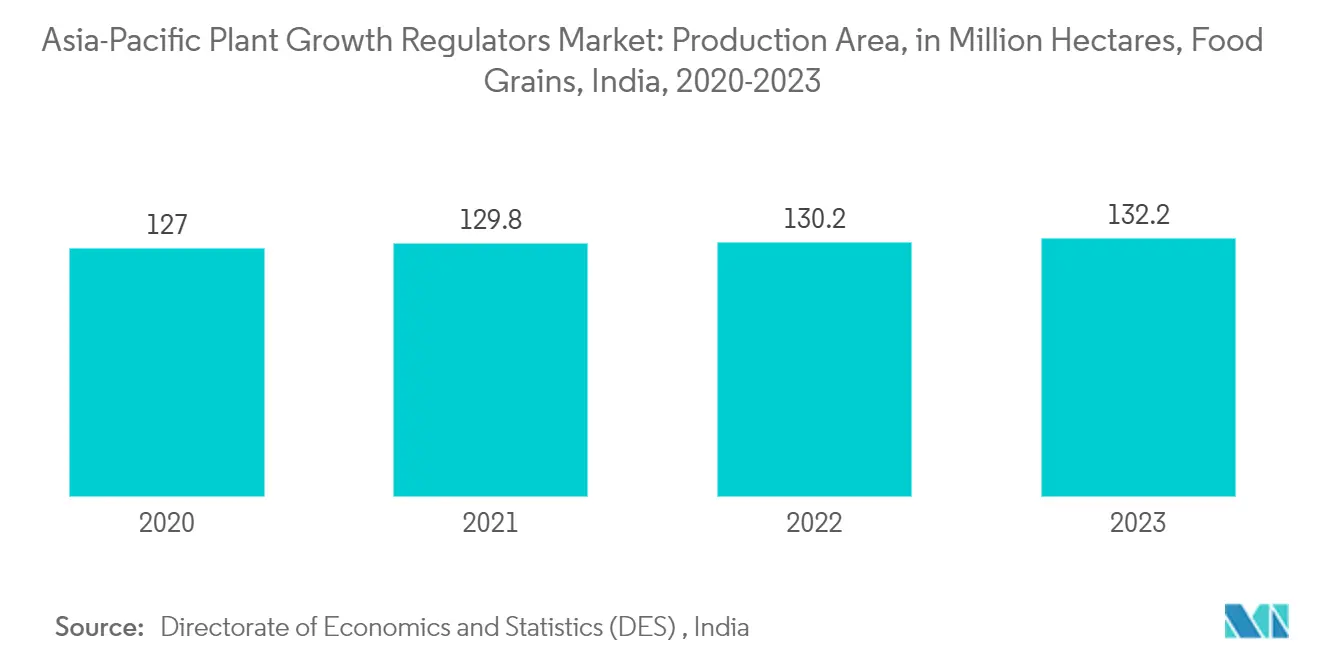
The region is also witnessing a surge in hybrid and genetically modified (GM) cereals, which frequently depend on PGRs for optimal growth and yield maximization. Supporting this trend, the Directorate of Economics and Statistics (DES) in India noted a rise in the cultivation area for food grains, expanding from 127 million hectares in 2020 to 132 million hectares in 2023. Consequently, the combination of heightened production and consumption of cereal and grain crops, proactive product offerings from market players, and government initiatives promoting PGR use for bolstered cereal production and food security underscore the surging demand for PGRs in the Asia-Pacific's cereal and grain sectors.


China Dominates The Market
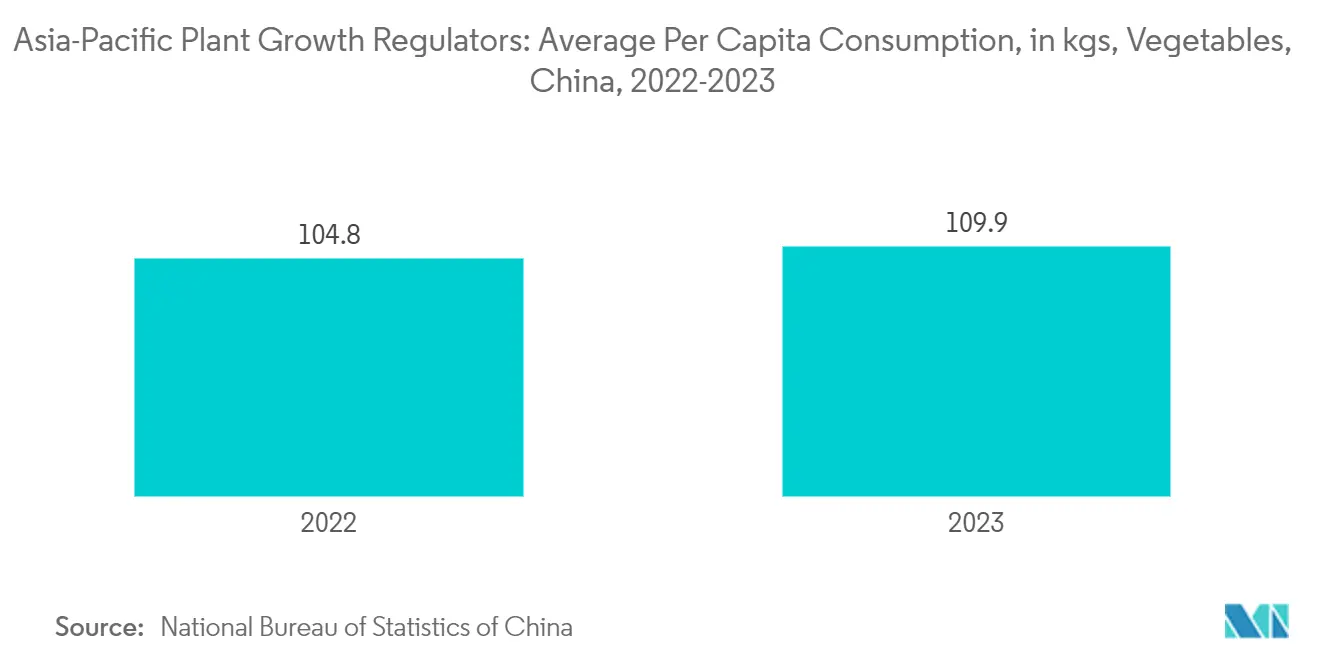
China's plant growth regulators (PGRs) market has witnessed significant growth and transformation in recent years. This surge is largely attributed to advancements in agriculture and an escalating demand for food production. According to the National Bureau of Statistics of China, the average per capita fresh vegetable consumption in China grew from 104.8 kgs in 2022 to 109.9 kgs in 2023. This supports the usage of plant growth regulators (PGRs) in vegetable production to improve yield, quality, and resistance to pests. Along with there is a heightened awareness of sustainable farming practices. Confronted with land degradation, water scarcity, and climate change, China's agricultural sector is pivoting towards sustainability. Illustratively, the Chinese government has set ambitious targets aiming for carbon neutrality by 2060 and peaking carbon emissions by 2030. These goals are spurring substantial investments in green technologies and the adoption of sustainable agricultural practices. PGRs, recognized as sustainable inputs, play a pivotal role in optimizing crop production while mitigating environmental impacts.
China, home to one of the world's largest populations, grapples with a pressing demand for food. To bolster food security, both the government and the agricultural sector are intensifying efforts to boost crop yields. PGRs emerge as vital tools in this endeavour, optimizing growth, enhancing yields, and ensuring superior crop quality. For instance, gibberellins, auxins, and cytokinins are instrumental in seed germination, fruit development, and overall crop performance. Such enhancements are paramount as China strives to cater to its burgeoning population. In 2023, underscoring its commitment to food security for its 1.4 billion citizens, Chinese authorities ramped up financial support to stabilize the production of key agricultural products, grains included. This initiative, part of a broader strategy, was bolstered by a joint statement from the central bank, agriculture ministry, and financial regulator, emphasizing support for agriculture and small businesses.
As awareness of environmental sustainability grows and consumer demand for organic produce rises, there's a noticeable shift towards the development and adoption of bio-based and organic PGRs. These bio-based products are increasingly viewed as safer alternatives, promising a reduced environmental footprint. In response to this trend, companies are actively introducing innovative products to the market. For instance, the Mindleader (Pilarquim), in 2023, unveiled its BIYI product (PILAROPTIM) at a launch event. This product comprises gibberellic acid, indoleacetic acid, and 14-hydroxylated brassinosteroid and is useful to a diverse range of crops, including citrus, chilli, pseudo ginseng, watermelon, muskmelon, mango, honeydew melon, peanuts, various vegetables, and staple grains like wheat, corn, and rice. Thus, with an emphasis on sustainability, food security, and continuous product innovations, the market is poised for growth in the coming years.

Competitive Landscape
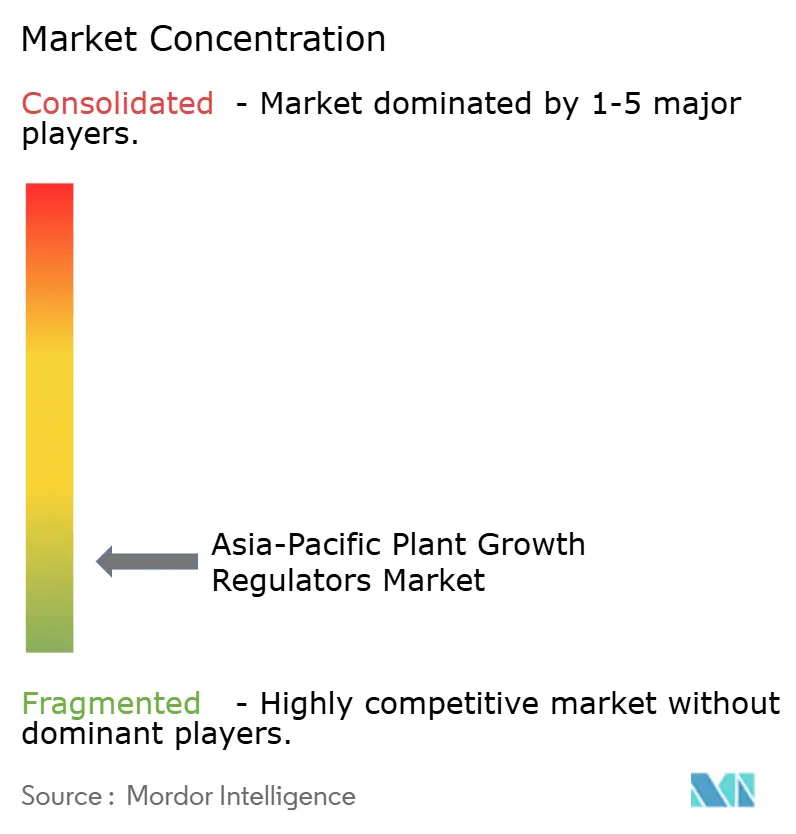
The Asia-Pacific Plant Growth Regulators Market is fragmented, with the presence of few international players and several small players competing in the market. The major companies are Bayer AG, FMC Corporation, Corteva AgriScience, Syngenta AG, and BASF SE. Agreements with other companies, new product launches, and investments for the expansion of manufacturing units globally have been the strategies mostly adopted by these players. Some of the players have been expanding their geographical presence by acquiring or merging with manufacturers in foreign markets. Major investments were made by companies in their domestic market to cater to the local demand.
Asia-Pacific Plant Growth Regulators Industry Leaders
Bayer AG
FMC Corporation
Corteva Agri Science
Syngenta AG
BASF SE
- *Disclaimer: Major Players sorted in no particular order

Recent Industry Developments
- July 2024: Zhejiang SEGA Science and Technology Co., Ltd. (SEGA) launched PANG, a new plant growth regulator that combines Choline chloride and S-Abscisic acid, at a product launch conference in Zhejiang Province, China. The conference was titled "Creating a Better Future Together."
- March 2023: Sumitomo Chemical India Ltd. introduced Promalin, a biorational plant growth regulator, for apple cultivation in India. The product aims to improve apple quality for growers in Himachal Pradesh, Jammu & Kashmir, and Uttarakhand, enhancing their export opportunities.


Asia-Pacific Plant Growth Regulators Market Report Scope
Plant growth regulators (PGRs) are growth substances that modify plant growth such as increasing branching, suppressing shoot growth, increasing return bloom, removing excess fruit, or altering fruit maturity. The plant hormones are identified as promoters (auxins, gibberellin, and cytokinin), inhibitors (abscisic acid and ethylene), and other hypothetical growth substances (florigen, flowering hormone, etc.). The Asia-Pacific Plant Growth Regulators Market is segmented by Type (Cytokinins, Auxins, and Gibberellins), Application (Crop Based, and Non Crop Based), and Geography (China, India, Japan, Australia, and Rest of Asia-Pacific). The report offers market estimation and forecast in value (USD) for the above-mentioned segments.
Type
| Cytokinins |
| Auxins |
| Gibberellins |
Application
| Crop Based |
| Non Crop Based |
Geography
| China |
| India |
| Japan |
| Australia |
| Rest of Asia Pacific |
| Type | Cytokinins |
| Auxins | |
| Gibberellins | |
| Application | Crop Based |
| Non Crop Based | |
| Geography | China |
| India | |
| Japan | |
| Australia | |
| Rest of Asia Pacific |


Key Questions Answered in the Report
How big is the Asia-Pacific Plant Growth Regulators Market?
The Asia-Pacific Plant Growth Regulators Market size is expected to reach USD 1.42 billion in 2025 and grow at a CAGR of 8.20% to reach USD 2.11 billion by 2030.
What is the current Asia-Pacific Plant Growth Regulators Market size?
In 2025, the Asia-Pacific Plant Growth Regulators Market size is expected to reach USD 1.42 billion.
Who are the key players in Asia-Pacific Plant Growth Regulators Market?
Bayer AG, FMC Corporation, Corteva Agri Science, Syngenta AG and BASF SE are the major companies operating in the Asia-Pacific Plant Growth Regulators Market.
What years does this Asia-Pacific Plant Growth Regulators Market cover, and what was the market size in 2024?
In 2024, the Asia-Pacific Plant Growth Regulators Market size was estimated at USD 1.30 billion. The report covers the Asia-Pacific Plant Growth Regulators Market historical market size for years: 2019, 2020, 2021, 2022, 2023 and 2024. The report also forecasts the Asia-Pacific Plant Growth Regulators Market size for years: 2025, 2026, 2027, 2028, 2029 and 2030.
Page last updated on:
Asia-Pacific Plant Growth Regulators Market Report
Statistics for the 2025 Asia-Pacific Plant Growth Regulators market share, size and revenue growth rate, created by Mordor Intelligence™ Industry Reports. Asia-Pacific Plant Growth Regulators analysis includes a market forecast outlook for 2025 to 2030 and historical overview. Get a sample of this industry analysis as a free report PDF download.


 Your data is secure and never sold or shared.


