
Gelling Agent Market Size and Share
Market Overview
| Study Period | 2021 - 2031 |
|---|---|
| Market Size (2026) | USD 5.87 Billion |
| Market Size (2031) | USD 7.79 Billion |
| Growth Rate (2026 - 2031) | 5.79 % |
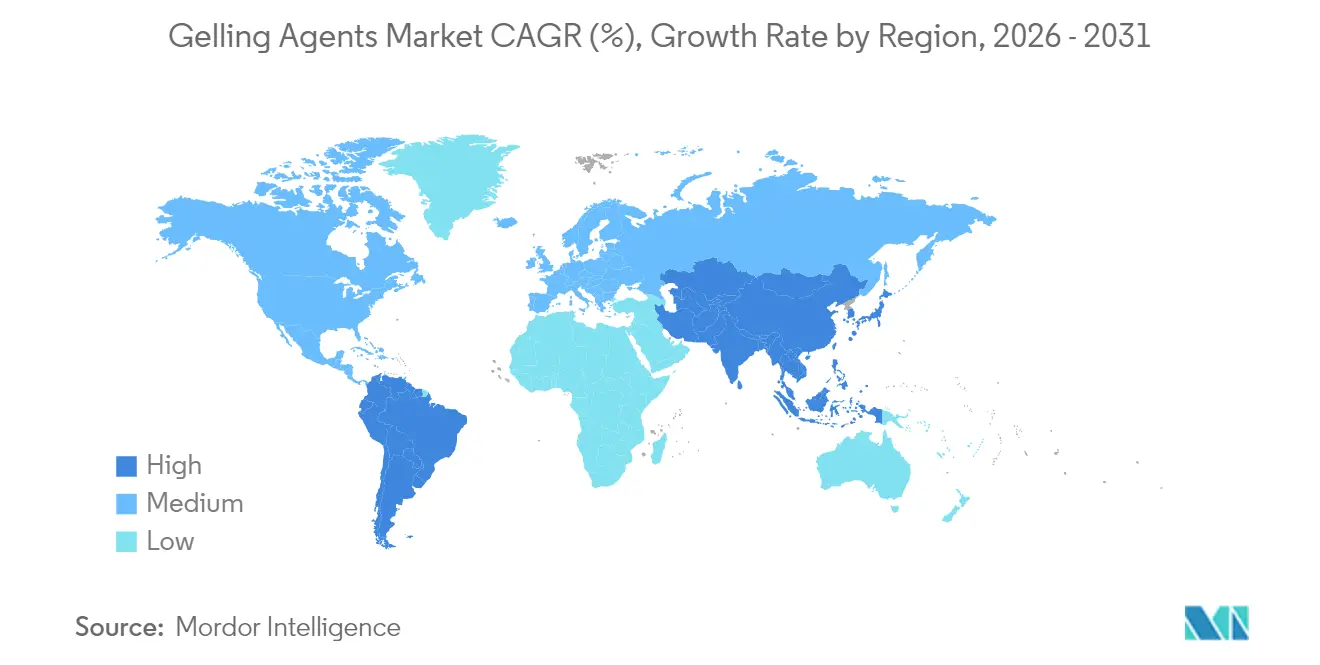
| Fastest Growing Market | South America |
| Largest Market | Asia Pacific |
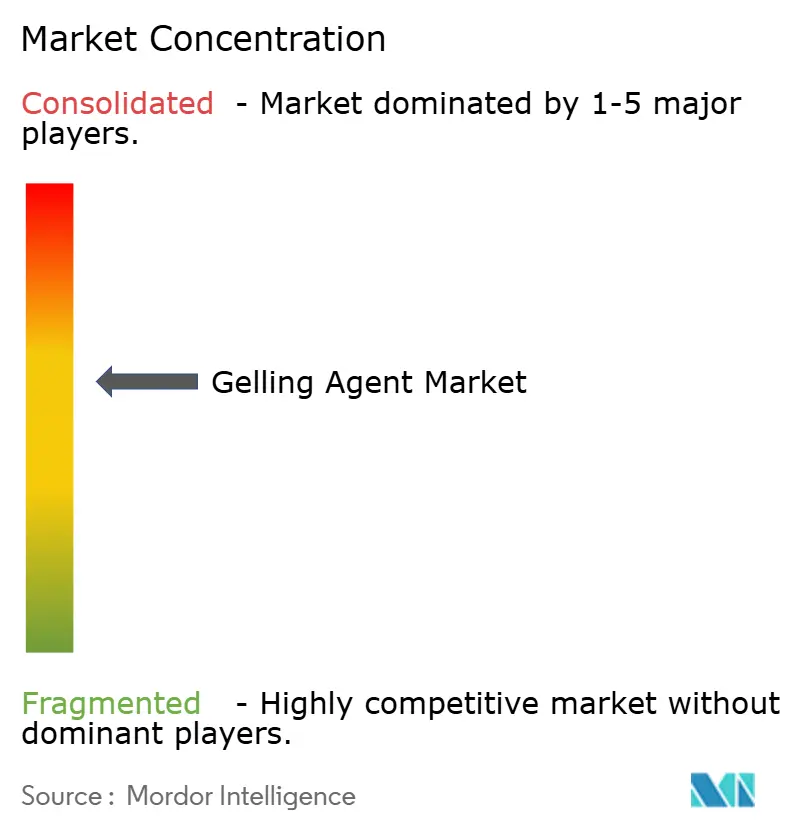
| Market Concentration | Medium |
Major Players
*Disclaimer: Major Players sorted in no particular order Image © Mordor Intelligence. Reuse requires attribution under CC BY 4.0. |
|
Gelling Agent Market Analysis by Mordor Intelligence
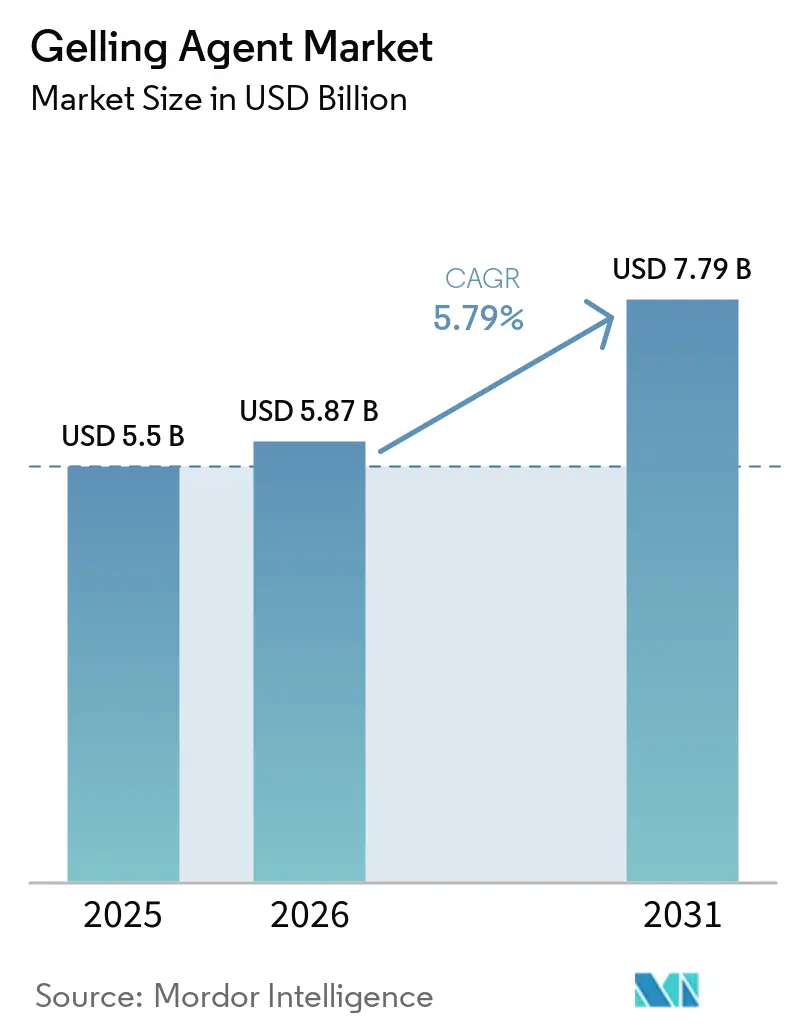
The gelling agents market size in 2026 is estimated at USD 5.87 billion, growing from 2025 value of USD 5.5 billion with 2031 projections showing USD 7.79 billion, growing at 5.79% CAGR over 2026-2031. Robust demand for clean-label ingredients, expanding applications in hydrogel-enabled drug delivery, and step-change improvements in extraction efficiency anchor this trajectory. Natural product substitution is accelerating after the United States Food and Drug Administration (FDA)[1]Food and Drug Administration, "Generally Recognized as Safe (GRAS) documentation rules", www.fda.gov strengthened Generally Recognized as Safe (GRAS) documentation rules in 2025, rewarding suppliers able to provide deep safety dossiers. Simultaneously, plant-based diets and the rise of dairy alternatives are broadening the commercial scope of high-performance hydrocolloids, while breakthroughs in microbial fermentation improve functional consistency and shorten production lead times. South America, led by Brazil’s USD 231 billion food-processing base, is becoming the fastest-growing region, whereas Asia-Pacific retains volume leadership on the back of dominant seaweed and guar cultivation [2]U.S Department of Agriculture, "food-processing base", www.fas.usda.gov.
Key Report Takeaways
• By type, pectin held 34.19% of gelling agents market share in 2024; gellan gum is forecast to expand at 8.34% CAGR through 2030.
• By source, plant-derived materials accounted for 58.45% of gelling agents market size in 2024, while microbial-derived alternatives are projected to grow at 8.56% CAGR to 2030.
• By function, thickening applications led with 27.45% revenue share in 2024; encapsulation and controlled release is advancing at 9.01% CAGR.
• By application, food and beverages commanded 35.89% share of the gelling agents market size in 2024, whereas pharmaceuticals are set to climb at 9.34% CAGR.
• By geography, Asia-Pacific contributed 36.73% of global revenue in 2024; South America is poised for 8.45% CAGR to 2030.
Note: Market size and forecast figures in this report are generated using Mordor Intelligence’s proprietary estimation framework, updated with the latest available data and insights as of 2026.
Market Trends and Insights
Drivers Impact Analysis of Gelling Agent Market*
| Driver | (~) % Impact on CAGR Forecast | Geographic Relevance | Impact Timeline |
|---|---|---|---|
| Processed and convenience food demand | +1.2% | Global; strongest in Asia-Pacific & North America | Medium term (2-4 years) |
| Clean-label and natural additive preference | +1.5% | North America & EU; spreading to Asia-Pacific | Short term (≤ 2 years) |
| Dairy and dairy-alternative consumption | +0.8% | Global; led by North America & Europe | Medium term (2-4 years) |
| Extraction and processing innovation | +1.0% | Global; R&D hubs in EU & North America | Long term (≥ 4 years) |
| Widening Addoption in Pharmaceutical Formulation | +1.0% | Global; led by North America & Europe | Long term (≥ 4 years) |
| Application in plant based meat and seafood | +0.8% | Global; led by North America & Europe | Medium term (2-4 years) |
| Source: Mordor Intelligence | |||
Growing demand for processed and convenience foods
Urban lifestyles and dual-income households continue to push ready-to-eat meal uptake, requiring hydrocolloids with superior freeze-thaw tolerance and thermal stability. China's imports of high-value food ingredients rose sharply in 2024, lifting regional consumption of texture enhancers, thickeners, and stabilizers. Processors are engineering hybrid systems—such as carrageenan-starch blends—to maintain viscosity across cold-chain fluctuations. These tailored formulations underpin higher specification standards in frozen entrées, soups, and premium sauces. Consequently, the gelling agents market is experiencing a product-mix shift toward multi-component solutions that guarantee texture integrity over extended shelf life. The growing adoption of plant-based alternatives in food products has increased the demand for natural gelling agents derived from seaweed and fruit sources. Additionally, manufacturers are investing in research and development to create clean-label gelling agents that meet consumer preferences for transparent ingredient lists.
Increasing demand for clean-label and natural food additives
Regulatory bodies and consumers are intensifying their examination of ingredient lists. The 2024 ban on specific synthetic dyes in California and the European Food Safety Authority's (EFSA) [3]European Food Safety Authority’s (EFSA), "tighter heavy-metal limits", www.efsa.europa.eustricter heavy-metal restrictions for guar gum demonstrate this increased oversight. Hydrocolloid suppliers with established, transparent supply chains, particularly for pectin and alginate, are securing reformulation contracts in confectionery and beverage applications. While premium natural grades cost significantly more than their chemically modified alternatives, brand owners accept these higher costs to achieve clearer labels and regulatory compliance. This transition strengthens the gelling agents market as manufacturers switch from synthetic thickeners to plant-based and seaweed-derived alternatives. The market is further bolstered by increasing consumer awareness of natural ingredients and their health benefits. Additionally, technological advancements in extraction and processing methods are enabling manufacturers to produce higher quality natural gelling agents at improved efficiency levels.
Rising consumption of dairy and dairy-alternative products
Global retail sales of plant-based beverages reached new highs in 2024, increasing the demand for hydrocolloids that replicate dairy mouthfeel. Ashland's Benecel methylcellulose, designed to enhance body and suspension in oat-milk lattes, demonstrates application-specific innovation. Carrageenan-locust bean gum combinations continue to be essential in vegan cheese slices for meltability, while gellan gum provides clarity and protein stabilization in ambient nut-milk drinks. The expansion of dairy-alternative portfolios enables multinational ingredient suppliers to enter premium nutrition segments, thus expanding the gelling agents market. The growing consumer preference for clean-label products has led manufacturers to develop natural gelling agents derived from seaweed and plant sources. Additionally, the rising adoption of gelling agents in the pharmaceutical industry for drug delivery systems and capsule manufacturing contributes to market growth.
Technological advancements in hydrocolloid extraction and processing
The extraction of pectin from citrus peels using ultrasound technology achieves higher yields while consuming less energy, enhancing cost efficiency. The implementation of AI-controlled monitoring systems for viscosity and color reduces production failures and material waste. In pharmaceutical applications, the development of pH-responsive hydrogels through green chemistry methods enables targeted drug delivery, expanding pharmaceutical applications. These technological improvements support increased profit margins for innovative suppliers and create additional product specifications that expand the gelling agents market. The food industry's growing demand for natural and clean-label ingredients has accelerated research into plant-based gelling alternatives. Additionally, the increasing adoption of gelling agents in cosmetic formulations for texture enhancement and stability has opened new market opportunities.
Restraints Impact Analysis of Gelling Agent Market*
| Restraint | (~) % Impact on CAGR Forecast | Geographic Relevance | Impact Timeline |
|---|---|---|---|
| Raw material price volatility | -0.7% | Global; highest in Asia-Pacific | Short term (≤ 2 years) |
| High extraction and purification costs | -0.5% | Global; smaller firms hardest hit | Medium term (2-4 years) |
| Stringent regulatory and clean-label compliance challenges | -0.6% | Global; highest in Northa America and Europe | Medium term (2-4 years) |
| Low awareness and adoption in emerging and underdeveloped markets | -0.3% | Asia-pacific, Africa, Latin America | Long term (4+ years) |
| Source: Mordor Intelligence | |||
Fluctuating raw material prices
Seaweed-derived carrageenan and agar remain vulnerable to climate events and trade restrictions in Indonesia and the Philippines, causing spot price swings that challenge profit forecasting. Guar gum relies heavily on monsoon patterns in India and Pakistan, where drought can cut yields up to 40%. Large buyers now use long-term offtake contracts and partial vertical integration into seaweed farming to buffer cost volatility. At the same time, fermentation-based xanthan and gellan gum provide a hedge because their carbon sources are more diversified, although they are not immune to global dextrose and energy price movements. The market's heavy dependence on specific geographic regions exposes manufacturers to significant supply chain disruptions. Natural disasters and changing weather patterns continue to threaten raw material availability and price stability. Additionally, regulatory changes in key producing countries can create unexpected barriers to trade and impact global supply dynamics.
High costs of extraction and purification processes
The gelling agents market faces significant operational challenges due to traditional extraction methods and evolving regulatory requirements. Conventional hot-acid extraction of seaweed hydrocolloids consumes significant steam and generates saline effluent that demands treatment, inflating production overheads. Continuous-flow reactors and membrane filtration reduce wastewater volumes by 30–50% but require upfront investment. Smaller regional processors struggle to finance such upgrades, limiting their ability to serve high-margin medical and cosmetics segments. The increasing environmental regulations across regions require manufacturers to implement costly wastewater treatment systems, further straining their operational budgets. Additionally, the rising energy costs and raw material prices have pushed many small and medium-sized producers to operate at reduced capacities, affecting the overall market supply. The lack of technological innovation in extraction processes has resulted in stagnant production efficiency levels across the industry. Market consolidation is expected as larger manufacturers with stronger financial capabilities acquire smaller players struggling with operational costs.
*Our forecasts treat driver/restraint impacts as directional, not additive. The impact forecasts reflect baseline growth, mix effects, and variable interactions.
Gelling Agent Market Segment Analysis
By Type:
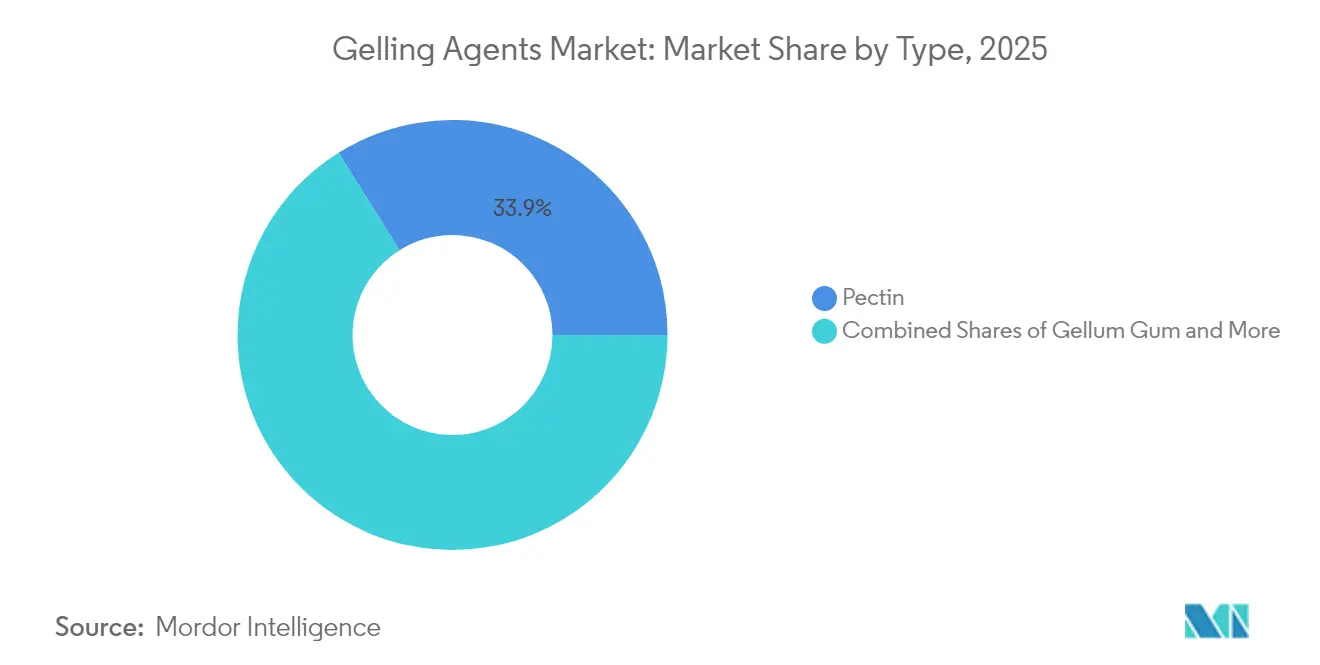
Pectin Dominance Amid Gellan InnovationPectin dominated the global gelling agents market with a 33.89% revenue share in 2025. The stable supply chain from citrus peel and apple pomace, combined with increasing applications in reduced-sugar jams and nutraceutical gummies, maintains its market leadership. Cargill's recent UniPECTINE capacity expansion in Brazil demonstrates strong market confidence in sustained demand growth. The versatility of pectin in clean-label formulations and its natural origin further strengthen its market position. Consumer preference for plant-based ingredients continues to drive pectin adoption across various food applications. Gelatin maintains its strong presence in confectionery and capsule shells, although ethical and religious considerations encourage manufacturers to explore pectin-gelatin combinations.
Gellan gum, while currently occupying a smaller market share, projects a robust growth rate of 8.09% CAGR, driven by its thermoreversible properties and high efficiency at low dosages, particularly in premium dairy alternatives and ophthalmic drugs. Carrageenan and agar maintain consistent market uptake in applications requiring vegan certification, despite facing geographic supply concentration challenges. The increasing demand for plant-based alternatives in Asian markets particularly supports the growth of these marine-derived gelling agents. The continuous development of specialized gelling agents expands the overall market scope by enabling manufacturers to achieve specific functional properties in various applications. The trend toward clean-label products and natural ingredients further accelerates innovation in the gelling agents segment.



By Source:
Plant-Derived Leadership Challenged by Microbial InnovationPlant-based raw materials generated 57.92% of 2025 revenues, reinforcing consumer trust in recognizable botanical origins such as guar, locust bean, and citrus pectin. The widespread adoption of plant-based ingredients reflects the growing consumer preference for natural and sustainable food solutions. Seaweed sources, while technically plant-derived, deliver differentiated rheology that commands price premiums in dairy and meat analogues. The versatility of seaweed-based gelling agents has led to their increased incorporation in various food applications, particularly in Asian cuisine and modern plant-based products.
Microbial-derived gums—xanthan and gellan—are on track for the fastest expansion at 8.18% CAGR through 2031. Animal-derived gelatin remains critical in biomedical scaffolds and high-bloom confectionery, even as vegan claims temper volume growth. Synthetic and chemically modified alternatives keep niche relevance where exacting functional thresholds outweigh clean-label positioning. The mix shift toward fermentation platforms helps diversify supply and dampen raw-material risk for the gelling agents industry. The advancement in fermentation technology has improved production efficiency and reduced costs, making microbial-derived gums more commercially viable. The increasing investment in research and development of novel fermentation processes is expected to further enhance the quality and functionality of microbial gelling agents.
By Function:
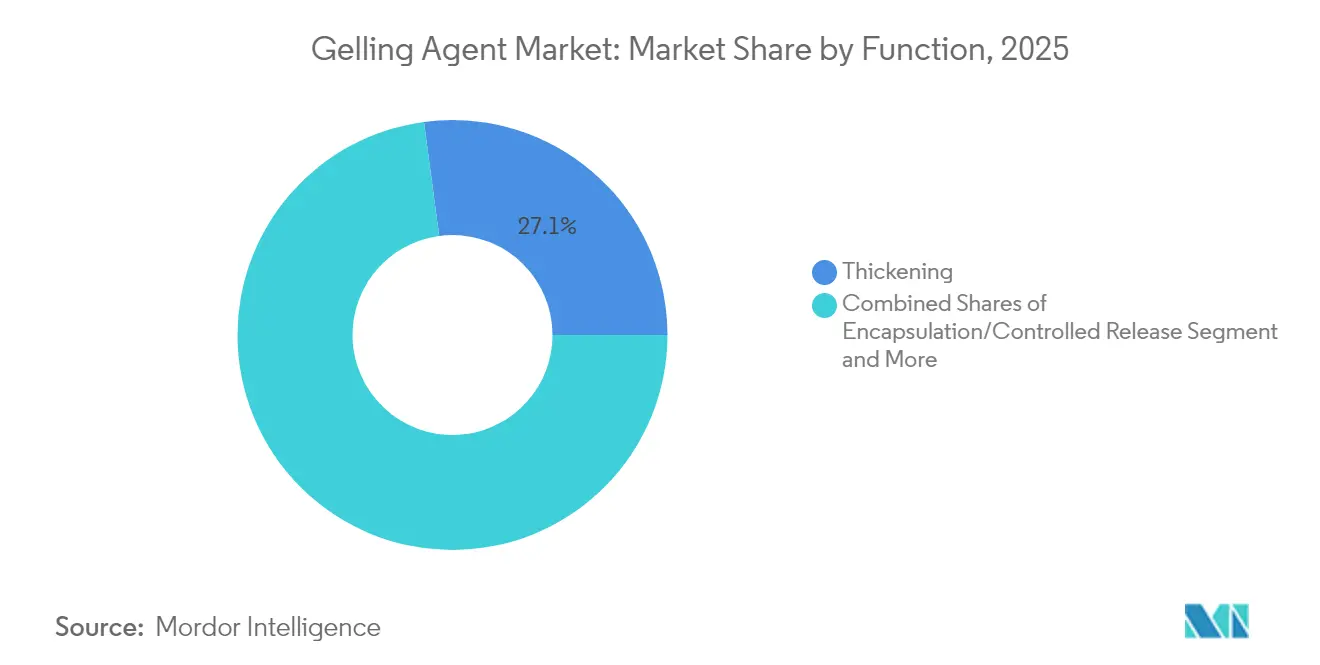
Thickening Applications Lead While Encapsulation AcceleratesThickening retained 27.12% of 2025 turnover, reflecting the central role of hydrocolloids in viscosity control for soups, sauces, and dairy desserts. The increasing consumer preference for convenience foods has accelerated the adoption of thickening agents in ready-to-eat products. Robust conversion to instant mixes and frozen entrées safeguards baseline demand, while manufacturers continue to innovate with clean-label thickening solutions to meet evolving consumer preferences.
Encapsulation and controlled-release systems will post the highest 8.62% CAGR as pharmaceutical and nutraceutical players exploit hydrogel matrices to regulate bio-active release. Recent approvals of sodium alginate edible coatings for fresh produce preservation illustrate cross-sector uptake according to food standards agency (UK). Multi-functional products combining gelation, stabilization, and encapsulation within one hydrocolloid blend open new design latitude for formulators, supporting additional revenue streams for the gelling agents market. The integration of nanotechnology in encapsulation systems has enhanced the efficiency of active ingredient delivery. The development of sustainable and biodegradable encapsulation materials aligns with growing environmental concerns and regulatory requirements.
By Application:
Food Dominance Amid Pharmaceutical AccelerationFood and beverage manufacturers absorbed 35.41% of global sales in 2025, spotlighting hydrocolloids' ubiquity in texture, suspension, and moisture control. Gluten-free bakery, low-sugar confectionery, and premium ice-cream lines act as innovation hotbeds where differentiated mouthfeel commands shelf premiums. The increasing consumer demand for clean-label products has further accelerated hydrocolloid adoption in natural formulations. Manufacturers are investing heavily in research and development to optimize hydrocolloid combinations that deliver superior functionality at lower usage levels.
Pharmaceutical applications, however, will register the quickest 8.97% CAGR. Cosmetics, personal care, and pet nutrition round out the portfolio, each capitalizing on the moisture-binding and film-forming attributes inherent to hydrocolloids. The broadening use cases reinforce the structural growth narrative for the gelling agents market. The pharmaceutical sector's rapid growth stems from increased tablet coating applications and controlled-release drug delivery systems. Rising healthcare expenditure and pharmaceutical manufacturing expansion in emerging economies further strengthen the demand outlook.
Geography Analysis
APAC Gelling Agent Market
Asia-Pacific accounted for 36.28% of global revenue in 2025, buoyed by dominant seaweed and guar cultivation plus the world’s largest population of processed-food consumers. China alone supplies more than 60% of global carrageenan and agar raw material, while India produces roughly 80% of guar gum. Rapid urbanization and rising disposable incomes in Southeast Asia further stimulate convenience-food demand, reinforcing regional buying power.
South America Gelling Agent Market
South America delivers the fastest 8.12% CAGR projection through 2031. Brazil’s USD 231 billion food-processing industry, which logged 7.2% growth in 2024, underpins a surge in demand for functional ingredients that extend shelf life in tropical distribution conditions according to U.S Department of Agriculture. Abundant citrus and sugarcane residues also present cost-effective substrates for future pectin and xanthan production, enhancing import substitution prospects. Collectively, these regional dynamics diversify revenue streams and mitigate single-market exposure for global participants in the gelling agents market.
North America and Europe Gelling Agent Market
North America and Europe contribute lower volume yet higher unit value, thanks to strict regulatory regimes and advanced R&D ecosystems. The FDA’s 2025 GRAS reforms accelerate clean-label substitution, coaxing formulators to secure supply from pectin, alginate, and celluloses with proven safety records. Europe’s sustainability ethos and EFSA’s rigorous contaminant limits incentivize traceable supply chains and green extraction technologies, elevating profit pools for compliant suppliers.
Note: Segment shares of all Individual segments will be available upon report purchase

Regulatory Landscape
Regulatory oversight for gelling agents is tightening around additive specifications, contaminants, and dossier depth, which increases compliance and testing requirements for global suppliers serving regulated food and pharma markets. In the European Union, Commission Regulations (EU) 2026/189 and (EU) 2026/196 (in force from February 18, 2026) updated purity specifications and introduced stricter microbiological criteria for widely used hydrocolloids such as locust bean gum (E 410), guar gum (E 412), xanthan gum (E 415), and pectins (E 440). An August 2026 compliance milestone is set for revised specifications, with defined transition periods for products already placed on the market.
In the United States, FDA scrutiny has shifted toward more formalized safety substantiation, consistent with the GRAS documentation requirements strengthened in 2025. As a marker of the active GRAS pathway for novel texturizers, the FDA issued a no-questions letter closing GRN 1256 on February 5, 2026 for Lemna leaf protein as a gelling agent/thickener. Policy discussions in 2025 also highlighted potential future changes to the self-affirmed GRAS route that would further increase the value of robust safety dossiers for new gelling systems.
Value Chain Analysis
The gelling agents value chain begins with feedstock production and aggregation, then moves through extraction or fermentation, refining and standardization, blending and application engineering, and finally distribution to end users in food and beverage, cosmetics and personal care, and pharmaceuticals. Key raw material streams include seaweed (for agar, carrageenan, and alginate), agricultural co-products such as citrus peels and apple pomace (for pectin), seed gums (guar and locust bean), and microbial fermentation inputs (for xanthan and gellan). International reference frameworks such as the Codex General Standard for Food Additives (GSFA) define additive functions and support cross-border alignment, while regulators including FDA, EFSA, and Health Canada govern permitted uses and specifications.
Processing and formulation capability are a key value-add step because performance targets, such as clarity, gel strength, freeze-thaw stability, and protein stabilization, vary by application. Fermentation-based production provides an alternate supply route to reduce exposure to agricultural and marine harvest variability, illustrated by gellan gum produced via microbial fermentation (for example, Tate and Lyle's KELCOGEL). Marine polysaccharide supply chains remain more geographically concentrated in Southeast Asia, so procurement strategies, traceability systems, and long-term supplier relationships are important levers for quality consistency and cost management as specifications and microbiological criteria tighten in major consuming regions.
Competitive Landscape
The gelling agents market shows moderate consolidation with a concentration ratio of 6 out of 10. The top five companies - Tate & Lyle, CP Kelco, Cargill, Ashland, and Jungbunzlauer - account for the majority of market revenue in 2024. These companies benefit from economies of scale, enabling vertical integration in raw material procurement and investments in extraction and fermentation capabilities.
Tate & Lyle's USD 1.8 billion acquisition of CP Kelco demonstrates the industry trend toward specialty hydrocolloids expansion, enabling enhanced cross-selling opportunities and research synergies. Companies differentiate through technological capabilities - Jungbunzlauer operates a continuous fermentation xanthan gum facility in Canada to reduce emissions, while Cargill implements artificial intelligence for quality control. The increase in patent applications for pH-responsive hydrogels and multi-polymer complexes indicates growing competition in intellectual property.
Mid-sized companies focus on specialized applications, including tissue scaffolds and biodegradable packaging, utilizing their flexibility and close customer relationships. Large companies invest in seaweed farming operations and fermentation alternatives to protect against raw material supply fluctuations and weather-related disruptions. This diverse range of business strategies maintains market competition and supports continuous innovation in the gelling agents industry.
Gelling Agent Industry Leaders
-
Cargill, Incorporated
-
Archer Daniels Midland Company
-
Ashland Global Holdings
-
Tate and Lyle plc
-
International Flavors and Fragrances
- *Disclaimer: Major Players sorted in no particular order
Gelling Agent Market Companies Covered in this Report
- Cargill, Incorporated.
- Archer-Daniels-Midland (ADM)
- International Flavors and Fragrances
- Tate and Lyle plc
- Ashland Global Holdings Inc.
- Kerry Group plc
- Ingredion Incorporated
- CEAMSA
- Gelita AG
- Darling Ingredients (Rousselot)
- DSM-Firmenich
- FMC Corporation
- Herbstreith and Fox GmbH
- Algaia SA
- Fiberstar Inc.
- CINOGEL Biotech
- Gino Gums (Chemsino)
- Marine Biopolymers Ltd.
- Hawkins Watts Ltd.
- Herbstreith & Fox GmbH & Co. KG
- J.M. Huber Corporation
- Pacific Pectin, Inc.
- Lucid Colloids Ltd.

Market Opportunities and Future Outlook
Compliance-driven reformulation and specification upgrades in regulated markets create near-term whitespace for suppliers that can provide traceable, testable, and application-ready hydrocolloid systems. The EU update to additive specifications under Commission Regulation (EU) 2026/196 (adopted January 2026 and effective February 18, 2026) raises the bar for purity and microbiological controls across multiple high-volume gelling agents, including pectins, xanthan gum, locust bean gum, and guar gum. This shift is supporting demand for higher-spec grades, stronger supplier documentation, and on-pack simplification that aligns with clean-label positioning.
Capacity modernization and raw material access are also active investment themes that broaden addressable use cases and improve supply resilience. Cargill's EUR 25 million modernization of its Baupte, France site, including Mechanical Vapor Recompression (MVR) technology, highlights how energy efficiency and emissions reduction influence manufacturing competitiveness for hydrocolloids. On the supply-security side, Nexira's July 2026 acquisition of Keragum in Morocco strengthens vertical integration in locust bean gum, which aligns with customer requirements for traceability and consistency as regulatory scrutiny increases. Expanding output for animal-derived gel systems also supports pharmaceutical and biomedical demand, with Gelita's Liaoyuan facility in Jilin, China cited at 11,000 tons of annual capacity and exports targeted at 30% of 2026 production.
Recent Industry Developments in Gelling Agent Market
- July 2026: Nexira acquired Keragum, a Moroccan producer of carob ingredients, adding upstream capability tied to locust bean gum supply. This acquisition strengthens vertical integration and traceability for a key gelling agent feedstock used in clean-label and plant-based formulations, supporting supply security as additive specifications tighten in major markets.
- January 2026: Archer Daniels Midland Company announced a USD 26 million investment in its Erlanger, Kentucky, innovation campus to expand flavor and color reformulation capabilities by 40 percent. The upgrade supports reformulation workstreams that often rely on hydrocolloids to rebuild texture and stability when removing or replacing additives, which can accelerate customer development cycles for cleaner-label and sugar-reduced products.
- September 2024: Jungbunzlauer invested USD 200 million to establish Canada's first xanthan gum manufacturing facility in Port Colborne, Ontario, supported by Invest Ontario. This added fermentation-derived capacity helps diversify supply away from weather-sensitive agricultural inputs and improves regional availability of a widely used stabilizer and thickener across food and industrial applications.


Gelling Agent Market Report Scope and Research Methodology
Market Definition and Coverage
For this methodology, the market covers commercial gelling agents sold as ingredients to manufacturers that need texture build, gel formation, or stabilization in finished products, and the value is measured in USD at the ingredient level.
Scope exclusions: We exclude industrial drilling and paper grade thickeners that are not purchased as gelling agents for formulated consumer or pharma products.
Segments Covered in This Report
-
By Type
- Pectin
- Gelatin
- Agar
- Carrageenan
- Alginate
- Gellan Gum
- Xanthan Gum
- Guar Gum
- Cellulose Derivatives
- Locust Bean Gum
- Others
-
By Source
- Plant-derived
- Seaweed-derived
- Microbial-Derived
- Animal-derived
- Synthetic/Chemically-modified
-
By Function
- Gelling
- Thickening
- Stabilising/Emulsifying
- Film-forming and Coating
- Encapsulation/Controlled Release
-
By Application
-
Food and Beverage
- Bakery
- Confectionery
- Dairy and Frozen Desserts
- Beverages
- Meat and Poultry Products
- Plant-based and Vegan Alternatives
- Pet Food
- Other Food and Beverage Applications
-
Cosmetics and Personal Care
- Skin-care
- Hair-care
- Oral-care
- Colour Cosmetics
- Pharmaceuticals
- Others
-
Food and Beverage
-
By Geography
-
North America
- United States
- Canada
- Mexico
- Rest of North America
-
Europe
- United Kingdom
- Germany
- Spain
- France
- Italy
- Russia
- Rest of Europe
-
Asia-Pacific
- China
- India
- Japan
- Australia
- Rest of Asia-Pacific
-
South America
- Brazil
- Argentina
- Rest of South America
-
Middle East and Africa
- Saudi Arabia
- South Africa
- Rest of Middle East and Africa
-
North America
Data Sources, Market Sizing, and Validation
Desk Research
Desk work starts by mapping where gelling agents show up in real demand. We reviewed public statistics and reference sources that explain food processing and ingredient usage, such as FAO food balance sheets, UN Comtrade trade flows, USDA and FDA materials, and published standards or monographs from pharmacopeias and related bodies.
To keep the model grounded in how the value chain works, we also used company annual reports, investor presentations, technical notes from ingredient associations, and reputable business press to track capacity additions, pricing direction, and formulation shifts. A paid subscription for company financials and a patent database was used selectively to fill gaps on product launches and where innovation was moving. The sources listed here are illustrative and not exhaustive, and many other public sources were checked as well for data collection, validation, and clarification.
Primary Interviews and Surveys
Primary work focused on confirming what gets counted as a gelling agent sale, and how prices move by grade, region, and end use. We spoke with ingredient suppliers, distributors, and downstream formulators across the Americas, EMEA, and APAC, and used the inputs to correct desk assumptions before carrying them into the final sizing.
Distribution of primary research fieldwork respondents
| Company type | Respondent position | Region |
|---|---|---|
| Top tier: 29% | CXOs: 17% | APAC: 49% |
| Mid tier: 53% | Functional/Unit leaders: 40% | EMEA: 30% |
| Smaller Players: 18% | Managers: 43% | Americas: 21% |
Market-Sizing & Forecasting
Sizing is built using top-down demand pool reconstruction. Food and personal care output, formulation intensity for key categories, and the regional mix are used to approximate ingredient consumption, then converted to value using validated average selling prices. The results are then checked with selective bottom-up approximations, including sampled supplier volumes, distributor channel checks, and price-by-grade sanity checks, so totals stay realistic even when some countries have limited disclosures.
Inputs that mattered in this market included hydrocolloid import and export movements, observed price spreads between animal, plant, and microbial sources, changes in clean label preferences that shift product mix, and manufacturing output trends in processed foods, dairy alternatives, and personal care formats that use gels. For forecasting, we used scenario analysis supported by a light multivariate regression view, where demand drivers and expected price progression were stress tested with experts before the final curve was locked. When bottom-up checks were incomplete, gaps were handled by applying neighboring-country intensity and price bands, then rebalanced at the regional level to avoid overstating smaller markets.
Data Validation & Update Cycle
Model outputs are tested against independent signals, including trade direction, known capacity moves, and the implied per-unit ingredient usage in major end products. Variances are reviewed in steps: first at the country and application level, then at the regional roll-up, and finally through a dedicated analyst review before sign-off.
Reports are refreshed annually, and interim updates are made when material events change the ingredient usage baseline, such as large plant expansions, sharp price shocks, or regulatory changes. Right before delivery, we do a fresh pass on key inputs so clients receive an updated view rather than an older snapshot.
Mordor Intelligence's Gelling Agents Market Market Sizing Compared With Other Published Estimates
Published market values for gelling agents can differ because the in-scope ingredient set is not the same across studies, and because some models lean on broad hydrocolloid groupings instead of gelling-specific demand signals. Differences also come from the year chosen for pricing, how currency conversion is timed, and whether the forecast starts from an adjusted base year or a straight-line historical average.
Hydrocolloid trade movements and grade-level price spreads, confirmed through supplier and buyer checks, are the evidence points that keep Mordor Intelligence tied to ingredient sales into food, personal care, and pharma manufacturing, with industrial drilling and paper grade thickeners left out of scope.
Benchmark comparison
| Source | Market Size | Gaps in Research Methodology |
|---|---|---|
| Mordor Intelligence | USD 5.87 B (2026) | |
| Industry Publisher A | USD 4.95 B (2024) | Uses an earlier base year and applies a broader application basket without stating clear exclusions, which can compress value if lower-priced industrial volumes are blended into averages. |
| Industry Publisher B | USD 5.37 B (2025) | Starts from a different base-year structure and emphasizes segmented functions, which can shift pricing assumptions and delay how quickly higher-grade mixes are reflected in value. |
The spread mainly comes from year selection and from what gets treated as gelling demand versus nearby thickening uses. By anchoring the total to trade signals, grade-level pricing bands, and realistic usage intensity in major end products, the number stays traceable to clear variables that can be checked and repeated.


Key Questions Answered in the Report
What is the current size of the gelling agents market?
The gelling agents market size reached USD 5.87 billion in 2026 and is projected to climb to USD 7.79 billion by 2031 at a 5.79% CAGR.
Which product type holds the largest market share?
Pectin leads with 33.89% gelling agents market share in 2025 due to its versatility in reduced-sugar foods and nutraceutical gummies.
What is driving pharmaceutical demand for gelling agents?
Hydrogel-based formulations enable controlled and targeted drug delivery, propelling pharmaceutical applications at a 8.97% CAGR.
Which region is expected to grow the fastest?
South America, anchored by Brazil’s expanding food-processing industry, is forecast to achieve an 8.12% CAGR between 2026 and 2031.
Page last updated on:


 Your data is secure and never sold or shared.


