
Digital Workplace In Energy and Utilities Market Size and Share
Market Overview
| Study Period | 2020 - 2031 |
|---|---|
| Market Size (2026) | USD 5.23 Billion |
| Market Size (2031) | USD 14.19 Billion |
| Growth Rate (2026 - 2031) | 22.09 % |
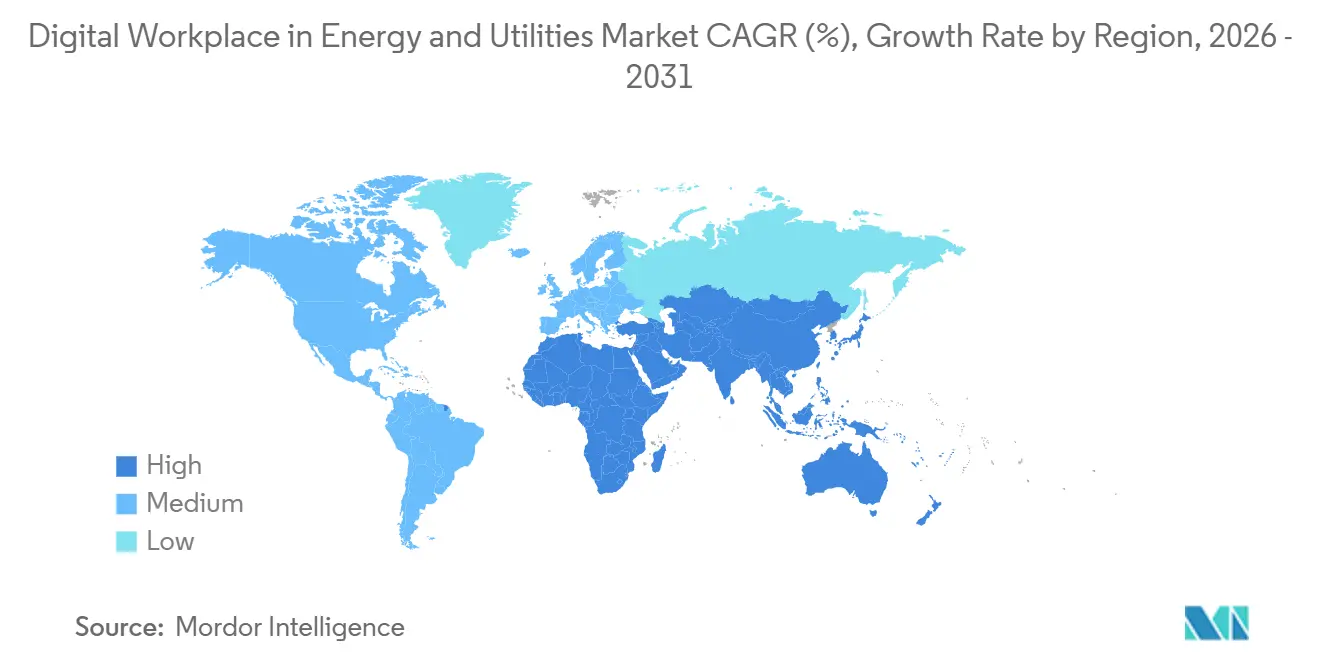
| Fastest Growing Market | Middle East and Africa |
| Largest Market | Europe |
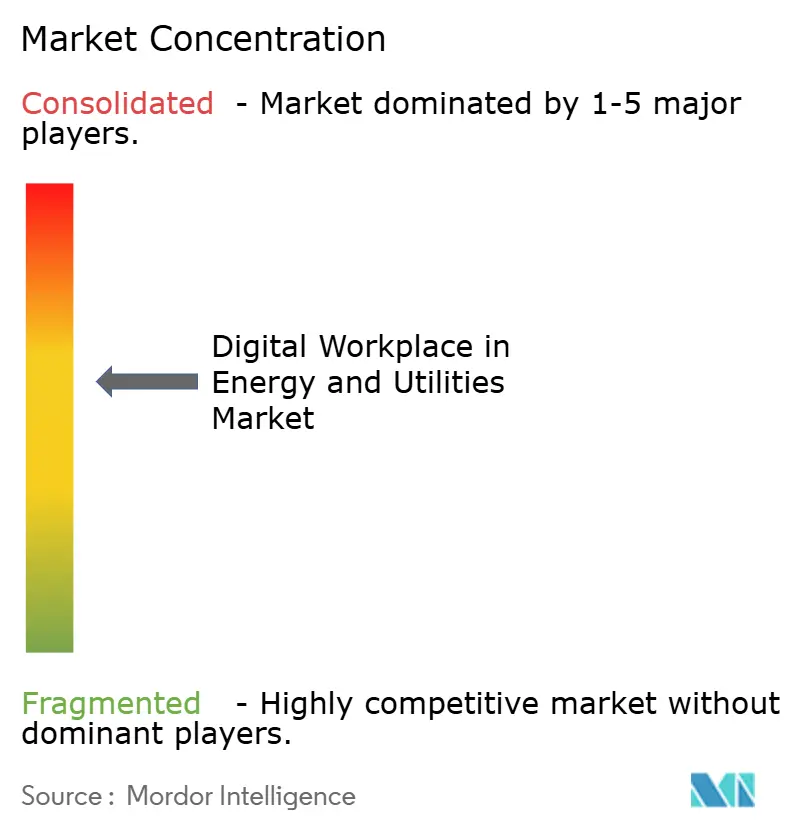
| Market Concentration | Medium |
Major Players *Disclaimer: Major Players sorted in no particular order Image © Mordor Intelligence. Reuse requires attribution under CC BY 4.0. | |
Digital Workplace In Energy and Utilities Market Analysis by Mordor Intelligence
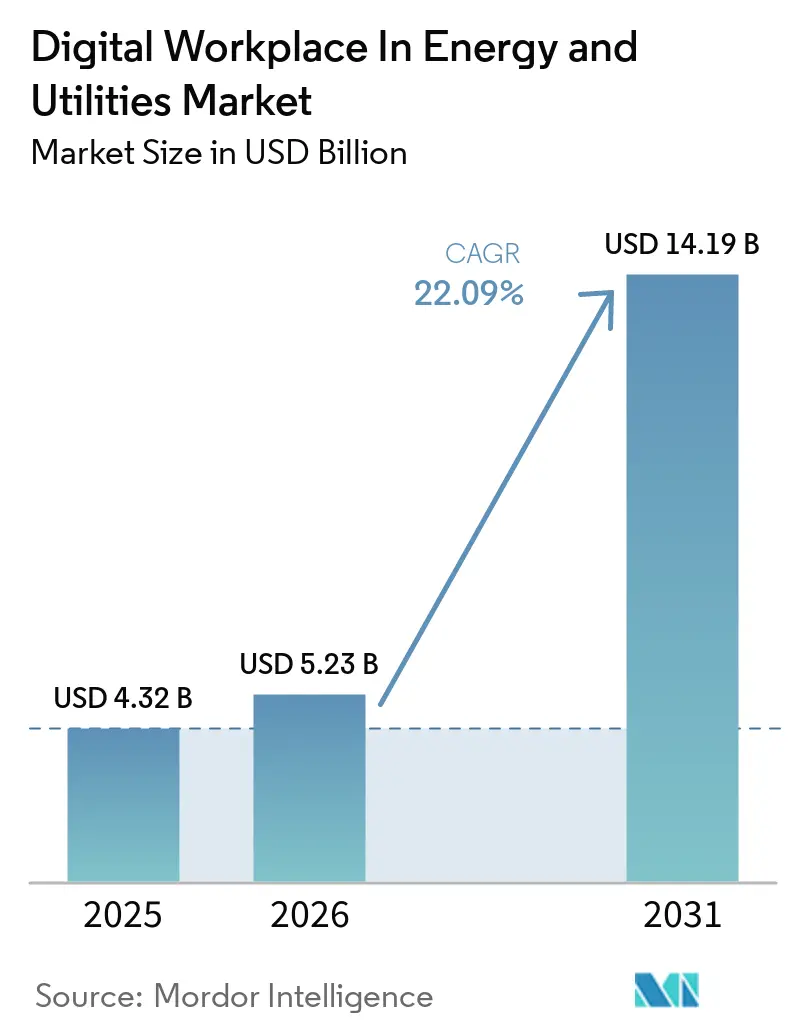
The digital workplace in energy and utilities market size is projected to expand from USD 4.32 billion in 2025 and USD 5.23 billion in 2026 to USD 14.19 billion by 2031, registering a CAGR of 22.09% between 2026 and 2031. The digital workplace in energy and utilities market is shifting from basic collaboration deployments toward governed platforms that connect devices, identities, workflows, and AI-supported productivity in a single environment. Growth is being supported by stronger enterprise investment in integrated productivity suites, wider use of AI-enabled collaboration tools, and the need to manage frontline, field, and office work through a common control layer. The digital workplace in energy and utilities market is also benefiting from the convergence of operational technology and enterprise IT, as utilities and energy operators now need a single platform to support maintenance teams, remote engineers, and compliance-sensitive workflows. Europe remained the largest regional demand center in 2025, while the Middle East and Africa are set to grow fastest through 2031 as sovereign cloud investment and national AI strategies improve deployment conditions. Competitive pressure is rising as large platform vendors move beyond communication licenses and into autonomous workflow execution, while fragmented legacy identity environments continue to slow deployment in large organizations.
Key Report Takeaways
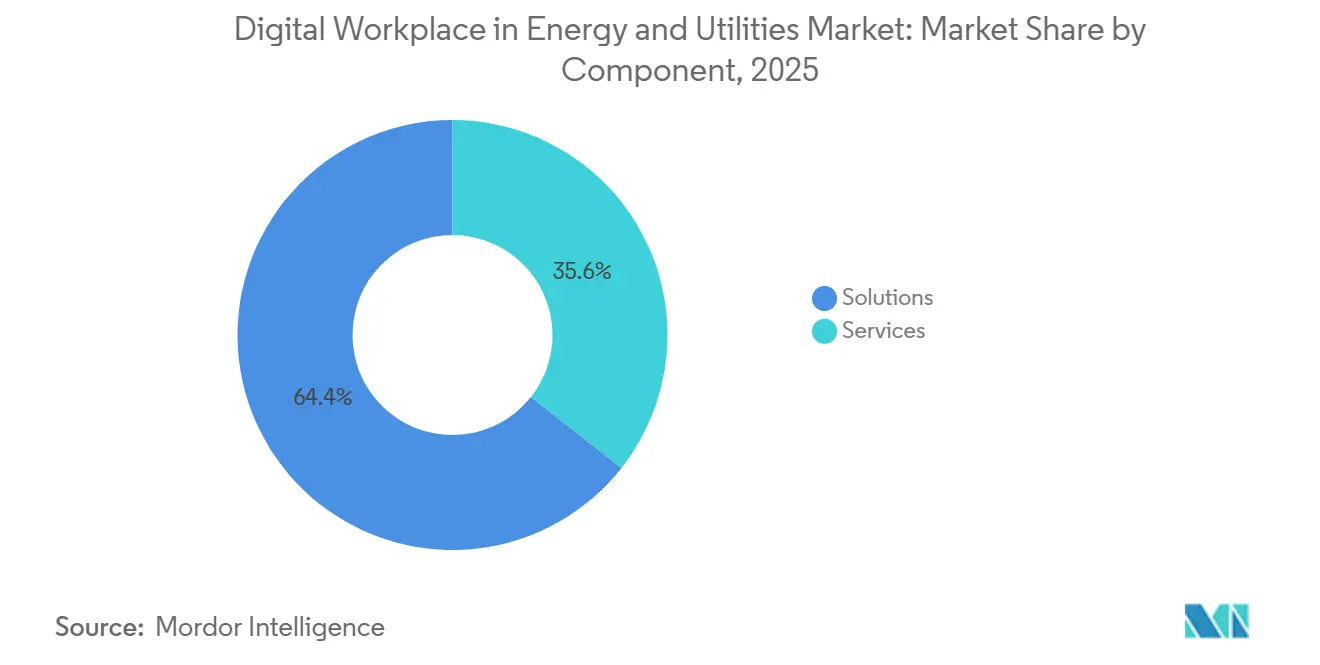
- By component, solutions led with a 64.38% revenue share in 2025 and are projected to expand at a 22.93% CAGR through 2031.
- By deployment mode, cloud accounted for 52.86% of the digital workplace in energy and utilities market in 2025, and is projected to grow at a 23.37% CAGR through 2031.
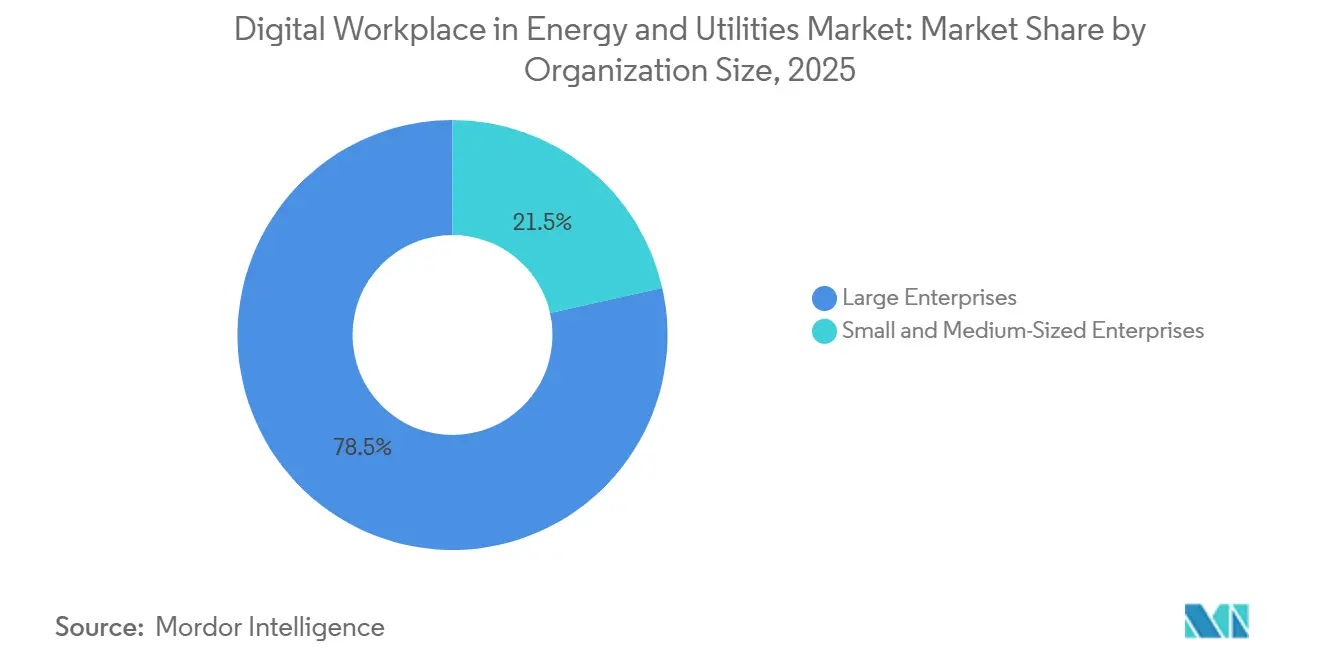
- By organization size, large enterprises accounted for 78.51% share in 2025, while small and medium-sized enterprises are projected to record the fastest growth at a 23.19% CAGR through 2031.
- By geography, Europe accounted for 31.52% of revenue share in 2025, while the Middle East and Africa are projected to expand at a 23.65% CAGR through 2031.
Note: Market size and forecast figures in this report are generated using Mordor Intelligence’s proprietary estimation framework, updated with the latest available data and insights as of January 2026.
Market Trends and Insights
Drivers Impact Analysis of Digital Workplace In Energy and Utilities Market*
| Driver | (~) % Impact on CAGR Forecast | Geographic Relevance | Impact Timeline |
|---|---|---|---|
| Hybrid and Distributed Workforce Digitization | +6.5% | Global, the highest concentration in North America and Europe | Short term (≤ 2 years) |
| AI-Assisted Search and Knowledge Retrieval | +5.2% | Global, accelerating in Asia-Pacific and Middle East, and Africa | Short term (≤ 2 years) |
| OT and IT Workflow Convergence | +3.1% | Global, the highest in Asia-Pacific industrial hubs and European manufacturing | Medium term (2-4 years) |
| Safety-Critical Knowledge Access Demand | +2.7% | Global, highest in energy, healthcare, and critical infrastructure | Medium term (2-4 years) |
| Mobile-First Enablement for Field Personnel | +2.4% | Global, highest in the Middle East and Africa, and South America | Medium term (2-4 years) |
| Regulatory Pressure for Audit-Ready Collaboration | +1.8% | Europe and North America | Medium term (2-4 years) |
| Source: Mordor Intelligence | |||
Hybrid and Distributed Workforce Digitization
The digital workplace in energy and utilities market continues to gain from the normalization of hybrid work, even though fully remote work has fallen from its earlier peak. In 2026, 62% of organizations mandate fixed in-office days, up from 49% in 2025, indicating that enterprises now need tools that support access, presence, scheduling, and collaboration across office, field, and distributed teams simultaneously. The gap between actual and target office utilization narrowed to 18 percentage points in 2026 from 25 in 2025, and employees attending 3-4 days per week rose by 19 percentage points to 55%, indicating that structured hybrid work is becoming an operating model rather than a temporary adjustment. In the digital workplace in energy and utilities market, this matters because utilities, grid operators, and energy service firms must now coordinate office staff, field crews, and regulated workflows within a single, governed platform. Vendors that can combine endpoint control, collaboration, and workforce visibility in the same environment are better placed to win new enterprise spending.
AI-Assisted Search and Knowledge Retrieval
The shift from keyword search to AI-based knowledge retrieval is changing how organizations structure digital work. Amazon Web Services made Bedrock Managed Knowledge Base generally available in June 2026, giving enterprises a way to deploy retrieval systems for their proprietary data without managing the complexity of vector databases themselves. The digital workplace in energy and utilities market is responding to the same pressure, as frontline and office users increasingly need permission-aware access to technical documents, maintenance records, and policy content within daily workflows. Executives expect generative AI to support growth, but deployment maturity remains low, which shows that knowledge retrieval and governance are still limiting scaled adoption. As a result, AI search is no longer treated as an optional premium feature, and the platforms that unify knowledge at the architecture layer are gaining an advantage as enterprise agent use expands.
OT and IT Workflow Convergence
The digital workplace in energy and utilities market is expanding beyond office-based productivity as operational technology environments become more connected to enterprise systems. Microsoft’s 2026 Release Wave 1 for Dynamics 365 Field Service deepened mobile capabilities for frontline workers and simplified work execution, which reflects the broader need to connect field activity with centrally governed digital workflows. Salesforce also highlighted secure, headless, and offline-first data delivery for blended workforces in facilities and field environments, showing that digital workplace design is moving closer to equipment-side and field-side execution.[1] In the digital workplace in energy and utilities market, this broadens demand beyond knowledge workers and brings plant personnel, maintenance engineers, and mobile supervisors into the same architecture. Vendors that already support rugged mobility, identity controls, and workflow continuity across both enterprise IT and field operations are likely to hold a stronger position over the next few years.
Safety-Critical Knowledge Access Demand
The digital workplace in energy and utilities market is supported by demand for verified, up-to-date knowledge in work settings where delays or errors carry operational and regulatory consequences. Salesforce’s field-service architecture underscores this requirement by emphasizing secure, offline-capable access for blended workforces operating outside standard browser-based systems. Microsoft also strengthened mobile workflow support for frontline workers in 2026, indicating that vendors are redesigning interfaces for faster task completion rather than just for simple information display. This is especially relevant for energy and utility operators that depend on technicians, dispatchers, and contractors to follow current procedures under time pressure. The result is a stronger willingness to invest in workplace platforms that support audit-readiness, controlled content access, and reliable field execution within a single system.
Restraints Impact Analysis of Digital Workplace In Energy and Utilities Market*
| Restraint | (~) % Impact on CAGR Forecast | Geographic Relevance | Impact Timeline |
|---|---|---|---|
| Cybersecurity and Data Sovereignty Concerns | -2.8% | Global, highest in Europe, and GCC markets with sovereign cloud mandates | Short term (≤ 2 years) |
| Legacy Systems and Identity Fragmentation | -2.3% | Global, the highest in large enterprises with complex M&A histories | Medium term (2-4 years) |
| Low Adoption Among Field and Contractor Users | -1.5% | Global, the highest in the Asia-Pacific industrial sectors and South America | Medium term (2-4 years) |
| Integration Complexity Across OT and Enterprise Apps | -1.4% | Global, the highest in manufacturing-heavy economies in Asia-Pacific and Europe | Long term (≥ 4 years) |
| Source: Mordor Intelligence | |||
Cybersecurity and Data Sovereignty Concerns
Cybersecurity and data sovereignty remain major constraints on deployment speed in the digital workplace in energy and utilities market. Fujitsu reported in May 2026 that only 8% of organizations can control how their AI systems learn and behave after deployment, underscoring how quickly governance exposure can widen as workplace data feeds AI tools. In Europe, the EU AI Act will start to make workplace AI obligations more concrete, including worker notification requirements and log retention expectations for relevant systems, effective from August 2, 2026. These requirements lengthen review cycles and push buyers to favor platforms that offer stronger control, auditability, and regional hosting options. Orange Business responded to this pressure in March 2026 with the launch of Live Collaboration on sovereign infrastructure in France, which shows that compliance complexity is now shaping vendor positioning as much as product design.
Legacy Systems and Identity Fragmentation
Legacy systems and fragmented identity environments continue to slow large-scale deployment in the digital workplace in energy and utilities market. Large enterprises accounted for 78.51% of revenue in 2025, and these organizations often run broad application estates, multiple identity providers, and inherited systems that make achieving policy consistency difficult. A 2026 commissioned study published by Simpplr found that 85% of technology leaders see fragmented data sources and knowledge systems as a prerequisite problem to solve before AI can deliver expected workplace outcomes. This pushes projects toward longer integration cycles, higher service costs, and more selective rollout phases instead of broad enterprise activation. In practice, most organizations are trying to layer orchestration and hybrid identity controls on top of existing environments rather than replace the full stack, which reduces disruption but also delays time to value.
*Our forecasts treat driver/restraint impacts as directional, not additive. The impact forecasts reflect baseline growth, mix effects, and variable interactions.
Digital Workplace In Energy and Utilities Market Segment Analysis
By Component:
Solutions Consolidate Platform LeadershipSolutions accounted for 64.38% of revenue in 2025 and are also projected to record the fastest 22.93% CAGR through 2031 in the digital workplace in energy and utilities market. This shows that buyers are prioritizing integrated suites over narrow point tools as they connect communication, endpoint governance, mobility, workflow automation, and knowledge access. Unified communication and collaboration, unified endpoint management, enterprise mobility management, employee experience platforms, workflow automation, and virtual desktop infrastructure all sit within this layer, making it the core spending destination for new deployments. The digital workplace in energy and utilities market is therefore moving toward platform consolidation rather than a more fragmented tool base.
Services represented the balance of the market in 2025, and their role is becoming more important as solution rollouts now require governance, tuning, change management, and managed support. In the digital workplace of the energy and utilities industry, service demand is shifting away from basic implementation work toward long-term support for AI governance, workflow optimization, and employee experience management. Unily’s June 2026 launch of Indi, which generates governed intranet environments from a single natural-language prompt, shows how solution providers are raising the level of post-deployment service and configuration support that customers will need. As autonomous features expand inside workplace platforms, services are likely to become stickier because organizations will need ongoing oversight instead of one-time setup. That shift favors vendors and partners that can support both the software layer and the operational model around it.
By Deployment Mode:
Cloud Accelerates, Hybrid Gains Strategic WeightCloud accounted for 52.86% of the digital workplace market size in energy and utilities in 2025, and is projected to expand at a 23.37% CAGR through 2031. This lead reflects continued movement toward SaaS-based collaboration, mobile access, and centralized policy control across wide employee and contractor groups. Even so, a large share of the installed base remained outside fully cloud-native delivery in 2025, as regulated environments, latency-sensitive operations, and data residency requirements continue to support on-premises and hybrid choices. The digital workplace in energy and utilities market, therefore, remains shaped by practical architecture decisions rather than a single deployment path.
Hybrid configurations are gaining more strategic weight because many organizations need to connect cloud-native collaboration with legacy infrastructure and region-specific hosting rules. Omnissa highlighted this direction in 2026 when Workspace ONE UEM received the highest marks across all 4 use cases in Gartner’s Critical Capabilities for Endpoint Management Tools, reinforcing the value of unified control across Windows, macOS, iOS, Android, Linux, and ChromeOS from one console.[2] Orange Business also moved into sovereign collaboration hosting in France, underscoring how regional compliance requirements are driving hybrid, jurisdiction-aware deployment models. On-premises environments are likely to lose share in new procurement, but they will remain part of the digital workplace in energy and utilities industry where critical assets, industrial systems, and public-sector obligations prevent quick migration. Vendors that apply consistent security and identity policies across all 3 deployment modes are in a stronger position when selling into complex enterprise accounts.
By Organization Size:
Large Enterprise Anchors Revenue While SMEs Drive GrowthLarge enterprises held 78.51% of the digital workplace in energy and utilities market share in 2025, which makes this group the main revenue anchor for the period. Their lead reflects broader endpoint fleets, more complex compliance requirements, contractor-heavy labor models, and a greater need for integrated tools that support identity, collaboration, governance, and field operations. In the digital workplace in energy and utilities market, these buyers also shape the services opportunity because they tend to sign multi-year contracts that include deployment, optimization, and managed operations. This means large enterprise demand still sets the direction for platform design and partner strategy across most of the competitive field.
Small and medium-sized enterprises are projected to record the fastest 23.19% CAGR through 2031, which shows that digital adoption is widening beyond the largest accounts. Lower cloud entry costs, simpler SaaS administration, and expanding low-code automation are making workplace deployment more realistic for smaller energy service providers and utility contractors. Small and medium-sized enterprises' spending in the Middle East digital transformation market is projected to grow at a 16.97% CAGR through 2031, supporting the view that smaller organizations are gaining access to the tools and budgets needed for digital modernization. The digital workplace in energy and utilities market is also benefiting from AI-enabled employee experience tools that reduce the specialist effort once required to maintain portals, workflows, and internal communication systems. Skill gaps and cyber-risk concerns still limit adoption in many small firms, but the cost and capability gap with large enterprises is narrowing across the forecast period.
Geography Analysis
Europe Digital Workplace in Energy and Utilities Market
Europe held 31.52% of the digital workplace market share in energy and utilities in 2025, making it the largest regional contributor in the base year. Germany, the United Kingdom, and France remained the main demand centers, while the Netherlands and the Nordic countries added support through stronger digital maturity. Bitkom found that 41% of German companies used AI in business processes in 2026, up from 17% in 2025, and that 77% of AI adopters reported a measurable improvement in their competitive position. Atos and Microsoft expanded secure agentic AI deployment to 56,000 Atos employees across 54 countries in June 2026, which shows that large European enterprises are moving ahead with scaled activation even as compliance expectations rise.[3] The EU AI Act is adding another layer to this regional profile, as workplace AI deployment now requires greater attention to worker notification, logging, and accountable governance.
The Americas and APAC Digital Workplace in Energy and Utilities Market
North America remained the second-largest demand pool in the digital workplace in energy and utilities market because of its mature cloud base, strong collaboration software footprint, and high level of AI-related enterprise spending. Asia-Pacific ranked next, led by China, Japan, India, and South Korea, where large industrial and technology ecosystems support workplace modernization across both office and frontline use cases. India continues to matter through its deep IT services base, while Japan and South Korea create additional demand for endpoint and workflow tools that can extend into production and operational settings. South America is growing from a smaller base, with Brazil and Colombia leading adoption as cloud affordability and mobile-first work patterns widen the addressable customer pool.
MEA Digital Workplace in Energy and Utilities Market
The Middle East and Africa held a smaller base in 2025, but it is projected to record the fastest 23.65% CAGR through 2031 in the digital workplace in energy and utilities market. Growth is being supported by sovereign cloud investment, national AI programs, and expanding digital adoption among both large enterprises and SMEs. Microsoft’s Saudi Arabia Azure datacenter region reached general availability in January 2026, which improved local data residency options for regulated industries and strengthened cloud deployment conditions across the Gulf Cooperation Council. Across Africa, adoption is also gaining support from state-led digitization programs and wider mobile broadband access, especially in South Africa, Nigeria, Kenya, and Egypt, where field-intensive sectors can benefit from mobile-first workplace platforms.
Competitive Landscape
The digital workplace in energy and utilities market shows a moderately consolidated structure at the platform level. Microsoft, Cisco, Accenture plc, and IBM hold strong anchor positions in the core platform environment, but specialist vendors and regional providers still compete on implementation simplicity, localization, and depth of governance. This balance means the digital workplace in energy and utilities market is not controlled by a single vendor group, even though the largest players shape product direction and buyer expectations. Competitive differentiation is shifting away from seat-based software supply and toward AI-enabled execution, policy control, and platform breadth. That change is raising the importance of product ecosystems, partner networks, and the ability to manage cross-functional workflows in regulated settings.
Microsoft moved this competition forward in June 2026 when it made Copilot Cowork generally available, extending its role from assistance into autonomous multi-step workflow execution across Microsoft 365. Unily also raised competitive pressure in June 2026 by launching Indi, an AI-native employee experience agent that can generate governed intranet environments from a single prompt. AvePoint added to this shift through multiple 2026 Confidence Platform updates that expanded AI governance, multicloud resilience, lifecycle automation, and cross-tenant visibility for enterprise customers. These moves show that vendors are trying to own not just collaboration interfaces, but also the controls, policies, and data flows that determine how AI operates inside workplace environments.
M&A activity is reinforcing the same pattern in the digital workplace in energy and utilities market. IBM completed its acquisition of Confluent in March 2026 to improve continuously refreshed enterprise data support for AI models and agents across hybrid cloud environments. SAP also announced its agreement to acquire Reltio in March 2026 to strengthen data unification and master data readiness for AI-led enterprise workflows. Orange Business launched Live Collaboration in France in the same month, showing that regional players are using sovereign hosting and trusted collaboration positioning to compete where buyers want alternatives to hyperscaler-dependent architectures.[4] Taken together, these actions suggest that future competitive advantage will depend on who can combine AI execution, data readiness, governance, and field-capable user experiences inside one cohesive operating layer.
Digital Workplace In Energy and Utilities Industry Leaders
-
Microsoft Corporation
-
IBM Corporation
-
Accenture plc
-
Cisco Systems, Inc.
-
Citrix Systems, Inc.
- *Disclaimer: Major Players sorted in no particular order
Digital Workplace In Energy and Utilities Market Companies Covered in this Report
- Microsoft Corporation
- IBM Corporation
- Accenture plc
- Cisco Systems, Inc.
- Omnissa, Inc.
- Citrix Systems, Inc.
- HCL Technologies Limited
- Wipro Limited
- Infosys Limited
- NTT DATA Group Corporation
- Capgemini SE
- DXC Technology Company
- Atos SE
- AvePoint, Inc.
- Unily Group Ltd
- Claromentis Limited
- Workai Sp. z o.o.
- Nutanix, Inc.
- SAP SE
- Oracle Corporation
Recent Industry Developments in Digital Workplace In Energy and Utilities Market
- June 2026: Unily announced the general availability of Indi, an AI-native employee experience agent that generates complete, governed intranet environments from a single natural-language prompt. The product was piloted with Johnson & Johnson and 19 other enterprise customers before GA, establishing a new capability benchmark for the intranet and employee experience platform sub-segment.
- June 2026: Atos Group and Microsoft expanded their strategic collaboration to deploy secure agentic AI to all 56,000 Atos employees across 54 countries, deploying Microsoft 365 Copilot E7 with Work IQ and advanced security capabilities from Microsoft Entra Suite, Defender, Intune, and Purview. The deployment is one of the largest enterprise-wide agentic AI rollouts yet completed in the European market.
- April 2026: AvePoint released updates to the Confidence Platform expanding agentic AI governance and multicloud resilience, including active AI enforcement for autonomous agents, cross-tenant license visibility, and guided workspace security remediation workflows for Microsoft 365 data owners.
- March 2026: IBM completed its acquisition of Confluent, the real-time data streaming platform used by more than 6,500 enterprises, including 40% of the Fortune 500, integrating it with IBM WatsonX Data and IBM WebMethods Hybrid Integration to deliver continuously refreshed data for AI models and agents across hybrid cloud environments.
Global Digital Workplace In Energy and Utilities Market Report Scope
The Digital Workplace in Energy and Utilities Market focuses on the adoption and integration of digital tools, platforms, and technologies to enhance operational efficiency, collaboration, and decision-making within the energy and utilities sector. This report examines the scope of digital transformation, including cloud computing, artificial intelligence, IoT, and advanced analytics, tailored to meet the unique demands of energy production, distribution, and utility management.
The Digital Workplace in Energy and Utilities Market is Segmented by Component [Solutions (Unified Communication and Collaboration, Unified Endpoint Management, Enterprise Mobility Management, Employee Experience Platforms and Intranet, Workflow Automation and Knowledge Management, and Virtual Desktop Infrastructure and Cloud PC), and Services], Deployment Mode (Cloud, On-Premises, and Hybrid), Organization Size (Large Enterprises, and Small and Medium-Sized Enterprises), and Geography (North America, Europe, Asia-Pacific, South America, Middle East, and Africa). The Market Sizes and Forecasts are Provided in Terms of Value (USD).
Segmentation Overview
| Solutions | Unified Communication and Collaboration |
| Unified Endpoint Management | |
| Enterprise Mobility Management | |
| Employee Experience Platforms and Intranet | |
| Workflow Automation and Knowledge Management | |
| Virtual Desktop Infrastructure and Cloud PC | |
| Services |
| Cloud |
| On-Premises |
| Hybrid |
| Large Enterprises |
| Small and Medium-Sized Enterprises |
| North America | United States |
| Canada | |
| Mexico | |
| South America | Brazil |
| Argentina | |
| Chile | |
| Colombia | |
| Rest of South America | |
| Europe | Germany |
| United Kingdom | |
| France | |
| Italy | |
| Spain | |
| Netherlands | |
| Nordics | |
| Russia | |
| Rest of Europe | |
| Asia-Pacific | China |
| Japan | |
| India | |
| South Korea | |
| Australia and New Zealand | |
| Southeast Asia | |
| Rest of Asia-Pacific | |
| Middle East | Saudi Arabia |
| United Arab Emirates | |
| Turkey | |
| Israel | |
| Rest of Middle East | |
| Africa | South Africa |
| Egypt | |
| Nigeria | |
| Kenya | |
| Rest of Africa |
| By Component | Solutions | Unified Communication and Collaboration |
| Unified Endpoint Management | ||
| Enterprise Mobility Management | ||
| Employee Experience Platforms and Intranet | ||
| Workflow Automation and Knowledge Management | ||
| Virtual Desktop Infrastructure and Cloud PC | ||
| Services | ||
| By Deployment Mode | Cloud | |
| On-Premises | ||
| Hybrid | ||
| By Organization Size | Large Enterprises | |
| Small and Medium-Sized Enterprises | ||
| By Geography | North America | United States |
| Canada | ||
| Mexico | ||
| South America | Brazil | |
| Argentina | ||
| Chile | ||
| Colombia | ||
| Rest of South America | ||
| Europe | Germany | |
| United Kingdom | ||
| France | ||
| Italy | ||
| Spain | ||
| Netherlands | ||
| Nordics | ||
| Russia | ||
| Rest of Europe | ||
| Asia-Pacific | China | |
| Japan | ||
| India | ||
| South Korea | ||
| Australia and New Zealand | ||
| Southeast Asia | ||
| Rest of Asia-Pacific | ||
| Middle East | Saudi Arabia | |
| United Arab Emirates | ||
| Turkey | ||
| Israel | ||
| Rest of Middle East | ||
| Africa | South Africa | |
| Egypt | ||
| Nigeria | ||
| Kenya | ||
| Rest of Africa | ||
Key Questions Answered in the Report
What is the size outlook for the digital workplace in energy and utilities market?
The digital workplace in energy and utilities market stood at USD 4.32 billion in 2025, is valued at USD 5.23 billion in 2026, and is projected to reach USD 14.19 billion by 2031 at a 22.09% CAGR.
Which deployment model is leading adoption?
Cloud led with a 52.86% share in 2025 and is also projected to post the fastest growth at a 23.37% CAGR through 2031.
Why are large enterprises still the main buyers?
Large enterprises held 78.51% share in 2025 because they manage broader endpoint fleets, more complex compliance needs, and mixed office and field workforces that require integrated platforms.
Which region is growing the fastest through 2031?
The Middle East and Africa is projected to grow at a 23.65% CAGR, supported by sovereign cloud investment, national AI strategies, and stronger data residency options.
What is driving vendor competition right now?
Competition is moving toward AI-enabled workflow execution, governance, and data readiness, with major moves from Microsoft, AvePoint, SAP, IBM, and Unily in 2026.
What is the main barrier to faster rollout?
Cybersecurity, data sovereignty, and fragmented identity environments remain the main barriers because they extend review cycles and make enterprise-wide deployment harder to standardize.