
South Africa Digital Workplace Market Size and Share
Market Overview
| Study Period | 2020 - 2031 |
|---|---|
| Forecast Data Period | 2026 - 2031 |
| Base Year Market Size (2025) | USD 0.68 Billion |
| Market Size (2026) | USD 0.82 Billion |
| Market Size (2031) | USD 2.28 Billion |
| Growth Rate (2026 - 2031) | 22.65 % |
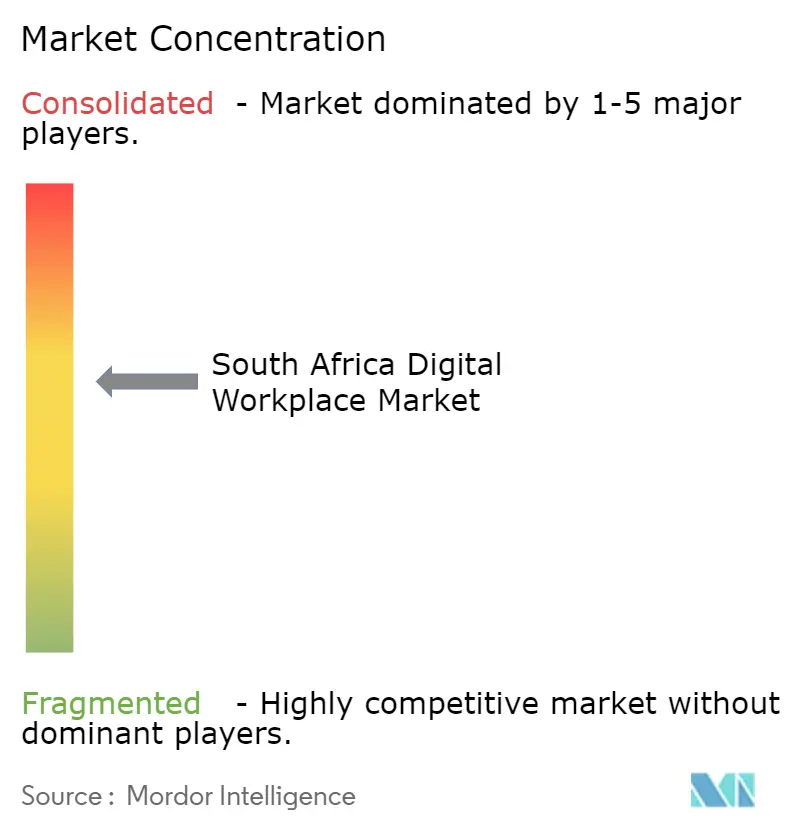
| Market Concentration | Medium |
Major Players *Disclaimer: Major Players sorted in no particular order Image © Mordor Intelligence. Reuse requires attribution under CC BY 4.0. | |
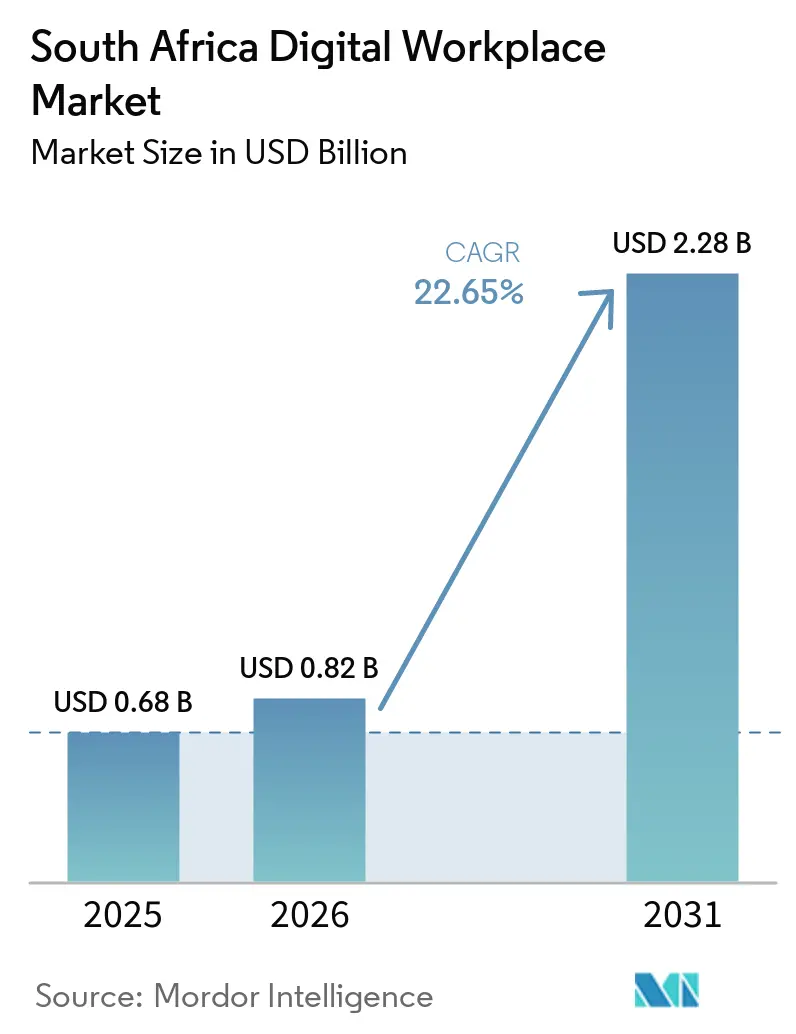
South Africa Digital Workplace Market Analysis by Mordor Intelligence
The South Africa digital workplace market size was valued at USD 0.68 billion in 2025 and estimated to grow from USD 0.82 billion in 2026 to reach USD 2.28 billion by 2031, at a CAGR of 22.65% during the forecast period (2026-2031). The South Africa digital workplace market is now being shaped by long-term operating priorities, as enterprises treat collaboration, endpoint control, identity, and content access as core infrastructure instead of temporary work-enablement tools. Regulatory pressure, local cloud capacity expansion, and better power reliability have lowered the risk attached to cloud-first workplace rollouts, which has made larger transformation programs easier to justify at the board and CIO level. Competition among global platform vendors has also improved local processing options for voice, collaboration, and productivity workloads, which matters for sectors that must keep tighter control over user access and data handling. Buyers are increasingly favoring integrated workplace platforms that can link communications, security, compliance, and workflow tools in one operating model, which supports higher recurring spend per user over time. The South Africa digital workplace market still faces execution limits from uneven connectivity, stack costs for smaller firms, legacy systems in the public sector, and a shortage of specialist skills, but these constraints affect rollout depth more than the underlying direction of demand.
Key Report Takeaways
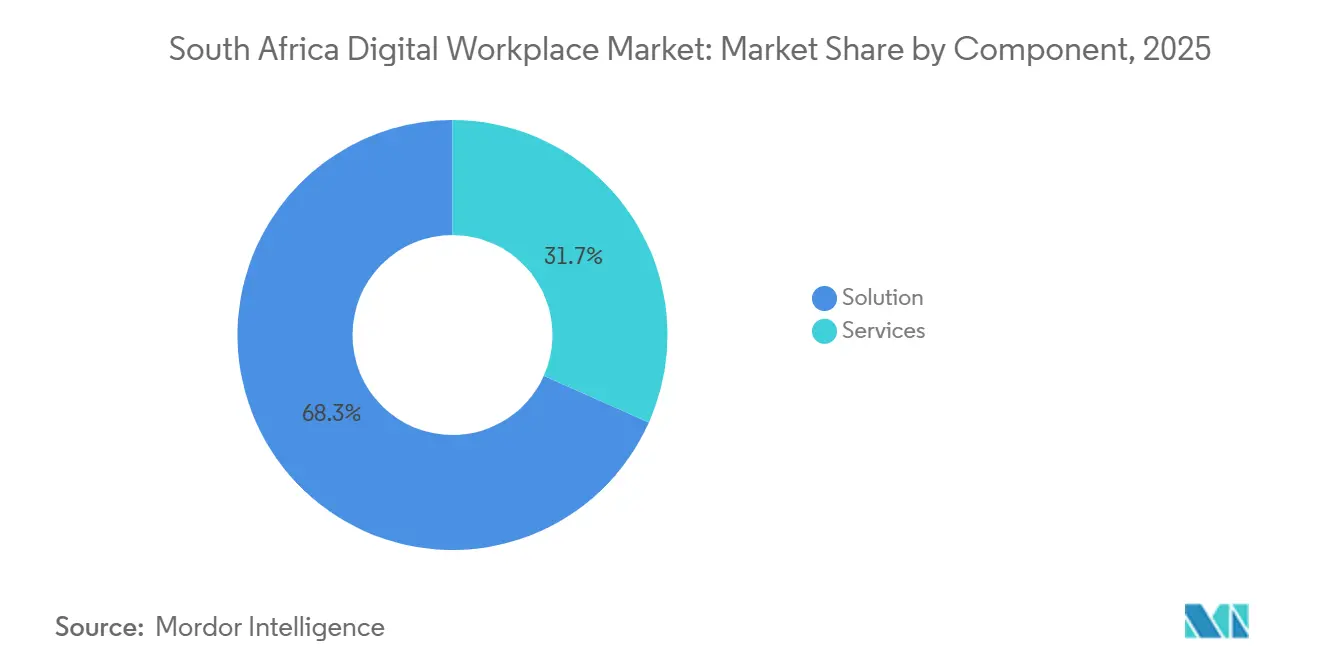
- By component, solutions held 68.33% of the market of the South Africa Digital Workplace Market in 2025, showing that software-led standardization remained the main spending pattern across the South Africa digital workplace market.
- By deployment mode, cloud is projected to expand at a 23.02% CAGR between 2026 and 2031, making it the fastest-growing deployment architecture in the South Africa digital workplace market.
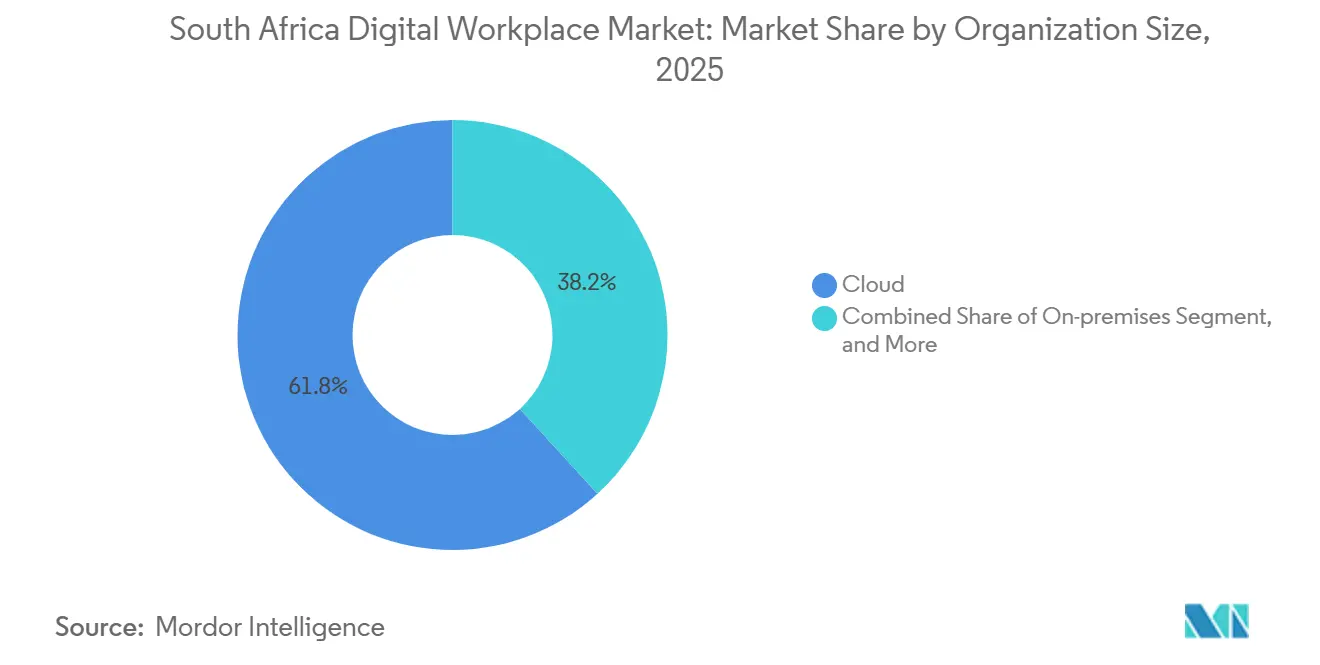
- By organization size, large enterprises held 63.46% share in 2025, while SMEs are projected to expand at a 23.43% CAGR through 2031.
- By end-user industry, BFSI held 25.44% share in 2025, while healthcare is projected to expand at a 23.56% CAGR through 2031.
Note: Market size and forecast figures in this report are generated using Mordor Intelligence’s proprietary estimation framework, updated with the latest available data and insights as of January 2026.
South Africa Digital Workplace Market Trends and Insights
Drivers Impact Analysis*
| Driver | (~) % Impact on CAGR Forecast | Geographic Relevance | Impact Timeline |
|---|---|---|---|
| Hybrid Work Normalization Across Regulated Enterprises | +5.2% | National, with early momentum in Gauteng and Western Cape | Medium term (2-4 years) |
| POPIA-Driven Demand for Secure Collaboration and Endpoint Control | +4.5% | National, compliance influence strongest in financial and healthcare hubs | Long term (≥ 4 years) |
| Cloud Migration of Productivity, Voice, and Device Management Workloads | +3.8% | National, concentrated in Johannesburg and Cape Town data center corridors | Medium term (2-4 years) |
| Microsoft Teams-Centered Workplace Standardization | +2.8% | National, with large-enterprise concentration in Gauteng | Short term (≤ 2 years) |
| Load-Shedding-Resilient Digital Work Models and Remote Operations | +2.2% | National, historically strongest outside major grid-stable business hubs | Short term (≤ 2 years) |
| Managed Workplace Services Adoption Among Skills-Constrained IT Teams | +1.8% | National, SME uptake concentrated in secondary metros | Medium term (2-4 years) |
| Source: Mordor Intelligence | |||
Hybrid Work Normalization Across Regulated Enterprises
Hybrid work has moved from a temporary operating response to a formal workplace design choice in financial services, legal services, telecommunications, and other regulated fields. When companies standardize hybrid users, they usually need licensed collaboration tools, managed devices, identity policies, secure access controls, and support layers, which raises the recurring value of each employee seat in the South Africa digital workplace market. This spending pattern often continues after the first rollout because firms keep adding governance, analytics, security, and workflow tools once basic collaboration is already in place. Companies that reduce office space are also redirecting part of those savings into software subscriptions and managed service contracts, which helps convert fixed facilities spending into recurring digital operating spend. Early adopters who tied hybrid work to formal governance models now have a larger installed base for AI-enabled productivity layers, which gives vendors more room to upsell advanced features over the next cycle. The South Africa digital workplace market benefits from this shift because hybrid work now supports procurement logic, workplace policy, and compliance design at the same time.
POPIA-Driven Demand For Secure Collaboration And Endpoint Control
The amended POPIA regulations that took effect on April 17, 2025, tightened expectations around consent, data subject rights, and the ongoing compliance duties of information officers, which made workplace technology choices more sensitive to audit and access-control requirements. POPIA now shapes procurement well beyond messaging tools because employers need clearer retention controls, user-level permissions, documented access trails, and stronger endpoint governance inside their daily work environment. The enforcement path taken against WhatsApp reinforced the view that consumer-grade communication tools do not provide the controls required for corporate data handling, especially when firms must evidence lawful processing and access rights over time. This is pushing regulated buyers toward platforms that can combine role-based access, encryption, auditability, and integration with document and identity systems inside one policy framework. Endpoint management is also gaining weight because compliance does not stop at the application layer, and enterprises increasingly want only approved and monitored devices to reach sensitive records. The South Africa digital workplace market is therefore being supported by regulations that reach across collaboration, content management, identity control, and device administration instead of influencing only one product category.
Cloud Migration Of Productivity, Voice, And Device Management Workloads
The shift of workplace workloads into local cloud environments is widening from productivity software into voice, endpoint management, and device orchestration, which is strengthening subscription-led revenue across the South Africa digital workplace market. Microsoft had already committed ZAR 20.4 billion, or USD 1.1 billion, over 3 years to establish enterprise-grade data center capacity in Johannesburg and Cape Town, and in March 2025, it announced an additional ZAR 5.4 billion, or USD 295 million, to expand cloud and AI infrastructure by the end of 2027.[1] Google Cloud officially launched its Johannesburg region in March 2025, which gave enterprises another in-country option for workplace application processing and storage. Local infrastructure from multiple hyperscalers has removed much of the latency and data residency friction that used to delay migration in banking, healthcare, and other tightly governed sectors. Voice workloads are also moving into the same cloud-managed environment, which matters because unified communications, calling, and productivity suites are being bought as connected user subscriptions rather than as separate systems. As these workloads converge, the South Africa digital workplace market is becoming more favorable for vendors and partners that can manage a broader stack under one recurring commercial model.
Microsoft Teams-Centered Workplace Standardization
Microsoft Teams has become the default collaboration layer in many enterprise accounts, giving Microsoft a strong position in the daily workflow environment of the South African digital workplace market. The relevance of this position goes beyond meetings and chat, as Teams is tied to Outlook, SharePoint, identity management, endpoint security, and newer AI tools within the same software estate. Public-sector demand also supports that direction, with the Technology Innovation Agency tendering in June 2026 for 6 Microsoft Teams Rooms Pro licenses under a 2-year CSP agreement that runs from July 2026 through June 2028.[2] Microsoft also widened the AI adoption path around this stack through its January 2026 partnership with SABC Plus, which aimed to broadcast AI and digital skills programs to millions of South Africans under the Microsoft Elevate initiative.[3] Once enterprises standardize on Teams and connected Microsoft 365 controls, they are less likely to buy isolated tools for voice, file collaboration, or employee experience, since much of that capability can be enabled within the same environment. This gives the South African digital workplace market a platform-led structure, with the installed collaboration base serving as the entry point for broader monetization across compliance, voice, automation, and AI.
Restraints Impact Analysis*
| Restraint | (~) % Impact on CAGR Forecast | Geographic Relevance | Impact Timeline |
|---|---|---|---|
| Connectivity Inequality Outside Major Business Hubs | -3.5% | National, most acute in Limpopo, Eastern Cape, and Northern Cape | Long term (≥ 4 years) |
| Device, Licensing, And Security Stack Cost Pressure On SMEs | -2.8% | National, disproportionate impact in SME-heavy metros outside Gauteng | Medium term (2-4 years) |
| Fragmented Legacy Application Environments Slowing Workplace Modernization | -2.2% | National, concentrated in government and parastatal sectors | Medium term (2-4 years) |
| Shortage Of Cloud, Endpoint, And Collaboration Security Skills | -1.8% | National, most acute outside Johannesburg and Cape Town | Long term (≥ 4 years) |
| Source: Mordor Intelligence | |||
Connectivity Inequality Outside Major Business Hubs
The South Africa digital workplace market remains heavily urban in practical terms because high-quality broadband access is still concentrated in the largest business corridors. The Development Bank of Southern Africa estimated that the country would need between ZAR 108 billion, or USD 5.9 billion, and ZAR 142 billion, or USD 7.8 billion, in real terms to connect all households to high-speed broadband, which indicates that nationwide parity will not be achieved within this forecast window. ICASA also noted that telecoms infrastructure theft and vandalism cost the sector more than ZAR 340 million, or USD 18.6 million, in 2025, with rural and peri-urban locations facing slower recovery and weaker investment incentives. This creates a two-speed adoption pattern where businesses in Gauteng, Cape Town, and other better-served hubs can deploy cloud-heavy workplace tools more easily than organizations with dispersed branch or field operations. Mining, agriculture, logistics, and public service networks face higher rollout costs because the quality of user experience depends on local access conditions that software vendors cannot fix through pricing alone. Until connectivity improves further, the South Africa digital workplace market will continue to deliver its strongest growth from metro-centered demand rather than from evenly distributed national adoption.
Device, Licensing, And Security Stack Cost Pressure On SMEs
Cost pressure is not limited to collaboration licenses, because smaller firms often need endpoint management, identity protection, data controls, and support services before they can operate a secure workplace environment at scale. A Microsoft 365 Business Premium license was priced at ZAR 302 per user per month, or USD 16.50, in 2026, and even that entry point does not cover the full operational cost of a security-complete setup for every SME. This means many smaller companies adopt only parts of the stack, such as messaging and meetings, while delaying unified endpoint management, data loss prevention, or more formal compliance tooling. The result is shallower adoption depth, not a full absence of demand, because SMEs still need digital work tools but often cannot move to enterprise-grade configurations in one step. Budget pressure is especially visible in retail, hospitality, and informal professional services, where technology spending must compete directly with narrow operating margins. The South Africa digital workplace market, therefore, has a strong SME growth story, but the value captured per user will depend on whether vendors and service providers can simplify the cost of a fully managed and secure configuration.
*Our forecasts treat driver/restraint impacts as directional, not additive. The impact forecasts reflect baseline growth, mix effects, and variable interactions.
Segment Analysis
By Component: Solutions Anchor The Enterprise Digital Workplace Stack
Solutions held 68.33% of the South Africa digital workplace market share in 2025 by component, which shows that most spending was directed toward software platforms rather than toward services alone. This spending pattern reflects a strong preference for standardized workplace environments where enterprises buy broad subscriptions first and then activate added controls across collaboration, content access, endpoint security, and employee workflow over time. Unified communication and collaboration platforms are at the center of that stack, and their role is now wider because employers expect the same environment to support meetings, messaging, file access, governance, and AI-enabled productivity. Unified endpoint management is also becoming a baseline requirement because regulated employers want approved devices, policy enforcement, and stronger access visibility across hybrid workforces. FNB's deployment of Microsoft Sales Copilot for more than 4,000 front-line employees showed how workplace software is being tied more closely to day-to-day revenue and service activity instead of remaining a back-office enablement layer.
Services remain smaller in value terms, but they still carry high delivery importance when clients need integration, policy design, migration support, and managed operations around a growing platform estate. The South Africa digital workplace industry is seeing more demand for specialist delivery where enterprises must connect modern workplace tools with legacy business systems, internal records environments, and sector-specific compliance processes. Managed services are becoming more valuable than one-off projects in many accounts because customers want ongoing administration of endpoint controls, collaboration policies, and user support without building larger in-house teams. This is especially relevant in BFSI, government, and other regulated settings where documentation, permissions, and connector work can slow down internal rollout teams. Even so, the solutions layer will continue to anchor the South Africa digital workplace market because software activation remains the main route through which users, seats, and recurring subscriptions scale.
By Deployment Mode: Cloud Becomes The Default Enterprise Architecture
Cloud deployment is projected to expand at a 23.02% CAGR, which makes it the fastest-growing deployment model in the South Africa digital workplace market size over 2026-2031. That growth is being supported by both greenfield cloud-first rollouts and by the steady migration of productivity, voice, and device management workloads out of on-premises environments. Eskom reached 308 consecutive days without load shedding as of March 2026 and saved ZAR 9 billion, or USD 493 million, in diesel costs year on year, which improved confidence in daily operating stability even though it did not reverse the economics of cloud migration. Instead, improved grid conditions allow some organizations to redirect resilience budgets away from backup infrastructure and toward workplace software, device control, and cloud-managed user environments. The presence of Microsoft Azure in Johannesburg and Cape Town, AWS in Cape Town, and Google Cloud in Johannesburg has reduced the earlier friction tied to latency and in-country processing for workplace workloads.
Hybrid deployment still holds a meaningful place in sectors that need tighter control over some data classes while still benefiting from public cloud for analytics, AI, testing, and user-facing productivity tools. Banks, utilities, and critical infrastructure operators often keep sensitive records or specific transaction systems on dedicated environments while moving collaboration, workflow, and selected intelligence layers into cloud services. This model means the South Africa digital workplace market will not become fully cloud-only, even if cloud takes the clear lead in new investments. On-premises environments are declining in mainstream commercial use, but they remain relevant in defense, government, and some parastatal settings where air-gapped or highly restricted operating models still apply. Cisco's Sovereign Critical Infrastructure launch in April 2026 addressed this need directly by offering configurable infrastructure for customers that require stricter control over remote vendor access and system governance.
By Organization Size: SMEs Emerge As The Next Growth Frontier
Large enterprises held 63.46% of the South Africa digital workplace market share in 2025, while SMEs are projected to expand at a 23.43% CAGR through 2031. Large organizations moved earlier because they faced stronger compliance demands, larger distributed user bases, and more formal procurement cycles that supported multiyear platform commitments. They also had more reason to build integrated environments that combined collaboration, endpoint management, identity, document control, and workflow layers under a common operating model. This early adoption explains why the South Africa digital workplace market remained concentrated in enterprise accounts in 2025 even though the next growth wave is shifting toward smaller firms. SMEs are now moving faster because SaaS delivery, monthly licensing, and outsourced administration have lowered the practical barrier to entry for professional-grade workplace environments. The shift is not only technology-led, because larger clients increasingly expect suppliers and service partners to meet minimum security, communication, and data-handling standards in everyday work.
Microsoft 365 Business Standard and Business Premium have become common entry points for formal workplace adoption among smaller South African firms, although pricing still shapes how much of the full stack they can activate at once. Many SMEs therefore prefer managed service arrangements that let them outsource policy setup, device administration, and support instead of hiring scarce internal specialists. This favors providers with coverage beyond Gauteng because the next phase of SME growth will depend on service reach as much as on software availability. The South Africa digital workplace industry is also seeing a client-pull effect, where small firms upgrade their workplace tools because enterprise customers are tightening vendor questionnaires and access expectations. That dynamic should keep SME participation rising in the South Africa digital workplace market even if per-seat spending remains sensitive to budget limits.

By End-user Industry: BFSI Leads While Healthcare Accelerates
BFSI held 25.44% of the South Africa digital workplace market size in 2025, while healthcare is projected to expand at a 23.56% CAGR through 2031. Banking and financial institutions remain the largest buyers because they combine strong compliance obligations with broad use of unified communications, endpoint governance, identity controls, and auditable collaboration systems. Their digital workplace deployments usually extend across front-office, contact center, operations, and controlled document workflows, which raises the value of each transformation program. Absa's use of Microsoft Teams with the Anywhere365 cloud contact center platform illustrated how workplace and customer interaction environments are being tied together inside one enterprise communications design. Healthcare is growing faster because providers now face a mix of administrative digitization needs, data governance demands, and readiness expectations linked to the National Health Insurance Act. Netcare's May 2026 AI-powered wearable monitoring pilot showed that workplace tools in healthcare are moving beyond administration and into settings where communication, records access, and response coordination affect care delivery itself.
The National Health Insurance Act, signed into law in May 2024, is reinforcing the need for integrated digital capabilities across providers that must manage records access, internal communication, and process coordination more consistently. IT and telecommunications, government, manufacturing, retail, education, and energy also contribute to the South Africa digital workplace market, but they differ in procurement speed, budget structure, and integration complexity. Government remains slower because of procurement cycles and budget rigidity, yet directionally it is still moving toward stronger digital identity, data exchange, and service delivery foundations. Manufacturing and utilities are adopting workplace tools for field coordination, remote monitoring support, and contractor workflows, which makes endpoint control and secure communications more relevant outside pure office settings. As these vertical patterns deepen, the South Africa digital workplace market will continue to balance one mature volume anchor in BFSI with a faster modernization cycle in healthcare.
Geography Analysis
Gauteng remains the largest center of demand in the South Africa digital workplace market because it concentrates the country's main financial institutions, technology businesses, large corporate headquarters, and a significant share of enterprise decision-making. The province's stronger fiber footprint, dense office corridors, and proximity to major data center assets make large-scale workplace rollouts easier to implement and support over time. Microsoft Azure's South Africa North region and Google Cloud's Johannesburg region have strengthened Gauteng's position by giving enterprises in the province closer access to in-country cloud processing for collaboration and productivity workloads. This matters most for financial services and other regulated users because workplace modernization in these sectors depends on both cloud capability and confidence in local data handling. The South Africa digital workplace market, therefore, shows a clear metro concentration, with Gauteng setting the pace for multi-layer adoption that combines communications, identity, endpoint control, and workflow software.
The Western Cape is the second-largest regional base in the South Africa digital workplace market, and its demand profile is somewhat more diverse because it includes fintech firms, creative agencies, business process outsourcing players, and a broader mix of SaaS-first buyers. Cape Town tends to support faster procurement cycles and a greater willingness to evaluate alternatives outside one dominant platform stack, especially in cloud-native environments. Cisco's Webex media point of presence launch in Cape Town in January 2025 added local voice and video processing capacity for enterprises that wanted better performance and stronger data sovereignty alignment in their communications layer. The presence of Microsoft Azure South Africa West, AWS Africa Cape Town, and local collaboration infrastructure has made the province an attractive environment for low-latency workplace deployment. Hybrid work patterns are also more established in Cape Town's professional labor base, which supports ongoing spending on subscription-led collaboration and device management models.
KwaZulu-Natal and the rest of the country represent meaningful expansion territory for the South Africa digital workplace market, but they still face a harder infrastructure path than Gauteng and the Western Cape. Secondary cities such as Gqeberha, Bloemfontein, and Polokwane have growing business activity, yet rollout costs are higher because service coverage, broadband consistency, and on-site support depth are not as strong as in the main metro corridors. The most severe gaps remain in the Eastern Cape, Limpopo, and Northern Cape, where connectivity limitations directly reduce the feasibility of cloud-heavy workplace configurations. The DBSA study on digital infrastructure investment makes clear that the capital required to close these gaps is large, which means regional expansion through 2031 will depend on selective managed services, gradual broadband improvement, and only partial relief from satellite connectivity options.
Competitive Landscape
The South Africa digital workplace market is moderately concentrated at the platform level, but it remains far more fragmented in services, implementation, and support. Microsoft holds the strongest structural position because its workplace stack links Teams, SharePoint, Intune, Defender, Outlook, and adjacent AI tools inside one operating environment, which increases switching costs once enterprises standardize on it. This platform depth means many customers do not evaluate communications, content access, endpoint control, and employee workflow tools as separate purchases anymore. Google Workspace remains a relevant challenger in cloud-native and education-led environments, while Cisco continues to compete through unified communications, networking, and security-led collaboration architecture. The South Africa digital workplace market is now moving into a phase where platform value is increasingly judged by how well vendors connect AI, workflow, compliance, and communication layers instead of offering point tools alone.
Strategic moves over 2025 and 2026 showed that incumbent vendors are trying to expand this platform logic even further. ServiceNow and Microsoft broadened their strategic alliance in November 2025 to connect Microsoft 365 Copilot with ServiceNow's Now Assist and wider workflow orchestration capabilities, which tightened the link between productivity tools and enterprise process execution. Cisco and ServiceNow also deepened their partnership in April 2025 by integrating Cisco AI Defense with ServiceNow SecOps, which strengthened the governance case around AI-enabled workplace environments. Microsoft added another layer of advantage through continued investment in local cloud and AI infrastructure, which helps support both performance and compliance confidence for South African enterprise users. These moves reinforce an environment where leading vendors are using ecosystems and adjacent controls to defend their installed base rather than competing only on standalone product features.
Specialist vendors and local integrators still have meaningful room in the South Africa digital workplace market because not every customer can be served through a single standard platform design. Ivanti, Omnissa, and OpenText remain relevant where enterprises need stronger support for mixed environments, virtual desktop use cases, or stricter operational separation than native tools provide. iOCO is strategically important in the delivery chain because it has deep relationships across large South African corporates and can support complex implementations in compliance-sensitive settings. White-space opportunities remain strongest in healthcare workflow automation, AI-linked employee experience, and managed workplace services for SMEs in secondary metros where global vendors do not always maintain direct local execution depth.
South Africa Digital Workplace Industry Leaders
-
Microsoft Corporation
-
Cisco Systems, Inc.
-
Dell Technologies Inc.
-
HP Inc.
-
Lenovo Group Limited
- *Disclaimer: Major Players sorted in no particular order
Recent Industry Developments
- January 2026: Microsoft South Africa and the SABC signed an MoU at the 2026 Microsoft AI Tour Johannesburg to broadcast AI and digital skills programmes through SABC Plus, targeting accessible AI fluency development for millions of South Africans under the Microsoft Elevate initiative.
- November 2025: ServiceNow and Microsoft announced an expanded strategic alliance enabling agentic AI orchestration between Microsoft 365 Copilot and ServiceNow's Now Assist platform, including Microsoft Agent 365 integration and joint AI governance capabilities for enterprise IT, HR, and customer-facing workflows.
- September 2025: Mint Group became the first systems integrator in South Africa to achieve Microsoft Copilot Advanced Specialization across all three solution areas, Modern Work, Business Applications, and Security, establishing it as the primary certified delivery channel for enterprise Microsoft 365 Copilot deployments in the market.
- April 2025: Cisco and ServiceNow deepened their seven-year partnership by integrating Cisco AI Defense with ServiceNow SecOps, creating holistic AI risk management and governance capabilities for enterprises deploying AI-augmented digital workplace tools.
South Africa Digital Workplace Market Report Scope
The South Africa Digital Workplace Market refers to the market for digital tools, platforms, and services that help organizations in South Africa enable secure communication, collaboration, and productive work across office, remote, and hybrid environments. It includes cloud-based productivity suites, unified communications, employee experience platforms, endpoint management, and workplace security and compliance solutions.
The South Africa Digital Workplace Market Report is Segmented by Component (Solutions and Services), Deployment Mode (Cloud, On-Premises, and Hybrid), Organization Size (Large Enterprises and Small and Medium-Sized Enterprises), End-User Industry (IT and Telecommunications, BFSI, Healthcare, Manufacturing, Retail, Government and Public Sector, Education, Energy and Utilities, and Legal and Professional Services). The Market Forecasts are Provided in Terms of Value (USD).
| Solutions | Unified Communication and Collaboration |
| Unified Endpoint Management | |
| Enterprise Mobility and Management | |
| Employee Experience Platforms and Intranet | |
| Workflow Automation and Knowledge Management | |
| Virtual Desktop Infrastructure and Cloud PC | |
| Services |
| Cloud |
| On-premises |
| Hybrid |
| Large Enterprises |
| Small and Medium-sized Enterprises |
| IT and Telecommunications |
| BFSI |
| Healthcare |
| Manufacturing |
| Retail |
| Government and Public Sector |
| Education |
| Energy and Utilities |
| Legal and Professional Services |
| Other End-user Industries |
| By Component | Solutions | Unified Communication and Collaboration |
| Unified Endpoint Management | ||
| Enterprise Mobility and Management | ||
| Employee Experience Platforms and Intranet | ||
| Workflow Automation and Knowledge Management | ||
| Virtual Desktop Infrastructure and Cloud PC | ||
| Services | ||
| By Deployment Mode | Cloud | |
| On-premises | ||
| Hybrid | ||
| By Organization Size | Large Enterprises | |
| Small and Medium-sized Enterprises | ||
| By End-user Industry | IT and Telecommunications | |
| BFSI | ||
| Healthcare | ||
| Manufacturing | ||
| Retail | ||
| Government and Public Sector | ||
| Education | ||
| Energy and Utilities | ||
| Legal and Professional Services | ||
| Other End-user Industries |
Key Questions Answered in the Report
How large is the South Africa digital workplace market in 2026, and what is the 2031 outlook?
The market stands at USD 0.82 billion in 2026 and is projected to reach USD 2.28 billion by 2031 at a CAGR of 22.65%.
Which component leads spending in South Africa's digital workplace space?
Solutions led the market in 2025 with a 68.33% share, showing that buyers still prioritize software platforms over stand-alone services.
Why is cloud deployment rising so quickly in South Africa?
Cloud is projected to grow at a 23.02% CAGR because local hyperscaler capacity, better in-country processing options, and wider workload migration are making cloud-first workplace models easier to adopt.
Which company group has the strongest position in this space?
Microsoft holds the strongest structural position at the platform layer, while Google and Cisco remain important challengers and the services layer stays fragmented.
Which customer group is creating the next growth wave?
SMEs are the fastest-growing organization segment with a 23.43% CAGR, supported by SaaS pricing, managed services, and rising client expectations around secure work tools.
Which end-user sector combines the largest current demand with the fastest future expansion?
BFSI held the largest 2025 share at 25.44%, while healthcare is growing the fastest at a 23.56% CAGR through 2031.