
Fume Hood Market Size and Share
Market Overview
| Study Period | 2020 - 2031 |
|---|---|
| Market Size (2026) | USD 657.85 Million |
| Market Size (2031) | USD 814.33 Million |
| Growth Rate (2026 - 2031) | 4.36 % |
| Fastest Growing Market | Asia Pacific |
| Largest Market | North America |
| Market Concentration | Medium |
Major Players *Disclaimer: Major Players sorted in no particular order Image © Mordor Intelligence. Reuse requires attribution under CC BY 4.0. | |
Fume Hood Market Analysis by Mordor Intelligence
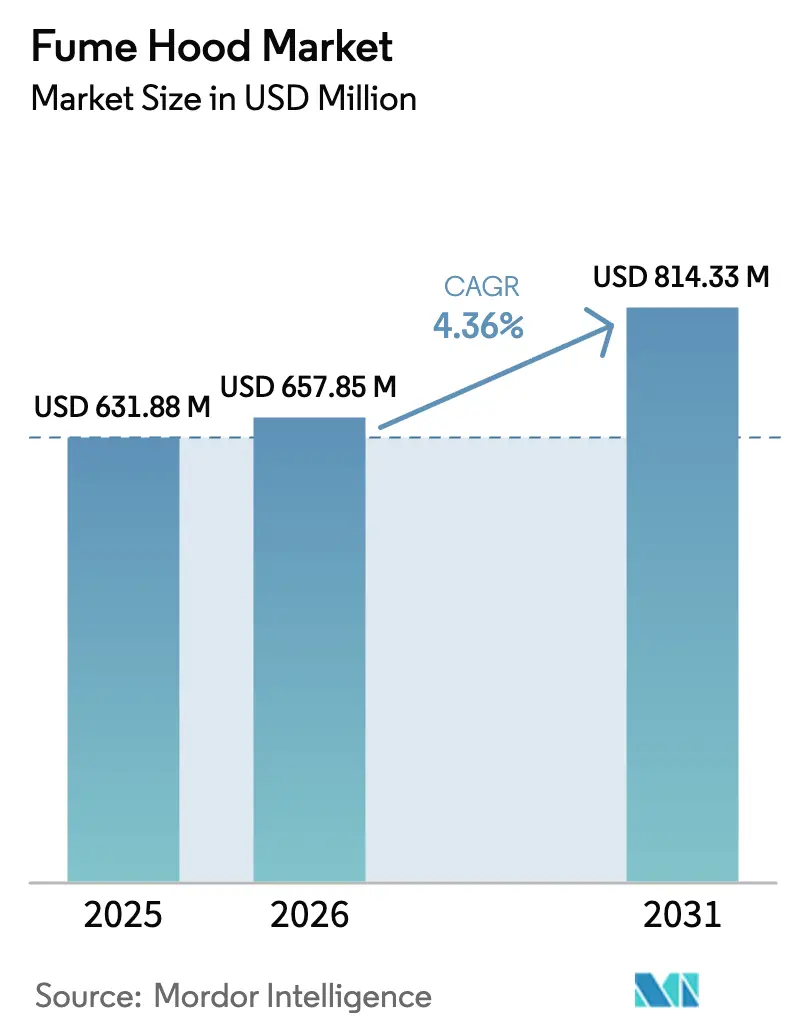
The Fume Hood Market size is expected to grow from USD 631.88 million in 2025 to USD 657.85 million in 2026 and is forecast to reach USD 814.33 million by 2031 at 4.36% CAGR over 2026-2031.
Buyers now assign greater weight to lifetime energy and filter costs than to acquisition price, prompting vendors to emphasize variable-air-volume (VAV) designs and multi-stage filtration that lower operating expenses by 30-40% compared to legacy units. Pharmaceutical and biotechnology R&D budgets continue to anchor baseline demand. Yet, the fastest incremental growth arises from universities replacing outdated hoods with IoT-enabled models that satisfy both safety audits and campus-wide carbon-reduction mandates. Retrofit activity also benefits from building-code changes that cap permissible air changes per hour, effectively making older constant-air-volume hoods obsolete. On the supply side, specialty carbon and HEPA media constraints, though episodic, keep lead times volatile and favor manufacturers with vertically integrated filter production.
Key Report Takeaways
- By product type, ducted systems led with a 62.45% market share of the fume hood market in 2025, while ductless units are forecast to expand at a 6.65% CAGR through 2031.
- By mobility, bench-top configurations accounted for 66.43% of the Fume Hood market size in 2025; mobile/cart-mounted units are advancing at a 6.87% CAGR to 2031.
- By end-user, pharmaceutical and biotechnology labs captured 48.54% of the revenue in 2025, whereas academic and research institutions are projected to post the fastest growth of 7.65% CAGR through 2031.
- By material, stainless steel retained 41.34% share of the fume hood market size in 2025; polypropylene is rising at a 6.32% CAGR through 2031 on corrosive-chemistry demand.
- By geography, North America retained 42.34% share of the fume hood market size in 2025; Asia-Pacific is rising at a 5.43% CAGR through 2031.
Note: Market size and forecast figures in this report are generated using Mordor Intelligence’s proprietary estimation framework, updated with the latest available data and insights as of January 2026.
Market Trends and Insights
Drivers Impact Analysis of Fume Hood Market*
| Driver | (~) % Impact on CAGR Forecast | Geographic Relevance | Impact Timeline |
|---|---|---|---|
| Stringent Laboratory Safety Regulations | +0.9% | North America, Europe, spill-over to APAC | Medium term (2-4 years) |
| Expansion of Pharma & Biotech R&D Expenditure | +1.2% | Global hubs in North America, Europe, Asia-Pacific | Long term (≥ 4 years) |
| Energy-Efficiency Mandates Accelerating Retrofit Demand | +0.8% | North America, Europe, emerging in APAC | Short term (≤ 2 years) |
| Rapid Adoption of IoT-Enabled Smart Fume Hoods | +0.6% | Tier-1 cities across North America, Europe, APAC | Medium term (2-4 years) |
| Growing Demand from Emerging-Market Academic Labs | +0.5% | APAC core, Middle East, South America | Long term (≥ 4 years) |
| Rising Focus on Indoor Air Quality Certification in Green Buildings | +0.4% | North America, Europe, nascent in APAC | Medium term (2-4 years) |
| Source: Mordor Intelligence | |||
Stringent Laboratory Safety Regulations
Global regulators now audit containment performance far more frequently. The U.S. Occupational Safety and Health Administration revised its Laboratory Standard in 2024, adopting quarterly face-velocity verification, which necessitates the early retirement of hoods that fail to meet the 80-120 feet-per-minute threshold[1]. In parallel, ANSI Z9.5 updates and Europe’s EN 14175 harmonization compel universities and pharmaceutical sites to budget for compliant replacements. The National Institutes of Health allocated USD 42.5 billion for FY 2025 infrastructure, earmarking 15% for environmental health and safety upgrades that include new fume hoods. Heightened litigation risk around occupational exposure now makes proactive hood replacement a board-level risk-mitigation measure. Collectively, these actions add 0.9 percentage points to the forecast CAGR.
Expansion of Pharma & Biotech R&D Expenditure
Life-science companies continue record capital outlays. Roche plans USD 50 billion in R&D for 2024-2026, allocating 8% to facility upgrades that include advanced containment. Novartis spent CHF 23 billion (approximately USD 26 billion) in 2024, prioritizing oncology suites that require HEPA-filtered, negative-pressure hoods. CBRE reported that North American lab space under construction reached 45 million square feet in Q4 2024, a 22% year-over-year surge, and most developers now specify energy-efficient hoods at the shell-and-core stage. Contract development and manufacturing organizations such as Catalent and Lonza likewise scale up, each requiring validated containment to secure FDA and EMA approvals. These investments increase long-run growth by 1.2 percentage points.
Energy-Efficiency Mandates Accelerating Retrofit Demand
Building codes are tightening fast. California’s Title 24 updates, effective 2025, require new labs to reduce HVAC energy use by 30% from 2019 baselines, which is achievable only with VAV fume hoods linked to occupancy sensors. The U.S. Department of Energy’s Better Buildings Lab Accelerator achieved electricity savings of 35-50% after VAV retrofits, often paying back in four years[2]. Europe’s 2024 revision of the Energy Performance of Buildings Directive extends similar rules to renovations, creating a retrofit backlog across Germany, France, and the Nordics. Facility managers thus have both regulatory and financial incentives to replace constant-air-volume hoods promptly.
Rapid Adoption of IoT-Enabled Smart Fume Hoods
Smart containment converts static assets into data nodes. Kewaunee Scientific’s SmartFlow platform embeds sensors that report face velocity, sash position, and differential pressure in real-time, enabling predictive maintenance and up to 25% reduction in servicing costs. Siemens integrated similar telemetry into building-management systems in 2025, supporting campus-wide energy optimization for universities operating hundreds of hoods. Early adopters cite 15% energy savings from demand-controlled ventilation algorithms. With sustainability metrics now factoring into grant awards, especially in U.S. public universities, digital readiness of fume hoods becomes a funding prerequisite.
Restraints Impact Analysis of Fume Hood Market*
| Restraint | (~) % Impact on CAGR Forecast | Geographic Relevance | Impact Timeline |
|---|---|---|---|
| High Capital and Operating Costs | -0.7% | Global, acute in emerging markets | Short term (≤ 2 years) |
| Complex Multi-Standard Regulatory Compliance | -0.5% | Global, fragmented across jurisdictions | Medium term (2-4 years) |
| Emergence of Alternative Containment Technologies | -0.3% | North America, Europe | Long term (≥ 4 years) |
| Supply-Chain Volatility for Specialty Media | -0.4% | Global, episodic | Short term (≤ 2 years) |
| Source: Mordor Intelligence | |||
High Capital and Operating Costs
A fully specified VAV ducted hood can cost USD 25,000 to install, while high-performance ductless units can start at around USD 18,000, which can squeeze budgets for small research labs. Annual energy outlays range from USD 3,500 to USD 5,000 for constant-air-volume models in North America, and ductless filter replacement averages USD 1,800, eroding operating funds. Indian universities, for example, face a 28% GST plus customs duties on imported hoods, which inflates prices by 40% over domestic but lower-spec options. These economic delays extend upgrade cycles, shaving 0.7 percentage points off growth.
Complex Multi-Standard Regulatory Compliance for Ductless Filters
Filter testing requirements diverge widely: the U.S. leans on OSHA self-certification, Europe mandates EN 14175-3 type tests, and France overlays AFNOR guidelines, forcing suppliers to maintain multiple SKUs and certification dossiers. Re-testing for new chemical classes, such as PFAS, adds cost and time to market. Smaller vendors struggle with this regulatory overhead, which limits product availability and dampens uptake by 0.5 percentage points.
*Our forecasts treat driver/restraint impacts as directional, not additive. The impact forecasts reflect baseline growth, mix effects, and variable interactions.
Fume Hood Market Segment Analysis
By Product Type:
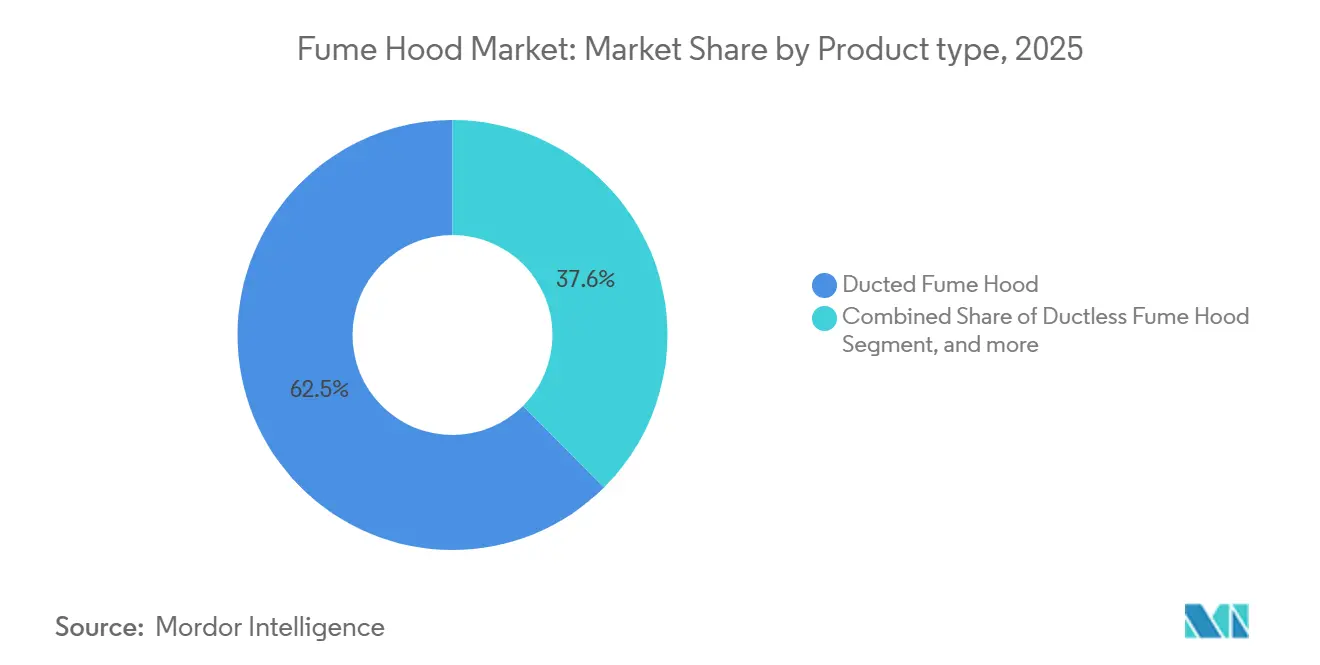
Retrofit Economics Propel Ductless ExpansionDucted units dominated, accounting for 62.45% of 2025 revenue, reflecting entrenched installations in pharmaceutical QC labs where centralized exhaust is already in place. These customers value unlimited chemical throughput and straightforward regulatory audits. Yet ductless hoods are slated to outpace with a 6.65% CAGR through 2031. Modern multi-stage filters that meet ASHRAE 110 criteria have softened historical safety concerns, while avoiding ductwork can save USD 100,000 on a typical retrofit in 1950s-era university buildings. Accessories ranging from VAV controllers to IoT-ready sash sensors now account for a recurring aftermarket that suppliers bundle within service contracts.
Ductless adoption also benefits from application-specific niches, notably battery R&D and semiconductor wet benches where corrosive electrolytes or hydrofluoric acid would corrode stainless ductwork within years. Polypropylene cabinet construction and on-board filtration make these hoods plug-and-play, a feature prized by institutions operating within heritage architecture that restricts structural penetrations. As a result, the ductless portion of the Fume Hood market gains wallet share faster than headline unit volumes suggest, underpinning supplier gross-margin expansion.

By Mobility:
Flexible Workflows Favor Portable DesignsBench-top systems captured 66.43% of 2025 spending and remain the mainstay in fixed research suites that rarely reconfigure protocols. Their larger work surfaces and integration with casework make them irreplaceable in high-throughput analytical chemistry. The mobile/cart segment, however, is forecasted to grow at a 6.87% CAGR through 2031, driven by contract research organizations orchestrating multi-site clinical trials that require uniform containment across rented lab space. Battery-powered models introduced in 2024 further enhance portability by eliminating reliance on facility power outlets during short-term deployments.
Flexible lab layouts, including hot-desking for equipment, have gained traction in large pharmaceutical innovation centers and are being adopted by university incubators. Mobile hoods allow space planners to switch from organic synthesis one week to cell-culture prep the next without extensive HVAC rebalancing. The premium for mobility, typically 15-20% above bench-top equivalents, is offset by space-utilization gains that property managers now quantify in lease negotiations.
By End-User:
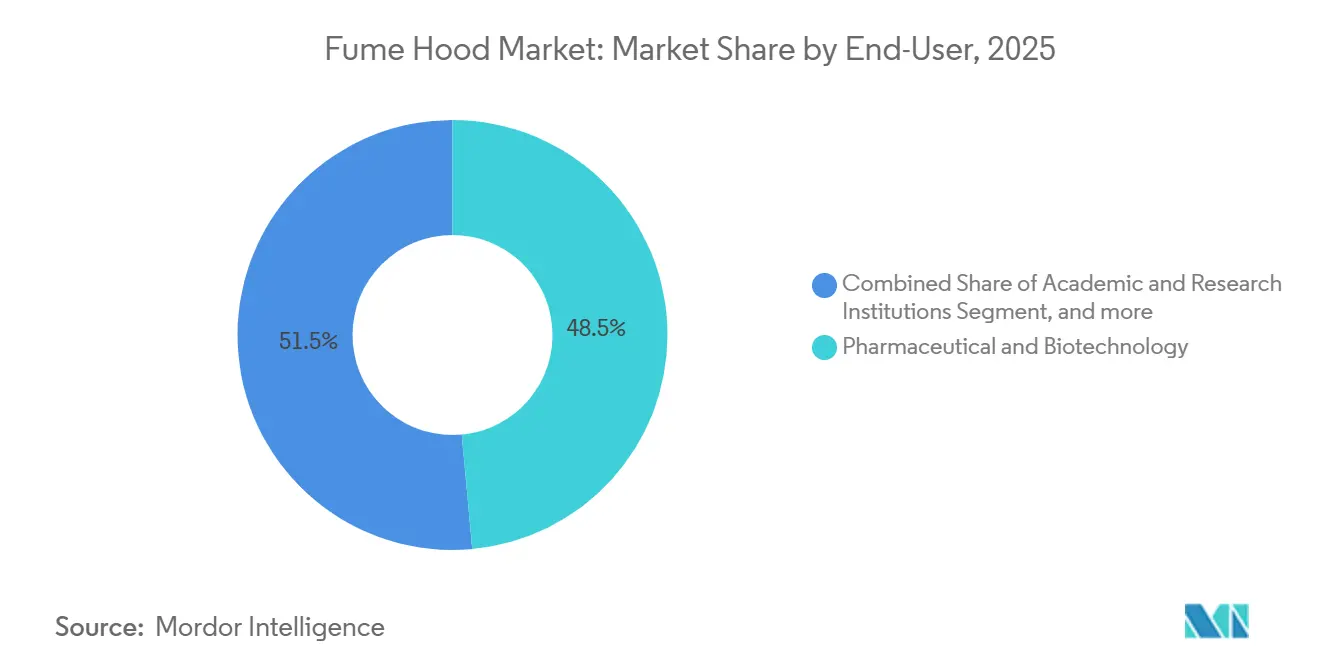
Universities Post the Fastest GrowthPharmaceutical and biotechnology firms held 48.54% of 2025 revenue, underpinned by strict containment standards and planned 15-year replacement cycles. Nonetheless, academic and government research institutions are projected to achieve a 7.65% CAGR to 2031, the fastest among end-users. U.S. federal stimulus under the CHIPS and Science Act and China’s Double First-Class University program channel billions into lab modernization, with fume hoods topping procurement lists because they confer immediate safety and energy wins. Partnerships where pharma outsources discovery work to universities further shift capital budgets toward academia.
Diagnostics laboratories and hospital pathology suites form the smallest slice yet sustain modest growth tied to healthcare infrastructure upgrades begun during the pandemic. They require compact hoods primarily for handling formalin and xylene, rather than broad-spectrum chemical containment, making them attractive targets for ductless suppliers that can pre-qualify filter matrices for typical reagent sets.
By Material:
Corrosion Concerns Elevate PolypropyleneStainless steel retained 41.34% of 2025 demand thanks to its longevity and compatibility with most disinfectants. However, polypropylene cabinets are expected to post a 6.32% CAGR on the back of battery and semiconductor research that involves corrosive chemistries intolerant of metal. Polypropylene also reduces weight, a significant advantage in mobile configurations where cart maneuverability is crucial. Mixed-material designs are emerging—stainless steel work surfaces paired with polypropylene side panels—to strike a balance between durability, corrosion resistance, and cost.
Powder-coated mild steel remains a budget option in cash-constrained public colleges, although its share is gradually being ceded to composite and fiberglass variants in ultra-corrosive environments. Material choice has thus become application-specific, a shift that suppliers accommodate through on-demand fabrication and the selection of modular bill-of-materials, enabled by digital twins.
Geography Analysis
North America Fume Hood Market
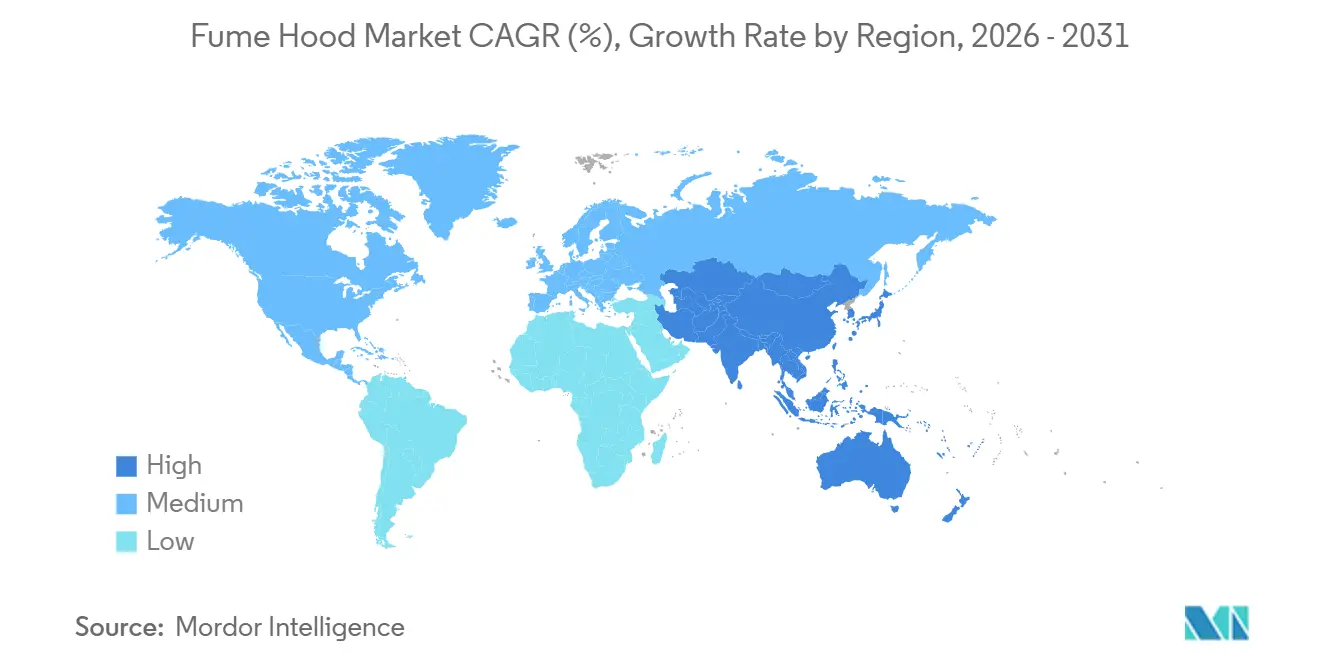
North America commanded 42.34% of the 2025 global revenue, supported by OSHA and ANSI Z9.5 enforcement, deep pharmaceutical pipelines, and a vibrant life-science real estate sector that embeds high-efficiency hoods in spec builds. NIH infrastructure grants further bolster replacement cycles as universities race to meet quarterly velocity audits. Despite a maturing installed base, continued construction—45 million ft² in progress as of Q4 2024—keeps the regional Fume Hood market expanding, albeit below the global average.
APAC Fume Hood Market
The Asia-Pacific region is forecasted to be the fastest-growing territory, with a 5.43% CAGR through 2031, accounting for over one-third of the incremental units added worldwide. China’s self-sufficiency drive in pharmaceuticals and India’s biosimilar scale-up underwrite a wave of new laboratory construction. Government subsidies that cover 30% of energy-efficient equipment costs in Japan and South Korea also stimulate the replacement of constant-air-volume models with VAV hoods. Suppliers that pair local manufacturing with EN 14175 and ANSI certifications stand to outcompete import-only rivals.
Europe, Middle East and South America Fume Hood Market
Europe is experiencing slower top-line growth, constrained by a mature asset base and modest expansion of its R&D pipeline. Even so, the European Union’s 2024 revision of the Energy Performance of Buildings Directive has turned energy efficiency into a compliance requirement for renovations, catalyzing a retrofit market from Germany to the Nordics. Meanwhile, Middle Eastern research universities, such as KAUST and the UAE’s Masdar Institute, create beachheads for premium suppliers, although annual volumes remain relatively small. South America experiences episodic demand spikes linked to public university stimulus, but is hindered by currency volatility and import duties.
Regulatory Landscape
In the United States, OSHA 29 CFR 1910.1450 (Laboratory Standard) requires laboratories to maintain a Chemical Hygiene Plan that includes properly functioning chemical fume hoods, with containment performance commonly verified using ANSI/ASHRAE 110; the 2016 version was reaffirmed in 2025 (R2025). Federal projects add another layer through United Facilities Guide Specifications (UFGS 11 53 00), which prescribes design and field-testing requirements for fume hoods used in Department of Defense and other federal facilities.
In Europe, EN 14175 remains the core framework for ducted fume cupboards, while EN 17242:2025 clarifies design, manufacturing, and test requirements for recirculatory filtration fume cabinets, reinforcing separate compliance tracks for ducted versus ductless/filtration units. For clinical diagnostic environments where equipment is used as part of medical testing workflows, some installations may also be assessed against applicable safety and performance requirements under the EU Medical Devices Regulation (EU) 2017/745, raising documentation and traceability expectations for suppliers that serve hospital laboratories in addition to research customers.
Value Chain Analysis
The fume hood value chain starts with upstream inputs (stainless steel, polypropylene/resins, glass, fans/blowers and controls, lighting, and specialty carbon and HEPA media) and moves through cabinet fabrication, airflow engineering, filtration integration (for ductless), and final assembly and factory acceptance testing. Manufacturers differentiate by vertical integration in metal fabrication and filter media sourcing, which helps stabilize lead times when specialty filtration media or blower assemblies become constrained. Standards-driven performance testing (for example, ASHRAE 110 and EN 14175) also pushes value upstream into specialized test equipment and engineering capabilities, not only into raw materials.
Downstream, value accrues heavily in project delivery and lifecycle services: specification support with architects/MEP engineers, coordination with laboratory furniture and fit-out contractors, installation, commissioning, and recurring certification/validation. Large pharmaceutical, biotech, and university buyers frequently bundle accessories and controls (VAV components, auto-sash, and monitoring sensors) into service contracts, making the aftermarket for filters, calibration, and recertification an important profit pool alongside new hood shipments.
Competitive Landscape
Thermo Fisher Scientific, Esco Group, and Labconco collectively generated just over 45% of the global revenue in 2025, contributing to a moderate concentration in the Fume Hood market. Their competitive edge lies in global service footprints, bundled maintenance contracts, and the ability to provide end-to-end laboratory furniture suites that simplify vendor management for large R&D campuses. The integration of IoT telemetry into product lines has become a key differentiator. Esco’s 2025 alliance with Siemens enables facility-wide energy dashboards that competing mid-tier suppliers cannot yet match.
Challengers exploit regional footholds and niche offerings. Kewaunee Scientific’s battery-powered mobile hood targets clinical trial logistics, while Terra Universal’s modular CleanPro platform serves pop-up research centers that proliferated during pandemic response. Local manufacturers in India and Vietnam often undercut prices, prompting multinationals to open regional plants to avoid tariffs and shorten lead times, as evidenced by Esco’s 2024 Vietnam facility.
Regulatory expertise acts as a soft barrier to entry; maintaining parallel compliance tracks for OSHA, EN 14175, and country-specific addenda requires in-house testing chambers and seasoned documentation teams. Incumbents leverage this capability to fast-track customer validation, while smaller entrants often rely on white-label filters that may delay approvals. The rise of robotics as an alternative containment route has spurred incumbents to explore hybrid biological-chemical safety cabinets, such as NuAire’s FDA-cleared NU-540.
Fume Hood Industry Leaders
-
Flow Sciences, Inc.
-
ThermoFisher Scientific
-
NuAire
-
Hemco Corporation
-
Erlab
- *Disclaimer: Major Players sorted in no particular order

Fume Hood Market Companies Covered in this Report
- Air Master Systems
- Air Science
- Airclean Systems
- Baker Company
- Erlab
- Esco Group
- EuroClone
- Flow Sciences
- Germfree
- Hamilton Company
- Hemco
- Kewaunee Scientific
- Kottermann
- Labconco
- Mott Manufacturing
- NuAire
- Terra Universal
- Thermo Fisher Scientific
- Thomas Scientific
- Waldner
- Yamato Scientific
Market Opportunities and Future Outlook
Energy and ventilation-management retrofits present a largely untapped space, with buyers prioritizing lifetime operating cost reductions over initial price. California Title 24 updates effective 2025 tightened HVAC energy requirements for new labs, and the U.S. Department of Energy Better Buildings Lab Accelerator documented large electricity savings from VAV retrofits, supporting a strong business case for replacing constant-air-volume hoods. Vendors that can integrate sash/face-velocity telemetry into building management systems and package measurement-based verification alongside equipment sales have an advantage with campus-scale operators running hundreds of hoods.
Technology-led product differentiation is also creating openings in high-performance, low-flow containment and in application-specific designs for corrosive or microelectronics processes. In March 2026, WALDNER introduced the Ventus osciJET fume hood featuring oscillating air jets and an energy-reduction claim tied to faster pollutant removal, highlighting how airflow engineering is being used to cut energy intensity while keeping containment performance measurable. On the ductless side, EN 17242:2025 further formalizes the European compliance pathway for recirculatory filtration cabinets, creating room for suppliers with strong test data, filter-change traceability, and multi-standard documentation to win share where buyers require clearer evidence of performance by chemical class.
Recent Industry Developments in Fume Hood Market
- April 2026: Flow Sciences announced a new office in North Carolina's Research Triangle Park and also named Kent Lupino as chief marketing officer. The combination expands local coverage in a major life-sciences cluster and aligns commercial leadership with consultative, engineered containment selling, a format increasingly used for higher-spec enclosures and fume extraction solutions.
- September 2025: Clean Air launched its Discovery fume cupboard at Lab Innovations in the United Kingdom, positioning the product around safety, sustainability, and affordability and noting development without SF6 gas. The launch supports procurement themes tied to campus carbon-reduction mandates and strengthens competitive pressure for energy-focused upgrades and replacement projects.
- November 2024: Franke Group completed the acquisition of WESCO Group, a supplier of extractor hoods and ventilation systems in Switzerland and Germany, after receiving competition-authority approvals. The deal broadens Franke's ventilation portfolio and strengthens its presence in key European markets where standards compliance and retrofit-driven demand shape buying decisions.
Fume Hood Market Report Scope and Research Methodology
Market Definition and Coverage
This market covers revenue from fume hoods used to capture and exhaust hazardous fumes and particles in controlled workspaces. It counts unit sales of fume hoods and the closely linked items typically purchased for safe operation, such as accessory components needed for installation.
Scope exclusions: This sizing does not count building-wide HVAC projects that are not directly tied to a fume hood installation, and it does not include general lab furniture unless it is sold as a fume hood accessory or consumable.
Segments Covered in This Report
- By Product Type
- Ducted Fume Hood
- Ductless Fume Hood
- Accessories & Consumables
- By Mobility
- Bench-Top
- Mobile / Cart-Mounted
- By End-User
- Pharmaceutical & Biotechnology
- Academic & Research Institutions
- Healthcare & Diagnostics
- By Material
- Stainless Steel
- Polypropylene
- Mild Steel & Powders-Coated Alloys
- Composite & Other Materials
- Geography
- North America
- United States
- Canada
- Mexico
- Europe
- Germany
- United Kingdom
- France
- Italy
- Spain
- Rest Of Europe
- Asia-Pacific
- China
- Japan
- India
- Australia
- South Korea
- Rest Of Asia-Pacific
- Middle East And Africa
- GCC
- South Africa
- Rest Of Middle East And Africa
- South America
- Brazil
- Argentina
- Rest Of South America
- North America
Data Sources, Market Sizing, and Validation
Desk Research
Desk research started by mapping where demand originates and how installations are tracked across countries, before the model was built. We reviewed public sources such as US CDC and OSHA guidance, NIOSH technical notes, and ASHRAE ventilation standards to understand the safety drivers and typical exhaust design practices used in regulated lab settings.
To anchor the demand pool, we also used national science and R&D statistics, including OECD and UNESCO datasets, along with government procurement portals and import and customs trade statistics where available. Company annual reports, investor decks, and reputable press were used to cross-check product mix and regional exposure. We also referenced paid subscriptions for company financials, news and financials, patent databases, and shipment-level import and export data when that helped fill gaps. These examples are not exhaustive, and many other public documents and datasets were reviewed for validation and clarification.
Primary Interviews and Surveys
Primary work focused on confirming what gets purchased with a hood, how pricing changes by material and airflow class, and where replacement demand is showing up versus new lab builds. We spoke with a mix of manufacturers, distributors, installers, lab planners, and end users across major regions so assumptions on volumes, accessory attach rates, and lead times could be checked and adjusted.
Distribution of primary research fieldwork respondents
| Company type | Respondent position | Region |
|---|---|---|
| Top tier: 31% | CXOs: 13% | APAC: 47% |
| Mid tier: 55% | Functional/Unit leaders: 33% | EMEA: 33% |
| Smaller Players: 14% | Managers: 54% | Americas: 20% |
Market-Sizing & Forecasting
Sizing was built using a top-down approach where lab and industrial safety activity is converted into a realistic install base and annual demand, and then valued using observed price bands. Typical model inputs included lab construction and renovation activity, R&D spending signals, the number of regulated lab sites, replacement cycles tied to hood age and corrosion, and the mix split between ducted and ductless setups.
After that, selective bottom-up checks were run using sampled supplier revenues, distributor channel feedback, and volume times average selling price approximations by mobility and material, to keep totals practical. When product or country splits were incomplete, gaps were handled by applying validated proxy ratios, such as comparable end-user intensity and historical import patterns, and then re-tested with interview feedback.
For forecasting, scenario analysis reflected different paths for lab capex, safety compliance adoption, and pricing progression. A light multivariate regression check was used on the most stable drivers to keep the curve consistent over time. Growth rates were not applied blindly, because regional timing for new lab capacity and replacement demand differs and needed separate treatment.
Data Validation & Update Cycle
Outputs were cross-checked against independent signals, such as trade flow direction, changes in lab construction announcements, and shifts in reported order activity discussed by market participants. If a region or segment showed a sharp step-up that did not match those signals, the assumptions were revisited and interviews were re-opened to confirm whether it was a real change or a modeling artifact.
Before sign-off, the model went through multi-step analyst reviews where share splits, price bands, and growth drivers were challenged, then recalculated for internal consistency. The report is refreshed annually, with interim updates when material events occur, and a final pre-delivery pass is completed so clients receive the latest view available at that time.
Mordor Intelligence's Fume Hood Market Size Measured Against Other Published Estimates
Published market values for fume hoods can appear far apart because each publisher defines the fume hood scope differently, including what adjacent equipment is counted. Differences also come from how quickly price is assumed to move, which end-use settings are included, and whether the estimate is updated when regulations and lab spending shift.
A common gap driver in this market is the handling of accessories and consumables, along with whether biosafety cabinets and other containment products are combined into the same bucket. Another driver is the demand base itself, since some models rely more on long-horizon growth assumptions, while others rebuild annual demand from lab build activity and replacement timing. These approaches are then checked with real channel and user feedback in Mordor Intelligence.
Benchmark comparison
| Source | Market Size | Gaps in Research Methodology |
|---|---|---|
| Mordor Intelligence | USD 657.85 M (2026) | |
| Industry Publisher A | USD 633.12 M (2025) | Includes biosafety cabinets and walk-in fume hoods in the same type bucket, which changes the scope compared to estimates focused on fume hoods plus accessories and consumables. |
| Industry Publisher B | USD 630.40 M (2025) | Uses an end use lens that leans toward portable extraction for welding and soldering, which can shift volumes and pricing away from lab-focused ducted and ductless hood demand. |
The table shows that scope choices explain much of the spread, not just growth math. By keeping the demand pool tied to fume hood installations and their attached accessories, and then validating price and replacement assumptions with field feedback, our sizing remains traceable to clear inputs and repeatable steps.
Key Questions Answered in the Report
How large is the Fume Hood market in 2026?
The Fume Hood market size is USD 657.85 million in 2026.
What CAGR is expected for global demand through 2031?
Demand is projected to advance at a 4.36% CAGR to 2031.
Which end-user segment will grow fastest?
Academic and research institutions are forecast to register a 7.65% CAGR through 2031 on the back of government stimulus.
Why are ductless hoods gaining popularity?
They cut retrofit costs by eliminating ductwork, achieve ASHRAE 110 containment with multi-stage filters, and now integrate IoT monitoring for predictive maintenance.
Which region will add the most incremental units?
Asia-Pacific, propelled by laboratory construction booms in China and India, is projected as the fastest-growing territory.
Who are the leading suppliers?
Thermo Fisher Scientific, Esco Group, and Labconco together account for just over 45% of global revenue, giving the market a moderate concentration profile.