
Market Overview
| Study Period | 2020 - 2031 |
|---|---|
| Market Size (2026) | USD 159.44 Billion |
| Market Size (2031) | USD 193.94 Billion |
| Growth Rate (2026 - 2031) | 3.99 % |
| Fastest Growing Market | Asia Pacific |
| Largest Market | North America |
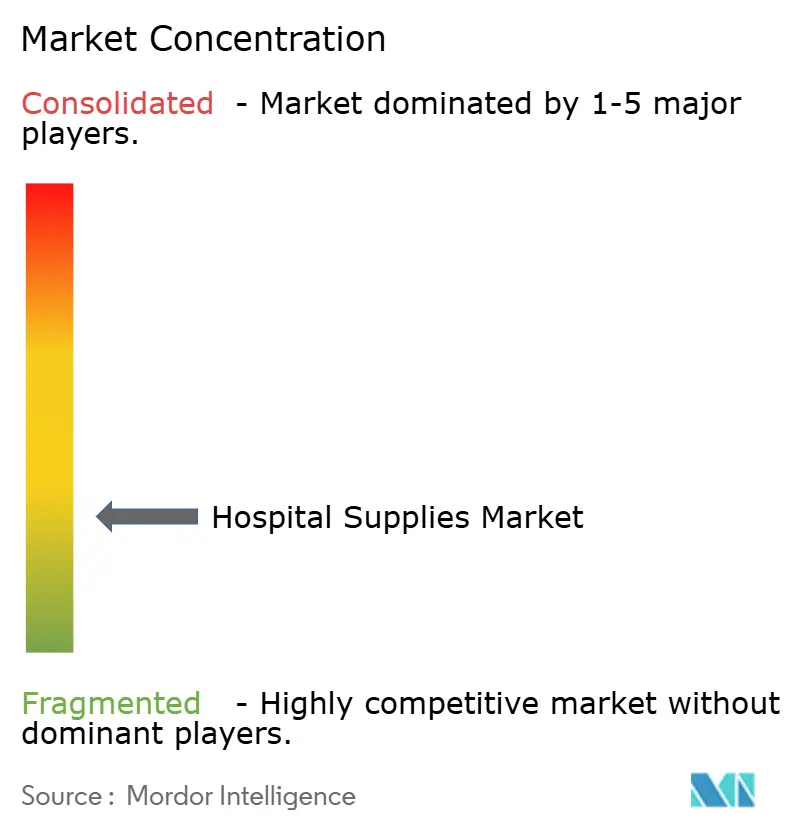
| Market Concentration | Low |
Major Players *Disclaimer: Major Players sorted in no particular order Image © Mordor Intelligence. Reuse requires attribution under CC BY 4.0. | |
Hospital Supplies Market Analysis by Mordor Intelligence
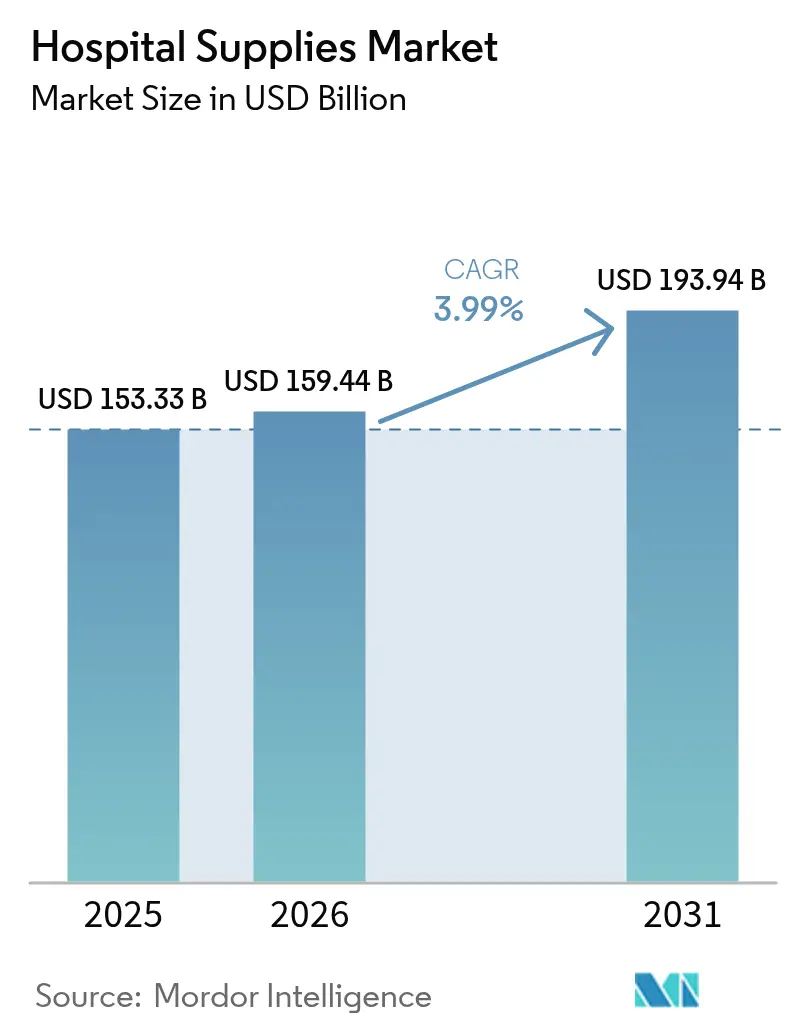
The Hospital Supplies Market size is expected to grow from USD 153.33 billion in 2025 to USD 159.44 billion in 2026 and is forecast to reach USD 193.94 billion by 2031 at 3.99% CAGR over 2026-2031.
This trajectory is supported by infection-control investments, technology-enabled inventory systems, and accelerating demand from developing regions. Disposable products, sterile processing equipment, and digital supply-chain solutions remain central to procurement decisions, while sustainability mandates are beginning to influence product selection. Asia-Pacific’s rapid infrastructure build-out, coupled with post-pandemic surgery backlogs in developed nations, is reshaping global competitive dynamics. Suppliers that combine physical goods with analytics-driven efficiency tools are capturing share as hospitals seek to align clinical performance, cost control, and regulatory compliance within tighter budget cycles.
Key Report Takeaways
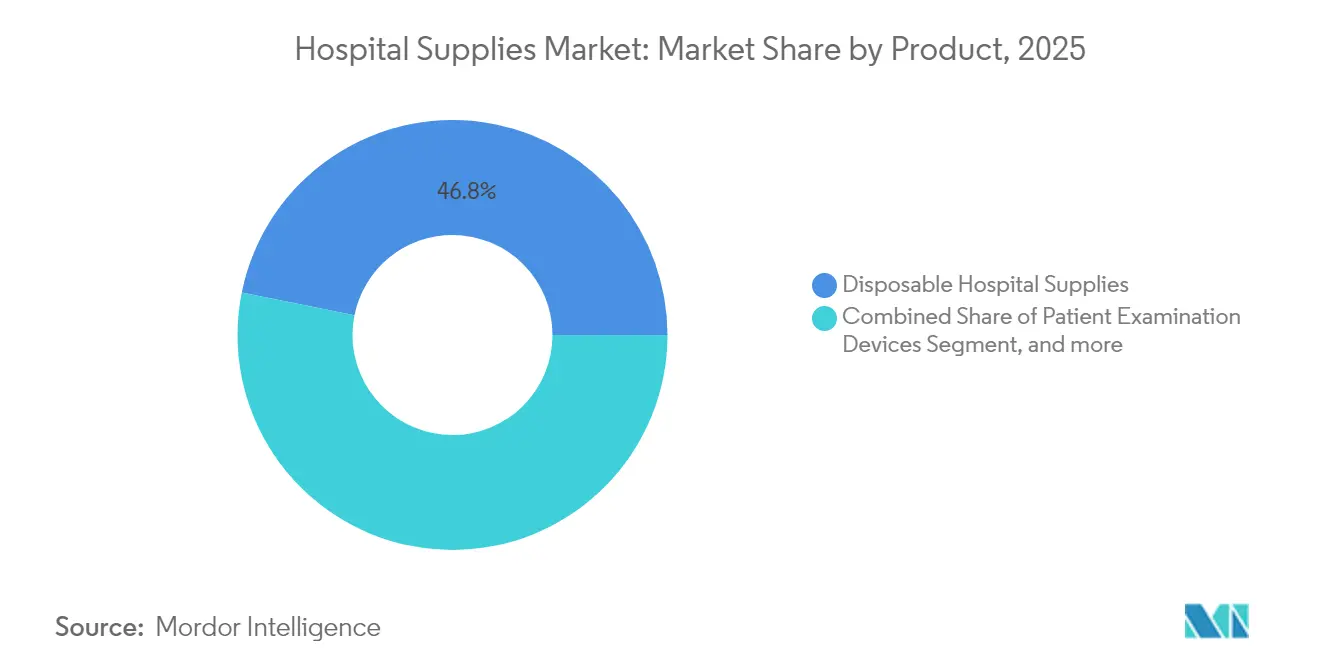
- By product category, disposable hospital supplies led with 46.83% hospital supplies market share in 2025; sterilization and disinfectant equipment is projected to advance at a 10.42% CAGR through 2031.
- By end-user, hospitals accounted for 67.88% of the hospital supplies market size in 2025, while ambulatory surgical centers are forecast to grow at 6.45% CAGR between 2026-2031.
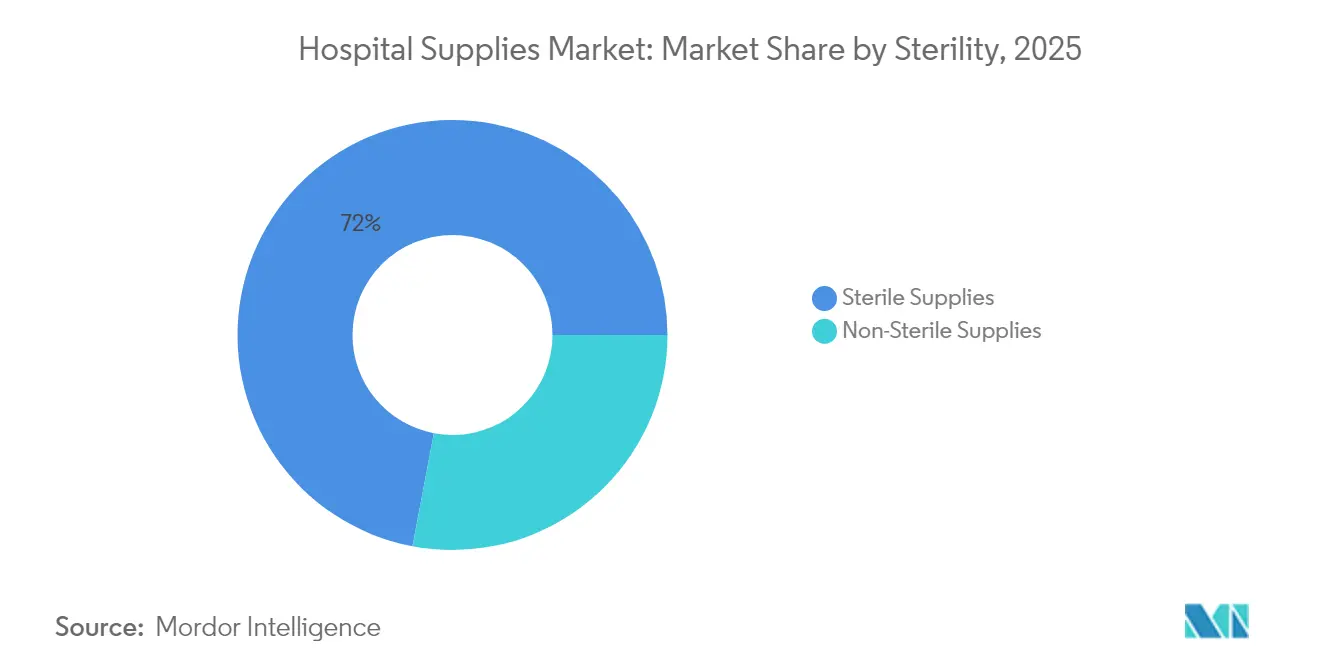
- By sterility, sterile supplies commanded 72.02% share of the hospital supplies market size in 2025 and are expanding at a 6.19% CAGR through 2031.
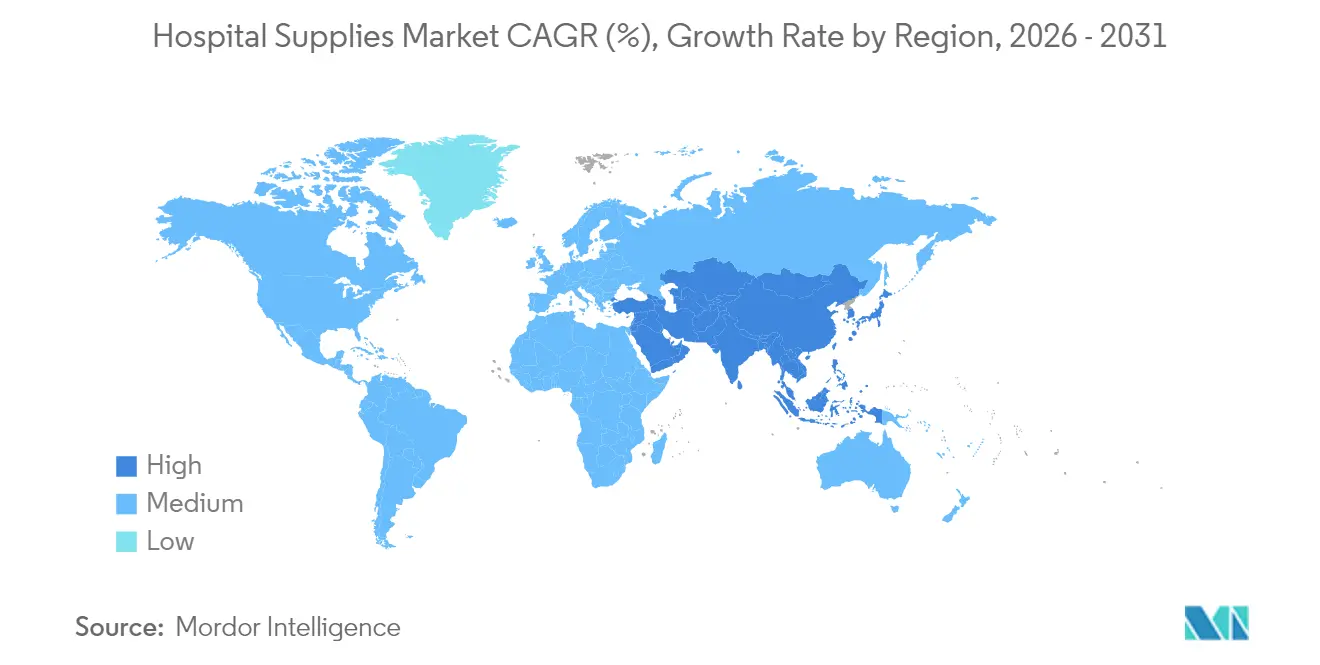
- By geography, North America retained 33.92% share in 2025; Asia-Pacific is the fastest-growing region at an 8.18% CAGR to 2031.
Note: Market size and forecast figures in this report are generated using Mordor Intelligence’s proprietary estimation framework, updated with the latest available data and insights as of 2026.
Market Trends and Insights
Drivers Impact Analysis of Hospital Supplies Market*
| Driver | (~) % Impact on CAGR Forecast | Geographic Relevance | Impact Timeline |
|---|---|---|---|
| Increasing incidences of communicable and chronic diseases | +1.2% | Global – higher impact in Asia-Pacific | Medium term (2-4 years) |
| Growing public awareness about hospital-acquired infections | +0.8% | North America, Europe | Medium term (2-4 years) |
| High demand for hospital supplies in developing countries | +1.5% | Asia-Pacific, Middle East & Africa | Long term (≥ 4 years) |
| Hospital-acquired infection penalties catalyzing investment in sterilization equipment | +0.9% | North America, Europe | Short term (≤ 2 years) |
| Surge in surgical volume post-pandemic in developed countries | +0.6% | North America, Europe | Short term (≤ 2 years) |
| Government initiatives and healthcare spending | +0.5% | North America, Europe | Long term (≥ 4 years) |
| Source: Mordor Intelligence | |||
Increasing Incidences of Communicable and Chronic Diseases
Rising diabetes, cardiovascular, and respiratory case loads are forcing hospitals to re-think inventory plans to assure continuous availability of wound-care dressings, monitoring kits, and ventilation circuits. Diabetes alone affects 537 million adults and is projected to reach 783 million by 2045, pushing up specialized dressing use by 30% since 2024.[1] Health systems now pair electronic health-record data with predictive stocking algorithms, enabling tighter alignment between anticipated caseloads and replenishment cycles. This patient-centric approach is steering capital allocations toward versatile sterile supplies, driving the hospital supplies market forward in both mature and emerging economies.
Growing Public Awareness about Hospital-Acquired Infections
Consumers increasingly select facilities based on perceived infection-control performance. Each HAI adds USD 28,400–33,800 in treatment costs, prompting administrators to adopt antimicrobial materials for high-touch surfaces and to publicize compliance metrics. The Centers for Disease Control and Prevention notes that 1 in 31 hospitalized patients contracts an HAI on any given day, spurring hospital supplies market investment into single-use drapes, barrier gowns, and self-disinfecting device casings.[2] Suppliers offering verifiable sterility assurance and product traceability gain a competitive advantage.
High Demand for Hospital Supplies in Developing Countries
Asia-Pacific’s expanding middle class is accelerating healthcare construction and driving bulk purchases of beds, surgical packs, and diagnostic disposables. Innovative financing programs such as the International Finance Corporation’s USD 300 million Africa Medical Equipment Facility allow small providers to bypass legacy constraints and adopt modern inventory platforms from day one. Manufacturers that localize production and embed RFID-ready labels are well positioned as regional governments push for resilient supply chains and clinical self-sufficiency.
Hospital-Acquired Infection Penalties Catalyzing Investment in Sterilization Equipment
The Hospital-Acquired Condition Reduction Program cut Medicare payments by up to 1% for the lowest-performing quartile of U.S. hospitals. By 2025, 98.1% of penalized facilities improved scores, triggering a 35% rise in capital outlays for low-temperature sterilizers and track-and-trace autoclaves.[3] Administrators increasingly deploy automated re-processing lines that capture cycle parameters and push data back into quality dashboards, aligning regulatory reporting with lean workflow principles.
Restraints Impact Analysis of Hospital Supplies Market*
| Restraint | (~) % Impact on CAGR Forecast | Geographic Relevance | Impact Timeline |
|---|---|---|---|
| Stringent regulatory framework | −0.7% | Global – higher impact in North America & Europe | Medium term (2-4 years) |
| Emergence of home care services | −0.5% | North America, Europe, developed Asia-Pacific | Long term (≥ 4 years) |
| High costs of advanced equipment | −0.4% | Europe, developed Asia-Pacific | Long term (≥ 4 years) |
| Supply chain disruptions | −0.2% | North America, Europe | Short term (≤ 2 years) |
| Source: Mordor Intelligence | |||
Stringent Regulatory Framework
Efforts to curb ethylene-oxide emissions threaten the sterility pathways for roughly 20 billion medical devices annually. The FDA warned that abrupt closures of sterilization plants could disrupt care continuity, illustrating how environmental policy can ripple through hospital supplies market logistics. Firms now investigate alternative sterilants and invest in redundant capacity, adding cost and complexity to already tight production schedules.
Emergence of Home Care Services
Shifting chronic-care delivery into the home reduces inpatient bed-days and alters purchasing channels. Medicare reimburses approved home-hospital models, prompting manufacturers like 3M Healthcare, Medtronic, and Medline to develop compact infusion pumps, sensor patches, and mail-ready packaging. The distributed nature of home care raises last-mile fulfillment costs and requires consumer-grade user interfaces, tempering traditional volume growth within centralized hospital accounts while opening new but fragmented revenue streams across the wider hospital supplies industry.
*Our forecasts treat driver/restraint impacts as directional, not additive. The impact forecasts reflect baseline growth, mix effects, and variable interactions.
Hospital Supplies Market Segment Analysis
By Product:
Infection Control Technologies Accelerate Upgrade CyclesDisposable supplies retained a 46.83% hospital supplies market share in 2025, underscoring their role in combating cross-contamination. Bundled procedure packs and single-use gowns streamline operating-room turnover and reduce labor spent on laundering. However, sustainability policies have sparked pilot projects in selective re-processing and recyclable polymers, pressuring vendors to declare lifecycle emissions. Sterilization and disinfectant equipment, while only a mid-sized segment, is growing fastest at a 10.42% CAGR to 2031. The hospital supplies market size for sterilization equipment is forecast to climb in tandem with digital record-keeping mandates that tie device release to documented microbial kill parameters. Suppliers that bundle cloud-based validation software with low-temperature sterilizers see traction in tier-1 hospital systems.
Patient examination devices and operating-room equipment are integrating sensor arrays and IoT gateways. Smart stethoscopes, computer-assisted navigation, and AI-driven intraoperative imaging drive premium pricing tiers, with procurement decisions increasingly influenced by interoperability scores. Mobility aids and transportation equipment ride demographic trends as aging populations demand pressure-reducing mattresses, electric hoists, and bariatric wheelchairs. Sustainability credentials, spare-parts availability, and cloud-ready diagnostics are now weighted alongside upfront price when frameworks evaluate bids.

By End User:
Ambulatory Centers Challenge Hospital DominanceHospitals still represent 67.88% of 2025 demand and wield scale economies that translate into bulk-purchase rebates and customized consignment stocks. Their steady case mix supports multi-year sourcing contracts covering gowns, drapes, suction canisters, and composite furniture. However, ASCs are on track to register a 6.45% CAGR through 2031, absorbing an expanding share of elective orthopedics, ophthalmology, and cardiology cases. The hospital supplies market size for ASC-specific product kits is forecast to widen as procedure migration continues. Manufacturers now offer compact autoclaves, low-profile instrument tables, and pre-configured mayo stands optimized for rapid room turnover in small-footprint facilities.
Trauma centers and specialty clinics create niche demand for advanced airway management consumables and tissue adhesives. Private chains deploy enterprise-wide RFID cabinets that feed real-time depletion alerts into central dashboards. Such analytics enhance compliance with FIFO rotation policies and reduce expiration-driven write-offs, translating into lower total-supply costs even when unit prices are higher. Vendors supplement physical goods with data subscriptions, driving sticky, recurring revenue beyond the one-time sale.
By Sterility:
Premium on Assured CleanlinessSterile supplies captured 72.02% of 2025 revenue. This dominance is tied to infection-penalty programs that penalize facilities with preventable contamination incidents. The hospital supplies market size advantage for sterile products is amplified by 6.19% CAGR growth to 2031. Mobile sterile processing units allow hospitals to refurbish central re-processing departments without interrupting surgical schedules, expanding demand for rental solutions and single-use container systems. Innovations range from vaporized-hydrogen-peroxide cabinets to plasma-based sterilizers, each accompanied by traceability software.
Non-sterile supplies retain essential roles in low-risk procedures and primary care. A 2024 MDPI study found comparable infection outcomes for certain minor dermatological interventions conducted with non-sterile gloves, encouraging formulary committees to re-assess over-specification that may inflate costs. Yet, even in these categories, antimicrobial surface treatments and sustainable packaging improvements differentiate offerings and maintain relevance within broader hospital supplies market purchasing frameworks.
Geography Analysis
North America Hospital Supplies Market
North America’s advanced infrastructure and strict infection-control mandates secured 33.92% share of global revenue in 2025. Large-scale adoption of RFID-enabled smart cabinets and AI-assisted demand-planning systems underpins supplier opportunities for analytics-rich value propositions. Tariff uncertainties threatened price stability, prompting distributors like Cardinal Health to consider pass-through mechanisms that could influence hospital supplies market elasticity in 2026.
APAC Hospital Supplies Market
Asia-Pacific delivers the strongest growth at an 8.18% CAGR, driven by healthcare capacity expansion in China, India, and Southeast Asia. Rapid investment in tertiary hospitals, coupled with government incentives for local manufacturing, shifts component sourcing closer to end-markets. The hospital supplies market size for sterilization consumables is rising briskly as accreditation bodies adopt Western infection-control benchmarks. Medical tourism growth in Thailand and Malaysia further widens procurement pipelines for high-quality but cost-competitive disposables.
Europe Hospital Supplies Market
Europe maintains a technology-oriented stance, with sustainability mandates encouraging suppliers to validate carbon footprints and integrate recycled polymers. Germany leads by volume, while Switzerland’s high-tech niche manufactures propel segment innovation. Regulatory clarity around the Medical Device Regulation (MDR) encourages early-adopter hospitals to pilot smart labeling and tamper-evident packaging, sustaining premium price points in a mature hospital supplies market.
MEA Hospital Supplies Market
The Middle East and Africa witness marked divergence. Gulf Cooperation Council nations invest in flagship hospitals that demand state-of-the-art sterilization suites and automated inventory systems. Meanwhile, the International Finance Corporation’s Africa Medical Equipment Facility funds small providers, creating distributed demand for essential devices across East and West Africa. Suppliers that bundle training, maintenance, and micro-leasing schemes gain traction in these price-sensitive yet volume-rich niches.
Regulatory Landscape
Hospital supplies that meet the definition of medical devices are subject to increasingly harmonized quality and traceability expectations across major regions. In the United States, the US FDA moved the sector onto the Quality Management System Regulation (QMSR) framework effective February 2026, aligning device quality-system requirements more directly with ISO 13485 and increasing scrutiny of supplier controls and outsourced processes. For manufacturers of sterile supplies, procedure kits, and monitoring accessories used in hospital settings, this represents a tightening in how quality responsibilities are managed.
In Europe, EU MDR digital compliance obligations continued to harden through 2026 as EUDAMED timelines reached operational milestones, pushing manufacturers and distributors to integrate UDI and device-registration data into commercial workflows. The European Commission also advanced the harmonized-standards framework, including an Implementing Decision in June 2026, reinforcing conformity expectations for products entering hospital procurement channels. Separately, trade-policy actions, including US Section 301 tariff discussions highlighted by MedTech Europe in July 2026, add another layer of landed-cost and sourcing compliance complexity for globally distributed hospital supplies.
Value Chain Analysis
The hospital supplies value chain starts with upstream raw materials and components, including oil-derived plastics for disposables, metals such as aluminum for equipment housings, semiconductors for connected devices, and specialty gases such as helium. It then runs through device and consumable manufacturing, sterilization and packaging, and into distribution via broadline and specialty channels. Downstream, group purchasing organizations (GPOs) and integrated delivery networks shape demand through formularies, multi-year contracting, and compliance-driven standardization, while hospitals and ambulatory surgical centers increasingly require RFID-ready labeling and interoperability with inventory and EHR-linked analytics.
Logistics and compliance are decisive handoffs between value-chain nodes. The FDA QMSR effective February 2026 increases the burden of supplier qualification and documentation across outsourced processes, which cascades into contract manufacturing, sterilization service providers, and packaging partners. Tariff regimes and geopolitical chokepoints also amplify variability in landed cost and lead times, which supports dual sourcing, redundant capacity, and software-enabled visibility across shippers and carriers. This is especially relevant for high-velocity disposable supplies and sterile items, where stock-outs and recalls have outsized clinical and financial consequences.
Competitive Landscape
The hospital supplies market is fragmented, with leading players leveraging integration, innovation, and regional manufacturing to preserve margins amid pricing pressure. Johnson & Johnson and Medtronic expand digital ecosystems by embedding sensors in disposables and harvesting utilization data through cloud portals. Becton, Dickinson and Company’s 2025 decision to spin off its Biosciences and Diagnostic Solutions unit illustrates a sharpened focus on core medical-surgical lines that align tightly with infection-prevention spending priorities.
Sumitomo Corporation deepened its presence in the U.S. home-care channel by acquiring ActivStyle and raising its stake in Vast Medical Holdings, demonstrating how conglomerates deploy diversified capital to capture chronic-disease therapy spend. Henry Schein’s late-2024 acquisition of Acentus underscores the strategic logic of integrating direct-to-patient logistics with sensor-enabled glucose monitoring portfolios. Smaller firms carve out defensible positions in antimicrobial coatings, low-temperature plasma sterilizers, and AI-assisted asset-tracking, frequently partnering with large distributors to extend global reach.
Strategic alliances between device manufacturers and software vendors generate bundled value propositions that streamline clinician workflows. For example, RFID cabinet deployments often come packaged with predictive analytics dashboards co-developed by start-ups specializing in supply-chain AI. The resulting data feeds enable just-in-time restocking, slashing stock-outs and expiration losses. Meanwhile, private-label opportunities proliferate as health systems seek to reduce brand premiums while maintaining stringent quality benchmarks. Suppliers mindful of regulatory shifts, raw-material cost inflation, and sustainability metrics will continue to out-perform within the evolving hospital supplies market.
Hospital Supplies Industry Leaders
-
Boston Scientific Corporation
-
Cardinal Health Inc.
-
B Braun Melsugen AG
-
3M
-
Medtronic
- *Disclaimer: Major Players sorted in no particular order
Hospital Supplies Market Companies Covered in this Report
- 3M
- B. Braun
- Baxter
- Beckton Dickinson
- Boston Scientific
- Cardinal Health
- Medtronic
- GE HealthCare Technologies Inc.
- Johnson & Johnson
- Thermo Fisher Scientific
- Danaher
- Eurofins
- STERIS
- Getinge
- Smith+Nephew Plc
- Stryker
- Terumo
- Ecolab
- HARTMANN Group
- Nipro
Market Opportunities and Future Outlook
Digitally enabled compliance and traceability create near-term opportunity for suppliers that can connect physical products with data workflows. The EU shift toward mandatory EUDAMED participation, including core module usage for UDI and device registration, raises the value of UDI-clean labeling, master data governance, and packaging formats that support hospital scan-to-chart and scan-to-bill processes, particularly for sterile supplies that represented 72.02% of 2025 revenue. At the same time, FDA activity around distributed manufacturing registration and listing concepts points to a pathway for localized or point-of-care production models, which aligns with hospital priorities for resilience in high-turn consumables and essential accessories.
Supply-chain infrastructure expansion is another concrete lever for availability and service-level differentiation. NHS Supply Chain opened the 400,000-square-foot Gorsey Point distribution center in Widnes in July 2024 to serve 115 NHS Trusts with 60,000 pallet spaces, illustrating how modern distribution nodes can standardize product availability and reduce variability across large health systems. More recently, Medline’s July 2026 leasing of a 925,000-square-foot Northern California warehouse to restore distribution capacity after a fire highlights continued investment in redundancy and throughput by distributors and manufacturers. This supports demand for vendor-managed inventory, RFID cabinet integration, and consolidated replenishment programs that help reduce expirations and stock-outs across hospitals and ambulatory surgical centers.
Recent Industry Developments in Hospital Supplies Market
- June 2026: Medtronic completed its acquisition of Scientia Vascular for USD 550 million, adding neurovascular access technologies to complement its therapeutic portfolios. The combination supports bundled procedural offerings across catheter-based care pathways and strengthens Medtronic’s position with hospitals seeking fewer suppliers and more integrated product sets.
- May 2026: Boston Scientific announced a USD 1.5 billion investment in MiRus LLC for an approximately 34% equity stake and an exclusive option to acquire MiRus’s transcatheter aortic valve replacement business. The deal expands Boston Scientific’s exposure to structural heart procedure platforms that drive demand for hospital-based disposables and supporting procedural supplies.
- November 2024: Henry Schein agreed to acquire Acentus, a provider of glucose sensors and other medical supplies delivered directly to patients’ homes. The agreement deepens direct-to-patient fulfillment capabilities and reflects how chronic-disease supply models are reshaping demand patterns beyond traditional hospital purchasing channels.
Hospital Supplies Market Report Scope and Research Methodology
Market Definition and Coverage
For this study, the hospital supplies market covers the products and consumables that hospitals routinely use to examine patients, support procedures, move patients safely, and maintain hygiene and sterility inside clinical areas.
Scope exclusions: We exclude capital-heavy hospital systems and services that are not purchased as physical supplies (for example, hospital IT software, staffing, and facility management services).
Segments Covered in This Report
- By Product
- Patient Examination Devices
- Operating Room Equipment
- Mobility Aids & Transportation Equipment
- Sterilization & Disinfectant Equipment
- Disposable Hospital Supplies
- Syringes & Needles
- Smart RFID-Enabled Consumables
- Other Products
- By End User
- Public Hospitals
- Private & Chain Hospitals
- Ambulatory Surgical Centers
- Specialty Clinics & Trauma Centers
- By Sterility
- Sterile Supplies
- Non-Sterile Supplies
- By Geography
- North America
- United States
- Canada
- Mexico
- Europe
- Germany
- United Kingdom
- France
- Italy
- Spain
- Rest of Europe
- Asia-Pacific
- China
- Japan
- India
- Australia
- South Korea
- Rest of Asia-Pacific
- Middle East & Africa
- GCC
- South Africa
- Rest of Middle East & Africa
- South America
- Brazil
- Argentina
- Rest of South America
- North America
Data Sources, Market Sizing, and Validation
Desk Research
Desk research was used to set the market boundaries and build the first layer of demand and pricing context before moving into interviews. We relied on public and official sources such as World Health Organization health statistics, World Bank indicators, OECD health data, US CDC healthcare utilization releases, and UN Comtrade trade flows for relevant supply categories, followed by peer reviewed journals that discuss procedure volumes and infection control practices.
To keep the regional model realistic, we also reviewed annual reports and investor presentations, regulatory and procurement notices published by public health systems, and publications from hospital and medical device associations. In a few cases, paid database subscriptions were used only for structured company financials, patent activity screening, and shipment-level import and export checks where public data was too aggregated. These desk sources are illustrative and not exhaustive, since many additional references were used for data collection, validation, and research clarification.
Primary Interviews and Surveys
Primary work was used to confirm what hospitals actually buy, how often replenishment happens, and how pricing moves across tenders, distributors, and direct contracts. We spoke with manufacturers, distributors, group purchasing stakeholders, hospital procurement and materials management teams, and clinical users, covering the Americas, EMEA, and APAC so the assumptions were not overly shaped by a single system type. Inputs from these conversations were then used to fine-tune penetration, replacement cycles, and realistic price bands for the final model.
Distribution of primary research fieldwork respondents
| Company type | Respondent position | Region |
|---|---|---|
| Top tier: 37% | CXOs: 12% | APAC: 45% |
| Mid tier: 46% | Functional/Unit leaders: 36% | EMEA: 34% |
| Smaller Players: 17% | Managers: 52% | Americas: 21% |
Market-Sizing & Forecasting
Market sizing starts with a top-down build that reconstructs the addressable demand pool using healthcare activity signals and supply intensity, then maps it to the supply categories counted in scope. In practice, procedure volumes, inpatient and outpatient visits, hospital bed stock and occupancy patterns, and infection prevention protocols were used as anchors, and then translated into expected consumption for key supply groups (with adjustments for region-level purchasing practices).
Once the top layer was in place, selective bottom-up checks were run to keep the totals realistic, such as supplier revenue sampling, channel discussions on mix, and a volume times average selling price approach for a few high-usage categories where replenishment is frequent. When country-level gaps appeared, they were handled using proxy indicators like public spend trends, hospital infrastructure growth, and trade-based availability signals, and then normalized through interview feedback. For forecasting, scenario analysis was used around utilization and price assumptions, supported by expert expectations on elective procedure normalization, tender-driven pricing pressure, and adoption of higher-spec infection control consumables, and the output was made consistent with the overall 2026 to 2031 trajectory.
Data Validation & Update Cycle
Validation is done in layers so the market totals do not depend on a single data stream. Model outputs are compared against independent signals like hospital activity trends, trade movements for relevant supply groups, and publicly visible procurement patterns, and then the largest variances are reviewed and corrected before sign-off.
A second analyst review is performed to check formulas, unit consistency, currency timing, and any outlier growth rates by region and category. If a key assumption shifts, such as a material change in procedure volumes or a pricing shock for high-usage disposables, we re-contact sources to confirm the direction and practical magnitude. Reports are refreshed annually, with interim updates when material events occur, and a final pre-delivery pass is completed so clients receive the most current view.
Mordor Intelligence's Global Hospital Supplies Market Sizing Compared With Other Published Estimates
Published market sizes for hospital supplies can look far apart because each publisher draws the line differently on what counts as a supply, and because inputs such as utilization, pricing, and currency timing are not treated the same way. Differences also show up when one estimate leans more heavily on broad healthcare spending, and another leans more on hospital activity and replenishment behavior.
Some external estimates fold hospital equipment into the same bucket or use a narrower definition that mostly tracks a subset of consumables. In Mordor Intelligence, the total is tied to hospital-driven consumption across the included supply categories, and it is kept separate from broader equipment-heavy groupings so the demand pool stays linked to routine procurement and usage signals.
Benchmark comparison
| Source | Market Size | Gaps in Research Methodology |
|---|---|---|
| Mordor Intelligence | USD 153.33 B (2025) | |
| Global Publisher A | USD 189.42 B (2025) | This figure is presented for a combined hospital equipment and supplies scope, which can pull in higher-value equipment categories and lift the total beyond routine supplies tied to replenishment cycles. |
| Industry Publisher B | USD 31.90 B (2025) | This estimate appears to use a tighter product basket that emphasizes selected consumables, so large parts of the broader hospital supplies mix are not fully captured in the stated total. |
Taken together, the spread mainly comes from what is included and how demand is reconstructed, not from math errors. By keeping the scope aligned to hospital procurement behavior, checking volumes and price bands with interviews, and then stress-testing the totals with independent signals, the resulting market size stays transparent and repeatable for planning.
Key Questions Answered in the Report
What is the current size of the hospital supplies market?
The hospital supplies market size is USD 159.44 billion in 2026 and is projected to reach USD 193.94 billion by 2031.
Which product segment is growing fastest?
Sterilization and disinfectant equipment is expanding at a 10.42% CAGR due to intensified infection-control investments.
Why are ambulatory surgical centers important for suppliers?
ASCs are forecast to grow at 6.45% CAGR, creating demand for compact, high-throughput kits that differ from traditional hospital preferences.
How are sustainability concerns influencing procurement?
Hospitals increasingly evaluate disposables based on recyclability and carbon footprint, opening opportunities for eco-designed products with validated lifecycle metrics.
What role does technology play in modern hospital supplies?
RFID-enabled cabinets and AI-powered analytics integrate with electronic health records to optimize stock levels, reduce waste, and strengthen compliance reporting, giving tech-savvy suppliers a competitive edge.