
Fresh Pumpkin Market Size and Share
Fresh Pumpkin Market Analysis by Mordor Intelligence
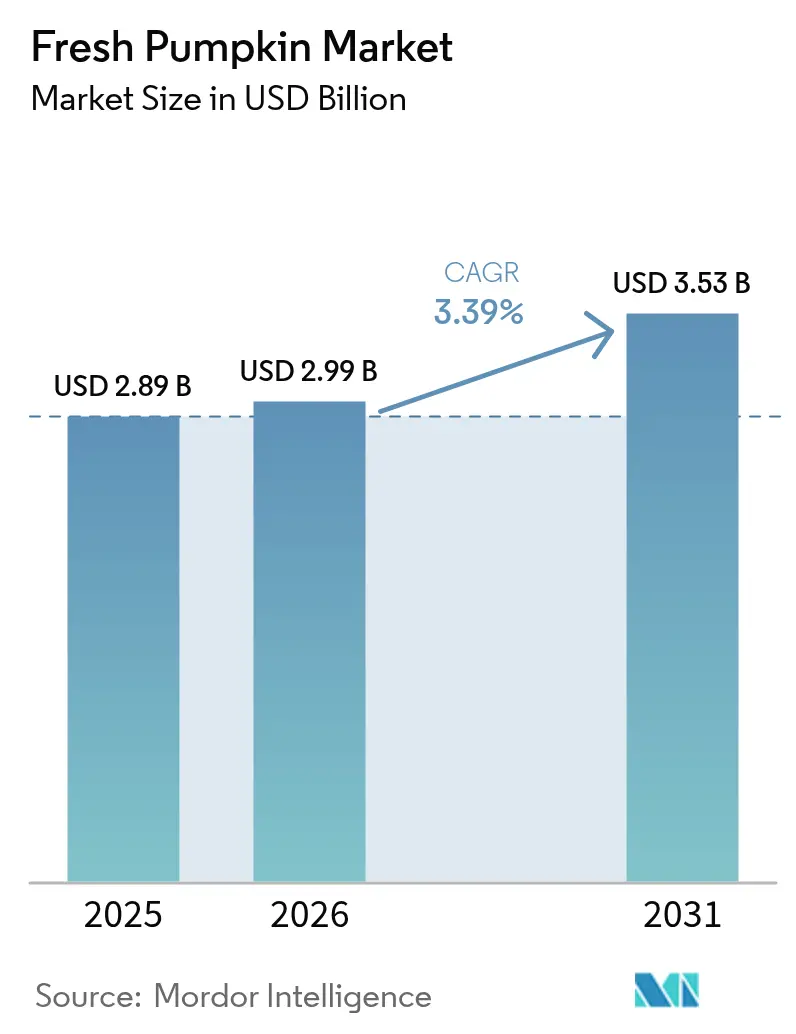
The fresh pumpkin market size is expected to grow from USD 2.89 billion in 2025 to USD 2.99 billion in 2026 and is forecast to reach USD 3.53 billion by 2031 at 3.39% CAGR over 2026-2031. This growth is driven by a shift in demand from whole-fruit sales to processed formats, functional ingredients, and industrial feedstocks. The Asia-Pacific region, led by China's significant production, accounts for half of the current consumption. Africa is experiencing the highest regional growth, supported by increased smallholder production, the establishment of new cold-chain facilities in Egypt and South Africa, and the scaling of seed exports from Malawi. Innovations in processing, such as seed-protein isolation and stand-up-pouch puree, are reducing reliance on autumn seasonality and enabling year-round production. Competitive dynamics remain uneven, with Libby’s single hub in Morton, Illinois, dominating canned pumpkin supply, while numerous fresh fruit and seed growers operate in fragmented spot markets.
Key Report Takeaways
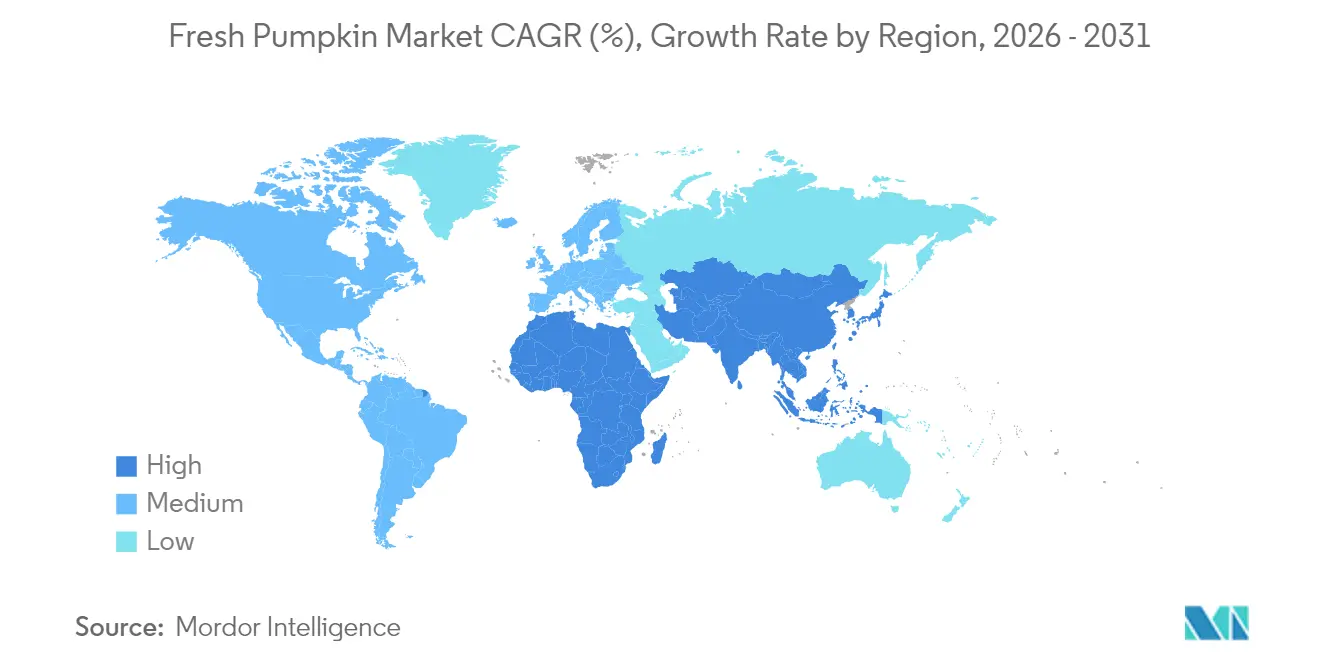
- By geography, the Asia-Pacific captured 50.20% of the fresh pumpkin market share in 2025, and Africa is projected to expand at a 3.88% CAGR through 2031, the fastest among all regions.
Note: Market size and forecast figures in this report are generated using Mordor Intelligence’s proprietary estimation framework, updated with the latest available data and insights as of 2026.
Market Trends and Insights
Drivers Impact Analysis of Fresh Pumpkin Market*
| Driver | (~) % Impact on CAGR Forecast | Geographic Relevance | Impact Timeline |
|---|---|---|---|
| Surging Demand from Health-Conscious Consumers | +0.80% | North America and Europe, spillover in Asia | Medium term (2-4 years) |
| Popularity of Cultural and Seasonal Events | +0.60% | North America dominant, rising in Europe and urban Asia | Short term (≤ 2 years) |
| Growth in Processed Pumpkin Demand | +0.70% | North America processing hubs, Asia-Pacific consumption | Medium term (2-4 years) |
| Rising Pet-Food Formulations Using Pumpkin Fiber | +0.40% | North America and Europe | Medium term (2-4 years) |
| Government Support for Nutrient-Dense Crops | +0.30% | Asia-Pacific and Africa | Long term (≥ 4 years) |
| Use of Pumpkin Residue in Bio-Based Plastics | +0.20% | Europe and North America | Long term (≥ 4 years) |
| Source: Mordor Intelligence | |||
Surging Demand from Health-Conscious Consumers
Wellness positioning has transformed pumpkin into a year-round functional ingredient within the fresh pumpkin market. Seed-protein isolates achieve extraction yields of 25%–35%, while ultrasound combined with pH-shift treatments enhances solubility to 69.1%, comparable to that of soy protein [1]Source: Adebowale K., “Enhancing Techno-Functionality of Pumpkin Seed Protein,” sciencedirect.com. Pumpkin purée's low glycemic index enables bakers to reduce refined sugar without compromising texture, and its high carotenoid content supports front-of-pack vitamin A claims. In North America, retail buyers increasingly request detailed nutrient profiles during category reviews, driving the adoption of pumpkin seed protein in plant-based meat and dairy products.
Popularity of Cultural and Seasonal Events
Halloween and Thanksgiving continue to sustain the visibility of the fresh pumpkin market, though the seasonal demand period is expanding. In the United States, pumpkin-flavored product launches now commence as early as late August, with restaurants incorporating pumpkin spice into cocktails, pasta dishes, and breakfast menus. Illinois remains the leader in pumpkin processing. In Europe, urban centers are experiencing double-digit growth in the adoption of carved-pumpkin traditions, while social media drives increased experimentation with pumpkin-based recipes. To capitalize on this visibility, suppliers are emphasizing premium, organic, and heirloom varieties and leveraging direct-to-consumer shipping models to minimize their reliance on commodity pricing.
Growth in Processed Pumpkin Demand
Processed formats are contributing to an increasing farm-gate value within the fresh pumpkin market. Pumpkin seed oil is valued in both cosmetic and culinary applications due to its high content of linoleic acid and tocopherols. The use of combined enzymatic and ultrasound extraction methods enhances yields to over 40% while maintaining flavor integrity[2]Vinay Kumar Pandey and coauthors, “Current Strategies to Modify Functional Properties of Pumpkin Seed Protein,” horticulturae.org. For pumpkin purée, autoclave sterilization at 121°C for 10 to 30 minutes effectively eliminates microbial load but impacts volatile compounds, requiring careful adjustment of dwell time to achieve optimal sensory quality. Ambient-stable stand-up pouches reduce dependence on cold-chain logistics, making purée more accessible in emerging markets with limited refrigerated infrastructure. Additionally, by-product seed cake is being repurposed into protein concentrates and biodegradable films, supporting circular economy initiatives.
Rising Pet-Food Formulations Using Pumpkin Fiber
Digestive health claims are a key driver in pet nutrition, with pumpkin fiber's combination of soluble and insoluble properties providing motility support without the need for additives. Premium pet food brands in North America and Europe are enhancing their formulations by incorporating pumpkin, sustaining ingredient demand even during periods of reduced human consumption. Brand owners prioritize suppliers that offer complete farm-to-bag traceability and ensure the absence of heavy metals, following recalls involving other plant fibers. Additionally, cross-channel exposure supports human snacking brands like SuperSeedz, which have expanded through national natural-food distributors.
Restraints Impact Analysis of Fresh Pumpkin Market*
| Restraint | (~) % Impact on CAGR Forecast | Geographic Relevance | Impact Timeline |
|---|---|---|---|
| High Post-Harvest Losses in Developing Regions | -0.50% | Africa, South Asia, rural South America | Short term (≤ 2 years) |
| Seasonality Constraining Year-Round Supply | -0.40% | Temperate zones worldwide | Medium term (2-4 years) |
| Price Pressure from Substitute Squash Varieties | -0.30% | Processed-purée and fresh-retail segments | Medium term (2-4 years) |
| Fragmented Grower Base Limiting Scale | -0.30% | Africa and South Asia, smallholder Europe segments | Long term (≥ 4 years) |
| Source: Mordor Intelligence | |||
High Post-Harvest Losses in Developing Regions
Up to 30% of harvested pumpkins in Africa and South Asia spoil before reaching markets due to inadequate rural roads, limited access to cold storage facilities, and insufficient availability of fungicides. According to the FAO, reducing such waste by half could lower agricultural greenhouse gas emissions by 4% and decrease food prices by up to 10% in low-income countries[3]Food and Agriculture Organization of the United Nations, “FAOSTAT Commodity Data,” fao.org. Pilot initiatives, such as solar-powered cold rooms and ventilated crates, have reduced losses to single-digit percentages. Additionally, fragmented extension services hinder training on techniques such as rapid drying and mildew prevention. Reducing post-harvest losses is therefore a critical cost-saving measure, but it requires the development of integrated infrastructure and agronomic support.
Seasonality Constraining Year-Round Supply
Temperate growing cycles limit most pumpkin cultivation to late-summer planting and autumn harvesting, requiring processors to store purée and inventory for up to nine months. In the United States, 95% of processing pumpkins are sourced from central Illinois, a 45-mile region susceptible to rainfall fluctuations that can delay planting. Counter-seasonal production in countries like Brazil and South Africa helps address supply gaps. Trials in controlled-environment agriculture show potential but are constrained by significant energy costs. Companies adopting latitude diversification strategies or transitioning to shelf-stable packaging can reduce the capital tied up in storage.
*Our forecasts treat driver/restraint impacts as directional, not additive. The impact forecasts reflect baseline growth, mix effects, and variable interactions.
Geography Analysis
APAC Fresh Pumpkin Market
By geography, the Asia-Pacific captured 50.20% of the fresh pumpkin market share in 2025. The Asia-Pacific region dominates the fresh pumpkin market, with China accounting for a significant share of global production and consuming most of its harvest in fresh and dried forms. India and Indonesia have expanded cultivation areas through nutrition-focused subsidy programs. Although inconsistent monsoons and limited irrigation constrain yield potential. In China, advancements in ultrasound protein extraction technology have enhanced localized value addition, reducing raw seed exports.
North America and Europe Fresh Pumpkin Market
North America ranks second in value, largely due to a cultural attachment to autumn rituals. Fields in Illinois, located within 45 miles of Morton, produce yields that are 5,000–25,000 pounds higher per acre than the national average, contributing to Libby’s cost advantage. Europe's market remains fragmented. Germany's Styria region holds a protected geographical indication (PGI) status for premium pumpkin seed oil. Additionally, pilot biorefineries in Germany and the Netherlands are converting processing residues into bio-composite films. The European Union's sustainability due diligence directive requires importers to document smallholder traceability, increasing compliance costs while benefiting certified exporters.
MEA and South America Fresh Pumpkin Market
Africa, growing at a 3.88% CAGR, is supported by the intensification of Egypt's Nile Delta and seed-export corridors from Malawi. In South Africa, commercial farms are adopting drip irrigation and solar-powered cold rooms to reduce spoilage and meet regional export demand. South America and the Middle East are niche yet strategically significant regions. In the Middle East, Turkey dominates production, catering to domestic culinary needs, while Saudi Arabia is experimenting with greenhouse pumpkin cultivation as part of its food security initiatives, despite water scarcity issues.


Regulatory Landscape
International trade in fresh pumpkin is primarily shaped by sanitary and phytosanitary (SPS) and marketing-standard compliance. In the United States, USDA APHIS administers import admissibility for fresh produce under 7 CFR 319.56-4, and commodities not already authorized require a pest risk analysis process that includes public comment and Federal Register rulemaking before market entry. APHIS also runs a commodity import approval workflow for requesting authorization for new plant commodity imports, so regulatory clarity can determine whether exporters can target US retail and foodservice channels.
In the European Union, fresh pumpkin marketed in the region must meet the General Marketing Standard under Commission Delegated Regulation (EU) 2023/2429 (supplementing Regulation (EU) No 1308/2013), with conformity checks required across marketing stages under Commission Implementing Regulation (EU) 2023/2430, which applies since 1 January 2025. Beyond these regional rules, exporters also work within global and regional quality and phytosanitary frameworks such as UNECE fresh fruit and vegetable standards and ASEAN Stan 27:2012 for pumpkin. IPPC standard-setting, via adopted and reviewed ISPMs (including ISPM 46 commodity guidance referenced in CPM session documentation published in January 2026), supports more harmonized approaches to pest-risk management across trading partners.
Value Chain Analysis
The fresh pumpkin value chain typically spans input suppliers (seed, fertilizers, irrigation, crop protection), growers (smallholders and commercial farms), aggregators and collectors, packers and processors (fresh-cut, puree and canned, seed oil, and ingredient processors), logistics providers, wholesalers and distributors, and retailers and foodservice. For processing-grade supply, concentrated hubs create scale advantages, exemplified by central Illinois in the United States, where proximity to Morton supports efficient procurement and processing economics for large canned and puree volumes. Standards and coordination bodies such as the International Fresh Produce Association (IFPA) provide guidance and connectivity across growers, shippers, and buyers.
Perishability and seasonality are persistent bottlenecks for fresh channels, which makes curing, grading, packaging, and cold-chain management central to shelf-life extension and supply stabilization. In developing regions, weak rural logistics and limited cold storage contribute to higher post-harvest losses, reinforcing the role of intermediaries and limiting farm-gate value capture. Value addition shifts margin upstream when pumpkins and by-products are converted into shelf-stable formats (puree in ambient-stable pouches, dehydrated powders, and seed-derived oils and proteins), while trade-flow management can route through established European distribution hubs such as the Netherlands for re-exports within the EU market.
Competitive Landscape
The fresh pumpkin remain fragmented. Libby’s, a brand owned by Nestlé, dominates the canned pumpkin market with a significant share. The company sources over 90% of its raw pumpkin within a 45-mile radius of Morton, Illinois. This vertically integrated model enhances logistical efficiency but increases vulnerability to localized climate risks. Seneca Foods operates a smaller cannery in Princeville, Illinois, primarily serving private-label contracts.
The fresh pumpkin supply chain in regions like Africa and South Asia is fragmented, involving numerous small-scale farmers who often lack access to cold storage and collective bargaining mechanisms. As a result, premium retailers in the United States and Europe depend on a limited number of certified growers to meet organic standards. This reliance creates supply bottlenecks and price volatility, particularly during holiday demand peaks.
Strategic opportunities lie in counter-seasonal sourcing from regions such as Brazil and South Africa, enzymatic seed-protein extraction, and licensing bio-plastic feedstock technologies. Chinese patent holders specializing in ultrasound extraction methods and European startups developing residue-to-film technologies are well-positioned to generate royalty income as sustainability regulations become stricter. Producers that integrate farming, processing, and branded sales are better equipped to manage commodity price fluctuations and capture higher margins across the value chain.
Market Opportunities and Future Outlook
A key whitespace is shifting more of the category from whole-fruit seasonality into year-round ingredients and by-product streams, using processing approaches that preserve bioactives and improve functional performance. Peer-reviewed work published in Food Chemistry (April 2026) highlights scalable routes to valorize Cucurbita by-products (seeds and peels) for food, nutraceutical, and cosmetic applications, including non-thermal technologies such as high-pressure processing (HPP) and pulsed electric fields (PEF). This aligns with observed demand pull for seed-protein isolates and fiber ingredients used in plant-based foods and pet nutrition, where buyers increasingly request traceability and consistent functional specifications.
Circular-economy utilization of processing residues is another opportunity area tied to waste-reduction and cost-to-serve improvements, especially in regions constrained by storage and cold-chain access. Research published in Biomass and Bioenergy (March 2026) documents advancements in converting pumpkin processing waste into energy carriers (including biomethane pathways) and improved biodiesel process performance, supporting integrated models where processors monetize peels, seeds, and seed cake rather than treating them as disposal costs. In parallel, compliance-driven trade requirements in the EU, including mandatory conformity checks under Implementing Regulation (EU) 2023/2430 (applicable since 1 January 2025), raise the commercial value of standardized grading, labeling, and documentation systems, creating room for exporters and packers that can deliver repeatable quality and auditable supply-chain data.
Recent Industry Developments in Fresh Pumpkin Market
- February 2026: Go Raw introduced a 22 oz Dry Roasted Pumpkin Seeds pack as an exclusive item at Sam's Club. The company expands branded, value-added seed demand through warehouse retail, supporting larger-volume offtake and more predictable pull for seed-focused supply chains.
- August 2025: The Laughing Cow launched a limited-edition Pumpkin Spice spreadable cheese wedge variety. Extending pumpkin flavor into dairy spreads widens seasonal usage occasions and reinforces the role of pumpkin ingredients as cross-category flavor and formulation inputs beyond fresh whole-fruit sales.
- November 2024: Green Giant Vegetables expanded 100% Pure Canned Pumpkin canning and distribution capacity through a contract with Seneca Foods Corporation. The rollout increases shelf-stable pumpkin puree availability across national retail channels and highlights established canning and logistics networks supporting autumn demand and year-round availability.


Fresh Pumpkin Market Report Scope and Research Methodology
Market Definition and Coverage
For this study, the market covers fresh pumpkins sold as whole produce through organized and unorganized channels, valued at the point of first sale in the supply chain. Our sizing focuses on edible fresh pumpkin consumption and trade flows, and it is expressed in USD.
Scope exclusions: Excludes processed pumpkin products such as canned, frozen, purees, and ingredients, and also excludes squash and gourds that may share similar customs headings.
Segments Covered in This Report
- By Geography
- North America
- United States
- Production Analysis (Volume)
- Consumption Analysis (Value and Volume)
- Import Analysis (Value and Volume)
- Export Analysis (Value and Volume)
- Price Trend Analysis
- Canada
- Production Analysis (Volume)
- Consumption Analysis (Value and Volume)
- Import Analysis (Value and Volume)
- Export Analysis (Value and Volume)
- Price Trend Analysis
- Mexico
- Production Analysis (Volume)
- Consumption Analysis (Value and Volume)
- Import Analysis (Value and Volume)
- Export Analysis (Value and Volume)
- Price Trend Analysis
- United States
- Europe
- Germany
- Production Analysis (Volume)
- Consumption Analysis (Value and Volume)
- Import Analysis (Value and Volume)
- Export Analysis (Value and Volume)
- Price Trend Analysis
- Spain
- Production Analysis (Volume)
- Consumption Analysis (Value and Volume)
- Import Analysis (Value and Volume)
- Export Analysis (Value and Volume)
- Price Trend Analysis
- Italy
- Production Analysis (Volume)
- Consumption Analysis (Value and Volume)
- Import Analysis (Value and Volume)
- Export Analysis (Value and Volume)
- Price Trend Analysis
- France
- Production Analysis (Volume)
- Consumption Analysis (Value and Volume)
- Import Analysis (Value and Volume)
- Export Analysis (Value and Volume)
- Price Trend Analysis
- Russia
- Production Analysis (Volume)
- Consumption Analysis (Value and Volume)
- Import Analysis (Value and Volume)
- Export Analysis (Value and Volume)
- Price Trend Analysis
- Germany
- Asia-Pacific
- China
- Production Analysis (Volume)
- Consumption Analysis (Value and Volume)
- Import Analysis (Value and Volume)
- Export Analysis (Value and Volume)
- Price Trend Analysis
- India
- Production Analysis (Volume)
- Consumption Analysis (Value and Volume)
- Import Analysis (Value and Volume)
- Export Analysis (Value and Volume)
- Price Trend Analysis
- Indonesia
- Production Analysis (Volume)
- Consumption Analysis (Value and Volume)
- Import Analysis (Value and Volume)
- Export Analysis (Value and Volume)
- Price Trend Analysis
- Philippines
- Production Analysis (Volume)
- Consumption Analysis (Value and Volume)
- Import Analysis (Value and Volume)
- Export Analysis (Value and Volume)
- Price Trend Analysis
- Australia
- Production Analysis (Volume)
- Consumption Analysis (Value and Volume)
- Import Analysis (Value and Volume)
- Export Analysis (Value and Volume)
- Price Trend Analysis
- China
- South America
- Brazil
- Production Analysis (Volume)
- Consumption Analysis (Value and Volume)
- Import Analysis (Value and Volume)
- Export Analysis (Value and Volume)
- Price Trend Analysis
- Argentina
- Production Analysis (Volume)
- Consumption Analysis (Value and Volume)
- Import Analysis (Value and Volume)
- Export Analysis (Value and Volume)
- Price Trend Analysis
- Peru
- Production Analysis (Volume)
- Consumption Analysis (Value and Volume)
- Import Analysis (Value and Volume)
- Export Analysis (Value and Volume)
- Price Trend Analysis
- Brazil
- Africa
- South Africa
- Production Analysis (Volume)
- Consumption Analysis (Value and Volume)
- Import Analysis (Value and Volume)
- Export Analysis (Value and Volume)
- Price Trend Analysis
- Malawi
- Production Analysis (Volume)
- Consumption Analysis (Value and Volume)
- Import Analysis (Value and Volume)
- Export Analysis (Value and Volume)
- Price Trend Analysis
- Egypt
- Production Analysis (Volume)
- Consumption Analysis (Value and Volume)
- Import Analysis (Value and Volume)
- Export Analysis (Value and Volume)
- Price Trend Analysis
- South Africa
- Middle East
- Turkey
- Production Analysis (Volume)
- Consumption Analysis (Value and Volume)
- Import Analysis (Value and Volume)
- Export Analysis (Value and Volume)
- Price Trend Analysis
- Saudi Arabia
- Production Analysis (Volume)
- Consumption Analysis (Value and Volume)
- Import Analysis (Value and Volume)
- Export Analysis (Value and Volume)
- Price Trend Analysis
- Turkey
- North America
Data Sources, Market Sizing, and Validation
Desk Research
Desk work starts by anchoring the supply and demand context using public agriculture statistics and trade references. Sources such as FAOSTAT for crop production, UN Comtrade for import and export values and volumes, and USDA and Eurostat for area, yield, and price direction are used to set realistic bounds by region.
We then add supporting signals from national agriculture ministries, customs bulletins, and trade association publications where available, followed by company filings and investor presentations for channel and pricing commentary. In a few cases, we also use paid subscriptions for company financials and intelligence, and shipment-level import and export checks, mainly to confirm extreme data points rather than to build the full model. The desk sources listed here are illustrative only, and many other public references were used to collect, verify, and clarify data points.
Primary Interviews and Surveys
Primary work is used to pressure-test assumptions that are hard to observe in public data, including the share of pumpkins sold fresh versus diverted to processing, typical seasonal price spreads, and realistic wastage in transit. We speak with growers, aggregators, traders, wholesalers, and retail and foodservice buyers across major producing and importing regions so our conversion factors and pricing logic reflect on-the-ground practices.
Distribution of primary research fieldwork respondents
| Company type | Respondent position | Region |
|---|---|---|
| Top tier: 37% | CXOs: 14% | APAC: 47% |
| Mid tier: 42% | Functional/Unit leaders: 31% | EMEA: 29% |
| Smaller Players: 21% | Managers: 55% | Americas: 24% |
Market-Sizing & Forecasting
Sizing is built mainly through a top-down reconstruction that starts with production and trade data and then converts it into an addressable fresh-pumpkin value pool. After production volumes are mapped by region, adjustments are applied for export and import balances, post-harvest loss, and the share that remains in the fresh channel, and then average wholesale or farmgate price ranges are used to convert volumes into USD value.
To keep the totals practical, we corroborate them with selective bottom-up approximations, such as sampled price per ton checks from wholesale markets and a limited roll-up of traded volumes through key import corridors. A few market fingerprints help steer the model, including harvested area and yield trends, seasonal price patterns around peak harvest months, import dependence of net-consuming regions, and observable shifts toward year-round availability through improved storage and cold-chain coverage. Forecasting uses scenario analysis supported by simple regression-style relationships between output (value) and drivers like yield, planted area, trade intensity, and price inflation, with assumptions refined through expert feedback when unusual weather or policy moves are expected.
Data Validation & Update Cycle
Validation is done in layers so results stay consistent with real market signals. We compare the final outputs against independent indicators such as major-country production totals, trade unit values, and wholesale price directions, and then we review any sharp year-to-year jumps to confirm they are explained by known supply shocks, price spikes, or reporting breaks.
Before sign-off, the model and assumptions go through an analyst review where inputs are rechecked and currency conversions are aligned to the correct time period. If a variance remains hard to explain, respondents are re-contacted and the relevant inputs are adjusted. Reports are refreshed annually, and interim updates are made when material events occur, followed by a final pre-delivery pass to ensure the latest public releases are reflected.
Mordor Intelligence's Fresh Pumpkin Market Size Compared With Other Published Estimates
Published market sizes for fresh pumpkin can vary even when the same label is used, because the boundaries and pricing points are not always the same. Differences usually come from what is counted as fresh, what geographies are included, and whether the value is measured at farmgate, wholesale, or later in the chain.
By tracking production and trade volumes, refreshing seasonal price bands, and keeping Mordor Intelligence in the middle of a clear rule on excluding processed pumpkin formats and non-pumpkin items that share trade codes, the estimate stays tied to an observable fresh supply pool. Some estimates also stretch the scope into broader pumpkin categories (including squash and gourds) or use retail-value assumptions that add margins and logistics, which can move the total meaningfully.
Benchmark comparison
| Source | Market Size | Gaps in Research Methodology |
|---|---|---|
| Mordor Intelligence | USD 2.99 B (2026) | |
| Global Publisher A | USD 4.01 B (2024) | Uses a different base year and a longer horizon, and the scope can be broader through added segment layers and pricing choices that may sit closer to downstream realized values rather than first-sale fresh pricing. |
| Trade Analytics B | USD 24.90 B (2024) | Represents a wider pumpkin category that can include squash and gourds, and it is framed as producer and importer revenues at nominal wholesale prices, which is not a like-for-like fresh pumpkin only boundary. |
The spread in the table is mostly explained by scope boundaries and the price point selected in the chain, not only by forecasting style. When the market is kept strictly to fresh pumpkins and checked against production, trade, and seasonal pricing signals, the resulting number is easier to trace and repeat year after year.


Key Questions Answered in the Report
How large is the fresh pumpkin market in 2026?
The fresh pumpkin market size is USD 2.99 billion in 2026 and is on track to reach USD 3.53 billion by 2031.
Which region leads pumpkin consumption?
Asia-Pacific holds 50.20% of worldwide consumption, driven by China’s scale and growing demand for functional foods.
What factors drive year-round demand beyond Halloween?
Growth stems from wellness-oriented seed proteins, purée in bakery reformulations, and pet-food fiber inclusion.
Why is Africa the fastest-growing region?
Smallholder intensification, new cold-chain links in Egypt and South Africa, and emerging seed export corridors propel a 3.88% CAGR.
What technologies raise pumpkin seed-protein yields?
Combined enzymatic and ultrasound extraction can push yields above 40% while maintaining functional quality.
Page last updated on:


 Your data is secure and never sold or shared.


