
Food Humectants Market Size and Share
Market Overview
| Study Period | 2021 - 2031 |
|---|---|
| Market Size (2026) | USD 5.41 Billion |
| Market Size (2031) | USD 7.45 Billion |
| Growth Rate (2026 - 2031) | 6.59 % |
| Fastest Growing Market | Asia-Pacific |
| Largest Market | Europe |
| Market Concentration | Medium |
Major Players
*Disclaimer: Major Players sorted in no particular order Image © Mordor Intelligence. Reuse requires attribution under CC BY 4.0. |
|
Food Humectants Market Analysis by Mordor Intelligence
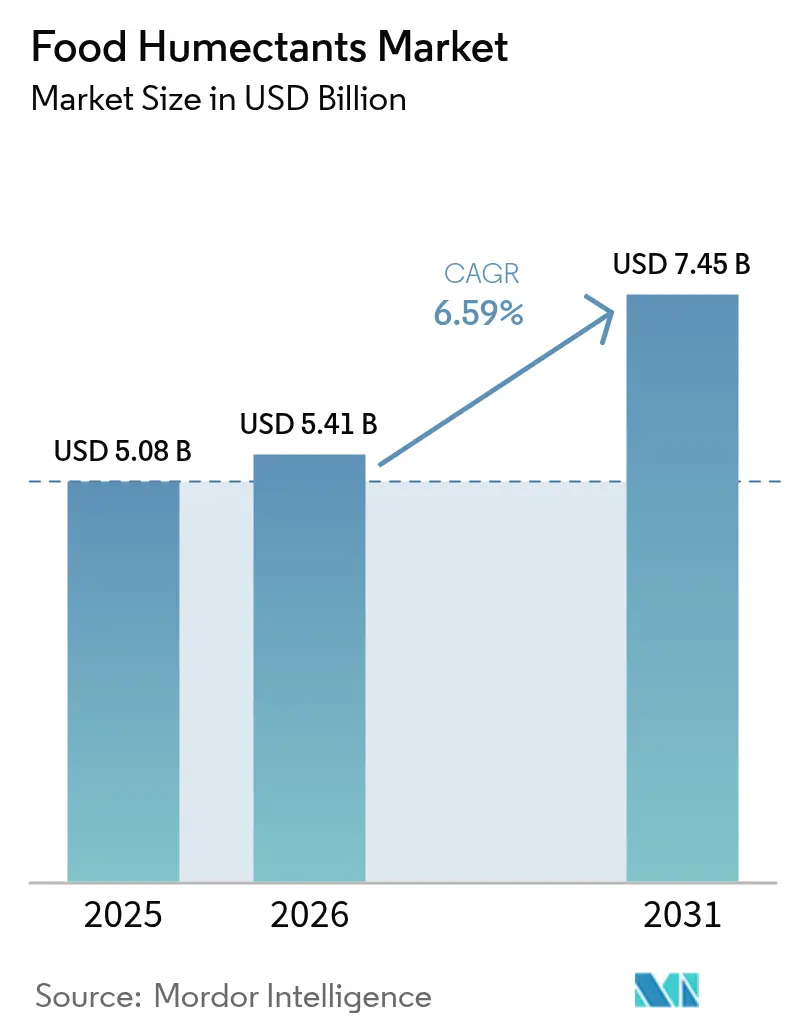
food humectants market size in 2026 is estimated at USD 5.41 billion, growing from 2025 value of USD 5.08 billion with 2031 projections showing USD 7.45 billion, growing at 6.59% CAGR over 2026-2031. Regulatory bodies, notably the FDA and EFSA, are ramping up their scrutiny, pushing the industry towards heightened standards in functionality, safety, and sustainability. In response to this regulatory impetus, the industry is channeling investments into cutting-edge technologies. These advancements not only bolster moisture retention and prolong product shelf life but also align with the clean-label claims that consumers are increasingly prioritizing. To navigate these shifting demands, formulators are turning to innovative solutions. These include bio-based propylene glycol, precision-fermented glycerine, and blends of sugar alcohols. Such choices not only adhere to regulatory benchmarks but also champion environmental sustainability. The competitive arena is witnessing a transformation. Multinational giants are honing their supply chains for enhanced efficiency. Simultaneously, niche suppliers are carving out a larger market share by rolling out natural, multifunctional ingredients that resonate with consumer desires.
Key Report Takeaways
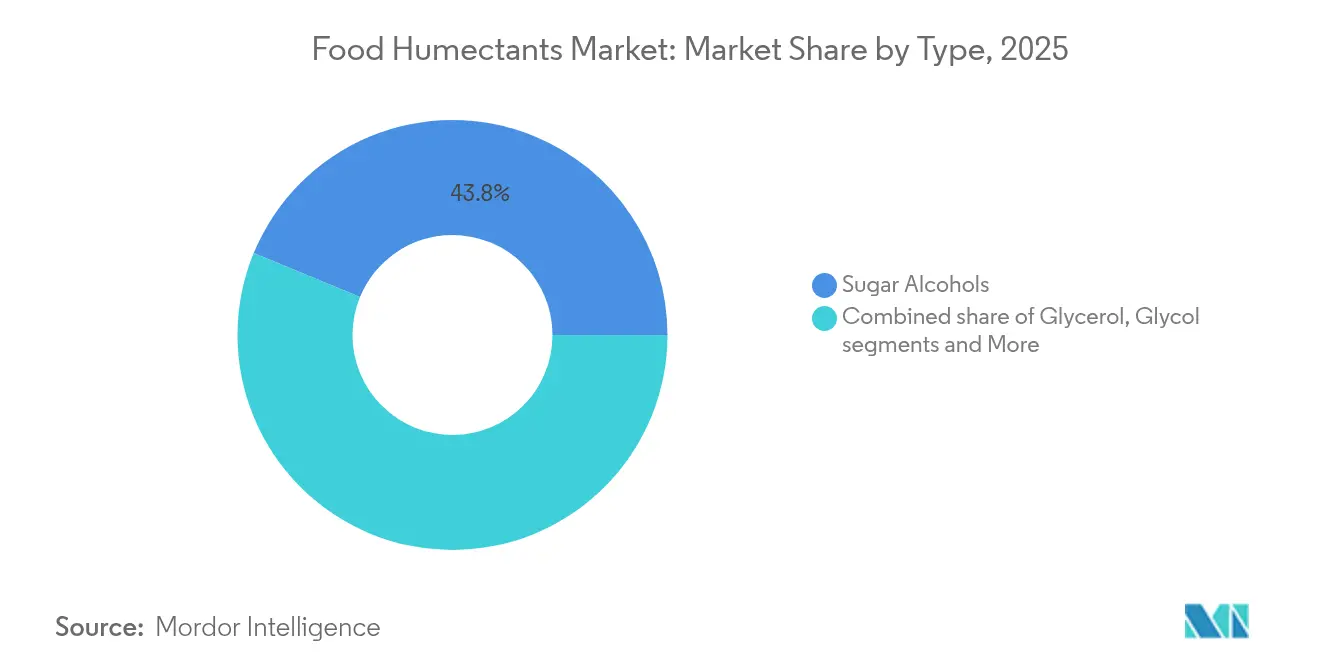
- By type, sugar alcohols led with 43.78% food humectants market share in 2025, while glycols are projected to expand at an 7.78% CAGR to 2031.
- By source, natural ingredients accounted for 70.83% of the food humectants market size in 2025 and are advancing at a 7.55% CAGR through 2031.
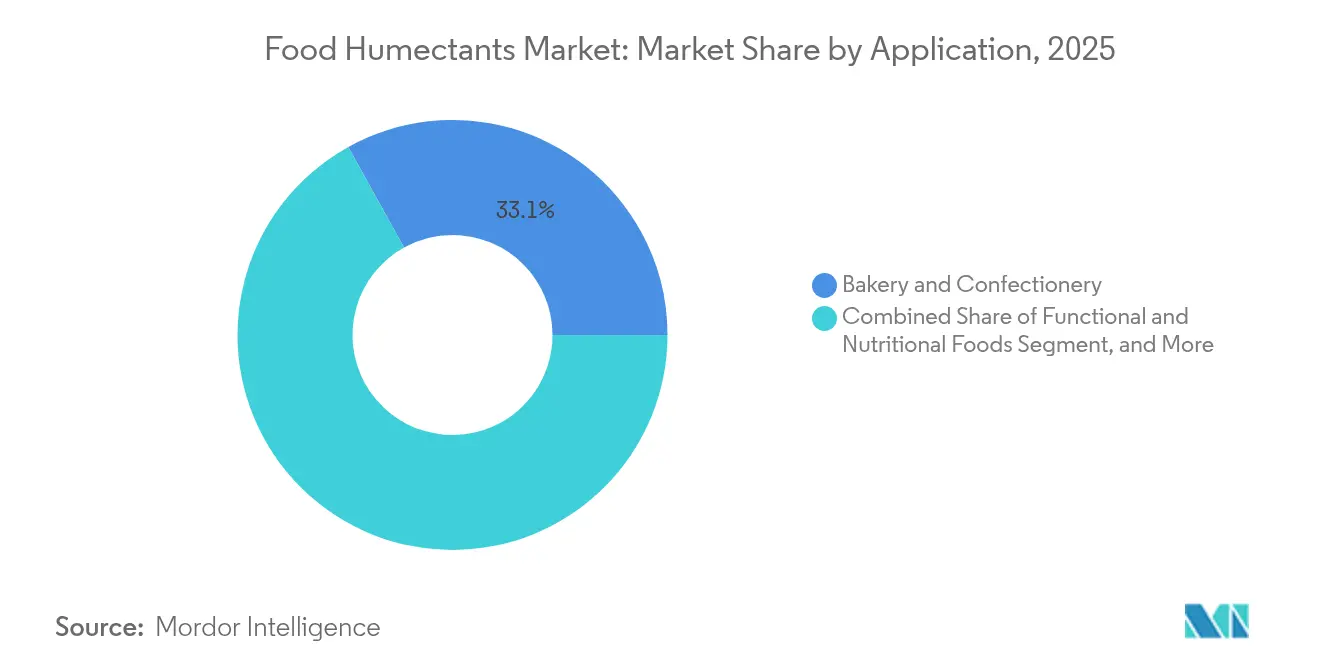
- By application, bakery and confectionery held 33.05% of the food humectants market share in 2025; savory and snacks is forecast to post the fastest 7.1% CAGR to 2031.
- By geography, Europe captured 32.48% of the food humectants market size in 2025, whereas Asia-Pacific is expected to grow at a 7.42% CAGR through 2031.
Note: Market size and forecast figures in this report are generated using Mordor Intelligence’s proprietary estimation framework, updated with the latest available data and insights as of 2026.
Global Food Humectants Market Trends and Insights
Drivers Impact Analysis*
| DRIVER | (~) % IMPACT ON CAGR FORECAST | GEOGRAPHIC RELEVANCE | IMPACT TIMELINE |
|---|---|---|---|
| Rising demand for moisture-retaining ingredients in bakery and confectionary | +1.8% | Global, with strong momentum in North America and Europe | Medium term (2-4 years) |
| Demand from frozen and refrigerated food categories | +1.2% | North America and Europe core, expanding to Asia-Pacific | Long term (≥ 4 years) |
| Use in low-sugar and sugar-free products | +1.0% | Global, led by developed markets | Short term (≤ 2 years) |
| Technology innovations in clean-label humectants | +0.9% | North America and Europe, spreading globally | Medium term (2-4 years) |
| Growing adoption in plant-based dairy alternatives | +0.7% | North America and Europe, emerging in Asia-Pacific | Medium term (2-4 years) |
| Development of multi-functional humectants | +0.6% | Global, technology-driven markets first | Long term (≥ 4 years) |
| Source: Mordor Intelligence | |||
Rising demand for moisture-retaining ingredients in bakery and confectionary
The bakery and confectionery sector's transition toward extended shelf-life products is driving significant advancements in humectant selection and regulatory compliance. The FDA's classification of glycerin as Generally Recognized as Safe (GRAS) under 21 CFR 582.1320, when used in accordance with good manufacturing practices, provides manufacturers with a reliable regulatory framework[1]U.S. Food and Drug Administration, "Code of Federal Regulations", www.ecfr.gov. This clarity fosters innovation in moisture-retention solutions, which are critical for maintaining product quality and enhancing consumer satisfaction in bakery applications. Additionally, the Food and Agriculture Organization's Codex GSFA standards for glycerol (E422) establish internationally recognized guidelines, facilitating seamless global trade of bakery products containing humectants. To address evolving moisture management challenges across product lifecycles—from production to retail distribution—manufacturers are increasingly adopting advanced formulations that combine multiple humectants. These formulations are tailored to optimize moisture retention while ensuring product stability.
Demand from frozen and refrigerated food categories
Innovations in humectant technology and formulation strategies are being driven by the unique moisture management challenges posed by frozen food applications. In February 2025, a pilot plant jointly launched by Dow and Evonik, converting hydrogen peroxide to propylene glycol, marked a significant leap in sustainable humectant production. This method slashes water consumption by over 95% when stacked against conventional techniques. Such advancements cater to the frozen food sector's pressing demands: effective moisture retention and a commitment to environmental sustainability. Formulators are honing in on curbing ice crystal formation during freeze-thaw cycles. To uphold product integrity, they're turning to essential stabilizer combinations, notably starches and hydrocolloids. The surge in plant-based frozen alternatives adds layers of complexity. These alternatives exhibit moisture migration patterns that starkly contrast with their traditional animal-based counterparts, necessitating tailored humectant systems.
Use in low-sugar and sugar-free products
The growing emphasis on sugar reduction is driving significant changes in humectant selection, as manufacturers prioritize ingredients that deliver both sweetening and moisture-retention capabilities. Roquette's LYCASIN 80/55 maltitol syrup exemplifies this trend by functioning as a sugar-free sweetener and humectant while effectively preventing crystallization in confectionery applications. This development aligns with increasing consumer awareness of the health risks associated with high sugar consumption, with approximately two-thirds of consumers actively seeking to reduce their sugar intake. The innovation landscape is expanding beyond traditional sugar alcohols to include natural alternatives such as allulose and tagatose. These alternatives not only provide superior moisture retention but also align with clean-label demands, appealing to health-conscious consumers. Regulatory developments further support this shift, as the FDA's recognition of certain humectants as dietary fiber creates new marketing opportunities for manufacturers.
Technology innovations in clean-label humectants
Clean-label initiatives are propelling advancements in the extraction and processing of natural humectants, focusing on maintaining their functional properties while meeting stringent regulatory transparency standards. The FDA's comprehensive framework for food additives, as outlined in 21 CFR Part 172, provides clear regulatory pathways for the development of innovative humectant technologies that comply with safety and efficacy requirements[2]U.S. Food and Drug Administration, "Part 172—Food Additives Permitted For Direct Addition To Food For Human Consumption", www.ecfr.gov. This regulatory support encourages the adoption of novel extraction and processing methods that preserve the natural status of ingredients while enhancing their functionality. Recent research underscores the efficiency of non-thermal extraction technologies in obtaining natural humectants, ensuring the retention of their nutritional value and functional properties. Additionally, the integration of biotechnology, particularly through precision fermentation, enables the production of natural humectants with consistent quality and reliable supply chains, all while adhering to clean-label principles.
Restraints Impact Analysis*
| RESTRAINT | (~) % IMPACT ON CAGR FORECAST | GEOGRAPHIC RELEVANCE | IMPACT TIMELINE |
|---|---|---|---|
| Regulatory restrictions om usage levels in food applications | -0.8% | Global, varying by jurisdiction | Short term (≤ 2 years) |
| Limited awarness in developing countries | -0.6% | Asia-Pacific, Middle East and Africa, Latin America | Medium term (2-4 years) |
| Growing demand for preservative-free and natural products | -0.4% | North America and Europe primarily | Medium term (2-4 years) |
| Adultration risks in unregulated markets | -0.3% | Developing markets, unregulated regions | Long term (≥ 4 years) |
| Source: Mordor Intelligence | |||
Regulatory restrictions om usage levels in food applications
Major markets are tightening their regulatory frameworks, posing compliance challenges that limit humectant usage and complicate formulations. In February 2025, China rolled out its GB 2760-2024 standards, imposing stricter limits on food additives. These revisions not only set new usage requirements for humectants but also banned certain compounds in specific food categories. Reflecting heightened safety concerns, the FDA is consulting on contamination limits for ethylene glycol and diethylene glycol in food additives, a move that could influence humectant sourcing and processing[3]Food Compliance International, "CFSA officially implements the standard for the use of food additives (GB 2760-2024)", www.foodcomplianceinternational.com. Meanwhile, European regulations on mineral oil hydrocarbons in food add another layer of compliance challenges. The EU's guidelines targeting MOAH in foodstuffs have implications for both packaging and processing materials. Such regulatory pressures are inflating compliance costs and extending product development timelines. This is especially burdensome for smaller manufacturers who often lack extensive regulatory expertise.
Limited awarness in developing countries
In developing economies, the adoption of humectants in food processing faces significant challenges due to technical knowledge gaps and infrastructure limitations. According to the USDA's analysis of China's food processing ingredients market, the demand for imported food processing ingredients, including humectants, is increasing as consumers show a growing preference for healthier and premium food products. However, this growth is largely concentrated in developed urban areas, leaving rural and emerging markets with substantial knowledge deficits. Educational initiatives and training programs are primarily focused on developed regions, neglecting areas with rapidly expanding food processing industries. This lack of awareness is compounded by limited access to technical support and application expertise, which hampers innovation and the optimal utilization of humectants in these regions. Additionally, supply chain complexities in developing markets present further obstacles. Inconsistent quality standards and inadequate cold chain infrastructure negatively impact the stability and performance of humectants, creating significant barriers to their effective use.
*Our forecasts treat driver/restraint impacts as directional, not additive. The impact forecasts reflect baseline growth, mix effects, and variable interactions.
Segment Analysis
By Type: Sugar Alcohols Maintain Leadership Through Regulatory Advantages
In 2025, sugar alcohols capture a 43.78% market share, bolstered by global regulatory endorsements and proven safety records. The FDA's designation of sorbitol as GRAS under 21 CFR Part 184 paves the way for its widespread use in food applications. Such regulatory backing empowers manufacturers to harness sugar alcohols across various applications, all while adhering to stringent food safety standards. The segment's stronghold is further solidified by the FAO's Codex GSFA standards, which set global benchmarks for sugar alcohols in food, promoting international trade and consistency. Beyond their roles as sweeteners, sugar alcohols serve as humectants, meeting manufacturers' demands for versatile ingredients that streamline formulations without compromising quality or compliance.
Glycols are set to be the fastest-growing segment, boasting an 7.78% CAGR through 2031, thanks to their enhanced performance in niche applications and a surge in regulatory endorsements. The FDA's oversight of propylene glycol mono- and diesters under 21 CFR 172.856 underscores the agency's acknowledgment of glycol-based humectants in targeted food uses. This regulatory nod fuels innovations in glycol formulations, tackling moisture management in frozen and processed foods. The segment is also reaping rewards from strides in sustainable production, notably the rise of bio-based propylene glycol via eco-friendly processing techniques. These advancements not only lessen environmental footprints but also uphold performance standards. Modern glycol formulations are now equipped with controlled-release features, ensuring moisture retention throughout a product's shelf life, effectively countering quality dips in less-than-ideal storage conditions.



By Source: Natural Sources Dominate Through Clean-Label Momentum
Natural sources hold a dominant 70.83% share of the market in 2025, driven by the growing consumer demand for recognizable and familiar ingredients, alongside regulatory frameworks that actively promote their adoption. The segment's growth is further supported by advancements in natural extraction technologies, which enhance ingredient functionality while preserving their integrity. These innovations allow natural sources to establish sustainable competitive advantages in markets that prioritize transparency, clean-label standards, and ingredient recognition. Additionally, the increasing focus on sustainability and environmental responsibility strengthens the appeal of natural sources, making them a preferred choice for both consumers and manufacturers.
Natural sources are projected to achieve the highest growth rate, with a strong 7.55% CAGR anticipated through 2031. This growth trajectory is driven by the rising consumer preference for clean-label products and significant advancements in the processing of natural ingredients. Biotechnology-driven production methods are leading the way, enabling the fermentation of nature-identical humectants that balance natural authenticity with consistent quality. Recent patent filings highlight innovative approaches in natural humectant production, emphasizing plant-based systems and the use of upcycled materials, which integrate sustainability with high performance. Advanced processing techniques are also leveraging agricultural waste to extract natural humectants, promoting sustainable supply chains and reducing environmental impact.
By Application: Bakery Leadership Supported by Regulatory Framework
Bakery and confectionery applications dominate the market with a 33.05% share in 2025, driven by comprehensive regulatory frameworks that promote the use of humectants in baked goods. Humectants play a critical role in preserving texture, extending shelf life, and preventing staleness in baked products. Tailored formulations are developed to address the specific requirements of various product categories and storage conditions. The industry's progression toward multifunctional ingredient solutions is evident in the integration of natural humectants with antimicrobial properties, which not only enhance moisture retention but also ensure food safety, meeting both consumer expectations and regulatory standards.
The savory and snacks segment is anticipated to be the fastest-growing application, with a strong CAGR of 7.1% through 2031. This growth is fueled by the increasing demand for innovative texture solutions and effective moisture management in shelf-stable products. Anderson Advanced Ingredients' MoisturLOK technology exemplifies the advancements in this segment, offering up to an 80% extension in shelf life while addressing moisture migration challenges in baked goods and snacks. The product's dual availability in powder and syrup forms underscores its versatility, catering to diverse manufacturing processes and highlighting the growing need for adaptable, high-performance solutions in the market.
Geography Analysis
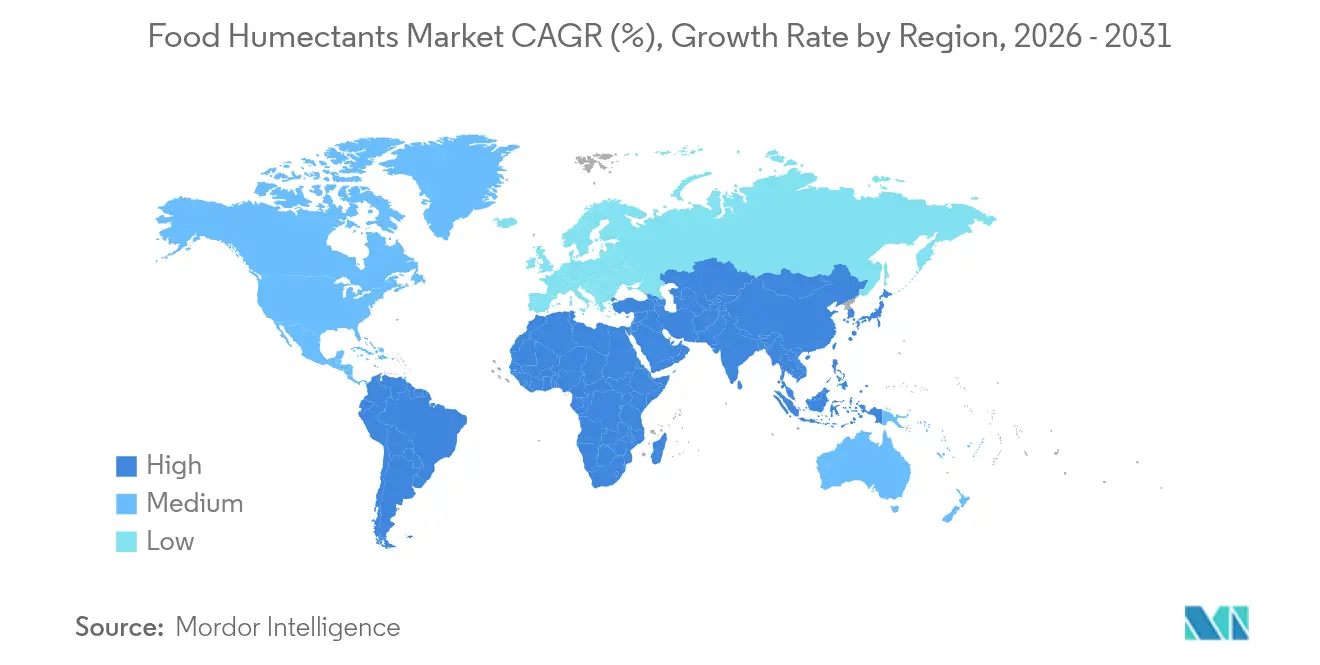
In 2025, Europe holds a leading 32.48% market share, driven by its advanced food processing industries and stringent quality standards that promote humectant usage across a wide range of applications. The region's regulatory framework, particularly the implementation of Commission Regulation (EU) 2023/915, which sets maximum contaminant levels, creates a dual landscape of challenges and opportunities for humectant suppliers. Germany, the United Kingdom, and France dominate regional consumption, supported by their sophisticated bakery industries and increasing demand for clean-label ingredients. Europe's strong focus on sustainability aligns with the growing preference for natural humectants, while its well-established supply chains ensure consistent product availability and quality.
Asia-Pacific is positioned as the fastest-growing region, with a projected CAGR of 7.42% through 2031. This growth is fueled by rapid industrialization in food processing and changing dietary habits that favor convenience foods. Meanwhile, India and Southeast Asia drive volume growth through rising consumption of processed foods, while Australia and South Korea contribute with their adoption of advanced food technologies. The region's diverse regulatory environment necessitates tailored strategies, prompting companies to establish local partnerships and production facilities to address specific market demands effectively.
North America maintains a strong market presence, supported by its leadership in innovation and a well-established food processing infrastructure that enables advanced humectant applications. The region benefits from the FDA's comprehensive regulatory framework, including the GRAS designation for key humectants under 21 CFR Part 184, which facilitates streamlined product development and market entry. Mexico's expanding food processing industry and Canada's focus on natural ingredients further contribute to the region's growth dynamics. In contrast, South America and the Middle East & Africa represent emerging opportunities. In South America, Brazil and Argentina lead the expansion, driven by their growing food processing capabilities. Simultaneously, the Middle East's emphasis on food security and Africa's rapidly urbanizing population are increasing the demand for shelf-stable products, underscoring the critical role of effective moisture management systems in these regions.

Regulatory Landscape
Food humectants operate under food-additive frameworks that increasingly emphasize specifications, purity, and documentation. In the United States, the FDA regulates food additives and GRAS substances through pathways reflected in 21 CFR Parts 172, 182, 184, and 582, and its Human Foods Program has articulated 2026 priority deliverables that include work on food substance safety and greater supply chain transparency. In Europe, the EU food additive regime under Regulation (EC) 1333/2008 continues to be implemented through updates to specifications and EFSA scientific expectations, with 2026 EFSA guidance reinforcing the data package needed for additive authorization and re-evaluation.
In Asia, regulators are tightening administrative and technical controls in ways that affect time-to-approval and ongoing compliance for humectant-containing formulations. China implemented GB 2760-2024 in February 2025, updating additive use limits and restricting certain compounds by food category. This increases reformulation and dossier work for brands selling across borders. In India, the Food Safety and Standards Authority of India (FSSAI) directed that, effective June 1, 2026, applications for prior approval/authorization be filed only through the ePAAS portal, pushing manufacturers and importers toward more standardized, digitally auditable submissions and tighter document-readiness cycles.
Value Chain Analysis
The food humectants value chain starts with upstream feedstocks and intermediates, including plant- and bio-based carbohydrate streams for sugar alcohols, fermentation-based routes for glycerol alternatives, and petrochemical or bio-based routes for glycols. Ingredient manufacturing and purification, formulation and blending, quality and regulatory documentation, and downstream distribution into food processors follow. Market participants include large integrated producers and specialty ingredient companies (including BASF, ADM, Cargill, Ingredion, Roquette, Corbion, Jungbunzlauer, and Tate & Lyle), plus distributors and application labs that support bakery and confectionery, dairy and frozen desserts, beverages, savory and snacks, and functional and nutritional foods.
Standards and compliance checkpoints shape flows across borders and channels. Codex Alimentarius (GSFA) and JECFA specifications provide internationally referenced identity and purity anchors, while region-specific rules such as FDA GRAS conventions and China GB 2760-2024 drive product specifications, labeling, and category-specific allowable-use matrices. The chain also remains sensitive to manufacturing incidents and logistics friction: for example, BASF declared force majeure after a late-July 2024 fire at its Ludwigshafen site, impacting supply tightness into late 2024 and early 2025. In 2025, logistics constraints such as port congestion and refrigerated container availability have reinforced the value of diversified sourcing, distributor-led inventory positioning, and longer-term transport and service contracting for imported ingredients.
Competitive Landscape
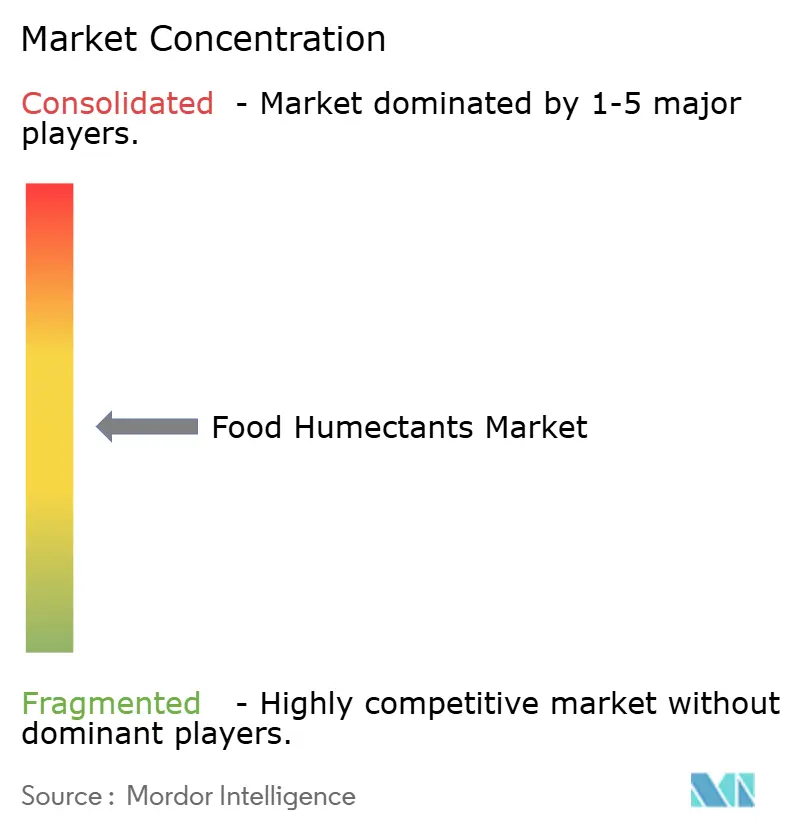
The global food humectants market is moderately concentrated, with prominent players such as BASF SE, Ingredion Incorporated, Archer Daniels Midland Company, Cargill Incorporated, and Roquette Frères SA leading the market. These key players, along with other domestic and international companies, are actively focusing on innovation and launching new products to address the growing consumer demand for advanced food humectants while maintaining their competitive edge in the market. The market is witnessing a steady rise in demand, driven by the increasing use of humectants in processed foods, bakery products, and confectionery to enhance texture, moisture retention, and shelf life.
Strategic consolidation activities are significantly reshaping the competitive landscape of the market. For instance, in March 2025, Louis Dreyfus Company acquired BASF's food and health performance ingredients business. This acquisition has strengthened Louis Dreyfus Company's capabilities in ingredient sourcing and distribution, highlighting the industry's increasing emphasis on vertical integration and supply chain optimization. Such strategies are crucial to meeting the rising demand for specialized humectant solutions, which are becoming essential in various food applications. Additionally, the consolidation trend reflects the growing need for companies to streamline operations and enhance their global footprint in a competitive market environment.
Innovation remains a key driver in the market, with companies focusing on clean-label technologies and multi-functional ingredients to align with evolving consumer preferences and stringent regulatory requirements. Furthermore, the rising consumer inclination toward plant-based and organic products is pushing companies to invest in research and development for eco-friendly and health-conscious solutions.
Food Humectants Industry Leaders
-
BASF SE
-
Ingredion Incorporated
-
Archer Daniels Midland Company
-
Cargill Incorporated
-
Roquette Frères SA
- *Disclaimer: Major Players sorted in no particular order

Market Opportunities and Future Outlook
Clean-label reformulation is creating space for natural-source and fermentation-enabled humectant systems that can manage moisture while simplifying ingredient statements. The market already shows strong adoption of natural sources (70.83% share in 2025), supporting opportunities for suppliers to expand portfolios in plant-derived polyols, sugar-alcohol blends, and nature-identical ingredients produced via biotech routes that improve consistency and traceability. On the product side, reduced-sugar formulation trends also support opportunities where a humectant can contribute sweetness or bulking alongside moisture control, including allulose- and maltitol-based positioning in confectionery and bakery applications.
Regulatory and digital-compliance changes are also opening opportunities in documentation, specifications management, and region-ready formulations, particularly for suppliers that can provide complete technical files and rapid change control. India moving prior-approval submissions to FSSAI ePAAS (effective June 1, 2026) and China tightening additive rules under GB 2760-2024 elevate the value of regulatory services bundled with ingredients, such as category-specific use guidance and contaminant-risk controls. On the supply side, sustainability-linked process innovation provides a commercialization pathway for lower-footprint humectants in glycol families, anchored by the February 2025 Dow and Evonik pilot that converts hydrogen peroxide to propylene glycol with substantially lower water use. This supports procurement programs that increasingly ask for verified process and supply-chain transparency.
Recent Industry Developments
- June 2026: Roquette launched NEOSORB AG, a plant-based multifunctional polyol range positioned for humectancy in foliar and liquid fertilizer formulations. While targeted at agri-use, it reinforces Roquette's plant-based polyol platform expansion, which can strengthen scale, sourcing flexibility, and downstream formulation know-how relevant to polyol-based humectant supply chains.
- March 2025: Louis Dreyfus Company acquired BASF's food and health performance ingredients business, strengthening ingredient sourcing and distribution capabilities. The transaction supports more integrated supply options for food ingredient buyers and intensifies competitive pressure on incumbents to differentiate via application support and compliant, traceable product grades.
- June 2024: Univar Solutions expanded its distribution alliance with Ingredion to cover Germany, Italy, and Switzerland, with a focus on functional food and beverage ingredients. Broader distribution coverage improves access and technical support for formulators seeking humectant-adjacent systems (for example, texture and moisture management toolkits) across key European processing hubs.


Research Methodology Framework and Report Scope
Market Definition and Coverage
This market covers ingredients used in food and beverage formulations to retain moisture, support texture, and extend freshness, with values captured as sales of humectant ingredients into food manufacturing across major regions.
Scope exclusions: This sizing excludes humectants used only in non-food end uses such as cosmetics, home care, pharma, and industrial applications.
Segmentation Overview
-
By Type
- Sugar Alcohol
- Glycerol
- Glycol
- Lactate
- Others
-
By Source
- Natural
- Synthetic
-
By Application
- Bakery and Confectionery
- Functional and Nutritional Foods
- Beverage
- Dairy and Frozen Desserts
- Savory and Snacks
- Others
-
By Geography
-
North America
- United States
- Canada
- Mexico
- Rest of North America
-
Europe
- Germany
- United Kingdom
- Italy
- France
- Spain
- Netherlands
- Poland
- Belgium
- Sweden
- Rest of Europe
-
Asia-Pacific
- China
- India
- Japan
- Australia
- Indonesia
- South Korea
- Thailand
- Singapore
- Rest of Asia-Pacific
-
South America
- Brazil
- Argentina
- Colombia
- Chile
- Peru
- Rest of South America
-
Middle East and Africa
- South Africa
- Saudi Arabia
- United Arab Emirates
- Nigeria
- Egypt
- Morocco
- Turkey
- Rest of Middle East and Africa
-
North America
Data Sources, Market Sizing, and Validation
Desk Research
Desk research was used to build the basic structure of the market, align definitions, and collect the demand and supply signals that can be checked year over year. We referred to public sources such as the US FDA and the European Food Safety Authority for ingredient and usage context, and trade and food safety guidance that influences adoption in bakery, dairy, beverages, and functional foods.
To shape the quantitative inputs, we also reviewed materials from sources such as the FAO and UN Comtrade for agriculture and ingredient-related trade signals, along with USDA publications for sugar and starch value chain context. Supporting evidence was taken from company annual reports and investor presentations, industry association websites, and reputed press coverage, then supplemented with paid subscriptions focused on company financials, patent databases, and shipment-level import and export intelligence when it helped confirm volumes and direction of trade. These desk sources are illustrative, and many other public references were used for data collection, validation, and clarification.
Primary Interviews and Surveys
Primary work was used to pressure-test demand drivers and pricing logic for key humectant types used in food, and to confirm what is actually sold into food applications versus adjacent end uses. We spoke with participants across ingredient manufacturing, distribution, and food processing roles, and coverage was balanced across Americas, EMEA, and APAC so regional formulation norms and regulatory considerations were reflected in the assumptions.
Distribution of primary research fieldwork respondents
| Company type | Respondent position | Region |
|---|---|---|
| Top tier: 39% | CXOs: 14% | APAC: 40% |
| Mid tier: 44% | Functional/Unit leaders: 35% | EMEA: 34% |
| Smaller Players: 17% | Managers: 51% | Americas: 26% |
Market-Sizing & Forecasting
Market size was first reconstructed using a top-down approach where food production patterns and ingredient trade flows help rebuild the addressable demand pool for humectants by region, and then the totals are mapped to typical usage intensity in moisture-sensitive food categories. Once that structure was set, results were checked with selective bottom-up approximations, including supplier and distributor channel checks and sampled average selling price by estimated consumption volumes, before final totals were adjusted.
Key inputs used in the model included processed food output growth, bakery and confectionery production direction, sugar alcohol and polyol supply indicators, import and export movements for relevant ingredient codes, and observed price movements for common humectant chemistries as they shift between natural and synthetic sourcing. For forecasting, we leaned on scenario analysis so changes in clean-label preferences, reformulation activity, and regulatory attention could be applied as practical upside and downside cases, and then narrowed using expert feedback to keep assumptions realistic. Where bottom-up visibility was thin in smaller countries, gaps were handled by using regional proxy ratios tied to food manufacturing scale and trade reliance, and then rechecked in interviews.
Data Validation & Update Cycle
Validation is done through repeated cross-checks, where model outputs are compared against independent signals like trade direction, food processing output trends, and reported ingredient business performance in public filings. If an outlier appears, it is reviewed step by step, and follow-up questions are sent back to experts when the variance cannot be explained by currency timing, inflation, or a known supply shift.
Before sign-off, the model and assumptions are reviewed by more than one analyst so logic, units, and conversion steps are consistent across regions and years. Reports are refreshed annually, and interim updates are added when material events occur, such as regulation changes, sharp feedstock movements, or major capacity additions. Right before delivery, a final pass is completed so clients receive the latest updated view available at that time.
Mordor Intelligence's Food Humectants Market Size Compared Against Other Published Estimates
Published market sizes for food humectants can vary more than expected because the boundaries are not always the same, and the same year can be treated differently across sources. Differences usually come from what gets counted as a food humectant, whether values include adjacent ingredient functions, and how pricing is converted into USD.
By tracking application-level demand signals and refreshing price and currency assumptions each cycle, Mordor Intelligence keeps the 2026 estimate anchored to humectants sold into food and beverage uses, rather than blending in broader humectant consumption from non-food categories or adding extra ingredient families by default.
Benchmark comparison
| Source | Market Size | Gaps in Research Methodology |
|---|---|---|
| Mordor Intelligence | USD 5.41 B (2026) | |
| Industry Data Provider A | USD 3.27 B (2024) | Uses a different base year and a smaller starting value, and the scope often mixes in broader application lists that can blur the line between food-only demand and adjacent personal care use cases, which can shift the counted volume and pricing basis. |
| Global Consultancy B | USD 5.11 B (2026) | Reports a similar year but applies a faster growth path and a wider segmentation lens that can treat form and source splits as additive in interpretation, and it may assume quicker ASP expansion, which can push value upward even if volumes move steadily. |
The spread in the table is mainly explained by timing and what is included in the demand pool, along with how price progression is carried forward into USD values. When scope is kept tight to food applications and assumptions are checked against trade, production, and interview feedback, the resulting market value becomes easier to trace and repeat across updates.


Key Questions Answered in the Report
What is the current size of the food humectants market?
The food humectants market size is valued at USD 5.41 billion in 2026 and is projected to reach USD 7.45 billion by 2031.
Which segment holds the largest food humectants market share?
Sugar alcohols lead by type with 43.78% market share in 2025, and bakery and confectionery dominate by application with 33.05%.
Which region is growing fastest in the food humectants market?
Asia-Pacific is the fastest-growing region, forecast to expand at a 7.42% CAGR through 2031.
Why are natural humectants gaining traction?
Natural sources command 70.83% of the market due to clean-label demand, GRAS approvals, and advances in fermentation that boost supply and functionality.
Page last updated on:


 Your data is secure and never sold or shared.


