
EV Cables Market Size and Share
Market Overview
| Study Period | 2019 - 2031 |
|---|---|
| Market Size (2026) | USD 12.76 Billion |
| Market Size (2031) | USD 30.43 Billion |
| Growth Rate (2026 - 2031) | 18.98 % |
| Fastest Growing Market | Asia Pacific |
| Largest Market | Asia Pacific |
| Market Concentration | Medium |
Major Players *Disclaimer: Major Players sorted in no particular order Image © Mordor Intelligence. Reuse requires attribution under CC BY 4.0. | |
EV Cables Market Analysis by Mordor Intelligence
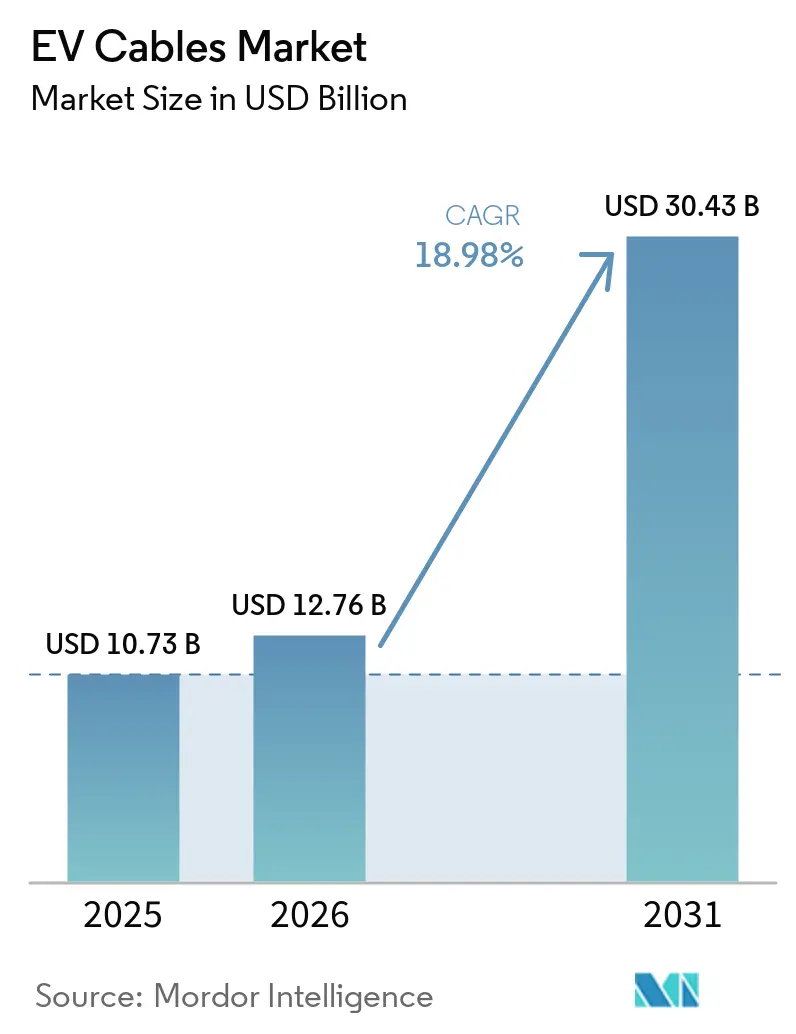
The EV Cables Market size is expected to increase from USD 10.73 billion in 2025 to USD 12.76 billion in 2026 and reach USD 30.43 billion by 2031, growing at a CAGR of 18.98% during the forecast period (2026-2031). Major economies are tightening zero-emission regulations, automakers are rapidly upgrading electrical platforms to higher voltage levels, and there's a noticeable shift from plug-in hybrids to pure battery-electric powertrains. These trends are propelling the EV cables market into a steep growth trajectory. Automakers are now standardizing high-voltage harnesses, achieving significant reductions in copper weight. Concurrently, public agencies are investing heavily in ultra-fast charging corridors, necessitating thicker, liquid-cooled cables. Suppliers who can embed sensors and provide ISO 19642-certified assemblies are securing a larger share of new platform awards. However, they face challenges with rising copper prices and labor shortages, which jeopardize their near-term profit margins. Globally, the EV cables market is evolving from bespoke, one-off harnesses to modular kits. These kits are designed to fit specific vehicle architectures and allow for over-the-air reconfiguration.
Key Report Takeaways
- By EV type, Battery Electric Vehicles secured 63.36% of 2025 revenue, while Fuel Cell Electric Vehicles are projected to grow at the fastest 19.01% CAGR between 2026 and 2031.
- By voltage type, high-voltage cables dominated, with a 56.73% share in 2025, and are also forecast to post the highest CAGR at 19.05% over 2026-2031.
- By application, battery and battery-management wiring led with 34.47% share in 2025, whereas charging-management cabling is expected to advance at a 19.08% CAGR through 2031.
- By component, wires accounted for 47.71% of 2025 revenue, while connectors are set to expand the quickest at a 19.03% CAGR during the forecast period.
- By insulation type, XLPE captured a 42.26% share in 2025 and is projected to maintain its leadership, with a 19.11% CAGR from 2026 to 2031.
- By shielding type, copper held a commanding 78.81% share in 2025, whereas aluminum shielding is anticipated to register the fastest CAGR at 19.13% through 2031.
- By geography, Asia-Pacific dominated, accounting for 36.74% of global revenue in 2025, and is poised for the highest regional growth, at a 19.16% CAGR through 2031.
Note: Market size and forecast figures in this report are generated using Mordor Intelligence’s proprietary estimation framework, updated with the latest available data and insights as of January 2026.
Market Trends and Insights
Drivers Impact Analysis of EV Cables Market*
| Driver | (~) % Impact on CAGR Forecast | Geographic Relevance | Impact Timeline |
|---|---|---|---|
| Rapid BEV Production Ramp-Up in China & Europe | +4.5% | Asia-Pacific core, Europe secondary | Short term (≤2 years) |
| Shift Toward 400-800V+ EV Architectures | +4.2% | Global, led by China, Europe, North America | Medium term (2-4 years) |
| Stringent Zero-Emission Mandates Elevate HV-Cable Demand | +3.8% | North America and EU, spillover to Asia-Pacific | Long term (≥4 years) |
| Government-Funded Fast-Charging Roll-Outs | +3.1% | North America, EU, select Asia-Pacific markets | Medium term (2-4 years) |
| Automaker Switch to Zonal Harness Topologies | +2.0% | Global, early adoption in premium segments | Long term (≥4 years) |
| XLPO Insulation Adoption Lowers Cable Costs | +1.4% | Global | Medium term (2-4 years) |
| Source: Mordor Intelligence | |||
Rapid BEV Production Ramp-Up in China & Europe
In recent years, China has significantly increased its production of Battery Electric Vehicles (BEVs), showing substantial year-on-year growth. Similarly, Europe has experienced a notable rise in production, reflecting strong market momentum. In response to these trends, leading cable manufacturers have strategically established extrusion and braiding facilities near major assembly hubs like Zwickau in Germany and Shenzhen in China. This approach reduces logistics expenses and shortens lead times. Chinese Original Equipment Manufacturers (OEMs) are transitioning to cell-to-pack battery systems, which eliminate the need for module wiring and enable the reallocation of materials to enhance busbars and thermal lines. In Europe, luxury automotive brands are driving demand for advanced features, including liquid-cooled charging cables that maintain optimal temperatures during rapid charging. This has created a profitable opportunity for suppliers specializing in innovative designs using XLPE and aluminum-polymer materials.
Shift Toward 400-800 V + EV Architectures
Automakers are moving en masse from legacy 400 V systems to 800 V platforms that halve current draw for equal power, enabling thinner conductors and lighter harnesses. Porsche, Hyundai, and Kia led early rollouts, and Tesla and BYD are now following suit, reinforcing an irreversible design pivot [1]“Taycan Technical Presentation,” Porsche AG, porsche.com . As refined copper prices reached unprecedented levels in early 2026, the architecture's reduction in copper usage per vehicle aligns seamlessly with the technology shift. Once considered a premium, silicon-carbide inverters have become more affordable, now fitting within mainstream budgets, thereby hastening the adoption of 800 V. To address compatibility challenges with older 400 V chargers, voltage-boost stations have emerged, adding additional costs per site. This development has cast a spotlight on the rising demand for ISO 19642 Class B high-voltage cables.
Stringent Zero-Emission Mandates Elevate HV-Cable Demand
California’s Advanced Clean Cars II rule, the European Union’s proposed Clean Corporate Vehicles Directive, and China’s dual-credit program together lock in a global trajectory toward fully electric light-duty fleets. These regulations compel automakers to electrify platforms faster than planned, lifting per-vehicle cable length to 1.5–2 km for a BEV versus about 1 km for an internal-combustion model. New compliance layers, such as ISO 15118 vehicle-to-grid communication, require extra data pairs and shielding, embedding incremental cable value in every car sold. The effect is structural: even if total vehicle production stalls, the EV cables market continues to expand as cable content per unit climbs.
Government-Funded Fast-Charging Roll-Outs
The U.S. NEVI program disbursed nearly USD 885 million in fiscal 2024 and will keep the spigot open through 2026, while EU member states funnel matching funds into Ten-T highway corridors. Every 150 kW CCS dispenser requires 15–20 m of EN 50620-rated cable; a 350 kW pillar can double both the cable cross-section and the cost. Because charging cables undergo separate certifications from in-vehicle harnesses, they open a parallel revenue stream for specialized producers that often operate outside the traditional automotive supply chain.
Restraints Impact Analysis of EV Cables Market*
| Restraint | (~) % Impact on CAGR Forecast | Geographic Relevance | Impact Timeline |
|---|---|---|---|
| Copper & Aluminum Price Volatility | -2.8% | Global | Short term (≤2 years) |
| Limited Automated EV-Cable Manufacturing Capacity | -1.5% | North America, Europe | Medium term (2-4 years) |
| Fire-Safety & EMC Qualification Burden | -0.9% | Global | Medium term (2-4 years) |
| Extra Shielding for Ultra-Fast-Charge Heat Loads | -0.6% | North America, EU, select Asia-Pacific markets | Long term (≥4 years) |
| Source: Mordor Intelligence | |||
Copper & Aluminum Price Volatility
Between late 2025 and early 2026, copper prices rose significantly, while aluminum prices also increased. Smelter curtailments drove this upward trend in response to growing demand for electric vehicles (EVs). Even a moderate fluctuation in copper's spot price can substantially affect the margins of leading harness manufacturers, prompting them to adopt aggressive hedging strategies. Suppliers with limited financial resources are often forced to renegotiate contracts or face customer attrition, which delays their ability to invest in new ISO 19642 production lines.
Limited Automated EV-Cable Manufacturing Capacity
High-voltage extrusion and nearly-complete-coverage braiding processes still rely on semi-manual methods. Each automated braider entails a significant investment and requires a lengthy procurement lead time. Following this, OEM validation adds further delays, extending the overall timeline. As a result, capacity struggles to keep pace with demand, particularly for the fast-charge cable families, which require precise tolerances and integrated cooling.
*Our forecasts treat driver/restraint impacts as directional, not additive. The impact forecasts reflect baseline growth, mix effects, and variable interactions.
EV Cables Market Segment Analysis
By EV Type:
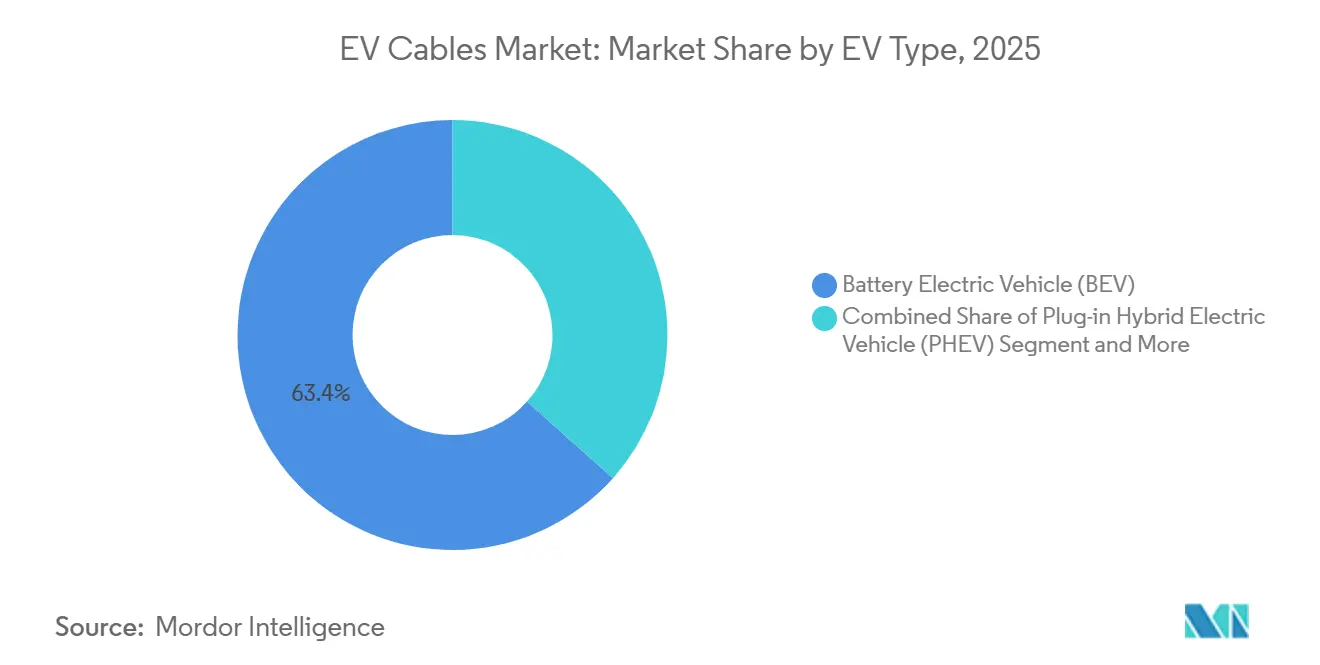
BEVs Anchor Value While FCEVs AccelerateBattery Electric Vehicles accounted for 63.36% of the EV cables market share in 2025, reflecting their dominant production scale and the high cable content per vehicle required for 400 V–800 V battery packs, inverters, and traction motors. The segment’s large installed base ensures steady replacement demand for high-voltage harnesses as automakers roll out refreshed models and software-enabled upgrades that call for additional data and power lines.
Fuel Cell Electric Vehicles are projected to post the quickest advance at a 19.01% CAGR over 2026-2031, even though they start from a much smaller volume base. Commercial bus and heavy-truck pilots in Japan, South Korea, and select European corridors specify 650-750 V stack interconnects, hydrogen-sensor wiring, and high-current pump controllers, all of which lift per-vehicle cable value above the BEV average. This niche, therefore, represents an outsized revenue upside for suppliers that can meet SAE J2578 hydrogen-permeation limits and 120 °C continuous-temperature duty cycles.



By Voltage Type:
High-Voltage Cables Dominate and Drive GrowthHigh-voltage lines captured 56.73% of the 2025 EV cables market share and are forecast to expand at a 19.05% CAGR through 2031. Every migration from 400 V to 800 V platforms increases conductor cross-sections and insulation requirements, keeping high-voltage content ahead of medium- and low-voltage categories. OEM specifications now routinely call for ISO 19642 Class B ratings (1,000 VAC / 1,500 VDC), integrated temperature sensing, and aluminum substitution for runs beyond 2 m, all of which raise bill-of-materials value.
Medium- and low-voltage cables continue to play critical roles in auxiliary loads. Still, their combined share continues to edge down as automakers consolidate 12 V functions into zonal controllers and elevate mild-hybrid architectures to 48 V backbones. This structural shift keeps high voltage the undisputed value engine of the overall segment.
By Application:
Battery Wiring Leads, Charging Management SurgesBattery & Battery-Management cabling accounted for the largest share at 34.47% of 2025 revenue, driven by kilometer-long cell-sensor loops, busbar jumpers, and thermal-monitoring harnesses within each traction pack. Requirements for low-smoke, zero-halogen insulation and real-time voltage taps ensure sustained material intensity even as cell-to-pack designs reduce the number of individual interconnects.
Charging-Management assemblies, however, are on track for the fastest 19.08% CAGR over 2026-2031. A single 350 kW liquid-cooled cable demands 95–120 mm² conductors, triple-layer shielding, and embedded data pairs for ISO 15118 plug-and-charge protocols, lifting per-meter value well above that of in-vehicle wiring. Government-funded corridor rollouts ensure that this external-infrastructure niche grows in parallel with vehicle production.
By Component:
Wires Hold Value, Connectors Pace GrowthWires accounted for 47.71% of the total 2025 revenue because every harness—regardless of architecture—starts with conductor length. Yet connector demand is projected to climb at a 19.03% CAGR as zonal designs multiply inter-zone joins and hybrid housings bundle 150 A power plus gigabit Ethernet lanes in space-efficient shells. Each new connector spec must withstand 2,000 mating cycles and meet IP6K9K ingress protection, raising average selling prices.
Fuse and protection devices face slower value growth as solid-state switching migrates into zone controllers, while insulation and shielding materials ride the same high-voltage expansion that benefits conductors and connectors alike.
By Insulation Type:
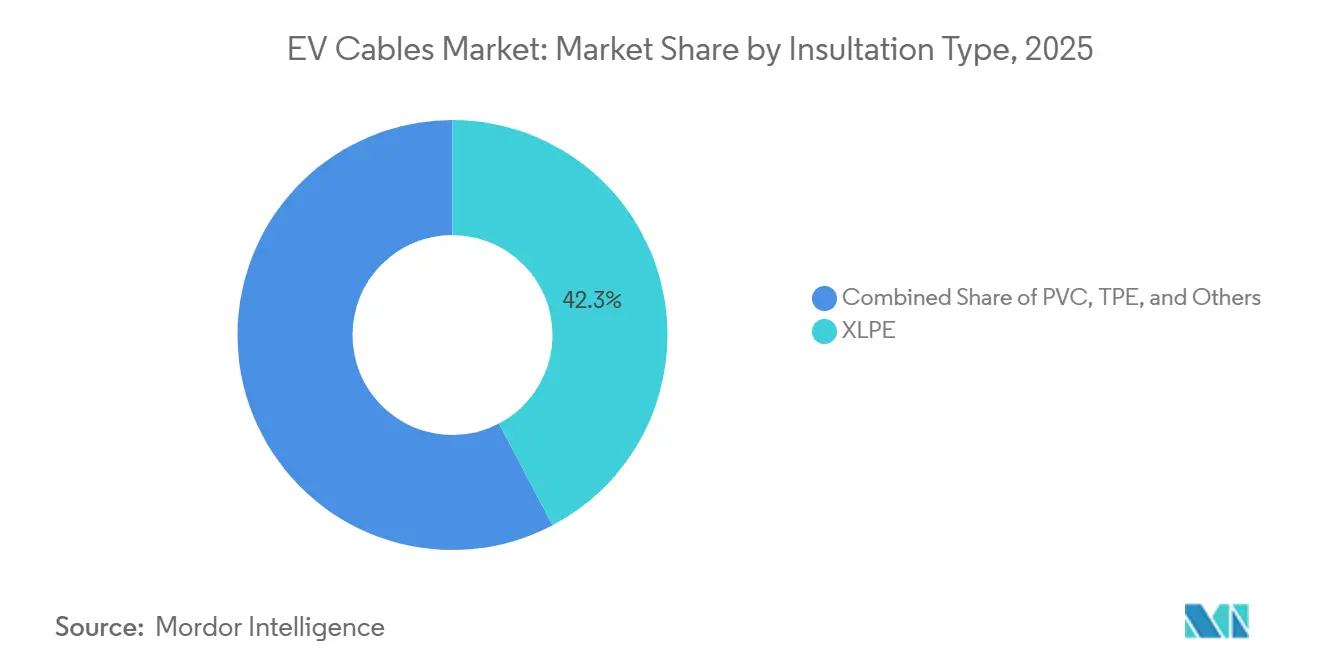
XLPE Maintains Commanding LeadCross-linked polyethylene captured 42.26% of the 2025 EV cables market share and is forecast to advance at a 19.11% CAGR. Its >30 kV/mm dielectric strength and 90–125 °C continuous-temperature ceiling allow thinner walls, reducing harness weight by up to 15% compared with PVC, keeping it the default for high-voltage runs. XLPE grades that meet low-smoke, zero-halogen criteria solidify the material’s regulatory edge.
PVC persists in low-voltage auxiliary loops where heat loads are mild, while TPE, silicone, and fluoropolymer insulations fill flexibility, high-temperature, and chemical-resistance niches. None, however, challenges XLPE’s cost-performance sweet spot in mainstream high-voltage applications.
By Shielding Type:
Copper Dominates Today, Aluminum Climbs FastCopper shielding retained a commanding 78.81% share in 2025, owing to its unmatched 58 MS/m conductivity and low contact resistance—both critical for 20–50 kHz inverter outputs. Yet aluminum braid is the fastest-growing segment, set to grow at a 19.13% CAGR through 2031 as the copper-to-aluminum price ratio remains above 4.0. Aluminum-clad steel wires address ductility issues and, when corrosion-resistant coatings are applied, deliver 85–90% of copper’s screening performance at half the weight and at 30–40% lower cost.
Premium European marques will keep copper for the no-compromise EMC requirements of performance EVs. Still, high-volume Asia-Pacific models under USD 20,000 already use aluminum shielding in up to 80% of high-voltage runs, confirming the substitution trend’s staying power.
Geography Analysis
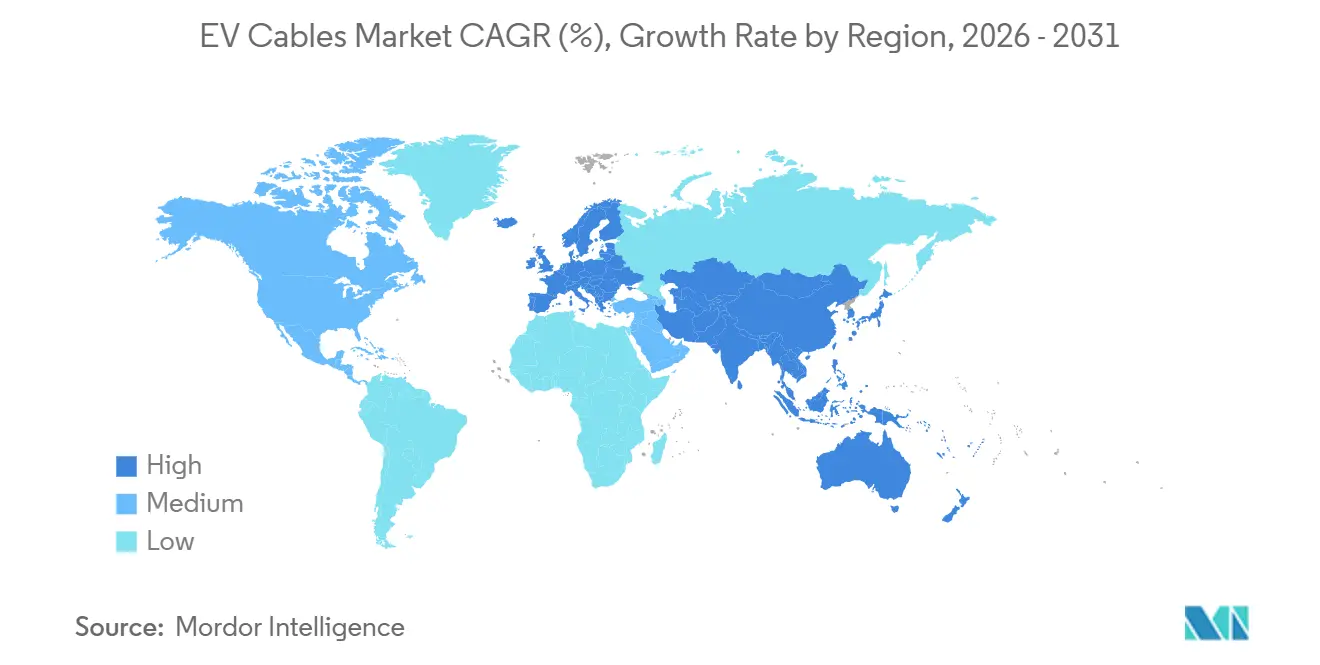
Asia-Pacific accounting for 36.74% of global revenue in 2025, and is projected to grow at 19.16 % CAGR through 2031. In the near future, China is expected to lead regional demand with significant BEV production. Meanwhile, India's Production-Linked Incentive scheme emphasizes a substantial domestic value threshold for subsidies to be met within a few years. Japan and South Korea are focusing on premium BEVs and FCEVs, with cable content per vehicle well above the global average.
North America is experiencing robust growth, supported by the Inflation Reduction Act, which requires that vehicles be sourced locally to qualify for consumer credits. Key players like Yazaki, Aptiv, and Lear are expanding operations with new plants in Mexico and the southern U.S. However, labor shortages are presenting challenges, slowing the pace of growth. Europe is matching North America's growth trajectory, with countries like Germany, France, and Spain making significant investments in converting platforms for EVs. Volkswagen, in particular, has allocated substantial resources for localizing electrical components [2]“Planning Round 70 Investor Deck,” Volkswagen AG, volkswagenag.com.
Although South America, the Middle East, and Africa are behind in absolute volume, they are achieving notable growth from a smaller base. Brazil's Rota 2030 initiative is encouraging local assembly efforts by companies such as BYD and Great Wall, which are now seeking certified cable lines to meet local-content requirements. In the UAE, plans are underway to establish a substantial number of DC chargers along the Dubai-Abu Dhabi corridor within a few years. South Africa's incentive program is extending to cable harnesses. However, these markets are awaiting more extensive charging infrastructure before large-scale demand can be realized.

Competitive Landscape
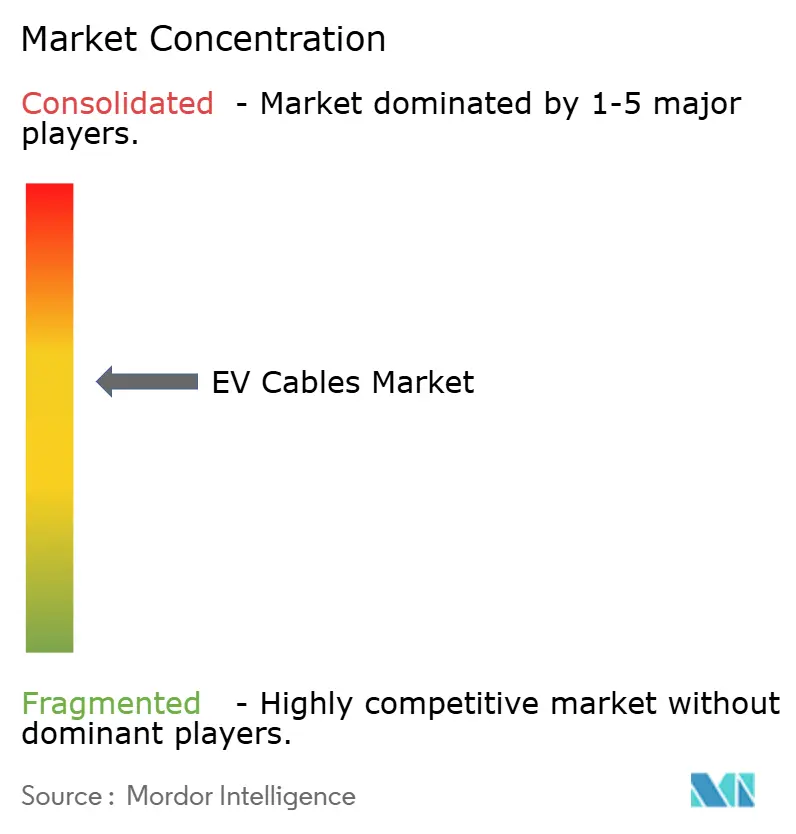
A significant portion of global EV cable revenue is commanded by a limited number of suppliers, creating a moderately concentrated market in which no single firm holds a dominant share. Yazaki, Sumitomo Electric, and Leoni leverage their legacy ties with OEMs and in-house XLPE compounding to secure core harness awards. Meanwhile, Huber + Suhner and Prysmian have carved out niches in liquid-cooled fast-charge cables that sustain high-duty cycles by using their proprietary aluminum-polymer shields.
Mid-tier challengers like Rosenberger and BizLink are seizing opportunities in pre-validated zonal kits. They offer significant cycle-time reductions, making them attractive to disruptor OEMs. In today's landscape, technology trumps volume: Aptiv’s Smart Cable not only integrates fiber for gigabit sensor feeds but also embeds temperature monitors for predictive replacements, a feature currently being trialed by autonomous vehicle programs.
OEMs are now mandating dual sourcing for every cable family, ensuring at least two ISO 19642-approved suppliers. This requirement paves the way for cost-competitive players from China and Southeast Asia. Patent data highlight the industry's rapid pace: Recently, Sumitomo Electric has secured multiple grants focused on EMC shielding. At the same time, Leoni has bolstered its extrusion capacity in Morocco to comply with EU sourcing regulations. While copper price fluctuations and emissions mandates underscore the importance of high-voltage expertise, geographic proximity is swiftly gaining prominence on the customer priority list.
EV Cables Industry Leaders
Yazaki
Sumitomo Electric
Leoni
Aptiv PLC
TE Connectivity
- *Disclaimer: Major Players sorted in no particular order
EV Cables Market Companies Covered in this Report
- Yazaki Corporation
- Sumitomo Electric Industries
- Leoni AG
- Aptiv PLC
- TE Connectivity
- Prysmian Group
- Nexans SA
- Huber+Suhner AG
- Fujikura Ltd.
- Furukawa Electric
- Lear Corporation
- LS Cable & System
- Amphenol Corp.
- ABB Ltd.
- Brugg Group
- Volex plc
- Rosenberger Group
- BizLink Group
- HELUKABEL GmbH
- Jiangsu Etern Co., Ltd.

Recent Industry Developments in EV Cables Market
- May 2026: Taiwan-based component supplier Sinbon Electronics debuted at Power2Drive Europe 2026 in Munich in June, where it will showcase a portfolio of EV charging products that meet European standards. Sinbon’s Munich portfolio includes Type 2 AC charging cables, CCS2 DC charging cables, CCS2 liquid-cooled charging cables, and CCS2 charging inlets, all designed specifically to meet European market requirements.
- January 2025: Leoni inaugurated a new factory in Agadir, Morocco, adding 3,000 jobs focused on commercial vehicle wiring harnesses.


Global EV Cables Market Report Scope
The scope of the report includes EV Type (Battery Electric Vehicle and More), Voltage Type (Low Voltage and More), Application (Engine & Powertrain and More), Component (Wire and More), Insulation Type (PVC and More), Shielding Type (Copper and Aluminum), and Geography.
Segmentation Overview
| Battery Electric Vehicle (BEV) |
| Plug-in Hybrid Electric Vehicle (PHEV) |
| Hybrid Electric Vehicle (HEV) |
| Fuel Cell Electric Vehicle (FCEV) |
| Low Voltage |
| Medium Voltage |
| High Voltage |
| Engine & Powertrain |
| Battery & Battery Management |
| Charging Management |
| Power Electronics |
| Motor Cables |
| Others |
| Wire |
| Connectors |
| Fuse |
| Insulation & Shielding Materials |
| PVC |
| XLPE |
| TPE |
| Others |
| Copper |
| Aluminum |
| North America | United States |
| Canada | |
| Rest of North America | |
| South America | Brazil |
| Argentina | |
| Rest of South America | |
| Europe | United Kingdom |
| Germany | |
| Spain | |
| Italy | |
| France | |
| Russia | |
| Rest of Europe | |
| Asia-Pacific | India |
| China | |
| Japan | |
| South Korea | |
| Rest of Asia-Pacific | |
| Middle East and Africa | United Arab Emirates |
| Saudi Arabia | |
| Turkey | |
| Egypt | |
| South Africa | |
| Rest of Middle East and Africa |
| By EV Type | Battery Electric Vehicle (BEV) | |
| Plug-in Hybrid Electric Vehicle (PHEV) | ||
| Hybrid Electric Vehicle (HEV) | ||
| Fuel Cell Electric Vehicle (FCEV) | ||
| By Voltage Type | Low Voltage | |
| Medium Voltage | ||
| High Voltage | ||
| By Application | Engine & Powertrain | |
| Battery & Battery Management | ||
| Charging Management | ||
| Power Electronics | ||
| Motor Cables | ||
| Others | ||
| By Component | Wire | |
| Connectors | ||
| Fuse | ||
| Insulation & Shielding Materials | ||
| By Insulation Type | PVC | |
| XLPE | ||
| TPE | ||
| Others | ||
| By Shielding Type | Copper | |
| Aluminum | ||
| By Geography | North America | United States |
| Canada | ||
| Rest of North America | ||
| South America | Brazil | |
| Argentina | ||
| Rest of South America | ||
| Europe | United Kingdom | |
| Germany | ||
| Spain | ||
| Italy | ||
| France | ||
| Russia | ||
| Rest of Europe | ||
| Asia-Pacific | India | |
| China | ||
| Japan | ||
| South Korea | ||
| Rest of Asia-Pacific | ||
| Middle East and Africa | United Arab Emirates | |
| Saudi Arabia | ||
| Turkey | ||
| Egypt | ||
| South Africa | ||
| Rest of Middle East and Africa | ||


Key Questions Answered in the Report
How large is the EV cables market expected to be by 2031?
Global revenue is projected to reach USD 30.43 billion by 2031, reflecting an 18.98% CAGR from 2026 to 2031.
Which voltage category shows the strongest growth outlook?
High-voltage cables—rated up to 1,500 V DC—lead value today and are forecast to expand at roughly 19.05% CAGR through 2031.
Why are aluminum shields gaining popularity over copper?
A copper-to-aluminum price ratio above 4.0 in early 2026 makes aluminum 30–40% cheaper and 40–50% lighter, persuading automakers to adopt it for non-critical EMC shielding.
What drives Asia-Pacific’s leadership in EV cabling?
China’s 9.5 million BEV output in 2025, combined with India’s localization incentives and aggressive fast-charge rollout, underpins the region’s 19.16% CAGR outlook.
How do zero-emission mandates influence cable demand?
Rules such as California’s ACC II and the EU’s clean-fleet targets boost BEV share, increasing per-vehicle cable length from about 1 km in ICE cars to up to 2 km in BEVs.
What role do connectors play in new zonal vehicle platforms?
Zonal architectures multiply inter-zone joins, so high-voltage hybrid connectors that bundle power and Ethernet data are growing near 19.03% CAGR and cutting harness install time by up to 30%.
Page last updated on:


 Your data is secure and never sold or shared.


