
Residential EV Charger Market Size and Share
Market Overview
| Study Period | 2020 - 2032 |
|---|---|
| Market Size (2027) | USD 15.45 Billion |
| Market Size (2032) | USD 49.76 Billion |
| Growth Rate (2027 - 2032) | 26.35 % |
| Fastest Growing Market | Middle East and Africa |
| Largest Market | Asia-Pacific |
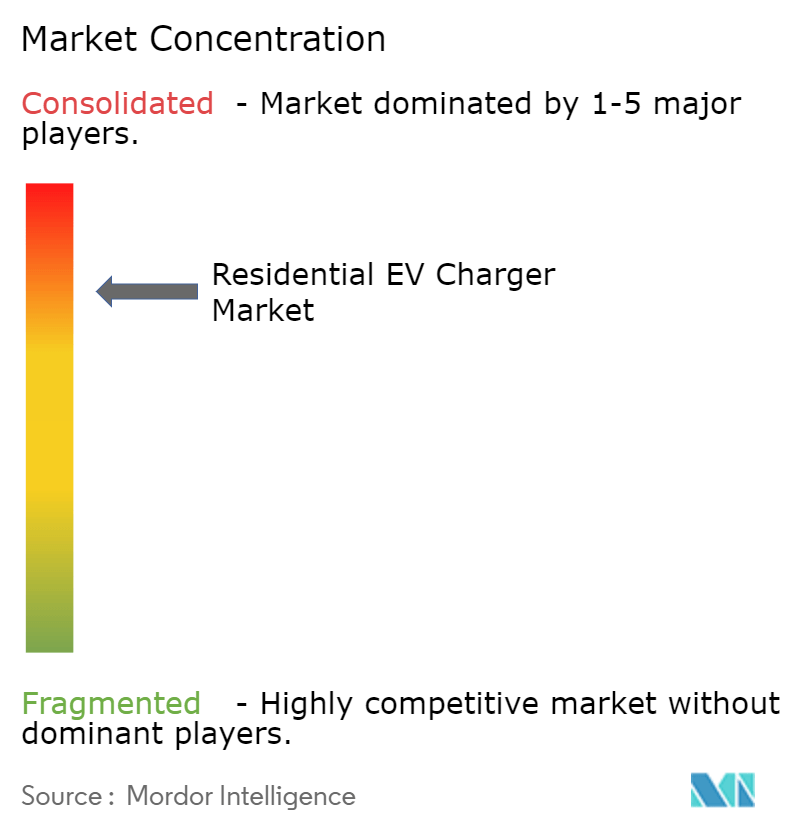
| Market Concentration | Medium |
Major Players *Disclaimer: Major Players sorted in no particular order Image © Mordor Intelligence. Reuse requires attribution under CC BY 4.0. | |
Residential EV Charger Market Analysis by Mordor Intelligence
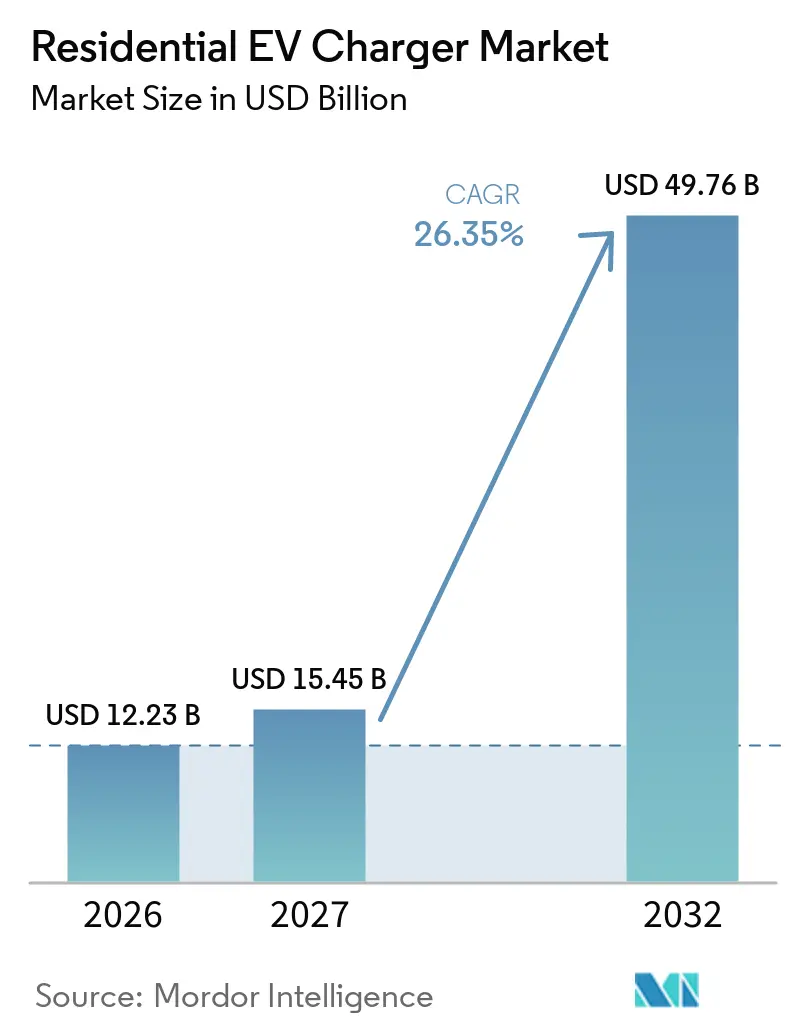
The residential EV charger market size was valued at USD 12.23 billion in 2026, is estimated at USD 15.45 billion in 2027, and is projected to reach USD 49.76 billion by 2032, growing at a CAGR of 26.35% from 2027 to 2032. Global electric car sales surpassed 20 million units in 2025, and the International Energy Agency expects 23 million units in 2026, supporting continued demand for home charging equipment. More than 43 million private home charge points were in service worldwide at the end of 2025, making home charging the principal routine charging location for a large part of the EV fleet. The residential EV charging market benefits from public incentives, falling equipment costs, and the growing use of residential solar and battery systems. Competition is moving beyond basic Level 2 hardware toward managed charging, home energy coordination, and bidirectional capability. Installation costs, electrical panel limits, permitting, and cybersecurity risks remain important barriers, especially in older homes.
Key Report Takeaways
- By charger type, Level 2 chargers held 67.83% of the residential EV charging market share in 2026, while wireless and inductive chargers were the fastest-growing type at 34.78% through 2032.
- By vehicle type, passenger cars accounted for 92.58% of the residential EV charging market share in 2026, while two-wheelers and micro-mobility devices are projected to grow at a 30.09% CAGR through 2032.
- By charging-station power band, the medium power band held 44.13% of the residential EV charging market share in 2026, while the high power band is projected to grow at a 27.59% CAGR through 2032.
- By connectivity, smart and networked chargers accounted for 65.55% of market share in 2026 and are projected to grow at a 28.12% CAGR through 2032.
- By installation type, wall-mounted chargers held 60.25% of the residential EV charging market share in 2026, while portable plug-in chargers were the fastest-growing installation type at a 28.35% CAGR through 2032.
- By purchase channel, OEM bundled programs accounted for 47.19% of volume in 2026, while specialist EV stores and installer networks are projected to grow at a 27.11% CAGR through 2032.
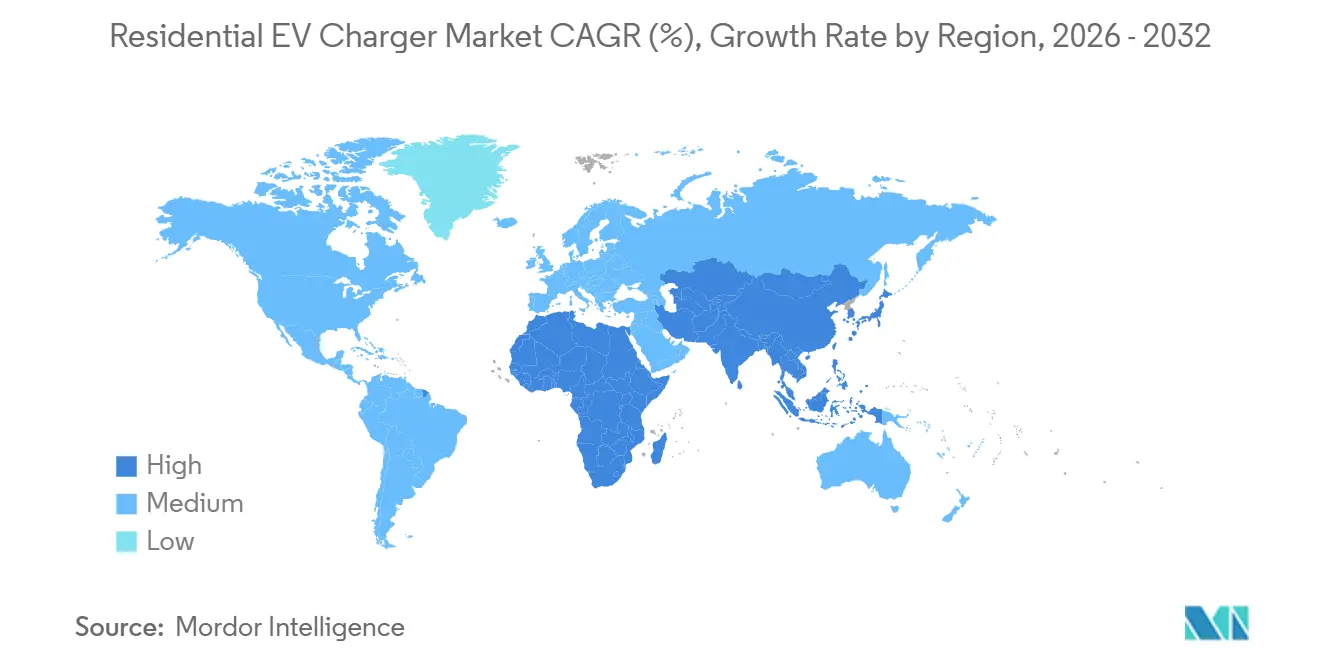
- By geography, Asia-Pacific held 40.01% of the residential EV charging market share in 2026, while the Middle East and Africa are projected to grow at a 27.44% CAGR through 2032.
Note: Market numbers in this report are based on Mordor Intelligence's proprietary estimation framework, which combines nine months of actuals with Q4 projections for base year 2026.
Market Trends and Insights
Drivers Impact Analysis of Residential EV Charger Market*
| Driver | (~) % Impact on CAGR Forecast | Geographic Relevance | Impact Timeline |
|---|---|---|---|
| Rising EV Adoption | +8.5% | Global, with Asia-Pacific and North America leading | Medium term (2-4 years) |
| Government Incentives for Home Charging | +6.2% | North America and Europe core, | Short term (≤ 2 years) |
| Falling Charger Hardware Costs | +4.8% | Global, with manufacturing scale benefits in Asia-Pacific | Medium term (2-4 years) |
| Residential Solar-Plus-Storage Uptake | +3.1% | North America, Europe , Australia with high solar penetration | Long term (≥ 4 years) |
| Second-Hand EV Aftermarket Demand | +2.4% | Global, with early adoption in developed markets | Long term (≥ 4 years) |
| V2H / V2G Monetisation Opportunities | +1.7% | North America and Europe regulatory frameworks, | Long term (≥ 4 years) |
| Source: Mordor Intelligence | |||
Rising EV Adoption
Global electric car sales continue to rise significantly from the preceding period. China’s target for EVs to account for a substantial share of new car sales reinforces regional momentum and highlights the critical link between vehicle adoption and residential infrastructure. Rapid adoption is no longer limited to leading markets. In Jordan, EVs account for a significant share of vehicle sales, as tax exemptions drive a surge in imports. Consistent with the International Energy Agency's findings, more than 90% of UK owners already rely on home charging, reinforcing the primacy of residential access [2].
Government Incentives for Home Charging
Tax credits, building codes and infrastructure mandates together lower up-front costs and guarantee long-term demand for home equipment. In the United States, individuals can offset 30% of qualified installation expenses, capped at USD 1,000, through 2032[3]. California tightens the policy net by requiring every new dwelling to include EV-ready circuits from 2026, while the EU’s Energy Performance of Buildings Directive obliges new multi-space residential structures to fit charging or at least pre-cabling. Mandatory public-road charging every 60 km under the Alternative Fuels Infrastructure Regulation creates further confidence for homeowners considering overnight charging solutions.
Falling Charger Hardware Costs
Economies of scale at Asian factories, cheaper battery cathodes and integrated load-management electronics push average selling prices lower each year. Argonne National Laboratory projects U.S. battery costs sliding toward USD 86 per kWh by 2035, reinforcing a downward trajectory for associated charging electronics. Emporia’s Pro charger retails for USD 599 with built-in load management, illustrating how smart features now arrive at mid-market price points. Siemens’ USD 25 million stake in WiTricity highlights how investment capital accelerates cost reductions in wireless technology.
Residential Solar-Plus-Storage Uptake
Coupling rooftop PV, batteries, and EV chargers lets households arbitrage tariffs and ride through grid outages. A 4 kW solar-based hybrid station can refuel 10-12 EVs daily and even export surplus power, improving payback on solar arrays. Schneider Electric integrates these assets into a single energy platform, simplifying monitoring and bringing prosumer capabilities into the mainstream.
Restraints Impact Analysis of Residential EV Charger Market*
| Restraint | (~) % Impact on CAGR Forecast | Geographic Relevance | Impact Timeline |
|---|---|---|---|
| High Installation Cost | -2.30% | Global, with higher impact in price-sensitive markets | Short term (≤ 2 years) |
| Legacy Home electrical-Panel Limits | -1.80% | North America and older Europe housing stock | Medium term (2-4 years) |
| Permit and Inspection Delays | -1.20% | North America regulatory jurisdictions | Short term (≤ 2 years) |
| Cyber-Security Vulnerabilities in Smart Chargers | -0.90% | Global, with higher concern in developed markets | Medium term (2-4 years) |
| Source: Mordor Intelligence | |||
High Installation Cost
Beyond the charger, households can face several thousand dollars in panel or service-line upgrades, delaying payback and slowing adoption. Multifamily residents encounter added complexity when parking bays lack sufficient electrical feeds, a gap now addressed by dynamic load-sharing products that minimise upfront work. Utilities such as PG&E apply grid-edge intelligence to curb those expenses, offering real-time control that keeps upgrade requirements modest.
Legacy Home Electrical-Panel Limits
Many older homes cannot support a dedicated high-capacity circuit without rewiring, prompting early consultations with utilities such as the Los Angeles Department of Water and Power. The development of power-control system standards, notably UL standards, is likely to validate multi-appliance load management and reduce the need for costly service upgrades.
*Our forecasts treat driver/restraint impacts as directional, not additive. The impact forecasts reflect baseline growth, mix effects, and variable interactions.
Residential EV Charger Market Segment Analysis
By Charger Type:
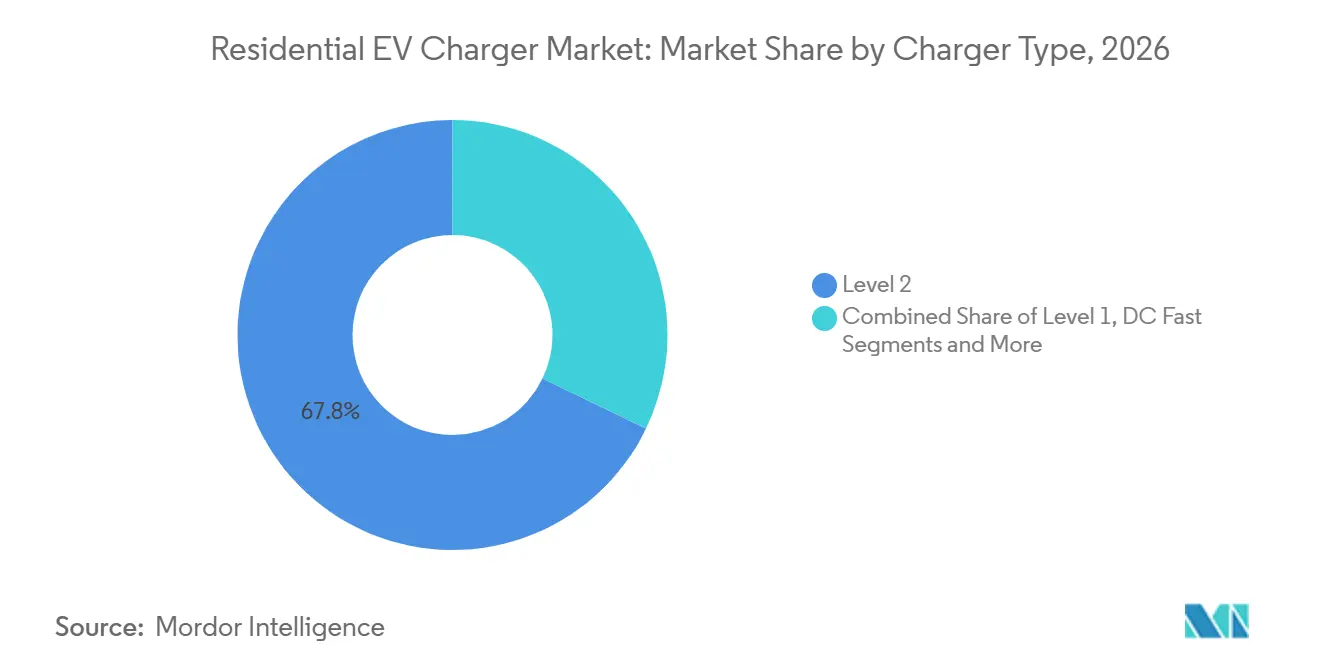
Level 2 Dominance Meets Wireless MomentumLevel 2 devices accounted for 67.83% of 2026 revenue, reflecting their overnight charging convenience and compatibility with existing 240 V circuits. This slice of the residential EV charging market will persist thanks to modest equipment costs, established installation protocols, and rising vehicle battery capacities, which make Level 1 gear less attractive. Meanwhile, the wireless segment is on a 34.78% CAGR path, spurred by consumer preference data showing 96% of buyers view cable-free charging as ideal.
Tesla’s patent work underscores growing OEM interest, and SAE’s 2024 standard now offers a foundation for interoperable designs. As component cost curves drop, wireless solutions can erode perceived complexity, particularly for older or mobility-limited drivers. Because power delivery scales up to 11 kW in forthcoming home pads, dwell times remain comparable to wired Level 2 units, minimizing range anxiety while elevating user convenience.

By Vehicle Type:
Passenger-Car Core with Micromobility UpsidePassenger cars accounted for 92.58% of 2026 unit sales, anchoring the residential EV charging market and reflecting mature incentive structures and mass-market model availability. Light commercial fleets will gain traction as urban delivery mandates multiply, but remain secondary through the medium term.
Micromobility formats—e-scooters, e-bikes, and related platforms—are tracking a 30.09% CAGR because low-power batteries enable flexible, decentralized charging. These vehicles present unique infrastructure challenges, prompting innovation in compact, shared, or solar-assisted dock systems. Flexible battery-swap schemes and wireless induction pads tailored for two-wheelers should unlock new revenue streams in dense urban centers where passenger-car ownership is limited.
By Charging-Station Power Band:
Medium Strength, High-Power SurgeMedium systems in the 3.8–11 kW range accounted for 44.13% of 2026 revenue, a proportion that sets the performance benchmark for mainstream homeowners. They offer full battery charging overnight without overburdening typical 200-amp panels, underpinning much of the residential EV charging market share held by smart, load-controlled devices. Low-power units below 3.7 kW will retreat as battery capacities widen.
High-power stations above 11 kW are forecast to compound at a 27.59% CAGR, driving the residential EV charging market size in this niche. Falling silicon-carbide inverter costs, plus growing three-phase supply in new construction, drive that appetite. High-rate equipment also aligns with bidirectional needs: feeding a whole home during grid failures requires robust discharge rates best served by high-power ports.
By Connectivity:
Smart Chargers Anchor Grid ServicesSmart models accounted for 65.55% of 2026 revenue, thanks to open protocols such as OCPP 2.0.1, utility demand-response incentives, and homeowner interest in tariff optimization. WeaveGrid’s software tie-up with Emporia shows how cloud analytics balance grid stress while lowering consumer bills.
The segment’s 28.12% CAGR rests on deeper integration with rooftop solar, stationary batteries, and demand-response markets. Firmware updates already allow chargers to follow real-time marginal-cost signals, unlocking new revenue and accelerating customer payback. Non-networked devices will persist in budget or off-grid settings but will lose relative share as the smart premium falls below USD 50 per unit.
By Installation Type:
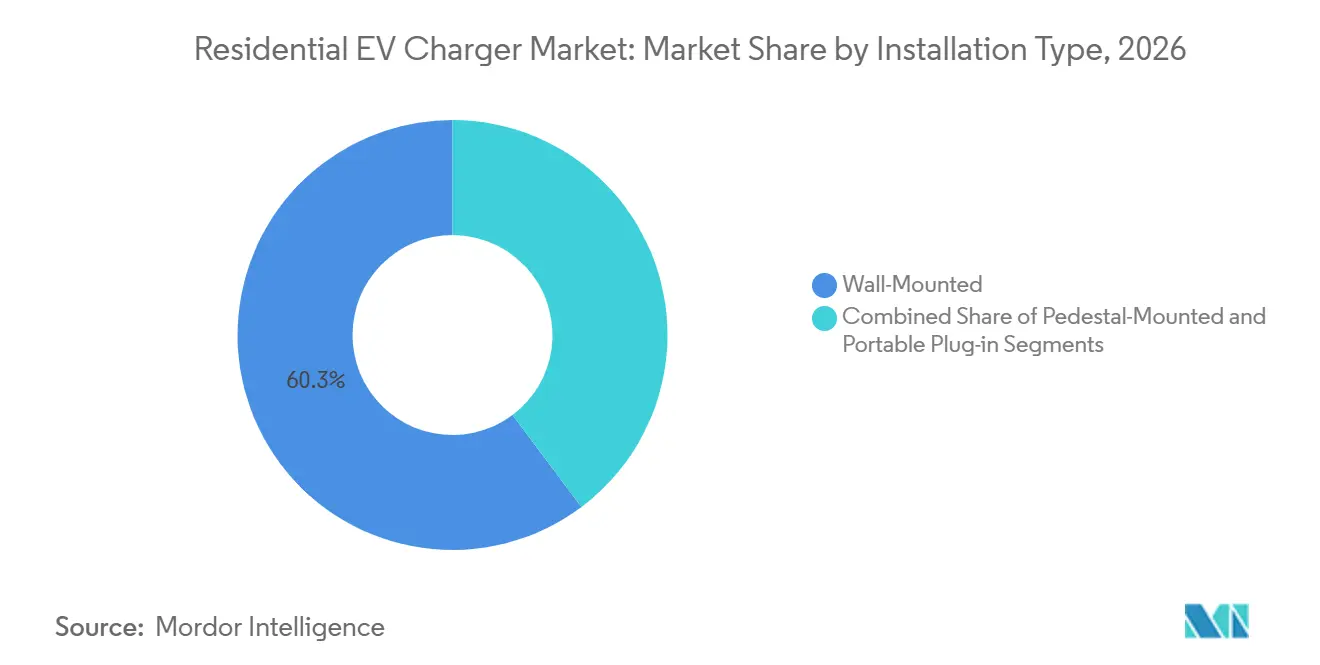
Wall-Mount Prevalence, Portable FlexibilityWall-mounted solutions captured 60.25% of 2026 revenue, long favored for tidy garage fits and direct conduit runs to panels. Combined with simple drip covers, these units satisfy insurance and local code criteria across most climates, ensuring an entrenched position in the residential EV charging market.
Portable plug-in units, however, are growing at 28.35% CAGR, appealing to renters, apartment dwellers, and traveling professionals alike. Their value proposition rests on avoiding permit delays and providing users with resilience in emergencies when fixed equipment may be offline. Recent innovations have shrunk form factors while boosting power to 9.6 kW, blurring the lines with permanent installations and inviting wider uptake.
By Purchase Channel:
OEM Bundling Retains the LeadAutomakers accounted for nearly 47.19% of 2026 home equipment sales, leveraging showroom influence and ensuring brand-authorized compatibility. Integrating installation services into the vehicle finance package simplifies the customer path and maintains a critical lock-in advantage for OEMs within the residential EV charging market.
Specialist EV installers and dedicated retail outlets are growing at a 27.11% CAGR. As home charging evolves into an energy-system upgrade, buyers increasingly rely on experienced electricians versed in solar, storage, and load-management design. Partnerships like ChargePoint’s program with Airbnb show how niche channels target unique user cohorts and raise overall adoption.
Geography Analysis
Asia-Pacific Residential EV Charger Market
Asia-Pacific led with a 40.01% share in 2026 after China’s government backed unified charging standards that support mass production efficiencies and compressed installation costs. Japan’s early embrace of vehicle-to-home backup, alongside high rooftop solar penetration in Australia, further cements regional leadership. India lags on home-charger penetration—only 55% of EV owners have private access—but strong policy pushes and local manufacturing incentives make it pivotal for future volume.
North America and EMEA Residential EV Charger Market
North America is powered by federal tax incentives and active state mandates. California alone counts more than 2 million registered EVs and will require chargers at every new dwelling within 12 months of certificate-of-occupancy issuance. Canadian pilots on V2G reinforce the region’s path toward grid-service monetization while sparking demand for bidirectional-ready hardware.
Europe follows close behind, driven by the Alternative Fuels Infrastructure Regulation and strict building directives that oblige chargers in both new and renovated properties. Cybersecurity mandates—such as the UK’s anti-tampering rules—are shaping hardware specs and favoring established suppliers with deep compliance expertise. The Middle East and Africa, though smaller today, is the fastest-growing region, advancing at a 27.44% CAGR to 2032.
Competitive Landscape
Industry concentration is moderate. Tesla led the 2025 residential volume, extending its vehicle-owner ecosystem; Wallbox followed, having acquired ABL and added more than 1 million European installs. Schneider Electric differentiates itself through integrated home energy management, bundling solar, storage, and charger control within a single platform.
Mergers and acquisitions activity is accelerating as suppliers seek scale, portfolio breadth, and geographic reach. Wallbox’s EUR 15 million ABL purchase gave it German production and a stronger presence in utility tenders. Eaton and ChargePoint forged a first-of-its-kind alliance pairing switchgear with charge-point hardware, streamlining design and permitting for installers. Patent filings on wireless pads, load-balancing algorithms, and bidirectional interfaces illustrate a technology race favoring firms with cross-domain skill sets.
Cost barriers associated with panel upgrades continue to hinder expansion, yet software-defined load control is closing the gap. Companies such as Emporia now embed current-sensing modules in chargers, dynamically allocating household power without extra copper runs. As the standardization of power-control protocols matures, additional players will enter the market, keeping prices in check and sustaining healthy competition.
Residential EV Charger Industry Leaders
-
Tesla, Inc.
-
ChargePoint, Inc.
-
ABB Ltd.
-
Schneider Electric SE
-
Wallbox N.V.
- *Disclaimer: Major Players sorted in no particular order
Residential EV Charger Market Companies Covered in this Report
- Tesla Inc.
- Wallbox N.V.
- Schneider Electric SE
- Siemens AG
- ABB Ltd.
- ChargePoint Holdings Inc.
- Webasto Group
- Eaton Corporation plc
- Blink Charging Co.
- EVBox Group
- Enphase Energy, Inc.
- Enel S.p.A. (Enel X Way)
- Delta Electronics, Inc.
- Pod Point Group PLC
- Autel Intelligent Technology Corp.
Recent Industry Developments in Residential EV Charger Market
- September 2026: EP Cube, Canadian Solar’s residential energy storage and management brand, announced the launch of the EP Cube EV Charger in Europe through a strategic partnership with KEBA, a European leader in AC and DC charging infrastructure. Powered by KEBA’s proven charging technology, the new solution offers a reliable, easy-to-install EV charger that fully integrates with the EP Cube smart home energy ecosystem. It enables homeowners to optimize EV charging, reduce energy costs, and maximize the value of their solar investments.
- August 2026: Schneider Electric has unveiled Schneider Charge, a smart and simple residential EV charger designed to meet modern home energy needs. Schneider Charge automatically adjusts EV charging based on household energy consumption, enabling homeowners to add Level 2 charging at a lower cost and with less complexity. The solution also simplifies installation for electricians.
Residential EV Charger Market Report Scope and Research Methodology
Market Definition and Coverage
Our study defines the residential EV charger market as the sale of new alternating or direct current devices up to 22 kW that are permanently or semi permanently installed at single-family homes and multi-unit dwellings to replenish electric passenger vehicles overnight or during extended parking.
Scope Exclusions: Portable emergency cables, public or workplace charge points, and post-sale maintenance services are outside this scope.
Segments Covered in This Report
- By Charger Type
- Level 1 ( Up to 1.9 kW)
- Level 2 (2- 22 kW)
- DC Fast (50 kW and Above)
- Wireless / Inductive
- By Vehicle Type
- Passenger Cars
- Light Commercial Vehicles
- Two-Wheelers / Micro-mobility
- By Charging-Station Power Band
- Low ( Up to 3.7 kW)
- Medium (3.8 - 11 kW)
- High (Above 11 kW)
- By Connectivity
- Smart / Networked
- Non-Smart
- By Installation Type
- Wall-Mounted
- Pedestal-Mounted
- Portable Plug-in
- By Purchase Channel
- OEM Bundled
- EV Dealerships
- Online Retail
- Specialist EV Stores / Installers
- By Geography
- North America
- United States
- Canada
- Rest of North America
- South America
- Brazil
- Argentina
- Rest of South America
- Europe
- Germany
- United Kingdom
- France
- Italy
- Spain
- Russia
- Rest of Europe
- Asia-Pacific
- China
- Japan
- India
- South Korea
- Australia
- Rest of Asia-Pacific
- Middle East and Africa
- Saudi Arabia
- United Arab Emirates
- Turkey
- South Africa
- Egypt
- Rest of Middle East and Africa
- North America
Data Sources, Market Sizing, and Validation
Primary Research
Mordor analysts interviewed charger OEM product managers, residential installers, utilities, and EV owner associations across North America, Europe, China, and emerging ASEAN markets. These conversations validated household adoption curves, average selling prices, and failure rate assumptions that secondary sources could only hint at, letting us fine tune penetration and replacement cycles.
Desk Research
We began with public datasets such as the IEA Global EV Outlook, the US DOE Alternative Fuels Data Center, Eurostat trade filings, and China Customs import codes to size charger flows and price bands. Industry bodies such as the Electric Drive Transportation Association and AVERE supplied installation ratios, while peer-reviewed journals clarified load management efficiencies. To benchmark manufacturer revenues and shipment splits, we tapped paid databases that Mordor analysts subscribe to, including D&B Hoovers for company financials and Dow Jones Factiva for recent expansion news. This list is illustrative; several other open and subscription sources informed data checks and context building.
A second desk research wave collated regulatory triggers, home charger subsidies, building code mandates, and metering tariffs across 30 major EV nations; these inputs framed scenario bounds and ensured country models aligned with policy momentum.
Market-Sizing & Forecasting
A top down pool of installed EV stock by country is rebuilt from registration data and adjusted by our surveyed 'home charging share.' That demand pool is multiplied by weighted replacement and first fit rates, then cross checked with bottom up samples of supplier shipments and installer invoices. Key variables like EV parc growth, single-family housing mix, charger subsidy value, average unit price, and smart charger uptake feed a multivariate regression that projects demand through 2030. Where installer data were patchy, we bridged gaps with median ASPs from online retail trackers and regional proxy ratios derived from similar appliance roll outs.
Data Validation & Update Cycle
Model outputs pass three reviews: variance checks versus import records, peer analyst audits, and a reconciliation against electricity meter connections. Reports refresh annually, with interim tweaks when subsidy structures or major code revisions materially shift the outlook. Before delivery, an analyst conducts a last minute news sweep so clients receive our latest view.
How Mordor Intelligence's Residential EV Charger Market Size Compares to Other Published Estimates
Published numbers differ because some publishers fold in commercial stations, others blend hardware with services, and several use outdated EV stock baselines.
By selecting a charger only lens, applying live ASP sampling, and revisiting inputs every twelve months, Mordor produces a balanced midpoint, neither overly bullish nor cautious, that executives can trace back to observable levers.
Benchmark comparison
| Market Size | Anonymized source | Primary gap driver |
|---|---|---|
| USD 9.68 B (2025) | Mordor Intelligence | - |
| USD 14.49 B (2024) | Global Consultancy A | Includes public and workplace units, older currency rates |
| USD 4.20 B (2024) | Industry Journal B | Excludes multi-unit dwellings and uses conservative EV stock forecast |
The comparison shows that figures swing mainly on scope breadth, housing type coverage, and refresh cadence. By anchoring estimates to clear device definitions and policy aligned variables, Mordor delivers a transparent, reproducible baseline that planners can rely upon with confidence.
Key Questions Answered in the Report
What is the projected value of residential EV charging by 2032?
The residential EV charging market is forecast to reach USD 49.76 billion by 2032, from USD 12.23 billion in 2026.
Which charger type has the largest residential demand?
Level 2 chargers held 67.83% share in 2026 because they align with common 240 V home circuits and overnight charging needs.
Why are smart home chargers growing quickly?
Smart and networked chargers are projected to grow at 28.12% CAGR through 2032 because they support load management, utility programs, and remote diagnostics.
Which region has the largest share of home EV charging demand?
Asia-Pacific held 40.01% share in 2026, supported by China’s large EV fleet and private charger base.