
Nordics UEM Market Size and Share
Market Overview
| Study Period | 2020 - 2031 |
|---|---|
| Forecast Data Period | 2026 - 2031 |
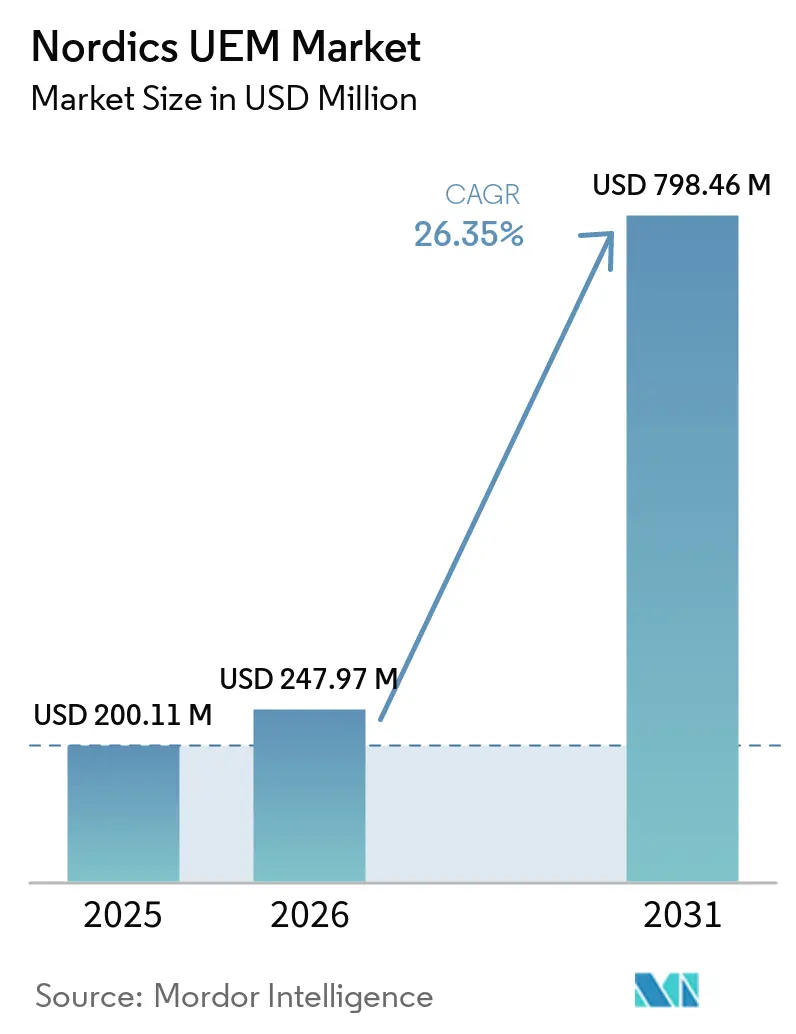
| Base Year Market Size (2025) | USD 200.11 Million |
| Market Size (2026) | USD 247.97 Million |
| Market Size (2031) | USD 798.46 Million |
| Growth Rate (2026 - 2031) | 26.35 % |
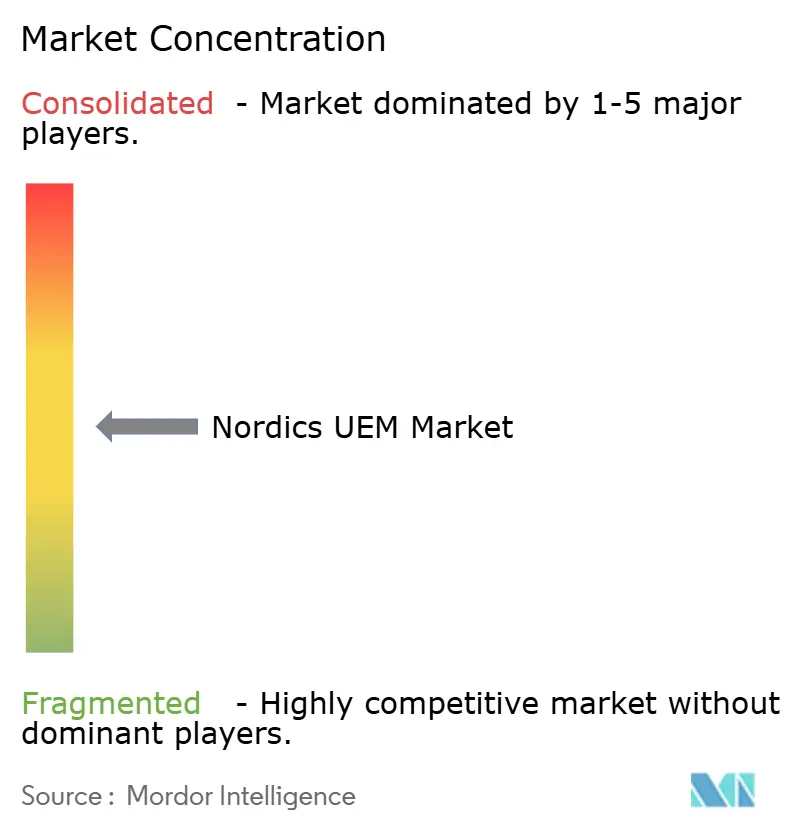
| Market Concentration | Medium |
Major Players *Disclaimer: Major Players sorted in no particular order Image © Mordor Intelligence. Reuse requires attribution under CC BY 4.0. | |
Nordics UEM Market Analysis by Mordor Intelligence
The Nordics UEM market size was valued at USD 200.11 million in 2025, USD 247.97 million in 2026, and is projected to reach USD 798.46 million by 2031, growing at a CAGR of 26.35% over 2026-2031. The Nordics unified endpoint management (UEM) market is moving ahead of broader European endpoint management demand because regulatory action in Sweden, Finland, and Denmark has brought security controls, reporting discipline, and management accountability into the same buying cycle. This has turned the Nordics UEM market into a compliance-led spending category rather than a discretionary IT upgrade, especially in regulated sectors that now need stronger policy enforcement and audit trails across device fleets. The Nordics UEM market is also being shaped by demand for in-region hosting and sovereign control, which is pushing vendors to prove jurisdictional alignment and public-sector readiness instead of competing only on feature depth. AI-based automation, shared device use, and healthcare digitization are widening the operational scope of the Nordics unified endpoint management (UEM) market across both knowledge-worker and frontline settings. At the same time, execution gaps inside buyer organizations are supporting a larger role for services, managed delivery, and channel-led implementation models across the Nordics UEM market.
Key Report Takeaways
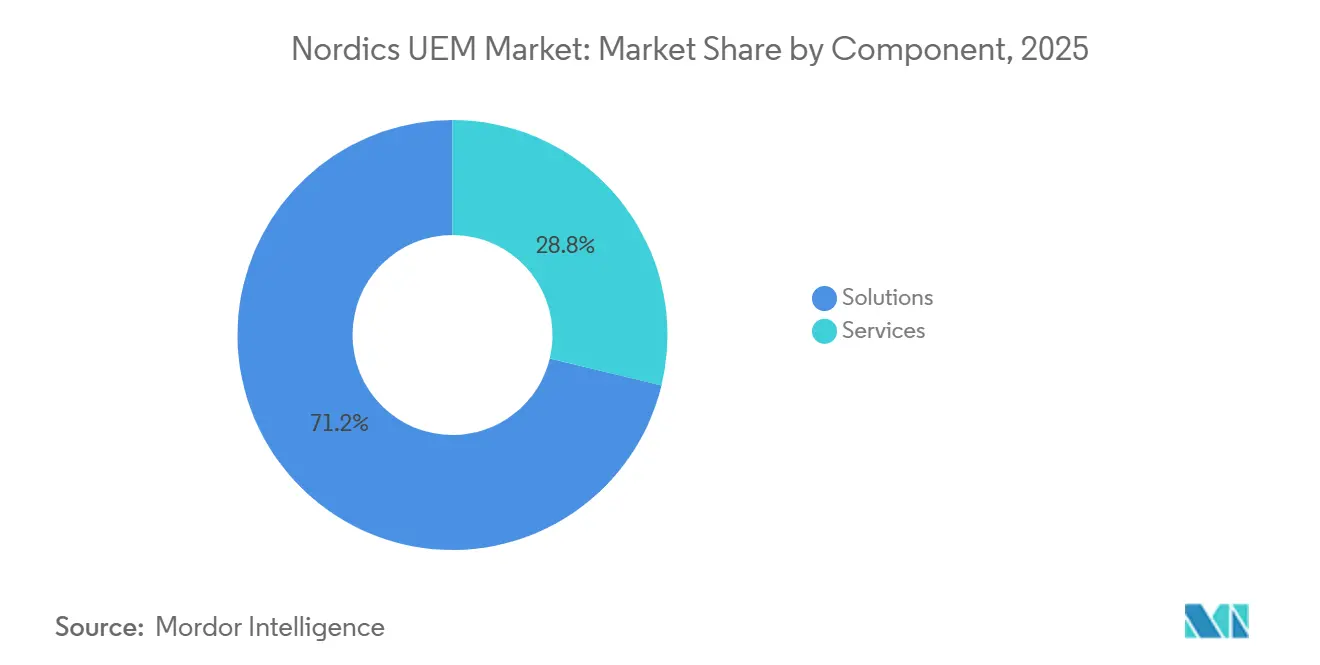
- By component, Solutions led with 71.23% revenue share in 2025, and the same segment is forecast to grow at a 27.14% CAGR to 2031 in the Nordics UEM market.
- By deployment mode, Cloud-based deployments accounted for 72.33% share in 2025, nd the same segment is forecast to grow at a 27.32% CAGR to 2031.
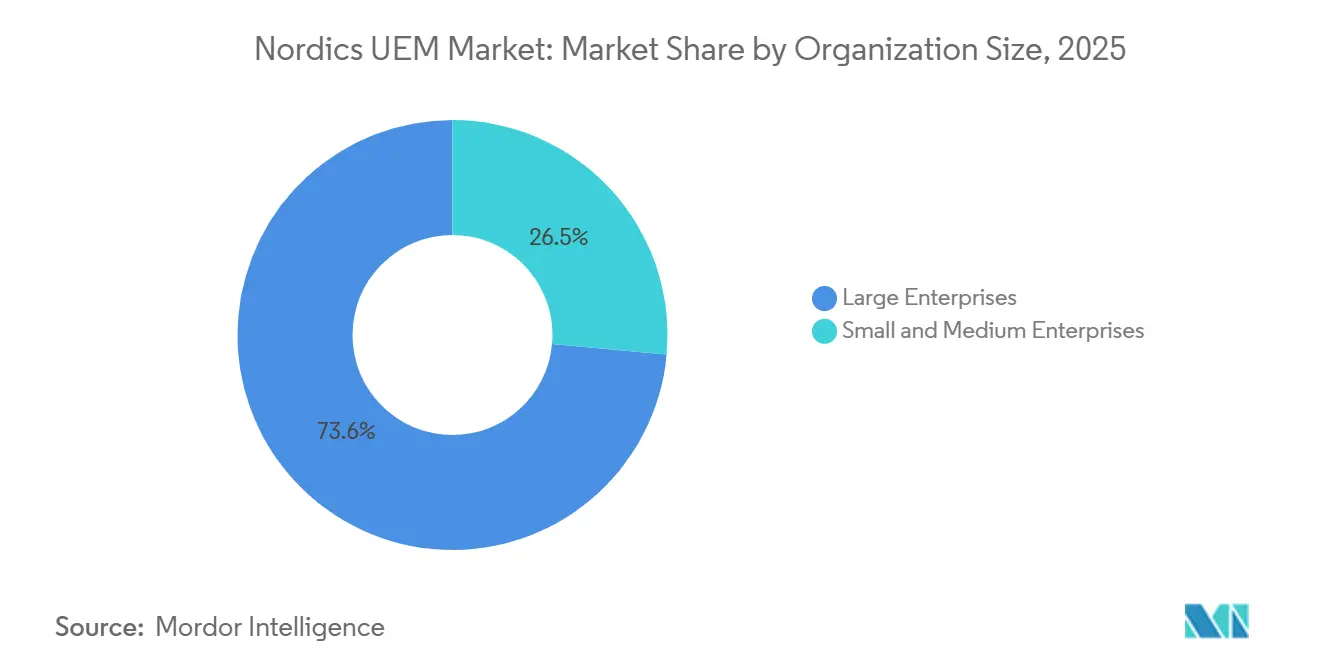
- By organization size, Large Enterprises led with 73.55% revenue share in 2025; Small and Medium-sized Enterprises are forecast to grow at a 27.45% CAGR to 2031 in the Nordics UEM market.
- By end-user industry, IT and Telecommunications led with 21.34% revenue share in 2025; Healthcare and Life Sciences are forecast to grow at a 27.41% CAGR to 2031.
- By country, Sweden held 36.77% of the Nordics UEM market share in 2025, while Finland is projected to expand at a 27.52% CAGR through 2031.
Note: Market size and forecast figures in this report are generated using Mordor Intelligence’s proprietary estimation framework, updated with the latest available data and insights as of January 2026.
Market Trends and Insights
Drivers Impact Analysis of Nordics UEM Market*
| Driver | (~) % Impact on CAGR Forecast | Geographic Relevance | Impact Timeline |
|---|---|---|---|
| Rising Zero Trust and Endpoint Threat Exposure | +5.1% | Nordic core, spill-over to EU-wide regulated sectors | Short term (≤ 2 years) |
| Cloud Sovereignty Preference for In-Region Data Residency | +4.8% | EU-wide, with Nordic lead in sovereign cloud procurement | Short term (≤ 2 years) |
| AI-Driven Device Automation and Self-Healing Workflows | +4.5% | Global, with early Nordic enterprise adoption | Medium term (2-4 years) |
| Hybrid Work and BYOD Expansion Across Regulated Nordics Workplaces | +4.2% | Nordics core, spill-over to broader EU hybrid workforce | Short term (≤ 2 years) |
| Growth in Frontline and Shared Device Fleets | +3.2% | Nordics core, retail, logistics, and healthcare verticals | Medium term (2-4 years) |
| Energy Efficient Endpoint Governance for ESG Reporting | +2.8% | Nordic-led, expanding to EU under CSRD requirements | Long term (≥ 4 years) |
| Source: Mordor Intelligence | |||
Rising Zero Trust and Endpoint Threat Exposure
Zero trust has shifted from a preferred security model to a defined operating requirement across the Nordics UEM market. Denmark’s NIS2-loven entered into force on July 1, 2025, and Sweden’s Cybersecurity Act entered into force on January 15, 2026, which moved endpoint protection, logging, and vulnerability management into formal compliance scope for many regulated organizations.[1] Finland followed the same direction when its Cybersecurity Act took effect in April 2025 and required risk management obligations for essential entities. This has widened the budget and decision authority around unified endpoint tools because device controls now support regulatory readiness as much as security operations. Buyers in the Nordics unified endpoint management (UEM) market are therefore asking for stronger telemetry, faster policy enforcement, and audit-ready device records instead of basic mobile device administration. That change is raising the value of full platform deployments over lighter point tools in the Nordics unified endpoint management (UEM) market.
Cloud Sovereignty Preference for In-Region Data Residency
Cloud sovereignty has become a direct buying factor in the Nordics UEM market because regulated entities increasingly want endpoint data to remain under clearly defined European jurisdiction. Ivanti’s April 2026 launch of Ivanti Neurons for MDM Sovereign Edition EU showed that vendors are now building dedicated offerings for public institutions and regulated enterprises that need certified European hosting and auditable control layers.[2] This matters in the Nordics UEM market because procurement frameworks are no longer treating hosting location as a secondary technical choice. They are evaluating whether a vendor can support local legal expectations, public-sector security reviews, and regulated workload separation inside a single management stack. Norway’s data center regulation, which took effect on January 1, 2025, also supports this direction by formalizing resilience and security expectations for infrastructure operators. As a result, the Nordics UEM market is rewarding vendors that combine cloud delivery with stronger jurisdictional control rather than vendors that rely only on scale and broad device coverage.
AI-Driven Device Automation and Self-Healing Workflows
AI-led automation is becoming a practical differentiator in the Nordics UEM market because enterprises want lower manual effort across large and mixed device estates. Tanium’s launch of Ask Agent in October 2025 brought natural-language investigation and remediation into endpoint operations, which showed how automation is moving from dashboards into direct action layers. ManageEngine’s January 2026 recognition as a Challenger in endpoint management tools also reflected that autonomous management is now being evaluated as a current product capability rather than a future roadmap claim. The Helsinki University Hospital case showed the operational value of this shift, with AI-informed lifecycle management across more than 30,000 endpoints extending device use and reducing annual costs. That example matters in the Nordics UEM market because public and private buyers are now testing whether automation can support both security enforcement and asset efficiency. It also strengthens the role of vendors that can connect patching, policy, analytics, and lifecycle decisions inside one operating model.
Hybrid Work and BYOD Expansion Across Regulated Nordics Workplaces
Hybrid work has become a permanent operating condition for the Nordics UEM market, which means device management now extends across office, field, store, and remote locations at the same time. The regulatory layer has made this more demanding because secure access, encryption, and identity checks now need to hold across every endpoint that touches in-scope systems.[3] This pressure is increasing demand for platform features that separate work data from personal use and apply policy without overreaching into private device activity. The Lindex deployment announced in January 2026 showed how large rollouts in the region are already combining shared device mode, centralized control, and user-specific authentication in frontline settings. In the Nordics UEM market, that use case matters because the line between corporate devices and operational devices has narrowed sharply. Vendors that can support both knowledge-worker and shift-based device governance are therefore gaining stronger positions in evaluation cycles.
Restraints Impact Analysis of Nordics UEM Market*
| Restraint | (~) % Impact on CAGR Forecast | Geographic Relevance | Impact Timeline |
|---|---|---|---|
| Strict Data Processing and Cross-Border Governance Constraints | -2.1% | European-wide, with acute compliance burden in Nordic public sector and healthcare | Short term (≤ 2 years) |
| Higher Integration Complexity in Legacy Device Estates | -2.0% | Global, with concentrated impact in Nordic manufacturing and public administration | Medium term (2-4 years) |
| Skills Gap in UEM Policy Orchestration and Scripting | -1.9% | Global, with documented talent shortfall in Nordic IT labor markets | Long term (≥ 4 years) |
| Procurement Friction From Vendor Consolidation and Packaging Changes | -1.6% | Global, primarily affecting large enterprise renewal cycles in 2025-2027 | Short term (≤ 2 years) |
| Source: Mordor Intelligence | |||
Strict Data Processing and Cross-Border Governance Constraints
Cross-border governance remains a real restraint for the Nordics UEM market because device telemetry, policy logs, and identity-linked configuration data can trigger legal review before deployment approval. Sweden, Finland, and Denmark have each moved forward with cybersecurity obligations through national implementation structures, which means buyers often need to align one endpoint program with several supervisory expectations at the same time. This raises the approval burden for cloud-based deployments, especially in healthcare, government, and other sensitive workloads. Large enterprises can usually absorb that work through internal legal and security teams, but smaller buyers in the Nordics UEM market face slower timelines and higher total cost. Vendor responses such as sovereign cloud editions show that this friction is shaping product strategy as much as it shapes procurement. The result is that strong demand in the Nordics UEM market does not always convert into fast project completion.
Higher Integration Complexity in Legacy Device Estates
Legacy estates continue to slow the Nordics UEM market because many organizations are trying to govern older operating systems, on-premises identity layers, and established workflow tools inside newer management frameworks. The challenge is strongest where endpoint fleets grew over time through separate clinical, industrial, retail, and public-administration systems that were never designed for one policy model. Large transformation cases in the region show the scale involved, including HUS with more than 30,000 endpoints and Lindex with more than 3,200 managed devices across 400 stores. For the Nordics UEM market, this means buyers are not only purchasing licenses, they are also buying time, integration work, and change management. Compliance timelines have made the issue sharper because organizations now need stronger monitoring and patch discipline even when part of the installed base is still hard to modernize. That is why the Nordics UEM market continues to favor vendors and partners that can support staged migration rather than only clean cloud-native deployment.
*Our forecasts treat driver/restraint impacts as directional, not additive. The impact forecasts reflect baseline growth, mix effects, and variable interactions.
Nordics UEM Market Segment Analysis
By Component:
Solutions Platforms Anchor Market Revenue Across Enterprise TiersSolutions held 71.23% share of the component segment in 2025, which kept the largest part of Nordics unified endpoint management (UEM) market size tied to platform licensing rather than implementation work. This position reflects enterprise demand for one control layer that can manage configuration, compliance, app delivery, and device visibility across mixed operating environments. The Nordics UEM industry has also favored platforms that fit into larger productivity and security stacks, which supports the standing of vendors with broad suite integration. Microsoft’s plan to include Intune Suite capabilities within Microsoft 365 E3 and E5 from mid-2026 strengthened that direction by widening access to advanced endpoint functions inside an already common enterprise environment. At the same time, the component mix in the Nordics UEM market is not static because broader access to platform features is raising the need for activation support. That shift is giving services a stronger role even though solutions still dominate headline revenue.
Services remain the smaller component, but they are becoming more important as the Nordics UEM market moves from enrollment to operational depth. Buyers increasingly need help with policy design, integration, cloud migration, security alignment, and ongoing optimization across device estates that are already in production. This is especially relevant in healthcare, public services, and manufacturing, where endpoint programs often connect to other operational systems and cannot be deployed as isolated projects. ManageEngine’s January 2026 positioning as a Challenger reflected demand for broader platform coverage, but it also highlighted how buyers are prioritizing tools that can support several endpoint use cases from one environment. In practice, that makes service partners more relevant because the full value of a platform depends on rollout quality, policy tuning, and sustained governance after deployment. The Nordics UEM market is therefore likely to keep a solutions-led revenue structure while seeing faster service demand over the forecast period.
By Deployment Mode:
Cloud-Native Architectures Redefine Endpoint GovernanceCloud-based deployments accounted for 72.33% share in 2025, which means the largest part of the Nordics UEM market size already sits in hosted delivery models. That dominance reflects enterprise preference for faster scaling, easier updates, and better support for distributed users and shared devices. The Nordics UEM market has also benefited from mature digital infrastructure and a buyer base that is comfortable with service-based IT operating models. Even so, cloud adoption in this market is no longer judged only on convenience because procurement teams increasingly connect hosting choices to legal control, data handling, and public-sector readiness. Ivanti’s sovereign edition launch in April 2026 showed how vendors are adapting their offers to meet these higher deployment standards. This keeps cloud in the lead while changing what buyers expect from a cloud-native UEM platform.
On-premise deployments still matter in the Nordics unified endpoint management market where air-gapped, defense-linked, or highly regulated environments cannot place core controls on standard commercial internet paths. Norway’s data center regulation added another layer to deployment assessment by formalizing resilience and security expectations for infrastructure that supports sensitive workloads. Hybrid deployment is therefore gaining relevance as a practical transition route for organizations with legacy estates, older device populations, or mixed trust requirements. In those cases, buyers can keep selected control functions close to internal systems while moving newer enrollment and policy workflows into the cloud. This is one reason the Nordics unified endpoint management market continues to support more than one deployment model even though cloud holds the clear lead. The broader pattern is that deployment decisions are becoming more strategic, with legal fit and transition feasibility carrying as much weight as feature coverage.
By Organization Size:
Large Enterprises Lead Spend While SMEs Accelerate QuicklyLarge Enterprises held 73.55% of Nordics UEM market share in 2025, which reflected the weight of large device fleets, complex compliance exposure, and broader internal IT capacity. This segment has driven the largest contracts in the Nordics UEM market because advanced policy enforcement, conditional access, analytics, and integrated security layers are easier to justify at scale. The Lindex rollout in January 2026 showed how large organizations are extending unified endpoint control into store operations and shared-use environments rather than limiting UEM to office devices. Large buyers also have stronger procurement leverage, which helps them test packaging changes, migration paths, and sovereign cloud options across several vendors. That keeps this segment at the center of revenue today. It also explains why most competitive moves in the Nordics unified endpoint management market still target enterprise renewals and platform consolidation.
Small and Medium Enterprises are the fastest-growing organization-size segment in the Nordics UEM market because regulatory obligations do not fall away with company size. Denmark’s cyberstrategy for 2026-2029, backed by DKK 211 million (USD 30 million) in government and private-sector co-investment, created a clearer path for SME security adoption through new support structures such as SME-CERT. That matters because SMEs often lack the staff needed for scripting, orchestration, and continuous policy tuning. In the Nordics unified endpoint management industry, this makes managed delivery and simplified cloud administration more important than broad feature catalogs alone. Buyers in this segment usually need fast deployment, predictable cost, and strong default security controls. As a result, the Nordics UEM market is likely to see SME growth tied closely to channel support, packaged services, and lower-friction implementation models.
By End-User Industry:
Healthcare Digitization Leads Fastest-Growing SegmentHealthcare and Life Sciences is projected to expand at a 27.41% CAGR through 2031, which makes it the fastest-growing end-user segment in the Nordics UEM market. Demand in this segment is being shaped by clinical device growth, stronger expectations around secure data handling, and the move from isolated digitization projects to managed endpoint estates. The HUS case in Finland showed how endpoint lifecycle governance is now being evaluated on uptime, asset quality, waste reduction, and cost control as much as on core security needs. That example carries weight across the Nordics UEM market because hospital groups and public health bodies face high operational dependence on mobile and shared devices. It also supports the case for platform models that can manage many device types under one policy structure. For the Nordics unified endpoint management industry, healthcare is becoming a proving ground for scale, compliance readiness, and lifecycle efficiency at the same time.
IT and Telecommunications held the largest end-user share in 2025, supported by high device density, multi-OS estates, and early adoption of zero-trust architecture across the region. This segment usually moves first on policy refinement, remote administration, and integration between endpoint tools and broader security controls. Government and Defense also remain important because national implementation frameworks are pushing public bodies toward clearer security ownership and stronger endpoint discipline. Manufacturing, retail, education, transportation and logistics, and energy and utilities are smaller today, but they are adding demand through rugged devices, warehouse mobility, classroom endpoints, and field operations. The Nordics UEM market is therefore widening beyond its earlier concentration in office IT and telecom settings. That broader vertical spread supports growth, but it also increases the need for industry-specific policy templates and rollout models.
Geography Analysis
Sweden UEM Market
Sweden held 36.77% share of the Nordics UEM market in 2025, which made it the largest country market in the region. Sweden’s lead reflects early enterprise adoption across financial services, retail, and public-sector organizations, along with a deeper installed base of large international software environments. The Cybersecurity Act that entered into force on January 15, 2026, reinforced this position by formalizing registration, security measures, management training, and incident reporting obligations for in-scope entities. The Lindex rollout added a clear operating example because it showed unified endpoint management extending into shared retail devices, sign-in controls, and RFID-enabled store workflows. Sweden’s current lead in the Nordics UEM market is therefore rooted in both regulatory timing and enterprise deployment depth.
Finland UEM Market
Finland is projected to expand at a 27.52% CAGR through 2031, giving it the fastest growth path in the Nordics UEM market size by country. Finland moved early on NIS2 transposition when the Cybersecurity Act took effect in April 2025, which gave the market a head start on compliance-linked endpoint demand. Healthcare digitization is a major local growth engine because large public health organizations are scaling device governance and lifecycle intelligence across wide endpoint estates. Elisa and Telia Finland have also been offering endpoint and device security services, which helps normalize managed delivery for both enterprises and smaller buyers. These conditions give Finland a strong base for sustained expansion within the Nordics UEM market.
Nordics UEM Market
Denmark has a distinct growth profile in the Nordics UEM market because its enterprise base is highly digitized and its cybersecurity strategy gives unusual weight to SME readiness. The 2026-2029 cyberstrategy and associated DKK 211 million, or USD 30 million, funding package created a public-private structure that should widen adoption beyond the largest companies. The Salling Group deployment of 13,000 mobile devices across 3 countries in 90 days also showed Denmark’s role as a strong base for large-scale retail mobility programs. Norway remains earlier in its transition path, but its national digital infrastructure security plan for 2026-2030 points to stronger hardening measures across critical systems. Iceland and the Rest of Nordics remain smaller in absolute terms, but they add incremental opportunity as regional managed service coverage expands and compliance alignment advances. Taken together, these country dynamics keep the Nordics UEM market regionally integrated while leaving clear differences in adoption pace and buyer priorities.
Competitive Landscape
The Nordics UEM market is moderately concentrated, with Microsoft Intune holding the strongest position because it is closely tied to the widely deployed Microsoft 365 stack. Microsoft strengthened that position further when it announced that Intune Suite capabilities would be included within Microsoft 365 E3 and E5 from mid-2026, which reduced the separate cost barrier for advanced endpoint functions. This matters in the Nordics UEM market because buyers already using Microsoft identity and productivity tools can extend control without adding a fully separate operating environment. The result is a strong incumbent advantage in enterprise renewals, especially where procurement favors platform consolidation. Even so, the market is not closed because several challengers are competing through specialization, automation, and compliance fit.
ManageEngine has been pushing breadth and execution range across the Nordics UEM market, supported by its January 2026 recognition as a Challenger in endpoint management tools. Ivanti has focused on regulated-sector positioning, and its sovereign cloud launch in April 2026 gave it a clearer entry point into Nordic public-sector and compliance-sensitive tenders. Tanium is competing on AI-led operational depth after introducing Ask Agent in October 2025, which brought natural-language-driven investigation and remediation into enterprise endpoint workflows. These strategic moves show that challengers are not only contesting price, they are contesting how the Nordics UEM market defines usable value. In practice, differentiation is forming around automation, sovereign deployment, and multi-use-case management rather than around basic enrollment alone.
Another important competitive shift in the Nordics UEM market came from the sale of VMware’s end-user computing business to KKR in February 2024, which made Omnissa the relevant Workspace ONE entity rather than Broadcom. That change created contract review pressure for enterprises whose agreements had been structured around earlier VMware frameworks. Advania’s January 2026 confirmation that it retained VMware Cloud Service Provider partner status positioned it as a continuity partner for organizations working through this transition. This has opened space for platform reassessment across large accounts in the Nordics UEM market, particularly where buyers are weighing cloud-native alternatives against legacy contract structures. Specialist vendors such as Jamf, SOTI, Hexnode, and Omnissa still retain relevance where Apple management, clinical mobility, kiosk environments, or existing Workspace ONE estates create practical switching barriers. Overall, the Nordics UEM market remains competitive enough to support displacement, but Microsoft’s installed-base strength keeps the structure from becoming fully fragmented.
Nordics UEM Industry Leaders
-
Microsoft Corporation
-
IBM Corporation
-
Broadcom Inc.
-
Ivanti, Inc.
-
BlackBerry Limited
- *Disclaimer: Major Players sorted in no particular order
Nordics UEM Market Companies Covered in this Report
- Microsoft Corporation
- IBM Corporation
- Broadcom Inc.
- Ivanti, Inc.
- Citrix Systems, Inc.
- BlackBerry Limited
- ManageEngine (Zoho Corporation Pvt. Ltd.)
- SOTI Inc.
- Matrix42 AG
- Jamf Software, LLC
- Sophos Ltd.
- Cisco Systems, Inc.
- Google LLC
- Tanium Inc.
- Kaseya Limited
- NinjaOne, LLC
- Hexnode
- Automox Inc.
- Quest Software Inc.
- 42Gears Mobility Systems Pvt. Ltd.
Recent Industry Developments in Nordics UEM Market
- April 2026: Ivanti launched Ivanti Neurons for MDM - Sovereign Edition - EU, a purpose-built sovereign cloud UEM solution hosted on BSI IT-Grundschutz-certified European infrastructure and classified at SEAL-2 under the EU Cloud Sovereignty Framework. The offering specifically targets Nordic and wider European public institutions and organizations in regulated sectors including financial services, energy, and healthcare, providing full device management for iOS, Android, macOS, Windows, ChromeOS, and industrial devices while guaranteeing EU-jurisdictional control and auditability. This positions Ivanti as a credible alternative in Nordic public-sector procurement frameworks that mandate verifiable data sovereignty.
- January 2026: Microsoft announced the inclusion of Intune Suite capabilities within Microsoft 365 E3 and E5 licenses from mid-2026, covering features including Intune Remote Help, Advanced Analytics, Endpoint Privilege Management, Microsoft Cloud PKI, and Security Copilot integration for E5 customers. This packaging change eliminates a separate USD 10 per user per month add-on cost and is expected to materially accelerate Intune Suite deployment across Nordic enterprise M365 customers.
- January 2026: Lindex deployed over 3,200 Microsoft Intune-managed Android Enterprise Dedicated devices across 400 of its stores in Europe, using Shared Device Mode in Microsoft Entra ID to enable personalized shift-by-shift authentication, RFID-enabled inventory management, and centralized policy enforcement. The deployment consolidated device management into a single platform, reduced licensing and hardware costs, and improved store associate efficiency and stock accuracy.
- January 2026: Advania announced the retention of its VMware Cloud Service Provider status under the Broadcom Advantage Partner Program, confirming its position as one of the few Nordic-qualified providers capable of delivering VMware Cloud Foundation-based private cloud services including sovereign cloud and Private AI for customers navigating the post-VMware divestiture environment.
Nordics UEM Market Report Scope
The Nordics unified endpoint management (UEM) Market represents a comprehensive ecosystem of solutions, platforms, and services designed to centrally manage, monitor, and secure a diverse range of endpoint devices, including smartphones, tablets, laptops, desktops, wearables, IoT devices, and ruggedized enterprise hardware, across organizations.
The Nordics UEM Market Report is Segmented by Component (Solutions [Device Management, Application Management, Content Management, Security and Compliance Management, and Analytics and Automation] and Services), Deployment Mode (Cloud-Based, On-Premise, and Hybrid), Organization Size (Large Enterprises and Small and Medium Enterprises), End-User Industry (IT and Telecommunications, BFSI, Government and Defense, Healthcare and Life Sciences, Manufacturing, Retail and E-Commerce, Education, Transportation and Logistics, Energy and Utilities, and Other End-User Industries), and Country (Denmark, Finland, Iceland, Sweden, and Rest of Nordics). The Market Forecasts are Provided in Terms of Value (USD).
Segmentation Overview
| Solutions |
| Services |
| Cloud-Based |
| On-Premise |
| Hybrid |
| Large Enterprises |
| Small and Medium Enterprises |
| IT and Telecommunications |
| BFSI |
| Government and Defense |
| Healthcare and Life Sciences |
| Manufacturing |
| Retail and E-Commerce |
| Education |
| Transportation and Logistics |
| Energy and Utilities |
| Other End-User Industries |
| Denmark |
| Finland |
| Iceland |
| Sweden |
| Rest of Nordics |
| By Component | Solutions |
| Services | |
| By Deployment Mode | Cloud-Based |
| On-Premise | |
| Hybrid | |
| By Organization Size | Large Enterprises |
| Small and Medium Enterprises | |
| By End-User Industry | IT and Telecommunications |
| BFSI | |
| Government and Defense | |
| Healthcare and Life Sciences | |
| Manufacturing | |
| Retail and E-Commerce | |
| Education | |
| Transportation and Logistics | |
| Energy and Utilities | |
| Other End-User Industries | |
| By Country | Denmark |
| Finland | |
| Iceland | |
| Sweden | |
| Rest of Nordics |
Key Questions Answered in the Report
What is the size of the Nordics UEM market in 2025 and what will it reach by 2031?
The Nordics UEM market was valued at USD 200.11 million in 2025 and is projected to reach USD 798.46 million by 2031 at a 26.35% CAGR.
Which country leads unified endpoint management demand in the Nordic region?
Sweden led the region with 36.77% share in 2025, supported by early enterprise adoption and the January 2026 Cybersecurity Act.
Which country is expected to grow fastest in Nordic endpoint management?
Finland is projected to record the fastest growth at a 27.52% CAGR through 2031, helped by early NIS2 implementation and healthcare digitization.
Which deployment model is most used across Nordic enterprises?
Cloud-based deployment led with 72.33% share in 2025 because buyers want scalable management, easier updates, and stronger support for distributed users and shared devices.
Which customer group drives the most revenue today?
Large Enterprises held 73.55% share in 2025 because they manage larger device estates and face broader compliance and security requirements.
Which end-user segment is expanding fastest across the region?
Healthcare and Life Sciences is projected to grow at a 27.41% CAGR through 2031 as hospitals and public health systems scale secure device and lifecycle management.