
Europe Excavator and Loaders Market Size and Share
Market Overview
| Study Period | 2019 - 2031 |
|---|---|
| Forecast Data Period | 2026 - 2031 |
| Base Year Market Size (2025) | USD 21.73 Billion |
| Market Size (2026) | USD 23.15 Billion |
| Market Size (2031) | USD 31.85 Billion |
| Growth Rate (2026 - 2031) | 6.58 % |
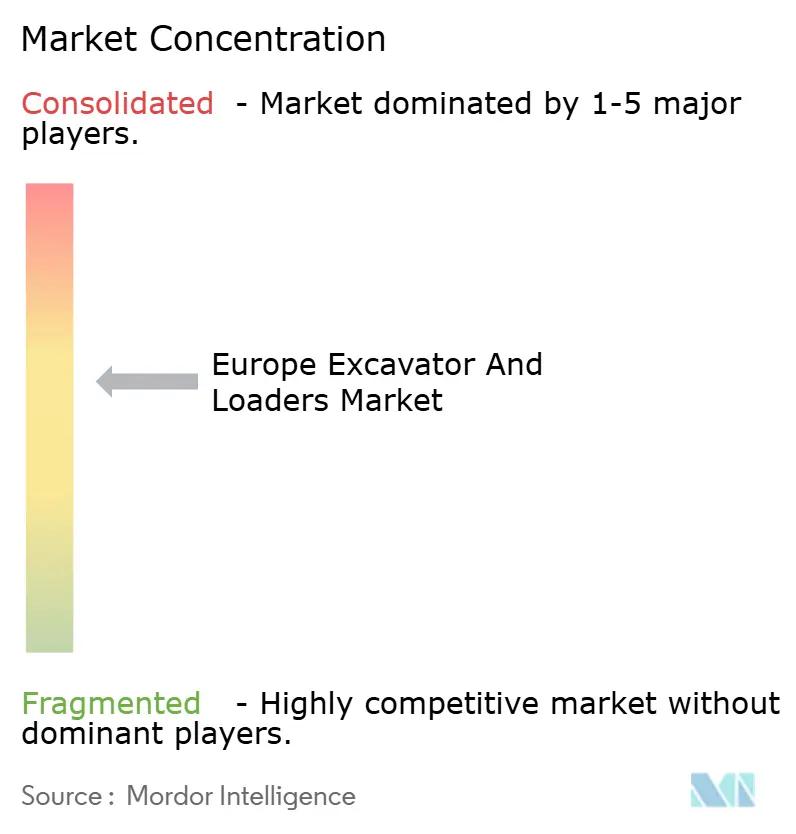
| Market Concentration | Medium |
Major Players *Disclaimer: Major Players sorted in no particular order Image © Mordor Intelligence. Reuse requires attribution under CC BY 4.0. | |
Europe Excavator and Loaders Market Analysis by Mordor Intelligence
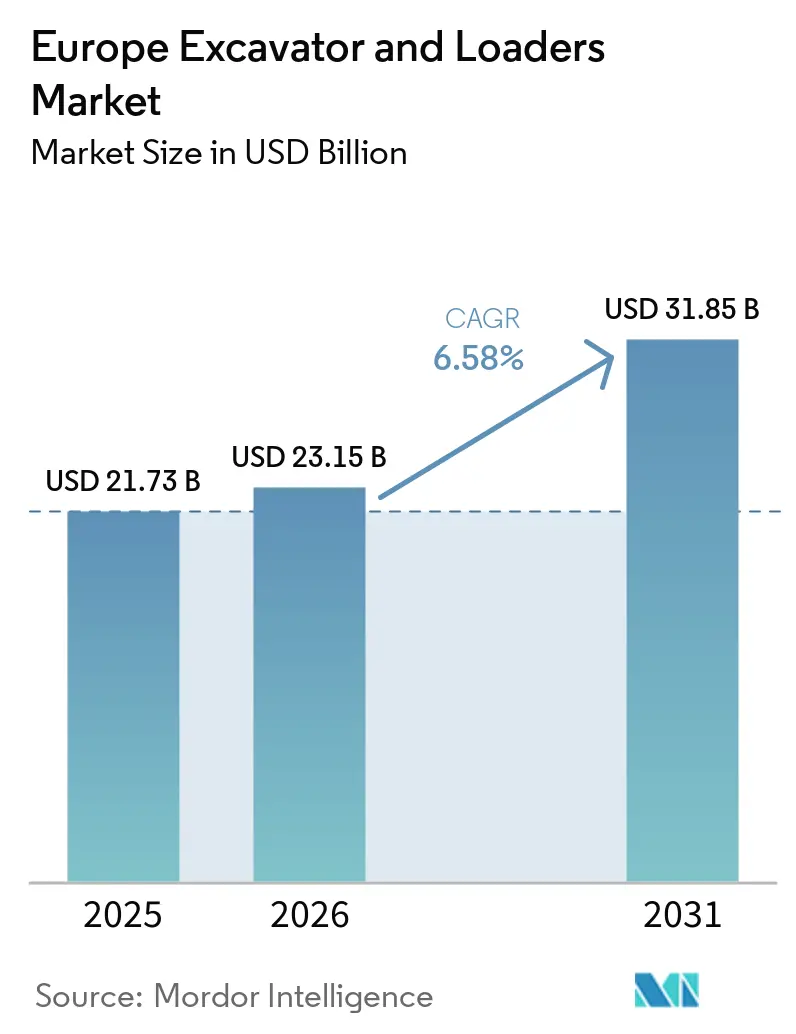
The Europe Excavator And Loaders Market size is projected to be USD 21.73 billion in 2025, USD 23.15 billion in 2026, and reach USD 31.85 billion by 2031, growing at a CAGR of 6.58% from 2026 to 2031. Demand momentum rests on three pillars: net-zero infrastructure mandates, Stage V fleet replacement, and an urban shift toward compact equipment that fits tight job-sites. Contractors weigh retrofit costs against the four-year payback of electric drivetrains, while rental groups exploit high utilization to expand fleets despite elevated financing costs. Digital-twin automation and Equipment-as-a-Service contracts are further tilting preferences toward connected machines that lower unplanned downtime and de-risk residual values. As a result, the European excavators & loaders market is experiencing structural, not cyclical, growth.
Key Report Takeaways
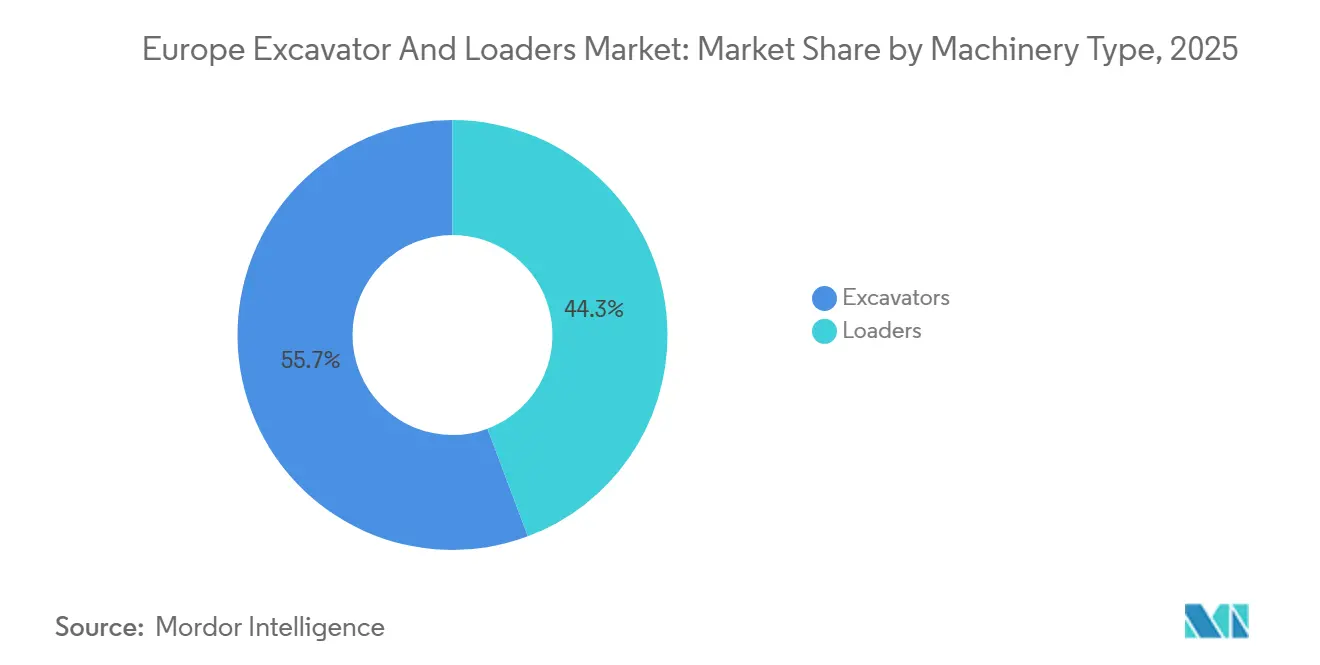
- By machinery type, excavators led the European excavators & loaders market with a 55.71% market share in 2025; loaders are forecast to expand at a 6.55% CAGR through 2031.
- By drive type, diesel and hydraulic systems accounted for 88.15% market share in 2025, while electric units are pacing at a 6.66% CAGR through 2031, continuing to reshape the European excavators & loaders market.
- By operating weight, the 6-to-14-tonne class commanded a 38.45% share of the European excavators & loaders market in 2025, yet sub-6-tonne machines are advancing at a 6.63% CAGR through 2031.
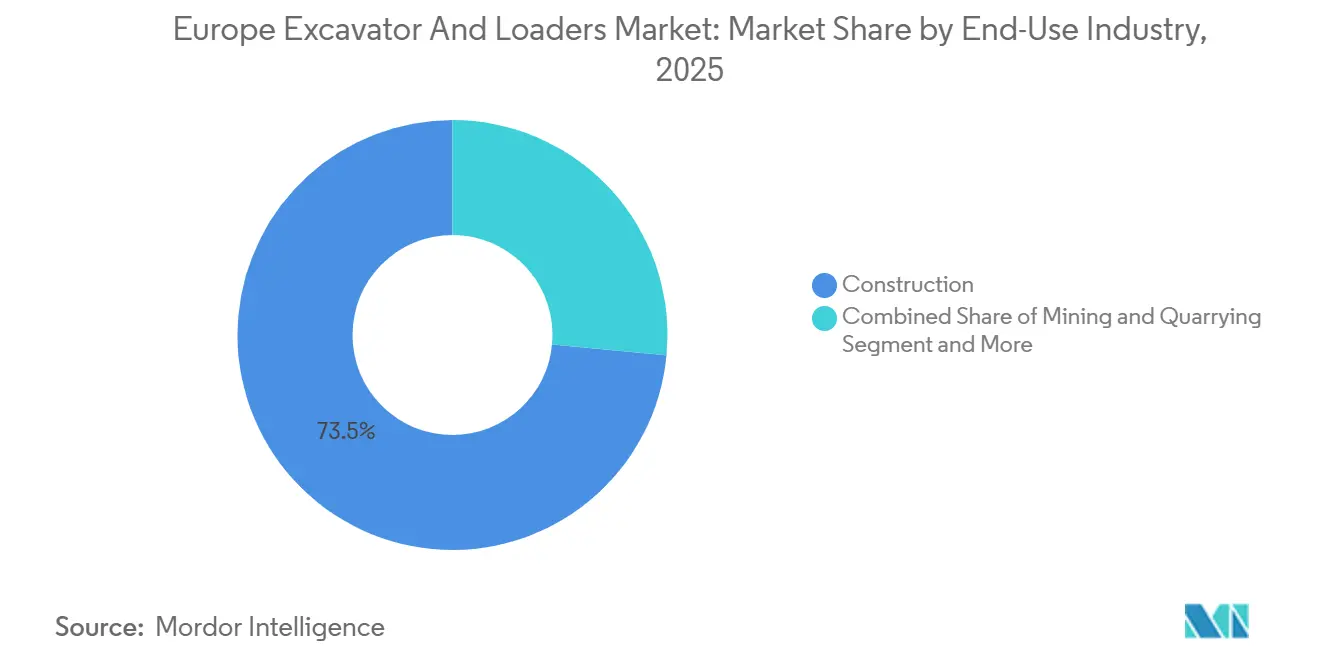
- By end-use, construction accounted for 73.51% market share in 2025. In contrast, utilities and urban infrastructure are the fastest-growing, with a 6.68% CAGR through 2031, underscoring diversification within the Europe excavators & loaders market.
- By application, excavation and earthmoving captured 41.25% market share in 2025. Demolition is projected to expand at a 6.71% CAGR through 2031.
- By country, Germany held 24.46% of market share in 2025 in the European excavators & loaders market; Norway posts the highest forecast CAGR at 6.73% by 2031.
Note: Market size and forecast figures in this report are generated using Mordor Intelligence’s proprietary estimation framework, updated with the latest available data and insights as of 2026.
Market Trends and Insights
Drivers Impact Analysis of Europe Excavator and Loaders Market*
| Driver | (~) % Impact on CAGR Forecast | Geographic Relevance | Impact Timeline |
|---|---|---|---|
| Stage V Emission Norms Driving Fleet Renewal | +1.4% | EU-27, UK, Norway, Switzerland | Medium term (2-4 years) |
| EU Green-Deal Infrastructure Funding Boom | +1.2% | Pan-European, with concentration in Germany, France, Netherlands | Medium term (2-4 years) |
| Post-Pandemic Construction Backlog Release | +0.9% | France, Italy, Spain, with spillover to Eastern Europe | Short term (≤ 2 years) |
| Zero-Emission Site Mandates in Scandinavia | +0.7% | Norway, Sweden, Denmark, with pilot adoption in Netherlands | Long term (≥ 4 years) |
| Equipment-as-a-Service Business Models | +0.6% | UK, Germany, Benelux, expanding to Southern Europe | Medium term (2-4 years) |
| Digital-Twin Job-Site Automation Uptake | +0.5% | Germany, UK, France (early adopters in large-scale infrastructure) | Long term (≥ 4 years) |
| Source: Mordor Intelligence | |||
Stage V Emission Norms Driving Fleet Renewal
In Europe’s construction equipment market, Stage V emission norms are accelerating fleet renewal, particularly for excavators and loaders. Many operators, especially small- and mid-sized contractors, are trading in their older machines sooner than anticipated due to the steep costs of retrofitting them with advanced after-treatment systems. Meanwhile, electric drivetrains are gaining momentum, sidestepping retrofit costs, thanks to Germany’s tax incentives and sustainability mandates. This evolving landscape is not only reshaping procurement strategies but also amplifying leasing and certified pre-owned programs. Furthermore, it's spurring original equipment manufacturers (OEMs) to ramp up investments in electrification, hybridization, and cutting-edge battery technologies.
EU Green Deal Infrastructure Funding Boom
Under the Connecting Europe Facility, substantial funding is set to flow into transport and energy corridors over the next few years. This surge in investment is poised to boost the demand for mid-size excavators and wheel loaders. Notably, Germany and France have identified projects that will necessitate a significant increase in machinery during the latter part of the decade. Furthermore, with accelerated depreciation for zero-emission assets, rental cycles have shortened considerably, leading to a trend of early replacements in the European excavators and loaders market.
Post-Pandemic Construction Backlog Release
In 2025, Europe witnessed a pronounced surge in equipment rentals, especially in Italy, Spain, and France. This uptick followed a post-pandemic construction recovery, as governments and contractors tackled significant project backlogs from lockdowns and supply chain disruptions. Rental fleets, providing flexible machinery access without hefty capital investments, primarily absorbed this pent-up demand. This surge underscored the pivotal role of rental channels in managing short-term demand fluctuations, especially for excavators and loaders, even as new equipment sales held steady.
Zero-Emission Site Mandates in Scandinavia
Scandinavian nations are reshaping the construction equipment market with zero-emission site mandates. Norway's upcoming regulations and Sweden's bold push for emission-free targets are spurring a swift shift towards electric excavators. These initiatives are strongly motivating contractors to move away from diesel machinery, especially in urban projects with tight emission controls. Subsidies are easing the financial burden of electric equipment's higher initial costs, hastening the journey to cost parity and making the switch to electrification more feasible. This strategy is crafting a blueprint for other EU countries, merging regulatory demands with financial incentives to drive a greener fleet renewal and transform the market.
Restraints Impact Analysis of Europe Excavator and Loaders Market*
| Restraint | (~) % Impact on CAGR Forecast | Geographic Relevance | Impact Timeline |
|---|---|---|---|
| High Interest-Rate Environment Dampening CAPEX | -1.1% | Pan-European, with acute pressure in Southern Europe and Eastern Europe | Medium term (2-4 years) |
| Growth of Rental Fleets Suppressing Purchases | -0.8% | UK, Germany, France, Netherlands, with emerging impact in Spain, Italy | Short term (≤ 2 years) |
| Battery-Material Cost Volatility | -0.4% | EU-27, UK (affects electric-equipment adoption rates) | Medium term (2-4 years) |
| Dealer-Network Consolidation Blocking New Entrants | -0.3% | Germany, France, Italy, Spain (limits competitive pressure on pricing) | Long term (≥ 4 years) |
| Source: Mordor Intelligence | |||
High Interest-Rate Environment Dampening CAPEX
Across Europe, high interest rates are curbing capital expenditure in the construction equipment market, especially for excavators and loaders. Due to the European Central Bank's tight monetary policy, contractors face higher financing costs, making outright purchases less appealing. As a result, many contractors are either extending loan tenors to alleviate repayment pressures or choosing mid-life overhauls to prolong the service life of their current fleets. This prudent strategy not only decelerates the equipment refresh cycle and diminishes demand for new machinery but also strengthens the focus on maintenance strategies, altering procurement habits until borrowing costs become more favorable.
Growth of Rental Fleets Suppressing Purchases
During the forecast period, rental penetration grew significantly. This increase was driven by Ashtead and Loxam, which expanded their fleets substantially. Despite utilization reaching unprecedented levels, the fleet expansion limited shipments from OEMs. In the European excavators and loaders market, bundled maintenance and insurance services have reduced the breakeven point for ownership, leading to a slowdown in direct sales.
*Our forecasts treat driver/restraint impacts as directional, not additive. The impact forecasts reflect baseline growth, mix effects, and variable interactions.
Europe Excavator and Loaders Market Segment Analysis
By Machinery Type:
Excavators Pull Ahead in Compact Urban JobsEurope's excavator and loader market size peaked at 55.71% in 2025. Mini excavators below 6 tonnes post the fastest gains, favored by zero-tail-swing designs that slip into tight pedestrian zones. Midi units between 6 and 14 tonnes hold significant weight-segment revenue and anchor foundation and trenching needs. Loaders trail but still grow at 6.55% as wheel loaders remain indispensable at aggregate plants. Skid-steer and compact track loaders win share inside interior demolition and soft-ground agriculture, respectively, reflecting diversified pull on the European excavators & loaders market.
Replacement of backhoe loaders with dedicated mini excavators and telehandlers continues, shrinking the backhoe portion. At the same time, small articulated loaders carve out space in municipal snow removal. Attachment versatility—quick couplers that allow tool swaps in 90 seconds—elevates utilization, helping OEMs lock in service revenue in the European excavators & loaders market.
By Drive Type:
Electric Momentum Builds Despite Diesel LeadDiesel and hydraulic equipment account for 88.15% of the market share, yet their grip is easing as electric shipments expand at a 6.66% CAGR through 2031. Europe excavators & loaders market share for electric machines will climb by 2031 on the back of charging costs undercutting diesel on high-hour fleets. Hybrid drivetrains appeal where charging is scarce.
Hydrogen fuel-cell pilots remain below 20 units, signaling long-term optionality but negligible volume before 2031. Cable-tethered excavators thrive in Norway’s hydropower dams, where grid access is stable. Biodiesel blends ease compliance but void warranties unless OEM-approved, leaving many contractors to leapfrog straight to battery power, a strategic inflection for the European excavators & loaders market.
By Operating Weight:
Sub-6-Tonne Machines Outpace Heavier ClassesThe middle 6-to-14-tonne group, with 38.45% of 2025 revenue, remains the volume workhorse and anchors rental fleets. Sub-6-tonne units grow at 6.63% as urban densification in Paris, Milan, and Brussels demands footprints under 1.8 meters and noise under 95 dB(A).
Machines weighing more than 45 tonnes, tied to quarrying and dam projects, inch forward amid coal phase-out policies. Utilization metrics favor compact models, achieving higher utilization rates for equipment weighing more than 30 tonnes, bolstering returns, and reinforcing the shift within the European excavators & loaders market.
By End-Use Industry:
Construction Dominates, Utilities SurgeConstruction accounted for 73.51% of demand in 2025, but utilities and urban infrastructure rose 6.68% annually as district heating and fiber-optic trenching expanded. Germany’s broadband push needs compact excavators through 2027.
Aggregate extraction and waste recycling require robust material handlers to lift non-construction shares. OEMs embed telematics as standard on rental-destined machines, keeping uptime above 90% and sharpening competitiveness across the European excavators & loaders market.

By Application:
Excavation Leads, Demolition Takes FlightExcavation and earthmoving still account for 41.25% of activity, but demolition posts the highest CAGR at 6.71% as circular-economy rules press for building deconstruction and high material-recovery rates. High-reach demolition excavators have boom capacities exceeding 30 meters.
Road building accounts for a smaller share of activity, while snow removal punches above its weight during Q1 rentals in Alpine markets. Attachment flexibility and quick-coupler systems increase machine utilization, extending the revenue arc in the European excavators & loaders market.
Geography Analysis
Germany Excavator and Loaders Market
Germany delivered 24.46% of 2025 revenue, supported by a USD 295 billion federal transport plan that lifts machine intensity to 14.2 units per 1,000 construction employees. Electric equipment hit 11.3% of new German sales due to 50% first-year depreciation. Rental penetration climbed to 34%, softening direct OEM orders but maintaining high utilization in the European excavators & loaders market.
Northern Europe Excavator and Loaders Market
Norway registers the fastest 6.73% CAGR through 2031 following its 2027 zero-emission mandate and a USD 18.8 million subsidy program. Cheap hydropower at USD 0.08 per kWh assures total-cost parity above 1,200 utilization hours, explaining why 42% of 2025 orders there were electric. Sweden and the Netherlands follow growth on the back of urban renewal and offshore wind projects.
Southern and Eastern Europe Excavator and Loaders Market
France's demand is fueled by a USD 59 billion France 2030 plan, while Italy and Spain hover near 10% as pandemic backlog unwinds [2]. Eastern Europe adds revenue but faces higher borrowing costs that slow replacement, a drag on localized slices of Europe.
Regulatory Landscape
The European excavator and loader market operates under EU-wide safety and market-access rules anchored by the Machinery Regulation (EU) 2023/1230, which replaces Directive 2006/42/EC and becomes fully applicable from 20 January 2027. The regulation tightens requirements for safety functions that rely on software, adds explicit cybersecurity considerations for connected equipment and over-the-air updates, and expands obligations tied to "substantial modification" (which brings some retrofitters and rebuilders into a manufacturer-like compliance role). Member States must notify penalty regimes by 20 October 2026, increasing near-term compliance planning needs for OEMs, dealers, and large fleet refurbishers.
Emissions compliance for engines in non-road mobile machinery remains governed by Stage V under Regulation (EU) 2016/1628, supporting ongoing fleet renewal dynamics. Regulation (EU) 2025/14 (adopted in December 2024) sets approval and market surveillance requirements for non-road mobile machinery circulating on public roads, affecting machines that travel between sites and increasing scrutiny for on-road circulation in certain use cases. From 29 May 2026, emergency procedures inserted into the Machinery Regulation by Regulation (EU) 2024/2748 define how designated crisis-relevant machinery is handled during activated Internal Market Emergency Mode (IMERA), adding a contingency layer to market access and surveillance during exceptional periods.
Value Chain Analysis
The value chain for excavators and loaders in Europe begins with upstream inputs such as steel structures, castings, hydraulics, powertrains, electronics, batteries, and software, before moving into OEM design and manufacturing, assembly, and testing. Distribution then follows through captive dealer networks and independent distributors. European production and assembly footprints remain important for lead times and parts availability, reflected in established local operations such as Hitachi Construction Machinery (Europe) NV with manufacturing and assembly for excavators and wheel loaders in the Netherlands (Amsterdam and Oosterhout) supported by a European parts center, and Komatsu Germany GmbH mining division engineering and production of hydraulic mining excavators in Dusseldorf, Germany.
Downstream, demand splits between direct contractor fleets and large rental companies, with aftersales (parts, service, reman, attachments, and telematics subscriptions) acting as a major profit pool. Dealer-network concentration affects market access for challengers, while association platforms such as CECE and VDMA help coordinate technical positions and guidance across OEMs and suppliers. Recent industrial moves point to more regionalized assembly capacity and tighter logistics control, including Volvo Construction Equipment selecting Eskilstuna, Sweden for a new crawler excavator assembly facility (announced November 2025), which supports shorter supply chains and higher responsiveness to mixed demand for diesel and electric variants.
Competitive Landscape
In 2025, Caterpillar, Komatsu, Volvo CE, and CNH Industrial collectively accounted for a significant share of European revenue, indicating a moderately concentrated profile for the European excavators & loaders market. Despite offering substantial price discounts, Chinese challengers Sany and XCMG have limited combined market share. This is mainly due to dealer exclusivity clauses that prevent them from accessing crucial service bays.
Contracts like Equipment-as-a-Service from Volvo CE and JCB shift the residual-value risk onto OEMs. This move is particularly beneficial for contractors with tighter balance sheets, facilitating a broader adoption of electric machinery. Furthermore, systems such as Caterpillar’s Command for Excavation, which utilize digital-twin and autonomous grade control technologies, have demonstrated significant reductions in operator input and fuel consumption.
Starting in 2027, the EU Machinery Directive mandates the integration of cybersecurity measures and over-the-air updates in machinery. This requirement is driving up the per-unit R&D expenditure considerably. As a result, smaller brands might either exit the market or seek consolidation, reshaping current fragmentation and bolstering the dominance of leading players in the European excavators & loaders market.
Europe Excavator and Loaders Industry Leaders
-
Caterpillar Inc.
-
Komatsu Corp.
-
Liebherr Group
-
Volvo Construction Equipment
-
JC Bamford Excavators Limited (JCB)
- *Disclaimer: Major Players sorted in no particular order
Europe Excavator and Loaders Market Companies Covered in this Report
- Caterpillar Inc.
- Komatsu Ltd.
- Volvo Construction Equipment
- CNH Industrial N.V. (CASE and New Holland)
- Deere and Company
- Hitachi Construction Machinery
- Liebherr-International Deutschland GmbH
- Doosan Bobcat Co.
- Kobelco Construction Machinery
- Manitou BF SA
- Yanmar Construction Equipment
- JCB Ltd.
- Kubota Corp.
- Sany Europe
- XCMG Europe
- Wacker Neuson SE
- Hyundai Construction Equipment Europe
- Mecalac SAS
- Wirtgen Group (John Deere)
- Avant Tecno Oy
Market Opportunities and Future Outlook
Zero-emission and low-noise jobsite requirements across Northern and Western Europe are driving specific OEM actions that create opportunities in compact and mid-size electric excavators, as well as in charging, service, and fleet-management offerings. In 2026, product availability has widened with launches including Volvo Construction Equipment bringing the EWR150 Electric wheeled excavator to the European market, and Komatsu expanding its electric compact lineup, including the PC26E-6 electric mini excavator for Europe and micro-excavator market evaluations. Alongside high rental utilization and the shift toward compact equipment for tight urban job-sites, this supports rental-led electrification bundles (machine, charger, service, telematics) and attachment solutions tuned to electric duty cycles.
Manufacturing and supply-chain investment in Europe also creates room for more localized sourcing, faster delivery, and differentiated aftersales support. In 2026, multiple OEMs expanded European industrial capacity, including Yanmar CE completing expansion of its Saint-Dizier, France site with a new wheel loader production line and logistics center, Volvo CE breaking ground on its Eskilstuna crawler excavator assembly plant, and Liebherr breaking ground on a new Nambsheim, France assembly facility to manufacture earthmoving machine cabs. These initiatives create opportunities for tier suppliers (cabs, harnesses, thermal systems, battery integration, power electronics) and for dealers to build capabilities around connected-machine cybersecurity readiness ahead of the Machinery Regulation (EU) 2023/1230 becoming fully applicable in 2027, especially for fleets adopting Equipment-as-a-Service and over-the-air software update models.
Recent Industry Developments in Europe Excavator and Loaders Market
- June 2026: Volvo Construction Equipment brought the EWR150 Electric wheeled excavator to the European market, expanding its zero-emission lineup beyond compact tracked models. The launch supports contractors working under urban emissions and noise constraints and gives rental fleets another high-utilization electric platform to standardize around.
- June 2025: Fayat Group acquired Mecalac, strengthening its position in compact equipment and adding a broader manufacturing footprint through Mecalac sites. The deal expands product breadth in urban-focused segments where compact excavators and loaders are gaining share, and it reshapes competitive positioning for dealers and rental partners in several European markets.
- July 2024: Regulation (EU) 2024/2748 inserted emergency procedures into the EU Machinery Regulation framework, creating a defined process for crisis-relevant machinery during activated Internal Market Emergency Mode (IMERA). This formalizes how market access and surveillance can be managed in exceptional periods, which can influence OEM compliance planning and cross-border equipment circulation during disruptions.
Europe Excavator and Loaders Market Report Scope and Research Methodology
Market Definition and Coverage
This market is counted as the revenue generated from selling excavators and loaders in Europe, where values reflect equipment sold into construction, infrastructure, and related earthmoving activity across the region.
Scope exclusions: Used equipment transactions, rental-only revenue, and standalone attachments are excluded unless they are bundled and priced within a new machine sale.
Segments Covered in This Report
- By Machinery Type
- Excavators
- Mini (Below 6 t)
- Midi (6 to 14 t)
- Crawler
- Wheeled
- Amphibious
- Large (Above 45 t)
- Loaders
- Wheel Loader
- Skid Steer Loader
- Compact Track Loader
- Backhoe Loader
- Small Articulated Loader
- Excavators
- By Drive Type
- Diesel / Hydraulic
- Electric
- Hybrid
- Hydrogen Fuel-Cell (emerging)
- Cable / Grid-tethered
- By Operating Weight (t)
- Below 6
- 6 to 14
- 14 to 30
- 30 to 45
- Above 45
- By End-Use Industry
- Construction
- Mining and Quarrying
- Agriculture and Forestry
- Waste and Recycling
- Utilities and Urban Infrastructure
- Rental Companies
- By Application
- Excavation and Earthmoving
- Material Handling
- Demolition
- Landscaping
- Snow Removal
- Road Building and Maintenance
- By Country
- Germany
- United Kingdom
- France
- Italy
- Spain
- Netherlands
- Sweden
- Norway
- Rest of Europe
Data Sources, Market Sizing, and Validation
Desk Research
We start by building the factual base around Europe construction activity and equipment demand signals, then align it with what manufacturers report on shipments and order trends. Public sources used include Eurostat construction output and related price series, European Commission publications on infrastructure funding, national statistics offices for major countries, and CECE and other industry body releases that discuss equipment sales momentum. For emissions and compliance timing, we check EU Stage V and related EU regulatory documents so older engine classes are not carried into forward demand assumptions.
On the supply side, we review company annual reports, investor presentations, and earnings call transcripts to understand product mix, delivery timing, and regional exposure. Where available, we use paid company financials and intelligence to standardize revenue splits, and a patent database to confirm technology direction (for example, electrification and hybrid drives) when it impacts adoption rates. This list is not exhaustive, and many other public sources were also reviewed to collect data, validate inputs, and clarify open questions.
Primary Interviews and Surveys
To close gaps that desk sources cannot answer cleanly, we run expert interviews and structured surveys with OEM-facing distributors, rental and fleet owners, large contractors, and parts and service channels. Because this is a regional market, we also check inputs across major European demand centers and smaller countries, so assumptions on utilization, replacement cycles, and pricing are not driven by just one country's conditions.
Distribution of primary research fieldwork respondents
| Company type | Respondent position |
|---|---|
| Top tier: 35% | CXOs: 14% |
| Mid tier: 50% | Functional/Unit leaders: 30% |
| Smaller Players: 15% | Managers: 56% |
Market-Sizing & Forecasting
The core sizing uses a top-down approach where country-level construction activity and equipment demand indicators are reconstructed into an addressable demand pool, and then converted into excavator and loader value using penetration and pricing logic. To keep the model practical, we focus on a few repeatable inputs, including new machine sales volumes (units), average selling prices by operating weight class, replacement cycle timing by customer type, share of projects that are earthmoving-intensive, and the pace of Stage V compliant fleet renewal.
After the first total is built, we corroborate it with selective bottom-up approximations, such as sampling supplier and dealer revenue disclosures, checking channel markups where relevant, and running unit-times-ASP cross-checks for major countries before totals are finalized. Where coverage is thin for smaller countries, we handle gaps by using regional ratios anchored to construction output and equipment density, then correcting using primary feedback on local fleet age and buying behavior. For forecasting, scenario analysis is used around two practical drivers, infrastructure spending visibility and interest rate sensitivity for contractors, and the final path is chosen based on what interviewees see in order books and tender pipelines.
Data Validation & Update Cycle
We validate the output through triangulation across independent signals, and then run variance checks at country level so one outlier assumption does not distort the Europe total. If a country's implied units, pricing, or replacement rates drift away from what interviews and public indicators suggest, the assumptions are revisited and, when needed, respondents are re-contacted for clarification.
Before sign-off, the model goes through multi-step analyst reviews, where calculations are rechecked and key inputs are stress-tested against recent macro conditions and construction movements. Reports are refreshed annually, with interim updates triggered by material events like regulation changes, sharp price inflation, or sudden demand shocks. Right before delivery, an analyst performs a fresh pass so clients receive the latest updated view.
Mordor Intelligence's Europe Excavator and Loaders Market Size Measured Against Other Published Estimates
Published market values for excavators and loaders in Europe can look far apart because the boundary is not always the same, and the timing choices can shift the number materially. Differences usually come from what is counted as new equipment revenue, which countries are included under Europe, and how inflation and currency conversion are applied for the stated year.
By tracking unit demand signals, refreshing average selling price steps by operating-weight band, and then validating country totals with field checks, Mordor Intelligence keeps the market value tied to new-machine sales rather than mixing in rental revenue or broader construction equipment categories.
Benchmark comparison
| Source | Market Size | Gaps in Research Methodology |
|---|---|---|
| Mordor Intelligence | USD 21.73 B (2025) | |
| Industry Newsroom A | USD 6.91 B (2029) | This value is presented as a growth amount over a multi-year window for Europe construction equipment, so it is not a like-for-like single-year market size for excavators and loaders. |
| Regional Consultancy B | USD 44.67 B (2024) | This estimate is for a wider heavy construction equipment pool, which can fold multiple equipment families beyond excavators and loaders, thereby raising the stated value versus a tighter product scope. |
The spread is mainly explained by scope and year framing, where some sources talk about total construction equipment or multi-year growth instead of the specific new excavator and loader revenue pool. Once the perimeter is kept consistent and the unit and price logic is checked country by country, the estimate becomes easier to trace back to real demand drivers and to repeat during annual updates.
Key Questions Answered in the Report
How large is the European excavators & loaders market today, and where is it headed by 2031?
It stands at USD 23.15 billion in 2026 and is projected to climb to USD 31.85 billion by 2031 at a 6.58% CAGR.
Which machinery type holds the biggest revenue share?
Excavators led with 55.71% of 2025 revenue thanks to their versatility across excavation, demolition, and material handling.
Why is electric adoption accelerating in this equipment class?
Stage V regulations, zero-emission site mandates, and four-year payback periods in high-utilization fleets make battery units increasingly economical.
Which country will grow the fastest through 2031?
Norway, posting a 6.73% CAGR, is driven by its 2027 zero-emission public works requirement and low-cost hydropower.
How are rental trends shaping equipment demand?
Rental fleets absorbing demand while higher interest rates delay contractor purchases, a dynamic likely to persist until ECB rate cuts.