
Europe Car Insurance Market Size and Share
Market Overview
| Study Period | 2020 - 2031 |
|---|---|
| Forecast Data Period | 2026 - 2031 |
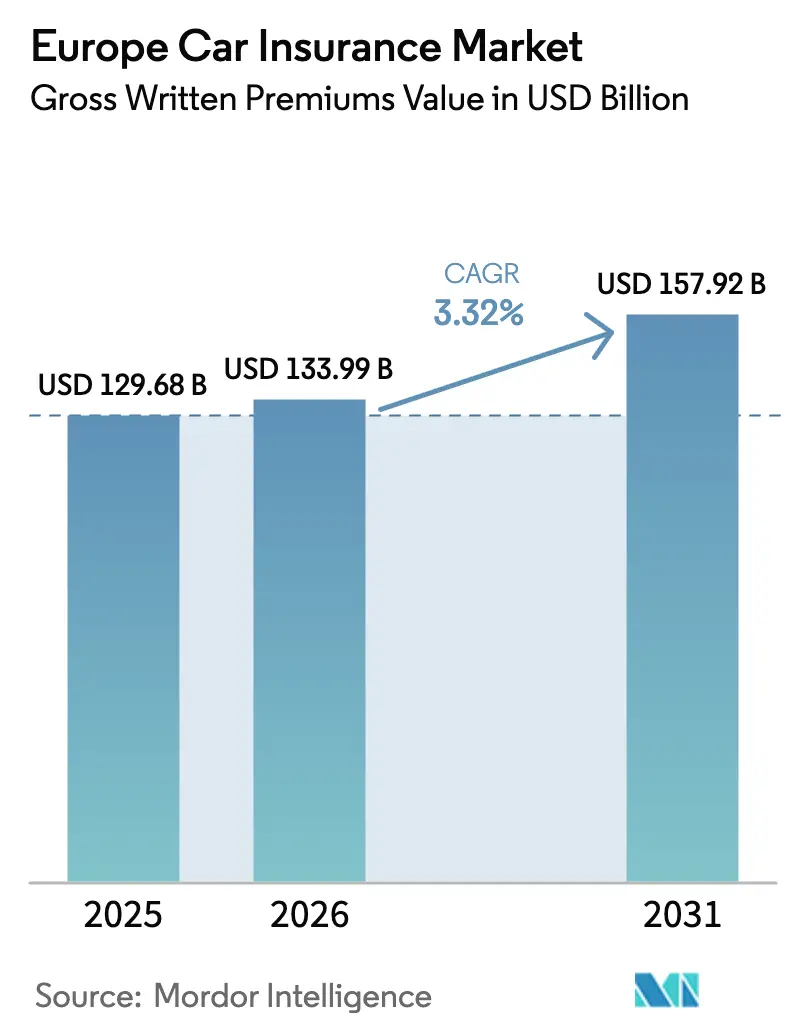
| Base Year Market Size (2025) | USD 129.68 Billion |
| Market Size (2026) | USD 133.99 Billion |
| Market Size (2031) | USD 157.92 Billion |
| Growth Rate (2026 - 2031) | 3.32 % |
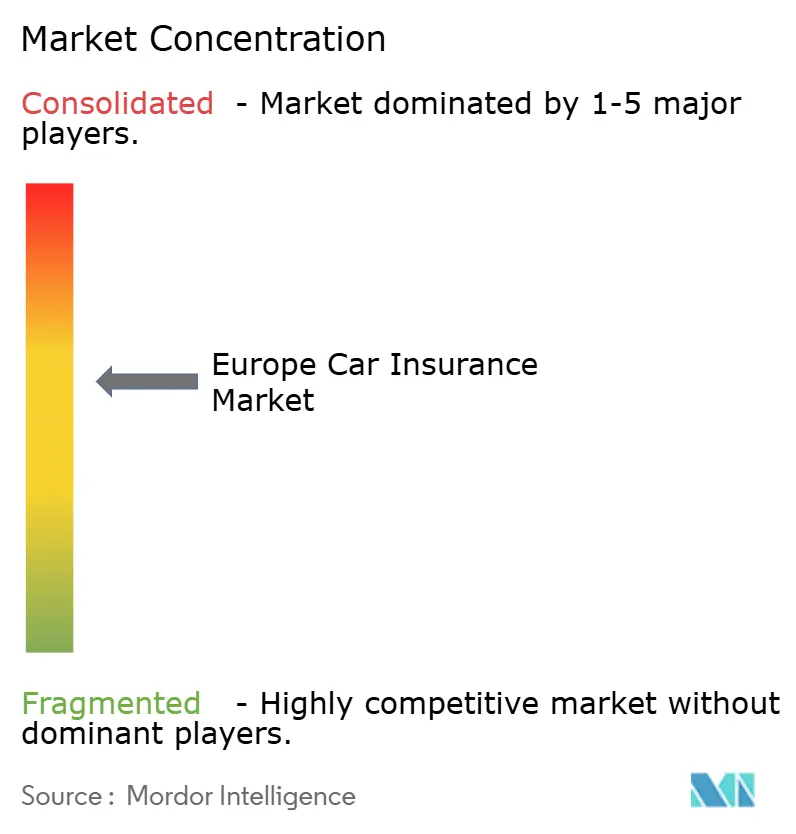
| Market Concentration | Medium |
Major Players *Disclaimer: Major Players sorted in no particular order Image © Mordor Intelligence. Reuse requires attribution under CC BY 4.0. | |
Europe Car Insurance Market Analysis by Mordor Intelligence
Europe car insurance market size in 2026 is estimated at USD 133.99 billion, growing from 2025 value of USD 129.68 billion with 2031 projections showing USD 157.92 billion, growing at 3.32% CAGR over 2026-2031. The expansion demonstrates a mature regulatory environment that enforces mandatory third-party liability, while telematics adoption, electrification of fleets, and artificial-intelligence-powered underwriting jointly reshape premium structures. Rising penetration of Advanced Driver Assistance Systems (ADAS) and battery-electric vehicles elevates average claim severity, prompting carriers to upgrade actuarial models and negotiate preferred-pricing agreements with certified repair networks. At the same time, direct-to-consumer digital channels are expanding rapidly, compressing acquisition costs and channeling more parametric data into pricing engines that refine risk segmentation. Ongoing consolidation—exemplified by Ageas’s GBP 1.295 billion purchase of esure—supplies scale advantages in reinsurance, analytics, and procurement that counteract margin pressure from comparison sites and regulatory rate caps.
Key Report Takeaways
- By vehicle type, personal policies accounted for 78.06% of the Europe car insurance market share in 2025, while commercial coverage is projected to post the fastest growth, advancing at a 4.63% CAGR through 2031.
- By insurance type, third-party liability provided 60.72% of the Europe car insurance market size in 2025; however, comprehensive plans are set to expand at an 8.05% CAGR over 2026-2031.
- By distribution channel, agent networks controlled 56.88% revenue share in 2025, although direct online platforms are forecast to record a 5.12% CAGR during the same period.
- By country, the United Kingdom held 22.33% of the Europe car insurance market size in 2025, whereas Italy is expected to register the highest CAGR at 5.39% through 2031.
Note: Market size and forecast figures in this report are generated using Mordor Intelligence’s proprietary estimation framework, updated with the latest available data and insights as of 2026.
Europe operates as part of an interconnected international environment rather than as a self-contained unit. The car insurance market research by Mordor Intelligence places together all major regional developments across the globe within that wider frame.
Market Trends and Insights
Drivers Impact Analysis of Europe Car Insurance Market*
| Driver | (~) %Impact on CAGR Forecast | Geographic Relevance | Impact Timeline |
|---|---|---|---|
| EU-wide compulsory motor liability law | +0.8% | All EU member states | Long term (≥ 4 years) |
| ADAS-linked repair cost inflation | +1.2% | Germany, United Kingdom, France, BENELUX, Nordics | Medium term (2-4 years) |
| Growth of personal leasing and PCP contracts | +0.6% | United Kingdom, Germany, Netherlands, Southern Europe | Medium term (2-4 years) |
| Expanding vehicle parc and aging fleet | +0.4% | Eastern and Southern Europe | Long term (≥ 4 years) |
| Rapid adoption of telematics-based usage-based insurance | +0.7% | Italy, United Kingdom, Germany, Nordics | Short term (≤ 2 years) |
| Digital claims processing and AI-driven underwriting | +0.5% | All European markets | Short term (≤ 2 years) |
| Source: Mordor Intelligence | |||
EU-wide Compulsory Motor-Liability Law Sustains Baseline Demand
European motor insurance relies on a legal framework that obligates every vehicle owner to hold third-party liability cover, ensuring the Europe car insurance market remains insulated from macroeconomic cycles. The 2024 Insurance Recovery and Resolution Directive formalized failure-resolution mechanisms, boosting consumer confidence and curbing systemic risk across borders. Harmonized enforcement under the European Insurance and Occupational Pensions Authority (EIOPA) sustains renewal volumes even when disposable incomes tighten, because non-compliance can lead to fines, vehicle impoundment, or registration suspension. This consistent policy base allows insurers to scale digital investments, knowing core premium flows are predictable. However, rate-setting freedom is curtailed as several regulators condition approval on social objectives, such as affordability for low-income drivers, which prevents carriers from passing the full burden of claims inflation through to customers. To offset this constraint, many insurers deploy usage-based products that maintain regulatory compliance while rewarding safer behavior with lower pricing bands. The resulting alignment of incentives supports both road-safety goals and stable premium growth[1].
ADAS Technology Mandates Drive Claims Cost Inflation
Mandatory ADAS features introduced under the General Safety Regulation 2 for all new cars from July 2024 materially increased repair complexity and labor times. Sophisticated sensors housed behind bumpers or windshields require recalibration after even minor collisions, sending average repair invoices 20-30% higher than on pre-regulation vehicles. German insurers reported combined underwriting losses of more than EUR 3 billion in 2023, with HUK-Coburg alone posting a EUR 500 million deficit attributed largely to ADAS-related spare-part costs[2]. The expense is compounded by the limited availability of manufacturer-certified technicians, elongating key-to-key cycle times and pushing up courtesy-car costs. While collision frequency is starting to decline due to automatic emergency braking, the higher severity of each incident offsets these gains, forcing actuaries to recast frequency-severity assumptions in pricing models. Insurers with direct repair-network agreements negotiate bulk discounts on lidar modules and camera units, clawing back a portion of the incremental outlay. Others experiment with refurbished sensors and aftermarket calibration rigs to preserve loss-ratio targets without breaching type-approval standards.
Personal Contract Purchase Growth Expands Comprehensive Coverage Demand
Personal Contract Purchase (PCP) and leasing arrangements represented more than 40% of new passenger-car registrations in the United Kingdom and Germany during 2024. Finance companies typically obligate borrowers to secure comprehensive insurance that safeguards the vehicle’s residual value throughout the lease term, driving a structural increase in premium per policy. As more consumers prefer lower upfront commitments and predictable monthly costs, embedded insurance at the point of sale has become a primary acquisition channel for carriers. Insurers that forge exclusive partnerships with captive finance arms convert these long-term contracts into high-persistence revenue streams, enjoying lower churn than in traditional renewal cycles. In parallel, leasing penetration among last-mile delivery fleets has expanded rapidly, requiring bespoke coverages that incorporate replacement-vehicle guarantees, roadside EV charging, and battery-health monitoring. The higher average value of leased assets magnifies insured sums, amplifying the Europe car insurance market’s premium base. Yet underwriting such assets demands granular data on driver behavior, mileage patterns, and battery degradation, pushing insurers to invest in advanced telematics and predictive maintenance analytics to protect margins.
Vehicle Parc Expansion and Aging Demographics Support Volume Growth
Europe’s vehicle fleet surpassed 250 million registered units in 2024 and continues to grow at roughly 1.5-2% annually, fueled by economic convergence in Eastern Europe and replacement demand in mature economies. Simultaneously, the average age of vehicles has stretched to more than 12 years as improved reliability encourages owners to postpone new-car purchases. Older vehicles generate higher claim frequencies because aging mechanical parts fail more often, and they require more frequent roadside assistance, thereby guaranteeing a steady stream of policies despite sluggish new-vehicle sales. Insurers capitalize by bundling ancillary services—towing, glass repair, tire replacement—that create fee income while improving customer stickiness. Commercial vehicle demand also remains buoyant: e-commerce growth means urban delivery fleets expand each year, and these operators often select fleet policies that cover diverse risks, from cargo damage to driver liability. Additionally, demographic shifts reveal that aging populations prefer private transport over public alternatives, maintaining vehicle ownership rates among retirees. As a result, policy volumes rise even where average premiums remain stable, contributing to consistent top-line growth for the Europe car insurance market.
Restraints Impact Analysis of Europe Car Insurance Market*
| Restraint | (~) % Impact on CAGR Forecast | Geographic Relevance | Impact Timeline |
|---|---|---|---|
| Price wars ignited by comparison sites | -0.9% | United Kingdom, Netherlands, Germany | Short term (≤ 2 years) |
| Regulatory caps and bonus-malus limits on premium hikes | -0.7% | France, Italy, Spain, and select Eastern Europe | Medium term (2-4 years) |
| Persistently low investment yields | -0.4% | EU-wide | Long term (≥ 4 years) |
| Soft new-car sales in major markets | -0.3% | Germany, France, United Kingdom | Medium term (2-4 years) |
| Source: Mordor Intelligence | |||
Price Competition Through Comparison Platforms Pressures Margins
Digital aggregators empower shoppers to obtain more than 50 quotes within seconds, homogenizing products and encouraging an almost mechanical focus on the lowest price. In the United Kingdom, average personal-car premiums fell 17% during 2025, the steepest annual contraction since 2014, as insurers slashed rates to hold share. The churn rate approached 40%, forcing carriers to pump marketing budgets into retention emails, auto-renewal incentives, and app-based loyalty perks that dilute net acquisition savings. Smaller underwriters with limited brand recognition often accept loss-making business in hopes of cross-selling ancillary covers, a tactic that raises long-term solvency concerns. The transparency also exposes historical pricing inequities; regulators have intervened to outlaw “price walking,” narrowing the gap between new-business and renewal quotes and compressing lifetime-value calculations. Larger insurers leverage machine-learning price-optimization engines, but the arms race raises IT costs, eroding margin advantages. Unless carriers can innovate beyond price—through bundled ADAS calibration services or EV-specific warranties, the comparison-site dynamic will remain a formidable drag on the Europe car insurance market’s profitability.
Regulatory Pricing Constraints Limit Premium Adjustment Flexibility
Several European authorities closely monitor premium revisions, seeking a balance between insurer solvency and consumer affordability. France’s 2025 cap of 6% on motor-premium increases, despite 8% repair-cost inflation, exemplifies the tension. Bonus-malus frameworks, intended to reward accident-free driving, restrict surcharges on high-risk motorists, compelling cross-subsidization that blurs actuarial fairness. Gender-neutral and age-neutral rating policies remove historically predictive variables, further challenging loss-cost alignment. In Spain and Italy, antitrust watchdogs review rate filings to prevent perceived “collective hikes,” extending approval timelines and injecting uncertainty into pricing cycles. The result is asymmetric risk transfer: insurers shoulder inflation spikes but must wait months or years to recoup via higher rates. To maintain earnings stability, many carriers now hedge claims inflation with structured reinsurance, yet this pushes up ceded-premium ratios. Together, these supervisory pressures force strategic reallocation toward risk-selection technology and cost-efficiency drives, shaping competitive behavior across the Europe car insurance market.
*Our forecasts treat driver/restraint impacts as directional, not additive. The impact forecasts reflect baseline growth, mix effects, and variable interactions.
Europe Car Insurance Market Segment Analysis
By Vehicle Type:
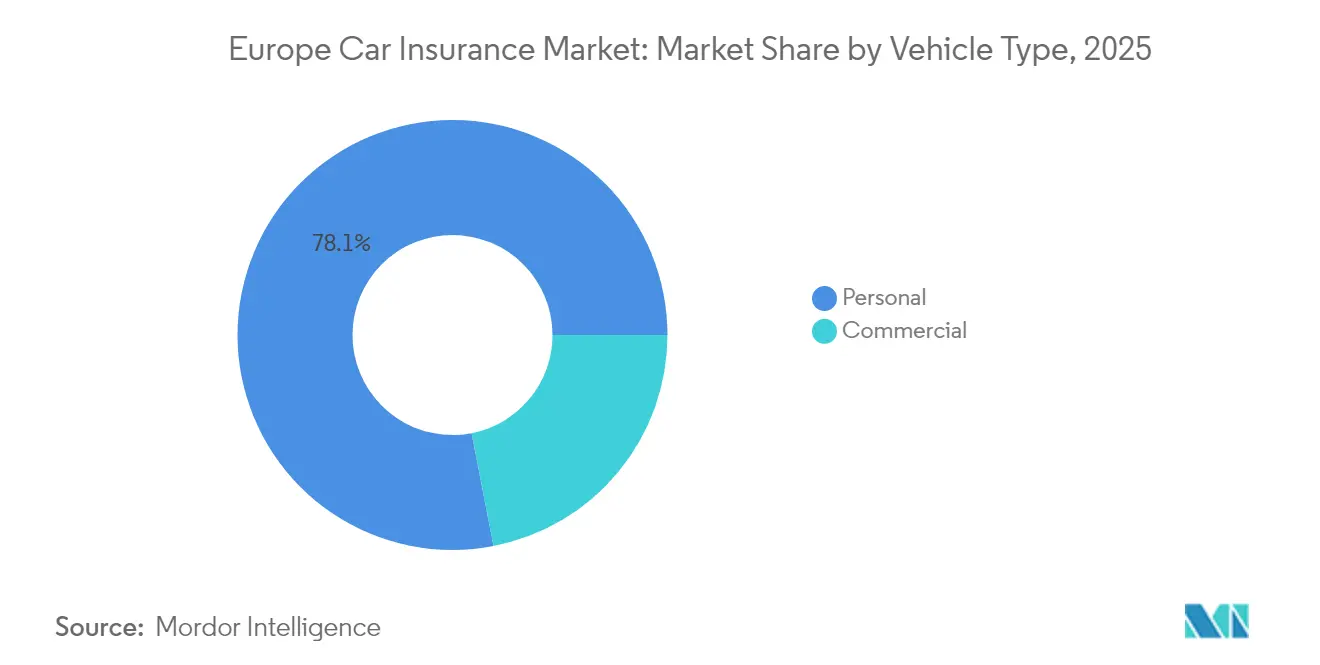
Fleet Electrification Redefines Commercial Risk ProfilesCommercial vehicles generated only 21.94% of written premium in 2025, yet are forecast to expand faster than any other class, clocking a 4.63% CAGR through 2031 as Europe accelerates toward net-zero targets. EU heavy-duty CO₂ regulations mandate a 45% emissions cut by 2030, spurring logistics operators to acquire battery-electric vans priced up to 80% higher than diesel equivalents. Higher asset values translate to larger insured sums, while battery-fire risk, charger-downtime exposure, and limited repair-shop familiarity increase loss volatility. Insurers respond by packaging risk-management services such as thermal-runaway monitoring, mobile charging, and scheduled battery diagnostics, capturing fee income alongside premiums. Fleet managers appreciate the holistic offerings, bolstering renewal affinities that offset lower margins in commoditized personal lines.
Personal policies sustained 78.06% of the Europe car insurance market in 2025, underpinned by mandatory cover laws and stable vehicle-ownership rates across mature economies. Nevertheless, personal lines face relentless price competition; average U.K. personal-motor premiums compressed 17% in 2025 due to aggregator influence. Insurers mitigate attrition by introducing pay-per-mile products that entice urban drivers who clock limited mileage. Telematics-enabled young-driver programs record accident reductions that support differentiated pricing, maintaining relevance even under stringent rate-approval regimes. Over time, the interplay of electrification and usage-based pricing will reshape personal-line profitability ladders, pushing analytics-savvy carriers to the forefront of the Europe car insurance market.

By Insurance Type:
Complexity Fuels Shift Toward Comprehensive PoliciesThird-party liability constituted 60.72% of premium income in 2025, upheld by compulsory-insurance statutes that deliver a predictable revenue floor for underwriters. However, comprehensive contracts are expanding at an 8.05% CAGR because modern vehicles integrate expensive electronics and battery systems that can push claim totals well above EUR 10,000 even after low-speed collisions. Finance houses involved in PCP deals require borrowers to carry gap and comprehensive coverage to safeguard residual value, embedding these richer policies into loan documentation. Cyber-risk endorsements, once niche, gain traction as over-the-air software updates and vehicle-to-infrastructure communications raise hacking concerns, enhancing the coverage suite in comprehensive plans.
Insurers exploiting this shift bundle glass replacement, roadside assistance, and mobility-as-a-service vouchers that appeal to urban consumers, lifting non-premium revenue. Their ability to cross-sell add-ons boosts average revenue per user, offsetting strict liability-rate caps. Furthermore, early adopters of comprehensive-EV products command premium loadings that cushion the claims-cost spike associated with battery fires or charger damage. Consequently, comprehensive policies will continue to erode the dominance of liability-only contracts, gradually increasing their proportional weight in the Europe car insurance market.
By Distribution Channel:
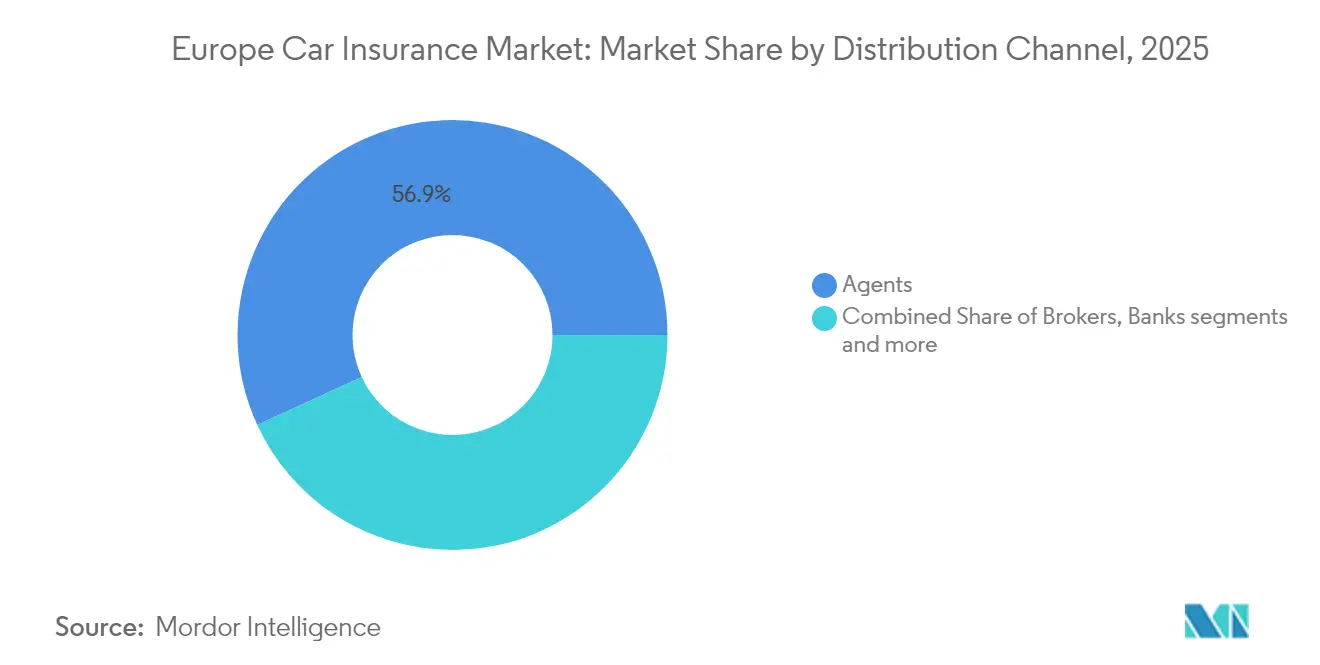
Multichannel Models Balance Efficiency and ExpertiseAgent networks retained 56.88% of gross written premium in 2025, illustrating the enduring value of personalized advice for high-complexity risks and multi-vehicle households. Agents excel at explaining nuanced coverages, navigating claim disputes, and orchestrating mid-term policy adjustments—services that purely digital interfaces sometimes mishandle. Yet direct online channels are accelerating at a 5.12% CAGR, as smartphone-native interfaces finalize quotes in under five minutes and embed payment plans that sync with digital-wallet ecosystems. Zurich’s EUR 10 million investment in Ominimo underscores incumbent recognition that AI-driven pricing engines can penetrate new geographies with lean cost bases.
Brokers remain critical in commercial lines, where fleet risks require bespoke wordings on trailers, cargo, and multinational driver pools. Bank-assurance channels leverage existing checking and savings relationships to cross-sell motor covers, though their share is slowly eroding as fintech partners layer in white-label policies at checkout. Insurers increasingly adopt omnichannel strategies, offering policyholders the freedom to begin a quote online, finalize through a call center, and lodge a claim via an app—creating a seamless journey that strengthens loyalty. Successful carriers optimize channel economics by steering low-touch renewals to self-service portals while reserving human expertise for complex risk consultations, preserving margin across the Europe car insurance market.
Geography Analysis
United Kingdom Car Insurance Market
The United Kingdom dominated the Europe car insurance market with a 22.33% share in 2025, sustained by high vehicle density, sophisticated telematics infrastructure, and a deeply competitive distribution landscape. Ageas’s acquisition of esure forms a top-three personal-lines entity, unlocking scale benefits in marketing expenditure and repair-network negotiations while diversifying distribution across agent, broker, and direct channels. Despite maturity, the U.K. market confronts stringent Financial Conduct Authority rules against dual-pricing, squeezing renewal profitability and forcing carriers to sharpen cost-reduction programs and invest in machine-learning price engines.
Europe Car Insurance Market
Germany ranks among the continent’s largest motor markets but wrestles with profitability. Average premiums climbed 20% in 2024 as insurers attempted to counter ADAS-driven repair bills, yet many carriers still produced negative underwriting margins. The industry lobbies for broader access to OEM diagnostic data to spur competition in parts supply, a move it claims could cut claim costs by 7-9%. France presents a contrasting dynamic: regulators capped 2025 premium hikes at 6%, yet repair-cost inflation broke 8%, intensifying the hunt for operational efficiencies. French carriers deploy AI triage tools to reduce average bodily-injury settlement cycles, freeing reserves and bolstering solvency ratios. Italy provides the fastest growth trajectory with a 5.39% CAGR forecast through 2031, powered by world-leading telematics penetration exceeding 30% of active policies. AXA’s planned acquisition of digital-native Prima Assicurazioni signals confidence in this data-rich market where insurers can refine risk pricing with sub-meter driving analytics. Spain, BENELUX, and the Nordics offer mid-single-digit growth under supportive innovation frameworks, though their smaller absolute premium pools cap upside scale. Eastern Europe remains underinsured relative to GDP, and as disposable incomes climb, vehicle ownership and premium volumes are set to rise, albeit from a lower base and with higher regulatory complexity. Collectively, geographic nuances require localized product design, yet pan-European players exploit cross-border scale in reinsurance, IT platforms, and procurement to maintain competitive advantage across the Europe car insurance market.
The car insurance market is assessed by Mordor Intelligence through a multi-layered geographic lens, covering other regions such as Asia, along with detailed country-level analysis for France, Germany, Russia, United Kingdom, Japan, China, India, and Brazil.
Regulatory Landscape
Europe car insurance operates under mandatory motor third-party liability rules anchored in Directive 2009/103/EC, as amended by Directive (EU) 2021/2118. The amendments reinforced minimum cover and strengthened injured-party compensation mechanisms, including in cases of insurer insolvency. Supervisory convergence is coordinated through EIOPA, and its Union-wide strategic supervisory priorities for 2026 emphasize DORA implementation, sustainability risk supervision, and consistency in solvency oversight. For motor carriers that rely on large-scale digital distribution and outsourced technology stacks, this increases the compliance workload.
Regulatory reporting requirements are also in transition. EIOPA has confirmed that Solvency II review changes to supervisory reporting and public disclosure become applicable on 30 January 2027, keeping 2026 reporting under the current framework but requiring insurers to prepare systems and data governance ahead of the switchover. Separately, EIOPA work on minimum common standards for Insurance Guarantee Schemes (IGS) targets cross-border disparities in policyholder protection, while consultation activity on Taxonomy-related disclosures signals a pathway for more standardized sustainability reporting that can extend into non-life lines such as motor.
Value Chain Analysis
The Europe car insurance value chain runs from product design and pricing through distribution (agents, brokers, banks, and direct platforms), policy administration, risk transfer (reinsurance and capital markets), and into claims management anchored in repair networks, parts supply, and service partners. Distribution and underwriting are increasingly data-led, with usage-based insurance and embedded dealer-enabled models using telematics, IoT, and AI to shift insurers from reactive loss payment toward prevention-focused risk management and more granular segmentation. This shortens quote-to-bind cycles, but it also raises requirements for secure data handling and operational resilience.
Claims and repair ecosystems remain a key cost lever, and insurers are tightening integration with repair networks and parts suppliers to manage ADAS-driven severity. Initiatives that emphasize repairability and circularity, including the use of refurbished components and repair-first claim pathways, are reshaping procurement and network strategies and increasing the importance of certified calibration capability in partner workshops. Capital management is also becoming more visible in the chain, with more structured risk transfer used to smooth motor volatility and protect solvency metrics when pricing freedom is constrained by country-level premium controls.
Competitive Landscape
Europe’s motor segment exhibits moderate concentration, with the five largest insurers capturing roughly two-thirds of premiums, yet none exceeding 10% individually. Generali broadened its footprint via the EUR 2.3 billion Liberty Seguros acquisition, strengthening its position in Iberia and creating claim-handling synergies. Allianz spearheaded a EUR 3.5 billion consortium purchase of Viridium, harvesting back-office economies of scale and unlocking cross-sell potential into motor from closed life-policyholder bases. Zurich’s minority stake in Ominimo exemplifies strategic ventures into agile insurtechs to fast-track AI underwriting capabilities and reach digitally savvy customers at lower acquisition costs.
Technological differentiation has emerged as the primary battleground: carriers race to deploy computer-vision claims tools, predictive fraud analytics, and behavioral pricing engines. Those with proprietary telematics datasets command competitive moats that deter pure-price entrants. At the same time, OEMs, rental platforms, and mobility-as-a-service providers test embedded insurance models, threatening to disintermediate traditional underwriters unless they partner or white-label offerings. Incumbents counter by bundling EV battery warranties, cyber-intrusion protection, and charger-breakdown services, stretching product scope beyond conventional indemnity.
Cost discipline remains paramount. Post-merger integration teams focus on consolidating IT systems, renegotiating parts contracts, and harmonizing reinsurance treaties to realize synergies. Talent shortages in data science and cybersecurity lead insurers to establish satellite hubs in tech-center cities like Berlin and Barcelona to attract specialists. Climate-related regulatory pressure also intensifies capital-allocation scrutiny, spurring investment in scenario-analysis tools that quantify flood and heat-event exposure for vehicle fleets. As these forces converge, carriers capable of balancing technology investments, capital efficiency, and customer experience will outperform peers in the Europe car insurance market.
Europe Car Insurance Industry Leaders
-
Allianz SE
-
AXA SA
-
Generali Group
-
Zurich Insurance Group
-
MAPFRE SA
- *Disclaimer: Major Players sorted in no particular order
Europe Car Insurance Market Companies Covered in this Report
- AXA SA
- Allianz SE
- Generali Group
- Zurich Insurance Group
- MAPFRE SA
- Aviva plc
- RSA Insurance Group
- Admiral Group plc
- Direct Line Group
- Groupama
- Talanx (HDI)
- Covéa
- Gjensidige Forsikring
- Tryg A/S
- Sampo (If P&C)
- UnipolSai Assicurazioni
- Baloise Group
- Aegon NV
- LV= (Liverpool Victoria)
- ERGO Group
Market Opportunities and Future Outlook
EV and ADAS complexity continues to make repair costs a central driver of loss outcomes, which creates room for insurers to manage claims severity through certified repair ecosystems, parts procurement, and circularity-focused programs. In 2026, Allianz highlighted efforts to reduce auto repair costs by promoting refurbished parts, and repair-first approaches in Northern Europe, such as Tryg-oriented repair strategies, show how claims supply-chain redesign can support pricing discipline in markets where premium increases face scrutiny, including France and Italy.
Opportunities are also developing in distribution and product design through embedded insurance and OEM-led ecosystems that bring insurers closer to point-of-sale data and recurring service touchpoints, such as financing, maintenance, charging, and roadside assistance. WTW has documented the acceleration of OEM-led, digital dealer-enabled insurance models in Europe, which supports propositions that combine comprehensive cover with mobility services and telematics-driven risk prevention. On capability, wider deployment of AI across non-life workflows and the use of geospatial intelligence platforms for road-risk modeling offer practical levers to improve underwriting selection, fraud detection, and claims triage, aligning with EIOPA 2026 supervisory attention on operational resilience and sustainability risk management.
Recent Industry Developments in Europe Car Insurance Market
- July 2026: Allianz UK launches Slick Cover, a digital-first motor insurance managing general agent available directly and via price comparison sites. The launch expands digital distribution for motor insurance and accelerates time-to-market via an MGA model.
- July 2026: AXA SA closed the first securitization of a motor insurance portfolio. The securitization unlocks capital efficiency and enables risk transfer for European motor portfolios.
- July 2026: John Lewis Money relaunched car insurance with a broker model featuring insurers including AXA and Ageas. The relaunch widens access to multi-insurer capacity and strengthens digital distribution in the UK market.
Europe Car Insurance Market Report Scope and Research Methodology
Market Definition and Coverage
For this report, the Europe car insurance market is defined as the total value of premiums written for insurance policies that cover passenger and commercial vehicles across European countries, including liability and own-damage type cover, captured in USD terms for a consistent comparison.
Scope exclusions: This sizing excludes non-motor insurance lines and any non-premium financial items that do not reflect insurance premium value.
Segments Covered in This Report
- By Vehicle Type (Value)
- Personal
- Commercial
- By Insurance Type (Value)
- Third-Party
- Comprehensive
- By Distribution Channel (Value)
- Direct
- Agents
- Brokers
- Banks
- Other Distribution Channels
- By Country (Value)
- United Kingdom
- Germany
- France
- Spain
- Italy
- BENELUX
- NORDICS
- Rest of Europe
Data Sources, Market Sizing, and Validation
Desk Research
Desk research was used to set the boundaries of what gets counted and to build reliable anchors for vehicle exposure and insurance demand. We referred to public sources such as national insurance associations and regulators, the European Insurance and Occupational Pensions Authority (EIOPA), Eurostat vehicle and mobility indicators, and national transport ministries that publish fleet and registration statistics.
It also helped to frame pricing and claims cost trends using inflation series, repair cost proxies, and combined ratio commentary from annual reports and investor presentations from insurers active in Europe. Where useful, paid databases that compile company financials, news and filings, and patent databases were used to cross-check multi-country premium growth narratives and product shifts (for example, telematics-led pricing). This desk list is illustrative only, and many other public and paid sources were reviewed to collect, validate, and clarify data points.
Primary Interviews and Surveys
Primary work focused on validating the premium pool sizing logic and the practical split between liability and comprehensive cover across major European markets. We spoke with a mix of underwriting, pricing, distribution, and claims leaders, then used follow-up questions to confirm rate change timing, average policy values, and how repair cost inflation flowed into loss costs across countries and channels.
Distribution of primary research fieldwork respondents
| Company type | Respondent position |
|---|---|
| Top tier: 37% | CXOs: 14% |
| Mid tier: 46% | Functional/Unit leaders: 39% |
| Smaller Players: 17% | Managers: 47% |
Market-Sizing & Forecasting
Sizing starts from a top-down build where country-level vehicle parc and new registrations are translated into an insurable exposure pool, then converted into premium value using coverage mix and average premium assumptions. Since Europe is not a uniform market, key adjustments are applied by country for compulsory insurance penetration, the share of comprehensive cover, and typical premium per policy for personal versus commercial vehicles.
Those totals are then corroborated through selective bottom-up approximations, including sampling insurer premium disclosures, channel checks with brokers and aggregators, and volume x average premium cross-checks for large countries before final numbers are locked. Inputs used in the model include vehicle fleet size trends, claim severity direction (often linked to repair and parts costs), tariff change cadence, distribution channel mix shifts, and regulatory or court-driven changes that influence claim payouts.
For forecasting, we run scenario analysis around rate momentum and claims inflation, with a smoothing approach on historical premium growth so short-term spikes do not overstate long-run expansion. Where country detail is limited, we use transparent proxies such as applying peer-country premium per vehicle ranges, then re-testing those ranges with expert feedback before inclusion.
Data Validation & Update Cycle
Validation is done through multiple checks so the final totals do not rely on one single data series. We compare modeled premiums with independent signals such as reported non-life and motor premium trends, vehicle exposure changes, and price change commentary from market participants, then investigate any large variances that fall outside expected ranges.
Before sign-off, the model is reviewed in steps, including assumption testing, currency consistency checks, and year-over-year movement checks at the country level. Reports are refreshed annually, and interim updates are triggered when a material change affects premiums or claims costs, after which we re-contact sources if the variance is meaningful. Before delivery, we complete one more analyst pass so clients receive the most current view available at the time.
Mordor Intelligence's Europe Car Insurance Market Size Compared With Other Published Estimates
Published market values for Europe car insurance often differ because not every publisher counts the same premium perimeter, and the choice of base year can shift the total when pricing is moving quickly. Variations also come from how each model handles country coverage, currency conversion, and whether the value is framed as premium written versus a broader insurance revenue view.
Evidence such as country-level premium growth commentary, reported rate increases, and changes in claims severity is used to keep Mordor Intelligence's estimate aligned with the premium value actually written in the region, rather than a wider revenue interpretation. When these signals are not used, assumptions on average premium per vehicle and the speed of price normalization can drift, which then pushes the total up or down.
Benchmark comparison
| Source | Market Size | Gaps in Research Methodology |
|---|---|---|
| Mordor Intelligence | USD 133.99 B (2026) | |
| Industry Publisher A | USD 140.68 B (2026) | This figure is presented as market revenue, and the scope statement also mentions motorcycles and broader territory coverage, which can lift totals versus a stricter car premium perimeter. |
| Trade Journal B | USD 0.17 B (2020) | The stated value appears to use a much narrower definition or a different unit basis, since it reports a very small 2020 number that is not consistent with premium pools implied by fleet and insurance penetration across Europe. |
Overall, the spread is mainly explained by boundary choices and unit consistency, followed by how average premium progression is carried forward into the forecast year. By keeping the model traceable to vehicle exposure, coverage mix, and rate and claims signals that can be rechecked each year, the resulting market size stays easier to reproduce and audit.
Key Questions Answered in the Report
How big is the Europe car insurance market today?
The Europe car insurance market size stands at USD 133.99 billion in 2026 and is forecast to reach USD 157.92 billion by 2031.
What factors are driving premium growth?
Rising ADAS repair costs, fleet electrification, and wider adoption of telematics-based usage-based insurance combine to lift average premiums despite regulatory price caps.
Which policy type is expanding fastest?
Comprehensive coverage is growing at an 8.05% CAGR as owners look to protect high-value sensors, batteries, and connected-vehicle systems.
Why is Italy outpacing other markets?
Italy’s telematics penetration exceeds 30%, enabling granular risk pricing that delivers both lower customer premiums and healthier loss ratios for insurers, supporting a 5.39% CAGR.
How are comparison sites affecting insurers?
Aggregators intensify price competition, leading to a 17% fall in average U.K. personal-motor premiums in 2025, which pressures underwriting margins and spurs cost-cutting programs.
What emerging covers are insurers offering for EVs?
Policies increasingly bundle battery-fire protection, mobile charging assistance, and cyber-intrusion safeguards to address the unique risks of electric vehicles.