
Employee Pulse Survey And Listening Platform Market Size and Share
Market Overview
| Study Period | 2020 - 2031 |
|---|---|
| Market Size (2026) | USD 2.87 Billion |
| Market Size (2031) | USD 5.40 Billion |
| Growth Rate (2026 - 2031) | 13.48 % |
| Fastest Growing Market | Asia-Pacific |
| Largest Market | North America |
| Market Concentration | Medium |
Major Players *Disclaimer: Major Players sorted in no particular order Image © Mordor Intelligence. Reuse requires attribution under CC BY 4.0. | |
Employee Pulse Survey And Listening Platform Market Analysis by Mordor Intelligence
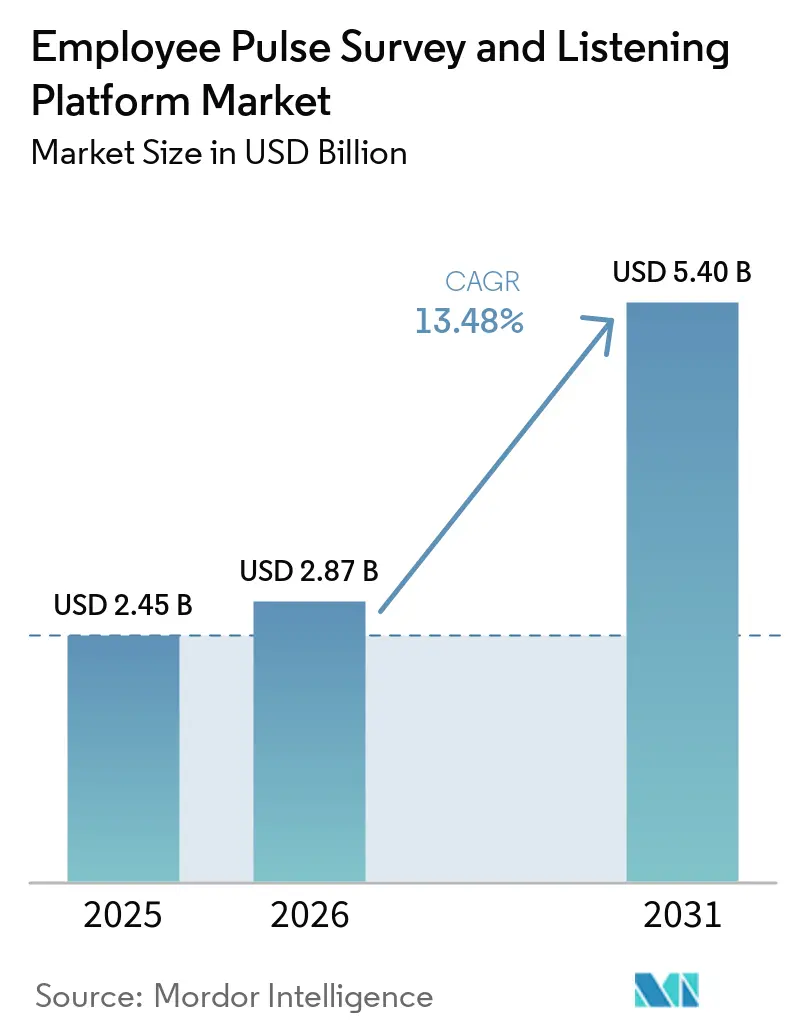
The employee pulse survey and listening platform market size is projected to be USD 2.45 billion in 2025, USD 2.87 billion in 2026, and reach USD 5.40 billion by 2031, growing at a CAGR of 13.48% from 2026 to 2031. Organizations are moving away from periodic census surveys toward continuous listening systems embedded in daily HR workflows. This change reflects a broader shift in how leadership treats employee sentiment, which is now handled more like an operating signal than a once-a-year culture check. Weak engagement levels, burnout pressure, and uneven manager follow-through are keeping demand strong because employers need faster feedback and clearer action paths. Compliance expectations for human capital reporting are also pushing public companies toward platforms that can generate repeatable, auditable workforce metrics. Competition is rising as specialist listening vendors, HCM suites, and broader employee experience platforms all try to own the feedback-to-action cycle.
Key Report Takeaways
- By component, platform/software held 71.20% of the employee pulse survey and listening platform market share in 2025, while managed services is forecast to expand at a 15.23% CAGR through 2031.
- By deployment, cloud-based deployment commanded a 68.45% share in 2025, while hybrid deployment is projected to grow at a 14.89% CAGR through 2031.
- By enterprise size, large enterprises accounted for 63.80% of of the employee pulse survey and listening platform market revenue in 2025, while SMEs are expected to record the highest CAGR of 16.11% through 2031.
- By capability, engagement and pulse surveys retained the largest share at 34.10% in 2025, while sentiment analytics and text intelligence are advancing at a 15.67% CAGR through 2031.
- By end-user industry, information technology and telecom accounted for 25.40% of revenue in 2025, while healthcare and life sciences are forecast to expand at a 16.73% CAGR through 2031.
- By geography, North America held 40.05% of of the employee pulse survey and listening platform market share in 2025, while Asia-Pacific is projected to grow at a 16.89% CAGR through 2031.
Note: Market size and forecast figures in this report are generated using Mordor Intelligence’s proprietary estimation framework, updated with the latest available data and insights as of January 2026.
Global Employee Pulse Survey And Listening Platform Market Trends and Insights
Drivers Impact Analysis*
| Driver | (~) % Impact on CAGR Forecast | Geographic Relevance | Impact Timeline |
|---|---|---|---|
| AI-Powered Sentiment Analytics And Predictive Insights | +3.2% | Global, with early concentration in North America and Western Europe | Short term (= 2 years) |
| Expansion Of Hybrid And Remote Work Models | +2.8% | Global, strongest in North America, Europe, and Australia and New Zealand | Short term (= 2 years) |
| Rising Enterprise Focus On Employee Engagement And Retention | +2.3% | Global, with elevated urgency in North America, the United Kingdom, and Australia | Medium term (2-4 years) |
| Growth Of Cloud-Native HR Technology Stacks | +1.8% | Global, accelerated adoption in Asia-Pacific and South America | Medium term (2-4 years) |
| Multilingual And Frontline-Friendly Survey Delivery | +1.2% | Asia-Pacific core, with spillover to the Middle East and Africa and South America | Long term (= 4 years) |
| Human Capital Disclosure And Well-Being Governance Requirements | +1.0% | EU and North America, with expansion to APAC national regulators | Medium term (2-4 years) |
| Source: Mordor Intelligence | |||
Ai-Powered Sentiment Analytics And Predictive Insights
Large language models are changing the employee pulse survey and listening platform market from a passive collection layer into a more active workforce intelligence system. Open-text analysis now helps vendors flag burnout signals, attrition risk, and manager-specific next steps without relying on manual interpretation at every step. That change matters because shorter pulse formats can still produce useful themes, reducing dependence on long surveys and helping counter survey fatigue. In the employee pulse survey and listening platform market, AI is also becoming a key metric, as employee sentiment around automation now affects trust, readiness, and adoption. Gallup reported in April 2026 that manager support for AI tools was the strongest predictor of employee AI adoption, which tied listening capability more closely to broader productivity agendas.[1]Jim Harter and Ryan Pendell, “Global Employee Engagement Continues Decline,” Gallup, gallup.com
Expansion Of Hybrid And Remote Work Models
Hybrid and remote work now function as a structural part of workforce design rather than a temporary operating model. That shift has made technology-mediated listening much more important because distributed teams lose many of the informal signals that managers once picked up in person. Annual engagement surveys don't fit well in this setting because team composition, workload levels, and manager relationships change too often for a single annual snapshot to remain useful. The employee pulse survey and listening platform market is benefiting from this pattern because buyers increasingly want mobile-first, asynchronous delivery that reaches people inside collaboration tools instead of asking them to log in to a separate system. ManpowerGroup Deutschland reported in January 2026 that 58% of German employees showed burnout symptoms, while 65% planned to stay with their employer and 54% were still searching for new roles, underscoring the need for continuous listening to become more operationally relevant.[2]ManpowerGroup Deutschland, “Presse: Global Talent Barometer 2026,” ManpowerGroup, manpowergroup.de
Rising Enterprise Focus On Employee Engagement And Retention
Disengagement now carries clearer financial and operating costs, so spending on workforce listening is being framed less as discretionary HR software and more as risk management. This has raised the profile of the employee pulse survey and listening platform market in board and finance discussions, especially when turnover, manager quality, and productivity are being reviewed together. The demand is strongest for products that place listening results directly into manager workflows, with action prompts, rather than leaving HR teams to interpret dashboards on their own. That preference also explains why action planning and nudge-based layers are growing faster than basic survey administration in many enterprise accounts. Gallup stated in April 2025 that low engagement cost the global economy USD 438 billion in lost productivity in 2024, which helped strengthen the case for more continuous employee listening programs.
Growth Of Cloud-Native Hr Technology Stacks
Enterprise HR architecture is moving toward integrated cloud systems that connect payroll, performance management, talent management, and employee feedback. This shift supports the employee pulse survey and listening platform market because listening can be triggered by lifecycle events, such as onboarding milestones, internal transfers, promotions, and goal completion, rather than a fixed survey calendar. Over time, those integrations create longitudinal workforce datasets that improve predictive models and make listening more valuable with each cycle. Leapsome launched its first people-centric HRIS in May 2026, combining payroll, absence management, document workflows, engagement surveys, and performance tools into one platform, demonstrating how listening is being built into broader systems of record.[3]Leapsome Team, “January 2026: AI-Powered Insights and Smarter Workflows for HR,” Leapsome, leapsome.com In the employee pulse survey and listening platform market, vendors with deeper native integrations are better placed to retain customers as employers simplify their software estates.
Restraints Impact Analysis*
| Restraint | (~) % Impact on CAGR Forecast | Geographic Relevance | Impact Timeline |
|---|---|---|---|
| Data Privacy, Anonymity, And Cross-Border Compliance Concerns | -1.8% | EU, with cross-border implications for global deployments spanning APAC and South America | Medium term (2-4 years) |
| Survey Fatigue And Declining Response Quality | -1.2% | Global, pronounced in North America and the United Kingdom | Short term (= 2 years) |
| Manager Actionability Gap After Survey Cycles | -0.9% | Global, particularly acute in mid-market segments and developing markets | Medium term (2-4 years) |
| Bundling Pressure From HCM Suites And Price Compression | -0.7% | North America and Western Europe | Short term (= 2 years) |
| Source: Mordor Intelligence | |||
Data Privacy, Anonymity, And Cross-Border Compliance Concerns
Privacy regulation remains one of the hardest operating constraints in the employee pulse survey and listening platform market. GDPR can impose fines of up to EUR 20 million (USD 22.6 million) or 4% of global annual turnover for violations of core processing rules, so vendors and employers need much tighter controls around employee feedback data.[4]Rachel Richardson, “GDPR for HR: Employee Data Processing Guide,” Grove HR, grove.hr The practical challenge is that surveys marketed as anonymous can still become re-identifiable when teams are small or when demographic filters and timestamp data are combined. In March 2026, it was noted that employee survey programs have to address consent, demographics, processors, and anonymity thresholds carefully under GDPR, which shows how governance has become part of product design rather than just legal review. The result is longer buying cycles, tighter vendor scrutiny, and stronger demand for regional hosting, threshold controls, and configurable data retention rules.
Survey Fatigue And Declining Response Quality
Survey fatigue limits the value of the employee pulse survey and the listening platform market when listening frequency rises faster than the rate of visible follow-up. Employees usually disengage from the process when they do not see action, and this weakens data quality before it fully shows up in headline response rates. Open-text answers become shorter, scoring patterns become less thoughtful, and trust in the program drops when each cycle feels repetitive. The challenge is greater in frontline environments, where survey access conflicts with shift schedules, device constraints, and a lower tolerance for repetitive requests. Leapsome introduced smart question sampling in January 2026 to spread survey burden across cohorts, which showed how vendors are trying to protect response quality without abandoning frequent listening.
*Our forecasts treat driver/restraint impacts as directional, not additive. The impact forecasts reflect baseline growth, mix effects, and variable interactions.
Segment Analysis
By Component: Services Gain As Analytics Complexity Deepens
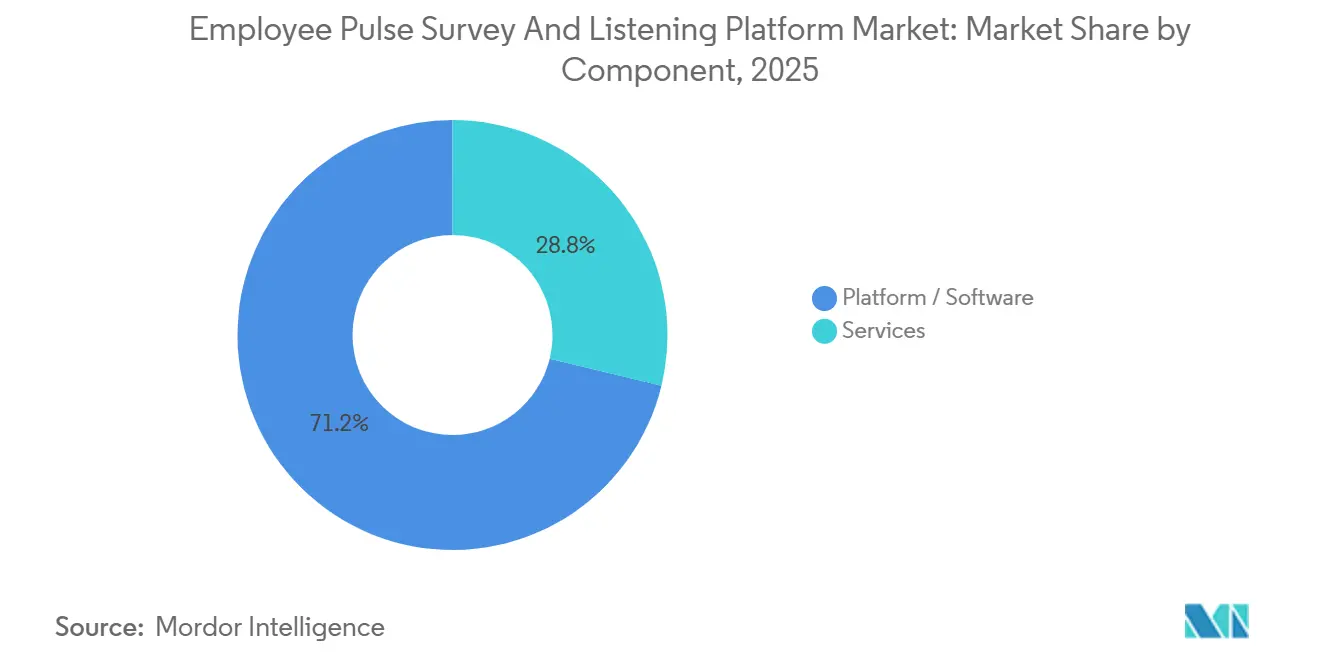
Platform/software held 71.20% of the employee pulse survey and listening platform market size in 2025, while services are forecast to expand at a 15.23% CAGR through 2031. Software remained the core layer of spending because it manages survey delivery, dashboarding, benchmarking, and analytics at scale. It also serves as the daily system through which employees and managers interact, so most initial buying decisions still center on the platform itself. Even so, services are growing faster because many HR teams lack the time or in-house capability to translate listening data into manager-ready actions across large organizations.
Services demand is being pulled by implementation work, analytics consulting, action-planning support, and ongoing program management. These revenue streams are also stickier than software-only subscriptions because the vendor relationship extends into governance, interpretation, and change execution. In the employee pulse survey and listening platform market, that matters because buyers increasingly want help closing the gap between measurement and visible manager response. Leapsome’s May 2026 move to a broader HRIS model followed the same logic, tying engagement data to payroll, absence management, and performance records within a single operating environment. The employee pulse survey and listening platform industry is therefore placing greater value on services that convert data into workflow changes rather than just producing another reporting layer.


By Deployment Mode: Hybrid Models Fit Regulated Enterprise Needs
Cloud-based deployment commanded a 68.45% share in 2025, while hybrid deployment is expected to grow at a 14.89% CAGR through 2031. Cloud remained the default choice because it supports rapid provisioning, continuous updates, lower maintenance burden, and easier access for distributed teams. It also aligns with the delivery model of most SaaS-based HR software, which makes procurement and rollout simpler for many employers. These advantages kept the cloud at the center of new deployments across multinational and mid-market accounts.
Hybrid deployment is growing because large regulated employers need cloud analytics and modern interfaces without sacrificing control over sensitive employee data. In the employee pulse survey and listening platform market, hybrid is not just a bridge toward full cloud adoption. It is a stable destination for BFSI, healthcare, public sector, and other organizations dealing with overlapping data residency and internal security rules. On-premises still matters when workforce data cannot be processed by third-party clouds under existing policy or security controls. As the employee pulse survey and listening platform market matures, deployment flexibility is becoming a buying criterion in its own right because switching costs rise once governance and infrastructure are set.
By End User Enterprise Size: SME Adoption Moves Beyond The Enterprise Base
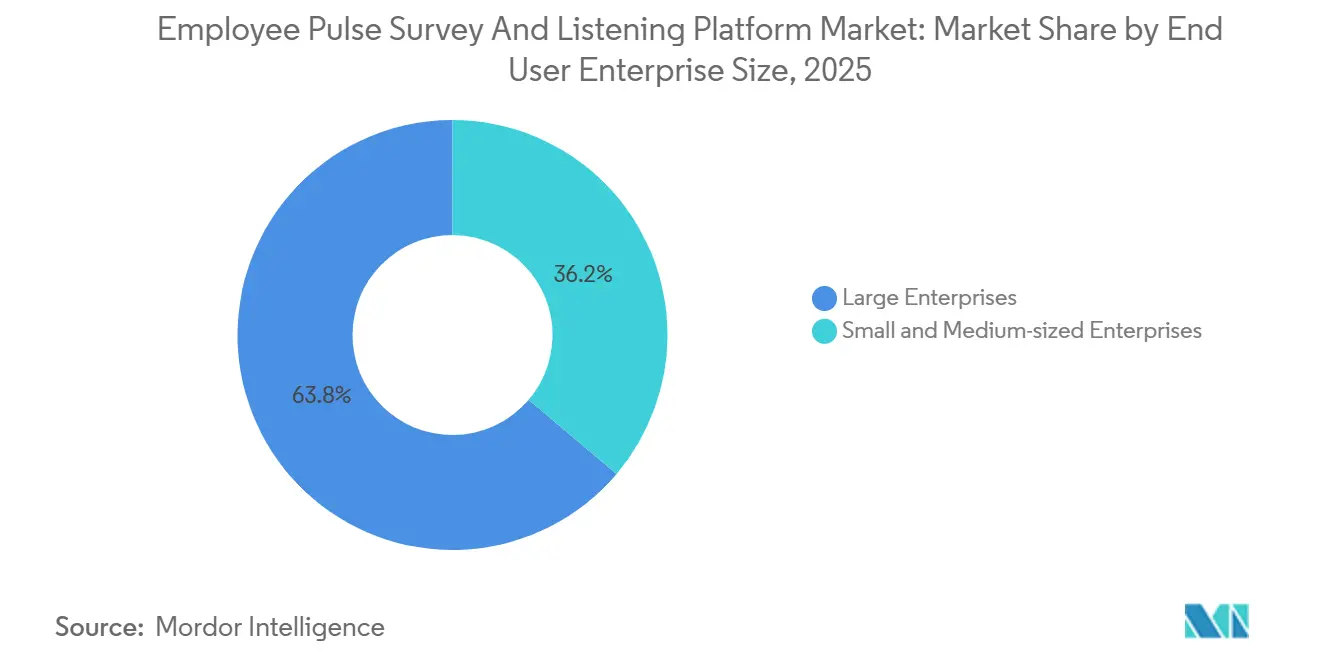
Large enterprises held 63.80% of revenue in 2025, while SMEs are projected to grow at a 16.11% CAGR through 2031. Large organizations stayed ahead because they operate more sites, more reporting lines, and more complex workforce structures that benefit from formal listening programs. They also have larger HR technology budgets and more specialized people analytics teams, which support enterprise-scale deployment. That scale keeps large accounts central to vendor revenue even as the customer base broadens.
SME demand is growing faster because lower-cost SaaS tiers, self-serve onboarding, and template libraries have reduced earlier adoption barriers. Smaller employers also feel disengagement more sharply because turnover in a core team can disrupt a significant share of operations. In the employee pulse survey and listening platform market, AI-guided interpretation is especially useful for this buyer group because it reduces the need for in-house analysts. A January 2026 release added AI-powered dashboard summaries and smarter survey sampling, demonstrating how vendors are simplifying operations for lean HR teams. The employee pulse survey and listening platform industry is therefore expanding beyond its traditional enterprise base into organizations with 50–500 employees that now have a realistic path to adoption.
By Capability: Sentiment Analytics Gains Ground On Core Survey Tools
Engagement and pulse surveys held 34.10% of the employee pulse survey and listening platform market share in 2025, while sentiment analytics and text intelligence are forecast to advance at a 15.67% CAGR through 2031. Core survey tools remained the main entry point because they are easier to deploy, explain to managers, and standardize across business units. They also provide the baseline measurement framework that many organizations still use to compare teams and track recurring metrics over time. This kept pulse and engagement survey modules at the center of most platform bundles.
Sentiment analytics is growing faster because open-text interpretation now captures nuance that structured scoring alone often misses. Lifecycle listening is also gaining ground as organizations want feedback across onboarding, transfers, promotions, exits, and other employee milestones rather than at a single annual moment. Perceptyx expanded its Activate solution in May 2025 so it could work with any third-party EX platform, and the company reported 66% manager engagement with AI-generated nudges and up to 12-point engagement score improvement within 6 months. Other premium capabilities, including wellness sensing, DEI diagnostics, and organizational network analysis, deepen stickiness without competing only on core survey price. The employee pulse survey and listening platform market is moving from survey infrastructure toward decision-support tools that sit closer to day-to-day management.
By End User Industry: Healthcare Broadens Demand Beyond Technology Buyers
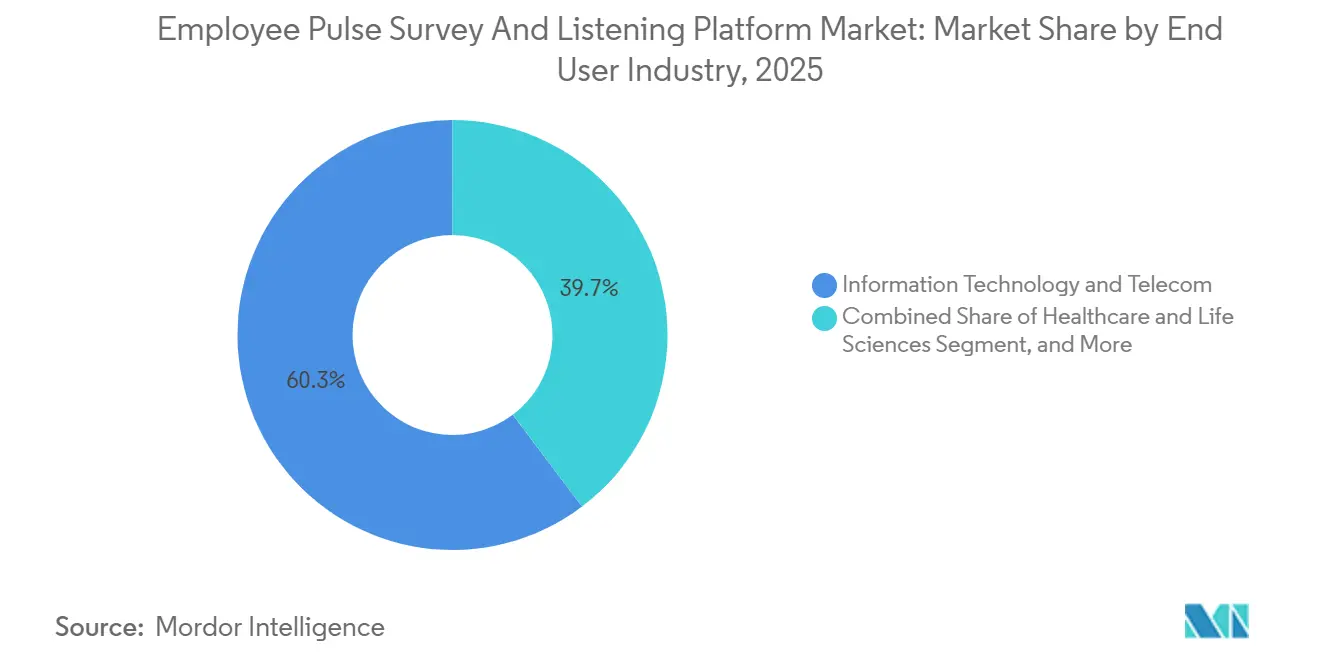
Information technology and telecom accounted for 25.40% of revenue in 2025, while healthcare and life sciences are expected to grow at a 16.73% CAGR through 2031. IT and telecom remained the largest vertical because the sector adopted HR software early and continues to face strong competition for skilled talent. Managers in this segment are also more accustomed to data-led performance processes, which support faster use of pulse feedback and related analytics. That combination kept the vertical as the most established buyer group in 2025.
Healthcare and life sciences are expanding faster because staffing shortages, burnout, and frontline retention problems now affect cost, capacity, and service continuity. Employers in this vertical need listening methods that work across shifts, sites, and mobile devices, which is pushing vendors beyond desk-based survey design. Retail and e-commerce are moving in the same direction as vendors build support for messaging channels, QR code surveys, and multilingual frontline delivery. In the employee pulse survey and listening platform market, vertical growth beyond IT is widening the product brief from knowledge-worker engagement toward frontline retention and operating resilience. The employee pulse survey and listening platform market, therefore, has more room for providers that combine broad functionality with vertical benchmarks, sector-specific question sets, and manager actions that fit local workflows.

Geography Analysis
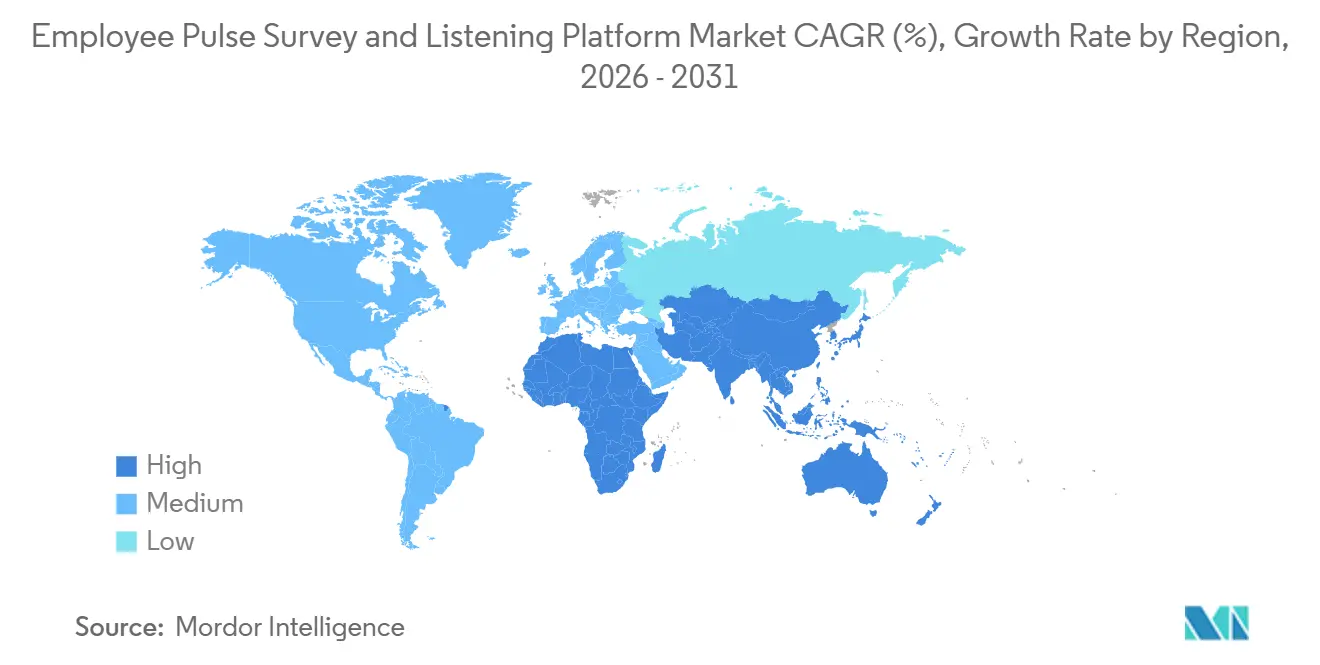
North America held 40.05% of the employee pulse survey and listening platform market size in 2025, while Asia-Pacific is forecast to grow at a 16.89% CAGR through 2031. North America remained the largest revenue pool because HR technology adoption is mature and many large employers already operate dedicated people analytics functions. Employee engagement in the United States and Canada stood at 31% in 2025, the highest among measured regions, but daily stress also reached 50%, which keeps demand for better listening infrastructure elevated. Canada and Mexico are also adding demand as adoption becomes more locally driven and less dependent on U.S. headquarters-led rollouts. The employee pulse survey and listening platform market in North America benefits from both scale and a stronger tendency to connect people data with business performance.
Europe remains strategically important in the employee pulse survey and listening platform market because compliance rules and buying decisions are closely linked. Workforce disclosure pressure under CSRD is making well-governed listening data more valuable for public companies that need repeatable reporting across multiple entities. Employee engagement in Europe was 12% in 2025 for the fifth straight year, which left the region with the lowest engagement level globally and a large improvement opportunity for well-executed platforms. EU-based vendors can hold an advantage when employers prioritize regional hosting, works council familiarity, and GDPR-aligned configuration.
Asia-Pacific is the fastest-growing geography in the employee pulse survey and listening platform market, supported by HR digitization in India, China, Japan, South Korea, and Australia. Multinational expansion across linguistically diverse workforces is also raising demand for multilingual delivery and centralized oversight. South America, the Middle East, and Africa remain smaller but increasingly relevant as domestic groups and multinational subsidiaries standardize workforce systems and adopt smartphone-first survey channels. Within this broader expansion, the employee pulse survey and listening platform market is gaining traction in regions where mobile delivery solves earlier access barriers and where workforce formalization is still progressing.

Competitive Landscape
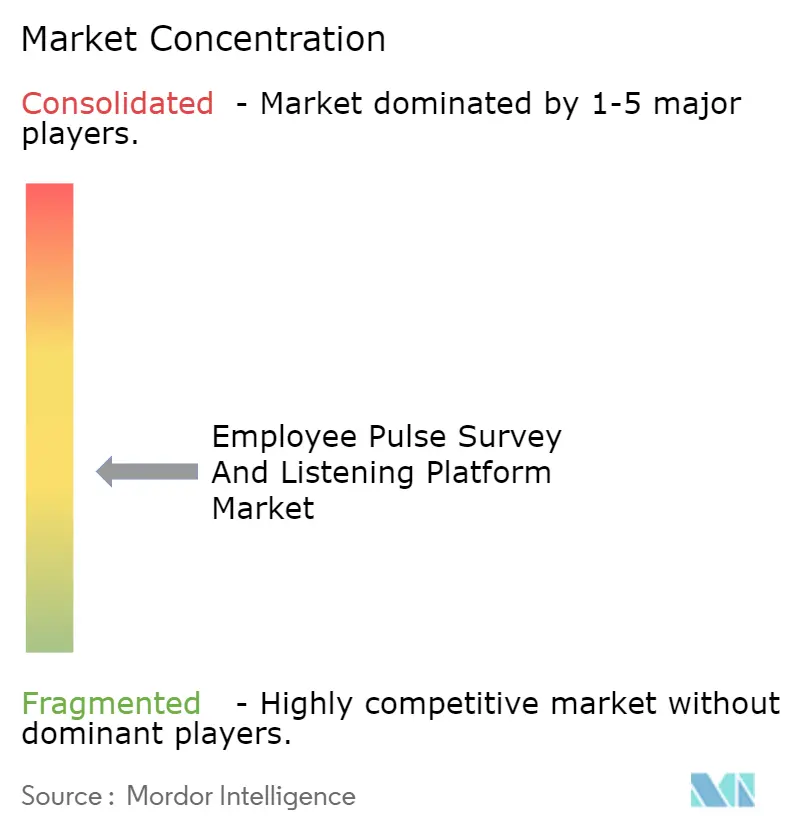
The employee pulse survey and listening platform market is moderately fragmented, with enterprise suite vendors, specialized platforms, and HCM providers all competing for similar budget lines. No single company controls the field because many buyers still distinguish between broad HCM coverage and deeper listening capability. Product roadmaps are converging around pulse surveys, sentiment analytics, lifecycle listening, and action planning, which makes core functionality less differentiating than it was a few years ago. That has shifted competition toward integration depth, benchmarking assets, AI usefulness, and proof that managers actually act on the results. The market also still has open space in frontline and deskless workforces, where mobile-first, multilingual, and low-bandwidth delivery is not yet evenly served.
Strategic moves increasingly focus on embedding listening inside wider people systems rather than selling it as a standalone survey layer. In May 2026, one vendor launched a people-centric HRIS that combined payroll, absence management, document workflows, engagement surveys, and performance management in a single environment, signaling a broader platform play for mid-market and enterprise buyers. Another vendor introduced a standalone people intelligence platform that connects work behavior, communication patterns, performance, and sentiment data, enabling leaders to act on workforce signals more continuously. These moves show that the market is shifting toward contextual workforce intelligence rather than isolated survey measurement.
Partnerships and ecosystem reach are also shaping competition because platform data becomes more useful when it flows across HCM tools and collaboration software. In October 2025, one provider joined a major partner program to unify engagement, performance, and HR operational data for shared customers through automated reporting and predictive analytics. Microsoft Viva Glint continues to pressure standalone vendors because Teams-native deployment can reduce adoption friction and compress pricing for organizations already licensed to Microsoft 365. In this market, vendors that translate feedback into manager behavior change and fit cleanly into existing software environments are likely to hold the strongest position over the next several years.
Employee Pulse Survey And Listening Platform Industry Leaders
Qualtrics, LLC
Culture Amp Pty Ltd
Perceptyx, Inc.
Degree, Inc. d/b/a Lattice
15Five, Inc.
- *Disclaimer: Major Players sorted in no particular order

Recent Industry Developments
- May 2026: Leapsome launched its first HRIS, integrating payroll, absence, and document workflows with engagement and performance tools, positioning as a full-stack HR system.
- May 2026: Workvivo by Zoom introduced Seer, a people intelligence platform led by Justin Black, connecting behavior, communication, performance, and sentiment for continuous workforce insights.
- May 2026: Semos Cloud became the first AI-native ISV on SAP Business AI, deploying 24 agents for surveys, sentiment, recognition, and autonomous engagement campaigns.
- April 2026: WorkTango launched WorkTango Coach, an AI survey analyst that converts employee feedback into personalized manager action plans with ownership tracking and feedback loop closure.


Global Employee Pulse Survey And Listening Platform Market Report Scope
The employee pulse survey and listening platform market refers to solutions that capture real-time employee feedback, measure engagement, and analyze sentiment to guide organizational decision-making. These platforms provide capabilities such as pulse surveys, lifecycle listening, text intelligence, and manager enablement, helping enterprises translate employee voice into actionable insights. Available via cloud, on-premises, or hybrid models, they serve both large enterprises and SMEs across industries, including BFSI, healthcare, IT and telecom, retail, manufacturing, government, and others. Their core purpose is to strengthen engagement, retention, and workplace culture through continuous listening.
The employee pulse survey and listening platform market is segmented by Component (Platform/Software, and Services), Deployment Mode (Cloud-Based, On-Premises, and Hybrid), Enterprise Size (Large Enterprises, and Small and Medium-sized Enterprises), Capability (Engagement and Pulse Surveys, Lifecycle Listening, Sentiment Analytics and Text Intelligence, Action Planning and Manager Enablement, and Other Capabilities), End-user Industry (BFSI, Healthcare and Life Sciences, Information Technology and Telecom, Retail and E-commerce, Industrial Manufacturing, and Government and Public Sector), and Geography (North America, South America, Europe, Asia-Pacific, Middle East, and Africa). The Market Forecasts are Provided in Terms of Value (USD).
| Platform/Software |
| Services |
| Cloud-Based |
| On-Premises |
| Hybrid |
| Large Enterprises |
| Small and Medium-sized Enterprises |
| Engagement and Pulse Surveys |
| Lifecycle Listening |
| Sentiment Analytics and Text Intelligence |
| Action Planning and Manager Enablement |
| Other Capabilities |
| BFSI |
| Healthcare and Life Sciences |
| Information Technology and Telecom |
| Retail and E-commerce |
| Industrial Manufacturing |
| Government and Public Sector |
| Other End-user Industries |
| North America | United States |
| Canada | |
| Mexico | |
| South America | Brazil |
| Argentina | |
| Rest of South America | |
| Europe | Germany |
| United Kingdom | |
| France | |
| Italy | |
| Spain | |
| Russia | |
| Netherlands | |
| Rest of Europe | |
| Asia-Pacific | China |
| Japan | |
| India | |
| South Korea | |
| Australia and New Zealand | |
| Rest of Asia-Pacific | |
| Middle East | Saudi Arabia |
| United Arab Emirates | |
| Rest of Middle East | |
| Africa | South Africa |
| Nigeria | |
| Rest of Africa |
| By Component | Platform/Software | |
| Services | ||
| By Deployment Mode | Cloud-Based | |
| On-Premises | ||
| Hybrid | ||
| By End User Enterprise Size | Large Enterprises | |
| Small and Medium-sized Enterprises | ||
| By Capability | Engagement and Pulse Surveys | |
| Lifecycle Listening | ||
| Sentiment Analytics and Text Intelligence | ||
| Action Planning and Manager Enablement | ||
| Other Capabilities | ||
| By End User Industry | BFSI | |
| Healthcare and Life Sciences | ||
| Information Technology and Telecom | ||
| Retail and E-commerce | ||
| Industrial Manufacturing | ||
| Government and Public Sector | ||
| Other End-user Industries | ||
| By Geography | North America | United States |
| Canada | ||
| Mexico | ||
| South America | Brazil | |
| Argentina | ||
| Rest of South America | ||
| Europe | Germany | |
| United Kingdom | ||
| France | ||
| Italy | ||
| Spain | ||
| Russia | ||
| Netherlands | ||
| Rest of Europe | ||
| Asia-Pacific | China | |
| Japan | ||
| India | ||
| South Korea | ||
| Australia and New Zealand | ||
| Rest of Asia-Pacific | ||
| Middle East | Saudi Arabia | |
| United Arab Emirates | ||
| Rest of Middle East | ||
| Africa | South Africa | |
| Nigeria | ||
| Rest of Africa | ||


Key Questions Answered in the Report
What is the current and forecast size of the employee pulse survey and listening platform market?
The employee pulse survey and listening platform market was valued at USD 2.45 billion in 2025, stands at USD 2.87 billion in 2026, and is projected to reach USD 5.40 billion by 2031 at a 13.48% CAGR.
Which component leads revenue today?
Platform and software led with 71.20% of revenue in 2025 because it remains the core layer for survey delivery, analytics, benchmarking, and manager dashboards.
Why are managed services growing faster than software?
Managed services is projected to grow at a 15.23% CAGR because many employers need help with interpretation, action planning, and program management after data is collected.
Which deployment model is expanding the fastest?
Hybrid deployment is the fastest-growing model at a 14.89% CAGR through 2031 because regulated employers often need cloud analytics with local data control.
Which user group is creating the strongest new demand?
SMEs are the fastest-growing buyer group at a 16.11% CAGR as SaaS pricing, self-serve setup, and AI-guided insights lower adoption barriers for smaller HR teams.
Which regions and industries offer the strongest growth outlook?
Asia-Pacific is the fastest-growing geography at a 16.89% CAGR, while healthcare and life sciences is the fastest-growing end-user industry at a 16.73% CAGR as staffing and retention pressures intensify.
Page last updated on:


 Your data is secure and never sold or shared.


