
Employee Feedback And Continuous Listening Market Size and Share
Market Overview
| Study Period | 2020 - 2031 |
|---|---|
| Market Size (2026) | USD 1.22 Billion |
| Market Size (2031) | USD 2.41 Billion |
| Growth Rate (2026 - 2031) | 14.59 % |
| Fastest Growing Market | Asia-Pacific |
| Largest Market | North America |
| Market Concentration | Low |
Major Players *Disclaimer: Major Players sorted in no particular order Image © Mordor Intelligence. Reuse requires attribution under CC BY 4.0. | |
Employee Feedback And Continuous Listening Market Analysis by Mordor Intelligence
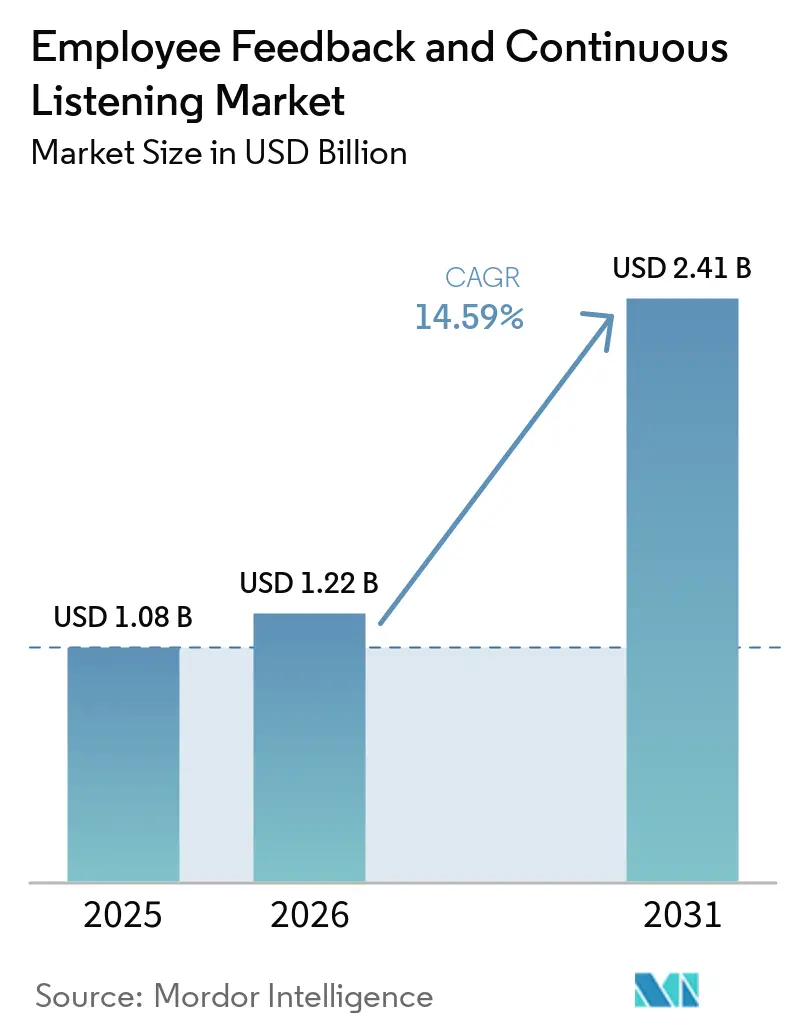
The employee feedback and continuous listening market size is projected to be USD 1.08 billion in 2025, USD 1.22 billion in 2026, and reach USD 2.41 billion by 2031, growing at a CAGR of 14.59% from 2026 to 2031. Growth is being shaped by a clear move away from occasional engagement checks and toward always-on feedback systems that feed daily management decisions and longer-term workforce planning. Organizations are also treating retention pressure as a direct cost issue, which makes faster detection of burnout, disengagement, and turnover risk more valuable than it was a few years ago. AI tools now process large volumes of employee comments quickly and turn them into ranked action priorities, which shortens the distance between listening and response. The market is also benefiting from stronger board and executive attention to workforce sentiment, especially where culture, reputation, and operational performance are closely linked. At the same time, vendors that can support action planning, compliance, and change management are gaining ground because many buyers no longer view listening platforms as stand-alone HR tools.
Key Report Takeaways
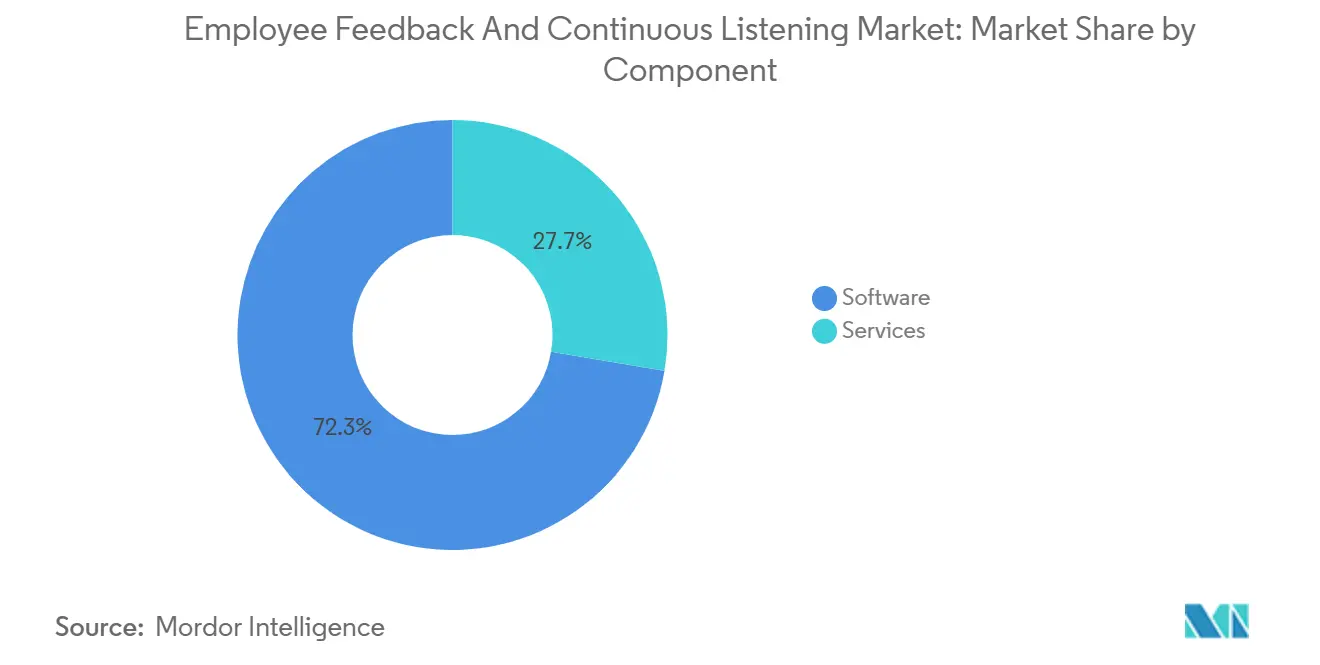
- By component, software accounted for 72.34% of revenue in the employee feedback and continuous listening market in 2025, while services are forecast to expand at a 15.47% CAGR through 2031.
- By deployment mode, cloud-based deployment accounted for 69.18% of revenue in 2025, while hybrid deployment is projected to grow at 14.89% CAGR through 2031.
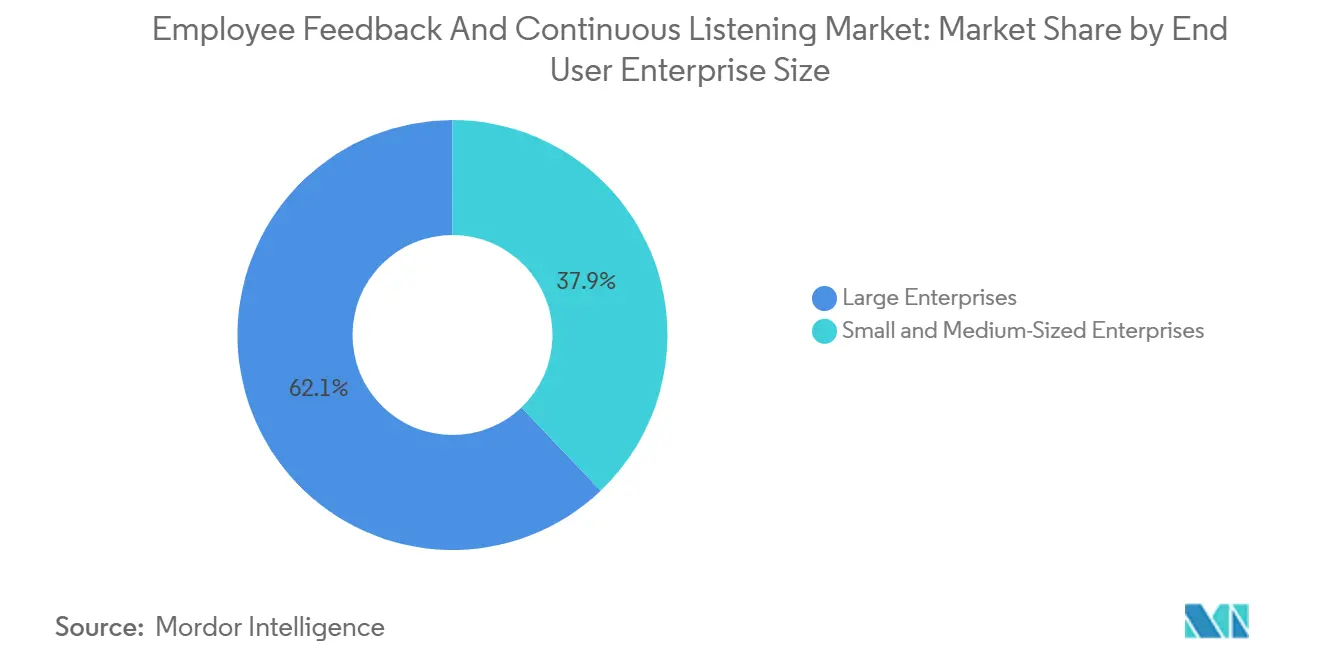
- By end-user enterprise size, large enterprises captured 62.11% of revenue share in 2025, while small and medium-sized enterprises are expected to expand at a 16.11% CAGR through 2031.
- By end-user industry vertical, BFSI accounted for 24.11% of revenue in 2025, while healthcare and life sciences are projected to grow at a 15.73% CAGR through 2031.
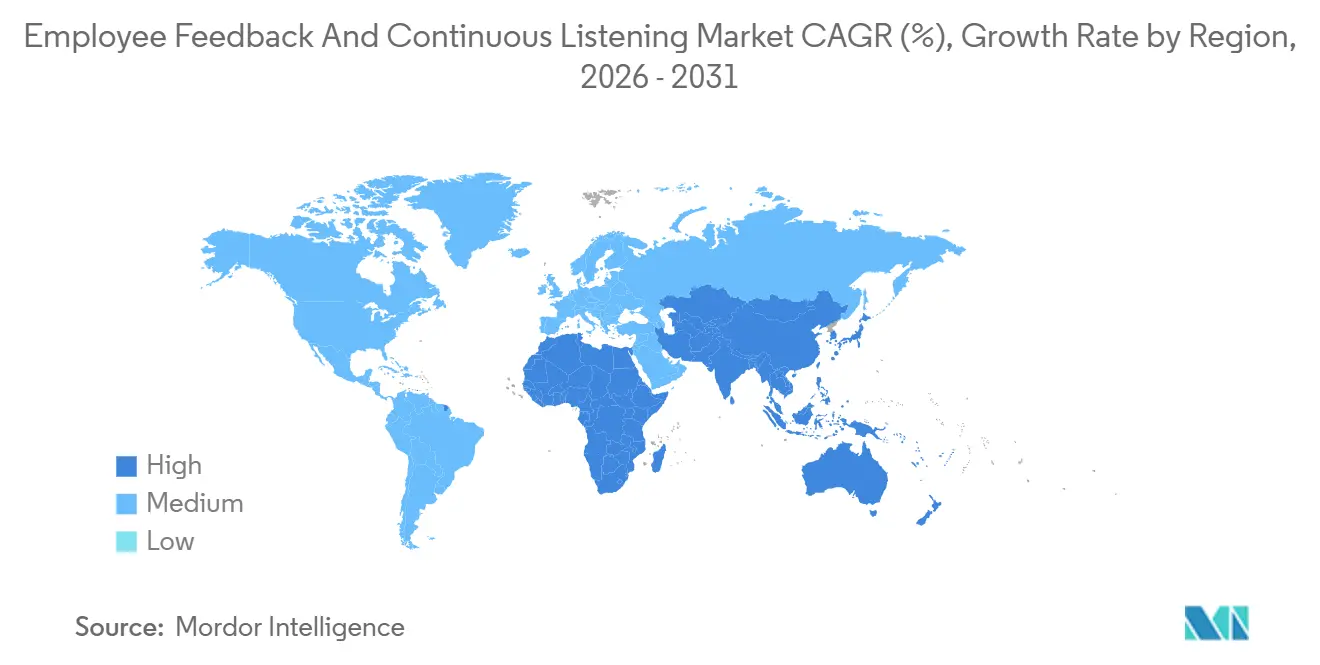
- By geography, North America led with 39.45% revenue share in 2025, while Asia-Pacific is expected to record the fastest CAGR of 16.89% through 2031.
Note: Market size and forecast figures in this report are generated using Mordor Intelligence’s proprietary estimation framework, updated with the latest available data and insights as of January 2026.
Market Trends and Insights
Drivers Impact Analysis of Employee Feedback And Continuous Listening Market*
| Driver | (~) % Impact on CAGR Forecast | Geographic Relevance | Impact Timeline |
|---|---|---|---|
| Shift To Continuous Listening From Annual Surveys | +2.8% | Global, with strongest acceleration in North America and Northern Europe | Short term (≤ 2 years) |
| AI-Enabled Sentiment Analysis And Action Planning | +2.4% | Global, with early maturity in North America and rapid uptake in Asia-Pacific | Medium term (2-4 years) |
| Focus On Employee Retention And Experience Metrics | +2.0% | Global, with stronger intensity in North America, Europe, and Australia | Short term (≤ 2 years) |
| Hybrid Work And Distributed Team Management Needs | +1.5% | Global, with highest impact across North America, Europe, and APAC tech corridors | Short term (≤ 2 years) |
| Frontline Worker Listening Through Kiosk, QR, And Messaging Channels | +1.1% | APAC core, with spillover to North America and Middle East and Africa manufacturing and retail | Medium term (2-4 years) |
| Board-Level Culture Risk Monitoring After Labor Activism And Reputation Shocks | +0.7% | North America and the EU primarily, with growing relevance in Asia-Pacific | Long term (≥ 4 years) |
| Source: Mordor Intelligence | |||
Shift From Annual Surveys To Continuous Listening
The employee feedback and continuous listening market is being driven by a broad shift from annual surveys to more frequent, embedded listening programs. By late 2025, 75% of organizations were collecting employee feedback at least quarterly, up from 18% a decade earlier, indicating how much faster the feedback cycle has become.[1]Perceptyx, “Employee Engagement Surveys, Trends, Challenges, And Action Gaps,” Perceptyx, perceptyx.com This shift is durable because the business case strengthens as organizations see that infrequent listening weakens the link between workforce experience and operating outcomes. Perceptyx also showed that the share of organizations at Stage 4 continuous listening maturity fell from 23% to 15%, indicating a real execution burden and creating additional demand for services and automation support. Qualtrics reported in March 2026 that 78% of organizations now conduct listening events at least quarterly, up from 60% in 2022, which confirms that higher-frequency listening has moved into the mainstream. As frequency rises, the employee feedback and continuous listening market benefits not only from greater software demand but also from a stronger need for actioning workflows, governance, and implementation support.
AI-Enabled Sentiment Analysis And Action Planning
The employee feedback and continuous listening market is also being shaped by AI's move from basic theme tagging into ranked action planning and manager support. Qualtrics stated at X4 2026 that organizations using personalized AI action recommendations saw up to 70% more managers create action plans, and adidas cut more than 160 hours of manual content creation per engagement cycle.[2]Qualtrics, “Thousands Of Organizations Use Qualtrics To Build Engaged, Productive, And High-Performing Teams,” Qualtrics, qualtrics.com That change matters because buyers increasingly want platforms that turn large volumes of unstructured feedback into actionable next steps rather than static reporting. The EU AI Act has also raised the bar, because AI systems used in employment contexts can fall into high-risk categories that require human oversight, documentation, and stronger controls. This means AI capability alone is no longer enough, and vendors need to show that their models can operate inside a credible compliance framework. In practice, the employee feedback and continuous listening market is rewarding providers that combine text analytics, action recommendations, and enterprise-grade trust markers such as ISO 27001, SOC 2 Type II, FedRAMP, and GDPR-aligned controls.
Rising Focus On Employee Retention And Experience Metrics
The employee feedback and continuous listening market is gaining support from companies that now treat turnover as a measurable financial issue instead of a softer engagement concern. Perceptyx reported that organizations with mature listening strategies were 6 times more likely to retain talent than those without structured programs, providing procurement teams with a direct retention narrative. The same dataset showed that managers who engaged with AI nudges were 2.4 times more likely to take action, and employees who received those nudges were 8% less likely to leave. These patterns are shifting the buying center beyond HR, because finance and operations leaders can connect listening outcomes to absenteeism, productivity, customer experience, and replacement costs. The logic is especially strong in labor-constrained settings where burnout or manager behavior can quickly turn into visible staffing losses. As that connection becomes clearer, the employee feedback and continuous listening market is moving closer to operational performance systems rather than remaining confined to a narrow engagement software category.[3]Workvivo By Zoom, “Workvivo Launches Seer To Advance People Intelligence And Close The Employee Listening Gap,” FinancialContent, financialcontent.com
Hybrid Work And Distributed Team Management Needs
The employee feedback and continuous listening market is also expanding because hybrid and distributed work has reduced many of the informal signals managers once relied on. When people work across offices, homes, shifts, and field sites, formal listening tools are among the few consistent ways to detect friction, isolation, or uneven manager follow-through. A 2026 Workvivo survey of 4,736 workers found that only 39% of frontline employees saw meaningful change from their feedback, compared with 54% of desk-based employees, which shows a clear execution gap across worker groups. That gap is changing product design, as vendors add kiosks, QR codes, SMS, and messaging channels for workers who do not sit at desks or use company email every day. The shift also favors platforms that can gather signals continuously and route them into manager workflows quickly enough to matter. As a result, the employee feedback and continuous listening market is being pulled toward broader workforce coverage instead of tools built mainly for desk-based corporate teams.
Restraints Impact Analysis of Employee Feedback And Continuous Listening Market*
| Restraint | (~) % Impact on CAGR Forecast | Geographic Relevance | Impact Timeline |
|---|---|---|---|
| Data Privacy, Anonymity, And Cross-Border Compliance Complexity | -1.3% | EU with GDPR and the EU AI Act, North America with CCPA and CPRA, and global multinationals | Short term (= 2 years) |
| Survey Fatigue And Low Action Follow-Through | -0.9% | Global | Medium term (2-4 years) |
| Manager Span-Of-Control Overload Weakens Closed-Loop Actioning | -0.6% | Global, with strongest effect in large matrixed organizations | Medium term (2-4 years) |
| Worker Council And Algorithmic Management Scrutiny Slows AI Listening Rollouts | -0.4% | EU, especially Germany, the Netherlands, France, and Austria, with spillover to the UK | Long term (= 4 years) |
| Source: Mordor Intelligence | |||
Data Privacy, Anonymity, And Cross-Border Compliance Complexity
The employee feedback and continuous listening market faces clear barriers due to privacy, data handling, and cross-border compliance requirements. Employee data can appear anonymous at the program level while becoming sensitive when broken down into small teams, demographic cuts, timestamps, or manager views, which makes buyers more cautious in regulated environments.[4]European Parliament And Council, “Regulation (EU) 2024/1689 Laying Down Harmonised Rules On Artificial Intelligence,” Official Journal Of The European Union, europa.eu The EU AI Act added further pressure by prohibiting workplace emotion inference from biometric data and by imposing tighter governance requirements on several employment-related AI uses. European policymakers also increased attention to algorithmic management in the workplace, which means vendors need stronger explanations for how models monitor, classify, or influence employee treatment. This increases implementation costs and extends sales cycles for global clients that require data residency, consent controls, and local governance options across multiple jurisdictions. The employee feedback and continuous listening market still has room to grow, but privacy architecture now carries more weight in purchasing decisions than it did when listening tools were mostly survey platforms.
Survey Fatigue And Low Action Follow-Through
The employee feedback and continuous listening market also faces greater behavioral restraints, because listening frequency alone does not build trust when employees do not see results. Perceptyx reported that only 51% of employees saw tangible improvements from their feedback, even when results were shared with them, highlighting the action gap at the center of many listening programs. The same company found in late 2025 that 62% of employees still preferred traditional surveys to conversational AI in higher-stakes situations such as promotions or leadership changes, indicating that channel expansion does not automatically improve confidence. When organizations increase listening touchpoints without clarifying purpose, ownership, and visible follow-through, response quality often weakens rather than improves. Vendors are trying to solve this with action planning tools, nudges, and guided manager workflows, but those features only work when managers have the time and support to use them. Until that cultural and managerial gap narrows, the employee feedback and continuous listening market will continue to face slower adoption among buyers who worry about participation fatigue and low credibility.
*Our forecasts treat driver/restraint impacts as directional, not additive. The impact forecasts reflect baseline growth, mix effects, and variable interactions.
Employee Feedback And Continuous Listening Market Segment Analysis
By Component:
Services Growth Signals A Structural Shift Beyond SoftwareSoftware accounted for 72.34% of revenue in 2025, indicating that SaaS-delivered survey tools, analytics dashboards, and AI listening platforms remain the core of demand. Much of that strength came from enterprise preference for scalable systems that can connect with existing HR technology rather than stand apart from it. Qualtrics reinforced that direction through its January 2025 partnership with SAP, which embedded XM for Employee Experience into SAP SuccessFactors workflows to support attrition and engagement use cases. In the employee feedback and continuous listening industry, software remains the anchor because buyers still need a central platform for data capture, analytics, reporting, and manager action flows.
Services are projected to grow at a 15.47% CAGR from 2026 to 2031, making it the fastest-growing component of the employee feedback and continuous listening market. That growth reflects a simple pattern, because many organizations now know that buying a platform does not guarantee that leaders will act on the results. Perceptyx reported in December 2025 that more than 4 in 10 HR leaders said their jobs had become harder, and 1 in 3 showed early signs of burnout, which supports demand for advisory, training, and managed support alongside software deployment. Service demand also rises when companies seek closed-loop actioning, executive coaching, survey design support, and post-launch governance that internal teams cannot manage on their own. That is why the employee feedback and continuous listening market is no longer defined solely by software subscription value. It is increasingly shaped by whether vendors can help clients move from listening to visible change. This gives services a more defensible role than a simple implementation add-on. It also helps explain why bundled accounts are becoming strategically important for retention and renewal.


By Deployment Mode:
Hybrid Architecture Bridges Compliance And FlexibilityCloud-based deployment accounted for 69.18% of the employee feedback and continuous listening market in 2025, keeping it well ahead of other deployment options. Cloud delivery aligns with how many organizations now run listening programs, as it supports broad geographic coverage, faster updates, and easier rollout across business units. It also aligns with the spread of mobile interfaces and the availability of multilingual survey access for distributed workforces. In the employee feedback and continuous listening market, cloud remains the default for organizations that want a common system across multiple countries and teams.
Hybrid deployment is projected to expand at a 14.89% CAGR through 2031, making it the fastest-growing architecture in the employee feedback and continuous listening market. The appeal of hybrid models comes from buyers who want cloud-based analytics and reporting while keeping sensitive employee data under tighter local control. This need is especially visible in regulated settings such as BFSI, government, and large multinational employers with strict internal governance rules. A hybrid design also gives global employers a way to balance central platform consistency with local privacy, residency, or labor expectations. That flexibility matters more as AI capabilities become more powerful and more closely reviewed. Vendors that can configure hosting, consent management, and workflow controls across jurisdictions are therefore gaining a practical advantage. On-premises deployments still hold a place in the most controlled environments, but their role is more stable than expansionary. The stronger momentum is clearly moving toward flexible mixed architectures rather than pure local infrastructure.
By End User Enterprise Size:
SME Adoption Emerges As The Fastest Expansion VectorLarge enterprises held 62.11% of the revenue share in 2025, reflecting the scale economics of running workforce listening across thousands of employees. These buyers often have dedicated people analytics teams, deeper integration needs, and a stronger case for unifying feedback across many functions and business units. Large organizations also gain more value from segmented dashboards, benchmarking, and manager-level action workflows because leadership structures are wider and more layered. In the employee feedback and continuous listening industry, those factors kept enterprise accounts at the center of current revenue.
Small and medium-sized enterprises are projected to grow at a 16.11% CAGR from 2026 to 2031, making them the fastest-expanding segment in the employee feedback and continuous listening market. Adoption is rising because lighter platforms now offer prebuilt survey templates, automated recommendations, and simpler integrations, reducing the need for specialized internal teams. Leapsome's 2025 product updates showed how vendors are addressing this need through AI-assisted survey creation, analytics widgets, and policy support that reduce the burden on HR teams. The demand case is also strong because growing firms often experience turnover shocks more sharply than larger employers with broader brand recognition and deeper staffing benches. Smaller companies still need proof that listening systems will remain easy to run after launch. That is why product simplicity matters more in this part of the market than long lists of advanced features. Platforms that shorten setup time and reduce service dependency are, therefore, well-positioned. The result is a broader customer base for listening vendors than the market had in its earlier enterprise-heavy phase.
By End User Industry Vertical:
Healthcare Accelerates While BFSI ConsolidatesBFSI held 24.11% of employee feedback and continuous listening market share in 2025, maintaining its lead among industry verticals. Financial institutions use workforce listening not only for engagement but also for conducting oversight, culture monitoring, and early detection of issues that could escalate into broader risk events. That makes employee sentiment data more operational in BFSI than in sectors where listening still sits closer to broad morale tracking. In the employee feedback and continuous listening market, the vertical's lead reflects how closely culture, compliance, and service quality are linked in regulated finance.
Healthcare and life sciences are projected to grow at a 15.73% CAGR through 2031, making it the fastest-growing vertical in the employee feedback and continuous listening market. This pace reflects heavy staffing pressure in clinical settings where burnout, scheduling strain, and manager support can quickly influence nurse and physician retention. Listening platforms are becoming more relevant in these environments because they give leaders earlier visibility into workforce stress before costly turnover or agency dependence intensifies. Retail, manufacturing, government, and education remain meaningful adjacent verticals, especially where frontline listening via kiosks, QR codes, and messaging channels is improving reach beyond desk-based teams. Healthcare growth also supports demand for platforms with strong privacy and security credentials, as employee data is highly sensitive and procurement standards are strict. The sector still needs practical workflows that fit shift-based operations and high-pressure care settings. That is why adoption will favor vendors that simplify manager response rather than just increasing survey frequency. Over time, healthcare's expansion should give the market a more balanced vertical mix beyond its current financial services strength.
Geography Analysis
North America Employee Feedback and Continuous Listening Market
North America held 39.45% of the employee feedback and continuous listening market share in 2025, which kept it firmly ahead of other regions. The United States remains the regional anchor because enterprise HR technology adoption is mature, and large employers are more likely to connect listening data with operational and financial measures. Qualtrics reported in March 2026 that 78% of organizations it surveyed were conducting listening events at least quarterly, up from 60% in 2022, which supports the region's shift from survey events to ongoing listening programs. Canada and Mexico add support through adoption in shared services, manufacturing, and business process environments. Privacy rules at the state and provincial level are also pushing buyers toward configurable consent and governance features rather than generic global deployments.
APAC Employee Feedback and Continuous Listening Market
Asia-Pacific is projected to expand at a 16.89% CAGR through 2031, making it the fastest-growing regional market in the employee feedback and continuous listening market. Growth is being supported by lower historical penetration, expanding enterprise workforces, and stronger competition for skilled talent across India, Australia, South Korea, and other digitalizing economies. Japan remains a notable opportunity because low engagement levels have created clear headroom for platforms designed to reduce hierarchy barriers and improve honest employee voice. U-ZERO launched an AI-powered engagement survey platform in late 2025 to address that gap, showing that local product development is starting to address region-specific management and communication patterns.
EMEA and South America Employee Feedback and Continuous Listening Market
Europe held a substantial share of revenue in 2025, with Germany, the United Kingdom, and France remaining the region's main demand centers. The defining feature in Europe is regulatory density, as employers must align AI-enabled listening with the GDPR, the EU AI Act, and growing scrutiny of algorithmic management in the workplace. That pressure supports longer sales cycles, stronger demand for compliance-ready vendors, and greater interest in hybrid data strategies across multinational employers. South America is still earlier in adoption, but Brazil and Argentina are seeing wider use through multinational subsidiaries that extend global listening programs into local operations, while the Middle East and Africa remain less mature and are led mainly by financial services and technology deployments in the Gulf.

Competitive Landscape
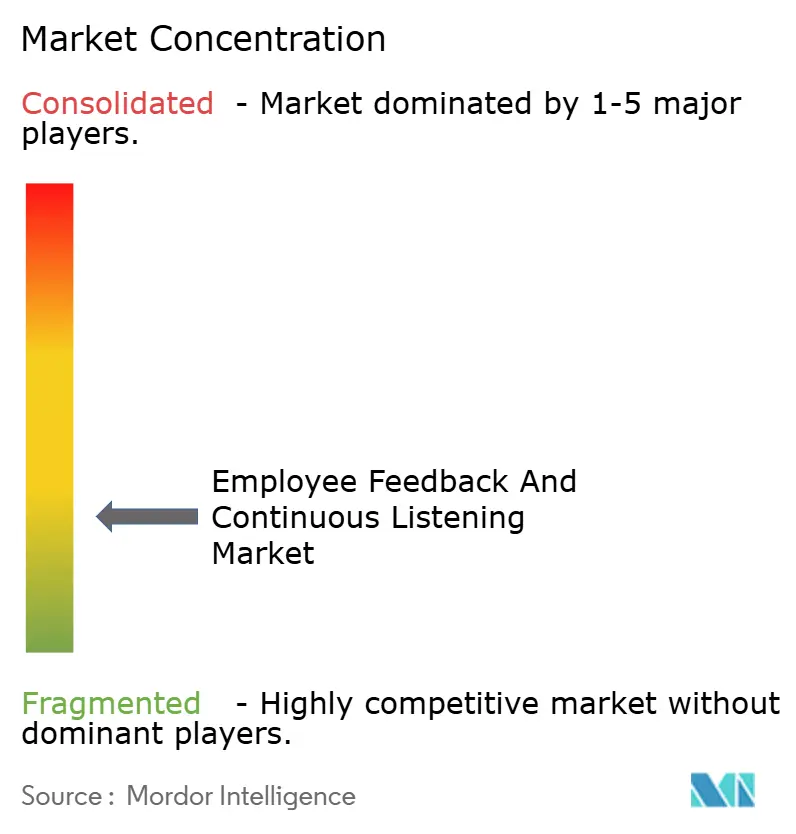
The employee feedback and continuous listening market remains moderately fragmented, with strong enterprise mindshare concentrated among a limited group of vendors but no single provider exercising dominant control across the field. Qualtrics and Medallia compete with broad experience management portfolios, while Culture Amp, Perceptyx, 15Five, Leapsome, and other specialists compete through deeper HR workflow alignment, faster product iteration, and more focused use cases. The employee feedback and continuous listening market is even more fragmented in the mid-market and SME tiers, where lighter deployment models and narrower feature sets allow more vendors to compete for accounts. This structure supports buyer choice, but it also means that differentiation depends less on basic survey capability and more on how well vendors connect listening with action, governance, and measurable outcomes. In practice, the strongest platforms are now trying to show that they can influence manager behavior and organizational follow-through, not merely produce cleaner dashboards.
Strategic moves over 2025 and 2026 show how the employee feedback and continuous listening market is evolving toward activation and workflow depth. Perceptyx acquired Lyceum AI in March 2026 to link employee listening with adaptive learning and development content, thereby extending its role beyond insight delivery into capability building after issues are identified. Qualtrics expanded its employee experience suite in 2025 with experience agents and AI-powered capabilities designed to address employee concerns earlier and support more responsive action at scale. Leapsome also broadened its product position with Leapy and AI-assisted review and survey tools, demonstrating that conversational support and reduced manual effort are becoming increasingly important across the competitive landscape. These moves indicate that the employee feedback and continuous listening market is shifting from listening alone toward manager enablement, action execution, and embedded workflow support after results are surfaced.
Trust, security, and compliance are also becoming stronger differentiators across the employee feedback and continuous listening market. CrowdStrike and Qualtrics launched a security integration in February 2026 to give customers stronger protection, visibility, and compliance support for employee experience program data, which reflected growing concern about how sensitive workforce information is handled. Frontline worker listening is another competitive opening, because many platforms still serve desk-based environments more effectively than large non-desk populations that need kiosk, QR, SMS, or messaging access. As a result, the employee feedback and continuous listening market is likely to see continued competition around AI-guided actioning, compliance readiness, and broader channel coverage rather than around simple survey creation tools. Vendors with strong certifications, better post-survey action plans, and clearer value in regulated or frontline-heavy settings are likely to defend their positions more effectively as the category matures.
Employee Feedback And Continuous Listening Industry Leaders
Qualtrics, LLC
Medallia, Inc.
Culture Amp Pty Ltd
Perceptyx, Inc.
WorkTango, Inc.
- *Disclaimer: Major Players sorted in no particular order
Employee Feedback And Continuous Listening Market Companies Covered in this Report
- Qualtrics, LLC
- Medallia, Inc.
- Culture Amp Pty Ltd
- Perceptyx, Inc.
- 15Five, Inc.
- Quantum Market Research, Inc.
- Leapsome GmbH
- WorkTango, Inc.
- Achievers Solutions Inc.
- Explorance Inc.
- Effectory B.V.
- Synergita Software Private Limited
- Engagedly Inc.
- Weekdone.Inc
- Energage, LLC
- Honestly MT GmbH
- EchoSpan, Inc.
- People Insight Ltd
- LutherOne a.s.
- Fulcrum Management Solutions Ltd.

Recent Industry Developments in Employee Feedback And Continuous Listening Market
- May 2026: LumApps and Beekeeper announced a merger to create an AI-powered Employee Hub serving both frontline and desk-based workers, with a combined valuation exceeding USD 1 billion and approximately USD 150 million in recurring revenue, targeting 100 million users by 2030.
- May 2026: Workvivo by Zoom launched Seer, a standalone people intelligence platform integrating feedback signals from communication, collaboration, and engagement channels into AI-powered manager dashboards. A 2026 Workvivo-commissioned survey of 4,736 workers found only 49% see meaningful change from feedback, highlighting the execution gap the product aims to address.
- March 2026: Perceptyx acquired Lyceum AI, an AI-native conversational learning platform, to bridge the gap between employee listening insights and personalized skill development, creating a unified system where workforce signals directly inform adaptive learning content.
- February 2026: CrowdStrike and Qualtrics launched a security integration connecting CrowdStrike Falcon Shield with the Qualtrics XM Platform to provide real-time visibility, automated protection, and compliance enforcement for employee experience program data, addressing the concern of 53% of employees who cite data misuse as a top AI concern.


Global Employee Feedback And Continuous Listening Market Report Scope
The Employee Feedback and Continuous Listening Market refers to software and service platforms that enable organizations to capture, analyze, and act on employee sentiment in real time. These solutions include pulse surveys, continuous listening tools, feedback dashboards, and AI-driven analytics that provide actionable insights into workforce engagement, performance, and well-being. Delivered via cloud, on-premises, or hybrid models, they serve enterprises of all sizes across industries such as BFSI, healthcare, retail, manufacturing, government, and education. The goal is to strengthen employee experience, improve retention, and align workforce feedback with organizational strategy.
The Employee Feedback and Continuous Listening Market is segmented by Component (Software and Services), Deployment Mode (Cloud-Based, On-Premises, and Hybrid), Enterprise Size (Large Enterprises and Small and Medium-Sized Enterprises), End-user Industry Vertical (BFSI, Healthcare and Life Sciences, Retail and E-commerce, Industrial Manufacturing, Government and Public Sector, Education, and Other End-user Industries), and Geography (North America, South America, Europe, Asia-Pacific, Middle East, and Africa). The Market Forecasts are Provided in Terms of Value (USD).
| Software |
| Services |
| Cloud-Based |
| On-Premises |
| Hybrid |
| Large Enterprises |
| Small and Medium-Sized Enterprises |
| BFSI |
| Healthcare and Life Sciences |
| Retail and E-commerce |
| Industrial Manufacturing |
| Government and Public Sector |
| Education |
| Other End-user Industry Verticals |
| North America | United States |
| Canada | |
| Mexico | |
| South America | Brazil |
| Argentina | |
| Rest of South America | |
| Europe | Germany |
| United Kingdom | |
| France | |
| Italy | |
| Spain | |
| Rest of Europe | |
| Asia-Pacific | China |
| Japan | |
| India | |
| South Korea | |
| Australia and New Zealand | |
| Rest of Asia-Pacific | |
| Middle East | Saudi Arabia |
| United Arab Emirates | |
| Rest of Middle East | |
| Africa | South Africa |
| Nigeria | |
| Egypt | |
| Rest of Africa |
| By Component | Software | |
| Services | ||
| By Deployment Mode | Cloud-Based | |
| On-Premises | ||
| Hybrid | ||
| By End User Enterprise Size | Large Enterprises | |
| Small and Medium-Sized Enterprises | ||
| By End User Industry Vertical | BFSI | |
| Healthcare and Life Sciences | ||
| Retail and E-commerce | ||
| Industrial Manufacturing | ||
| Government and Public Sector | ||
| Education | ||
| Other End-user Industry Verticals | ||
| By Geography | North America | United States |
| Canada | ||
| Mexico | ||
| South America | Brazil | |
| Argentina | ||
| Rest of South America | ||
| Europe | Germany | |
| United Kingdom | ||
| France | ||
| Italy | ||
| Spain | ||
| Rest of Europe | ||
| Asia-Pacific | China | |
| Japan | ||
| India | ||
| South Korea | ||
| Australia and New Zealand | ||
| Rest of Asia-Pacific | ||
| Middle East | Saudi Arabia | |
| United Arab Emirates | ||
| Rest of Middle East | ||
| Africa | South Africa | |
| Nigeria | ||
| Egypt | ||
| Rest of Africa | ||


Key Questions Answered in the Report
What is the current size of the employee feedback and continuous listening market?
The employee feedback and continuous listening market was valued at USD 1.08 billion in 2025 and stands at USD 1.22 billion in 2026. It is projected to reach USD 2.41 billion by 2031 at a 14.59% CAGR.
Which component currently contributes the most revenue in employee feedback and continuous listening?
Software led the category with a 72.34% share in 2025 because enterprises still prefer scalable SaaS platforms for survey administration, analytics, and AI-enabled action workflows.
Why are companies moving from annual employee surveys to continuous listening?
More frequent listening helps organizations identify risks earlier, shorten the feedback-to-action cycle, and support retention, manager effectiveness, and culture monitoring on a more regular basis.
Which deployment model is growing fastest in employee listening platforms?
Hybrid deployment is growing fastest at a 14.89% CAGR through 2031 because many buyers want cloud flexibility while keeping tighter control over sensitive employee data and regional compliance needs.
Which industries are creating the strongest growth opportunities through 2031?
BFSI remains the largest vertical with a 24.11% share in 2025, while healthcare and life sciences is growing fastest at a 15.73% CAGR due to staffing pressure, burnout risk, and the need for earlier intervention.
Which region offers the strongest expansion opportunity for vendors?
North America remains the largest regional base with a 39.45% share in 2025, while Asia-Pacific is the fastest-growing region at a 16.89% CAGR because adoption is still developing across several large labor markets.
Page last updated on:


 Your data is secure and never sold or shared.


