
Employee Net Promoter Score (eNPS) And Sentiment Analytics Market Size and Share
Market Overview
| Study Period | 2020 - 2031 |
|---|---|
| Market Size (2026) | USD 4.33 Billion |
| Market Size (2031) | USD 8.52 Billion |
| Growth Rate (2026 - 2031) | 14.50 % |
| Fastest Growing Market | Asia-Pacific |
| Largest Market | North America |
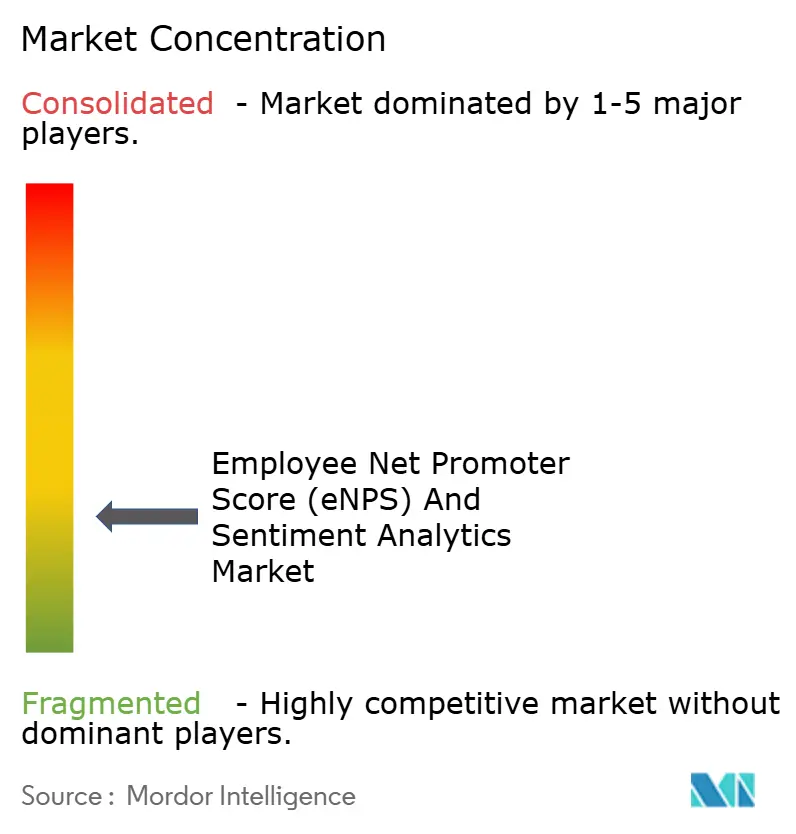
| Market Concentration | Low |
Major Players *Disclaimer: Major Players sorted in no particular order Image © Mordor Intelligence. Reuse requires attribution under CC BY 4.0. | |
Employee Net Promoter Score (eNPS) And Sentiment Analytics Market Analysis by Mordor Intelligence
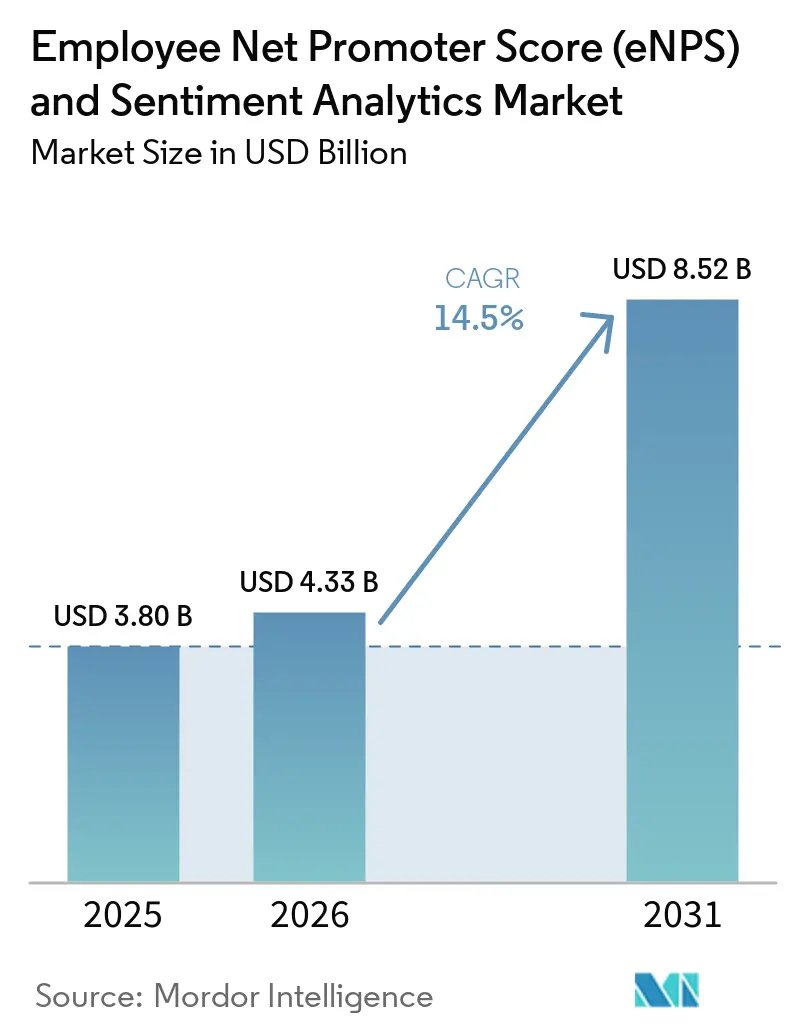
The Employee Net Promoter Score (eNPS) and Sentiment Analytics Market size is projected to be USD 3.80 billion in 2025, USD 4.33 billion in 2026, and reach USD 8.52 billion by 2031, growing at a CAGR of 14.50% from 2026 to 2031. In 2026, the eNPS and sentiment analytics market is moving away from its earlier role as a periodic HR compliance tool and is becoming a board-level signal for workforce health and operating performance. Hybrid work has made this shift more durable because employers now need a steady view of sentiment across office, home, and field settings rather than a few fixed survey points each year. AI-native sentiment tools are also changing buyer expectations because open-text feedback can now be processed much faster and with more usable detail than before. ESG reporting requirements, especially around workforce disclosures in Europe, are pushing employee listening into audited reporting cycles and raising the value of structured survey data. These changes are widening the addressable market for eNPS and sentiment analytics while also increasing pricing pressure on specialist vendors, which now compete more directly with broad HCM platforms.
Key Report Takeaways
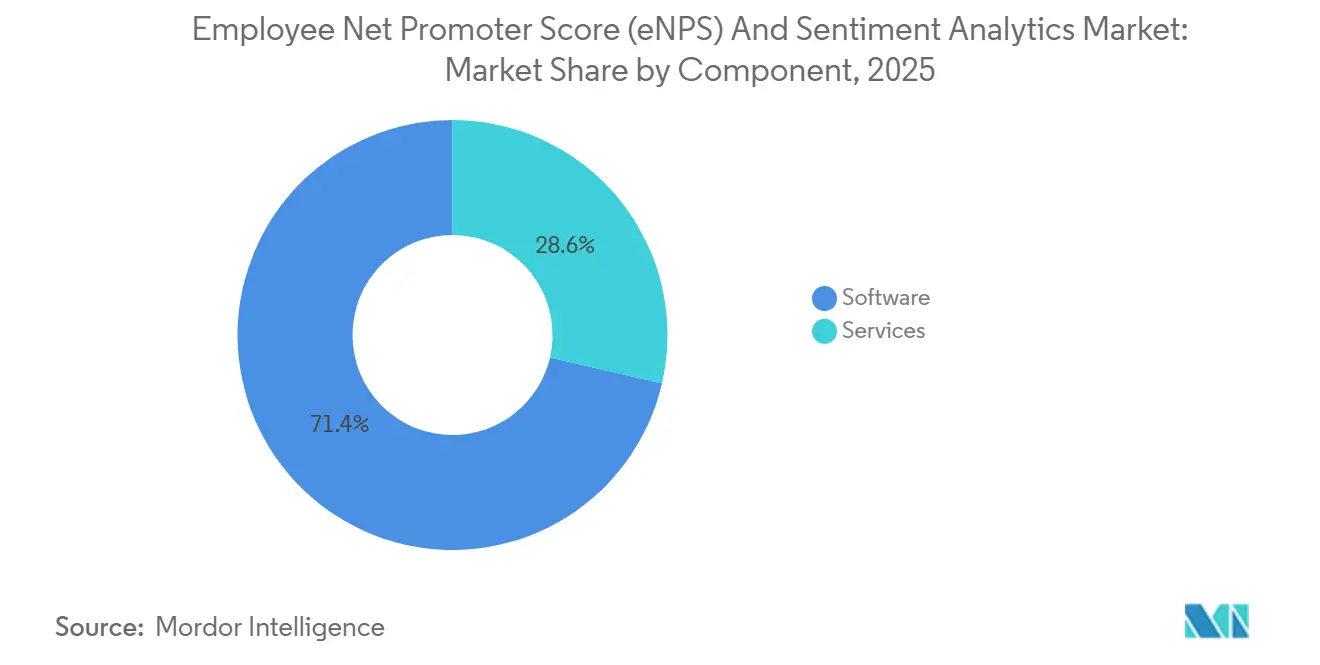
- By component, software led with a 71.37% revenue share in the employee net promoter score (eNPS) and sentiment analytics market in 2025, while services are projected to expand at an 18.73% CAGR through 2031.
- By deployment mode, cloud-based deployment held 69.41% share in 2025, while hybrid deployment is expected to record the highest CAGR at 16.94% through 2031.
- By enterprise size, large enterprises accounted for 64.29% of the 2025 installed base, while SMEs are projected to grow fastest at a 19.62% CAGR through 2031
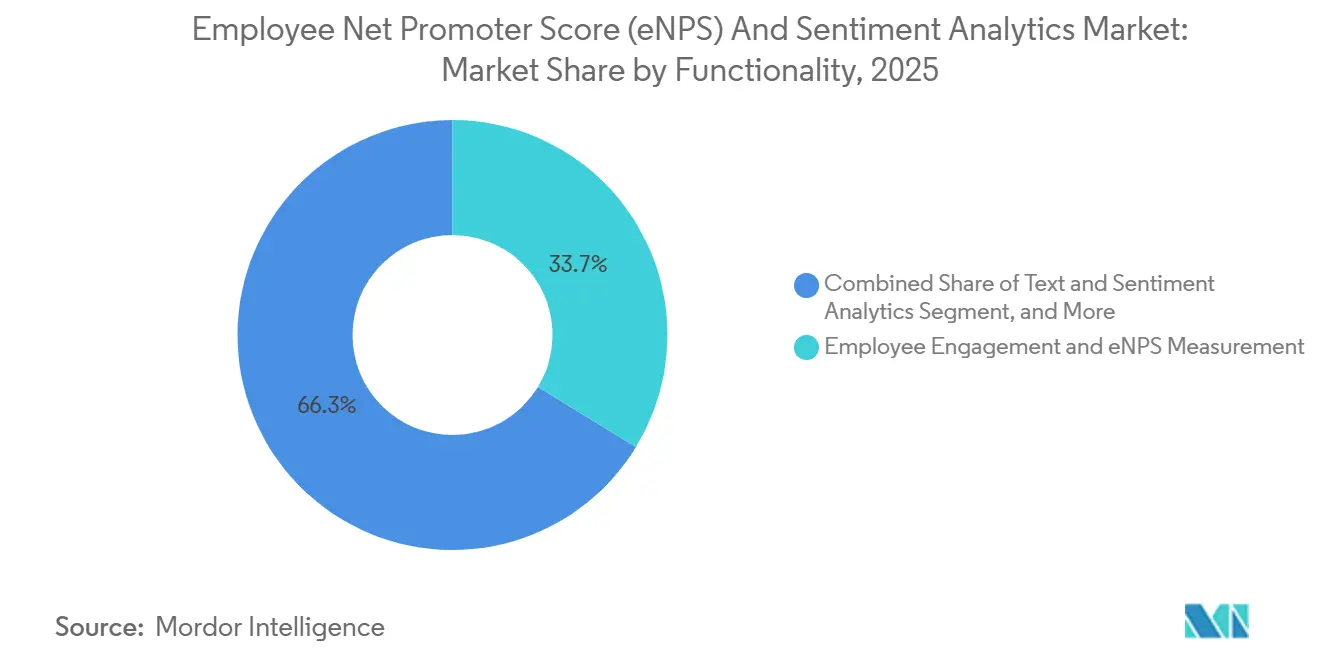
- By functionality, employee engagement and eNPS measurement captured 33.71% in 2025, while text and sentiment analytics are projected to expand at a 15.86% CAGR through 2031.
- By end user industry, information technology and telecom held 26.93% share in 2025, while healthcare and life sciences are expected to advance at a 17.38% CAGR through 2031.
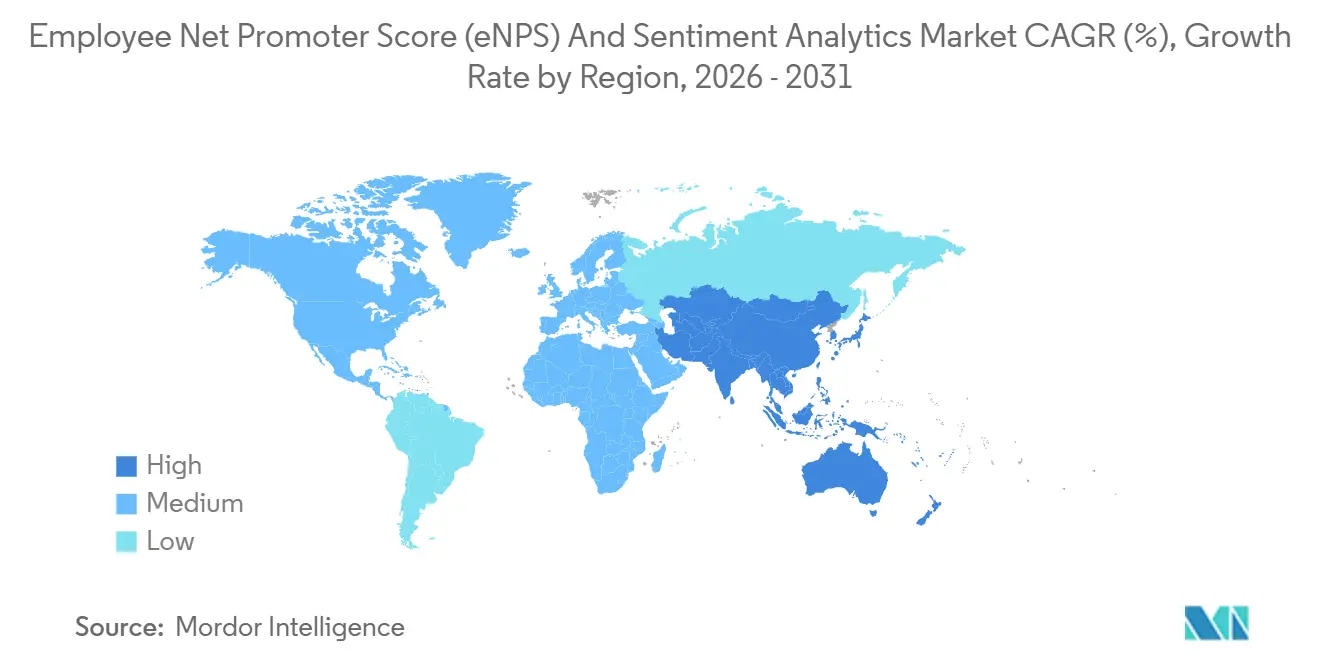
- By geography, North America held 40.17% share in 2025, while Asia-Pacific is projected to record the fastest regional CAGR at 14.92% through 2031.
Note: Market size and forecast figures in this report are generated using Mordor Intelligence’s proprietary estimation framework, updated with the latest available data and insights as of January 2026.
Market Trends and Insights
Drivers Impact Analysis of Employee Net Promoter Score (eNPS) And Sentiment Analytics Market*
| Driver | (~) % Impact on CAGR Forecast | Geographic Relevance | Impact Timeline |
|---|---|---|---|
| Hybrid And Distributed Work Models Raising Need for Continuous Listening | +3.2% | Global | Medium term (2-4 years) |
| AI and NLP Upgrades Making Open-Text Employee Feedback Actionable | +2.8% | Global | Short term (= 2 years) |
| C-Suite Pressure to Link EX Metrics To Retention And Productivity Outcomes | +2.0% | North America and Europe | Medium term (2-4 years) |
| ESG And CSRD-Linked Human Capital Disclosure Expanding Survey Demand | +1.5% | Europe and APAC | Medium term (2-4 years) |
| Employee-Owned AI Usage Creating New Need to Monitor Change Fatigue And Trust | +1.2% | North America, Europe, and APAC | Short term (= 2 years) |
| Deskless And Frontline Workforce Digitization Expanding Mobile-First eNPS Use Cases | +0.9% | APAC and North America | Long term (= 4 years) |
| Source: Mordor Intelligence | |||
Hybrid And Distributed Work Models Raising Need for Continuous Listening
Hybrid and distributed work have created a persistent visibility gap in the employee net promoter Score (eNPS) and sentiment analytics market because annual or quarterly surveys no longer capture how quickly sentiment changes across mixed work settings. Employers with office, remote, and field teams now need continuous listening models that can pick up changes between formal review cycles. Workvivo reported that 62% of employees were comfortable giving feedback, yet only 49% saw meaningful change from it, and the gap was wider for frontline workers.[1]Workvivo, “Workvivo Launches Seer to Advance People Intelligence and Close the Employee Listening Gap,” Workvivo, workvivo.com AgileHR also found in its updated July 2025 survey of 10,000 workers in Japan that blended home and office schedules aligned with the highest engagement results, while full-time office work aligned with the lowest. In the eNPS and sentiment analytics market, this is pushing buyers toward always-on listening setups that combine pulse surveys, lifecycle checks, and conversational tools instead of relying on a single annual program.
AI and NLP Upgrades Making Open-Text Employee Feedback Actionable
AI and language processing upgrades are removing one of the longest-standing limits in the eNPS and sentiment analytics market, which was the slow manual review of large volumes of written employee feedback. Buyers no longer want score-only reporting because open-text comments often explain whether low advocacy reflects workload, trust, manager behavior, or change fatigue. Perceptyx states that its Narrative Analysis Agent detects sentiment, intent, and emotional context across verbatim responses and ranks themes by both frequency and emotional weight. This means HR teams can move from long coding cycles to much faster review and can ask plain-language questions of the data instead of waiting for specialist analysis. Domo also describes same-day processing for large free-text response sets, which shows why faster analysis is becoming a basic expectation rather than a premium feature in the employee net promoter Score (eNPS) and sentiment analytics market.[2]Perceptyx, “Narrative Analysis Agent | Open-Text Comment Analysis,” Perceptyx, perceptyx.com
C-Suite Pressure to Link EX Metrics to Retention And Productivity Outcomes
Senior leadership teams now expect the eNPS and sentiment analytics market to deliver more than just survey administration, as workforce sentiment is increasingly treated as an input to retention, service quality, and execution. Enterprise buyers want platforms that can connect changes in employee advocacy with attrition, productivity, and customer outcomes at the team level, rather than reporting only companywide averages. This is also changing what vendors sell, because action planning, manager coaching, and follow-up workflows carry more weight in buying decisions than they did when survey tools were judged mainly on dashboard design. Arsaga Partners and Toridoll Holdings deployed an AI voice employee listening system across Marugame Seimen's workforce of around 30,000 employees, which shows how large operators are linking structured people data with operational outcomes at scale. Culture Amp also reported that employees who feel valued by their managers are 74% more likely to achieve high performance ratings, which supports the growing emphasis on turning listening data into direct manager action.[3]Culture Amp, “Culture Amp and Esther Perel Launch ‘Where Should We Begin? At Work,’” Culture Amp, cultureamp.com
ESG and CSRD-Linked Human Capital Disclosure Expanding Survey Demand
The eNPS and sentiment analytics market is also gaining support from compliance needs because workforce data is now moving into formal sustainability reporting. Under the European Sustainability Reporting Standards, ESRS S1 covers a company's own workforce, which places employee-related disclosure within a defined reporting structure rather than a voluntary HR program. This matters for software demand because companies need repeatable survey processes, clean audit trails, and data that can withstand external review. Great Place To Work Germany explicitly positioned employee surveys as the foundation for ESRS S1 data collection, reflecting the broader convergence between engagement measurement and ESG reporting infrastructure. As a result, the eNPS and sentiment analytics market is seeing demand from buyers that may have started with compliance concerns but are now building broader employee listening capability around the same systems.
Restraints Impact Analysis of Employee Net Promoter Score (eNPS) And Sentiment Analytics Market*
| Restraint | (~) % Impact on CAGR Forecast | Geographic Relevance | Impact Timeline |
|---|---|---|---|
| Survey Fatigue and Weak Close-The-Loop Execution Depressing Response Quality | -2.5% | Global | Short term (= 2 years) |
| Data Privacy, Worker Surveillance, and Consent Risk Slowing Passive Listening | -2.0% | Europe and North America | Medium term (2-4 years) |
| HR Analytics Skill Gaps Limiting Time-To-Insight And Actionability | -1.3% | Global | Medium term (2-4 years) |
| Commoditization From Bundled HCM and Collaboration Suites Pressuring Specialist Pricing | -0.8% | North America and Europe | Long term (= 4 years) |
| Source: Mordor Intelligence | |||
Survey Fatigue and Weak Close-The-Loop Execution Depressing Response Quality
Survey fatigue remains one of the clearest limits on theemployee net promoter Score (eNPS) and sentiment analytics market, as response quality declines when employees are asked frequently but see little follow-through. The same Workvivo study showed that while 62% of employees were comfortable giving feedback, only 49% saw meaningful change from it, suggesting a trust gap rather than a participation problem alone. When that gap persists, employees begin to treat surveys as symbolic exercises, and written comments often become shorter, less specific, or disappear altogether. This weakens the usefulness of eNPS trends because the number may still move while the underlying context becomes thinner and less reliable. In the eNPS and sentiment analytics market, vendors that can build tighter follow-up workflows for managers are better placed, but product design alone cannot solve a weak action culture.
Data Privacy, Worker Surveillance, and Consent Risk Slowing Passive Listening
Privacy and consent concerns are slowing some of the more advanced use cases in the eNPS and sentiment analytics market, especially where employers want to combine survey data with passive behavioral signals. Buyers in regulated settings are more cautious when listening tools extend beyond structured surveys into collaboration metadata, meeting signals, or other indirect indicators of sentiment. This has made deployment architecture, anonymization thresholds, and documented employee notice more important in vendor reviews. It also adds friction to implementation because legal, HR, data governance, and IT teams often need to agree on scope before a rollout can begin. The employee net promoter Score (eNPS) and sentiment analytics market will still expand in this area, but adoption will be slower where passive listening is seen as too close to employee monitoring.
*Our forecasts treat driver/restraint impacts as directional, not additive. The impact forecasts reflect baseline growth, mix effects, and variable interactions.
Employee Net Promoter Score (eNPS) And Sentiment Analytics Market Segment Analysis
By Component:
Software Leads The Platform Layer While Services Rise With Advisory NeedSoftware held 71.37% of the employee net promoter score (eNPS) and sentiment analytics market share in 2025, indicating that buyers still allocate most of their spending to the core platform rather than surrounding support. This dominance reflects the way pulse surveys, lifecycle listening, text analytics, and action workflows are increasingly bundled inside unified employee experience systems. Employee listening and survey tools still form the main entry point because they control how data is gathered and how often employees are reached. At the same time, text analytics and predictive features are moving deeper into the software layer, so vendors are trying to keep more of the analytic value within their own platforms rather than sending it to third-party tools.
Services are smaller in revenue yet are projected to grow at 18.73% through 2031, making them the fastest-growing component of the eNPS and sentiment analytics market. This pattern shows that simpler analytics do not eliminate the need for external support, because many organizations still struggle to turn feedback into team-level action. Workvivo's findings on the listening gap support this point, since organizations lose value when feedback is collected but not converted into visible change. The result is a category where implementation support, interpretation, and action planning are becoming increasingly important for growth, especially for mid-market buyers who want outcomes without building large internal people analytics teams.


By Deployment Mode:
Cloud-Based Adoption Stays Strong While Hybrid Gains On Governance NeedsCloud-based deployment accounted for 69.41% of the employee net promoter score (eNPS) and sentiment analytics market in 2025, confirming that this category remains primarily a SaaS market. Buyers value the faster updates, easier integrations, and lower maintenance burden that come with cloud delivery. On-premises options remain relevant for a narrower set of employers in tightly controlled environments where internal hosting still shapes technology policy. Even so, the center of demand remains with cloud systems that can connect quickly to HRIS, collaboration tools, and workflow platforms.
Hybrid deployment is projected to grow at 16.94% CAGR from 2026 to 2031, making it the fastest-growing deployment mode in the eNPS and sentiment analytics market. Growth here reflects the need to keep sensitive employee data within defined jurisdictions while still using modern analytics and cross-system workflows. Deployment decisions are therefore becoming governance decisions, not only IT decisions, because HR, legal, and security teams all have a stake in where data sits and how it moves. Lattice's Workday partnership illustrates why integration depth matters in this segment, as buyers increasingly prefer tools that fit into larger HCM environments rather than operate as isolated survey systems.[4]Lattice, “Lattice Joins Workday Partner Program to Power the Future of People + AI,” Lattice, lattice.com
By Enterprise Size:
Large Enterprises Form The Base While SME Adoption QuickensLarge enterprises represented 64.29% of the employee net promoter score (eNPS) and sentiment analytics market size in 2025, and that lead reflects the complexity of listening across large, multi-country workforces. These organizations need segmentation by business unit, manager, location, and legal entity, as well as stronger controls over confidentiality and reporting cadence. Large employers are therefore more likely to purchase specialist platforms with broad integration options, formal governance features, and service support for manager activation. Their scale also makes the cost of poor retention or weak engagement more visible, which supports steady investment in employee listening systems.
SMEs are projected to expand at a 19.62% CAGR through 2031, making them the fastest-growing segment in the eNPS and sentiment analytics market. SaaS delivery and AI-supported analysis have lowered earlier adoption barriers by reducing the need for a dedicated internal analytics function. Smaller employers are also showing interest because they want structured signals on culture and retention before growth makes informal feedback less reliable. In Europe, rising expectations around workforce disclosure and governance are adding another reason for smaller organizations to formalize employee listening, even when their first purchase is modest in scope.
By Functionality:
eNPS Measurement Remains The Entry Point While Sentiment Analytics Advances FastestEmployee engagement and eNPS measurement accounted for 33.71% of the employee net promoter score (eNPS) and sentiment analytics market in 2025, confirming that the core advocacy question still anchors most deployments. Many buyers continue to start with eNPS because it is easy to explain, easy to benchmark internally, and directly tied to a broad question of whether employees would recommend the employer. Lifecycle surveys, pulse programs, and action planning functions often build around that core measure rather than replace it. As a result, the leading functionality remains simple in concept even as the surrounding platform becomes more complex.
Text and sentiment analytics is projected to grow at a 15.86% CAGR through 2031, making it the fastest-growing functionality in the eNPS and sentiment analytics market. That pace reflects a basic buyer lesson: the score matters less when the written reasons behind it cannot be read and prioritized at scale. Perceptyx describes a model that identifies sentiment, intent, and emotional context across comments, which aligns with the rising demand for explanations rather than score reporting alone. Recognition and feedback orchestration are also gaining relevance, as Culture Amp's research shows that employees who feel valued by their managers are much more likely to achieve high performance ratings, which supports the case for visible response loops built around listening data.

By End User Industry:
IT And Telecom Leads While Healthcare And Life Sciences AcceleratesInformation technology and telecom accounted for 26.93% of 2025 demand in the employee net promoter score (ENPS) and sentiment analytics market, reflecting the sector's long-standing comfort with software-led people management and its exposure to hybrid work. These employers tend to adopt structured listening earlier because talent mobility is high and workforce sentiment can shift quickly during organizational change. Retail and e-commerce are also becoming meaningful users because turnover costs are high and distributed operations need earlier warning signs from stores and fulfillment centers. Healthcare and life sciences are projected to expand at 17.38% CAGR through 2031, supported by strong demand for tools that can surface early stress, retention risk, and workplace experience issues across large clinical and support teams.
Other sectors are broadening the category's reach as listening moves beyond white-collar office settings. WHI Holdings released a generative AI-powered census survey function for Japanese corporate users in late 2025, which shows how employee listening is being adapted for practical deployment in local enterprise environments. Arsaga Partners and Toridoll Holdings also deployed an AI voice employee listening system across around 30,000 frontline workers at Marugame Seimen, which underscores the relevance of these tools in operational, high-volume workforces. Manufacturing, government, and public service users therefore represent an important next layer for the eNPS and sentiment analytics market as vendors adjust products for non-desk and multilingual settings.
Geography Analysis
The Americas Employee Net Promoter Score (eNPS) and Sentiment Analytics Market
North America accounted for 40.17% of the employee net promoter score (eNPS) and sentiment analytics market share in 2025, maintaining the region's lead. The United States remained the center of regional demand because it combines a large enterprise buyer base with strong software adoption across HR workflows. The region also benefits from the presence of many established employee experience and HCM vendors, which makes integrations, partnerships, and bundled offerings more common. Canada added a distinct layer of demand, where workforce wellbeing and policy-related reporting remain important to employer decision-making. South America is still a smaller contributor, though larger multinational deployments in Brazil and Argentina are gradually widening the regional footprint of the eNPS and sentiment analytics market.
Europe Employee Net Promoter Score (eNPS) and Sentiment Analytics Market
Europe held a substantial position in the eNPS and sentiment analytics market because reporting needs and data governance concerns are simultaneously shaping demand. ESRS S1 places direct focus on own-workforce disclosure, which is one reason survey systems are moving closer to formal reporting processes in the region. Great Place To Work Germany also framed employee surveys as a base for ESRS S1 data collection, which supports continued demand for structured listening tools in European organizations. The United Kingdom, Germany, the Netherlands, and France, therefore, remain central European markets because they combine mature HR technology buying with stricter governance expectations.
APAC and MEA Employee Net Promoter Score (eNPS) and Sentiment Analytics Market
Asia-Pacific posted the fastest growth in the eNPS and sentiment analytics market size, with a 14.92% CAGR from 2026 to 2031. India, China, Japan, Australia, and New Zealand are leading that expansion through a mix of workforce digitization, AI adoption, and rising reporting expectations. Japan stands out because WHI Holdings introduced a generative AI-powered census survey function for its COMPANY Talent Management series, showing that local enterprise platforms are bringing automation directly into listening workflows. Japan also provided a visible frontline example with the Toridoll deployment of AI voice-listening across 30,000 employees, suggesting the model is moving beyond pilot programs. The Middle East is undergoing major transformations in Saudi Arabia and the United Arab Emirates. Africa remains an early-stage market, with South Africa and Nigeria serving as the main entry points for multinational vendors pursuing cloud-led rollouts. Across these regions, the eNPS and sentiment analytics market is expanding fastest, where workforce scale, digitization, and governance needs now overlap.

Competitive Landscape
The employee net promoter score (eNPS) and sentiment analytics market remains fragmented, with specialist vendors such as Culture Amp, Perceptyx, Leapsome, Lattice, 15Five, WorkTango, and Effectory competing across closely related capability sets. At the same time, broader HCM platforms such as Workday Peakon Employee Voice and SAP Qualtrics EmployeeXM are increasing pressure through bundled offerings that embed eNPS features within larger HR systems. This mix creates a difficult environment for stand-alone vendors, as point solutions must prove faster innovation or greater activation value to defend pricing. AI-led differentiation is therefore becoming a central part of positioning, especially where buyers want more than survey collection. The eNPS and sentiment analytics market is no longer being shaped only by who gathers feedback best, but also by who can turn that feedback into action across a wider employee lifecycle.
Leapsome's May 2026 HRIS launch shows how specialist vendors are moving toward broader platform coverage rather than staying limited to performance or engagement modules. The April 2026 Development Coach release also points in the same direction, with AI used to support feedback, coaching, and review preparation inside the same environment. Lattice's Workday partnership adds another competitive signal because interoperability with large HCM ecosystems is becoming harder to treat as optional. Together, these moves show that product breadth, integration depth, and workflow activation are becoming as important as survey design in the eNPS and sentiment analytics market.
Learning Pool's April 2026 acquisition of WorkStep highlights a clear white space around frontline and deskless workers, where many traditional employee listening tools have been less effective. Workvivo's Seer launch also points to broader competition in people intelligence, with vendors trying to combine feedback data and real-time workplace signals into a single operating view. Another open area is non-English AI sentiment capabilities, especially for Asian and European buyers who want local-language nuance without losing enterprise controls. Automated CSRD-ready reporting is also still underdeveloped as a stand-alone module, even though reporting pressure is becoming a practical buying factor. The competitive landscape suggests continued platform convergence in the eNPS and sentiment analytics market, as buyers favor vendors that can cover listening, analysis, action, and governance within a single connected stack.
Employee Net Promoter Score (eNPS) And Sentiment Analytics Industry Leaders
Culture Amp Pty Ltd
Perceptyx, Inc.
Achievers Solutions Inc.
Workleap Technologies Inc.
Degree, Inc. d/b/a Lattice
- *Disclaimer: Major Players sorted in no particular order
Employee Net Promoter Score (eNPS) And Sentiment Analytics Market Companies Covered in this Report
- Culture Amp Pty Ltd
- Perceptyx, Inc.
- WorkTango, Inc.
- Degree, Inc. d/b/a Lattice
- 15Five, Inc.
- Leapsome GmbH
- Workleap Technologies Inc.
- Achievers Solutions Inc.
- Effectory B.V.
- EngageRocket Pte Ltd.
- Synergita Software Private Limited
- Motivosity Inc.
- Betterworks System Inc.
- Kudos, Inc.
- Energage, LLC
- THANKSBOX LIMITED
- People Gauge Limited
- Small Improvements Software GmbH
- Quantum Market Research, Inc.
- WorkBuzz Analytics Limited
- SurveySparrow Inc.

Recent Industry Developments in Employee Net Promoter Score (eNPS) And Sentiment Analytics Market
- May 2026: Leapsome launched HRIS and “Leapsome for Startups,” integrating HR operations with performance, engagement, and learning, targeting SMEs after its funding round.
- May 2026: Workvivo by Zoom introduced Seer, a people intelligence platform combining feedback with real-time signals; survey showed 62% give feedback but only 49% see change.
- April 2026: Leapsome released Development Coach AI agent, offering proactive feedback nudges, meeting transcript analysis, and AI-generated performance reviews.
- April 2026: Learning Pool acquired WorkStep, adding its frontline engagement platform (clients include PepsiCo, Mattel, GEODIS) to deliver end-to-end deskless workforce lifecycle management.


Global Employee Net Promoter Score (eNPS) And Sentiment Analytics Market Report Scope
The Employee Net Promoter Score (eNPS) and Sentiment Analytics Market refers to technology platforms and services that measure employee engagement, loyalty, and workplace sentiment through structured surveys, text analytics, and AI-driven insights. These solutions combine employee listening tools, sentiment analysis engines, and workforce intelligence platforms to capture real-time feedback, identify cultural strengths and weaknesses, and guide action planning for managers and HR leaders.
The Employee Net Promoter Score (eNPS) and Sentiment Analytics Market is segmented by Component (Software [Employee Listening and Survey Platforms, AI and Sentiment Analytics Solutions, Workforce Intelligence and Action Management Platforms], and Services), Deployment Mode (Cloud-Based, On-Premises, and Hybrid), Enterprise Size (Large Enterprises, and Small and Medium-Sized Enterprises), Functionality (Employee Engagement and eNPS Measurement, Lifecycle and Pulse Survey Management, Text and Sentiment Analytics, Action Planning and Manager Coaching, Recognition and Feedback Orchestration, and Other Functionalities), End-user Industry (BFSI, Healthcare and Life Sciences, Information Technology and Telecom, Retail and E-commerce, Industrial Manufacturing, and Government and Public Sector), and Geography (North America, South America, Europe, Asia-Pacific, Middle East, and Africa). The Market Forecasts are Provided in Terms of Value (USD).
| Software | Employee Listening and Survey Platforms |
| AI and Sentiment Analytics Solutions | |
| Workforce Intelligence and Action Management Platforms | |
| Services |
| Cloud-Based |
| On-Premises |
| Hybrid |
| Large Enterprises |
| Small and Medium-Sized Enterprises |
| Employee Engagement and eNPS Measurement |
| Lifecycle and Pulse Survey Management |
| Text and Sentiment Analytics |
| Action Planning and Manager Coaching |
| Recognition and Feedback Orchestration |
| Other Functionalities |
| BFSI |
| Healthcare and Life Sciences |
| Information Technology and Telecom |
| Retail and E-commerce |
| Industrial Manufacturing |
| Government and Public Sector |
| North America | United States |
| Canada | |
| Mexico | |
| South America | Brazil |
| Argentina | |
| Rest of South America | |
| Europe | Germany |
| United Kingdom | |
| France | |
| Italy | |
| Spain | |
| Russia | |
| Netherlands | |
| Rest of Europe | |
| Asia-Pacific | China |
| Japan | |
| India | |
| South Korea | |
| Australia and New Zealand | |
| Rest of Asia-Pacific | |
| Middle East | Saudi Arabia |
| United Arab Emirates | |
| Rest of Middle East | |
| Africa | South Africa |
| Nigeria | |
| Rest of Africa |
| By Component | Software | Employee Listening and Survey Platforms |
| AI and Sentiment Analytics Solutions | ||
| Workforce Intelligence and Action Management Platforms | ||
| Services | ||
| By Deployment Mode | Cloud-Based | |
| On-Premises | ||
| Hybrid | ||
| By End User Enterprise Size | Large Enterprises | |
| Small and Medium-Sized Enterprises | ||
| By Functionality | Employee Engagement and eNPS Measurement | |
| Lifecycle and Pulse Survey Management | ||
| Text and Sentiment Analytics | ||
| Action Planning and Manager Coaching | ||
| Recognition and Feedback Orchestration | ||
| Other Functionalities | ||
| By End User Industry | BFSI | |
| Healthcare and Life Sciences | ||
| Information Technology and Telecom | ||
| Retail and E-commerce | ||
| Industrial Manufacturing | ||
| Government and Public Sector | ||
| By Geography | North America | United States |
| Canada | ||
| Mexico | ||
| South America | Brazil | |
| Argentina | ||
| Rest of South America | ||
| Europe | Germany | |
| United Kingdom | ||
| France | ||
| Italy | ||
| Spain | ||
| Russia | ||
| Netherlands | ||
| Rest of Europe | ||
| Asia-Pacific | China | |
| Japan | ||
| India | ||
| South Korea | ||
| Australia and New Zealand | ||
| Rest of Asia-Pacific | ||
| Middle East | Saudi Arabia | |
| United Arab Emirates | ||
| Rest of Middle East | ||
| Africa | South Africa | |
| Nigeria | ||
| Rest of Africa | ||


Key Questions Answered in the Report
What is the size of the Employee Net Promoter Score (eNPS) and Sentiment Analytics Market?
The Employee Net Promoter Score (eNPS) and Sentiment Analytics Market was valued at USD 3.80 billion in 2025, reaches USD 4.33 billion in 2026, and is forecast to reach USD 8.52 billion by 2031 at a 14.50% CAGR.
Which component leads spending in this space?
Software led with 71.37% share in 2025 because employers continue to buy unified platforms that bring surveys, text analysis, and action workflows into one system.
Which deployment model is growing the fastest?
Hybrid deployment is projected to grow at 16.94% CAGR through 2031 as employers balance cloud analytics with data governance and residency requirements.
Which enterprise group is expanding most quickly?
SMEs are the fastest-growing buyer group, with a projected 19.62% CAGR through 2031, helped by SaaS pricing and easier AI-supported analysis.
What functionality is moving fastest beyond core eNPS measurement?
Text and sentiment analytics is projected to grow at 15.86% CAGR through 2031 because buyers increasingly need the written reasons behind advocacy scores, not only the score itself.
Which region shows the strongest future growth?
Asia-Pacific is the fastest-growing regional segment, with a 14.92% CAGR from 2026 to 2031, supported by workforce digitization and expanding AI-led listening deployments.
Page last updated on:


 Your data is secure and never sold or shared.


