
Electronic Discovery Market Size and Share
Market Overview
| Study Period | 2021 - 2031 |
|---|---|
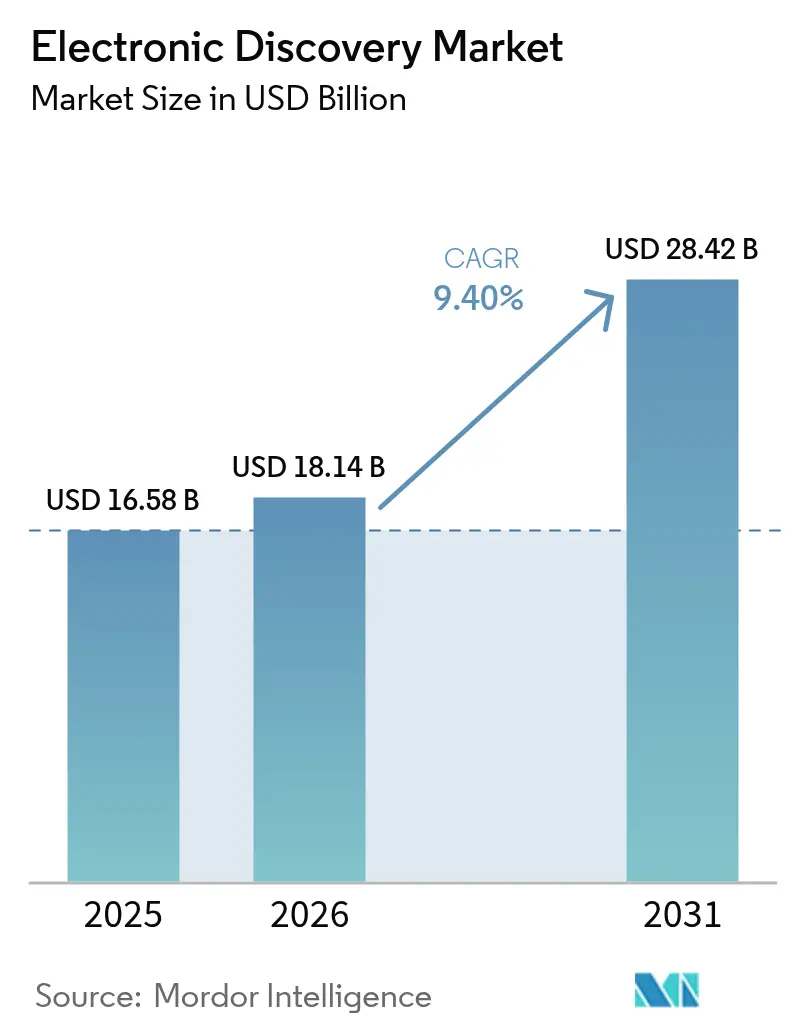
| Market Size (2026) | USD 18.14 Billion |
| Market Size (2031) | USD 28.42 Billion |
| Growth Rate (2026 - 2031) | 9.40 % |
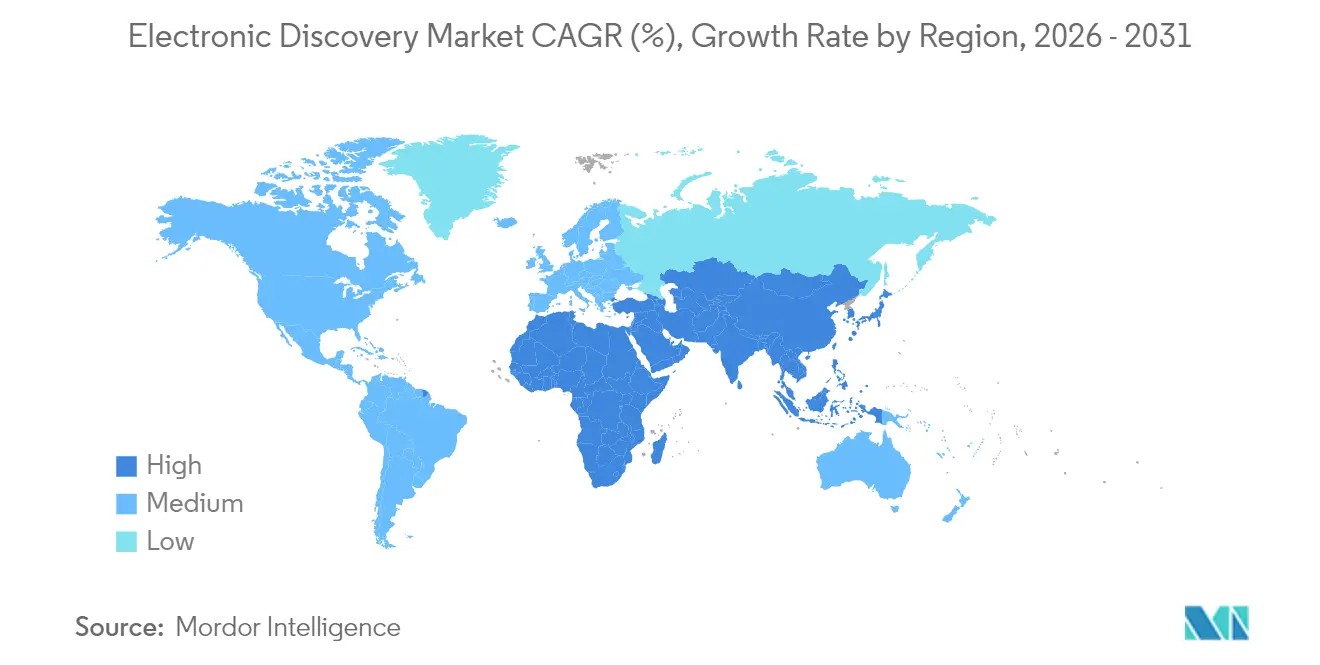
| Fastest Growing Market | Asia Pacific |
| Largest Market | North America |
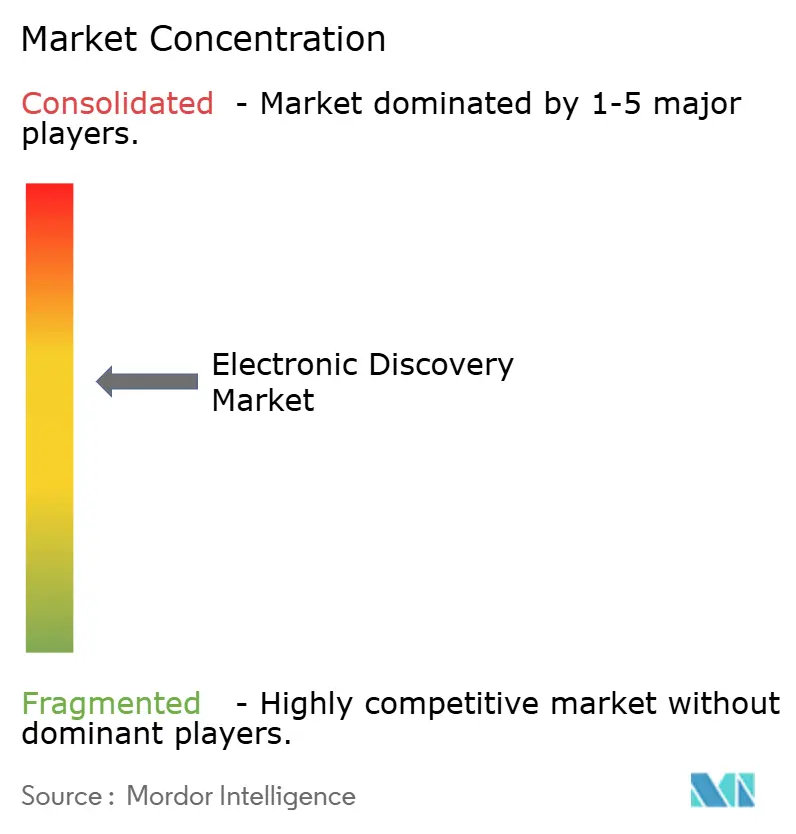
| Market Concentration | Medium |
Major Players *Disclaimer: Major Players sorted in no particular order Image © Mordor Intelligence. Reuse requires attribution under CC BY 4.0. | |
Electronic Discovery Market Analysis by Mordor Intelligence
The electronic discovery market size is expected to grow from USD 16.58 billion in 2025 to USD 18.14 billion in 2026 and is forecast to reach USD 28.42 billion by 2031 at 9.40% CAGR over 2026-2031. Heightened digitization of legal processes, the rapid rise in multi-format data, and mounting regulatory complexity are pushing legal departments to modernize discovery workflows and adopt AI-enabled review tools. Large enterprises view advanced analytics as a hedge against spiraling litigation costs, while small and mid-sized firms outsource to managed-service specialists to access comparable capabilities without bearing full infrastructure costs. Deployment preferences continue to swing toward cloud-first architectures, encouraged by pay-as-you-go economics and by heightened collaboration needs in hybrid work settings. North America retains scale advantages in platform innovation and case-law maturity, yet Asia-Pacific’s double-digit expansion underscores how local enforcement regimes and cross-border commerce are converging to create fresh revenue pools for vendors. Competitive intensity is rising as cloud-native entrants challenge incumbents with transparent pricing, streamlined user experiences, and explainable AI features that address emerging admissibility standards.
Key Report Takeaways
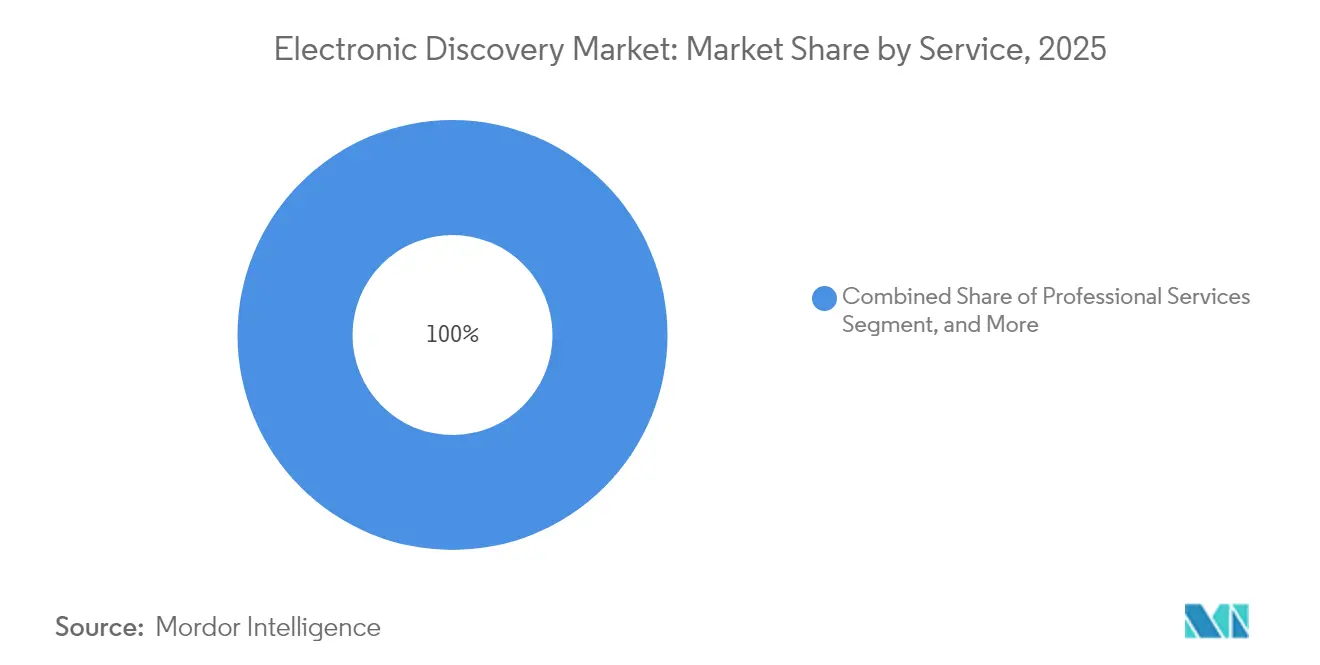
- By service, managed services held 45.72% of electronic discovery market share in 2025, whereas advisory and post-implementation services are forecast to compound at 10.02% through 2031.
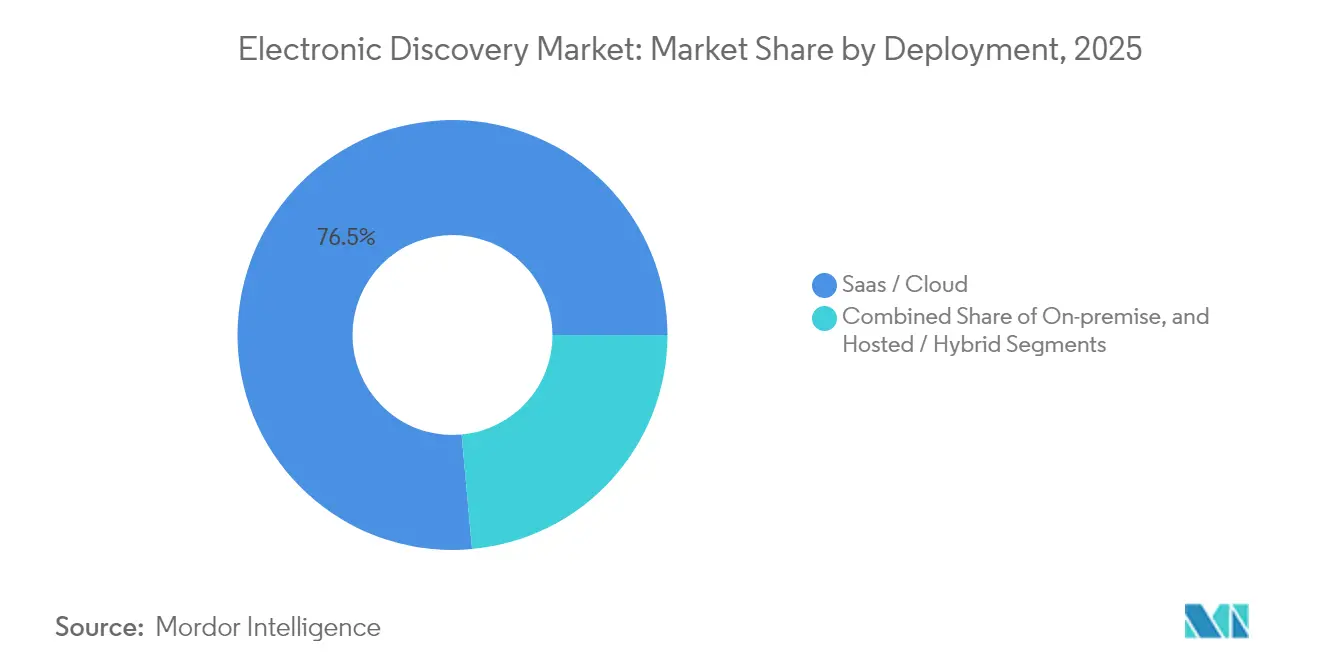
- By deployment, SaaS/cloud captured 76.45% of electronic discovery market share in 2025; the segment is expected to post a 10.55% CAGR to 2031.
- By software, e-discovery and early case assessment platforms led with 33.62% revenue share in 2025; AI-driven review and analytics software is projected to expand at 10.18% CAGR between 2026-2031.
- By end user, BFSI commanded 21.05% of electronic discovery market size in 2025, while healthcare and life sciences is advancing at an 11.24% CAGR to 2031.
- By geography, North America accounted for 40.75% revenue share in 2025; Asia-Pacific is the fastest-growing region with an 11.05% CAGR forecast for 2026-2031.
Note: Market size and forecast figures in this report are generated using Mordor Intelligence’s proprietary estimation framework, updated with the latest available data and insights as of 2026.
Market Trends and Insights
Drivers Impact Analysis of Electronic Discovery Market*
| Driver | (~) % Impact on CAGR Forecast | Geographic Relevance | Impact Timeline |
|---|---|---|---|
| AI/ML integration improving review efficiency | +2.1% | Global – early adoption in North America and EU | Medium term (2-4 years) |
| Proliferation of mobile and cloud data sources | +1.8% | Global – APAC acceleration | Long term (≥ 4 years) |
| Stringent data-privacy regulations | +1.5% | North America and EU, expanding to APAC | Short term (≤ 2 years) |
| Growth in corporate internal investigations | +1.2% | Global, notably North America and EU | Medium term (2-4 years) |
| Rise of collaborative platforms driving data complexity | +1.0% | Global, led by North America and EU | Short term (≤ 2 years) |
| Increasing cross-border litigation | +0.9% | Global, major commercial centers | Long term (≥ 4 years) |
| Source: Mordor Intelligence | |||
AI/ML Integration Improving Review Efficiency
Generative AI and large-language-model tooling now slash human review hours by up to 70%, enabling law firms to redeploy staff toward higher-value advocacy. CS Disco’s Cecilia assistant illustrates how conversational analytics curtail repetitive tagging while preserving audit trails [1]CS Disco Inc., “FORM 10-K,” sec.gov . Courts are concurrently tightening evidentiary standards: proposed U.S. Rule 707 amendments will oblige counsel to demonstrate reliability, not just accuracy, before AI outputs become admissible. Vendors are therefore investing in transparent model governance frameworks—explainable ranking, calibration metrics, and chain-of-custody logging—to sustain adoption momentum without jeopardizing admissibility. As these assurance layers mature, electronic discovery market participants that marry efficiency with defensibility will widen their competitive moat.
Proliferation of Mobile and Cloud Data Sources
Microsoft Teams alone processes more than 1 trillion pages annually, underscoring the scale challenge facing discovery teams. Hybrid work patterns extend evidence repositories into personal devices and consumer apps, compelling enterprises to revisit information-governance baselines. Cloud-native vendors are countering complexity through API-driven connectors that pull data directly from Slack, Google Vault, and Microsoft 365, automating legal hold and collection workflows. Yet every new data pipe expands the attack surface for privacy breaches, so clients demand zero-knowledge encryption and region-specific data-residency controls. The electronic discovery market is therefore gravitating toward platforms that integrate policy enforcement, federated search, and AI-powered entity extraction under a single user interface.
Stringent Data-Privacy Regulations (GDPR, CCPA, etc.)
HIPAA alone obliges health-care providers to retain protected-health-information emails for six years and execute secure deletion thereafter [2]Liyanda Tembani, “HIPAA and email deletion rules,” hipaatimes.com. Parallel statutes such as GDPR and the California Consumer Privacy Act impose overlapping yet sometimes conflicting obligations on data access, creating legal risk if discovery workflows overlook regional nuances. Enterprises are deploying fine-grained data-mapping and retention-schedule engines to reconcile discovery needs with statutory minima. Specialist managed-service providers that bundle multijurisdictional expertise with automated redaction and anonymization tooling are carving out premium pricing niches within the broader electronic discovery market.
Growth in Corporate Internal Investigations
Regulators from Australia to Japan have expanded corporate criminal-liability statutes inspired by the UK Bribery Act. Multinationals now frequently launch proactive investigations to cap penalty exposure and negotiate global settlements. This shift drives demand for discovery platforms capable of near-real-time analytics across multiple languages, custodians, and jurisdictions. Providers that embed investigation playbooks—preconfigured search templates, sentiment analysis, and visualization dashboards—position themselves as strategic partners rather than commodity vendors, enhancing customer stickiness and lifetime value.
Restraints Impact Analysis of Electronic Discovery Market*
| Restraint | (~) % Impact on CAGR Forecast | Geographic Relevance | Impact Timeline |
|---|---|---|---|
| Escalating total cost of ownership for SMEs | -1.4% | Global, acute in emerging markets | Short term (≤ 2 years) |
| Shortage of skilled e-discovery professionals | -1.1% | Global, severe in APAC | Medium term (2-4 years) |
| Cross-border data-transfer restrictions | -0.8% | China, Russia, EU | Long term (≥ 4 years) |
| AI model transparency concerns | -0.6% | Common-law jurisdictions | Medium term (2-4 years) |
| Source: Mordor Intelligence | |||
Escalating Total Cost of Ownership for SMEs
Entry-level processing fees of USD 15–30 per GB intersect with rising data volumes, pushing overall project spend beyond many small-firm budgets. While cloud licensing reduces upfront capital outlay, downstream expenses—storage, advanced analytics, specialist review talent—remain material. Debt-laden service providers such as KLDiscovery illustrate how margin pressure can ripple through pricing as vendors seek to shore up balance sheets. Affordable automation, transparent subscription tiers, and community-based training resources could blunt the restraint, but market bifurcation persists, with enterprise clients gravitating to full-service platforms and cost-sensitive users defaulting to rudimentary keyword searches.
AI Model Transparency Concerns Affecting Legal Admissibility
The District of Columbia Court of Appeals, in Ross v. United States, spotlighted ChatGPT citations in both majority and dissenting opinions, igniting debate over AI reliability. Proposed Rule 707 would require AI outputs to meet expert-testimony standards, raising documentation burdens for counsel adopting black-box models. Vendors must therefore invest in explainability layers—feature-weight visualizations, training-data provenance, and validation metrics—to mitigate judicial skepticism. Those that fail to demystify decision logic risk exclusion from high-stakes litigation workflows, slowing broader electronic discovery market adoption.
*Our forecasts treat driver/restraint impacts as directional, not additive. The impact forecasts reflect baseline growth, mix effects, and variable interactions.
Electronic Discovery Market Segment Analysis
By Service:
Managed Services Lead Market TransformationManaged services accounted for a 45.72% electronic discovery market share in 2025, reflecting corporate preference for outsourcing labor-intensive tasks such as processing, hosting, and AI model tuning. Providers achieve economies of scale by centralizing infrastructure and talent, letting clients convert fixed costs into variable spend. Advisory and post-implementation services, forecast at a 10.02% CAGR, attract organizations that need governance roadmaps to tame multicloud sprawl and to embed AI responsibly. As discovery requests span mobile chat, cloud archives, and social feeds, enterprises value end-to-end accountability, legal hold, collection, analytics, and production, under a single service-level agreement. The electronic discovery industry therefore rewards vendors that market outcome-based service bundles over piecemeal task pricing.
Managed specialists also integrate investigation accelerators such as data-minimization playbooks and privilege-screening models. These differentiators shorten review cycles and bolster defensibility in an era of stricter admissibility scrutiny. Providers expanding into high-growth geographies, exemplified by Exterro’s new forensics lab in Chennai, leverage local talent pools to scale 24/7 support and lower delivery costs.



By Software:
AI-Driven Analytics Reshape Platform CompetitionE-discovery and early case-assessment suites led the software category with 33.62% revenue share in 2025, yet AI-driven review and analytics is projected to rise at 10.18% CAGR, the fastest within the segment. Customers are shifting procurement criteria from raw processing horsepower toward insight velocity, how quickly a platform can surface custodial hot spots, sentiment pivots, or privilege anomalies. Relativity’s move to a 75% cloud adoption ratio illustrates how SaaS delivery accelerates feature rollout and scales compute for intensive machine-learning workloads. Meanwhile, point-solution vendors that specialize in legal hold or production are embedding API gateways to integrate seamlessly into broader case-management stacks, preserving niche relevance even as platforms consolidate.
The electronic discovery market size attached to AI analytics is increasingly defended by explainability dashboards and bias-testing protocols. Buyers demand configurable confidence thresholds and narrative summaries that support courtroom presentation. Vendors that package transparent AI with granular cost-tracking tools differentiate on both risk and financial stewardship, appealing to corporate counsel under budget oversight.
By Deployment:
Cloud Migration Accelerates Despite Security ConcernsSaaS and cloud deployments controlled 76.45% of electronic discovery market share in 2025 and are projected to compound at 10.55% through 2031. Elastic compute, automatic patching, and global edge networks align with surging data volumes and distributed review teams. Microsoft’s USD 40.9 billion cloud-segment revenue in Q2 2025 signals mainstream enterprise confidence in cloud-hosted legal workloads. Nevertheless, heavily regulated sectors, defense, energy, public sector, still favor on-premise or sovereign-cloud models for matters touching classified or critical-infrastructure data. Hybrid configurations persist as transitional architectures, hosting sensitive content on private clusters while leveraging cloud analytics for less restricted datasets. Continual improvements in encryption, secure enclaves, and zero-trust networking are reducing residual skepticism, paving the way for deeper cloud penetration during the forecast horizon.
By End User:
Financial Services Leadership Faces Healthcare ChallengeThe BFSI sector retained its leadership with 21.05% of electronic discovery market size in 2025, propelled by tight regulatory scrutiny, anti-money-laundering enforcement, and high-value securities litigation. Yet healthcare and life sciences is the momentum segment, tracking an 11.24% CAGR as electronic medical-record sprawl and HIPAA obligations intensify discovery complexity. Pharmaceutical firms also grapple with clinical-trial evidence and patent disputes, further driving specialized demand.
Technology and telecom operators remain heavy users owing to intellectual-property claims, while public-sector agencies modernize discovery tooling to comply with transparency mandates. Sector-specific plugins, FINRA-aligned retention modules, HIPAA-compliant redaction scripts, help providers defend pricing premiums and widen vertical moats.
Geography Analysis
North America Electronic Discovery Market
North America contributed 40.75% revenue in 2025 on the strength of established case law, prolific litigation, and a dense ecosystem of service providers. Market leaders headquartered in the region, Microsoft, IBM, OpenText, and Relativity, set product roadmaps that ripple globally. Growth, however, is moderating as cloud adoption approaches saturation and law firms finalize AI rollouts. Providers now emphasize value-add modules such as predictive outcome modeling and automated privilege screening to defend wallet share.
APAC Electronic Discovery Market
Asia-Pacific is forecast to grow at 11.05% CAGR through 2031, buoyed by expanding corporate-liability statutes and increasing cross-border deal activity. Japan’s limited discovery provisions and absence of attorney-client privilege create demand for hybrid workflows that blend local data processing with offshore analytics hubs. Australia, India, and Singapore spearhead regulatory harmonization that aligns local disclosure norms with global best practices, accelerating platform uptake. Vendors succeeding in APAC localize user interfaces, offer regional data centers, and cultivate in-country incident-response teams to satisfy sovereignty concerns.
EMEA and LATAM Electronic Discovery Market
Europe continues steady adoption while navigating GDPR-driven constraints on data transfer. Providers offering in-region hosting, fine-grained consent management, and automated PII redaction earn preference in competitive bids. Post-Brexit divergence in UK rules demands modular compliance engines capable of toggling retention and deletion policies per jurisdiction. Latin America and Middle East and Africa remain nascent, yet rising regulatory cooperation with U.S. agencies is tipping multinational corporations to pre-deploy discovery infrastructure before enforcement actions materialize.

Regulatory Landscape
Electronic discovery obligations are shaped by civil-procedure requirements, privacy rules, and data-sovereignty statutes that govern the collection, preservation, review, and cross-border transfer of electronically stored information (ESI). In the United States, FRCP 26 and related federal court general orders continue to anchor proportionality and good-faith preservation expectations, while federal recordkeeping requirements for electronic messages under 44 USC 2912 reinforce retention and defensible disposition practices in public-sector matters. At the state level, the California Privacy Protection Agency brought final CCPA regulations into effect in January 2026, covering risk assessments, automated decision-making technology, and cybersecurity audits, which pushes discovery programs toward more formal governance documentation and control testing.
Outside the United States, data-transfer restrictions increasingly shape e-discovery workflow design. China implemented the Measures for Certification of Cross-Border Personal Information Transfer in January 2026 as part of the PIPL pathway framework, reinforcing the need for localized processing, in-country hosting options, and controlled transfer mechanisms for multinationals. Industry standards bodies are also tightening protocol guidance for defensibility: EDRM issued a refreshed 2026 Annotated ESI Protocol in May 2026 (updating metadata and proportionality elements) and expanded IGRM v4.1 guidance in June 2026 to address AI-era privacy and cross-functional information governance, which influences how vendors document chain of custody, AI use, and audit-ready workflows.
Value Chain Analysis
The electronic discovery value chain spans data origination and governance through collection, processing, review, production, and presentation, with growing reliance on cloud infrastructure and specialized software. Enterprises generate evidence across email, collaboration platforms, mobile devices, and cloud apps, then apply legal hold and preservation policies supported by connectors and journaling capabilities. Collection and processing increasingly depend on hyperscaler IaaS/PaaS (notably AWS and Microsoft Azure) to scale ingestion and analytics, feeding SaaS platforms such as Relativity, OpenText, and Everlaw as well as forensic suites such as Exterro FTK. Managed service providers and consulting partners support projects end-to-end, supplying review labor, tuning models, and operationalizing defensible processes for regulated clients.
Bottlenecks cluster around high-velocity and hard-to-preserve data sources (ephemeral and off-channel messaging such as WhatsApp, Signal, and Slack) and around the governance burden introduced by generative AI. As courts and parties scrutinize AI-assisted workflows more closely, platforms need to produce verifiable logs, validation sampling, and workflow audit trails, which shifts differentiation toward forensic readiness rather than only processing throughput. The same scrutiny elevates privilege and confidentiality decisions into earlier procurement planning, because tool choice and hosting architecture affect how prompts, model interactions, and sensitive matter content are captured, secured, and produced across jurisdictions.
Competitive Landscape
The electronic discovery market exhibits moderate concentration. Top platforms—Relativity, Microsoft Purview, IBM, OpenText, Exterro, and KLDiscovery—collectively command an estimated 55-60% revenue share, while a long tail of boutique specialists compete on vertical expertise and regional presence. Strategic direction increasingly centers on three levers: AI Transparency, Cloud Scale, and Portfolio Convergence
Relativity’s USD 3.6 billion valuation and majority cloud revenue demonstrate capital market confidence in subscription-led growth. IBM’s acquisition of HashiCorp for USD 6.4 billion strengthens multicloud orchestration, indirectly boosting e-discovery platform flexibility.
OpenText’s divestiture of its application-modernization unit freed capital for AI investment, while Exterro’s 30% CAGR and India expansion signal aggressive geographic scaling. Competitive intensity is poised to rise as general-purpose generative-AI vendors eye adjacent legal verticals, but incumbents retain defensible positions through deep domain ontologies, pre-trained legal models, and long-standing channel relationships.
Electronic Discovery Industry Leaders
Relativity ODA LLC
Microsoft Corporation
OpenText Corporation
IBM Corporation
Exterro Inc.
- *Disclaimer: Major Players sorted in no particular order
Electronic Discovery Market Companies Covered in this Report
- IBM Corporation
- Microsoft Corporation
- OpenText Corporation
- Relativity ODA LLC
- Exterro Inc.
- Nuix Pty Ltd
- Micro Focus International plc
- Veritas Technologies LLC
- Logikcull.com Inc.
- CloudNine Discovery
- DISCO Inc.
- Everlaw Inc.
- ZyLAB Inc.
- FTI Consulting Inc.
- Deloitte Touche Tohmatsu Ltd.
- Kroll Ontrack LLC
- Xerox Holdings Corporation
- Catalyst Repository Systems Inc.
- Driven Inc.
- AccessData Group Inc.
- Guidance Software (OpenText)
- HaystackID LLC

Market Opportunities and Future Outlook
Modernization opportunities center on expanding the collection surface area and strengthening governance controls where evidence is created, particularly in cloud collaboration and emerging AI workstreams. Microsoft Teams processing at more than 1 trillion pages annually underscores the scale pressure on legal hold, search, and review, while hybrid work expands custodian data into personal devices and consumer apps. Vendors that can unify connectors, policy enforcement, and analytics in a single workflow can displace fragmented point solutions, especially when clients require region-specific data residency and automated redaction to navigate GDPR, CCPA, and cross-border transfer constraints.
Product and go-to-market moves in 2026 also show a shift from stand-alone e-discovery toward broader legal data intelligence and investigation operating systems. DISCO introduced an all-inclusive platform in February 2026 that bundles eDiscovery, AI tools, and matter workflows under a transparent per-GB model, creating a procurement pathway for cost-sensitive teams that still need advanced automation. Relativity expanded its AI footprint in June 2026 through the acquisition of Gavel, bringing AI-native drafting and document automation into Microsoft Word workflows, and it also pushed government-focused opportunity with Relativity FOIA inside the FedRAMP Class C certified RelativityOne Government environment. Together, these moves highlight openings for platforms and service providers that operationalize defensible AI usage (logging, validation, and chain-of-custody) while lowering unit economics of review and meeting public-sector and regulated-industry compliance requirements.
Recent Industry Developments in Electronic Discovery Market
- July 2026: Exterro launched ARMOUR for FTK, an agentic AI capability for remote forensic investigations within its FTK Central platform. The release expands automation in acquisition and triage steps that often precede e-discovery processing, tightening the link between forensics and downstream review workflows.
- June 2026: Relativity acquired Gavel, an AI-native legal technology company, to integrate AI-driven drafting and document automation directly into Microsoft Word workflows. The deal extends Relativity's positioning from e-discovery into legal data intelligence across earlier stages of matter work, increasing platform stickiness around document creation and review.
- May 2026: Relativity announced an integration with the Claude Compliance API to enable native collection of activity logs and conversation content from Claude Enterprise. Broadening collection to enterprise generative AI systems supports regulated clients that need auditable visibility into AI-assisted communications and work product during investigations and discovery.


Electronic Discovery Market Report Scope and Research Methodology
Market Definition and Coverage
For this study, the electronic discovery market covers the tools and services used to identify, preserve, collect, process, review, and produce electronically stored information for legal matters and investigations, where the output supports defensible disclosure and case preparation.
Scope exclusions: We exclude general cybersecurity, storage hardware, and standard content management tools when they are not purchased specifically for e-discovery workflows.
Segments Covered in This Report
- By Service
- Professional Services
- Managed Services
- Advisory and Post-Implementation Services
- By Software
- E-discovery and Early Case Assessment
- Legal Hold and Preservation
- Data Processing and Culling
- Document Review and Analysis
- Production and Presentation
- By Deployment
- SaaS / Cloud
- On-premise
- Hosted / Hybrid
- By End User
- Government and Public Sector
- BFSI
- IT and Telecommunication
- Healthcare and Life Sciences
- Energy and Utilities
- Transportation and Logistics
- Media and Entertainment
- Retail and E-commerce
- Other End Users
- By Geography
- North America
- United States
- Canada
- Mexico
- South America
- Brazil
- Argentina
- Rest of South America
- Europe
- Germany
- United Kingdom
- France
- Italy
- Russia
- Rest of Europe
- Asia Pacific
- China
- Japan
- India
- South Korea
- Australia and New Zealand
- Rest of Asia Pacific
- Middle East and Africa
- Middle East
- United Arab Emirates
- Saudi Arabia
- Israel
- Rest of Middle East
- Africa
- South Africa
- Nigeria
- Rest of Africa
- Middle East
- North America
Data Sources, Market Sizing, and Validation
Desk Research
Desk research starts by pinning down the legal and compliance context that drives adoption, then mapping those drivers to technology spend patterns that can be tracked year to year. For this market, we reviewed public sources such as US court rules and guidance, government and regulator publications, statistical releases from agencies that report on the justice system, and standards or reference material from recognized industry bodies.
To keep the model grounded in real buying behavior, we also used company filings, investor presentations, product documentation, and reputable press coverage to understand how pricing is packaged (subscription, per matter, usage-based review) and how delivery is changing with cloud and automation. Where needed, we referenced paid subscriptions for company financials and intelligence, news and financials, and patent databases to cross-check timelines and directional spending. These examples are not exhaustive, and many other public and paid sources were also used for data collection, validation, and clarification.
Primary Interviews and Surveys
Primary interviews were used to sanity-check what the desk sources cannot show clearly, especially the mix between software and services, typical matter sizes, and how review volumes move with regulatory activity. We spoke with stakeholders across providers, legal operations, and buyers in major regions, then used their input to refine assumptions on pricing structure, deployment mix, and adoption speed, followed by targeted re-contacts when answers diverged.
Distribution of primary research fieldwork respondents
| Company type | Respondent position | Region |
|---|---|---|
| Top tier: 27% | CXOs: 14% | APAC: 44% |
| Mid tier: 54% | Functional/Unit leaders: 29% | EMEA: 35% |
| Smaller Players: 19% | Managers: 57% | Americas: 21% |
Market-Sizing & Forecasting
Sizing is built using a top-down and bottom-up approach. First, we reconstruct a demand pool from indicators tied to e-discovery activity, then we check totals using selective supplier and channel approximations. On the top-down side, we translate litigation and investigation intensity, enterprise data growth signals, and compliance triggers into expected e-discovery workflow volumes, which are then valued using realistic price bands.
Key inputs we track in this market include the share of matters using cloud deployment, typical data volume handled per matter, review hours and automation penetration, the mix of software subscriptions versus managed services, and how per-GB or per-user pricing changes at larger scale. When a bottom-up check is needed, we use sampled pricing, known contract structures, and publicly visible revenue indicators to estimate an implied spend range, then close remaining gaps with conservative assumptions confirmed in interviews. Forecasts are produced using scenario analysis supported by expert views on regulatory pressure, AI-assisted review adoption, and buyer budget constraints, which helps keep the outlook reasonable when individual variables move faster than expected.
Data Validation & Update Cycle
Outputs are checked against independent signals such as cloud migration pace, legal services activity indicators, and visible shifts in pricing models, and then variances are investigated before finalizing the numbers. Where a region or segment shows an unusual jump, we reopen assumptions and trigger additional expert follow-ups to confirm whether it reflects a real market change or a modeling artifact.
Internally, we run a multi-step review, including cross-checks across regions and a final consistency pass to keep the definition stable across years. Reports are refreshed annually, and interim adjustments are made when material events occur, such as major regulatory actions or clear pricing shifts in common packaging. Before delivery, analysts complete a last update sweep so clients receive the most current view available at the time of publication.
Mordor Intelligence's Electronic Discovery Market Size Compared With Other Published Estimates
Published market sizes for electronic discovery often differ because firms do not treat the same spend items the same way, and the year used for pricing and currency can shift the headline value. Differences also come from how software and services are counted when contracts bundle review labor, hosting, and analytics into one blended rate.
The spread is usually driven by refresh cadence, the exact timing used for currency conversion in global rollups, and whether pricing is modeled as flat, blended, or usage stepped as data volumes rise. When quarterly pricing signals and interview-based checks are used to revalidate average selling price logic before the final cut, the totals tend to align more closely with what buyers actually pay, which is the refresh-led discipline applied by Mordor Intelligence.
Benchmark comparison
| Source | Market Size | Gaps in Research Methodology |
|---|---|---|
| Mordor Intelligence | USD 18.14 B (2026) | |
| Global Consultancy A | USD 18.73 B (2025) | Uses a different base year and likely values a broader bundle of spend, so the implied pricing level and service attachment can be higher even before forecasting assumptions are applied. |
| Industry Publisher B | USD 17.11 B (2024) | Anchors the estimate earlier in the cycle, and the uplift from cloud adoption and AI-assisted review may be partially pushed into later years, which reduces the current-year value versus newer pricing and mix inputs. |
Looking at the three figures together, the main lesson is that timing and pricing treatment can move the market by a meaningful margin even when everyone is discussing the same general workflow. By keeping scope tied to e-discovery specific spend and by repeatedly checking ASP progression and regional conversion timing, the estimate stays traceable to clear inputs that can be revisited and updated in a repeatable way.


Key Questions Answered in the Report
What is the current size of the electronic discovery market?
The electronic discovery market size reached USD 18.14 billion in 2026.
How fast is the electronic discovery market expected to grow?
The market is projected to expand at a 9.40% CAGR, achieving USD 28.42 billion by 2031 over 2026-2031.
Which service segment leads the electronic discovery market?
Managed services led with 45.72% electronic discovery market share in 2025 as organizations outsourced complex discovery tasks.
Why is Asia-Pacific the fastest-growing region?
Asia-Pacific’s 11.05% CAGR is driven by stricter corporate liability frameworks and rising cross-border investigations that require advanced discovery tools.
Page last updated on:


 Your data is secure and never sold or shared.


