
E-commerce Marketing Services Market Size and Share
Market Overview
| Study Period | 2020 - 2031 |
|---|---|
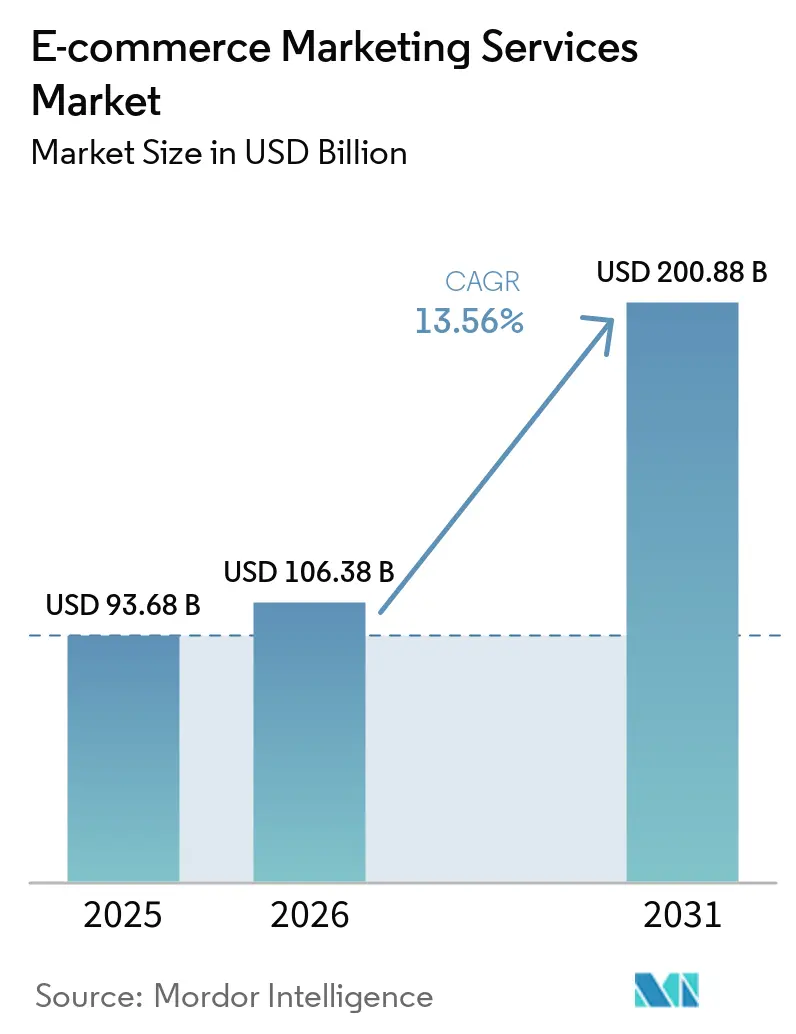
| Market Size (2026) | USD 106.38 Billion |
| Market Size (2031) | USD 200.88 Billion |
| Growth Rate (2026 - 2031) | 13.56 % |
| Fastest Growing Market | South America |
| Largest Market | North America |
| Market Concentration | Low |
Major Players *Disclaimer: Major Players sorted in no particular order Image © Mordor Intelligence. Reuse requires attribution under CC BY 4.0. | |
E-commerce Marketing Services Market Analysis by Mordor Intelligence
The E-commerce Marketing Services Market size is projected to be USD 93.68 billion in 2025, USD 106.38 billion in 2026, and reach USD 200.88 billion by 2031, growing at a CAGR of 13.56% from 2026 to 2031. The E-commerce Marketing Services Market is expanding because brands are operating in a more challenging digital commerce environment where paid acquisition is more expensive, and channel execution is more technical. The shift toward AI-driven automation, retail media, and social commerce is elevating the value of specialist partners that can manage performance, content, and measurement within a single operating model. Large brands still anchor spending because they can support multi-channel retainers across paid search, retail media, paid social, affiliate, and retention programs simultaneously. At the same time, modular and AI-native delivery models are making the E-commerce Marketing Services Market more accessible to SMEs that previously could not justify full agency support. Catalog enrichment, structured product data, and AI-ready discovery workflows are also becoming part of core service scopes, which is changing how agencies compete and where clients see durable value.
Key Report Takeaways
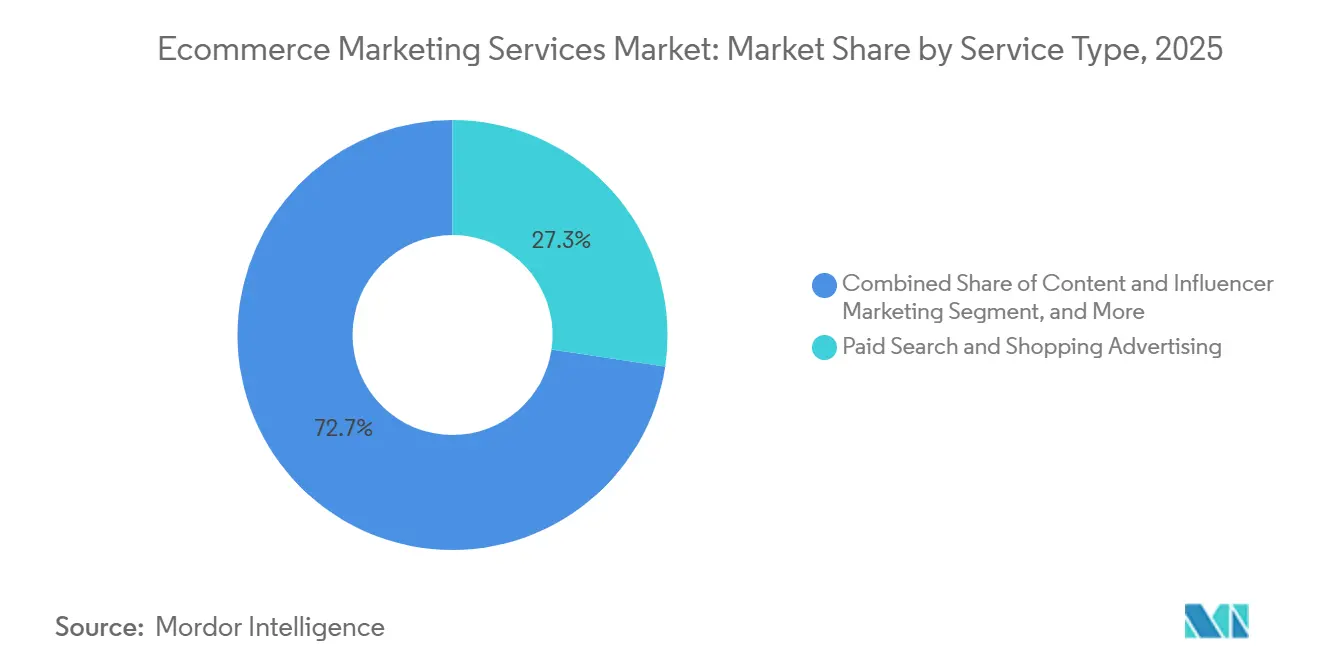
- By service type, paid search and shopping advertising held 27.13% of the E-commerce Marketing Services Market share in 2025, while paid social and social commerce marketing are projected to expand at a 16.53% CAGR through 2031.
- By organization size, large enterprises held 61.84% of the E-commerce Marketing Services Market share in 2025, while SMEs are projected to grow at a 14.43% CAGR through 2031.
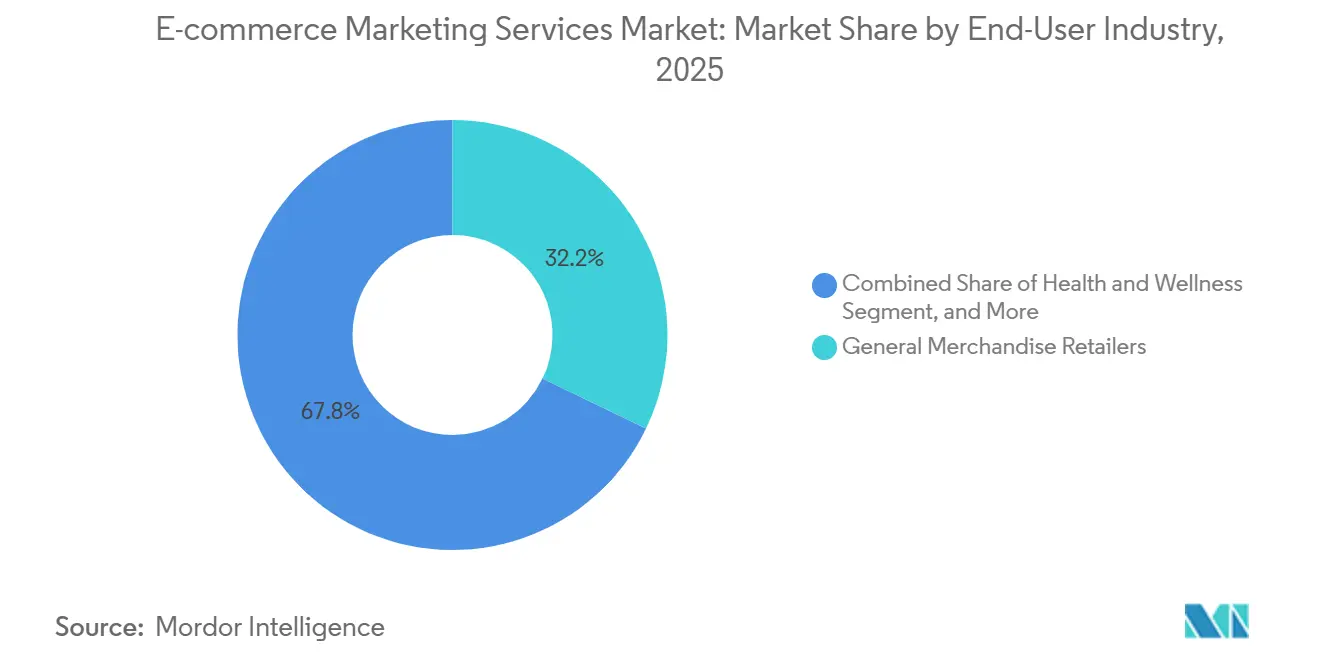
- By end-user industry, General Merchandise Retailers accounted for 32.16% of the ecommerce marketing services market size in 2025, while Health and Wellness is projected to expand at an 18.12% CAGR through 2031.
- By geography, North America accounted for 32.73% share of the E-commerce Marketing Services Market, while Asia-Pacific is projected to grow at a CAGR of 15.29% over the forecast period.
Note: Market size and forecast figures in this report are generated using Mordor Intelligence’s proprietary estimation framework, updated with the latest available data and insights as of January 2026.
Market Trends and Insights
Drivers Impact Analysis of E-commerce Marketing Services Market*
| Driver | (~) % Impact on CAGR Forecast | Geographic Relevance | Impact Timeline |
|---|---|---|---|
| AI-Driven Personalization and Creative Automation | +3.5% | Global, with concentrated impact in North America and Asia-Pacific | Medium term (2-4 years) |
| Retail Media and Marketplace Advertising Budget Expansion | +2.8% | North America and Europe core, spill-over to Asia-Pacific | Short term (≤ 2 years) |
| Rising Performance Pressure from Ecommerce Competition | +2.2% | Global | Short term (≤ 2 years) |
| Omnichannel Shopping and Social Commerce Integration | +1.8% | Asaia-Pacific core, North America and Europe following | Medium term (2-4 years) |
| Cross-Border Marketplace Diversification and Localization Needs | +1.2% | Global, with early gains in South America and Middle East | Long term (≥ 4 years) |
| Agentic Commerce and AI Product Discovery Readiness | +0.9% | North America and Europe, with early Asia-Pacific adoption | Long term (≥ 4 years) |
| Source: Mordor Intelligence | |||
AI-Driven Personalization and Creative Automation Improve Commerce ROI
The E-commerce Marketing Services Market is moving toward AI-led execution because personalization has become a baseline expectation rather than an optional feature. Shopify reported that AI-referred visitors converted at nearly 50% higher rates than organic search visitors and had 14% higher average order values in Q1 2026, which strengthens the case for agencies that can connect discovery, product data, and conversion workflows in a single program. That shift is raising the operating standard for agencies because human-only creative teams cannot match the testing speed or content volume that AI-supported teams can now deliver. It is also pushing clients to favor partners with proprietary workflow tools, stronger feed management, and better-structured catalog practices in the E-commerce Marketing Services Market. As a result, catalog enrichment, creative automation, and AI-ready content production are moving into core retainers instead of sitting in side projects.
Retail Media and Marketplace Advertising Budgets Keep Expanding
The E-commerce Marketing Services Market is gaining momentum from the expansion of retail media and marketplace advertising, as brands are directing more budget to channels closely tied to purchase behavior. Retail media has become more attractive as advertisers prioritize closed-loop measurement and first-party transaction data over awareness-led placements with weaker attribution. That shift is also changing account economics because agencies that can manage sponsored product media, shelf visibility, and cross-platform reporting are winning a larger share of performance-led budgets. The strongest momentum remains concentrated in major retail media ecosystems in North America and Europe, though the same buying logic is now spreading to other regions as marketplace competition deepens. Category demand is not moving evenly, which means agencies with strong presence in beauty, personal care, health, and other fast-turning consumer verticals are better positioned in the E-commerce Marketing Services Market.
Rising Performance Pressure as Ecommerce Competition Intensifies
The E-commerce Marketing Services Market is also benefiting from the simple fact that digital commerce has become harder to manage profitably without specialist support. Shopify reported that customer acquisition costs across its active merchant base rose from USD 274 to USD 318 in one year, a 16.1% increase that has made spend efficiency a much sharper board-level issue for brands in 2026. More merchants are competing in the same paid channels, which is increasing auction pressure and making basic campaign management less effective than it was only a few years ago. This is shifting client demand toward agencies that can prove attributable revenue outcomes, demonstrate stronger measurement discipline, and deliver faster creative iteration in the E-commerce Marketing Services Market. It also widens the gap between scaled agencies with proprietary reporting tools and smaller firms that still sell activity without giving clients enough visibility into return on spend.
Omnichannel Shopping and Social Commerce Raise Demand For Integrated Execution
The E-commerce Marketing Services Market is seeing increased demand from brands that now treat social commerce as a direct sales channel rather than a top-of-funnel media channel. Creator advertising spend reached USD 37 billion in 2025 and is projected to reach USD 44 billion in 2026, which shows how deeply creator-led commerce has moved into active budget planning.[1] As more commerce activity moves across creator content, paid social, and retailer storefronts, agencies are being asked to connect media buying, content production, and conversion tracking in one system. User-generated content is also gaining importance because it supports both discovery and purchase intent, which raises demand for agencies that can connect creator activity to measurable sales outcomes. This is making integrated execution more valuable in the E-commerce Marketing Services Market, especially for brands that sell across social platforms, owned channels, and large marketplaces simultaneously.
Restraints Impact Analysis of E-commerce Marketing Services Market*
| Restraint | (~) % Impact on CAGR Forecast | Geographic Relevance | Impact Timeline |
|---|---|---|---|
| Customer Acquisition Cost Inflation | -1.8% | Global, most acute in North America and Western Europe | Short term (≤ 2 years) |
| Signal Loss From Privacy Changes and Cookie Deprecation | -1.4% | Global, with highest regulatory influence in Europe and North America | Medium term (2-4 years) |
| Poor Product Data Readiness | -0.9% | Global, most acute in South America and Africa | Long term (≥ 4 years) |
| Black-Box Platform Automation and Lower Measurement Transparency | -0.7% | Global | Medium term (2-4 years) |
| Source: Mordor Intelligence | |||
Customer Acquisition Cost Inflation Compresses Campaign Efficiency
The E-commerce Marketing Services Market still faces pressure from rising acquisition costs because many agency scopes are tied directly to paid channel performance. Shopify's merchant data showed CAC rising to USD 318 in 2026 from USD 274 a year earlier, which means agencies must work harder to justify paid acquisition budgets and defend return on spend. When costs rise faster than conversion efficiency, brands shift funds toward retention channels such as email, SMS, loyalty programs, and affiliate programs. That mix shift does not eliminate agency demand, but it does reduce momentum for firms that depend too heavily on paid acquisition management alone in the E-commerce Marketing Services Market. It also favors agencies that can rebalance client budgets across acquisition and lifecycle channels without losing performance accountability.
Signal Loss From Privacy Changes and Cookie Deprecation Weakens Targeting
The E-commerce Marketing Services Market is also dealing with weaker browser-side targeting and attribution as privacy rules and platform changes continue to reshape digital measurement. A 2026 study in the Proceedings of the CHI Conference on Human Factors in Computing Systems found that ads delivered through Privacy Sandbox generated lower purchase intent than ads delivered under the status quo, while users did not report a stronger sense of privacy protection.[2] That result matters because agencies still need accurate signals for bidding, audience selection, and performance reporting even after Google's 2024 change in direction on third-party cookie deprecation. The operational gap is widening between firms that have already migrated clients toward stronger first-party and server-side measurement setups and those that still depend mainly on legacy pixel frameworks. In practice, this raises execution risk for the E-commerce Marketing Services Market because poor signal quality weakens targeting precision and makes cross-channel reporting less reliable.
*Our forecasts treat driver/restraint impacts as directional, not additive. The impact forecasts reflect baseline growth, mix effects, and variable interactions.
E-commerce Marketing Services Market Segment Analysis
By Service Type:
Paid Social Gains Speed While Paid Search Holds Core SpendPaid search and shopping advertising held 27.13% of E-commerce Marketing Services Market size in 2025, which kept it as the largest service line because commercial-intent queries still sit closest to purchase decisions. The channel continues to command spend even when cost pressure rises, because it remains one of the most directly attributable paths to revenue for brands selling online. That position is reinforced by Google's and Amazon's strength in capturing product-led demand; shoppers are already comparing options. In the E-commerce Marketing Services Market, this means agencies with strong feed management, bid strategy, landing page discipline, and marketplace integration continue to sit in the center of client relationships.
Paid social and social commerce marketing is projected to grow at a 16.53% CAGR from 2026 to 2031, making it the fastest-growing service type in the E-commerce Marketing Services Market. Social media advertising revenues have grown strongly globally, reflecting the scale and commercial pull of social-led demand environments. Content and influencer programs are also shifting toward shoppable formats tied more closely to direct sales, which is changing how brands assess creative output and channel value. Email, SMS, and push retention marketing are gaining weight at the same time because rising acquisition costs are pushing more growth plans toward owned-channel reactivation. Marketplace advertising and digital shelf optimization are also expanding as brands recognize that search visibility inside retail platforms increasingly shapes both conversion and blended acquisition costs.

By Organization Size:
Enterprise Spend Leads While SME Adoption BroadensLarge enterprises accounted for 61.84% of the E-commerce Marketing Services Market size in 2025, reflecting their ability to support broad retainers that cover paid search, retail media, social commerce, SEO, analytics, and affiliate execution. These clients often require unified measurement across Google, Meta, Amazon, and other commerce channels, giving agencies that can operate at scale across media, data, and reporting an edge. They are also simplifying agency rosters and shifting toward fewer commerce partners that can manage more of the workflow under a single contract. This keeps the top tier of the E-commerce Marketing Services Market closely tied to full-service providers with stronger infrastructure and procurement readiness.
SMEs are projected to expand at a 14.43% CAGR from 2026 to 2031, making them the fastest-growing segment of the E-commerce Marketing Services Market. The main reason is that AI-native delivery models and productized service packages are lowering the minimum spend needed to run disciplined performance programs. Stagwell reported 34% organic growth in its Marketing Cloud in 2025, showing that demand from self-service and mid-market advertisers is supporting scaled digital delivery models. SMEs also benefit more visibly from bidding automation and creative optimization, as efficiency gains can help protect thinner margins and smaller budgets. As this segment grows, the E-commerce Marketing Services Market is likely to see more modular pricing, narrower scopes, and stronger demand for agencies that can prove fast payback without enterprise-scale overhead.
By End-User Industry:
Health And Wellness Leads Growth Beyond General Merchandise RetailersGeneral Merchandise Retailers accounted for 32.16% of the ecommerce marketing services market in 2025, making it the leading end-user segment. The segment benefits from established digital commerce activity, extensive product catalogs, and ongoing investment in marketplace visibility, paid search, retail media, and retention programs. Its spending is increasingly moving from broad awareness campaigns toward conversion-focused commerce media that can demonstrate closer links to sales. This keeps General Merchandise Retailers central to agency revenue because brands require continuous optimization across marketplaces, product content, paid media, and customer retention.
Health and Wellness is projected to grow at an 18.12% CAGR from 2026 to 2031, giving it the strongest growth outlook among end-user groups. The category benefits from expanding direct-to-consumer supplement, fitness, and wellness brands that can support more intensive acquisition and retention activity. Marketplace-led distribution is also increasing the need for retail media management, structured product content, and digital shelf optimization. Home, furniture, grocery, and food and beverage continue to drive demand as omnichannel buying becomes more common for everyday and higher-consideration purchases.
Geography Analysis
North America and APAC E-commerce Marketing Services Market
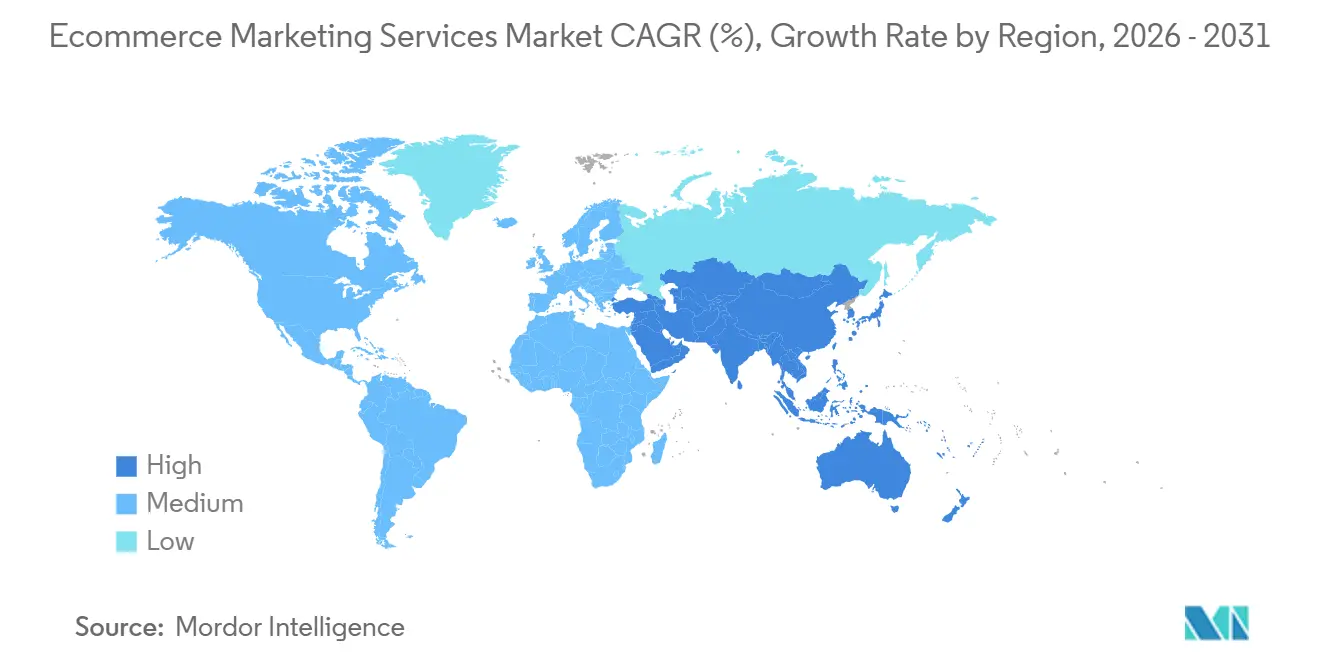
North America remained the leading regional revenue base with 32.73% share in the E-commerce Marketing Services Market in 2025, while Asia-Pacific is expected to post the fastest growth through 2031. The region's lead comes from deeper enterprise marketing budgets, broad adoption of retail media, and a more mature agency ecosystem that already supports integrated commerce execution. In the United States, creator advertising reached USD 37 billion in 2025, showing how quickly brand budgets are moving toward commerce-linked content and creator-led customer acquisition.[3] Canada and Mexico are also adding demand, especially as mobile commerce growth increases the need for localized paid social, marketplace advertising, and performance measurement. The regulatory environment is also becoming increasingly important, as privacy rules and guidance on AI-led endorsements are shaping how agencies handle targeting, content disclosure, and consumer data use.
China and APAC E-commerce Marketing Services Market
Asia-Pacific is the fastest-growing regional market, with a 15.29% CAGR in ecommerce marketing services, as ecommerce adoption remains strong and brands move quickly to newer forms of AI-assisted commerce execution. China stands out as the largest national market in the region and as a major testing ground for AI-led product discovery, social commerce, and marketplace-led customer acquisition. India, South Korea, and Australia are also adding new demand as domestic brands become more willing to outsource paid social, marketplace management, and conversion-focused campaign work. This is giving the E-commerce Marketing Services Market in Asia-Pacific a distinct profile in which speed, platform fluency, and localization matter as much as pure media-buying scale.
EMEA and South America E-commerce Marketing Services Market
Europe remains an important but more structurally constrained part of the E-commerce Marketing Services Market because privacy regulation and platform oversight affect how agencies collect data and measure performance. The United Kingdom, Germany, and France continue to anchor regional demand through established agency ecosystems and strong retail infrastructure. South America is emerging as a meaningful growth pocket as mobile commerce and marketplace adoption improve, especially in Brazil, where local execution and digital shelf visibility matter more amid rising platform competition. The Middle East and Africa also offer long-term growth opportunities as countries such as the United Arab Emirates and Saudi Arabia continue to invest in digital commerce infrastructure, while Nigeria and South Africa build service demand around mobile-first shopping behavior.
Competitive Landscape
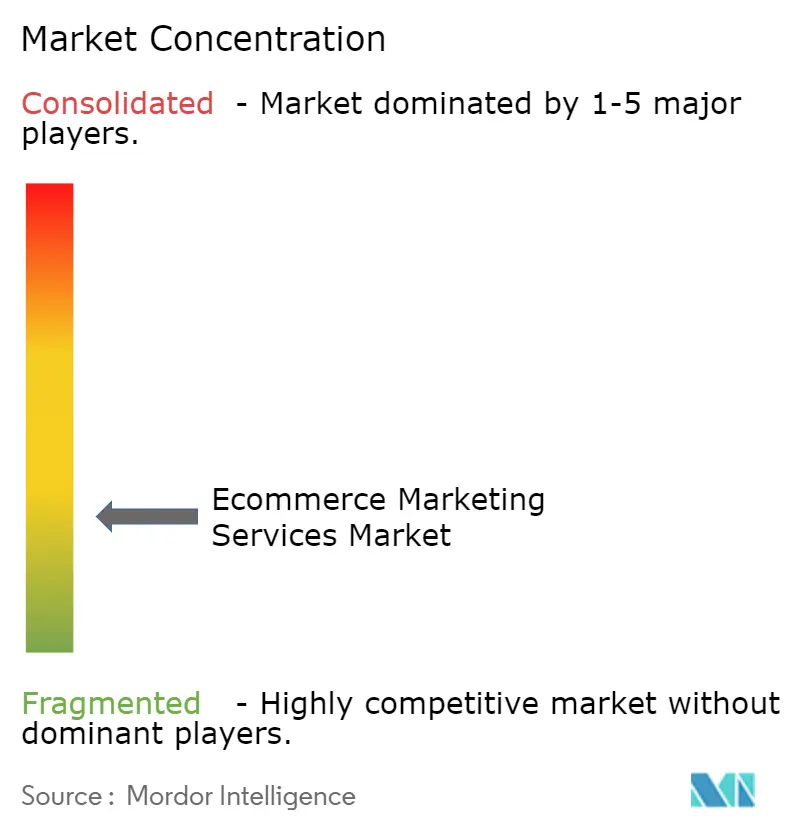
The E-commerce Marketing Services Market is fragmented at the lower end because thousands of boutique firms still compete on channel depth, category specialization, or geographic coverage. At the same time, the top of the market is consolidating as holding companies and commerce platforms invest in data, AI, and integrated execution. Omnicom completed its acquisition of Interpublic Group in November 2025, creating the world's leading marketing and sales company and reinforcing the view that scale in data and commerce capabilities is becoming more important for enterprise retention.[4] That move matters because it combines media, data, and commerce infrastructure in a way that smaller firms struggle to match. It also shows that the E-commerce Marketing Services Market is no longer being shaped only by agency brand strength, because platform assets and measurement systems now matter just as much.
A second clear pattern is that large service providers are building AI-enabled commerce stacks rather than relying solely on labor-intensive delivery. Adobe introduced CX Enterprise in April 2026 and expanded the availability of Adobe Marketing Agent across major enterprise workflow environments, pointing to a future in which a more automated operating system manages commerce content, visibility, and engagement. Merkle also launched industry-specific customer experience solutions with Adobe in April 2026, including a retail-focused offering designed to turn static ecommerce browsing into conversational shopping support. These moves reflect a broader push inside the E-commerce Marketing Services Market toward fewer disconnected tools and more unified delivery across content, media, and customer interaction.
Independent and challenger players are still relevant, but they are responding by leaning harder into focused technology or platform-led execution. Cart.com announced a USD 180 million strategic investment in March 2026 to expand its ecommerce software and unified commerce capabilities, underscoring continued investor support for commerce infrastructure models that combine software, operations, and marketing. Specialized marketplace agencies are also expanding through acquisitions to broaden their international reach and deepen their retail media presence, keeping the middle layer of the E-commerce Marketing Services Market active even as holding companies get larger. The practical outcome is a market where enterprise buyers may prefer integrated scale, while mid-market and fast-growth brands may still choose specialists with sharper execution in retail media, marketplace management, or AI-ready product discovery.
E-commerce Marketing Services Industry Leaders
-
Omnicom Group Inc.
-
Accenture Plc
-
Capgemini SE
-
Cognizant Technology Solutions Corporation
-
Deloitte Touche Tohmatsu Limited
- *Disclaimer: Major Players sorted in no particular order
E-commerce Marketing Services Market Companies Covered in this Report
- Accenture plc
- Omnicom Group Inc.
- Capgemini SE
- Cognizant Technology Solutions Corporation
- Deloitte Touche Tohmatsu Limited
- Infosys Limited
- International Business Machines Corporation
- Tata Consultancy Services Limited
- Wipro Limited
- Genpact Limited
- Adobe Inc.
- Merkle, Inc.
- Publicis Groupe S.A.
- WPP plc
- Stagwell Inc.
- Pattern, Inc.
- Cart.com, Inc.
- WebFX, Inc.
- SmartSites LLC
- NP Digital, LLC
Recent Industry Developments in E-commerce Marketing Services Market
- May 2026: Publicis Groupe announced a definitive agreement to acquire LiveRamp Holdings in an all-cash transaction with a total enterprise value of USD 2.2 billion, representing a 29.8% premium to LiveRamp's closing share price. The acquisition is intended to embed agentic AI capabilities into Publicis's commerce marketing infrastructure by integrating LiveRamp's data clean rooms, identity resolution, and marketplace connectivity with Publicis's existing Epsilon and Lotame data assets.
- April 2026: Adobe unveiled CX Enterprise at Adobe Summit 2026 in Las Vegas, rebranding and expanding its Experience Cloud into an end-to-end agentic AI system encompassing brand visibility, customer engagement, and content supply chain management. Adobe also announced the general availability of Adobe Marketing Agent within Microsoft 365 Copilot and beta availability in ChatGPT Enterprise and IBM watsonx Orchestrate.
- April 2026: Merkle, a Dentsu company, announced a suite of industry-specific CX solutions jointly developed with Adobe, combining Adobe Experience Cloud and Adobe Creative Cloud with Merkle's data science and CX transformation capabilities. The first solution, Experience Concierge for Retail, transforms static ecommerce browsing into intelligent conversational agent experiences for shoppers.
- April 2026: Podean, the independent global marketplace marketing agency, completed the acquisition of Amerge, a London-headquartered Amazon DSP and advertising partner operating across the European Union, financed by Mountaingate Capital. The combined entity represents more than 450 global brands, generates more than USD 4 billion in Amazon GMV annually, and holds more than USD 500 million in marketplace and retail media billables.
Global E-commerce Marketing Services Market Report Scope
The E-commerce Marketing Services Market comprises specialized digital marketing services designed to help online retailers, direct-to-consumer (DTC) brands, and marketplace sellers acquire, engage, convert, and retain customers across digital commerce channels. These services include search engine optimization (SEO), paid search and shopping advertising, paid social and social commerce marketing, marketplace advertising and digital shelf optimization, content and influencer marketing, email, SMS and push notification retention marketing, affiliate and partnership marketing, and other ecommerce-focused marketing solutions.
The E-commerce Marketing Services Market Report is Segmented by Service Type (Search Engine Optimization (SEO), Paid Search and Shopping Advertising, Paid Social and Social Commerce Marketing, Marketplace Advertising and Digital Shelf Optimization, Content and Influencer Marketing, Email/SMS and Push Retention Marketing, Affiliate and Partnership Marketing, and Other Service Types), Organization Size (SMEs, and Large Enterprises), End-User Industry (General Merchandise Retailers, Fashion and Apparel, Beauty and Personal Care, Consumer Electronics, Grocery and Food and Beverage, Home and Furniture, Health and Wellness, and Other End-User Industries), and Geography (North America, South America, Europe, Asia-Pacific, Middle East, and Africa). The Market Forecasts are Provided in Terms of Value (USD).
Segmentation Overview
| Search Engine Optimization (SEO) |
| Paid Search and Shopping Advertising |
| Paid Social and Social Commerce Marketing |
| Marketplace Advertising and Digital Shelf Optimization |
| Content and Influencer Marketing |
| Email, SMS and Push Retention Marketing |
| Affiliate and Partnership Marketing |
| Other Service Types (Conversion Rate Optimization (CRO), analytics, Marketing Automation) |
| SMEs |
| Large Enterprises |
| General Merchandise Retailers |
| Fashion and Apparel |
| Beauty and Personal Care |
| Consumer Electronics |
| Grocery and Food and Beverage |
| Home and Furniture |
| Health and Wellness |
| Other End-User Industry |
| North America | United States |
| Canada | |
| Mexico | |
| South America | Brazil |
| Argentina | |
| Chile | |
| Rest of South America | |
| Europe | Germany |
| United Kingdom | |
| France | |
| Italy | |
| Spain | |
| Rest of Europe | |
| Asia-Pacific | China |
| Japan | |
| India | |
| South Korea | |
| Australia | |
| Rest of Asia-Pacific | |
| Middle East | United Arab Emirates |
| Saudi Arabia | |
| Qatar | |
| Rest of Middle East | |
| Africa | South Africa |
| Egypt | |
| Nigeria | |
| Rest of Africa |
| By Service Type | Search Engine Optimization (SEO) | |
| Paid Search and Shopping Advertising | ||
| Paid Social and Social Commerce Marketing | ||
| Marketplace Advertising and Digital Shelf Optimization | ||
| Content and Influencer Marketing | ||
| Email, SMS and Push Retention Marketing | ||
| Affiliate and Partnership Marketing | ||
| Other Service Types (Conversion Rate Optimization (CRO), analytics, Marketing Automation) | ||
| By Organization Size | SMEs | |
| Large Enterprises | ||
| By End-user Industry | General Merchandise Retailers | |
| Fashion and Apparel | ||
| Beauty and Personal Care | ||
| Consumer Electronics | ||
| Grocery and Food and Beverage | ||
| Home and Furniture | ||
| Health and Wellness | ||
| Other End-User Industry | ||
| By Geography | North America | United States |
| Canada | ||
| Mexico | ||
| South America | Brazil | |
| Argentina | ||
| Chile | ||
| Rest of South America | ||
| Europe | Germany | |
| United Kingdom | ||
| France | ||
| Italy | ||
| Spain | ||
| Rest of Europe | ||
| Asia-Pacific | China | |
| Japan | ||
| India | ||
| South Korea | ||
| Australia | ||
| Rest of Asia-Pacific | ||
| Middle East | United Arab Emirates | |
| Saudi Arabia | ||
| Qatar | ||
| Rest of Middle East | ||
| Africa | South Africa | |
| Egypt | ||
| Nigeria | ||
| Rest of Africa | ||
Key Questions Answered in the Report
What is the E-commerce Marketing Services Market size in 2026 and how large will it be by 2031?
The E-commerce Marketing Services Market is expected to reach USD 106.38 billion in 2026 and USD 200.88 billion by 2031, growing at a 13.56% CAGR over 2026-2031.
Which service category leads spending in ecommerce marketing services?
Paid search and shopping advertising led spending with a 27.13% share in 2025 because it remains closely tied to high-intent product discovery and conversion.
Which service area is expanding fastest through 2031?
Paid social and social commerce marketing is projected to grow fastest, at a 16.53% CAGR, as brands shift more budget into creator-led and shoppable formats.
Why are more brands outsourcing ecommerce marketing work?
Rising acquisition costs, more crowded auctions, stronger retail media adoption, and the need for AI-ready product data are making specialist execution more valuable than in-house generalist management.
Which customer group contributes the most revenue to service providers?
Large enterprises accounted for 61.84% of revenue in 2025 because they can support multi-channel retainers across search, retail media, social, SEO, analytics, and affiliate programs.
Which end-user group shows the strongest growth outlook?
Health and Wellness is forecast to grow at an 18.12% CAGR through 2031, supported by expanding direct-to-consumer brands and stronger retention economics.