
E-Rickshaw Battery Market Size and Share
Market Overview
| Study Period | 2021 - 2031 |
|---|---|
| Market Size (2026) | USD 2.34 Billion |
| Market Size (2031) | USD 3.97 Billion |
| Growth Rate (2026 - 2031) | 11.13 % |
| Fastest Growing Market | Asia-Pacific |
| Largest Market | Asia-Pacific |
| Market Concentration | Medium |
Major Players *Disclaimer: Major Players sorted in no particular order Image © Mordor Intelligence. Reuse requires attribution under CC BY 4.0. | |
E-Rickshaw Battery Market Analysis by Mordor Intelligence
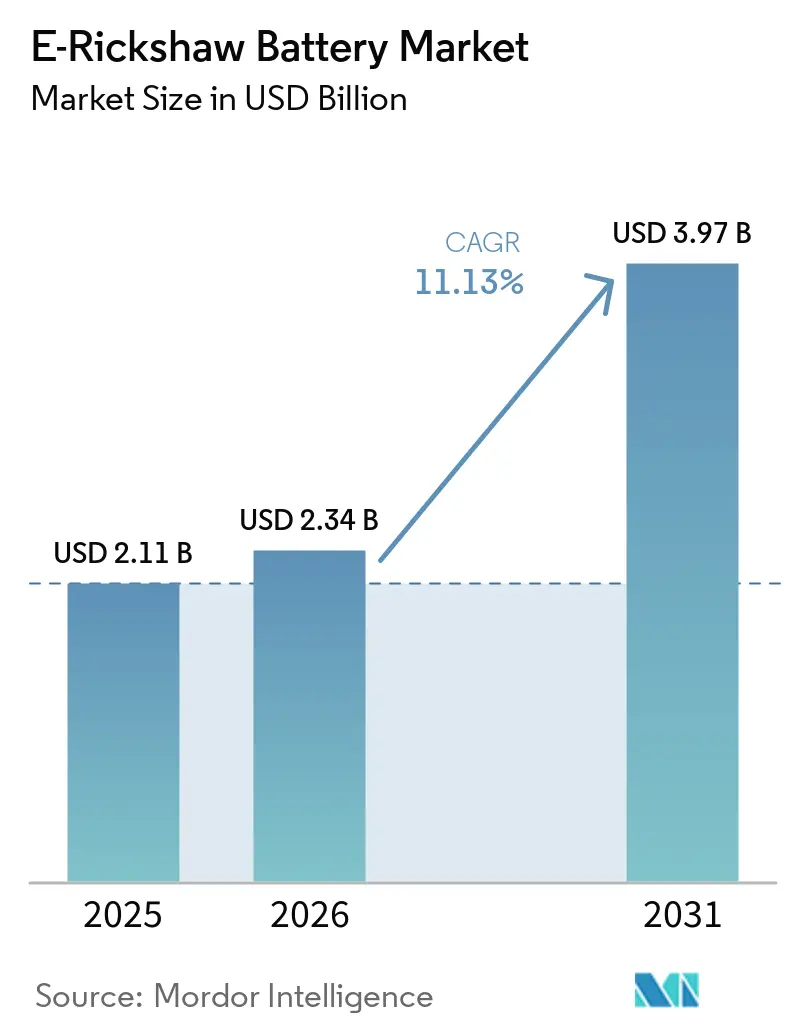
The E-rickshaw battery market size is projected to be USD 2.11 billion in 2025, USD 2.34 billion in 2026, and reach USD 3.97 billion by 2031, at a CAGR of 11.1% from 2026 to 2031. Replacement demand remains central because lead-acid packs commonly require replacement after 12 to 18 months in commercial service. This creates demand that is less dependent on new vehicle registrations than many other electric vehicle battery categories. Policy support, lower operating costs, and organized delivery fleets are moving procurement toward certified batteries and larger lithium-ion packs. Swapping networks can also increase battery use because centrally managed packs complete more charge cycles than conventionally charged batteries. The E-rickshaw battery market, therefore, combines a large low-cost replacement base with a gradual move toward longer-life chemistries and more formal supply channels.
Key Report Takeaways
- By battery type, lead-acid batteries held 63.1% of the share in 2025, while lithium-ion batteries are forecast to grow at a 16.3% CAGR through 2031.
- By vehicle type, passenger e-rickshaws held 87.6% of the E-rickshaw battery market share in 2025, while cargo e-rickshaws are forecast to grow at a 14.6% CAGR through 2031.
- By geography, Asia-Pacific held 55.3% of the share in 2025 and is forecast to grow at a 15.3% CAGR through 2031.
Note: Market size and forecast figures in this report are generated using Mordor Intelligence’s proprietary estimation framework, updated with the latest available data and insights as of January 2026.
Global E-Rickshaw Battery Market Trends and Insights
Drivers Impact Analysis*
| Driver | (~) % Impact on CAGR Forecast | Geographic Relevance | Impact Timeline |
|---|---|---|---|
| Government Incentives for Electric Three-Wheeler Adoption | +3.00% | India (national, with spill-over to Bangladesh, Indonesia, Vietnam) | Short term (≤ 2 years) |
| Lower Total Cost of Ownership Than ICE Rickshaws | +2.50% | Global; dominant in India, Bangladesh, and Southeast Asia | Medium term (2–4 years) |
| Lithium-Ion Cost Declines and LFP Commercialization | +2.00% | Global; most acute cost impact in APAC core | Long term (≥ 4 years) |
| Last-Mile Delivery and Fleet Electrification | +1.50% | Global; concentrated in India Tier-1 and Tier-2 cities, China logistics corridors | Medium term (2–4 years) |
| Battery-Swapping Networks Increasing Vehicle Utilization | +1.20% | India (national); early-stage in Bangladesh, Southeast Asia, East Africa | Medium term (2–4 years) |
| Replacement Demand From Short Lead-Acid Battery Lifecycles | +0.80% | India, Bangladesh, Nepal; rural and semi-urban markets | Short term (≤ 2 years) |
| Source: Mordor Intelligence | |||
Government Incentives for Electric Three-Wheeler Adoption
India’s PM E-DRIVE scheme extends purchase incentives for e-rickshaws and e-carts through March 2028. The scheme provides a per-vehicle cap of INR 25,000, equivalent to USD 300, and gives e-rickshaws a longer incentive window than electric two-wheelers[1]India Ministry of Heavy Industries, “PM Electric Drive Revolution in Innovative Vehicle Enhancement Scheme,” Government of India, pmedrive.heavyindustries.gov.in. This support helps maintain vehicle demand and supports battery purchases in the E-rickshaw battery market. The 2025 allocation revision shifted INR 1.42 billion, equivalent to USD 16 million, from e-rickshaws and e-carts toward L5 commercial three-wheelers. The change reduces support for basic units while favoring vehicles that require batteries with greater capacity. Bangladesh’s draft Electric Three-Wheeler Management Policy 2025 proposes registration requirements and BSTI-approved battery components for more than 2 million electric three-wheelers. If implemented, the policy could shift demand from informal packs to certified products and raise compliance requirements for suppliers.
Lower Total Cost of Ownership Than ICE Rickshaws
Lower running costs support the E-rickshaw battery market because operators can recover a larger initial battery investment through daily savings. Fleet operators in Delhi reported lithium-ion e-rickshaw payback periods of 18 to 24 months during 2025. Battery-as-a-Service arrangements separate battery ownership from vehicle ownership and reduce the immediate importance of pack price. Battery Smart reported FY25 revenue of INR 279 crore, with 49% year-over-year growth, indicating that swapping services can support an operating model built around repeated battery use. These models encourage decisions based on operating cost and battery availability rather than the purchase price alone. This gives the E-rickshaw battery market a route to adoption that does not depend on driver ownership of a battery.
Lithium-Ion Cost Declines and LFP Commercialization
Lithium-ion and LFP batteries are gaining relevance in the E-rickshaw battery market because commercial operators need longer service life and reliable daily performance. LFP chemistry provides thermal stability, which is important where high temperatures and improper charging practices increase safety concerns. It also reduces exposure to cobalt price changes and supports use in battery-swapping fleets. Exide Industries has invested INR 5,102 crore, equivalent to USD 612 million, in its Bengaluru LFP and NMC cell facility. Phase 1 has 6 GWh of capacity and is expected to begin generating revenue in Q3 FY27, initially serving three-wheeler battery pack customers. Domestic cell production could reduce logistics exposure and give Indian pack suppliers a more local source of advanced cells.
Last-Mile Delivery, Swapping Networks, and Fleet Electrification
E-commerce logistics and quick-commerce activity are changing battery procurement from driver-level purchases toward fleet contracts. The E-rickshaw battery market benefits when fleet buyers standardize battery specifications and require dependable cycle life. Delhivery and Bajaj Auto formed a 2025 to 2026 partnership to deploy electric cargo three-wheelers in Tier-2 and Tier-3 cities. The original deployment plan cited approximately 1,500 vehicles, while the reported initial deployment was 200 Bajaj RIKI e-carts. Cargo fleets have higher daily duty requirements, which makes range, charging time, and battery health important purchasing criteria. Battery-swapping networks also support higher vehicle utilization by reducing charging downtime in dense routes. India had more than 3,000 operational swapping stations by mid-2026, although coverage remained concentrated in urban areas. Higher utilization can shorten replacement intervals for centrally managed packs and strengthen demand for quality-controlled supply. This makes swapping a material demand channel for the E-rickshaw battery market.
Restraints Impact Analysis*
| Restraint | (~) % Impact on CAGR Forecast | Geographic Relevance | Impact Timeline |
|---|---|---|---|
| Limited Charging and Swapping Coverage Outside Major Cities | -1.80% | India rural Tier-3+, Bangladesh, Northeast India, rural Southeast Asia | Short term (≤ 2 years) |
| High Upfront Cost of Lithium-Ion Packs | -1.50% | Global; most acute in India, Bangladesh, Nepal (price-sensitive owner-operators) | Medium term (2–4 years) |
| Battery-Swapping Interoperability Gaps | -1.00% | India, emerging APAC markets | Medium term (2–4 years) |
| Informal Aftermarket Batteries and Thermal-Safety Risks | -0.70% | India (Delhi, UP, Bihar corridor), Bangladesh | Short term (≤ 2 years) |
| Source: Mordor Intelligence | |||
Limited Charging and Swapping Coverage Outside Major Cities
India’s swapping network has attracted more than USD 325 million in disclosed investment, but stations remain concentrated in large cities. Government estimates indicated a need for 26,000 swapping kiosks by the end of FY2026 and 111,000 by FY2030. The cited operating base was only 2,600 registered kiosks, leaving many rural and semi-urban operators dependent on conventional charging. This infrastructure gap limits vehicle availability and can force charging through unauthorized connections. Northeast India accounted for 1% of India’s charging infrastructure in 2025 despite notable e-rickshaw use in Assam. The uneven network creates downtime risk for operators, even where electric vehicle operating economics remain favorable. It also limits the E-rickshaw battery market in locations where vehicle demand exists but dependable charging does not.
High Upfront Cost of Lithium-Ion Packs
Lithium-ion batteries remain difficult to finance for many owner-operators despite their lower lifetime operating cost. The input placed a 48V lead-acid set at INR 8,000 to INR 15,000 in 2025 and an equivalent lithium-ion pack at INR 20,000 to INR 40,000. This gap can direct buyers toward lower-priced and informal products, especially where formal credit is limited. Battery-swapping services could reduce the immediate capital requirement, but the cited GST rate for swapping services was 18%, compared with 5% on electric vehicle purchases. Limited interoperability between platforms can also restrict the practical value of swapping outside a specific network. The E-rickshaw battery market faces a related safety issue because recycled or unverified lead-acid packs can increase thermal incidents and weaken buyer confidence in the segment.
*Our forecasts treat driver/restraint impacts as directional, not additive. The impact forecasts reflect baseline growth, mix effects, and variable interactions.
Segment Analysis
By Battery Type: Lead Acid Holds the Installed Base While Lithium-Ion Expands
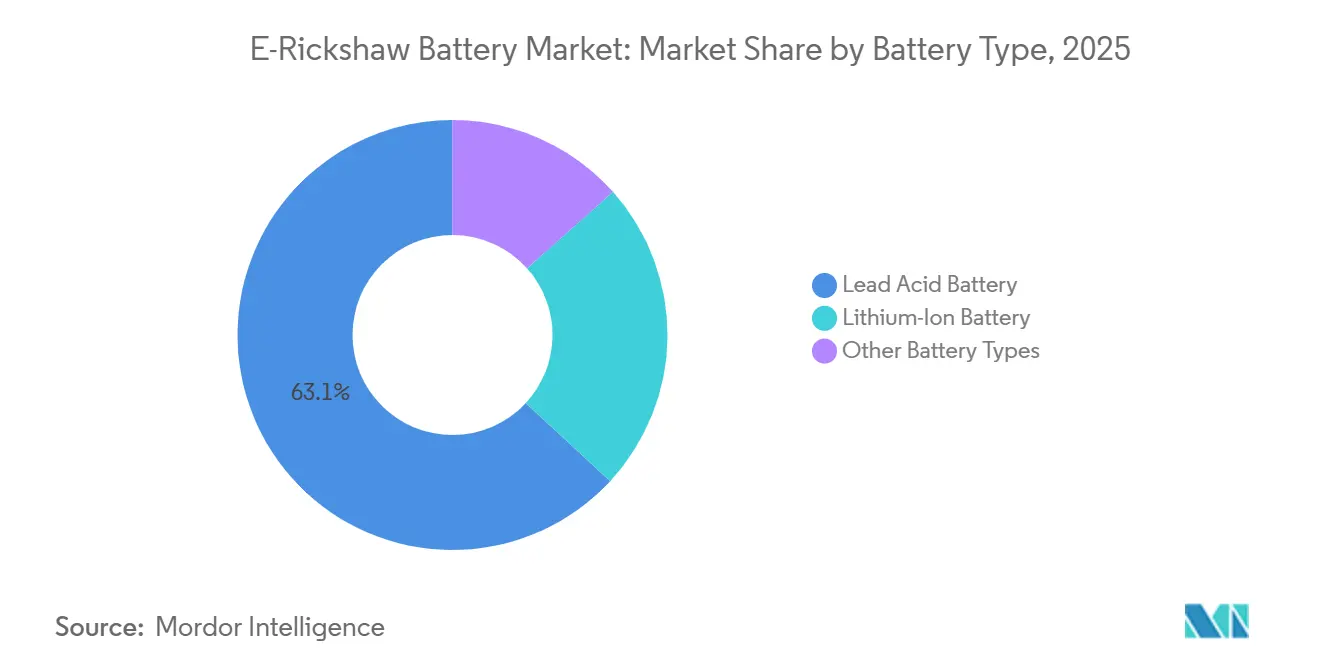
Lead-acid batteries held 63.1% of the E-rickshaw battery market share in 2025, supported by low purchase cost and extensive aftermarket availability. Their INR 8,000 to INR 15,000 price range remains accessible for drivers in India, Bangladesh, and Nepal. Mechanics across rural and semi-urban routes are familiar with lead-acid maintenance, which further supports their continued use. This chemistry also has a large installed base that produces recurring replacement demand. The E-rickshaw battery industry still relies on this replacement cycle because lead-acid packs often remain in commercial use for only 12 to 18 months. However, repeated replacements can make lifetime spending higher than the initial price suggests. Delhi’s requirement for lithium-ion batteries in registered e-rickshaws and advisory guidance on AIS-189 and AIS-190 standards can narrow the space for noncompliant packs. Nickel-metal hydride and early solid-state batteries remain marginal options, while LFP is absorbing more of the addressable use case.
Lithium-ion batteries are forecast to grow at a 16.3% CAGR from 2026 to 2031, making them the fastest-growing battery type. Longer life, greater usable range, and better suitability for repeated charging support their adoption in commercial fleets. LFP batteries are especially relevant for e-rickshaws because they offer thermal stability and do not rely on cobalt. The E-rickshaw battery industry is also shaped by swapping platforms that choose the chemistry on behalf of individual drivers. That arrangement can overcome financing limits that delay upgrades among owner-operators. Exide’s planned local cell output can support a more domestic supply chain for three-wheeler battery packs. Battery management systems and certified charging practices become more important as lithium-ion use increases. The shift does not remove lead-acid demand immediately because price-sensitive users still require affordable replacement options.



By Vehicle Type: Passenger Vehicles Provide Volume While Cargo Vehicles Gain Fleet Demand
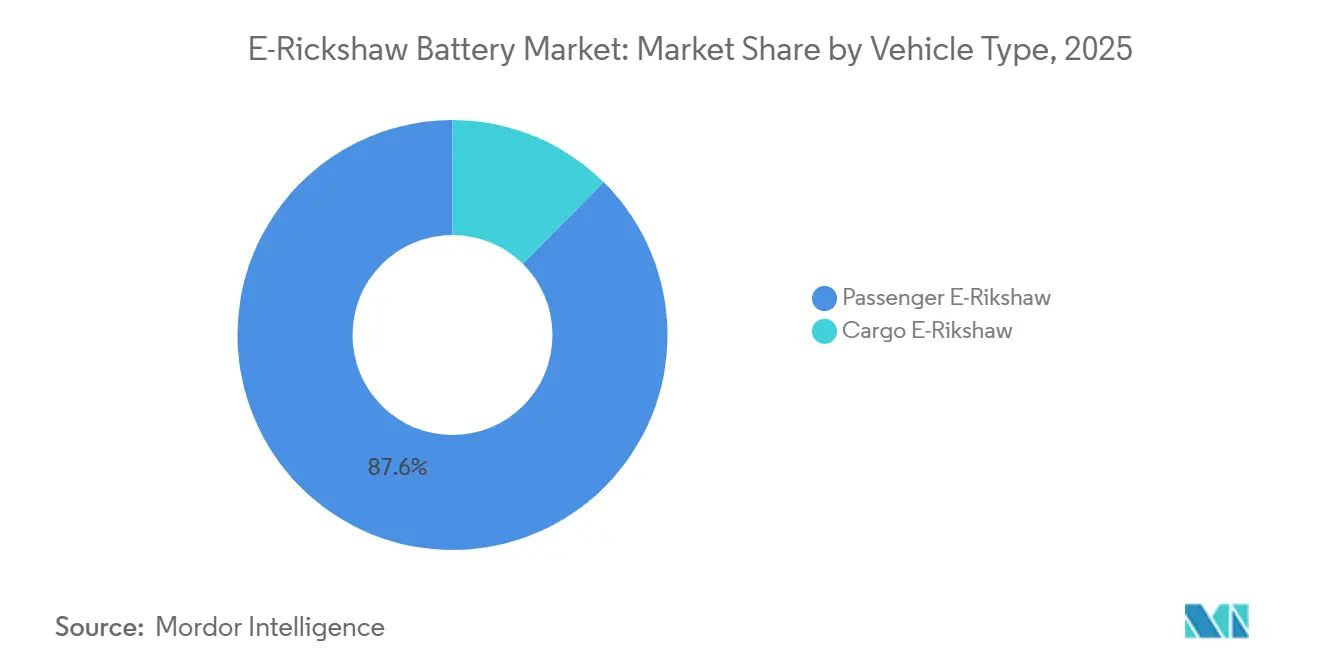
Passenger e-rickshaws accounted for 87.6% of the E-rickshaw battery market size in 2025. The large share reflects extensive informal passenger transport networks across Indian Tier-2 and Tier-3 cities. E-rickshaws represented 8% of all motor vehicle registrations in India during FY2025 to FY2026. Uttar Pradesh, Bihar, West Bengal, Assam, and Delhi have significant e-rickshaw registration activity. Passenger applications maintain demand for both low-cost replacement batteries and higher-value lithium-ion upgrades. Battery specifications are moving from 48V and 100Ah lead-acid configurations toward 60V LFP packs that can provide more than 100 kilometers of range. This raises the value of a battery purchase even when unit demand is driven by small operators. It also keeps passenger transport central to the E-rickshaw battery market. PM E-DRIVE support for e-rickshaws and e-carts continues through March 2028, which supports the broader passenger vehicle base.
Cargo e-rickshaws are forecast to grow at a 14.6% CAGR from 2026 to 2031. The E-rickshaw battery market gains from this segment because cargo vehicles face heavier loads and more demanding daily charge cycles. Organized logistics customers are more likely to require documented battery performance and fleet-level supply agreements. Delhivery’s partnership with Bajaj Auto illustrates the use of electric cargo vehicles in smaller Indian cities. iGowise Mobility and Elektrik Express began a phased deployment of 2,000 AI-integrated electric cargo trikes in August 2025. Their MicroLogi platform uses real-time IoT battery health monitoring, which supports data-based maintenance and procurement. Cargo duty conditions favor lithium-ion packs over lead-acid alternatives because range and cycle life affect delivery schedules. This part of the E-rickshaw battery market can therefore give organized suppliers a stronger role than in driver-led passenger replacement sales.
Geography Analysis
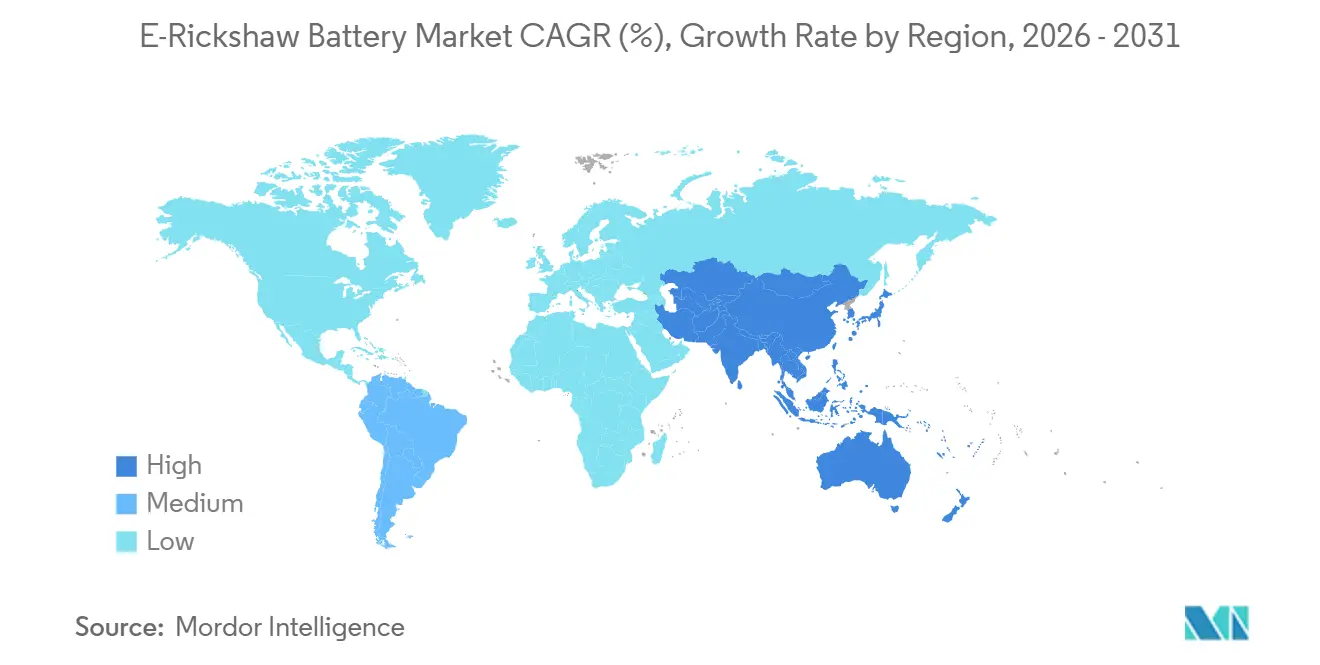
Asia-Pacific held 55.3% of the E-rickshaw battery market size in 2025 and is forecast to expand at a 15.3% CAGR from 2026 to 2031. India anchors regional demand through a large passenger e-rickshaw base and growing commercial three-wheeler use. E-rickshaws accounted for 8% of all Indian motor vehicle registrations in FY2025 to FY2026. Demand is concentrated in Uttar Pradesh, Bihar, West Bengal, Assam, and Delhi. PM E-DRIVE incentives support e-rickshaws and e-carts through March 2028 and help preserve demand for certified battery systems. Bangladesh had more than 2 million electric three-wheelers in 2025, most of which were unregistered. Its proposed registration and battery approval requirements could bring a significant informal battery base into formal supply channels.
China is both a source of battery cells and an important micro-electric vehicle ecosystem for the E-rickshaw battery market. Regional pack integrators use LFP cells from Chinese producers, including CATL and BYD. This supply position sets a competitive cost benchmark for battery manufacturers in India and neighboring countries. Vietnam, Indonesia, and Thailand are earlier-stage locations where cargo trikes are being introduced into FMCG distribution routes. These applications favor multi-cycle lithium-ion packs that can meet organized fleet requirements. India’s swapping network has the most visible scale in the region, but its urban concentration limits the benefit for many smaller towns. The region’s demand will continue to depend on the balance between affordable lead-acid replacement products and reliable lithium-ion infrastructure. That balance will shape the E-rickshaw battery market across both established and emerging regional corridors.
North America and Europe represent smaller demand pockets for the E-rickshaw battery market. In North America, use is concentrated in tourism corridors, university campuses, and urban micro-mobility trials. These applications commonly require lithium batteries because operators value range and reduced maintenance. European zero-emission freight zones have created a role for cargo trikes in last-mile delivery. Specifications often require certifications such as IEC 62133, which can raise the quality threshold for imported battery components. South America and the Middle East and Africa remain frontier regions for electric three-wheelers. Sun Mobility raised USD 135 million in 2025 to expand swapping networks in Africa and Southeast Asia, including activity in Kenya[2]Public Infrastructure Development Group, “Helios Climate and PIDG Back SUN Mobility to Deploy Battery Swapping Networks in Africa and Southeast Asia,” Public Infrastructure Development Group, pidg.org. Brazil, Argentina, Egypt, Morocco, and South Africa are exploring use cases in urban logistics or informal transit. Grid reliability, charging standards, and battery finance remain practical constraints in these markets.

Competitive Landscape
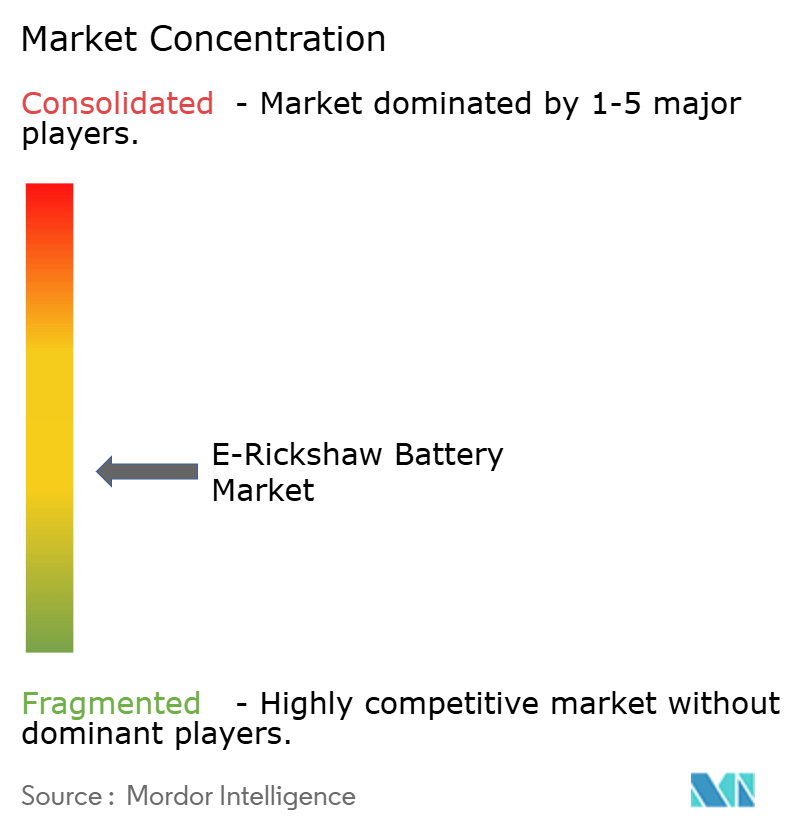
The E-rickshaw battery market remains moderately concentrated among manufacturers because no company has a decisive reported share. Exide Industries, Amara Raja Energy & Mobility, Eastman Auto & Power, and Okaya Power form part of the established Indian lead-acid supply base. Their distribution coverage and aftermarket presence remain important for price-sensitive replacement demand. Competition is shifting toward lithium-ion capability, battery management software, and access to swapping networks. Exide has invested INR 5,102 crore, equivalent to USD 612 million, in its Bengaluru LFP and NMC cell project. The facility’s 6 GWh Phase 1 is expected to generate revenue in Q3 FY27 and initially target three-wheeler battery pack customers. This investment indicates that incumbent lead-acid producers are seeking a position in the lithium transition. Rural replacement demand remains open to many suppliers because lead-acid packs require recurring purchases outside organized retail channels.
Battery swapping creates a separate competitive route because providers can influence battery choice without manufacturing every pack. Battery Smart operated more than 300,000 lithium-ion batteries across 1,600 stations in more than 75 cities and reached operational breakeven in FY26. The company was preparing an initial public offering and targeting 70% to 80% annual growth over 3 to 5 years. Sun Mobility follows a technology-led approach through patents covering high-voltage connectors, robotic alignment systems, and automated battery locking. The company became the first in India to receive AIS-038 certification for a swappable platform for heavy electric vehicles. Such network and technology models can strengthen standardized battery use where stations are sufficiently dense.
CATL and BYD have cell cost and technology positions that could become more significant as Indian OEMs increase LFP procurement. Domestic producers are responding through local cell capacity and advanced chemistry programs. Amara Raja has invested through its energy division in advanced cell chemistries, while Exide has committed capital to manufacturing capacity. The E-rickshaw battery market also includes direct battery suppliers such as Time Technoplast’s Power Build business, which offers the e-START lead-acid battery line. Battery Smart is relevant as a swapping operator but does not manufacture batteries commercially. Its role is service delivery rather than direct battery production or sales. Greaves Electric Mobility can be considered relevant through e-rickshaw integration, while the core manufacturer group remains diverse. Market concentration is low because the input gives no combined top-player share that would support a concentrated structure. Suppliers therefore compete across price, distribution, chemistry, pack quality, compliance, and relationships with fleet or platform operators. These factors will determine positioning in the E-rickshaw battery market as fleet and platform demand grows.
E-Rickshaw Battery Industry Leaders
Exide Industries Ltd
Eastman Auto & Power Ltd
Amara Raja Energy & Mobility Limited
Okaya Power Private Limited
Luminous Power Technologies Pvt. Ltd.
- *Disclaimer: Major Players sorted in no particular order

Recent Industry Developments
- August 2026: Exide Industries infused an additional INR 200 crore into its subsidiary Exide Energy Solutions, raising the cumulative total investment to INR 5,102 crore for the Bengaluru LFP/NMC cell plant with 6 GWh Phase 1 capacity. First commercial revenue is expected in Q3 FY27, primarily targeting three-wheeler battery pack customers ahead of two-wheeler and passenger vehicle applications.
- August 2026: Two fatalities in West Delhi’s Raghubir Nagar from an e-rickshaw battery explosion intensified regulatory pressure on the Ministry of Heavy Industries to accelerate enforcement of AIS-189 and AIS-190 battery safety and performance standards. The standards remained advisory for electric two- and three-wheelers as of mid-2026.
- July 2026: Energy In Motion signed a 500 MWh LFP battery supply agreement with CATL covering the CB7T0 cell model and L324D06 battery pack platform for heavy-duty electric commercial vehicles.
- June 2026: Battery Smart achieved operational breakeven in FY26 and planned to submit initial public offering papers to SEBI in September or October 2026. The network operated more than 300,000 lithium-ion batteries and more than 1,500 swapping stations across more than 75 cities.


Global E-Rickshaw Battery Market Report Scope
An e-rickshaw battery is a power storage device specifically designed to supply electric energy to e-rickshaws, three-wheeled electric vehicles used primarily for short-distance public transportation. These batteries, typically available in lead-acid and lithium-ion variants, provide the necessary energy to drive the electric motor, enabling the e-rickshaw to operate efficiently. Key attributes of these batteries include their capacity, charging time, lifespan, and cost, all of which significantly impact the performance, range, and overall economic viability of the e-rickshaw.
The E-Rickshaw Battery Market is segmented by battery type, vehicle type, and geography. By battery type, the market is segmented into lead-acid battery, lithium-ion battery, and other battery types. By vehicle type, the market is segmented into passenger e-rickshaw and cargo e-rickshaw. The report also covers the market size and forecasts for the global E-Rickshaw Battery Market across 21 countries in key regions. For each segment, the market sizing and forecasts have been provided on the basis of value (USD).
| Lead Acid Battery |
| Lithium-Ion Battery |
| Other Battery Types |
| Passenger E-Rickshaw |
| Cargo E-Rickshaw |
| North America | United States |
| Canada | |
| Mexico | |
| Europe | Germany |
| France | |
| Italy | |
| Turkey | |
| Rest of Europe | |
| Asia-Pacific | China |
| India | |
| Bangladesh | |
| Indonesia | |
| Vietnam | |
| Thailand | |
| Rest of Asia-Pacific | |
| South America | Brazil |
| Argentina | |
| Chile | |
| Rest of South America | |
| Middle East and Africa | Saudi Arabia |
| United Arab Emirates | |
| Egypt | |
| South Africa | |
| Morocco | |
| Rest of Middle East and Africa |
| By Battery Type | Lead Acid Battery | |
| Lithium-Ion Battery | ||
| Other Battery Types | ||
| By Vehicle Type | Passenger E-Rickshaw | |
| Cargo E-Rickshaw | ||
| By Geography | North America | United States |
| Canada | ||
| Mexico | ||
| Europe | Germany | |
| France | ||
| Italy | ||
| Turkey | ||
| Rest of Europe | ||
| Asia-Pacific | China | |
| India | ||
| Bangladesh | ||
| Indonesia | ||
| Vietnam | ||
| Thailand | ||
| Rest of Asia-Pacific | ||
| South America | Brazil | |
| Argentina | ||
| Chile | ||
| Rest of South America | ||
| Middle East and Africa | Saudi Arabia | |
| United Arab Emirates | ||
| Egypt | ||
| South Africa | ||
| Morocco | ||
| Rest of Middle East and Africa | ||


Key Questions Answered in the Report
What is the projected value of the e-rickshaw battery sector by 2031?
The sector is projected to reach USD 3.97 billion by 2031, expanding at an 11.13% CAGR from 2026 to 2031. The forecast reflects continued replacement demand for lead-acid packs and growing use of lithium-ion batteries in fleet applications. It also reflects policy support for e-rickshaws and e-carts under India’s PM E-DRIVE scheme.
Which battery type leads e-rickshaw use today?
Lead-acid batteries led with 63.1% share in 2025 because of their lower upfront cost, widespread availability, and established service network. Their short commercial service life also creates recurring replacement demand, especially in rural and semi-urban operating routes. However, compliance needs and fleet use are increasing the role of lithium-ion products.
Why are lithium-ion batteries gaining use in e-rickshaws?
Lithium-ion batteries are forecast to grow at a 16.3% CAGR through 2031 because fleets value longer life, range, and suitability for repeated charging. LFP chemistry also offers thermal stability and fits the standardized requirements of centralized swapping platforms. Local cell capacity plans can support a more domestic supply base for pack assemblers.
What is driving cargo e-rickshaw battery demand?
Cargo e-rickshaws are forecast to grow at a 14.6% CAGR through 2031 as logistics fleets require batteries that can handle heavier loads and frequent cycles. Fleet contracts also encourage documented battery performance, maintenance monitoring, and more consistent procurement specifications. The growing use of electric cargo vehicles in smaller cities supports this shift in purchasing behavior.
Which region has the largest e-rickshaw battery demand?
Asia-Pacific led with 55.3% share in 2025 and is forecast to grow at a 15.3% CAGR through 2031, led by India and Bangladesh. India has a large passenger e-rickshaw base, while Bangladesh’s proposed registration and approved-battery requirements could formalize informal demand. China also has a major role as a source of LFP cells used by regional battery pack integrators.
Page last updated on:


 Your data is secure and never sold or shared.


