
Drop-on-Demand Inkjet Printheads Market Size and Share
Market Overview
| Study Period | 2019 - 2030 |
|---|---|
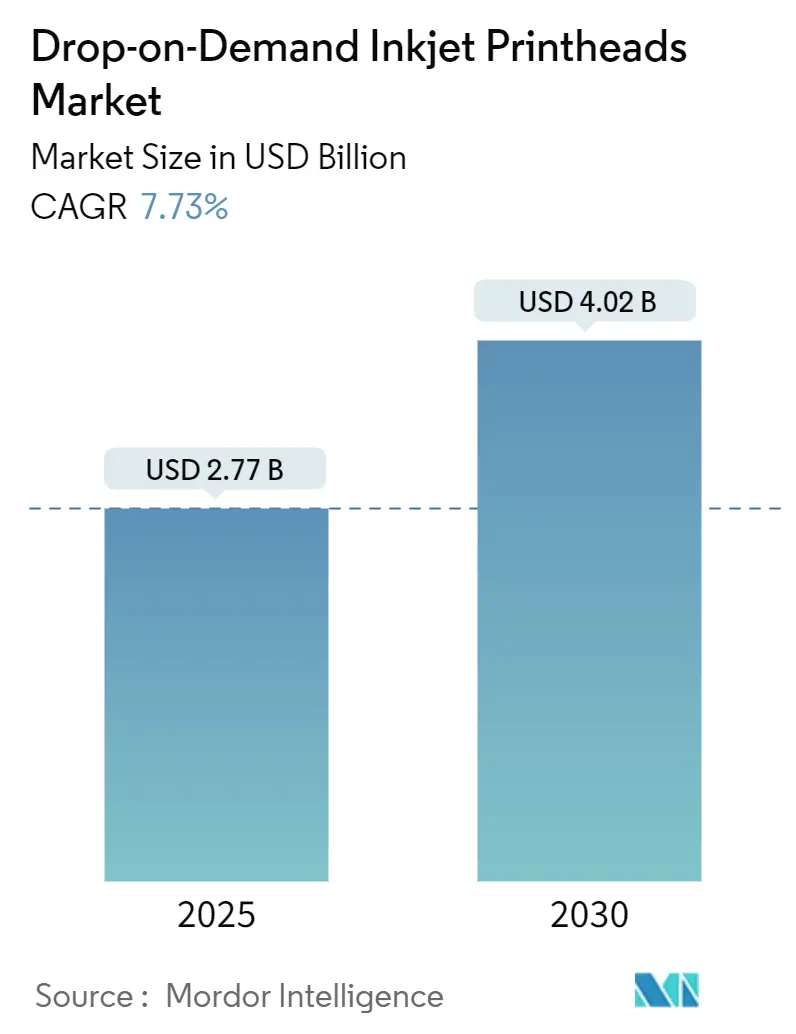
| Market Size (2025) | USD 2.77 Billion |
| Market Size (2030) | USD 4.02 Billion |
| Growth Rate (2025 - 2030) | 7.73 % |
| Fastest Growing Market | Asia Pacific |
| Largest Market | Asia Pacific |
| Market Concentration | Medium |
Major Players *Disclaimer: Major Players sorted in no particular order Image © Mordor Intelligence. Reuse requires attribution under CC BY 4.0. | |
Drop-on-Demand Inkjet Printheads Market Analysis by Mordor Intelligence
The Drop-on-Demand Inkjet Printheads market is currently valued at USD 2.77 billion in 2025 and is forecast to reach USD 4.02 billion by 2030, reflecting a 7.73% CAGR. Growth is propelled by the migration from analog to digital workflows, the precision required for additive manufacturing, and rising adoption in high-value biomedical and electronics applications. Single-pass architectures now let converters match analog line speeds while printing variable data, slashing changeover time and wastage. Recirculating designs capable of jetting high-viscosity fluids expand material latitude, enabling conductive pastes, UV-curable resins, and bio-inks. Asia-Pacific’s concentration of precision manufacturing and government incentives underpins its global leadership, while Europe’s sustainability mandates and North America’s additive-manufacturing ecosystem create robust regional demand.
Key Report Takeaways
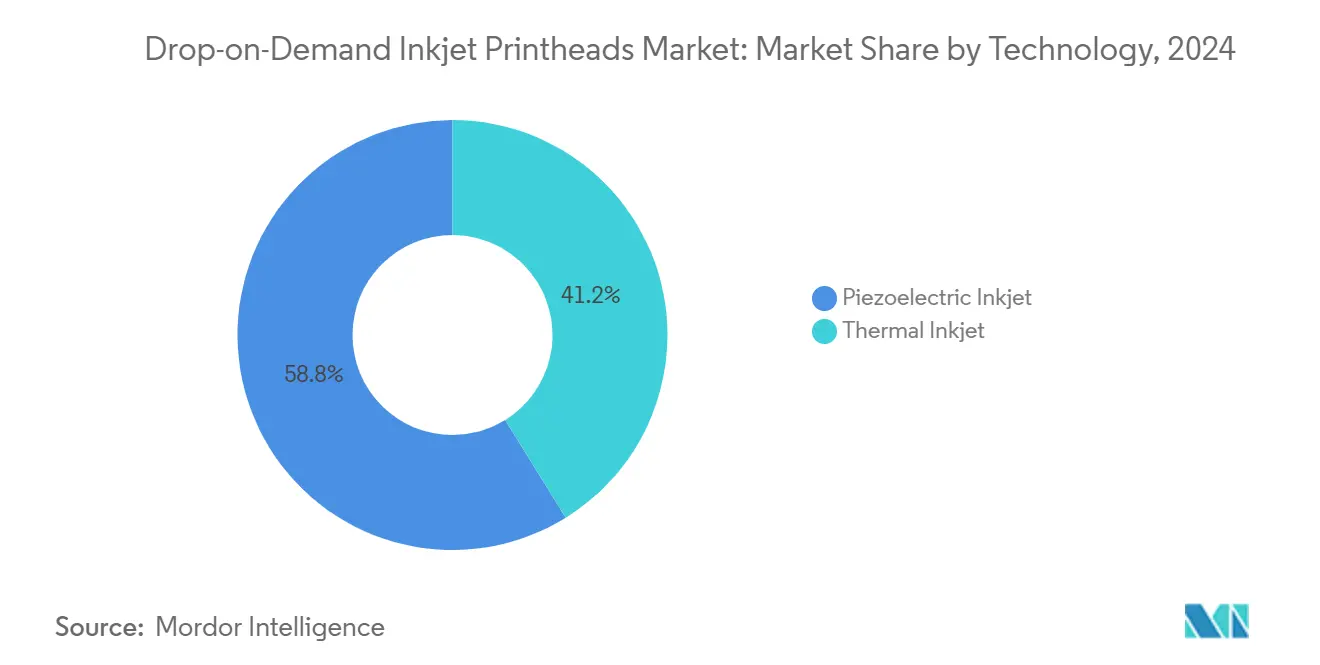
- By technology, piezoelectric devices held 58.84% of the Drop-on-Demand Inkjet Printheads market share in 2024.
- By ink type, water-based formulations contributed 44.39% of the Drop-on-Demand Inkjet Printheads market size in 2024.
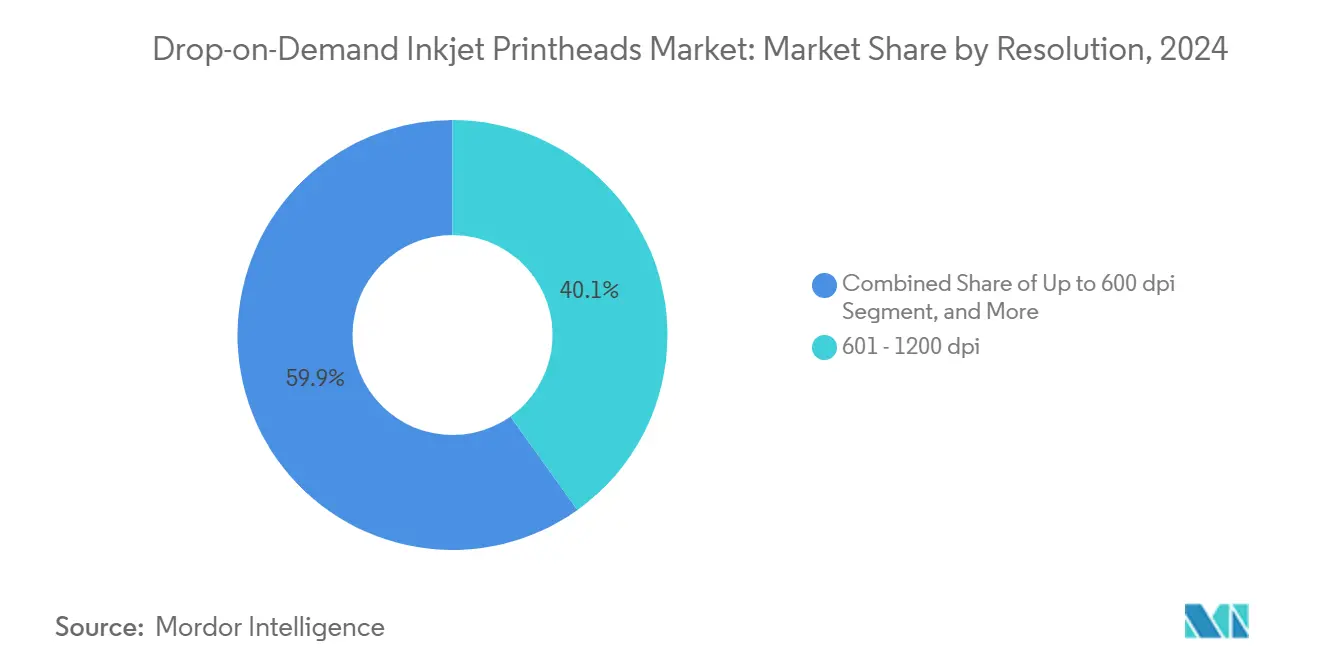
- By resolution, the 601-1,200 dpi class captured 40.13% revenue in 2024.
- By end-user, packaging and label converters commanded 29.63% revenue in 2024.
- By geography, Asia-Pacific generated 38.51% of global sales in 2024.
Note: Market size and forecast figures in this report are generated using Mordor Intelligence’s proprietary estimation framework, updated with the latest available data and insights as of January 2026.
Market Trends and Insights
Drivers Impact Analysis of Drop-on-Demand Inkjet Printheads Market*
| Driver | %Impact on CAGR Forecast | Geographic Relevance | Impact Timeline |
|---|---|---|---|
| Rising adoption of single-pass inkjet in packaging and labels | +2.1% | Europe, North America | Medium term (2-4 years) |
| Growth in digital textile printing | +1.8% | Asia-Pacific, Europe | Medium term (2-4 years) |
| Expansion of industrial coding and marking applications | +1.3% | Global | Short term (≤2 years) |
| Advances in bioprinting and additive manufacturing | +1.6% | North America, Europe, emerging Asia-Pacific | Long term (≥ 4 years) |
| Regional incentives and government policies | +0.7% | China, Japan, selected EU states | Medium term (2-4 years) |
| Rising demand for high-resolution electronics printing | +1.2% | Asia-Pacific, North America | Long term (≥4 years) |
| Source: Mordor Intelligence | |||
Rising Adoption of Single-Pass Inkjet in Packaging and Labels
Single-pass lines now deliver label and flexible-packaging jobs at up to 100 m/min while personalizing every impression, lowering total cost of ownership by 30-40% compared with flexography.[1]Memjet, “Opportunities in Inkjet Label and Packaging Applications,” memjet.com Variable data enables region-specific promotions with no plate change-overs, driving rapid returns on capital. Kyocera’s 80 kHz KJ4B-EX1200-RC head narrows the analog-digital speed gap. Recirculation maintains pigment suspension, enhancing uptime for brand-critical colors. As a result, converters across Europe and North America accelerate digital investments, bolstering the Drop-on-Demand Inkjet Printheads market.
Growth in Digital Textile Printing
Direct-to-fabric platforms deliver vibrant colors and intricate patterns without lengthy screens, cutting water use by up to 90%. Xaar’s Aquinox head boosts reliability with aqueous inks, encouraging mills to pivot toward on-demand models that slash inventory and respond quickly to fashion cycles. Asia-Pacific’s dense textile base scales adoption fastest, reinforcing its share of the Drop-on-Demand Inkjet Printheads market.
Expansion of Industrial Coding and Marking Applications
Food, pharma, and electronics plants now specify high-resolution, drop-on-demand codes to meet traceability mandates. Systems auto-tune print parameters to line speed, cutting misprints and reducing scrap. Robust heads withstand dust, vibration, and cold-chain environments, widening the Drop-on-Demand Inkjet Printheads market into production settings once dominated by continuous-inkjet gear.
Advances in Bioprinting and Additive Manufacturing
Inkjet-enabled 3D printers deposit multi-material layers that produce functional electronics, optical gradients, and tissue scaffolds. ChemStream’s UV-inkjet 3D platform creates micro-reactors and gradient-index optics with micron accuracy. Xaar’s Ultra High Viscosity technology now jets fluids with heavy particle loading, unlocking conductive and ceramic pastes for printed electronics. Collaborations like Meteor Inkjet and AMIS align drive electronics and build software, expanding the Drop-on-Demand Inkjet Printheads market for additive workflows.[2]Meteor Inkjet, “Meteor Inkjet and AMIS Collaborate on OEM Solution,” meteorinkjet.com
Restraints Impact Analysis of Drop-on-Demand Inkjet Printheads Market*
| Restraint | % Impact on CAGR Forecast | Geographic Relevance | Impact Timeline |
|---|---|---|---|
| High cost of piezo ceramic printheads | -1.2% | Global, cost-sensitive regions | Medium term (2-4 years) |
| Limited ink compatibility issues | -0.9% | Global | Short term (≤ 2 years) |
| Regulatory restrictions on consumables | -0.6% | Europe, North America, Asia-Pacific | Medium term (2-4 years) |
| Technical challenges like nozzle clogging | -0.8% | Global | Short term (≤ 2 years) |
| Source: Mordor Intelligence | |||
High Cost of Piezo Ceramic Printheads
Lead-zirconate-titanate wafers require stringent MEMS etching and bonding, making piezo heads 5–10 times more expensive than thermal units.[3]ResearchGate, “Challenges in Integration of Piezoelectric Ceramics in MEMS,” researchgate.net Price sensitivity in emerging economies slows upgrades, tempering overall Drop-on-Demand Inkjet Printheads market acceleration until low-cost piezo alternatives mature.
Technical Challenges like Nozzle Clogging
Nozzles as small as 10 microns clog easily from pigment agglomerates or air entrapment, halting production and driving maintenance costs. Recirculating heads such as Kyocera’s KJ4A-EX1200-RC keep ink moving even when idle to curb blockages. Until predictive monitoring and self-cleaning architectures mature, reliability concerns will restrain some investments in the Drop-on-Demand Inkjet Printheads market.
*Our forecasts treat driver/restraint impacts as directional, not additive. The impact forecasts reflect baseline growth, mix effects, and variable interactions.
Drop-on-Demand Inkjet Printheads Market Segment Analysis
By Technology:
Piezoelectric Dominates Industrial ApplicationsPiezo heads owned 58.84% of 2024 revenue thanks to material latitude spanning water-based dyes to UV pastes. Kyocera’s 80 kHz, 1,200 dpi model prints single-pass at 100 m/min, supporting serialization and variable graphics. The Drop-on-Demand Inkjet Printheads market size for piezo devices is projected to rise 9.62% CAGR, reflecting demand for high-viscosity jetting in electronics and additive builds.
Thermal heads persist in desk and photo printers where cost trumps versatility. Hybrid architectures pairing piezo actuation with electro-hydrodynamic assist are under study to cut price while widening viscosity windows. As industrial users prioritize uptime, piezo’s precision will keep steering the Drop-on-Demand Inkjet Printheads market.


By Ink Type:
UV-Curable Gains MomentumWater-based inks retained 44.39% share in 2024, buoyed by eco-compliance and broad media reach. Yet UV-curable sets advance 9.17% each year as LED lamps trim energy by 70% and pin inks in under one second. NUtec’s Quartz Q50-RTR2 extends low-odor UV ink to Fujifilm and Ricoh heads.
Solvent sets stay relevant for extreme outdoor durability, while functional inks carrying conductive or magnetic particles bolster printed-electronics demand, enriching the Drop-on-Demand Inkjet Printheads market.
By Resolution:
Higher Definition Drives InnovationPrintheads rated 601–1,200 dpi generated 40.13% of 2024 revenues, balancing clarity and throughput. Premium applications fine-art, security holograms, micro-circuitry push >1,200 dpi heads, now the fastest node at 8.63% CAGR.
Kyocera’s recirculating 1,200 dpi unit sustains quality at 81.3 m/min for label lines spain. Xerox’s missing-jet compensation keeps sub-600 dpi heads viable in coding where speed overshadows resolution. Enhanced RIPs and faster data buses help the Drop-on-Demand Inkjet Printheads market manage larger image volumes.

By End-User Industry:
Packaging Leads, Additive Manufacturing AcceleratesPackaging and label converters captured 29.63% revenue in 2024, adopting single-pass lines for just-in-time runs and regional variants. The Drop-on-Demand Inkjet Printheads market size for this segment will grow steadily with brand demand for personalization.
Additive manufacturing posts a 10.76% CAGR, leveraging inkjet for multi-material layering and internal channels. Meteor Inkjet’s controller suite links heads to build-chamber motion, shortening development cycles. Textiles, industrial coatings, printed circuits, and emerging biofabrication round out a diverse end-user mix that sustains the Drop-on-Demand Inkjet Printheads market.
Geography Analysis
APAC Drop-on-Demand Inkjet Printheads Market
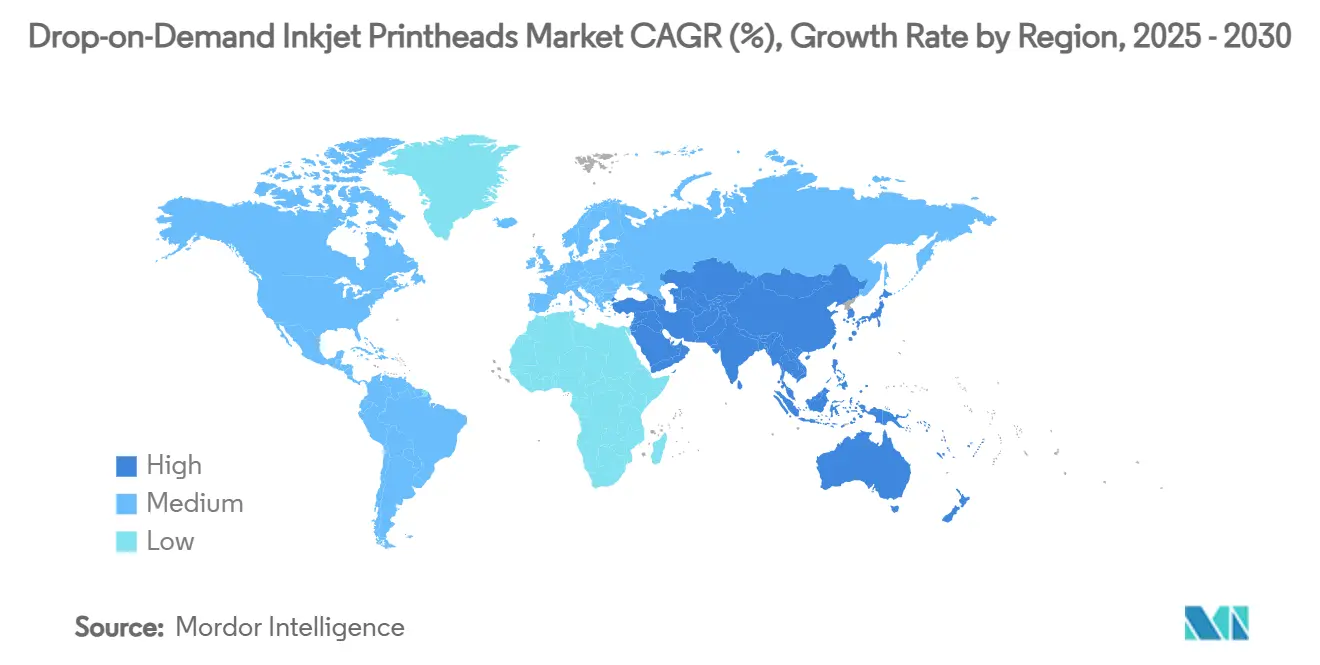
Asia-Pacific produced 38.51% of global sales in 2024 and is projected to grow at 8.02% CAGR. Japan blends MEMS prowess with piezo research, while China scales capacity and secures supply chains via new fabs such as Tohoku Epson’s expansion. Government subsidies target digital textiles and electronics printing, amplifying regional share within the Drop-on-Demand Inkjet Printheads market.
Europe Drop-on-Demand Inkjet Printheads Market
Europe ranks second thanks to stringent waste-reduction directives that favor short-run digital workflows. Italian and German OEMs integrate drop-on-demand heads into hybrid flexo-inkjet presses, servicing luxury goods and pharmaceutical codes. Research consortia explore bioprinting and advanced-materials jetting, expanding continental influence on the Drop-on-Demand Inkjet Printheads market.
North America, LATAM and MEA Drop-on-Demand Inkjet Printheads Market
North America’s additive-manufacturing cluster, anchored by aerospace and medical device firms, drives high-resolution head demand. Software alliances such as Fiery–Esko–GIS ease workflow integration for package printers.[4]Packaging Europe, “Fiery, Esko, and GIS Team Up to Streamline Digital Packaging Production,” packagingeurope.com Latin America, the Middle East, and Africa adopt wide-format graphics and basic packaging lines, offering longer-term growth potential for the Drop-on-Demand Inkjet Printheads market as infrastructure modernizes.

Competitive Landscape
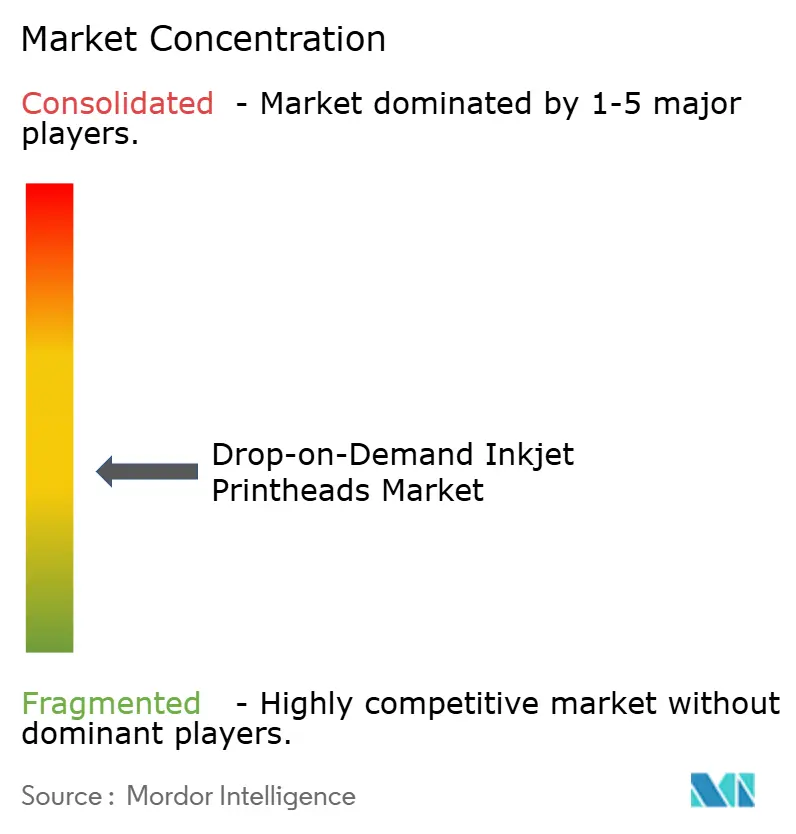
Seiko Epson, Fujifilm Dimatix, Konica Minolta, Kyocera, and Ricoh anchor a moderately concentrated arena, investing in thin-film piezo, recirculating manifolds, and integrated drive electronics. Epson added the I3200(8)-S1HD and S800-S1 heads in 2025, expanding solvent and UV options for signage. Kyocera’s KJ4A and KJ4B series target single-pass package lines with 1,200 dpi at industrial speeds.
Xaar’s Ultra High Viscosity platform secures ceramic tile and additive niches by jetting >1,000 cP fluids. Toshiba Tec’s UV/oil-based heads address metal-decorating and functional-coating segments. Ricoh formed ETRIA to blend motion control, robotics, and piezo heads for industrial inkjet lines, expanding its stake in the Drop-on-Demand Inkjet Printheads market.
Partnerships accelerate time-to-market: Meteor Inkjet couples electronics with AMIS 3D printers; Fiery and Esko supply turnkey packaging software stacks. Patent filings rise for self-heating nozzle plates and AI-based jet monitoring, signaling ongoing R&D intensity in the Drop-on-Demand Inkjet Printheads market.
Drop-on-Demand Inkjet Printheads Industry Leaders
Seiko Epson Corporation
HP Inc. (Specialty Printing Systems)
Ricoh Company, Ltd.
FUJIFILM Dimatix Inc.
Canon Inc.
- *Disclaimer: Major Players sorted in no particular order
Drop-on-Demand Inkjet Printheads Market Companies Covered in this Report
- Seiko Epson Corporation
- Konica Minolta, Inc.
- FUJIFILM Dimatix Inc.
- Kyocera Corporation
- Ricoh Company, Ltd.
- Xaar plc
- Canon Inc.
- Toshiba TEC Corporation
- HP Inc. (Specialty Printing Systems)
- Domino Printing Sciences plc
- Videojet Technologies, Inc.
- Markem-Imaje S.A.
- Seiko Instruments Inc. (SII Printek)
- Panasonic Micro-Devices Co., Ltd.
- Scrona AG
- MicroFab Technologies Inc.
- Beijing SPT Technology (SPT Printhead)
- Aim Micro Systems Pvt. Ltd. (AIM Jet)
- Memjet Ltd.
- MapleJet (Hitachi Industrial Equipment)

Recent Industry Developments in Drop-on-Demand Inkjet Printheads Market
- May 2025: Epson introduced three new industrial printheads with broader material compatibility.
- February 2025: Kyocera unveiled the KJ4A-EX1200-RC recirculating head, commercial in February 2025.
- November 2024: Meteor Inkjet partnered with AMIS on an OEM additive module.
- June 2024: Tohoku Epson announced a new printhead factory to expand capacity.
- February 2024: Kyocera shipped the first KJ4B-EX1200-RC head rated at 101.6 m/min and 1,200 dpi .


Global Drop-on-Demand Inkjet Printheads Market Report Scope
| Thermal Inkjet |
| Piezoelectric Inkjet |
| Water-Based / Aqueous |
| Solvent-Based |
| UV-Curable |
| Functional / Specialty Inks (High-Viscosity, Nano-Metallic, Conductive) |
| Up to 600 dpi |
| 601 – 1200 dpi |
| Above 1200 dpi |
| Packaging and Label Converters |
| Industrial Manufacturing and Processing |
| Textile and Apparel Producers |
| Commercial Graphics and Wide-Format Service Providers |
| Office, Home and Consumer Printer OEMs |
| Electronics and PCB Manufacturers |
| 3-D Printing / Additive Manufacturing Firms |
| Healthcare and Bio-printing Organisations |
| North America | United States |
| Canada | |
| Mexico | |
| South America | Brazil |
| Argentina | |
| Rest of South America | |
| Europe | Germany |
| Italy | |
| United Kingdom | |
| France | |
| Russia | |
| Rest of Europe | |
| Asia- Pacific | China |
| Japan | |
| India | |
| South Korea | |
| Rest of Asia-Pacific | |
| Middle East and Africa | United Arab Emirates |
| Saudi Arabia | |
| Turkey | |
| South Africa | |
| Rest of Middle East and Africa |
| By Technology | Thermal Inkjet | |
| Piezoelectric Inkjet | ||
| By Ink Type | Water-Based / Aqueous | |
| Solvent-Based | ||
| UV-Curable | ||
| Functional / Specialty Inks (High-Viscosity, Nano-Metallic, Conductive) | ||
| By Resolution | Up to 600 dpi | |
| 601 – 1200 dpi | ||
| Above 1200 dpi | ||
| By End-User Industry | Packaging and Label Converters | |
| Industrial Manufacturing and Processing | ||
| Textile and Apparel Producers | ||
| Commercial Graphics and Wide-Format Service Providers | ||
| Office, Home and Consumer Printer OEMs | ||
| Electronics and PCB Manufacturers | ||
| 3-D Printing / Additive Manufacturing Firms | ||
| Healthcare and Bio-printing Organisations | ||
| By Geography | North America | United States |
| Canada | ||
| Mexico | ||
| South America | Brazil | |
| Argentina | ||
| Rest of South America | ||
| Europe | Germany | |
| Italy | ||
| United Kingdom | ||
| France | ||
| Russia | ||
| Rest of Europe | ||
| Asia- Pacific | China | |
| Japan | ||
| India | ||
| South Korea | ||
| Rest of Asia-Pacific | ||
| Middle East and Africa | United Arab Emirates | |
| Saudi Arabia | ||
| Turkey | ||
| South Africa | ||
| Rest of Middle East and Africa | ||


Key Questions Answered in the Report
What is the current value of the Drop-on-Demand Inkjet Printheads market?
It is USD 2.77 billion in 2025, with a forecast value of USD 4.02 billion by 2030 at a 7.73% CAGR.
Which technology segment is expanding fastest?
Piezoelectric heads grow at 9.62% CAGR due to their ability to jet high-viscosity and functional fluids.
Why are UV-curable inks gaining popularity?
LED curing lowers energy use by 70% and hardens inks instantly, pushing UV formulations to a 9.17% CAGR.
Which region leads global demand?
Asia-Pacific holds 38.51% of 2024 revenue and is projected for the highest regional CAGR of 8.02%.
What limits broader adoption of piezo heads?
High manufacturing costs five to ten times thermal prices slow uptake in price-sensitive markets.
How is additive manufacturing influencing demand?
Inkjet’s precision enables multi-material 3D builds, driving a 10.76% CAGR in the additive-manufacturing segment.
Page last updated on:





