
Continuous Inkjet Printheads Market Size and Share
Market Overview
| Study Period | 2019 - 2030 |
|---|---|
| Market Size (2025) | USD 1.86 Billion |
| Market Size (2030) | USD 2.32 Billion |
| Growth Rate (2025 - 2030) | 4.52 % |
| Fastest Growing Market | Asia |
| Largest Market | Europe |
| Market Concentration | Medium |
Major Players *Disclaimer: Major Players sorted in no particular order Image © Mordor Intelligence. Reuse requires attribution under CC BY 4.0. | |
Continuous Inkjet Printheads Market Analysis by Mordor Intelligence
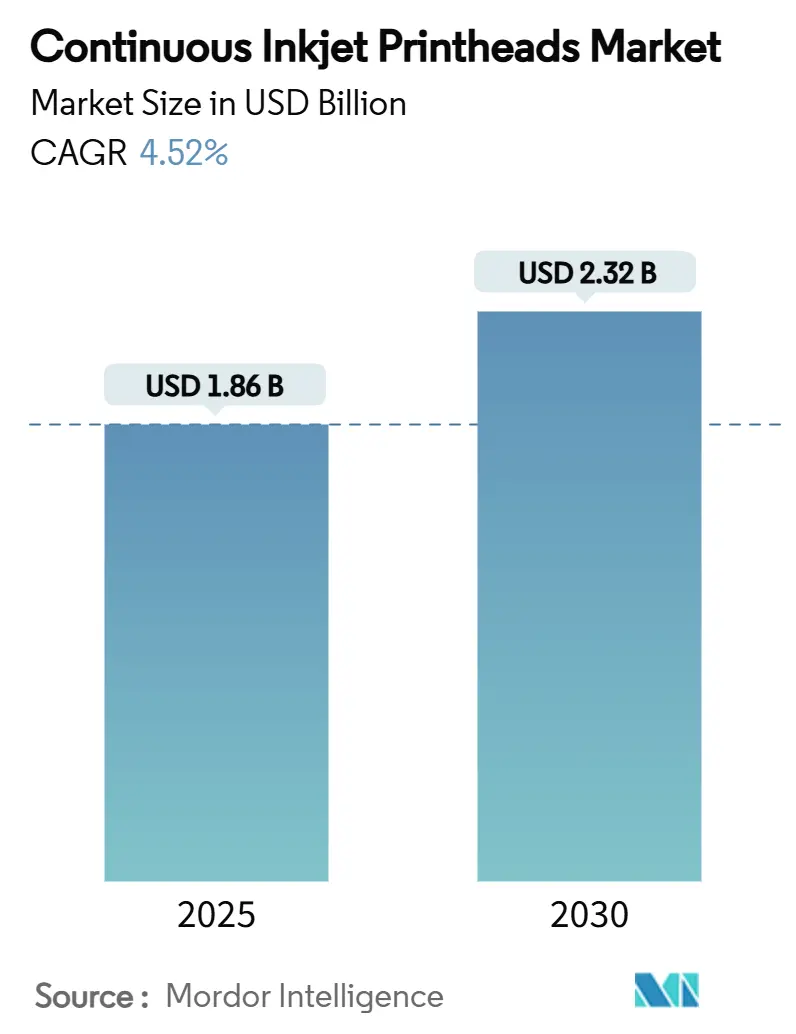
The continuous inkjet printhead market holds USD 1.86 billion in 2025 and is projected to reach USD 2.32 billion by 2030, advancing at a 4.52% CAGR. Regulatory deadlines in pharmaceuticals and food packaging are forcing producers to upgrade coding lines, while high-volume beverage plants demand faster, non-contact systems that protect throughput. Equipment makers now embed predictive-maintenance sensors and cloud links so printheads become data nodes inside Industry 4.0 architectures. At the same time, stricter VOC ceilings and corporate pledges for fully recyclable packs are accelerating a transition to UV-curable and low-VOC inks, driving replacement sales. Competitive advantage is shifting toward vendors that combine broad, compliant fluid portfolios with subscription-based uptime warranties. This interplay of compliance, sustainability and digital automation positions the continuous inkjet printhead market for steady, technology-led growth.
Key Report Takeaways
- By ink compatibility, the continuous inkjet printer market for UV-curable inks segment is projected to grow at a 6.18% CAGR between 2025-2030.
- By print-speed class, systems rated 301–600 m/min captured 39.57% share of the continuous inkjet printhead market in 2024.
- By end-user, the continuous inkjet printer market for the pharmaceuticals and healthcare segment is projected to grow at a 5.37% CAGR between 2025-2030.
- By distribution channel, direct OEM captured 56.37% share of the continuous inkjet printhead market in 2024.
- By geography, the continuous inkjet printer market for Asia-Pacific is the fastest-growing region at 5.53% CAGR between 2025-2030.
Note: Market size and forecast figures in this report are generated using Mordor Intelligence’s proprietary estimation framework, updated with the latest available data and insights as of January 2026.
Market Trends and Insights
Drivers Impact Analysis of Continuous Inkjet Printheads Market*
| Driver | (~) % Impact on CAGR Forecast | Geographic Relevance | Impact Timeline |
|---|---|---|---|
| Global pharmaceutical serialization mandates | +1.2% | North America, Europe, India | Medium term (2-4 years) |
| Flexible and sustainable packaging adoption | +0.9% | Global; focus on Europe, North America | Long term (≥ 4 years) |
| High-speed beverage bottling lines | +0.8% | Global; focus on Asia-Pacific | Short term (≤ 2 years) |
| Industry 4.0 driven smart CIJ systems | +1.1% | Europe, North America, developed Asia | Medium term (2-4 years) |
| Growth of multi-lingual export coding | +0.6% | Global; focus on Asia-Pacific, Europe | Medium term (2-4 years) |
| Shift to MEK-free eco-friendly inks | +0.7% | Europe, North America, Japan | Long term (≥ 4 years) |
| Source: Mordor Intelligence | |||
Global Pharmaceutical Serialization Mandates Accelerating CIJ Adoption
Serialization laws such as the U.S. Drug Supply Chain Security Act and parallel rules in Europe require each saleable unit to carry a unique data-matrix code. Continuous inkjet systems meet this need by printing crisp, durable marks on cartons, vials and blister packs at line speeds exceeding 300 m/min. Early adopters report a 23% drop in counterfeit incidents after installing serialization-ready printheads.[1]Regional suppliers gain opportunities by tailoring firmware for local language scripts and small-character fonts.
Increasing Use of Flexible and Sustainable Packaging Requiring CIJ Versatility
Brands switching to mono-material pouches and compostable films face coding challenges because many substrates warp under heat or resist solvent adhesion. Continuous inkjet printheads can jet low-migration inks that cure instantly under UV LEDs, retaining legibility even after steam sterilization tests carried out by SÜDPACK and Leibinger.[2] Equipment refresh cycles therefore quicken as converters seek heads compatible with emerging bio-based laminates.
High-Speed Beverage Bottling Lines Driving Demand for Durable Printheads
Beverage fillers run conveyors beyond 600 m/min, exposing nozzles to sugar mist and vibration. BestCode’s TruPoint platform maintains single-line clarity at 457 m/min while cutting downtime through dynamic drop control. Incremental uptime gains translate into significant savings because stoppages in large bottling plants can exceed USD 10,000 per minute of lost production.
Industry 4.0 Adoption Promoting Smart, Networked CIJ Systems
Modern factories integrate coding equipment with manufacturing execution systems for real-time quality analytics. Domino’s Ax-Series streams viscosity and temperature data to the Domino Cloud, enabling predictive servicing that reduces unplanned maintenance by up to 30%. Vendors offering secure APIs and remote firmware updates are securing preferred-supplier status in global tenders.
Restraints Impact Analysis of Continuous Inkjet Printheads Market*
| Restraint | (~) % Impact on CAGR Forecast | Geographic Relevance | Impact Timeline |
|---|---|---|---|
| VOC, REACH and EPA limits on solvent inks | -0.8% | Europe, North America, China | Long term (≥ 4 years) |
| Competition from TIJ and laser coding | -0.6% | Global; focus on North America, Europe | Medium term (2-4 years) |
| High total cost of ownership in harsh sites | -0.3% | Global; focus on emerging markets | Short term (≤ 2 years) |
| Source: Mordor Intelligence | |||
Regulatory Restrictions on Solvent-Based Inks (VOC, REACH, EPA Compliance)
The U.S. Environmental Protection Agency’s Regulation No. 7 caps VOC emissions from printing operations.[3] China’s ‘Blue Sky’ standards impose similar ceilings. Reformulating inks adds cost and can lengthen drying time, discouraging upgrades in price-sensitive segments.
Rising Competition from TIJ and Laser Coding in Select Segments
Thermal inkjet offers 600 dpi resolution in a disposable cartridge, appealing to cleanrooms where solvent fumes are discouraged. Market surveys indicate 15–20% of new pharmaceutical lines in 2024 selected TIJ over CIJ for carton coding. Laser coders, while capital-intensive, gain traction on aluminum cans due to zero consumables.
*Our forecasts treat driver/restraint impacts as directional, not additive. The impact forecasts reflect baseline growth, mix effects, and variable interactions.
Continuous Inkjet Printheads Market Segment Analysis
By Ink Compatibility:
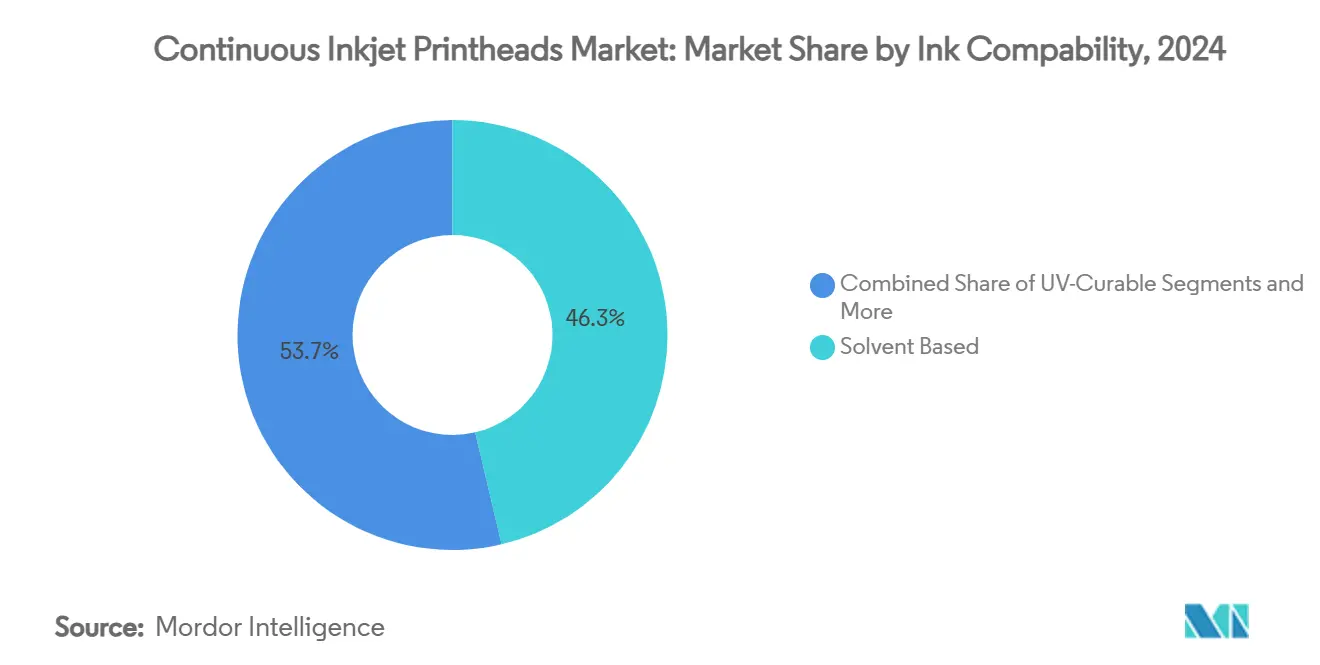
Sustainability Drives Formulation InnovationSolvent-based inks maintained 46.34% revenue share in 2024, thanks to fast drying and strong adhesion on metals, plastics and coated board. UV-curable alternatives, however, advance at the fastest 6.18% CAGR as buyers seek zero-VOC options that cure on contact with LED light. The continuous inkjet printhead market size for UV-curable fluids is set to climb from USD 0.42 billion in 2025 to USD 0.57 billion in 2030. Sun Chemical’s water-heavy Aquacure technology blends up to 90% water with photo-initiators, minimizing emissions without sacrificing color density.
Hybrid formulations are emerging that let operators switch from MEK to ethanol-based or UV formulations without swapping hardware. Equipment makers now install dual-circuit plumbing and automatic viscosity tuning so a single head can handle multiple fluids. This flexibility supports converters experimenting with recycled PET and biodegradable films, sectors forecast to outpace the broader continuous inkjet printhead market. Specialty pigmented inks, including UV-fluorescent and thermochromic blends, target anti-counterfeiting in luxury goods and pharmaceuticals, adding a premium niche for margin preservation.

By Print Speed Class:
High-Volume Production Demands Faster SystemsPrinters rated 301–600 m/min captured 39.57% of 2024 sales, balancing throughput and capital cost for mainstream FMCG lines. Systems exceeding 600 m/min post the highest 5.63% CAGR, driven by beverage fillers and contract packers adding parallel high-speed lines. The continuous inkjet printhead market size for this top tier will approach USD 0.68 billion by 2030 as operators target overall equipment effectiveness gains.
Control Print’s PENCH Ultra runs at 700 m/min while reducing ink use 15%, illustrating how nozzle geometry and real-time drop modulation break earlier speed barriers controlprint.com. At the lower end, sub-300 m/min machines remain popular with small enterprises printing batch codes on pouches or corrugated trays. Buyers increasingly adopt a lifecycle view, weighing the higher price of ultra-fast units against downtime savings and reduced scrap. As a result, premium speed classes are taking share in regions with high labor costs and automated warehouses.
By End-User Industry:
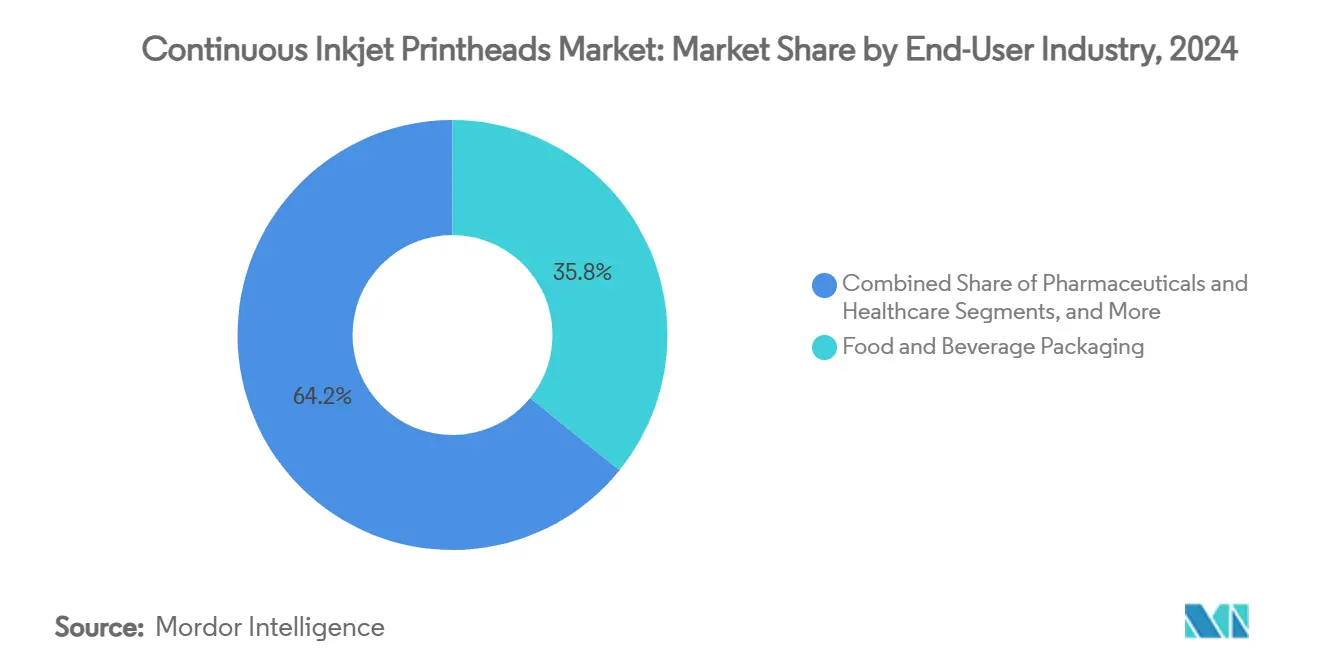
Compliance Realignment Fuels Diverse AdoptionFood and beverage packaging retained 35.83% of continuous inkjet printhead market share in 2024 on the strength of high-volume, multi-SKU production that relies on non-contact coding for expiry dates and traceability. Demand in this vertical remains steady because retailers now fine suppliers for unreadable codes, forcing frequent printhead calibration and periodic upgrades. Pharmaceuticals and healthcare represent the fastest gainer at a 5.37% CAGR to 2030 as global serialization mandates come fully into force; the continuous inkjet printhead market size allocated to this segment is forecast to reach USD 0.54 billion by 2030. Cosmetics and personal-care firms are also switching to low-migration inks that satisfy allergen-label rules, encouraging equipment makers to bundle fluid safety certifications with capital sales.
Industrial manufacturing and chemicals users favor rugged models that resist dust and aggressive solvents, while textile decorators turn to CIJ for delicate, non-contact marking of care labels. Regulations such as the 2024 methylene-chloride labeling rule have widened the addressable opportunity because every drum or tote now needs durable, machine-readable identifiers. Specialty niches—luxury goods, electronics and automotive wiring—value micro-print capabilities and invisible UV inks for anti-counterfeit defense, letting vendors secure premium margins even when unit volumes are modest.
By Distribution Channel:
Hybrid Go-to-Market Boosts ReachDirect OEM sales controlled 56.37% of 2024 revenue, reflecting large customers’ preference for single-source service agreements, bundled consumables and guaranteed uptime. OEMs enhance loyalty through Industry 4.0 dashboards that integrate printer health data with site MES platforms and automatically ship makeup fluids before line stoppages occur. Despite this dominance, distributor and value-added-reseller networks are expanding at a 5.81% CAGR because small and medium producers need localized support, flexible financing and multi-brand consumable choice.
In Asia-Pacific and Latin America, resellers often provide same-day printhead swaps and multilingual operator training, lowering adoption barriers for first-time buyers of coding automation. Some partners specialize in sustainable packaging, advising converters on ink compatibility with recyclable films and earning consultation fees in addition to hardware margin. The evolving hybrid structure allows OEMs to safeguard strategic global accounts while leveraging partner footprints to capture white-space regions, widening the overall continuous inkjet printhead market without ballooning fixed cost.
Geography Analysis
Europe Continuous Inkjet Printheads Market
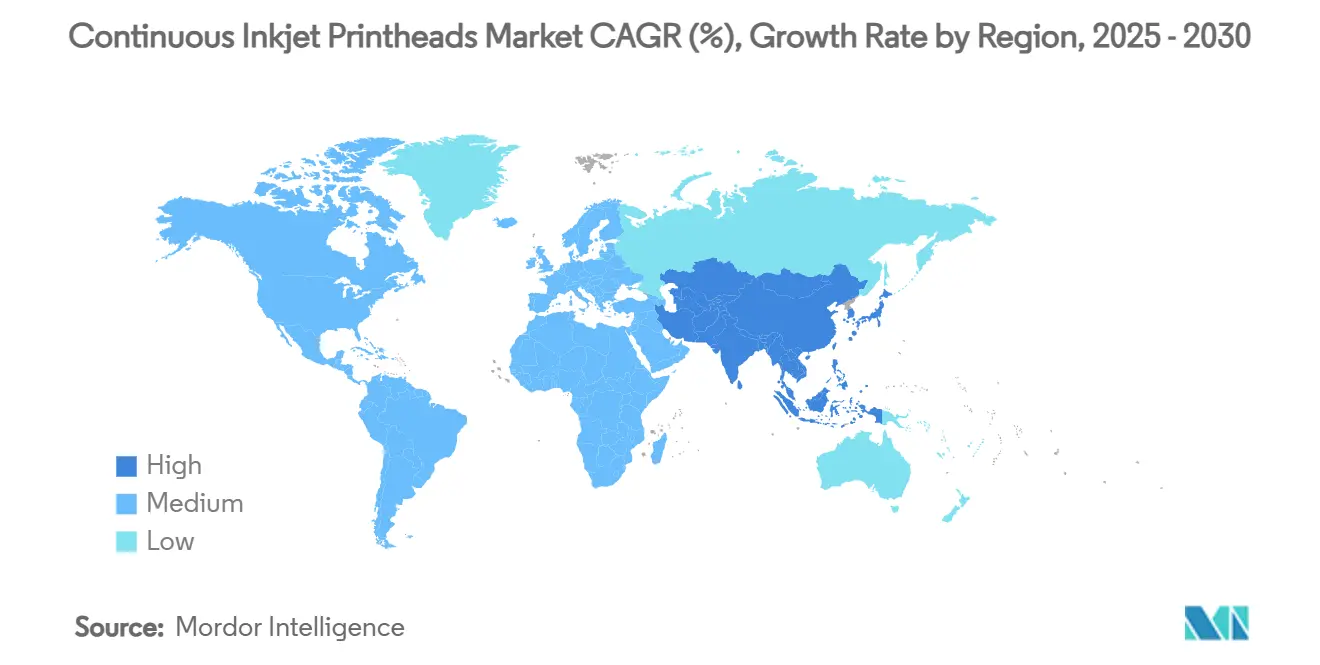
Europe remained the largest regional contributor, capturing 30.71% of the continuous inkjet printhead market in 2024. Production hubs in Germany, France and Italy combine stringent traceability laws with early adoption of recyclable mono-material packaging, prompting frequent equipment refresh cycles. Regional suppliers gain traction by offering MEK-free inks approved under REACH and by integrating printers with factory-wide digital twins for audit readiness. Funding from EU sustainability programs further accelerates upgrades as converters align line equipment with circular-economy targets.
APAC Continuous Inkjet Printheads Market
Asia-Pacific posts the quickest 5.53% CAGR through 2030, underpinned by industrial expansion in China, India and Southeast Asia. China’s enforcement of new VOC ceilings is nudging plants toward ethanol-based or UV-curable fluids, and local OEMs are pricing competitively to win first-time automation projects. India’s fast-growing pharmaceutical export pipeline drives demand for high-resolution data-matrix codes, and regional bottlers are investing in print speeds above 600 m/min to keep pace with rising beverage consumption. Government incentives for smart factories across ASEAN countries add another lift to the continuous inkjet printhead market as lines connect printers to cloud analytics for OEE monitoring.
North America, LATAM and MEA Continuous Inkjet Printheads Market
North America maintains a substantial share owing to its mature food and pharma sectors and early roll-out of Industry 4.0 pilot plants. The U.S. Drug Supply Chain Security Act’s 2024 serialization deadline catalyzed a surge of retrofits across contract packers, while stricter VOC caps encourage transitions to low-solvent inks. Suppliers differentiate through predictive-service portals and flat-fee consumable plans that reduce budgeting uncertainty for finance teams. Elsewhere, Latin America, the Middle East and Africa represent emerging pockets of growth as multinational FMCG firms localize production; new halal and pesticide-traceability labels in the Gulf and Brazil respectively are prompting first-wave CIJ adoption.
Competitive Landscape
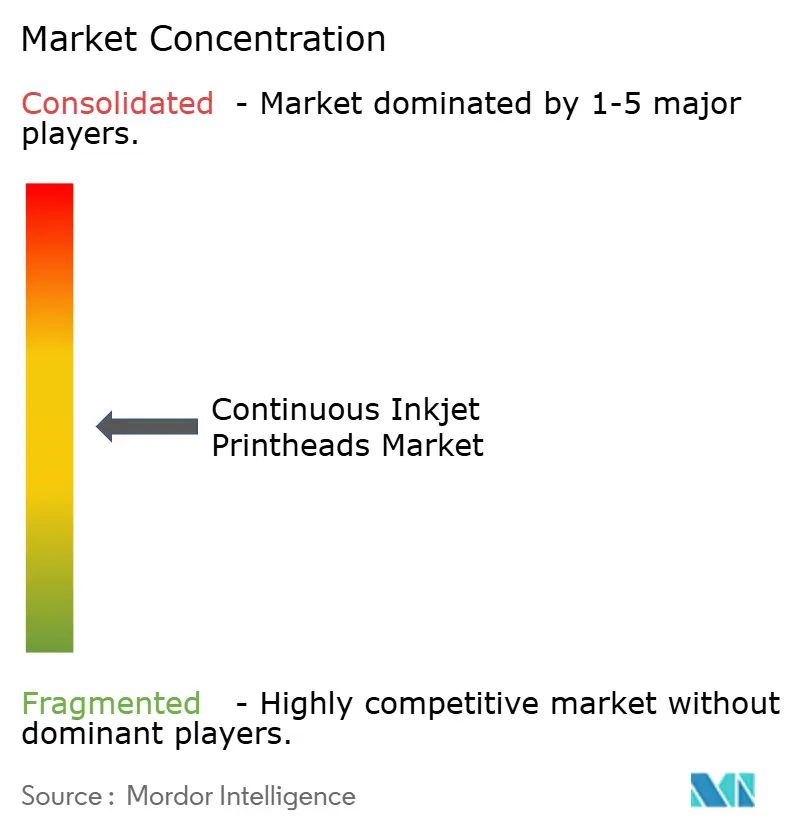
The continuous inkjet printhead market is moderately concentrated: the five largest manufacturers account for roughly 65% of global revenue. Multinationals such as Videojet Technologies, Domino Printing Sciences and Markem-Imaje defend share through broad ink portfolios, 24/7 service networks and aggressive R&D into Industry 4.0 features. Videojet’s 1880 series couples onboard diagnostics with remote-support portals, while Domino’s Ax-Series streams live viscosity metrics to cloud dashboards, reducing unplanned downtime and locking in multi-year service contracts.
Regional challengers—including Control Print, Citronix and KGK Jet—are capturing local accounts by tailoring hardware to climate and language requirements and by offering price-competitive aftermarket fluids. Control Print’s stainless-steel PENCH Ultra appeals to dusty milling plants in South Asia; Citronix’s ci8000 cuts maintenance frequency through self-cleaning nozzles, winning customers with limited technical staff. Some newer entrants bundle coding as a subscription service, charging per verified code rather than for the printer itself, which aligns with cash-flow priorities of growing SMEs.
Competition also arrives from adjacent technologies. Thermal inkjet systems win cleanroom applications because cartridges carry no volatile solvents, and laser coders are preferred for permanent marks on metal cans. Leading CIJ vendors therefore emphasize speed capability, curved-surface adhesion and multi-ink flexibility—attributes still unmatched by rivals at high throughputs. Strategic acquisitions and joint-development agreements—especially around low-VOC ink chemistry—are expected to continue as incumbents reinforce defensible differentiators.
Continuous Inkjet Printheads Industry Leaders
-
Videojet Technologies Inc.
-
Domino Printing Sciences plc
-
Markem-Imaje (Dover Corporation)
-
Hitachi Industrial Equipment Systems Co., Ltd.
-
Paul Leibinger GmbH & Co. KG
- *Disclaimer: Major Players sorted in no particular order
Continuous Inkjet Printheads Market Companies Covered in this Report
- Videojet Technologies Inc.
- Domino Printing Sciences plc
- Markem-Imaje (Dover Corporation)
- Hitachi Industrial Equipment Systems Co., Ltd.
- Paul Leibinger GmbH and Co. KG
- KGK Jet Co., Ltd.
- Control Print Limited
- Citronix, Inc.
- REA Elektronik GmbH
- Matthews International Corporation
- Squid Ink Manufacturing, Inc.
- EBS Ink-Jet Systeme GmbH
- Zanasi S.r.l.
- ANSER CODING INC.
- KBA-Metronic GmbH
Recent Industry Developments in Continuous Inkjet Printheads Market
- April 2025: BestCode upgraded Series 8 with TruPoint 2.0 dynamic drop optimization for printing at 1,500 ft/min on single-line jobs.
- February 2025: Paul Leibinger and SÜDPACK co-developed inks that remain readable on recyclable food film after steam sterilization.
- January 2025: Markem-Imaje launched the 9712 bi-jet coder that doubles either line speed or data payload while integrating Industry 4.0 connectivity.
- October 2024: Control Print Limited introduced the PENCH Ultra capable of 700 m/min with 15% lower ink consumption and 12-thousand-hour service intervals.
Global Continuous Inkjet Printheads Market Report Scope
Segmentation Overview
| Solvent-Based |
| UV-Curable |
| Aqueous |
| Pigmented / Specialty |
| Up to 300 m/min |
| 301 – 600 m/min |
| Above 600 m/min |
| Food and Beverage |
| Pharmaceuticals and Healthcare |
| Cosmetics and Personal Care |
| Industrial Manufacturing |
| Chemicals and Agro-chemicals |
| Textiles and Fabrics |
| Direct (OEM) |
| Distributors / Value Added Resellers |
| North America | United States | |
| Canada | ||
| Mexico | ||
| South America | Brazil | |
| Argentina | ||
| Rest of South America | ||
| Europe | Germany | |
| United Kingdom | ||
| France | ||
| Italy | ||
| Rest of Europe | ||
| Asia Pacific | China | |
| Japan | ||
| South Korea | ||
| India | ||
| Rest of Asia-Pacific | ||
| Middle East and Africa | Middle East | Saudi Arabia |
| United Arab Emirates | ||
| Turkey | ||
| Rest of Middle East | ||
| Africa | South Africa | |
| Nigeria | ||
| Rest of Africa | ||
| By Ink Compatibility | Solvent-Based | ||
| UV-Curable | |||
| Aqueous | |||
| Pigmented / Specialty | |||
| By Print Speed Class | Up to 300 m/min | ||
| 301 – 600 m/min | |||
| Above 600 m/min | |||
| By End-User Industry | Food and Beverage | ||
| Pharmaceuticals and Healthcare | |||
| Cosmetics and Personal Care | |||
| Industrial Manufacturing | |||
| Chemicals and Agro-chemicals | |||
| Textiles and Fabrics | |||
| By Distribution Channel | Direct (OEM) | ||
| Distributors / Value Added Resellers | |||
| By Geography | North America | United States | |
| Canada | |||
| Mexico | |||
| South America | Brazil | ||
| Argentina | |||
| Rest of South America | |||
| Europe | Germany | ||
| United Kingdom | |||
| France | |||
| Italy | |||
| Rest of Europe | |||
| Asia Pacific | China | ||
| Japan | |||
| South Korea | |||
| India | |||
| Rest of Asia-Pacific | |||
| Middle East and Africa | Middle East | Saudi Arabia | |
| United Arab Emirates | |||
| Turkey | |||
| Rest of Middle East | |||
| Africa | South Africa | ||
| Nigeria | |||
| Rest of Africa | |||
Key Questions Answered in the Report
What drives current investment in continuous inkjet technology?
Mandatory serialization, sustainability targets and Industry 4.0 integration prompt manufacturers to replace older contact coders with smart, low-VOC CIJ systems.
Which industry vertical will grow fastest through 2030?
Pharmaceuticals and healthcare are projected to post the highest 5.37% CAGR as traceability laws expand worldwide.
How are suppliers addressing environmental regulations?
They are releasing UV-curable and ethanol-based inks with near-zero VOCs and redesigning fluid circuits to accommodate multiple chemistries on one printhead.
Why is Asia-Pacific considered the most attractive growth region?
Rapid industrialization, stricter local VOC rules and large-scale upgrades in beverage and pharma sectors fuel a 5.53% CAGR—the highest among all regions.
What technological features help reduce total cost of ownership?
Predictive-maintenance sensors, cloud diagnostics, self-cleaning nozzles and dual-circuit plumbing cut downtime and extend service intervals.
Are alternative coding methods a serious threat to CIJ?
Thermal inkjet and laser systems gain share in niche applications, but CIJ retains advantages in high-speed, curved-surface and multi-substrate environments.