
Diversity, Equity And Inclusion (DEI) Analytics Platform Market Size and Share
Market Overview
| Study Period | 2020 - 2031 |
|---|---|
| Market Size (2026) | USD 1.94 Billion |
| Market Size (2031) | USD 4.26 Billion |
| Growth Rate (2026 - 2031) | 17.04 % |
| Fastest Growing Market | Asia-Pacific |
| Largest Market | North America |
| Market Concentration | Low |
Major Players *Disclaimer: Major Players sorted in no particular order Image © Mordor Intelligence. Reuse requires attribution under CC BY 4.0. | |
Diversity, Equity And Inclusion (DEI) Analytics Platform Market Analysis by Mordor Intelligence
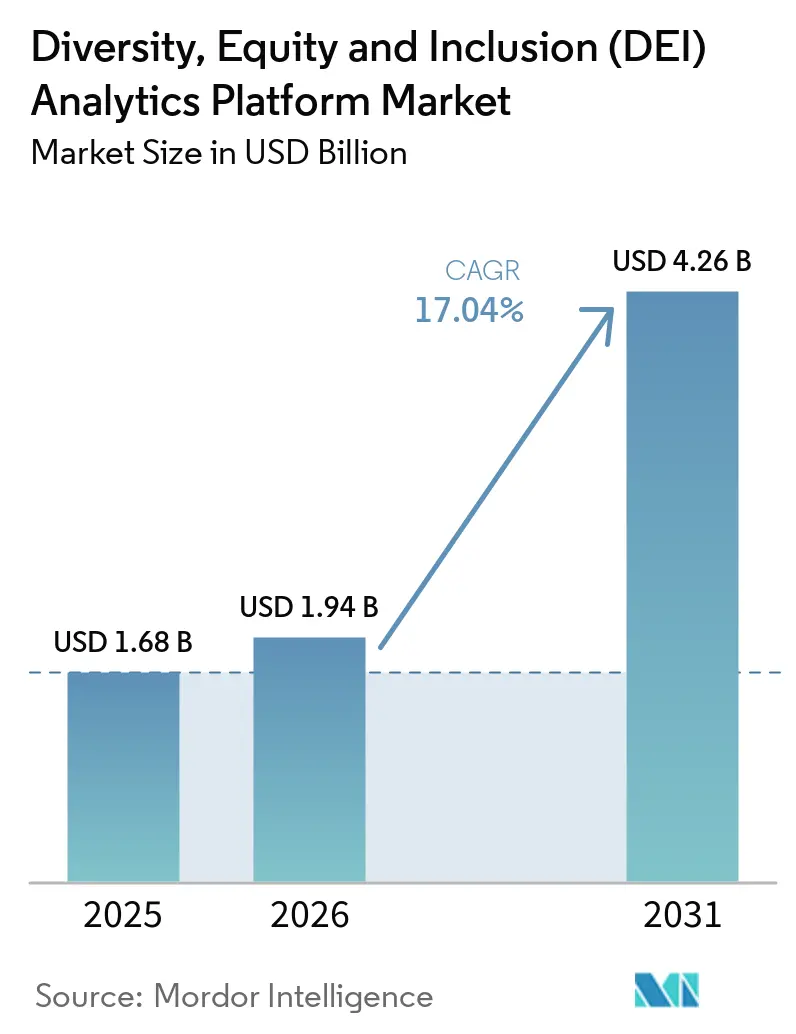
The Diversity, Equity, and Inclusion (DEI) Analytics Platform Market size is projected to be USD 1.68 billion in 2025, USD 1.94 billion in 2026, and reach USD 4.26 billion by 2031, growing at a CAGR of 17.04% from 2026 to 2031. Demand is rising because pay disclosure rules, algorithmic hiring oversight, and sustainability reporting now place pressure on the same workforce data foundation simultaneously. This is pushing buyers away from periodic DEI reporting and toward continuous workforce intelligence that can support audits, legal review, and board oversight. Spending is also expanding beyond HR, as compensation leaders, legal teams, and sustainability functions increasingly need the same employee data for different reporting purposes. Vendors are responding by linking pay governance, hiring bias monitoring, representation analysis, and benchmarking into broader suites, while focused specialists still hold an advantage where compliance depth matters most. Growth remains strong, though some organizations are shifting budget language toward workforce intelligence and risk management, and weak HR data quality continues to slow adoption, where legacy systems remain hard to unify.
Key Report Takeaways
- By deployment mode, cloud-based deployment accounted for 68.73% of the diversity, equity, and inclusion (DEI) analytics platform market share in 2025, while hybrid deployment is projected to expand at a 18.73% CAGR through 2031.
- By end-user enterprise size, large enterprises accounted for 63.41% of the DEI analytics platform market share in 2025, while SMEs are projected to grow at a 19.62% CAGR through 2031.
- By application, pay equity and compensation analytics held 29.87% share the diversity, equity, and inclusion (DEI) analytics platform market in 2025, while hiring, recruitment, and talent acquisition equity analytics is projected to expand at 17.86% CAGR through 2031.
- By end user industry, IT and telecom led with 26.93% share of the DEI analytics platform market in 2025, while BFSI is projected to record the fastest growth at 20.94% CAGR through 2031.
- By geography, North America held 41.37% share the diversity, equity, and inclusion (DEI) analytics platform market in 2025, while Asia-Pacific is projected to grow at 21.12% CAGR through 2031.
Note: Market size and forecast figures in this report are generated using Mordor Intelligence’s proprietary estimation framework, updated with the latest available data and insights as of January 2026.
Market Trends and Insights
Drivers Impact Analysis of Diversity, Equity And Inclusion (DEI) Analytics Platform Market*
| Driver | (~) % Impact on CAGR Forecast | Geographic Relevance | Impact Timeline |
|---|---|---|---|
| Pay Transparency Compliance Deadlines Accelerate Demand | +4.2% | North America (primary), EU, expanding to Asia-Pacific | Short term (= 2 years) |
| Artificial Intelligence-Enabled Workforce Decision-Making Expands Need for Bias Monitoring | +3.0% | Global | Medium term (2-4 years) |
| Hybrid Workforce Management Increases Need for Equity Visibility | +2.1% | Global, with high intensity in North America and Europe | Medium term (2-4 years) |
| Board and Investor Scrutiny Elevates Workforce Disclosure Requirements | +1.8% | North America and EU | Medium term (2-4 years) |
| European Sustainability Reporting Disclosures Require Auditable Inclusion Data Infrastructure | +1.4% | Europe (primary), spill-over to North America and APAC | Medium term (2-4 years) |
| Employment Algorithm Regulations Increase Bias Audit and Recordkeeping Demand | +1.1% | North America, EU | Short term (= 2 years) |
| Source: Mordor Intelligence | |||
Pay Transparency Compliance Deadlines Accelerate Demand
Pay transparency has shifted from a narrow policy issue into a wider operating requirement for employers with multi-location workforces. The EU Pay Transparency Directive requires member states to transpose new rules by 2026, and that raises the value of tools that can create consistent pay gap records across entities and job levels.[1]Aligning Gender-Related Activities to EU Regulations: An Overview of EU Reporting and Disclosure Topics, January 2025,” UK Government Foreign, Commonwealth and Development Office, gov.uk Once one location adopts a stricter disclosure rule, many employers treat that standard as the internal baseline across the whole company because separate pay logics by location create legal and administrative risk. That change pushes analytics procurement beyond compliance teams and into compensation planning, job architecture, and executive review cycles. In the DEI analytics platform market, vendors with auditable pay workflows benefit because employers need defensible explanations and traceable records, not just summary dashboards.
Artificial Intelligence-Enabled Workforce Decision-Making Expands Need for Bias Monitoring
AI tools are now used in hiring, evaluation, promotion, and compensation, extending bias risk well beyond older recruiting software. New York City's Local Law 144 already requires annual bias audits for automated employment decision tools, and a December 2025 review by the New York State Comptroller showed a clear gap between independent audit findings and formal enforcement outcomes.[2]Office of the New York State Comptroller, “Enforcement of Local Law 144 - Automated Employment Decision Tools,” Office of the New York State Comptroller, osc.ny.gov At the European level, employment-related AI systems fall into the high-risk category under the AI Act, which keeps workforce decision-making under close compliance scrutiny even as the implementation timeline remains under policy review. This means buyers increasingly need a record of how automated recommendations were generated, tested, and reviewed by humans before pay or hiring decisions are finalized. In the diversity, equity, and inclusion (DEI) analytics platform market, demand is broadening from specialist DEI teams to any organization using AI in core human capital workflows.
Hybrid Workforce Management Increases Need for Equity Visibility
Hybrid work makes fairness harder to judge because employees do not experience visibility, mentoring, or promotion review in the same way across locations and work arrangements. Japan's Ministry of Economy, Trade and Industry framed diversity management as a competitiveness issue in its April 2025 report, which supports broader executive interest in tools that connect workforce outcomes with business performance.[3]Ministry of Economy, Trade and Industry, “Report of the Research Group on Corporate Management Connecting Diversity to Competitiveness,” Ministry of Economy, Trade and Industry, meti.go.jp Once work patterns are split across office, remote, and cross-border teams, annual headcount summaries stop showing where mobility or evaluation gaps are forming. This raises demand for continuous analytics that can link location, role progression, and manager behavior instead of relying on static diversity counts alone. The DEI analytics platform market benefits because employers want a single view of equity performance, even when the underlying workforce data is spread across multiple systems and jurisdictions.
Board and Investor Scrutiny Elevates Workforce Disclosure Requirements
Workforce reporting is moving closer to financial and sustainability reporting, increasing the need for documented, repeatable analytics outputs. ESRS S1 requires companies to disclose workforce measures, including pay gaps, discrimination incidents, and board diversity, which pushes organizations toward auditable data pipelines rather than ad hoc HR files. The wider policy backdrop also matters because gender-related disclosure duties are now being aligned with other EU reporting rules, thereby raising the cost of poor data quality in public statements. As a result, chief human resources officers are gaining stronger cases for enterprise data budgets that were previously harder to justify on a stand-alone DEI basis. In the DEI analytics platform market, vendors that can support audit trails and time-stamped reporting are better placed than tools built only for survey-led reporting.
Restraints Impact Analysis of Diversity, Equity And Inclusion (DEI) Analytics Platform Market*
| Restraint | (~) % Impact on CAGR Forecast | Geographic Relevance | Impact Timeline |
|---|---|---|---|
| Sensitive Employee Data Privacy and Security Risks | -2.5% | Global, highest intensity in EU (GDPR) and Asia-Pacific | Long term (= 4 years) |
| Integration Complexity Across Fragmented Human Resources Data Stacks | -1.8% | Global, APAC core, spill-over to MEA | Medium term (2-4 years) |
| United States Political and Legal Backlash Slows Explicit Diversity Program Budgets | -1.4% | North America | Short term (= 2 years) |
| Weak Internal Ownership and Return on Investment Attribution Delay Buying Decisions | -0.8% | Global | Medium term (2-4 years) |
| Source: Mordor Intelligence | |||
Sensitive Employee Data Privacy and Security Risks
DEI analytics depends on demographic fields that are treated as sensitive personal data in many jurisdictions, which immediately narrows what employers can collect and how they can use it. A 2025 article noted that Article 10(5) of the EU AI Act permits the use of sensitive data for bias mitigation only within a strict compliance framework, which many mid-sized organizations still lack. Cross-border employers then face another challenge: data practices common in U.S. self-identification programs may be more restricted elsewhere. That leaves many analytics teams working with partial or voluntary datasets, which weakens statistical confidence and makes some reports harder to treat as audit-grade evidence. In the diversity, equity, and inclusion (DEI) analytics platform market, this issue slows adoption most where legal review, public accountability, and workforce sensitivity are highest.[4]Marvin van Bekkum, “Using Sensitive Data to De-Bias AI Systems: Article 10(5) of the EU AI Act,” Computer Law and Security Review, doi.org
Integration Complexity Across Fragmented Human Resources Data Stacks
Many employers still store workforce data across separate HCM, payroll, recruiting, performance, and learning systems, which slows DEI analysis before the software is even configured. In late 2025, research showed that healthcare organizations were far less likely to use dedicated pay equity software and often relied on basic statistical methods, highlighting the data maturity gap in complex sectors. The same research also showed weak transparency practices in manufacturing, indicating the operational burden of unifying compensation and workforce data before analysis begins. As a result, implementation timelines often depend more on connector quality and data mapping than on the analytics engine itself. This remains a real brake on the DEI analytics platform market because buyers can approve software fees faster than they can fix years of fragmented employee records.
*Our forecasts treat driver/restraint impacts as directional, not additive. The impact forecasts reflect baseline growth, mix effects, and variable interactions.
Diversity, Equity And Inclusion (DEI) Analytics Platform Market Segment Analysis
By Deployment Mode:
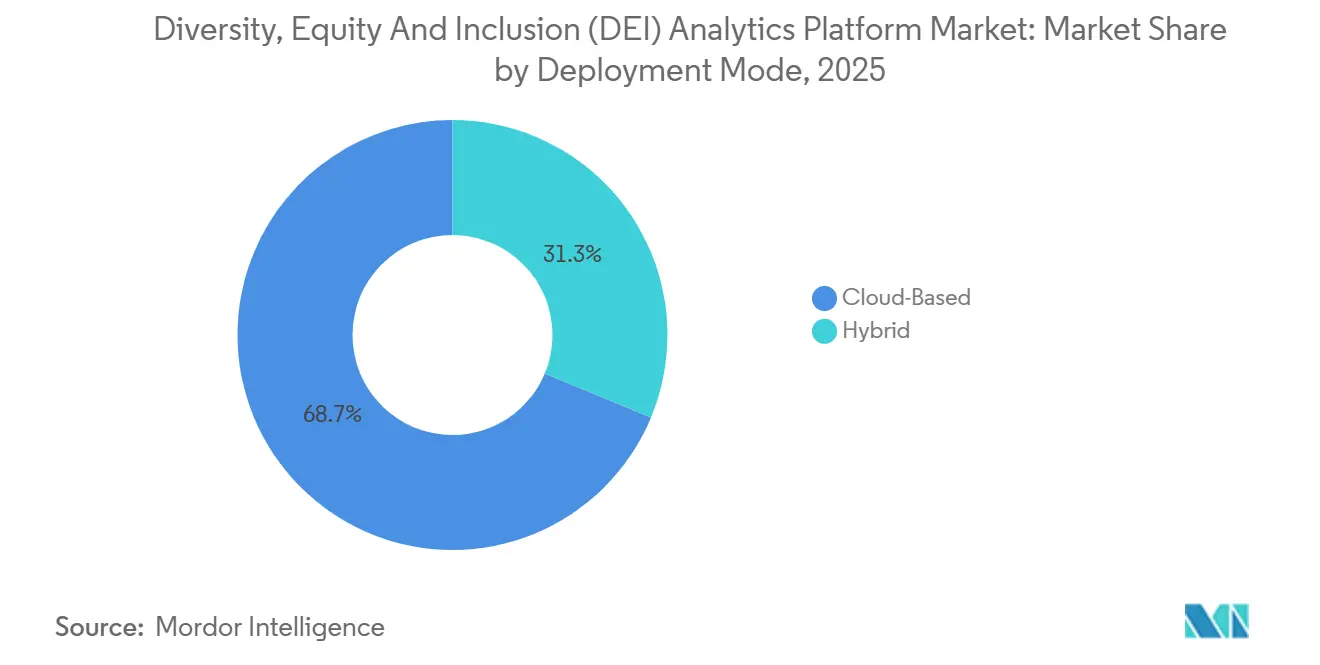
Cloud-First Adoption Meets Hybrid Governance DemandCloud-based deployment accounted for 68.73% of the diversity, equity, and inclusion (DEI) analytics platform market share in 2025, making it the clear operating model for organizations that need faster reporting across distributed HR systems. That lead came from easier deployment, centralized updates, and better support for multi-jurisdiction reporting when pay rules changed quickly. Cloud tools also help employers connect compensation, recruiting, and representation data without waiting for long internal release cycles. This matters because DEI analytics works best when data moves continuously rather than through yearly manual extracts. Within the DEI analytics platform industry, cloud remains the default choice for firms that want faster compliance execution and broader dashboard access.
Hybrid deployment is projected to expand at a 18.73% CAGR through 2031, and the diversity, equity, and inclusion (DEI) analytics platform market for this mode is growing as multinationals seek to balance speed with data residency controls. The pattern fits organizations that keep identifiable demographic records inside their own environments while sending limited analytics workloads to the cloud. SAP SuccessFactors added EU Pay Transparency Directive-ready pay gap analysis in its April 2026 release, which shows how major HCM vendors are building these capabilities into their cloud suites rather than leaving them fully to outside tools. On-premises systems, therefore, continue to play a durable role in government, regulated finance, and defense environments, even as most new deployments center on cloud or hybrid models.


By End User Enterprise Size:
Large Enterprise Core, SME Acceleration Reshaping DemandLarge enterprises held 63.41% share in 2025, reflecting the fact that large, multi-country employers face the highest reporting and governance burden. They usually manage more job structures, more pay bands, and more local compliance rules, which makes manual review hard to sustain. The EU reporting framework also favors platform spending by larger firms because workforce disclosures now sit closer to formal sustainability filings. Organizations above the revised threshold of more than 1,000 employees and EUR 450 million (USD 508 million) turnover face a clearer case for integrated workforce reporting systems. Large accounts, therefore, remain the commercial core of the diversity, equity, and inclusion (DEI) analytics platform market.
SMEs are projected to expand at a 19.62% CAGR through 2031, making them the fastest-growing buyer group as compliance expectations spread to smaller employer thresholds. Readiness remains uneven, and research in 2025 showed that many organizations were not prepared for core EU pay transparency requirements, with weaker readiness on wider compensation analysis. That gap creates space for lighter implementations, pre-built templates, and guided workflows that do not require a full enterprise analytics team from day one. The DEI analytics platform industry is therefore seeing demand widen from large enterprise governance programs toward smaller firms that need faster, more structured compliance support.
By Application:
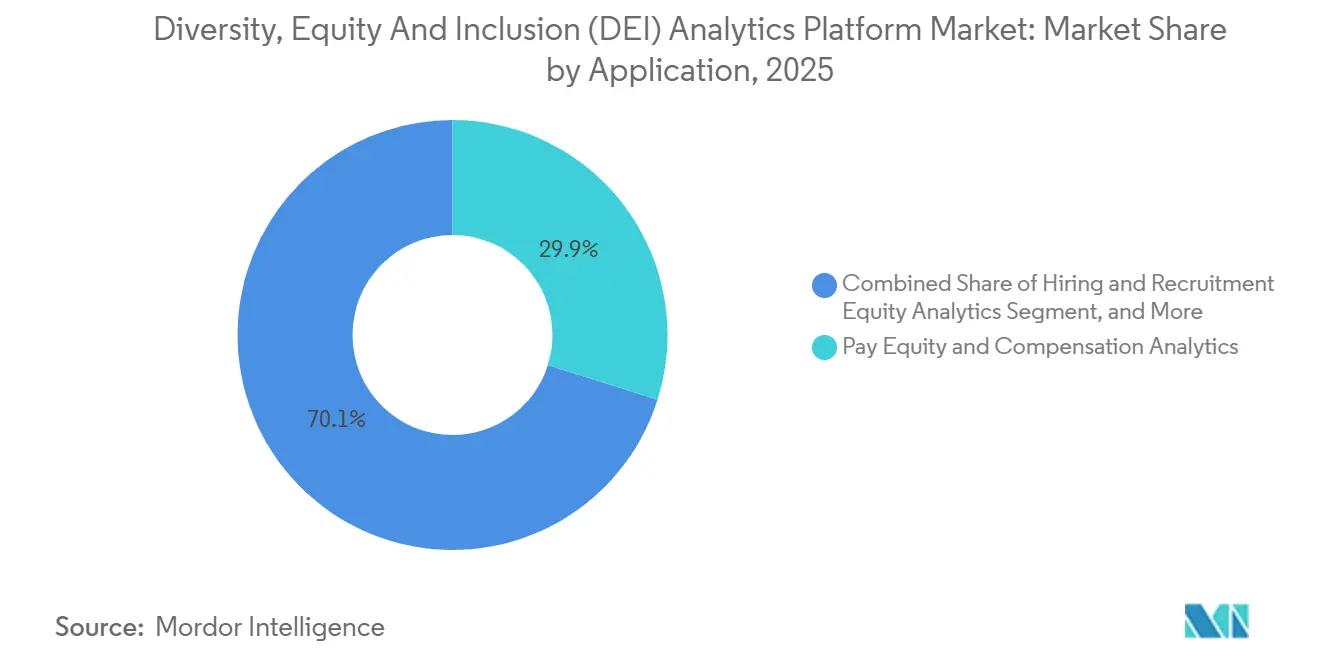
Pay Equity as Entry Point, Hiring Analytics as Structural Growth EnginePay equity and compensation analytics accounted for 29.87% of the market in 2025, making it the primary entry point for first-time buyers in the DEI analytics platform market. The segment benefits from a direct connection between regulation and measurable internal action, which makes funding easier to approve than more open-ended inclusion programs. Pay analysis also produces outputs that executives can review quickly, including gap detection, remediation scenarios, and standardized reporting files. The segment still has room to grow because many employers continue to rely on spreadsheets or basic statistical reviews rather than dedicated software. That keeps this category central to vendor positioning and product design across the market.
Hiring, recruitment, and talent acquisition equity analytics are projected to grow at 17.86% CAGR through 2031, supported by greater use of AI and skills-based assessments in recruitment. In July 2025, EY Netherlands adopted game-based assessments for candidates at levels up to manager, signaling that bias-aware hiring tools are moving into wider enterprise deployment. Promotion, performance, and career mobility analytics are also gaining ground because compensation gaps often widen when advancement patterns are not measured early. ESG reporting, bias detection, and benchmarking tools are becoming premium layers in the diversity, equity, and inclusion (DEI) analytics platform market as buyers look beyond reporting and toward predictive workforce risk management.

By End User Industry:
Technology Incumbency, Financial Services Velocity, and Mid-Market LaggardsIT and telecom led with 26.93% share in 2025, supported by stronger analytics maturity, broader digital HR adoption, and steady board attention to representation data. These companies often already have integrated HR systems, which lowers the technical barrier to adding DEI measurement on top. They also face scrutiny from employees and investors, which keeps workforce reporting visible at senior levels. That combination helped the segment hold the largest position in the DEI analytics platform market. It also explains why many vendors test new analytics modules first in technology-heavy enterprise accounts.
BFSI is projected to expand at 20.94% CAGR through 2031, showing that mature pay equity practices are now pushing firms toward more continuous documentation rather than less software spending. In 2025, financial services organizations led on annual audits and gap remediation, yet that maturity now supports deeper platform adoption as regulators pay closer attention to how talent decisions are made and recorded. Healthcare and manufacturing remain slower-moving because fragmented employee records and mixed workforces make integration more difficult at the outset. Retail, government, and other sectors still present meaningful whitespace for the DEI analytics platform market as equity measurement shifts from periodic review to ongoing governance.
Geography Analysis
North America Diversity, Equity and Inclusion (DEI) Analytics Platform Market
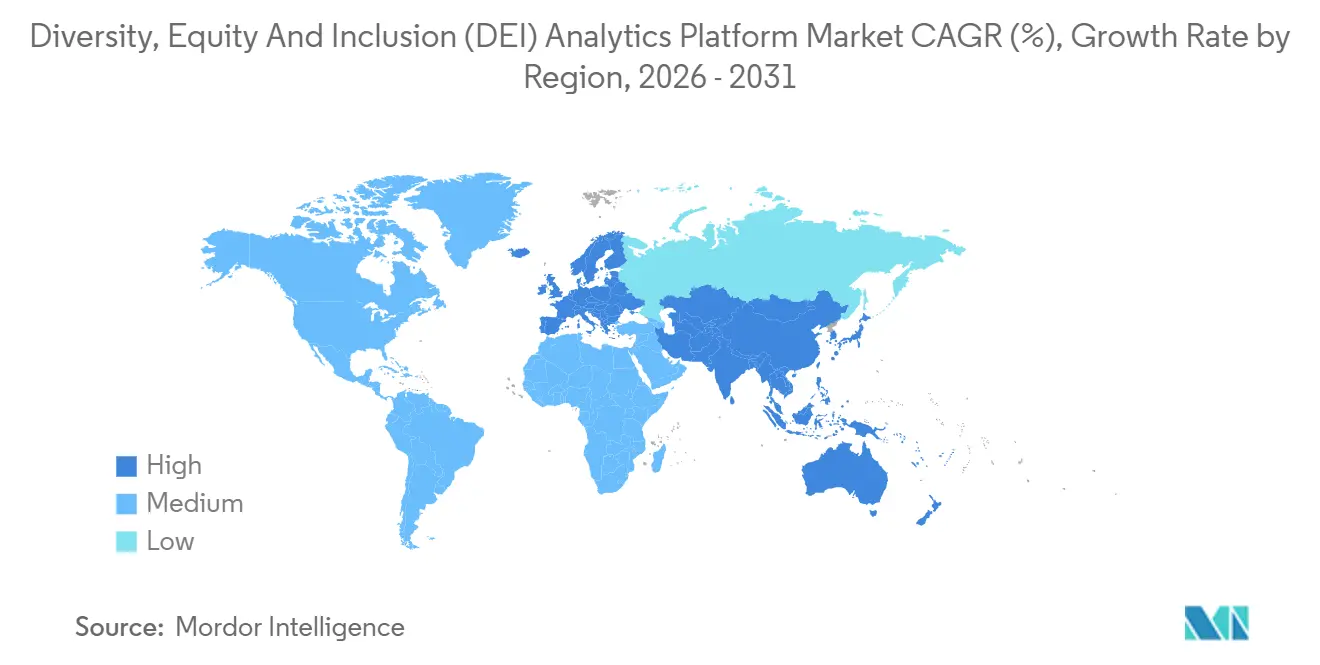
North America held a 41.37% share in 2025, making it the largest region in the diversity, equity, and inclusion (DEI) analytics platform market. The region benefits from strong employer focus on pay governance, hiring fairness, and defensible documentation across complex labor markets. New York City's automated hiring audit rule remains important because it turned bias review from a policy debate into an operating requirement for employers using automated decision tools. Political pressure also changed how some companies described budgets in 2024 and 2025, with workforce intelligence and risk management used more often than explicit DEI language. Even so, demand held because the underlying need for auditable workforce data did not disappear.
Europe Diversity, Equity and Inclusion (DEI) Analytics Platform Market
Europe has one of the most regulation-driven demand profiles, and the DEI analytics platform market size in the region is closely tied to formal disclosure and reporting requirements. ESRS S1 requires auditable disclosures on pay gaps, discrimination incidents, and board diversity, pushing companies toward stronger data pipelines for 2026 reporting cycles. The EU Pay Transparency Directive and related gender reporting rules are reinforcing that shift by requiring more consistency across pay structures and employee rights. The United Kingdom still follows its own path, but mandatory gender pay gap reporting keeps workforce equity analytics relevant for large employers across the wider European operating landscape.
APAC, South America and MEA Diversity, Equity and Inclusion (DEI) Analytics Platform Market
Asia-Pacific is projected to grow at a 21.12% CAGR through 2031, making it the fastest-growing regional segment and an important source of new demand for the diversity, equity, and inclusion (DEI) analytics platform market over the forecast period. Japan has already set a meaningful baseline through listed-company gender disclosure rules, and its 2025 framework connected diversity management with corporate competitiveness, which supports wider executive adoption. India and China remain earlier in platform penetration, while South America, the Middle East, and Africa are still more selective markets where multinational reporting needs often lead demand before local software ecosystems deepen. Brazil, Saudi Arabia, the UAE, South Africa, and Nigeria, therefore, matter less for current scale than for long-run expansion once digital HR infrastructure and reporting expectations strengthen.

Competitive Landscape
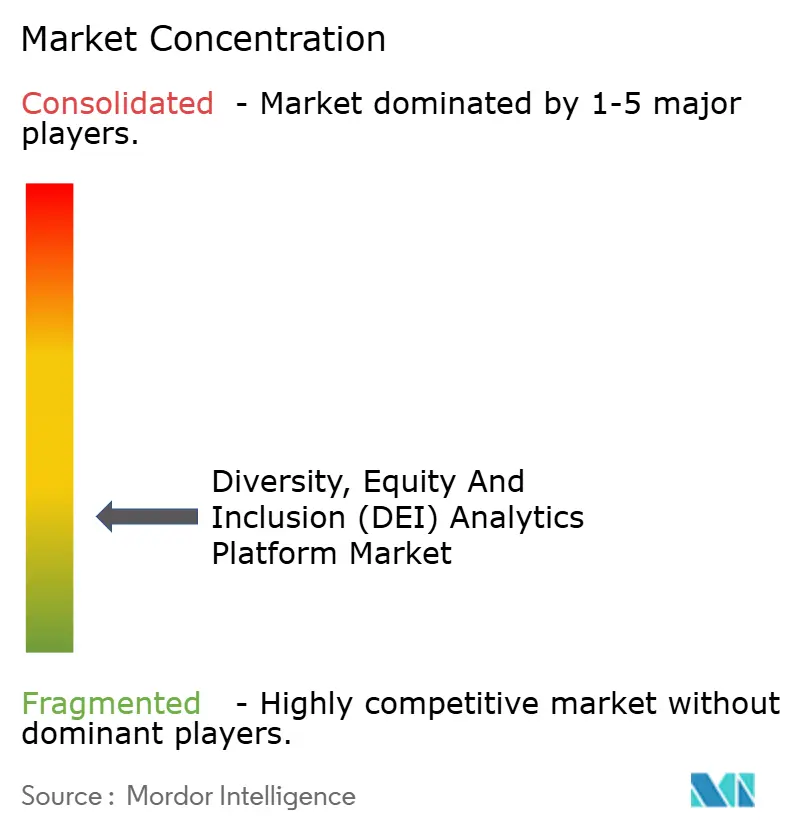
The diversity, equity, and inclusion (DEI) analytics platform market remains fragmented, with more than 20 identifiable vendors spread across pay equity, hiring analytics, workforce intelligence, and benchmarking. No provider holds more than a mid-single-digit global share, so competition depends more on specialization and retention than on raw scale. One cluster focuses on pay governance, another on broader people analytics, and a third on benchmarking and certification-linked tools. This structure keeps the field open for focused vendors that solve a narrow compliance problem well and then expand into adjacent workflows. It also explains why partnerships matter so much, because no single vendor covers every data source, compliance rule, and local reporting format out of the box.
The strongest strategic moves in 2025 and 2026 show a clear shift toward embedded decision support inside larger workforce systems. Phenom’s February 2026 acquisition of Be Applied brought bias-resistant assessment capability into a wider talent suite, strengthening the case for integrating equitable hiring into mainstream talent management rather than treating it as a stand-alone add-on. Textio also pushed deeper into structured hiring evaluation, leveraging proprietary AI models trained on more than 1 billion HR documents to support its position in interview and feedback workflows. Vendors are therefore competing not only on reporting depth, but also on how directly their tools influence live pay, hiring, and evaluation decisions.
Another group is differentiating through evidence standards, localized benchmarking, and measurable operating outcomes rather than just dashboard breadth. EDGE Strategy AG continues to compete through certification-linked analytics used across 65 countries, appealing to multinationals that want independently structured benchmarking. Diversio’s Optimo platform linked manager behavior to retention outcomes in 2025, reflecting the push to connect DEI analytics with business value rather than solely on compliance. The DEI analytics platform market still has room to grow in mid-market templates and non-English operating environments, where local regulations, data structures, and reporting practices are harder for global tools to standardize.
Diversity, Equity And Inclusion (DEI) Analytics Platform Industry Leaders
Syndio
First Capitol Consulting, Inc. dba Trusaic
Textio, Inc.
Diversio
EDGE Strategy AG
- *Disclaimer: Major Players sorted in no particular order
Diversity, Equity And Inclusion (DEI) Analytics Platform Market Companies Covered in this Report
- Syndio
- First Capitol Consulting, Inc. dba Trusaic
- Diversio
- Textio, Inc.
- Mathison Technologies, Inc.
- Clusivity .
- EDGE Strategy AG
- Sysarb AB
- Aleria PBC
- TheDenominator, Inc.
- Visier Inc.
- Kanarys Inc
- Eskalera, Inc.
- Vault Platform Ltd.
- Be Applied Limited
- Ligilo Inc. d/b/a Inclusively
- Diversance, Inc.
- One Model Inc.
- Focus Orange Technology B.V.
- Aperian Global, Inc.
- Equalture B.V.

Recent Industry Developments in Diversity, Equity And Inclusion (DEI) Analytics Platform Market
- May 2026: Syndio defined a new market category, "Decision Intelligence for Pay," and launched its "Decisions" product to govern real-time pay decisions for nearly 400 global enterprises covering over 10 million employees. The company concurrently formed a strategic alliance with Mercer to integrate Syndio's AI-powered pay governance with Mercer's global compensation advisory and market data.
- May 2026: Syndio and Mercer announced a formal strategic alliance combining Syndio's Syndi AI pay governance platform with Mercer's compensation advisory expertise, targeting enterprise clients requiring continuous pay governance across the full employee lifecycle.
- April 2026: Syndio expanded its executive leadership team across product, engineering, revenue, marketing, and customer success to accelerate technology and go-to-market execution in response to increasing enterprise demand for AI-guided pay decisions.
- March 2026: One Model reported record 2025 momentum, becoming cash-flow positive in the second half of 2025, with the go-to-market organization expanding by approximately 80% across North America, EMEA, and Asia-Pacific and EMEA pipeline reaching an all-time high.


Global Diversity, Equity And Inclusion (DEI) Analytics Platform Market Report Scope
The diversity, equity, and inclusion (DEI) analytics platform market comprises technology solutions that measure, analyze, and improve organizational DEI outcomes. These platforms provide advanced analytics across areas such as pay equity, recruitment, promotion, employee experience, workforce demographics, compliance, ESG reporting, bias detection, and benchmarking. Available via cloud, on-premises, or hybrid deployments, they serve both large enterprises and SMEs across industries, including BFSI, healthcare, IT and telecom, retail, manufacturing, government, and others. Their core purpose is to enable organizations to identify inequities, track progress, and drive inclusive workplace strategies through data-driven insights.
The Diversity, Equity And Inclusion (DEI) Analytics Platform Market is segmented by Deployment Mode (Cloud-Based, On-Premises, and Hybrid), Enterprise Size (Large Enterprises and Small and Medium-sized Enterprises), Application (Pay Equity and Compensation Analytics, Hiring, Recruitment and Talent Acquisition Equity Analytics, Promotion, Performance and Career Mobility Analytics, Inclusion, Belonging and Employee Experience Analytics, Workforce Demographic and Representation Analytics, Compliance, ESG and Sustainability Reporting Analytics, Bias Detection and Workforce Risk Analytics, DEI Benchmarking and Organizational Intelligence), End-user Industry (BFSI, Healthcare and Life Sciences, Information Technology and Telecom, Retail and E-commerce, Industrial Manufacturing, and Government and Public Sector), and Geography (North America, South America, Europe, Asia-Pacific, Middle East, and Africa). The Market Forecasts are Provided in Terms of Value (USD).
| Cloud-Based |
| On-Premises |
| Hybrid |
| Large Enterprises |
| Small and Medium-sized Enterprises |
| Pay Equity and Compensation Analytics |
| Hiring, Recruitment and Talent Acquisition Equity Analytics |
| Promotion, Performance and Career Mobility Analytics |
| Inclusion, Belonging and Employee Experience Analytics |
| Workforce Demographic and Representation Analytics |
| Compliance, ESG and Sustainability Reporting Analytics |
| Bias Detection and Workforce Risk Analytics |
| DEI Benchmarking and Organizational Intelligence |
| BFSI |
| Healthcare and Life Sciences |
| Information Technology and Telecom |
| Retail and E-commerce |
| Industrial Manufacturing |
| Government and Public Sector |
| North America | United States |
| Canada | |
| Mexico | |
| South America | Brazil |
| Argentina | |
| Rest of South America | |
| Europe | Germany |
| United Kingdom | |
| France | |
| Italy | |
| Spain | |
| Russia | |
| Netherlands | |
| Rest of Europe | |
| Asia-Pacific | China |
| Japan | |
| India | |
| South Korea | |
| Australia and New Zealand | |
| Rest of Asia-Pacific | |
| Middle East | Saudi Arabia |
| United Arab Emirates | |
| Rest of Middle East | |
| Africa | South Africa |
| Nigeria | |
| Rest of Africa |
| By Deployment Mode | Cloud-Based | |
| On-Premises | ||
| Hybrid | ||
| By End User Enterprise Size | Large Enterprises | |
| Small and Medium-sized Enterprises | ||
| By Application | Pay Equity and Compensation Analytics | |
| Hiring, Recruitment and Talent Acquisition Equity Analytics | ||
| Promotion, Performance and Career Mobility Analytics | ||
| Inclusion, Belonging and Employee Experience Analytics | ||
| Workforce Demographic and Representation Analytics | ||
| Compliance, ESG and Sustainability Reporting Analytics | ||
| Bias Detection and Workforce Risk Analytics | ||
| DEI Benchmarking and Organizational Intelligence | ||
| By End User Industry | BFSI | |
| Healthcare and Life Sciences | ||
| Information Technology and Telecom | ||
| Retail and E-commerce | ||
| Industrial Manufacturing | ||
| Government and Public Sector | ||
| By Geography | North America | United States |
| Canada | ||
| Mexico | ||
| South America | Brazil | |
| Argentina | ||
| Rest of South America | ||
| Europe | Germany | |
| United Kingdom | ||
| France | ||
| Italy | ||
| Spain | ||
| Russia | ||
| Netherlands | ||
| Rest of Europe | ||
| Asia-Pacific | China | |
| Japan | ||
| India | ||
| South Korea | ||
| Australia and New Zealand | ||
| Rest of Asia-Pacific | ||
| Middle East | Saudi Arabia | |
| United Arab Emirates | ||
| Rest of Middle East | ||
| Africa | South Africa | |
| Nigeria | ||
| Rest of Africa | ||


Key Questions Answered in the Report
What is the diversity equity and inclusion (DEI) analytics platform market size in 2026 and what is the 2031 outlook?
The diversity equity and inclusion (DEI) analytics platform market size is projected at USD 1.94 billion in 2026 and is forecast to reach USD 4.26 billion by 2031, growing at a 17.04% CAGR over 2026-2031.
Which deployment model leads DEI analytics platform adoption?
Cloud-based deployment led with 68.73% share in 2025 because organizations needed faster reporting, centralized updates, and easier integration across distributed HR systems.
Which application area is generating the most demand for DEI analytics tools?
Pay equity and compensation analytics led with 29.87% share in 2025, while hiring and talent acquisition equity analytics is expected to be the fastest-growing application at 17.86% CAGR through 2031.
Why are large enterprises still the main buyers of DEI analytics platforms?
Large enterprises held 63.41% share in 2025 because they face the greatest multi-jurisdiction compliance burden and need integrated reporting across compensation, workforce, and sustainability functions.
Which region is expanding the fastest for DEI analytics platforms?
Asia-Pacific is projected to grow at 21.12% CAGR through 2031, supported by rising workforce disclosure expectations and continued digital HR investment across major economies.
Which industry vertical shows the strongest future momentum?
BFSI is projected to expand at 20.94% CAGR through 2031, reflecting stronger regulatory attention to documented and bias-aware talent and compensation decisions.
Page last updated on:





