
Carbon-Intelligent Remote Work and Digital Workplace Software Market Size and Share
Market Overview
| Study Period | 2020 - 2031 |
|---|---|
| Market Size (2026) | USD 1.55 Billion |
| Market Size (2031) | USD 2.67 Billion |
| Growth Rate (2026 - 2031) | 11.51 % |
| Fastest Growing Market | Asia-Pacific |
| Largest Market | North America |
| Market Concentration | Low |
Major Players *Disclaimer: Major Players sorted in no particular order Image © Mordor Intelligence. Reuse requires attribution under CC BY 4.0. | |
Carbon-Intelligent Remote Work and Digital Workplace Software Market Analysis by Mordor Intelligence
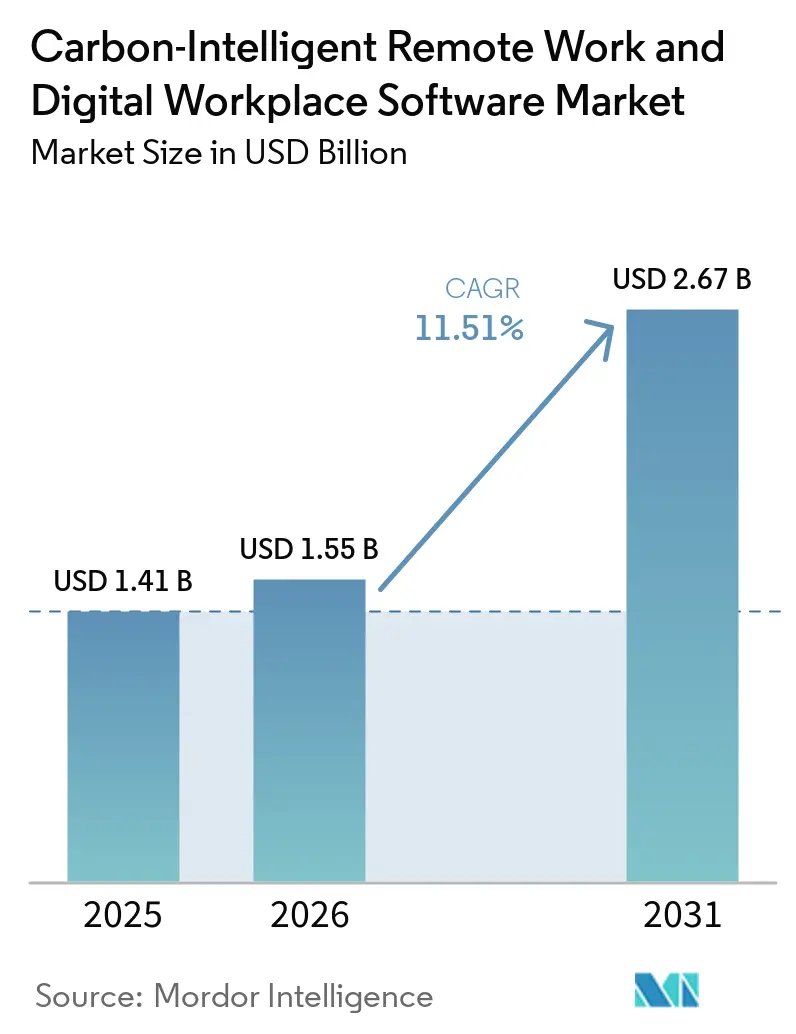
The Carbon-Intelligent Remote Work and Digital Workplace Software Market size is projected to expand from USD 1.41 billion in 2025 and USD 1.55 billion in 2026 to USD 2.67 billion by 2031, registering a CAGR of 11.51% between 2026 and 2031. The market is growing because hybrid work has become a durable operating model across large employers, which keeps demand steady for collaboration, workflow, and workplace management software. Buying behavior is also changing because carbon disclosure and audit-readiness now influence software selection, giving carbon-linked workplace capabilities a more central place in enterprise procurement. Large platform vendors are using their installed customer base to extend AI orchestration, sustainability reporting, and workflow automation across a broader operating layer, rather than leaving those functions to niche vendors. Adoption is still being slowed by integration complexity, fragmented enterprise data, and tighter privacy rules around employee monitoring, which means implementation quality is becoming as important as feature depth. The strongest opportunities are emerging for vendors to connect employee activity data, workplace systems, endpoint data, and reporting workflows in a single platform that supports both productivity and disclosure needs.
Key Report Takeaways
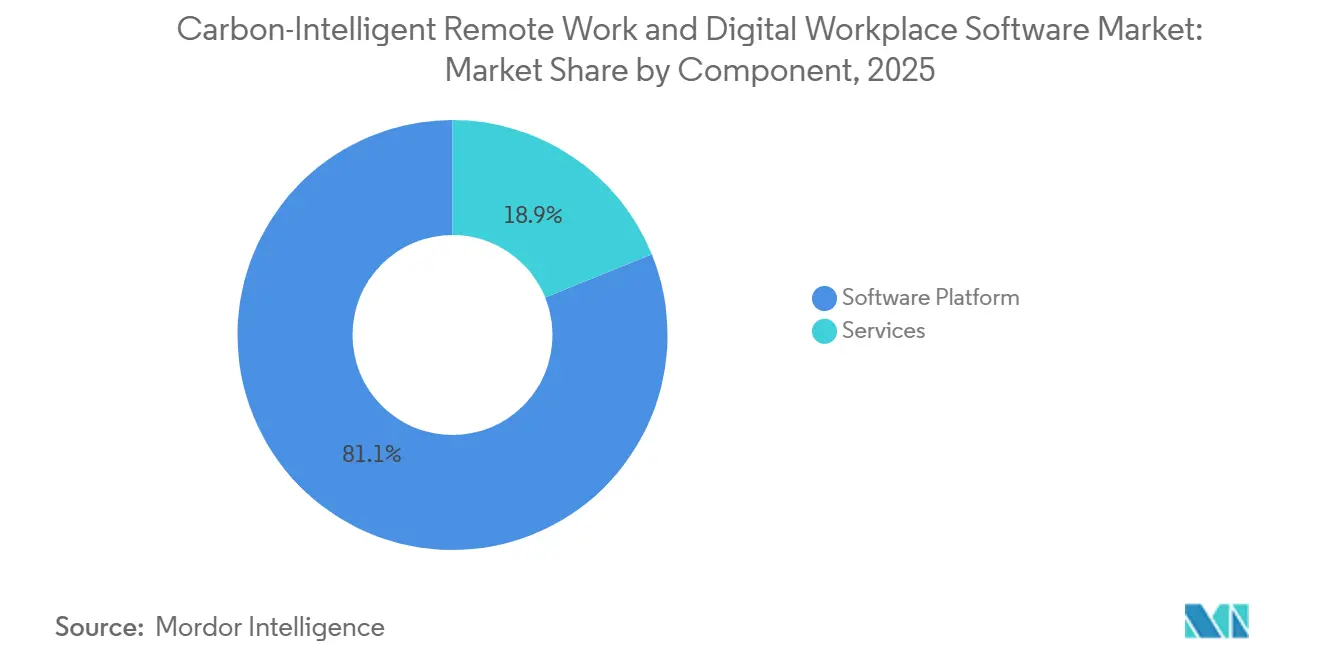
- By component, Software Platform accounted for 81.13% of revenue in 2025, and is projected to expand at a 12.13% CAGR through 2031 in the Carbon-Intelligent Remote Work and Digital Workplace Software Market.
- By deployment model, Cloud-based deployment accounted for 67.14% of revenue in 2025, while Hybrid deployment is projected to record the highest CAGR of 13.43% through 2031.
- By enterprise size, Large Enterprises represented 71.17% of revenue in 2025, while Small and Medium Enterprises are projected to expand at a 12.73% CAGR through 2031.
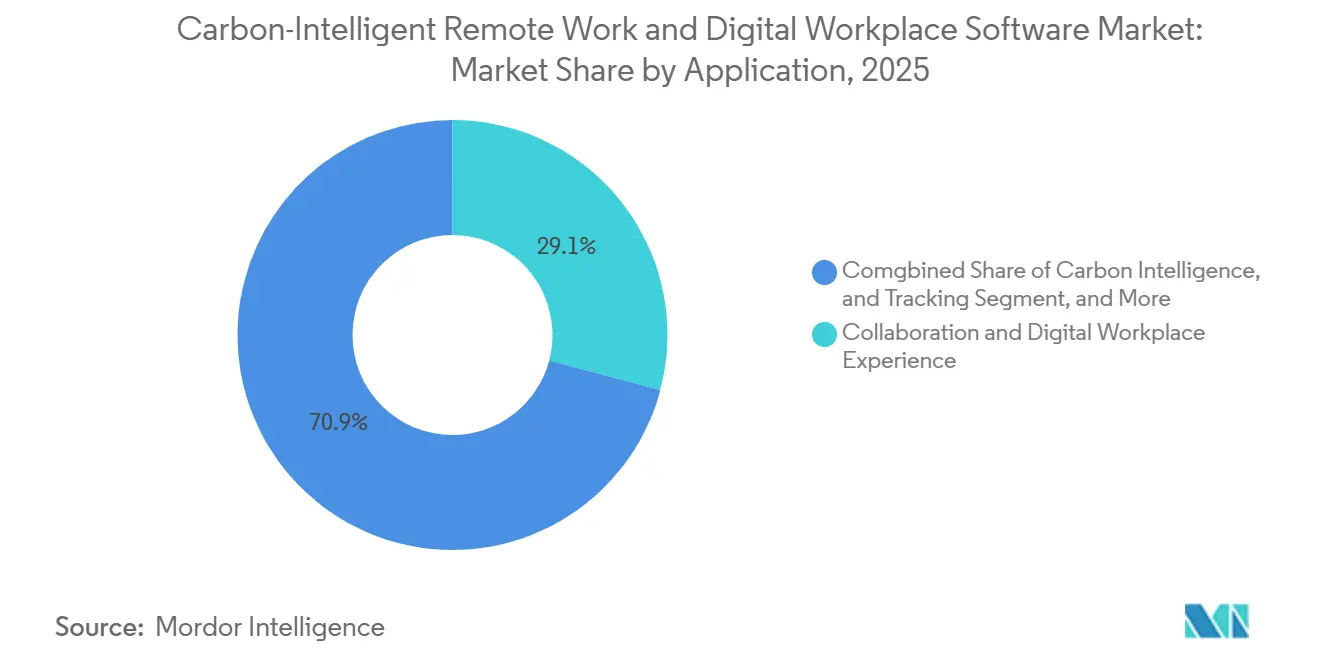
- By application, Collaboration and Digital Workplace Experience accounted for 29.12% of revenue in 2025, while Carbon Intelligence, Tracking, and Reporting are projected to advance at a 15.23% CAGR through 2031.
- By end user, IT and Telecom held 23.17% of revenue in 2025, while Energy and Utilities is projected to post the highest CAGR of 14.13% through 2031.
- By geography, North America held 39.12% of revenue in 2025, while Asia-Pacific is projected to expand at a 13.83% CAGR through 2031.
Note: Market size and forecast figures in this report are generated using Mordor Intelligence’s proprietary estimation framework, updated with the latest available data and insights as of January 2026.
Market Trends and Insights
Drivers Impact Analysis of Carbon-Intelligent Remote Work and Digital Workplace Software Market*
| Driver | (~) % Impact on CAGR Forecast | Geographic Relevance | Impact Timeline |
|---|---|---|---|
| Rising Hybrid Work Persistence | +2.8% | Global | Medium term (2-4 years) |
| Expansion of AI-Powered Workflow Orchestration | +2.4% | North America and Europe, APAC core | Short term (≤ 2 years) |
| Enterprise Demand for Unified Employee Experience Platforms | +2.3% | Global | Medium term (2-4 years) |
| Growing Need for Workplace Carbon Visibility and Optimization | +1.5% | Europe, North America | Medium term (2-4 years) |
| Compliance Pressure From Digital Operations Reporting | +1.2% | Europe, North America | Short term (≤ 2 years) |
| Shift Toward FinOps and Sustainability Convergence | +0.9% | Global, early gains in North America and Europe | Long term (≥ 4 years) |
| Source: Mordor Intelligence | |||
Rising Hybrid Work Persistence
Hybrid work remains a structural driver of the Carbon-Intelligent Remote Work and Digital Workplace Software Market, as employers still need a reliable system for collaboration, attendance planning, digital access, and workflow continuity. In 2026, 62% of organizations mandated a fixed number of in-office days, up from 49% a year earlier, while the share of employees attending the office 3 to 4 days per week rose to 55%. Another study in April 2026 found that 62% of respondents considered it sensible to work more from home to reduce energy costs, while only 20% currently do so, highlighting a clear gap between employee preferences and actual workplace behavior. That gap matters because organizations cannot turn hybrid work into measurable cost and carbon outcomes without software that connects schedules, commuting patterns, location choices, and energy use into a single operating record. The Carbon-Intelligent Remote Work and Digital Workplace Software Market is therefore benefiting from a multi-year operating shift rather than a short-lived response to earlier workplace disruption. Vendors that can link hybrid work management with auditable carbon accounting are in a stronger position, as buyers increasingly want a single system to support both employee coordination and disclosure readiness.[1]
Expansion of AI-Powered Workflow Orchestration
AI orchestration is becoming one of the clearest competitive differentiators in the Carbon-Intelligent Remote Work and Digital Workplace Software Market, as enterprises move away from isolated AI tools toward coordinated systems that can execute work across functions. In May 2026, the next generation of an orchestration platform was unveiled and positioned as an agentic control plane for enterprises managing large fleets of AI agents under common governance rules. New sustainability AI agents were also announced in May 2026, targeting general availability by the end of 2026, and beta testing reduced carbon scenario simulation time from 1 day to 20 minutes while cutting manual GHS classification effort by up to 80%.[2] These moves matter because AI workflow layers also generate process logs, resource records, and operational signals that are useful for carbon measurement and reporting within the same software environment. The Carbon-Intelligent Remote Work and Digital Workplace Software Market is gaining from that overlap because enterprises can justify the investment through both productivity gains and disclosure support. Vendors that treat orchestration as shared infrastructure for workforce and sustainability functions are building a stronger long-term position than vendors that keep carbon tools separate from operational software.
Enterprise Demand for Unified Employee Experience Platforms
Fragmentation across enterprise applications is pushing buyers toward broader software platforms, which supports the Carbon-Intelligent Remote Work and Digital Workplace Software Market at the platform tier. A 2025 benchmark report found that the average enterprise managed 897 applications, of which only 29% were integrated, and that IT teams spent 39% of their time building custom integrations rather than delivering new capabilities.[3] That integration burden matters directly for this market because telework accounting and workplace carbon visibility require access to HR data, scheduling data, facility records, endpoint information, and commuting details that are usually stored in separate systems. In 2025, bi-directional integration between widely used enterprise tools reached general availability, enabling business context and carbon data to flow between systems with fewer manual transfers. In 2026, AI Control Tower was also expanded to govern agents across multiple cloud and enterprise platforms, demonstrating that enterprise demand is moving toward a single governance surface for connected digital work environments. The Carbon-Intelligent Remote Work and Digital Workplace Software Market is therefore moving toward fewer disconnected tools and more integrated control layers, as buyers now place greater value on interoperability, shared policy enforcement, and cleaner data movement.
Growing Need for Workplace Carbon Visibility And Optimization
The need to measure workplace-related emissions with greater accuracy is giving the Carbon-Intelligent Remote Work and Digital Workplace Software Market a stronger reporting role inside enterprise operations. In April 2026, it was reported that 25% of all employed persons worked from home at least occasionally in 2025, up from 13% in 2019, confirming that telework now affects a large enough workforce to warrant more formal measurement. Another April 2026 study estimated that one additional home office day per week for car-commuting workers in Germany alone could save 32.03 million liters of fuel per day, equal to 19% of Germany’s daily fuel consumption for passenger and freight transport. The same need for reliable measurement is evident in vendor product development, as new emissions APIs and expanded sustainability consoles were launched in 2026, bringing Scope 1, 2, and 3 reporting into one place. Detailed product carbon footprint and metric calculation features also reached general availability in January 2026, which shows that traceable carbon reporting is moving into mainstream enterprise software. The Carbon-Intelligent Remote Work and Digital Workplace Software Market is therefore shifting from broad workplace enablement toward software that connects hybrid work patterns, digital operations, and carbon accounting within a defensible reporting framework.
Restraints Impact Analysis of Carbon-Intelligent Remote Work and Digital Workplace Software Market*
| Restraint | (~) % Impact on CAGR Forecast | Geographic Relevance | Impact Timeline |
|---|---|---|---|
| Complex Integration With Legacy Identity and Collaboration Stacks | -1.6% | Global | Medium term (2-4 years) |
| Data Privacy and Employee Monitoring Concerns | -1.1% | Europe, North America | Short term (≤ 2 years) |
| High Total Cost of Ownership for Advanced Platforms | -0.8% | SME-heavy markets in Asia-Pacific and South America | Long term (≥ 4 years) |
| Fragmented Carbon Data and Weak Baseline Quality | -0.6% | Global, most acute in APAC and Middle East and Africa | Long term (≥ 4 years) |
| Source: Mordor Intelligence | |||
Complex Integration With Legacy Identity and Collaboration Stack
Legacy complexity remains a major adoption barrier for the Carbon-Intelligent Remote Work and Digital Workplace Software Market because advanced workplace platforms must connect to many older enterprise systems simultaneously. A 2025 modernization report found that 35% of IT decision-makers cited technical debt and legacy complexity as the main constraint on modernization, while 54% were pursuing modernization to integrate legacy workloads with cloud-native platforms.[4] The challenge is wider than infrastructure because large enterprises often maintain multiple identity providers and older directory environments that are harder to federate cleanly with modern workplace tools. The Carbon-Intelligent Remote Work and Digital Workplace Software Market is affected more sharply because these platforms often need access to HR systems, facilities systems, asset management systems, collaboration data, and ERP records under different access models. Research in 2025 on enterprise integration also identified legacy database connections and inconsistent data standards as key integration issues, reflecting the broader data friction that slows unified workplace and carbon reporting deployments. Organizations that underestimate this burden often face longer implementation cycles and slower value realization, which is why integration architecture, pre-built connectors, and access design matter as much as product functionality.
Data Privacy and Employee Monitoring Concerns
Privacy and employee-monitoring rules also constrain the Carbon-Intelligent Remote Work and Digital Workplace Software Market, as some of the most useful workplace signals are the same ones regulators examine most closely. The EU AI Act entered into force on August 1, 2024, and full high-risk obligations for AI systems that make inferences about employees apply from August 2, 2026. In March 2026, it was noted that employee monitoring under EU privacy law must serve a legitimate purpose and cannot extend to constant productivity tracking, while works council co-determination is required in Germany, France, Italy, Spain, and Austria before deploying monitoring tools that affect employee data. The combined GDPR and EU AI Act framework can carry penalties of up to EUR 35 million (USD 40.25 million) or 7% of global annual turnover, making compliance documentation an important part of procurement reviews. The Carbon-Intelligent Remote Work and Digital Workplace Software Market faces a structural tension: scheduling, behavioral, and location data help improve workplace carbon analysis, but the same data categories can raise privacy concerns if handled too narrowly at the individual level. Vendors that use privacy-by-design architectures, team-level aggregation, and clear governance controls are likely to face less resistance in regulated enterprise sales cycles.
*Our forecasts treat driver/restraint impacts as directional, not additive. The impact forecasts reflect baseline growth, mix effects, and variable interactions.
Carbon-Intelligent Remote Work and Digital Workplace Software Market Segment Analysis
By Component:
Software Platform Anchors The Market And Extends Vendor ReachSoftware Platform accounted for 81.13% of revenue in 2025, giving it a clear lead in the Carbon-Intelligent Remote Work and Digital Workplace Software Market share. That concentration reflects enterprise buying behavior more than a narrow feature preference because most large organizations place workplace functions inside a primary software environment before adding specialist tools. The Carbon-Intelligent Remote Work and Digital Workplace Software Market, therefore, remains centered on platforms that already support collaboration, workflows, identity, and the movement of operational data across the business. This pattern also favors vendors that can offer a broader operating layer, as buyers prefer to add modules to existing enterprise systems rather than create another isolated environment. The platform-heavy structure shows that customers still value system continuity, shared governance, and reduced integration friction when choosing workplace software that now also addresses carbon reporting requirements.
Software Platform is also projected to expand at a 12.13% CAGR through 2031, indicating the leading component is still gaining traction rather than slowing under its own weight. Sustainability agents are a good example because they embed footprint simulation, regulatory readiness, labeling tasks, and workplace safety workflows within a broader enterprise platform rather than a standalone application. Emissions APIs support the same direction by allowing enterprises and software vendors to embed emissions calculations directly into existing workflows, rather than forcing users into a separate interface. In practical terms, the Carbon-Intelligent Remote Work and Digital Workplace Software Market becomes increasingly platform-led over time because switching costs rise as organizations build emissions baselines, scheduling histories, and endpoint records within a single core environment. The services segment remains important because large deployments still need customization, change management, and complex integration support, but its role is mainly to enable broader platform value rather than displace the software center of gravity.
By Deployment Model:
Hybrid Architectures Reflect Reporting And Data Control NeedsCloud-based deployment accounted for 67.14% of revenue in 2025, making it the dominant delivery model in the Carbon-Intelligent Remote Work and Digital Workplace Software Market. This lead reflects the maturity of software-as-a-service workplace tools and the preference for scalable access across locations, devices, and business units. Cloud environments also help vendors release new AI features, report updates, and introduce workplace enhancements to installed customer bases with fewer upgrade delays. The Carbon-Intelligent Remote Work and Digital Workplace Software Market has therefore continued to rely on the cloud as the default entry point for organizations seeking faster rollouts and easier cross-site access. That position is especially strong in mature enterprise markets where digital collaboration suites and cloud workflow software are already part of daily operations.
Hybrid deployment is projected to grow at a 13.43% CAGR through 2031, indicating that data processing and reporting precision are gaining influence in architectural decisions. It was noted that CSRD requires both market-based and location-based emissions reporting, which has pushed some enterprises to keep part of their carbon data processing or reconciliation in hybrid environments. Cloud provider methodologies have not always aligned equally on this issue, which creates a practical reason to retain local processing layers in multi-cloud environments. A 2026 cloud report found that nearly 1 out of 3 respondents considered cost optimization and carbon emissions reduction equal priorities, while 47% of European respondents reported defined sustainability programs. On-premise deployment still holds a place in banking, defense, and government settings where data residency and control requirements remain strict, so the Carbon-Intelligent Remote Work and Digital Workplace Software Market is expanding cloud usage while also creating more room for hybrid designs that support audit readiness and carbon data accuracy.
By Enterprise Size:
SME Adoption Broadens The Revenue BaseLarge Enterprises accounted for 71.17% of revenue in 2025, making them the leading customer group in the Carbon-Intelligent Remote Work and Digital Workplace Software Market share profile. This lead reflects higher IT budgets, earlier cloud adoption, and faster exposure to sustainability reporting requirements across multinational organizations. Large enterprises were also the first to face the operational challenge of linking workplace software, employee data, facility data, and reporting workflows within a single control environment. The market initially developed around these larger buyers because they faced both compliance pressure and the financial capacity to invest in broader digital workplace platforms. Their scale also made software standardization more valuable because shared systems help align global offices, teams, and operating policies.
Small and Medium Enterprises are projected to expand at a 12.73% CAGR through 2031, showing that the next growth wave is moving into the mid-market. This shift is tied to the widening scope of disclosure obligations, especially where suppliers and mid-sized firms are being drawn into larger corporate reporting chains. EFRAG’s simplified ESRS standards, published in December 2025, are expected to lower the cost and complexity of compliance for smaller organizations. Workiva expanded its sustainability tools with agentic AI and simplified ESRS Intelligence support, while its partnership with EcoVadis created a more structured route for supplier carbon data to flow into buyer reporting processes. As large enterprises increasingly ask suppliers for more primary data, the Carbon-Intelligent Remote Work and Digital Workplace Software Market is seeing stronger demand from smaller firms that need compatible tools to support customer retention, regulatory compliance, and smoother data exchange.
By Application:
Carbon Intelligence Becomes A Core Buying CriterionCollaboration and Digital Workplace Experience accounted for 29.12% of revenue in 2025, making it the largest application area in the Carbon-Intelligent Remote Work and Digital Workplace Software Market. This lead reflects the continued importance of communication, access, and coordination tools as the everyday base layer of digital work. Many organizations still begin their workplace software spend with collaboration suites and employee experience tools before expanding adoption to deeper reporting and optimization features. The Carbon-Intelligent Remote Work and Digital Workplace Software Market, therefore, still depends on a strong collaboration foundation because hybrid work cannot function well without reliable digital channels and unified employee access. It also means the broader market remains tied to workplace continuity needs even as new carbon-related functions gain urgency.
Carbon Intelligence, Tracking and Reporting is projected to advance at a 15.23% CAGR through 2031, making it the fastest-growing application area in the market. This growth shows that carbon functionality is shifting from a secondary reporting module into a direct procurement criterion for enterprises facing external disclosure expectations. SAP stated in beta testing that ESG data from industry averages could vary by 30%-40% or more from actual transaction-level values, highlighting the weakness of proxy data when firms need more reliable reporting inputs. The EcoVadis and Workiva Carbon Data Network partnership, announced in May 2026, addresses the same issue by allowing primary supplier carbon data to move more directly into reporting workflows. Other applications, such as Employee Wellbeing and Productivity Analytics, Workflow Automation and Process Orchestration, and Endpoint Performance and Resource Optimization, continue to expand functional coverage, but the Carbon-Intelligent Remote Work and Digital Workplace Software Market is clearly assigning greater value to applications that convert workplace data into auditable carbon outputs.

By End User:
Energy And Utilities Leads Growth Under Dual PressureIT and Telecom accounted for 23.17% of revenue in 2025, making it the largest end-user segment in the Carbon-Intelligent Remote Work and Digital Workplace Software Market. The sector’s lead reflects its long-standing role as an early adopter of digital infrastructure, hybrid work practices, and cloud-based collaboration software. IT and telecom companies also tend to operate with more mature software stacks, which makes it easier to adopt wider workplace automation and reporting capabilities. The Carbon-Intelligent Remote Work and Digital Workplace Software Market has therefore relied on this sector as a core demand base because these organizations already view digital work environments as strategic operating systems. Their continued spending also helps platform vendors introduce new carbon-linked features to customers who already use broad collaboration and workflow tools.
Energy and Utilities is projected to expand at a 14.13% CAGR through 2031, which makes it the fastest-growing end-user segment. Dual pressures are supporting the growth: these companies manage geographically distributed workforces while also facing some of the strongest carbon disclosure requirements among regulated sectors. Schneider Electric launched Resource Advisor+ in January 2026, with Carbon Performance and Supply Chain modules that demonstrate how vendors are targeting this sector with software built for GHG Protocol-aligned calculations and audit-ready outputs. GLOBENEWSWIRE.COM. Manufacturing also remains an important secondary growth pocket because industrial firms must manage the carbon footprint of remote engineering teams, connected shop-floor systems, and broader energy use across distributed operations. The Carbon-Intelligent Remote Work and Digital Workplace Software Market is therefore broadening beyond technology-heavy buyers and gaining momentum in sectors where operational coordination and carbon disclosure are increasingly linked in the same software workflow.
Geography Analysis
North America Carbon-Intelligent Remote Work and Digital Workplace Software Market
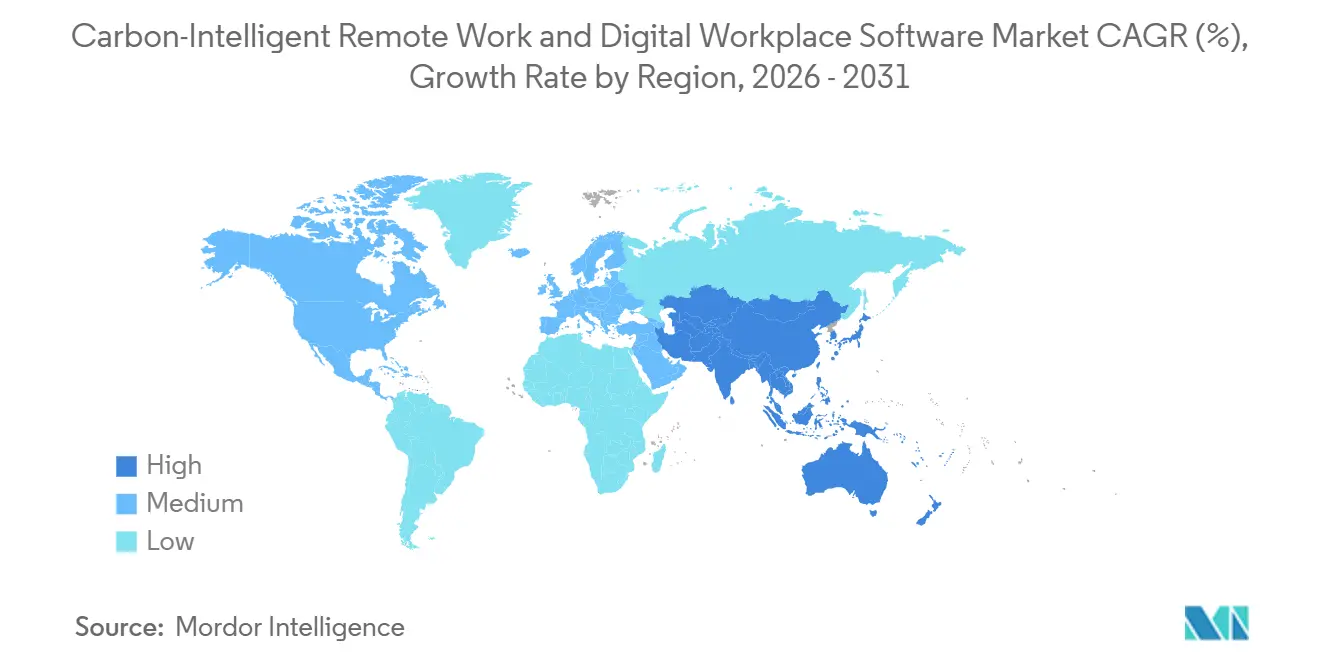
North America accounted for 39.12% of revenue in 2025, making it the leading region in the Carbon-Intelligent Remote Work and Digital Workplace Software Market. The region benefited from early investment in cloud-native workplace platforms and deeper enterprise use of Microsoft 365 and Google Workspace. The United States remained the largest national market because large enterprises already operated broad collaboration and workflow environments that could absorb new carbon and sustainability features with less disruption. Microsoft brought Product Carbon Footprint to general availability in January 2026 within Sustainability Manager, strengthening carbon accounting capability inside an established enterprise software base. California’s climate disclosure rules, taking effect in 2026, also expanded the practical need for software that can connect emissions reporting, risk documentation, and internal operating data.
Europe Carbon-Intelligent Remote Work and Digital Workplace Software Market
Europe was the second-largest regional segment in 2025, and it remained the most regulation-driven part of the market. Germany’s Federal Statistical Office stated in April 2026 that 25% of all employed persons worked from home at least occasionally in 2025, showing the scale of telework that now intersects with formal reporting expectations. France’s ADEME-linked telework carbon work also supported more structured thinking about how remote work should be integrated into broader carbon accounting practices. Germany, the United Kingdom, France, Italy, and Spain remained the leading national markets because each combined large enterprise demand with stronger momentum for climate-related disclosures. The EU AI Act also added another layer of product scrutiny, requiring workplace analytics that involve employee inferences to be designed and documented with greater care.
APAC, MEA and South America Carbon-Intelligent Remote Work and Digital Workplace Software Market
Asia-Pacific is projected to grow at a 13.83% CAGR through 2031, making it the fastest-growing geography in the market size outlook. India and China are providing the largest absolute growth contribution because enterprise software spending is expanding across large business bases. Japan and South Korea are also strengthening demand as listed companies move into more formal ESG disclosure expectations. JLL stated in 2026 that APAC led globally in full in-office attendance rates, giving the region a different demand profile from Western markets, as software needs are often more closely tied to office energy optimization and endpoint power management. South America, the Middle East, and Africa remain smaller markets, but Brazil and the United Arab Emirates stand out because both are advancing broader sustainability disclosure frameworks for large enterprises.
Competitive Landscape
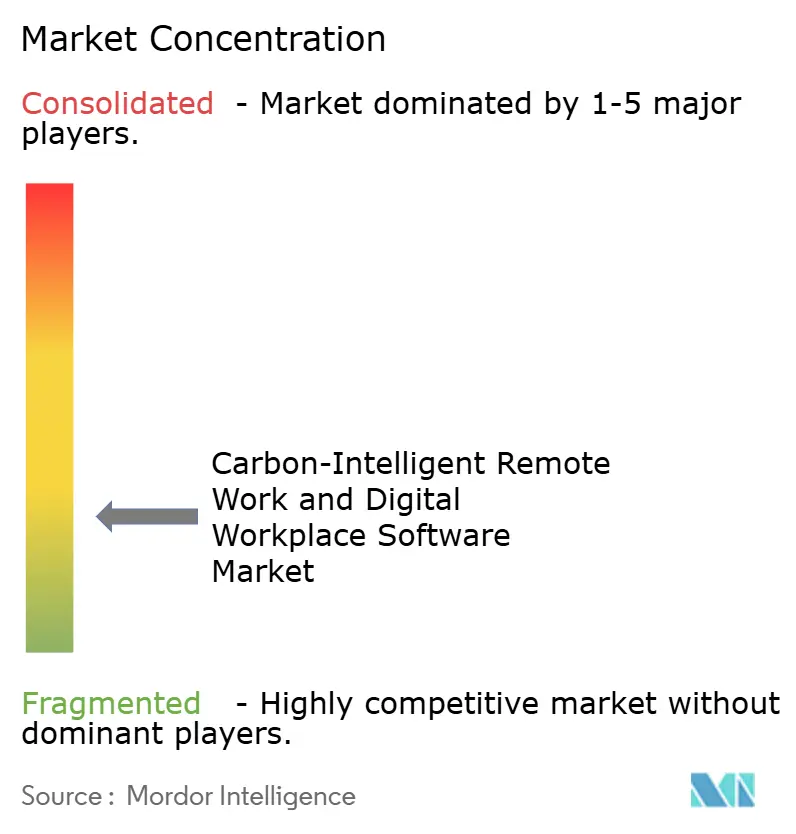
The Carbon-Intelligent Remote Work and Digital Workplace Software Market is fragmented at the platform tier, while the carbon intelligence and disclosure-focused layer remains more fragmented. Microsoft, SAP, and ServiceNow hold a structural advantage because they already sit inside large enterprise environments where collaboration, workflow, and data governance are part of daily operations. That position allows them to extend sustainability features, AI orchestration, and reporting support through existing relationships rather than through greenfield selling. The market is therefore not led by vendors that offer only a narrow reporting module, but by vendors that can embed carbon-aware functions within a broader work operating system. At the same time, specialists such as IBM Envizi, Workiva, and Schneider Electric still matter because they address detailed measurement, disclosure workflows, and carbon data quality issues that broader workplace platforms are still struggling to address.
Product strategy in the market is now centered on embedded AI, workflow reach, and ecosystem control. SAP’s Joule-powered sustainability agents demonstrate this clearly by combining regulatory readiness, footprint optimization, packaging compliance, and workplace safety tasks within a single software environment. ServiceNow also expanded AI agent governance through its Microsoft integration in May 2026, extending policy controls across Microsoft Foundry, Copilot Studio, and Microsoft 365. Microsoft continued to strengthen its sustainability stack through 2025 and 2026 by moving Product Carbon Footprint and calculation capabilities from preview to general availability. These moves show that market-share competition increasingly depends on which vendor can control the flow of operational data, reporting logic, and AI-enabled decisions within a single enterprise software layer.
Partnerships are also reshaping the market because no single vendor yet covers every need across workplace management, primary carbon data collection, and regulated disclosure workflows. EcoVadis and Workiva announced a Carbon Data Network partnership in May 2026 that allows customers to replace industry-average Scope 3 estimates with primary supplier carbon data flowing into audit-ready reporting workflows. Schneider Electric’s recognition across three 2025 sustainability software evaluations also strengthened its position as a specialist platform with broad credibility in regulated use cases. IBM’s investment in Envizi and watsonx Orchestrate shows that infrastructure and process governance are also becoming part of the competitive battleground. The market remains open enough for specialists to grow, but the strongest competitive positions are being built by vendors that integrate productivity, compliance, and carbon intelligence within a single enterprise workflow architecture.
Carbon-Intelligent Remote Work and Digital Workplace Software Industry Leaders
-
Microsoft Corporation
-
ServiceNow, Inc.
-
International Business Machines Corporation
-
SAP SE
-
Cisco Systems, Inc.
- *Disclaimer: Major Players sorted in no particular order
Carbon-Intelligent Remote Work and Digital Workplace Software Market Companies Covered in this Report
- Microsoft Corporation
- International Business Machines Corporation
- SAP SE
- ServiceNow, Inc.
- Broadcom Inc.
- Citrix Systems, Inc.
- Workiva Inc.
- Schneider Electric SE
- Hewlett Packard Enterprise Company
- Google LLC
- Cisco Systems, Inc.
- Accenture plc
- Eviden
- DXC Technology Company
- Tata Consultancy Services Limited
- Cognizant Technology Solutions Corporation
- Wipro Limited
- Infosys Limited
- Capgemini SE
- Unisys Corporation
Recent Industry Developments in Carbon-Intelligent Remote Work and Digital Workplace Software Market
- June 2026: Sweep launched a complete cloud emissions measurement solution built on AWS's standalone Sustainability service, consolidating Scope 1, 2, and 3 cloud emissions data into a unified, single-methodology carbon baseline. The solution enables audit-ready external reporting under CSRD's dual market-based and location-based reporting requirement, addressing a gap that previously required manual reconciliation for multi-cloud enterprises.
- May 2026: Workiva released Sustainability Reporting updates including support for simplified ESRS Intelligence, based on EFRAG's December 2025 draft simplified standards, and added direct CDP corporate disclosure submission capabilities for 2026 CDP reporting cycles, reducing multi-system submission overhead for sustainability teams.
- May 2026: Workiva launched an AI Disclosure Agent that assesses ESG content against evolving standards including ESRS and IFRS S1/S2, identifying present, partial, and missing disclosures earlier in the reporting cycle within the existing Workiva governance and audit trail environment.
- May 2026: EcoVadis and Workiva announced a Carbon Data Network partnership on May 12, 2026, enabling mutual customers to replace industry-average Scope 3 proxy estimates with primary supplier carbon data flowing directly into Workiva's audit-ready sustainability reporting workflows. The partnership targets the data quality gap identified in SAP's beta testing, where ESG data from industry averages varied 30%-40% or more from actual values.
Global Carbon-Intelligent Remote Work and Digital Workplace Software Market Report Scope
The Carbon-Intelligent Remote Work and Digital Workplace Software market refers to platforms and services that integrate sustainability intelligence into remote work and digital workplace environments. These solutions provide functionalities such as collaboration and workplace experience management, employee wellbeing analytics, workflow automation, carbon tracking and reporting, and endpoint resource optimization. By embedding carbon intelligence into digital workplace operations, these platforms help enterprises reduce IT-related emissions, optimize energy usage, enhance productivity, and comply with ESG frameworks. Serving both large enterprises and SMEs across diverse industries, the market’s primary objective is to enable organizations to balance operational efficiency, employee engagement, and environmental responsibility while supporting the transition toward sustainable digital work ecosystems.
The Carbon-Intelligent Remote Work and Digital Workplace Software market report is segmented by Component (Software Platform, and Services), Deployment Model (Cloud-Based, On-Premise, and Hybrid), Enterprise Size (Large Enterprises, and Small and Medium Enterprises), Application (Collaboration and Digital Workplace Experience, Employee Wellbeing and Productivity Analytics, Workflow Automation and Process Orchestration, Carbon Intelligence, Tracking and Reporting, and Endpoint Performance and Resource Optimization), End User (IT and Telecom, BFSI, Manufacturing, Energy and Utilities, Retail and E-Commerce, Construction and Infrastructure, Government and Public Sector, and Other End-User Industries), and Geography (North America, South America, Europe, Asia-Pacific, Middle East, and Africa). The Market Forecasts are Provided in Terms of Value (USD).
Segmentation Overview
| Software Platform |
| Services |
| Cloud-Based |
| On-Premise |
| Hybrid |
| Large Enterprises |
| Small and Medium Enterprises |
| Collaboration and Digital Workplace Experience |
| Employee Wellbeing and Productivity Analytics |
| Workflow Automation and Process Orchestration |
| Carbon Intelligence, Tracking and Reporting |
| Endpoint Performance and Resource Optimization |
| IT and Telecom |
| BFSI |
| Manufacturing |
| Energy and Utilities |
| Retail and E-Commerce |
| Construction and Infrastructure |
| Government and Public Sector |
| Other End-User Industries |
| North America | United States | |
| Canada | ||
| Mexico | ||
| South America | Brazil | |
| Argentina | ||
| Rest of South America | ||
| Europe | Germany | |
| United Kingdom | ||
| France | ||
| Italy | ||
| Spain | ||
| Russia | ||
| Rest of Europe | ||
| Asia-Pacific | China | |
| India | ||
| Japan | ||
| South Korea | ||
| Australia | ||
| Rest of Asia-Pacific | ||
| Middle East and Africa | Middle East | Saudi Arabia |
| United Arab Emirates | ||
| Rest of Middle East | ||
| Africa | South Africa | |
| Nigeria | ||
| Rest of Africa | ||
| By Component | Software Platform | ||
| Services | |||
| By Deployment Model | Cloud-Based | ||
| On-Premise | |||
| Hybrid | |||
| By Enterprise Size | Large Enterprises | ||
| Small and Medium Enterprises | |||
| By Application | Collaboration and Digital Workplace Experience | ||
| Employee Wellbeing and Productivity Analytics | |||
| Workflow Automation and Process Orchestration | |||
| Carbon Intelligence, Tracking and Reporting | |||
| Endpoint Performance and Resource Optimization | |||
| By End User | IT and Telecom | ||
| BFSI | |||
| Manufacturing | |||
| Energy and Utilities | |||
| Retail and E-Commerce | |||
| Construction and Infrastructure | |||
| Government and Public Sector | |||
| Other End-User Industries | |||
| By Geography | North America | United States | |
| Canada | |||
| Mexico | |||
| South America | Brazil | ||
| Argentina | |||
| Rest of South America | |||
| Europe | Germany | ||
| United Kingdom | |||
| France | |||
| Italy | |||
| Spain | |||
| Russia | |||
| Rest of Europe | |||
| Asia-Pacific | China | ||
| India | |||
| Japan | |||
| South Korea | |||
| Australia | |||
| Rest of Asia-Pacific | |||
| Middle East and Africa | Middle East | Saudi Arabia | |
| United Arab Emirates | |||
| Rest of Middle East | |||
| Africa | South Africa | ||
| Nigeria | |||
| Rest of Africa | |||
Key Questions Answered in the Report
What is the size outlook for the Carbon-Intelligent Remote Work and Digital Workplace Software Market?
The Carbon-Intelligent Remote Work and Digital Workplace Software Market stood at USD 1.41 billion in 2025, reached USD 1.55 billion in 2026, and is projected to reach USD 2.67 billion by 2031 at an 11.51% CAGR.
Which region led revenue generation in 2025?
North America led with 39.12% of revenue in 2025 because of early cloud-native workplace adoption and strong enterprise penetration of major software platforms.
Which geography is expanding the fastest through 2031?
Asia-Pacific is projected to grow at a 13.83% CAGR through 2031, supported by expanding enterprise software spending and wider ESG disclosure alignment.
Which application area is growing the fastest?
Carbon Intelligence, Tracking and Reporting is projected to expand at a 15.23% CAGR through 2031, making it the fastest-growing application area.
Why are small and medium enterprises becoming more important buyers?
Small and Medium Enterprises are projected to grow at a 12.73% CAGR because disclosure expectations are extending into the mid-market and simplified standards are lowering adoption friction.
Which end-user segment is expected to record the strongest growth?
Energy and Utilities is projected to post a 14.13% CAGR through 2031 because the sector combines distributed workforce management needs with strong carbon disclosure pressure.