
Digital Workplace In Education Market Size and Share
Market Overview
| Study Period | 2020 - 2031 |
|---|---|
| Market Size (2026) | USD 6.62 Billion |
| Market Size (2031) | USD 18.68 Billion |
| Growth Rate (2026 - 2031) | 23.04 % |
| Fastest Growing Market | Asia-Pacific |
| Largest Market | North America |
| Market Concentration | Medium |
Major Players *Disclaimer: Major Players sorted in no particular order Image © Mordor Intelligence. Reuse requires attribution under CC BY 4.0. | |
Digital Workplace In Education Market Analysis by Mordor Intelligence
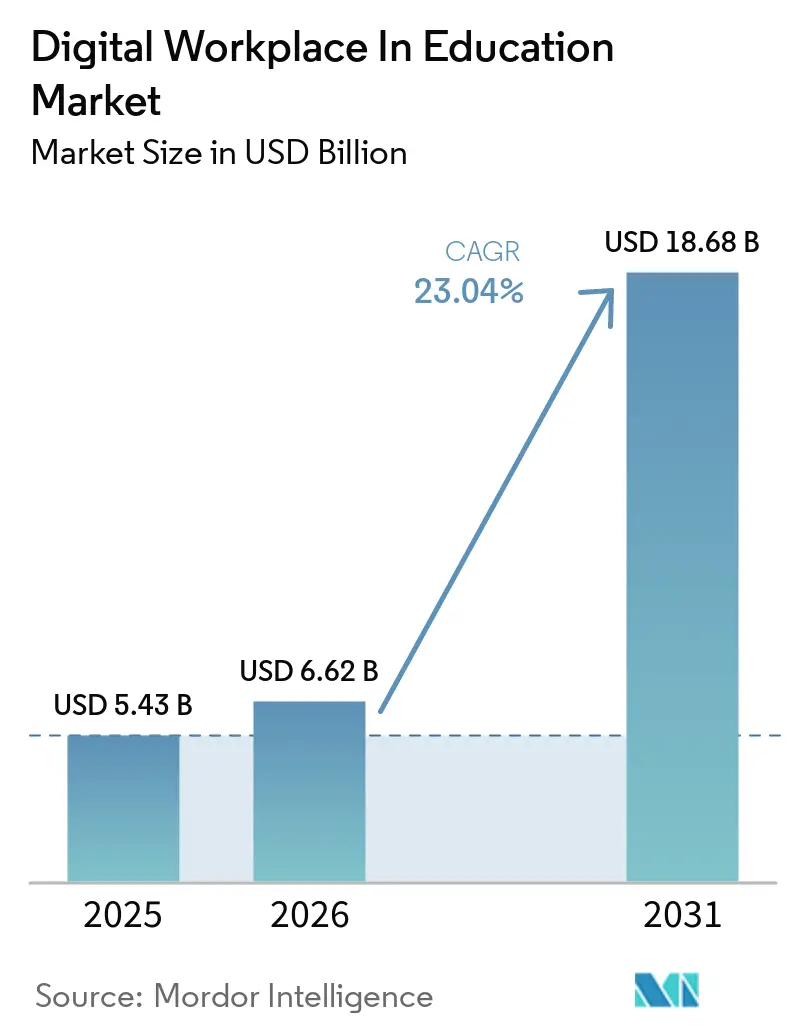
The digital workplace in education market size reached USD 5.43 billion in 2025 and is forecast to reach USD 18.68 billion by 2031, growing at a CAGR of 23.04% during 2026-2031. Growth is being shaped by a broad shift away from disconnected communication tools and older administrative systems toward integrated platforms that support staff, faculty, and student workflows in one governed environment. Institutions are also treating workplace software as a core operating layer because enrollment pressure, research coordination, hybrid work routines, and service expectations now depend on faster internal collaboration. Competition is also moving beyond basic messaging and productivity tools, because vendors are using embedded AI, stronger security controls, and broader cloud bundles to raise switching costs inside institutional accounts. The digital workplace in education market is also benefiting from demand for unified communication and collaboration tools, workflow automation, virtual desktop environments, and managed services that reduce operational strain on internal IT teams. Budget pressure in public education and complex privacy obligations still slow adoption at smaller institutions, but vendors that simplify integration, governance, and compliance continue to have clear room to grow.
Key Report Takeaways
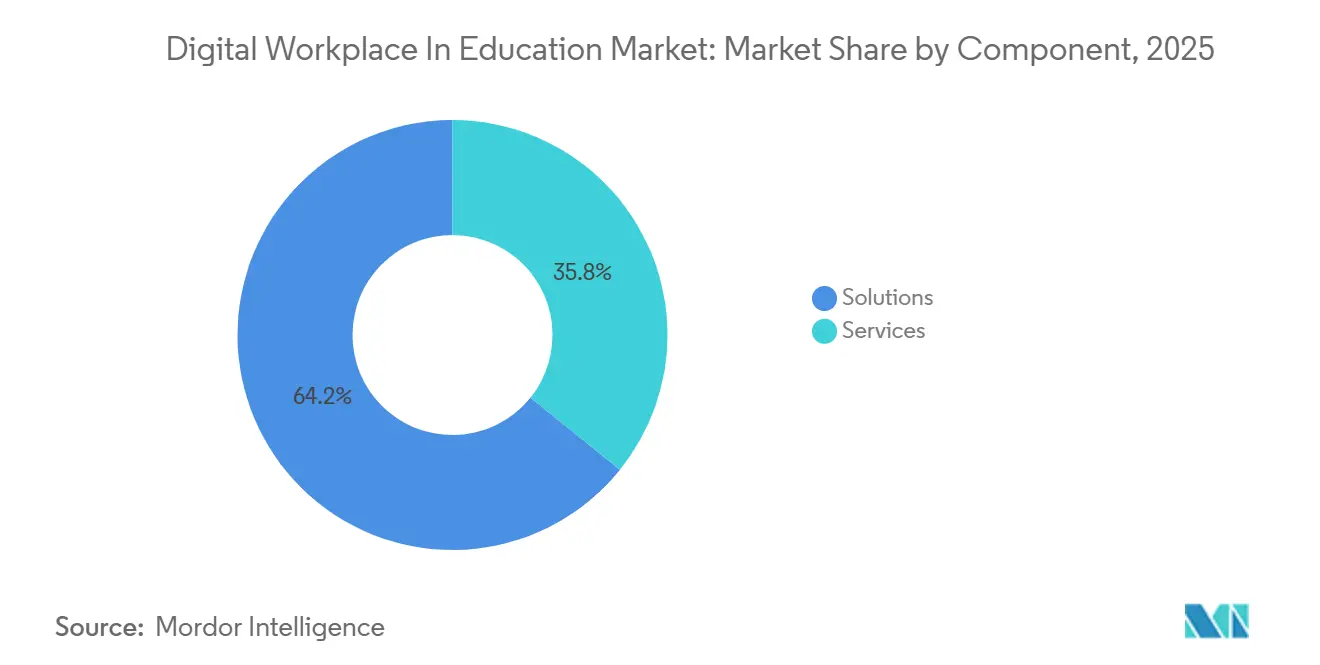
- By component, Solutions led with 64.22% of the digital workplace in education market size in 2025, while Services continue to gain relevance as institutions need more support for AI configuration, security management, and workflow integration.
- By deployment mode, Cloud is projected to expand at a 23.76% CAGR through 2031, while hybrid environments are becoming more important for institutions that want cloud agility without moving sensitive records off internal systems.
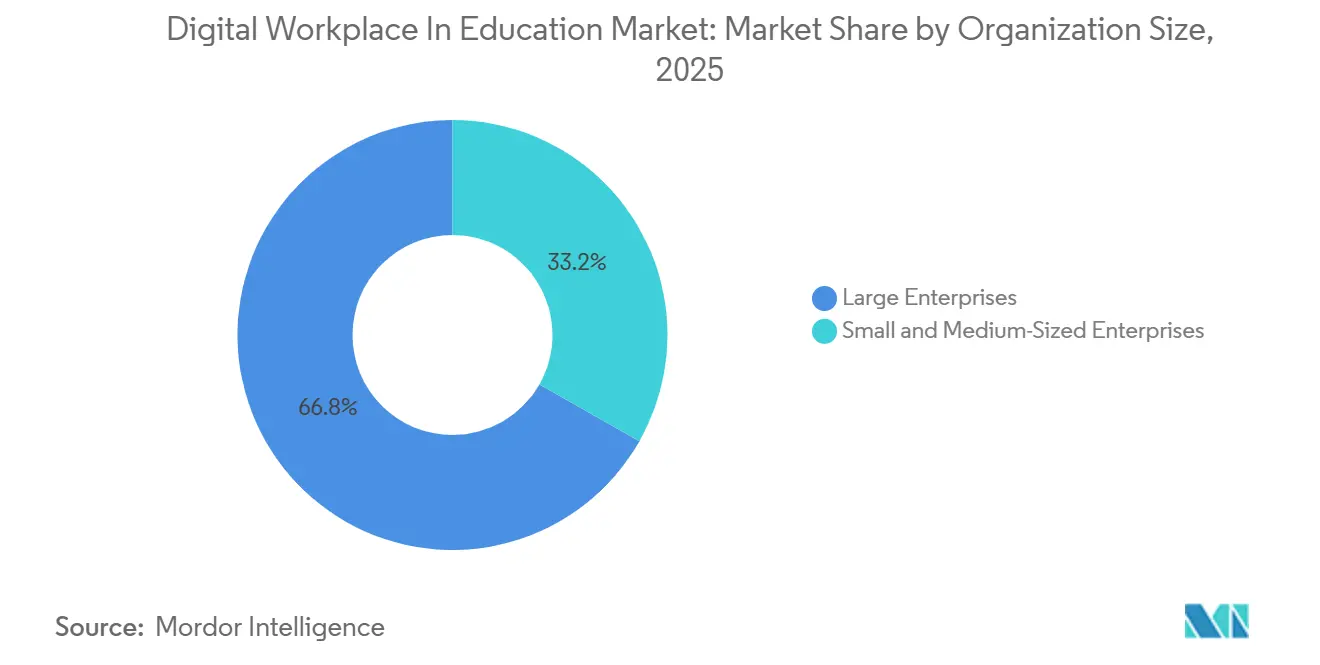
- By organization size, Large Enterprises held 66.77% of the digital workplace in education market share in 2025, while SMEs are projected to advance at a 23.76% CAGR through 2031 as SaaS pricing lowers entry barriers.
- By geography, North America held 38.22% share in 2025, while Asia-Pacific is projected to record the fastest regional CAGR of 24.07% through 2031.
Note: Market size and forecast figures in this report are generated using Mordor Intelligence’s proprietary estimation framework, updated with the latest available data and insights as of January 2026.
Market Trends and Insights
Drivers Impact Analysis of Digital Workplace In Education Market*
| Driver | (~) % Impact on CAGR Forecast | Geographic Relevance | Impact Timeline |
|---|---|---|---|
| GenAI-Enabled Knowledge Discovery and Workflow Automation | +5.2% | Global, with early concentration in North America and Northern Europe | Medium term (2-4 years) |
| Rising Demand for Unified Staff and Student Collaboration | +4.8% | Global | Short term (≤ 2 years) |
| Higher Education Digital Experience Modernization | +4.1% | North America and Europe, spill-over to Asia-Pacific | Medium term (2-4 years) |
| Security-First Consolidation of Fragmented Education Systems | +3.6% | Global, with North America and European Union leading compliance-driven spending | Short term (≤ 2 years) |
| Campus Mobility, BYOD, and Zero-Trust Access Expansion | +2.9% | North America and Asia-Pacific core, spill-over to Middle East | Medium term (2-4 years) |
| Managed Digital Workplace Outsourcing in Education | +2.5% | North America and Europe, early gains in Saudi Arabia and United Arab Emirates | Long term (≥ 4 years) |
| Source: Mordor Intelligence | |||
GenAI-Enabled Knowledge Discovery and Workflow Automation
Generative AI is shifting platform value in the digital workplace in education market from passive software access to active support for search, drafting, scheduling, and knowledge retrieval. The OECD reported that 57% of lower secondary teachers globally said AI improves lesson planning, and 37% already used AI tools for professional work in 2024, which shows that adoption in schools is already moving ahead of many formal procurement cycles.[1] Institutions that delay platform consolidation now face a higher risk of being locked into systems that cannot support AI agents for routine academic and administrative tasks. A 2026 study in Frontiers in Artificial Intelligence showed that a multi-agent retrieval pipeline could automatically create SCORM-compliant courses from enterprise documents, which points to a much deeper role for AI-native workflow tools in education settings. That changes buying behavior in the digital workplace in education market, because software selection now depends more on model integration, governance, and workflow fit than on standalone productivity features. It also strengthens the position of larger platform vendors, because embedded AI is becoming a baseline expectation rather than a premium add-on.
Rising Demand for Unified Staff and Student Collaboration
A major near-term growth force in the digital workplace in education market is the push to replace separate communication tools with one collaboration layer that serves academic delivery and back-office work together. EDUCAUSE highlighted data-informed decision making, future workforce readiness, and AI-aware knowledge practices as central priorities for higher education IT leaders in 2026, which supports stronger institutional demand for connected workplace systems.[2] Institutions are increasingly favoring platforms that reduce the number of logins, simplify identity controls, and create a consistent experience across HR, student services, and faculty coordination. Adoption is usually stronger when course rosters, schedules, and staff records connect cleanly into the collaboration layer, because daily use rises when users do not need to move across multiple disconnected interfaces. The digital workplace in education market is also being lifted by the practical need to support hybrid faculty work, cross-campus coordination, and faster response times in advising, administration, and student support. Procurement standards are also becoming stricter, because institutions want auditable separation between student records and staff communications when they evaluate platform design and data handling.
Higher Education Digital Experience Modernization
Universities are not modernizing internal experience tools only to reduce cost, they are also trying to improve faculty satisfaction, operating speed, and service quality across distributed campuses. The EDUCAUSE 2026 agenda placed technology literacy for the future workforce among the leading priorities for higher education IT teams, which supports the view that workplace systems now influence academic capability as well as administration. Germany’s Digitalpakt 2.0 committed EUR 5 billion (USD 5.4 billion), to digital education infrastructure through 2030, with support extending beyond hardware into teacher training and learning environments.[3] Funding of that scale supports a shift away from stopgap and BYOD-only models, because institutions can plan for broader, managed platforms instead of patchwork deployments. The digital workplace in education market is also benefiting from stronger demand at research universities, where grant administration, multi-site projects, and faculty coordination create a clear need for intranets, workflow tools, and better knowledge management. Compliance requirements also matter more in these decisions, because institutions increasingly expect vendors to support formal security and governance standards across multiple user groups and campuses.
Security-First Consolidation of Fragmented Education Systems
Security pressure is pushing many institutions to treat workplace modernization as a risk-control decision instead of a simple feature upgrade. The digital workplace in education market benefits from this shift because fragmented systems make identity control, endpoint management, and access monitoring harder to enforce across distributed campuses. When institutions adopt zero-trust models, they usually need to align collaboration tools, endpoint policies, and directory services under one governance structure. That favors vendors that can offer security, productivity, and device controls within a unified policy environment, because those bundles reduce integration burden and improve accountability. Modern observability tools also give institutions better visibility into access patterns, policy exceptions, and system use, which strengthens the case for integrated platforms over isolated point solutions. As a result, the digital workplace in education market is moving toward fewer disconnected systems and more tightly governed suites, especially where compliance risk is high and internal IT capacity is limited.
Restraints Impact Analysis of Digital Workplace In Education Market*
| Restraint | (~) % Impact on CAGR Forecast | Geographic Relevance | Impact Timeline |
|---|---|---|---|
| Budget Pressure and Long Replacement Cycles in Public Education | -3.2% | Global, most acute in publicly funded K-12 in North America and Europe | Short term (≤ 2 years) |
| Data Privacy, Child Protection, and Consent Compliance Complexity | -2.1% | Global, European Union (GDPR), United States (FERPA, COPPA), and national child-protection laws | Medium term (2-4 years) |
| Integration Friction With Legacy SIS, LMS, and IAM Stacks | -1.8% | Global, with higher severity in institutions with multi-decade-old ERP systems | Medium term (2-4 years) |
| Low Change Absorption Across Faculty and Administrative Teams | -1.5% | Global, most pronounced in tenured faculty environments | Long term (≥ 4 years) |
| Source: Mordor Intelligence | |||
Budget Pressure and Long Replacement Cycles in Public Education
Budget pressure remains one of the clearest limits on faster expansion in the digital workplace in education market, especially across public K-12 systems and smaller public colleges. Many institutions work within multi-year contract cycles, which means willingness to adopt newer tools does not always translate into immediate purchasing action. The end of emergency pandemic funding also tightened discretionary technology budgets in 2025 and 2026, which forced many administrators to delay platform changes and extend the life of existing software. This has a direct effect on the digital workplace in education market because advanced AI, endpoint management, and governance features are often tied to enterprise licensing tiers that smaller institutions cannot reach quickly. Grant programs and national frameworks provide some relief, but they do not fully cover the broader investment needed for integrated workplace platforms. Vendors therefore face slower conversion cycles in the public segment, even when the operational case for modernization is already clear.
Data Privacy, Child Protection, And Consent Compliance Complexity
Privacy and child protection rules continue to slow deployment in the digital workplace in education market because institutions must evaluate how every platform handles records, consent, and cross-system data access. FERPA, GDPR, and COPPA shape many of these decisions, and the challenge becomes harder when institutions serve users across different legal jurisdictions and age groups. The digital workplace in education market also faces longer onboarding cycles when AI features are involved, because institutions need clarity on data control, model behavior, auditability, and third-party access. State-level privacy rules in the United States add another layer of review, which makes compliance design especially difficult for smaller vendors with limited legal and engineering capacity. Behavioral analytics and engagement tracking can also come into conflict with data minimization expectations, particularly for younger student populations. As a result, privacy readiness is no longer a secondary requirement, because it now affects sales timing, deployment scope, and vendor eligibility at the institutional level.
*Our forecasts treat driver/restraint impacts as directional, not additive. The impact forecasts reflect baseline growth, mix effects, and variable interactions.
Digital Workplace In Education Market Segment Analysis
By Component:
Solutions Lead While Services Expand with ComplexitySolutions accounted for 64.22% of the digital workplace in education market size in 2025, which shows that institutions still place the highest value on software platforms rather than stand-alone support contracts. UC and collaboration tools remain the center of this spending because they shape daily communication between faculty, administrators, and support teams across in-person and hybrid settings. Workflow automation and knowledge management are also gaining more attention as institutions try to reduce repetitive work in scheduling, onboarding, grant administration, and reporting. The digital workplace in education market is also seeing stronger demand for virtual desktop environments in higher education, where research teams need secure and flexible access to computing environments across locations. Employee experience and intranet platforms are becoming more relevant in large university systems because leadership teams increasingly connect internal communication quality with retention, service consistency, and workforce coordination.
Services held a smaller share, but they are becoming more important as implementation demands rise across AI, security, and integration workstreams. Many institutions do not have enough internal capacity to configure complex suites, maintain security controls, and support change management across departments and campuses. That is making managed services a practical growth engine in the digital workplace in education market, especially among institutions that want enterprise features without building large in-house support teams. The 2026 Frontiers in Artificial Intelligence study on automated SCORM course creation illustrates how technical modern workplace deployments are becoming when AI is embedded into education workflows. This is one reason services are gaining weight in the digital workplace in education industry, because configuration, governance, and user rollout now require more specialized support than earlier productivity deployments. It also means providers that combine software with strong implementation and monitoring capabilities can deepen account value even when software procurement remains cautious.
By Deployment Mode:
Cloud Sets the Pace While Hybrid Models Hold Sensitive WorkloadsCloud deployment is projected to grow at a 23.76% CAGR through 2031, which places it at the center of expansion in the digital workplace in education market. Institutions continue to move toward cloud environments because they allow faster updates, easier remote access, and broader compatibility with AI-enabled collaboration and workflow tools. Cloud is especially attractive where internal IT teams need to support distributed faculty, mobile staff, and multi-campus operations without maintaining heavy on-site infrastructure. The digital workplace in education market is also seeing cloud adoption become less optional, because many of the newest platform capabilities reach education customers first through cloud-based delivery models. That pattern is pushing institutions to evaluate cloud readiness not just as a cost decision, but as a practical requirement for long-term platform relevance.
On-premises deployment still holds an important role in institutions that manage sensitive student records, health data, identity systems, and other regulated information. Many campuses are not abandoning internal systems completely, because some workloads still need tighter residency control and internal governance. Hybrid architecture is therefore becoming a deliberate choice in the digital workplace in education market, not merely a temporary midpoint on the way to full cloud adoption. In practice, institutions often move collaboration, content access, and knowledge tools to the cloud while keeping core administrative records under more direct control. This split model is also reducing resistance in the digital workplace in education industry, because it lets institutions modernize user-facing functions without forcing a full migration of sensitive back-end systems. The result is a deployment pattern where cloud drives momentum, while hybrid design helps institutions navigate privacy, legacy integration, and governance constraints with less operational disruption.
By Organization Size:
Large Institutions Control Revenue While SMEs Increase Adoption VolumeLarge enterprises held 66.77% of the digital workplace in education market share in 2025, which reflects the scale of their workforce, device fleets, research operations, and compliance obligations. Multi-campus universities and large private education networks usually have the budget and internal processes needed to adopt unified endpoint management, virtual desktop infrastructure, intranets, and advanced collaboration suites at scale. These institutions also face the most complex authentication paths, which makes integrated platforms more valuable because they reduce fragmentation across departments and campuses. The digital workplace in education market therefore remains revenue-heavy at the large-institution end, where procurement is slower but contract sizes are much larger. Large accounts are also where major vendors can bundle AI, security, and productivity layers together and deepen adoption across already established licensing relationships.
SMEs are projected to grow at a 23.76% CAGR through 2031, which makes them the fastest-moving customer group by adoption pace. Community colleges, regional institutions, and independent schools are gaining access to better tools because SaaS pricing and subscription models reduce the barrier to entry. This shift matters for the digital workplace in education market because smaller institutions represent a broad volume opportunity even when individual contracts remain modest. Many of these buyers are looking for fast deployment, lower administrative burden, and clear monthly pricing rather than customized enterprise architecture. Budget pressure still limits some decisions, but affordable cloud suites and simpler rollout models are helping SME adoption move faster than in earlier procurement cycles. That gives the digital workplace in education industry a second growth lane, where broad customer count expansion complements the large-contract base established by research universities and state systems.
Geography Analysis
North America Digital Workplace in Education Market
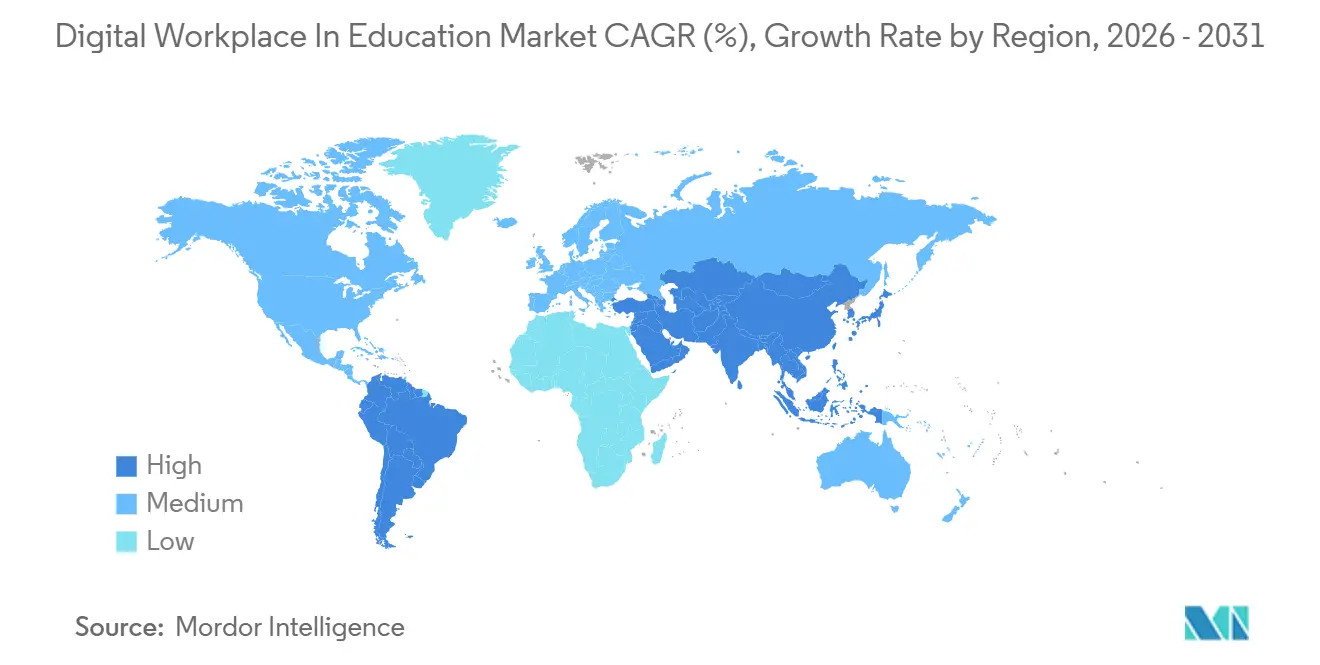
North America held 38.22% of revenue in 2025, which kept it as the leading regional base for the digital workplace in education market. The United States remains the main driver because its higher education system, K-12 technology spending, and deep vendor presence support broad platform adoption across institutional types. Statewide and system-wide agreements also matter more in this region, because they can move large user populations onto one platform at once. Google’s June 2026 partnership with the Utah State Board of Education to provide Gemini for Education and training support to more than 708,000 students and educators shows the scale of platform-led deployment now taking shape in U.S. education. North America also sets a demanding compliance standard, because institutions must manage FERPA, COPPA, and state-level privacy rules while still delivering modern collaboration environments.
APAC Digital Workplace in Education Market
Asia-Pacific is projected to expand at a 24.07% CAGR through 2031, which makes it the fastest-growing regional block in the digital workplace in education market. Growth in this region is being supported by national digitalization programs, growing enrollment, and direct policy support for AI and cloud-based education systems. China’s 2026 education planning direction and Fujian Province’s implementation framework for a “1-1-3-5” digital education architecture show how public policy is guiding platform buildout across infrastructure, intelligent systems, and learning environments. India and Southeast Asia are also adding momentum as institutions move toward cloud-led campus models and try to avoid long delays tied to older on-premises investments. Japan remains slower than many regional peers, because procurement practices and legacy vendor relationships still limit the speed of platform transition.
Europe, Middle East and South America Digital Workplace in Education Market
Europe remains a major spending geography in the digital workplace in education market, with Germany, the United Kingdom, France, and the Nordics accounting for much of regional demand. Germany’s Digitalpakt 2.0 is especially important because it directs EUR 5 billion, or USD 5.4 billion, toward school digital infrastructure through 2030 and supports a longer investment cycle across systems and training. The Middle East is also gaining attention as education infrastructure programs in Saudi Arabia and the UAE support enterprise-grade deployments with stronger sovereignty requirements. South America is developing at a steadier pace, with Brazil standing out after the federal launch of a national digital and media education collection for teacher support in April 2026.
Competitive Landscape
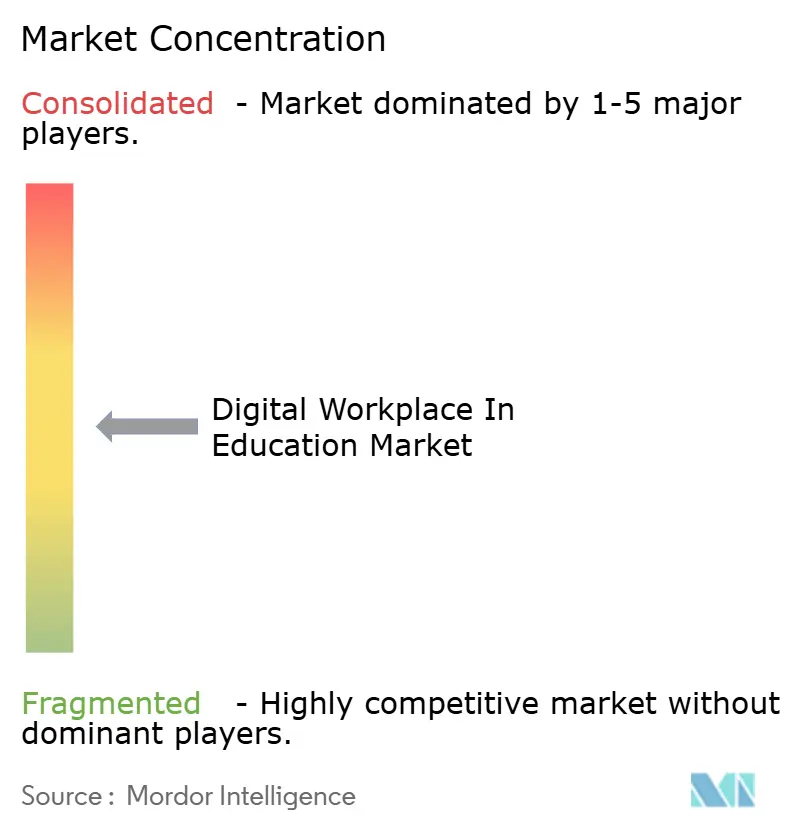
The digital workplace in education market is moderately consolidated at the platform level, where Microsoft and Google continue to shape baseline expectations around collaboration, identity, productivity, and embedded AI. Their strength comes from broad education suites that are already tied into everyday institutional workflows, which makes displacement harder once a campus standard has been set. At the same time, the market remains open at the specialist layer, where vendors such as Staffbase, Workvivo, LumApps, Simpplr, Happeo, Omnissa, and Citrix compete in narrower workloads that large suites do not fully address. This split structure means the digital workplace in education market is not controlled by one vendor class alone, because general-purpose suites and specialist tools still serve different operational needs. It also means competition is shifting from feature checklists toward integration quality, governance strength, and the ability to work across education-specific systems without heavy custom engineering.
A clear strategic move in 2026 was Cisco’s integration of Cisco Secure Access with Microsoft Edge for Business, which combined browser governance, data loss prevention, and AI oversight in a single operating flow. That kind of partnership matters because institutional buyers increasingly want security and productivity layers to work together instead of being managed as separate projects. Another major move was Ellucian’s completion of its acquisition of Anthology’s SIS and ERP business, which added more than 260 institutional customers and strengthened its position in the administrative systems layer that connects closely with workplace tools. The digital workplace in education market is therefore seeing competition widen beyond pure collaboration software, because the connection between workplace platforms, student systems, and enterprise records is becoming a central buying issue. Vendors that simplify these connections have a stronger chance of winning multi-year institutional contracts.
The market also leaves room for challengers that focus on intranet design, staff communication, research workflow coordination, and SME-friendly pricing. Atlassian continues to benefit in research-heavy environments where project coordination and structured documentation matter more than general communication alone. Zoho is also relevant at the smaller end, where institutions want a broad set of workplace functions without enterprise-tier pricing or complex rollout models. Overall, the digital workplace in education market rewards vendors that can combine platform breadth with education-specific operational fit, because institutions now judge tools on long-term governance, interoperability, and user adoption rather than on collaboration features alone.
Digital Workplace In Education Industry Leaders
-
Microsoft Corporation
-
Google LLC
-
Cisco Systems, Inc.
-
Omnissa, LLC
-
Citrix Systems, Inc.
- *Disclaimer: Major Players sorted in no particular order
Digital Workplace In Education Market Companies Covered in this Report
- Microsoft Corporation
- Google LLC
- Cisco Systems, Inc.
- Omnissa, LLC
- Citrix Systems, Inc.
- Unily Group Ltd
- LumApps SAS
- Staffbase GmbH
- Workvivo Limited
- Simpplr, Inc.
- Happeo Oy
- Interact Software Limited
- Claromentis Limited
- Atlassian Corporation Plc
- Zoho Corporation Pvt. Ltd.
- Blackbaud, Inc.
- Anthology Inc.
- PowerSchool Holdings, Inc.
- D2L Inc.
- Instructure Holdings, Inc.
Recent Industry Developments in Digital Workplace In Education Market
- June 2026: Microsoft rolled out Copilot Notebooks and the Study Guide experience to all Microsoft 365 Education A1, A3, and A5 license holders at no additional cost, making AI-powered note organization, mind mapping, and exam preparation tools available to millions of students and educators globally. The move extended Microsoft’s product footprint into seats already under institutional contract, deepening retention and compressing the competitive window for standalone student productivity applications.
- June 2026: Google announced a partnership with the Utah State Board of Education to deploy Gemini for Education across all K-12 schools in Utah from the 2026-2027 academic year, providing secure AI tools, AI literacy training, and free Google Career Certificates to over 708,000 students and educators. The agreement establishes a statewide-scale reference deployment for AI-embedded digital workplace tools in K-12 education.
- May 2026: Cisco Systems Inc. announced the integration of Cisco Secure Access with Microsoft Edge for Business, combining security service edge with enterprise browser governance to create a unified data loss prevention and AI governance layer. The integration applies DLP policies to generative AI tools accessed through Edge and extends AI agent oversight to Copilot environments.
- April 2026: Instructure announced an exclusive strategic partnership with K16 Solutions to automate LMS migration services for institutions transitioning from legacy platforms to Canvas LMS. The arrangement grants Instructure exclusive access to K16’s migration tools, reducing risk and disruption for institutions modernizing their digital learning infrastructure.
Global Digital Workplace In Education Market Report Scope
The Digital Workplace in Education Market comprises a comprehensive ecosystem of integrated digital technologies, platforms, and services specifically designed for educational institutions, including K-12 schools, universities, and training organizations. This ecosystem facilitates seamless teaching, learning, administration, and collaboration. Core components include cloud-based productivity tools, learning management systems (LMS), virtual classrooms, communication software, digital content creation platforms, cybersecurity solutions, and analytics tools, collectively supporting remote, hybrid, and on-campus learning environments.
The Digital Workplace in Education Market Report is Segmented by Component (Solutions [Unified Communication and Collaboration, Unified Endpoint Management, Enterprise Mobility and Management, Employee Experience Platforms and Intranet, Workflow Automation and Knowledge Management, and Virtual Desktop Infrastructure and Cloud PC] and Services), Deployment Mode (Cloud, On-Premises, and Hybrid), Organization Size (Large Enterprises and Small and Medium-Sized Enterprises), and Geography (North America, South America, Europe, Asia-Pacific, and Middle East, Africa). The Market Forecasts are Provided in Terms of Value (USD).
Segmentation Overview
| Solutions | Unified Communication and Collaboration |
| Unified Endpoint Management | |
| Enterprise Mobility and Management | |
| Employee Experience Platforms and Intranet | |
| Workflow Automation and Knowledge Management | |
| Virtual Desktop Infrastructure and Cloud PC | |
| Services |
| Cloud |
| On-Premises |
| Hybrid |
| Large Enterprises |
| Small and Medium-Sized Enterprises |
| North America | United States |
| Canada | |
| Mexico | |
| South America | Brazil |
| Argentina | |
| Chile | |
| Colombia | |
| Rest of South America | |
| Europe | Germany |
| United Kingdom | |
| France | |
| Italy | |
| Spain | |
| Netherlands | |
| Nordics | |
| Russia | |
| Rest of Europe | |
| Asia-Pacific | China |
| Japan | |
| India | |
| South Korea | |
| Australia and New Zealand | |
| Southeast Asia | |
| Rest of Asia-Pacific | |
| Middle East | Saudi Arabia |
| United Arab Emirates | |
| Turkey | |
| Israel | |
| Rest of Middle East | |
| Africa | South Africa |
| Egypt | |
| Nigeria | |
| Kenya | |
| Rest of Africa |
| By Component | Solutions | Unified Communication and Collaboration |
| Unified Endpoint Management | ||
| Enterprise Mobility and Management | ||
| Employee Experience Platforms and Intranet | ||
| Workflow Automation and Knowledge Management | ||
| Virtual Desktop Infrastructure and Cloud PC | ||
| Services | ||
| By Deployment Mode | Cloud | |
| On-Premises | ||
| Hybrid | ||
| By Organization Size | Large Enterprises | |
| Small and Medium-Sized Enterprises | ||
| By Geography | North America | United States |
| Canada | ||
| Mexico | ||
| South America | Brazil | |
| Argentina | ||
| Chile | ||
| Colombia | ||
| Rest of South America | ||
| Europe | Germany | |
| United Kingdom | ||
| France | ||
| Italy | ||
| Spain | ||
| Netherlands | ||
| Nordics | ||
| Russia | ||
| Rest of Europe | ||
| Asia-Pacific | China | |
| Japan | ||
| India | ||
| South Korea | ||
| Australia and New Zealand | ||
| Southeast Asia | ||
| Rest of Asia-Pacific | ||
| Middle East | Saudi Arabia | |
| United Arab Emirates | ||
| Turkey | ||
| Israel | ||
| Rest of Middle East | ||
| Africa | South Africa | |
| Egypt | ||
| Nigeria | ||
| Kenya | ||
| Rest of Africa | ||
Key Questions Answered in the Report
How large is the digital workplace in education market?
The digital workplace in education market reached USD 5.43 billion in 2025 and is forecast to reach USD 18.68 billion by 2031 at a 23.04% CAGR during 2026-2031.
What is driving adoption across schools and universities?
The biggest demand factors are platform consolidation, AI-enabled workflow support, stronger collaboration needs, and tighter security and governance requirements across campuses.
Which component leads spending?
Solutions led with 64.22% of revenue in 2025, as institutions prioritized collaboration, workflow, and productivity platforms over stand-alone service contracts.
Which deployment model is expanding the fastest?
Cloud is projected to grow at a 23.76% CAGR through 2031, supported by easier updates, broader remote access, and faster delivery of AI-enabled features.
Which organization type contributes the most revenue?
Large enterprises held 66.77% share in 2025 because multi-campus universities and large education networks have more complex digital workplace needs and larger contract values.
Which region is growing the fastest?
Asia-Pacific is projected to record the fastest regional CAGR at 24.07% through 2031, supported by state-led digitalization programs and expanding education infrastructure.