
Digital Workplace In Healthcare Market Size and Share
Market Overview
| Study Period | 2020 - 2031 |
|---|---|
| Market Size (2026) | USD 8.94 Billion |
| Market Size (2031) | USD 27.15 Billion |
| Growth Rate (2026 - 2031) | 24.78 % |
| Fastest Growing Market | Asia-Pacific |
| Largest Market | North America |
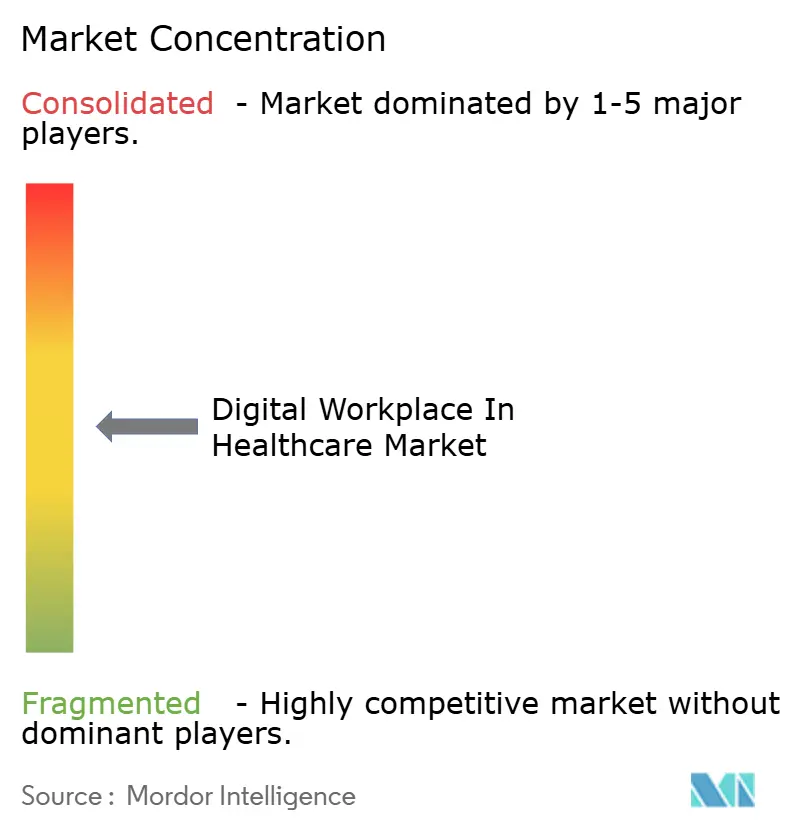
| Market Concentration | Medium |
Major Players *Disclaimer: Major Players sorted in no particular order Image © Mordor Intelligence. Reuse requires attribution under CC BY 4.0. | |
Digital Workplace In Healthcare Market Analysis by Mordor Intelligence
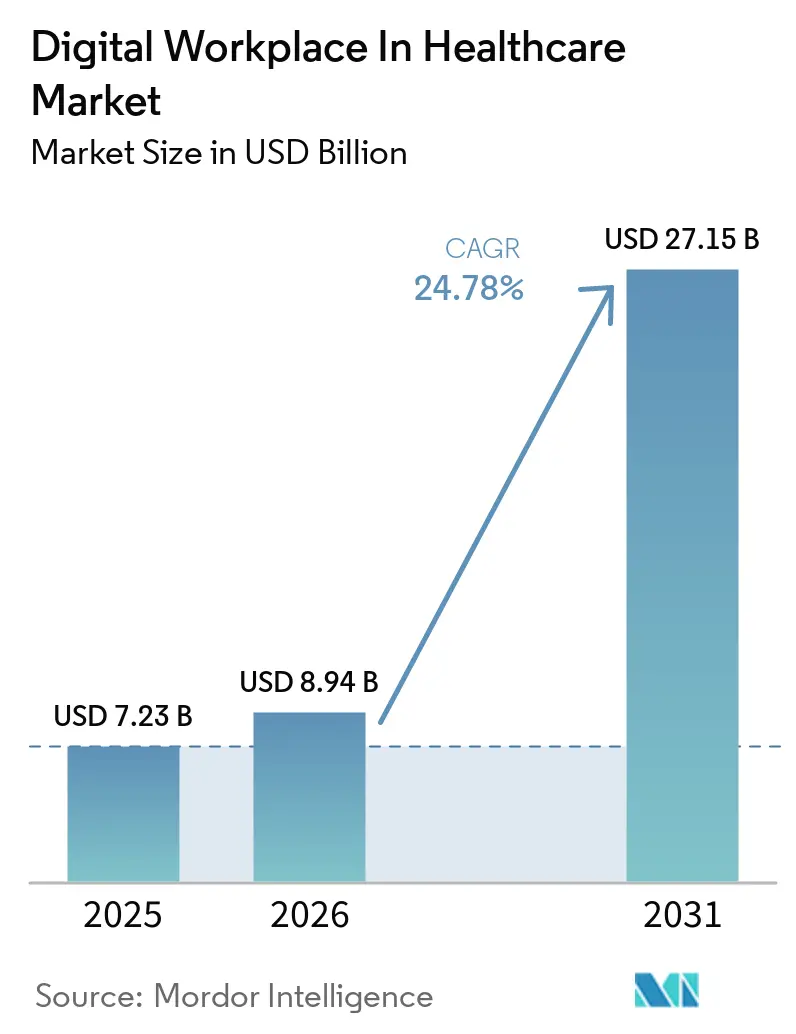
The digital workplace in healthcare market size is projected to be USD 7.23 billion in 2025, USD 8.94 billion in 2026, and reach USD 27.15 billion by 2031, growing at a CAGR of 24.87% from 2026 to 2031. The digital workplace in healthcare market is expanding because health systems are moving from disconnected collaboration tools toward integrated environments that support clinical, administrative, and operational work in one setting. Demand is rising across hospital networks, ambulatory centers, and home-based care programs because care teams now need persistent connectivity that follows them across sites, shifts, and care pathways. AI-enabled documentation, workflow support, and role-based workspaces are pushing the digital workplace in healthcare market closer to core delivery models rather than side projects within IT modernization plans. Cybersecurity controls, audit-ready communication, and stronger governance are also shaping vendor selection because distributed work has made informal or fragmented communication harder to justify in regulated care settings. The strongest opportunities in the digital workplace in healthcare market are tied to EHR-connected collaboration, cloud-native standardization, and managed service models that make enterprise-grade tools accessible to smaller provider organizations.
Key Report Takeaways
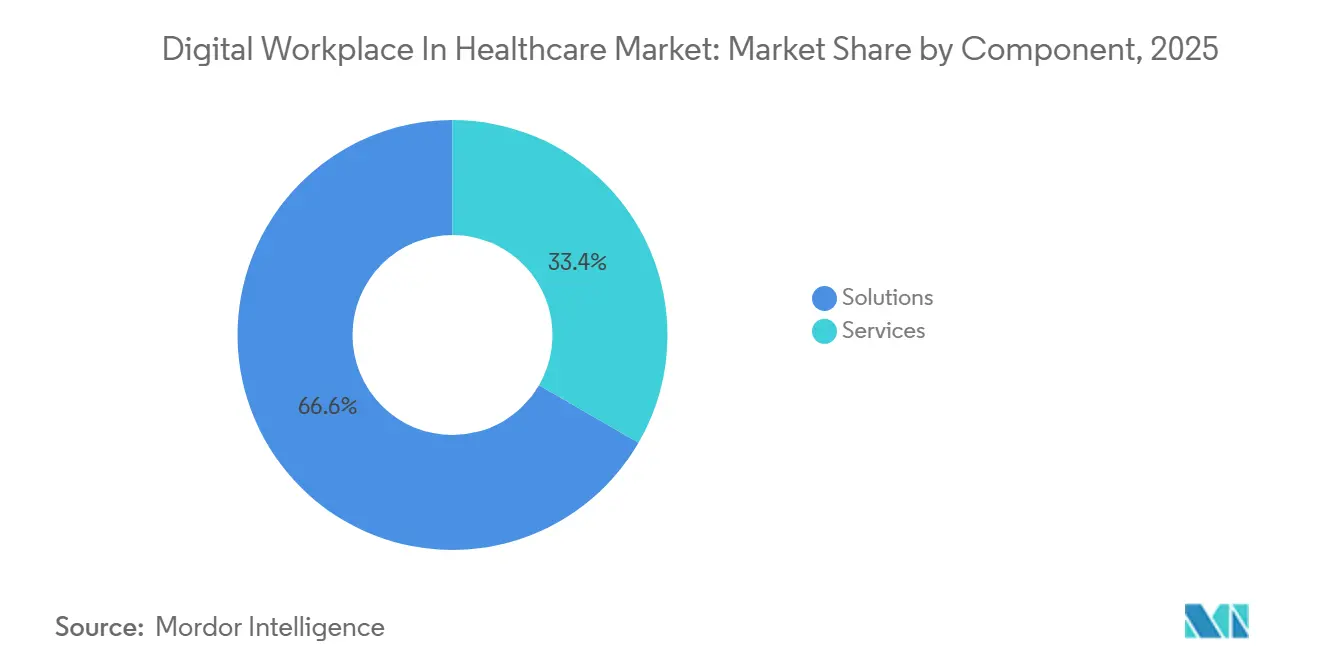
- By component, solutions held 66.64% share of the digital workplace in healthcare marketin 2025, and the solutions segment is projected to expand at a 25.22% CAGR through 2031.
- By deployment mode, cloud accounted for 53.67% share in 2025, and cloud is projected to expand at a 25.64% CAGR through 2031.
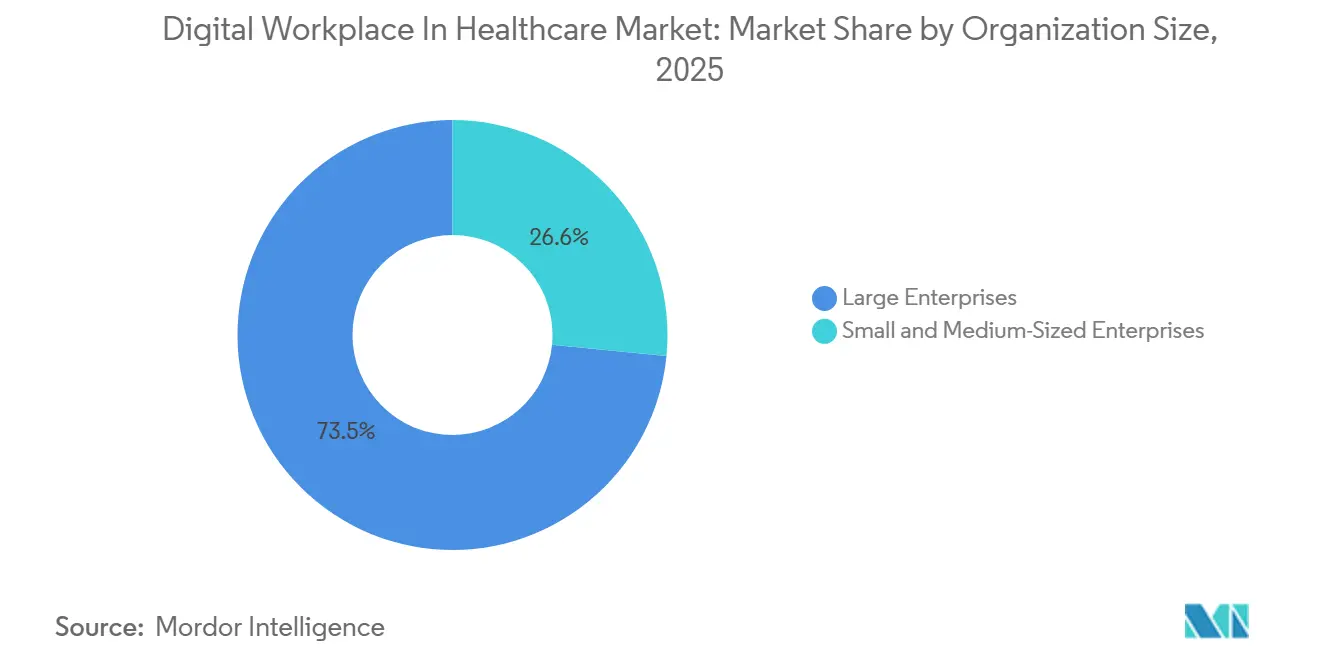
- By organization size, large enterprises held 73.45% share in 2025, while small and medium-sized enterprises are projected to record the fastest CAGR at 25.56% through 2031.
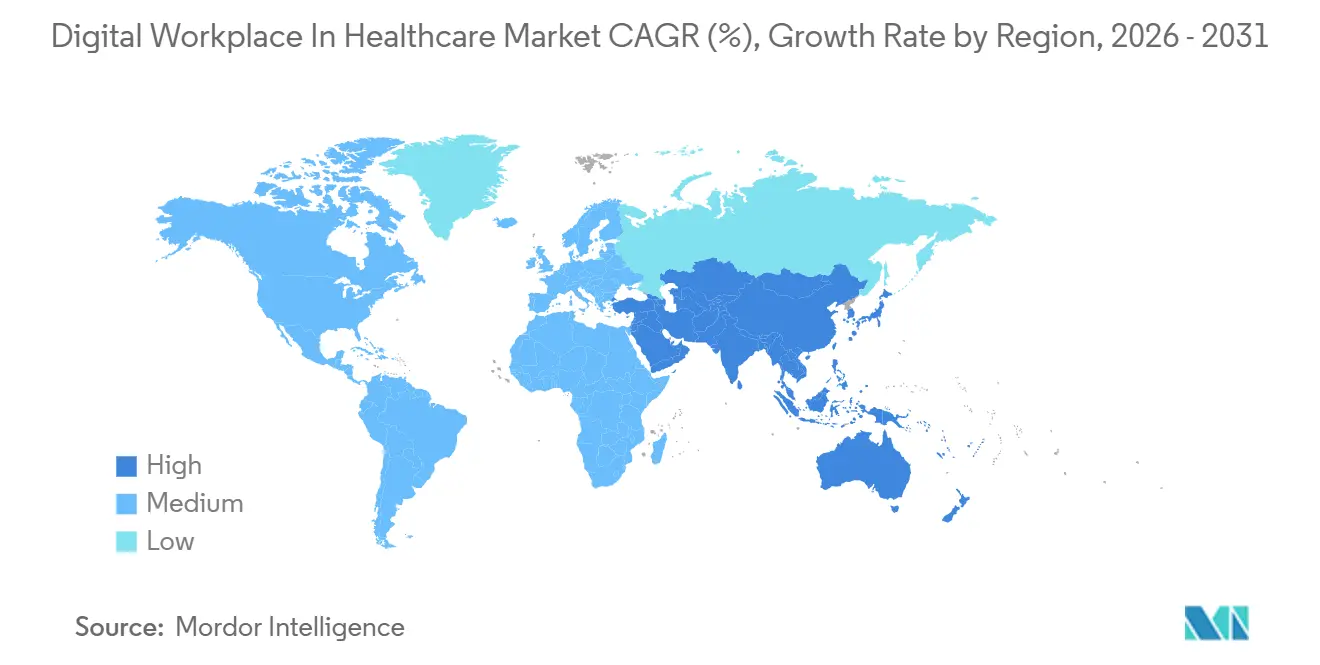
- By geography, North America held 35.78% share in 2025 within the digital workplace in healthcare market, while Asia-Pacific is projected to expand at a 25.43% CAGR through 2031.
Note: Market size and forecast figures in this report are generated using Mordor Intelligence’s proprietary estimation framework, updated with the latest available data and insights as of January 2026.
Market Trends and Insights
Drivers Impact Analysis of Digital Workplace In Healthcare Market*
| Driver | (~) % Impact on CAGR Forecast | Geographic Relevance | Impact Timeline |
|---|---|---|---|
| Rising Virtual Care Coordination Needs Across Care Settings | +3.5% | Global, accelerated in North America and Asia-Pacific | Short term (≤ 2 years) |
| Expansion of Interoperable Clinical Collaboration Workflows | +2.8% | Global, highest traction in North America and Europe | Medium term (2-4 years) |
| Shift Toward Unified Digital Front Doors for Care Teams | +2.4% | North America and Europe, with spillover into the Middle East | Medium term (2-4 years) |
| Compliance Pressure for Audit-Ready Communication Trails | +1.8% | North America and Europe | Short term (≤ 2 years) |
| Growth in Healthcare Employee Experience and Retention Programs | +1.2% | Global, concentrated in North America and Europe | Medium term (2-4 years) |
| Rising Demand for Cloud-Based Desktop and Workspace Standardization | +1.0% | Global, early adoption in North America and Asia-Pacific | Long term (≥ 4 years) |
| Source: Mordor Intelligence | |||
Rising Virtual Care Coordination Needs Across Care Settings
The digital workplace in healthcare market is gaining momentum because hybrid care models now require staff to coordinate across emergency departments, outpatient clinics, home health services, and remote monitoring programs without losing workflow continuity. Providers are no longer treating telehealth as a separate channel, because notes, tasks, secure messaging, pre-visit preparation, and follow-up work now need to sit inside the same operating environment to avoid repeated handoffs and fragmented accountability. This has shifted buying priorities away from isolated communication tools and toward platforms that can support daily work before, during, and after the care encounter. In March 2026, Amazon Web Services launched Amazon Connect Health, a purpose-built agentic AI platform that combines pre-visit patient insights, ambient clinical documentation, and post-visit medical coding within a unified SDK that integrates into existing EHR systems.[1] That launch shows that hyperscalers view care coordination as a direct route to deeper healthcare workflow ownership rather than a limited contact center opportunity. As a result, the digital workplace in healthcare market is increasingly shaped by enterprise cloud agreements, which gives CIO-led procurement teams more influence over decisions that once sat inside narrower clinical technology budgets.
Expansion of Interoperable Clinical Collaboration Workflows
The digital workplace in healthcare market is also benefiting from a broad shift toward platforms that connect clinical, administrative, and operational tasks in real time instead of leaving departments on separate systems. Hospitals have learned that communication tools create less value when nurses, physicians, and administrative teams still need to move between multiple interfaces to complete a simple request or document a service issue. EHR integration now serves as a screening condition in vendor selection, because buyers want collaboration tools that stay inside the same workflow context where clinical work already happens. In February 2026, ServiceNow launched Healthcare Operations, which embeds a shared operational system of record into the electronic medical record and lets care teams raise IT, biomedical, facilities, and environmental services requests without leaving the workflow environment they already use.[2] This model reduces context switching, shortens response loops between frontline teams and support functions, and makes operational coordination part of clinical throughput rather than an external service ticket process. That change supports the digital workplace in healthcare market because it moves collaboration spending closer to patient flow, staffing efficiency, and service reliability, which are harder for providers to delay when margins and labor capacity remain under pressure.
Shift Toward Unified Digital Front Doors for Care Teams
The digital workplace in healthcare market is moving toward unified digital front doors that give clinicians and administrative staff one login, one notification stream, and one mobile experience across communication, scheduling, documentation, and follow-up work. Health systems are consolidating fragmented tools because multiple apps create more interruptions, weaker governance, and more training overhead for already stretched teams. Buyers also want consistent role-based experiences so that physicians, nurses, and diagnostic staff can work inside shared infrastructure without losing task relevance or workflow speed. In March 2026, Microsoft expanded Dragon Copilot at HIMSS 2026 with role-based experiences for physicians, nurses, and radiologists, support for 58 languages, and integration of patient data with enterprise work context from Microsoft 365 Copilot in a single interface.[3] That rollout shows how large vendors are turning productivity suites into clinician-facing work hubs rather than back-office software layers. The digital workplace in healthcare market therefore favors vendors that can connect care-team workflows, enterprise identity, and role-based AI support inside a common environment that feels consistent across departments and care settings.
Compliance Pressure for Audit-Ready Communication Trails
The digital workplace in healthcare market is also being pushed forward by stronger demand for communication tools that create clear records of staff activity, access, and decision flow in regulated care environments. Health systems are under pressure to replace informal messaging patterns with platforms that can support encryption, retention policies, access governance, and audit review without breaking day-to-day clinical speed. This is especially important in distributed models where work now spans hospital floors, ambulatory sites, remote employees, and external care coordination partners. Germany's Federal Ministry of Health updated its GEMEINSAM DIGITAL 2026 strategy in February 2026 and set a target for AI-supported documentation to become standard practice across more than 70% of health and nursing facilities by 2028, which shows how policy is turning documentation and workflow tooling into a structured health system priority. Procurement teams increasingly treat traceable communication and documented workflow steps as required platform capabilities rather than premium features that can be added later. That shift strengthens the digital workplace in healthcare market because standardization becomes easier to justify when governance, documentation, and operational risk reduction are all addressed through the same platform decision.
Restraints Impact Analysis of Digital Workplace In Healthcare Market*
| Restraint | (~) % Impact on CAGR Forecast | Geographic Relevance | Impact Timeline |
|---|---|---|---|
| Legacy EHR and Identity System Integration Complexity | -2.4% | Global, most acute in North America and Europe | Medium term (2-4 years) |
| Cybersecurity and PHI Exposure Concerns in Distributed Workflows | -1.8% | Global | Short term (≤ 2 years) |
| Change Management Resistance Among Clinical Users | -1.2% | Global | Medium term (2-4 years) |
| Fragmented Budget Ownership Across IT, Clinical, and Operations Teams | -0.8% | Global, most pronounced in large integrated delivery networks | Long term (≥ 4 years) |
| Source: Mordor Intelligence | |||
Legacy EHR and Identity System Integration Complexity
The digital workplace in healthcare market still faces a persistent structural constraint because many provider organizations operate on EHR, identity, and messaging environments that were built over long periods and customized at many points. These installed systems often contain local codes, older message standards, and point-to-point interfaces that do not map cleanly into newer collaboration platforms or modern API-based architectures. A 2025 article in Trends in Health Informatics described how fragmented EHR and health information exchange ecosystems continue to require custom middleware, data mapping tools, and long integration timelines when organizations try to move toward interoperable digital health environments. This makes deployment more expensive and less predictable because a collaboration platform may appear straightforward until the buyer begins connecting identity controls, clinical records, scheduling tools, and support systems across a large health network. The problem is especially visible in academic medical centers and multi-site delivery systems where past customization has accumulated over many years and where each workflow change can affect several operational teams at once. The digital workplace in healthcare market therefore advances more slowly in settings where integration planning, testing, and maintenance demand almost as much attention as the platform rollout itself.
Cybersecurity And PHI Exposure Concerns In Distributed Workflows
The digital workplace in healthcare market also faces resistance when provider organizations worry that distributed work models can widen the path for PHI exposure, weak access control, or inconsistent endpoint protection. Remote collaboration, shared devices, browser access, mobile workflows, and cross-site coordination all improve flexibility, but they also increase the number of points where governance has to work correctly every day. Procurement teams now expect vendors to provide clear documentation on HIPAA eligibility, audit logs, identity controls, encryption practices, and security attestations before contracts can move forward. These security reviews can extend evaluation cycles and can slow adoption for newer entrants that do not yet have mature compliance documentation or a deep healthcare support track record. The burden is even heavier when buyers are already responding to past incidents or are tightening access policies across their broader application environment. For that reason, the digital workplace in healthcare market grows fastest where providers pair new collaboration tools with stronger identity management, endpoint monitoring, and workforce training rather than treating the platform itself as a stand-alone fix.
*Our forecasts treat driver/restraint impacts as directional, not additive. The impact forecasts reflect baseline growth, mix effects, and variable interactions.
Digital Workplace In Healthcare Market Segment Analysis
By Component:
Solutions Consolidate Across Clinical and Administrative FunctionsSolutions held 66.64% of digital workplace in healthcare market share in 2025, which confirms that software-led platform spending remained the core of the digital workplace in healthcare market. Providers directed most of that spending toward unified communication and collaboration platforms, virtual desktop infrastructure, workflow automation tools, and employee experience intranets that could support daily work across clinical and administrative settings. This mix reflects a practical buying pattern, because health systems often prefer to reduce tool sprawl before they expand consulting or integration scope around smaller point products. Within the digital workplace in healthcare industry, unified communication and collaboration platforms remained central because secure messaging, calling, shared workspaces, and mobile access now affect care coordination, staff responsiveness, and governance at the same time.
The solutions segment is projected to expand at a 25.22% CAGR through 2031, and that outlook reflects continued demand for platform layers that can standardize work across hospital campuses, ambulatory clinics, and remote care settings. Virtual desktop infrastructure and cloud PC models are strengthening this position because providers want more consistent access experiences in infection-sensitive clinical spaces where shared workstations and shifting user sessions still matter. Workflow automation and knowledge management are also taking a larger role because administrative burden remains a direct source of staff friction, delayed service response, and uneven onboarding. Employee experience platforms are being treated less as internal communication portals and more as operational infrastructure that can support retention, policy access, and manager follow-through. Services remain important to the digital workplace in healthcare market, but their demand is being shaped by the need to connect platform investments into existing EHR identity stacks and to maintain integrations over time as underlying clinical systems change. A meaningful shift is taking place within services as buyers move from one-time implementation projects toward recurring managed support, because EHR-connected environments require continuous API maintenance, governance checks, and workflow updates rather than simple post-launch stabilization.
By Deployment Mode:
Cloud Infrastructure Redefines Healthcare Workspace DeliveryCloud accounted for 53.67% of the digital workplace in healthcare market size in 2025 and is projected to expand at a 25.64% CAGR through 2031, making it the leading deployment model within the digital workplace in healthcare market. This position reflects the appeal of subscription pricing, faster rollout cycles, easier standardization across sites, and more direct access to AI, browser, and automation updates that would be slower to deploy in legacy local environments. Much of the current activity sits on Microsoft Azure, Google Cloud, and AWS, which has allowed hyperscalers to shape not just hosting choices, but also endpoint design, workflow integration, and security architecture. In May 2026, Google Cloud introduced Chrome Enterprise Premium integrations for healthcare, offering a secure browser environment that connects with leading clinical information systems and reinforces browser-based work as a viable operating layer for healthcare teams.
On-premises deployment still retains a role in the digital workplace in healthcare market where organizations face strict data residency rules, maintain disconnected clinical environments, or need local control over specific legacy applications that have not yet moved cleanly into cloud-ready architectures. Hybrid deployment has therefore become a practical bridge for providers managing multi-year EHR transitions or staggered application retirements across large estates. In many cases, hybrid is not being chosen as a permanent destination, but as a controlled path that allows providers to preserve continuity while they simplify identity, policy, and workflow dependencies over time. Vendors with clear migration roadmaps are better placed than those that simply offer hybrid as a long-term product tier without an operational path forward. The cloud shift is also changing contract structure in the digital workplace in healthcare market because bundled pricing, managed support, and security services are increasingly included in broader enterprise agreements rather than purchased as separate line items. That favors vendors that can combine infrastructure, collaboration, and governance into a single commercial relationship, especially when buyers want fewer suppliers and clearer accountability during rollout.
By Organization Size:
Large Enterprises Lead, But Midmarket Velocity AcceleratesLarge enterprises held 73.45% of digital workplace in healthcare market share in 2025, showing that the digital workplace in healthcare market still leaned heavily toward organizations with large user bases, stronger capital capacity, and dedicated integration teams. Academic medical centers and integrated delivery networks were especially active because they manage complex staffing patterns, multiple facilities, and high coordination loads that make unified platforms easier to justify. Their contract structures also give them an advantage, because multi-year agreements with productivity, cloud, and workflow vendors increasingly bundle collaboration capabilities into wider enterprise purchasing decisions. This means large organizations often adopt digital workplace tools as part of broader modernization programs rather than through isolated product selection.
Small and medium-sized enterprises are projected to record the fastest CAGR at 25.56% through 2031, which shows that the digital workplace in healthcare market is broadening beyond its traditional enterprise base. Managed service provider bundles and usage-based cloud pricing are making advanced communication, endpoint management, and workflow capabilities more accessible to rural hospitals, specialty group practices, and other smaller provider organizations. These buyers are not only seeking lower infrastructure burden, they are also looking for tools that help them stabilize staffing, shorten onboarding, and improve day-to-day communication without building large internal IT teams. AONL and Laudio Insights reported in spring 2026 that Gen Z registered nurses required 2.5 times more meaningful manager-employee interactions than prior generations to maintain equivalent retention rates, which shows how collaboration and documented touchpoints now influence workforce stability. The American Hospital Association also noted in its 2026 Health Care Workforce Scan that health systems with stronger culture and structured workforce programs are better positioned to retain early-career clinicians and support their long-term workforce pipeline. Those workforce dynamics give smaller organizations a clear reason to invest, because the operational cost of turnover is often harder for them to absorb than for larger systems with broader staffing depth.
Geography Analysis
North America Digital Workplace in Healthcare Market
North America held 35.78% share in 2025, and that kept the region at the center of the digital workplace in healthcare market. The United States remains the main driver because high healthcare IT spending, broad EHR penetration, and stricter accountability around compliant communication all support demand for more structured work environments. Buyers in this region are also more likely to evaluate collaboration platforms as part of enterprise productivity, cloud, and security architecture rather than as isolated communication upgrades. In March 2026, Google Cloud and CVS Health announced a strategic partnership to develop Health100, an integrated health technology services platform for consumers, care providers, payers, and digital health innovators, which reflects the region's tendency to connect care-team workflow with broader platform ecosystems. That pattern strengthens the digital workplace in healthcare market because payer-provider convergence and enterprise cloud strategy are increasingly influencing how workplace tools are selected and expanded.
APAC Digital Workplace in Healthcare Market
Asia-Pacific is projected to expand at a 25.43% CAGR through 2031, making it the fastest-growing regional segment in the digital workplace in healthcare market. Growth is being supported by national health digitalization programs, expanding private hospital networks, and stronger interest in AI-supported documentation and care coordination across India, China, South Korea, Australia, and Japan. In May 2026, Telstra Health launched Corus, a cloud-native and FHIR-native care intelligence ecosystem that supports population health, care navigation, and care coordination across multi-setting healthcare environments. That launch shows that regional demand is moving beyond basic digitization toward more connected workflow infrastructure with clearer interoperability expectations. The digital workplace in healthcare market is also benefiting from the fact that many Asia-Pacific providers are building newer digital layers without carrying the same volume of long-tail legacy customization seen in older Western hospital estates.
The Americas, EMEA and APAC Digital Workplace in Healthcare Market
Europe recorded a solid position in 2025, with Germany, the United Kingdom, France, and the Netherlands leading adoption in the digital workplace in healthcare market. Germany stands out because the Federal Ministry of Health updated GEMEINSAM DIGITAL 2026 in February 2026 and set a target for AI-assisted documentation to reach more than 70% of health and nursing facilities by 2028. That policy direction is pushing documentation and workflow tools closer to system-level implementation priorities and is favoring vendors that can provide EU data residency and GDPR-ready deployment models. South America and the Middle East and Africa remain part of the market scope, but the source material placed greater momentum on the policy, procurement, and platform activity occurring across North America, Europe, and Asia-Pacific.
Competitive Landscape
The digital workplace in healthcare market is moderately consolidated at the platform layer, but it remains fragmented at the point-solution layer where specialized vendors still address messaging, documentation, task routing, endpoint control, or employee experience needs. Large vendors such as Microsoft, ServiceNow, Cisco, Zoom, and Google Cloud have a structural advantage in enterprise procurement because they can bundle healthcare-specific capabilities into wider productivity, workflow, and infrastructure contracts. That advantage matters most in large provider organizations, where platform standardization often depends as much on contract reach and installed identity frameworks as on stand-alone product features. The digital workplace in healthcare market also includes focused healthcare IT players such as Epic Systems and eClinicalWorks, which compete by owning more of the workflow edge where collaboration tools meet clinical records, scheduling, or operational response. This creates a layered competitive pattern in which broad platform vendors control the commercial center, while workflow-specific suppliers continue to influence feature depth and care-setting relevance.
Strategic product moves have become the clearest way vendors are defending and expanding position in the digital workplace in healthcare market. In March 2026, Microsoft expanded Dragon Copilot with role-based experiences for physicians, nurses, and radiologists, multilingual documentation across 58 languages, and integration with Microsoft 365 Copilot work context, which strengthened its position at the intersection of productivity and clinician workflow. In February 2026, ServiceNow introduced Healthcare Operations to embed operational requests directly inside the electronic medical record, which pushed the company deeper into frontline care-team coordination and reduced the gap between clinical work and support service resolution. In March 2026, Google Cloud and CVS Health announced Health100, which showed how large ecosystem players are trying to connect consumer engagement, payer functions, and care-team workflows through one open platform direction. These moves show that competition in the digital workplace in healthcare market is shifting from feature comparison alone toward control of workflow context, enterprise identity, and multi-stakeholder platform reach.
Two open areas still leave room for competitive movement in the digital workplace in healthcare market. Mid-market health systems, especially regional hospital groups with multi-site footprints, still need integrated platforms that can deliver enterprise-grade coordination without the full implementation load that usually comes with large contracts. Care-team operational coordination also remains uneven, because the link between clinical decisions and support services such as biomedical engineering, facilities, environmental services, and IT is often still manual or handled through disconnected tools. That gap gives both platform vendors and EHR vendors room to extend workflow ownership, and it raises the chance of direct competition at the operational layer over the forecast period. Compliance requirements and security attestations remain practical barriers to entry, which means the digital workplace in healthcare market is unlikely to become highly fragmented at the enterprise core even as specialized vendors continue to appear around the edges.
Digital Workplace In Healthcare Industry Leaders
-
Microsoft Corporation
-
Oracle Corporation
-
Cisco Systems, Inc.
-
Epic Systems Corporation
-
ServiceNow, Inc.
- *Disclaimer: Major Players sorted in no particular order
Digital Workplace In Healthcare Market Companies Covered in this Report
- Microsoft Corporation
- Oracle Corporation
- Cisco Systems, Inc.
- VMware, Inc.
- Citrix Systems, Inc.
- ServiceNow, Inc.
- IBM Corporation
- SAP SE
- Zoom Video Communications, Inc.
- Google LLC
- Amazon Web Services, Inc.
- Dell Technologies Inc.
- Hewlett Packard Enterprise Company
- VMware by Broadcom Inc.
- eClinicalWorks LLC
- Epic Systems Corporation
- InterSystems Corporation
- Salesforce, Inc.
- athenahealth, Inc.
- Accenture plc
Recent Industry Developments in Digital Workplace In Healthcare Market
- May 2026: AWS HealthLake added native support for the CMS Interoperability and Prior Authorization Final Rule (CMS-0057-F), enabling healthcare payers to implement four standardized FHIR-based APIs required by January 1, 2027, directly broadening AWS's addressable payer-side digital workplace market.
- May 2026: Telstra Health launched Corus, a cloud-native and FHIR-native care intelligence ecosystem providing population health, care navigation, and care coordination capabilities across multi-setting healthcare environments, available from the second half of 2026.
- May 2026: Google Cloud introduced Chrome Enterprise Premium integrations for healthcare, offering a secure browser environment integrating with leading clinical information systems and providing eligible healthcare organizations with a specialized trial offer.
- March 2026: Amazon Web Services launched Amazon Connect Health, a purpose-built agentic AI platform for healthcare providers integrating pre-visit patient insights, ambient clinical documentation, and post-visit medical coding into existing EHR workflows via a unified SDK.
Global Digital Workplace In Healthcare Market Report Scope
The Digital Workplace in Healthcare Market refers to the ecosystem of technologies, platforms, and services that enable healthcare organizations to create connected, collaborative, and secure digital environments for clinical, administrative, and operational workflows. This market encompasses solutions such as unified communication and collaboration tools, electronic health record (EHR) integration interfaces, virtual desktop infrastructure (VDI), mobile device management, telehealth platforms, workflow automation tools, and cybersecurity frameworks, all designed to improve productivity, care coordination, and employee experience across hospitals, clinics, and other care settings.
The Digital Workplace in Healthcare Market Report is Segmented by Component (Solutions [Unified Communication and Collaboration, Unified Endpoint Management, Enterprise Mobility and Management, Employee Experience Platforms and Intranet, Workflow Automation and Knowledge Management, and Virtual Desktop Infrastructure and Cloud PC] and Services), Deployment Mode (Cloud, On-Premises, and Hybrid), Organization Size (Large Enterprises and Small and Medium-Sized Enterprises), and Geography (North America, South America, Europe, Asia-Pacific, and Middle East, Africa). The Market Forecasts are Provided in Terms of Value (USD).
Segmentation Overview
| Solutions | Unified Communication and Collaboration |
| Unified Endpoint Management | |
| Enterprise Mobility and Management | |
| Employee Experience Platforms and Intranet | |
| Workflow Automation and Knowledge Management | |
| Virtual Desktop Infrastructure and Cloud PC | |
| Services |
| Cloud |
| On-Premises |
| Hybrid |
| Large Enterprises |
| Small and Medium-Sized Enterprises |
| North America | United States |
| Canada | |
| Mexico | |
| South America | Brazil |
| Argentina | |
| Chile | |
| Colombia | |
| Rest of South America | |
| Europe | Germany |
| United Kingdom | |
| France | |
| Italy | |
| Spain | |
| Netherlands | |
| Nordics | |
| Russia | |
| Rest of Europe | |
| Asia-Pacific | China |
| Japan | |
| India | |
| South Korea | |
| Australia and New Zealand | |
| Southeast Asia | |
| Rest of Asia-Pacific | |
| Middle East | Saudi Arabia |
| United Arab Emirates | |
| Turkey | |
| Israel | |
| Rest of Middle East | |
| Africa | South Africa |
| Egypt | |
| Nigeria | |
| Kenya | |
| Rest of Africa |
| By Component | Solutions | Unified Communication and Collaboration |
| Unified Endpoint Management | ||
| Enterprise Mobility and Management | ||
| Employee Experience Platforms and Intranet | ||
| Workflow Automation and Knowledge Management | ||
| Virtual Desktop Infrastructure and Cloud PC | ||
| Services | ||
| By Deployment Mode | Cloud | |
| On-Premises | ||
| Hybrid | ||
| By Organization Size | Large Enterprises | |
| Small and Medium-Sized Enterprises | ||
| By Geography | North America | United States |
| Canada | ||
| Mexico | ||
| South America | Brazil | |
| Argentina | ||
| Chile | ||
| Colombia | ||
| Rest of South America | ||
| Europe | Germany | |
| United Kingdom | ||
| France | ||
| Italy | ||
| Spain | ||
| Netherlands | ||
| Nordics | ||
| Russia | ||
| Rest of Europe | ||
| Asia-Pacific | China | |
| Japan | ||
| India | ||
| South Korea | ||
| Australia and New Zealand | ||
| Southeast Asia | ||
| Rest of Asia-Pacific | ||
| Middle East | Saudi Arabia | |
| United Arab Emirates | ||
| Turkey | ||
| Israel | ||
| Rest of Middle East | ||
| Africa | South Africa | |
| Egypt | ||
| Nigeria | ||
| Kenya | ||
| Rest of Africa | ||
Key Questions Answered in the Report
What is the digital workplace in healthcare market size outlook through 2031?
The digital workplace in healthcare market size was USD 7.23 billion in 2025, reached USD 8.94 billion in 2026, and is projected to reach USD 27.15 billion by 2031 at a 24.87% CAGR.
Which component leads spending in digital workplace platforms for healthcare providers?
Solutions led with a 66.64% share in 2025, reflecting strong demand for unified communication, virtual desktop infrastructure, workflow automation, and employee experience tools.
Why is cloud deployment gaining traction across provider organizations?
Cloud held 53.67% share in 2025 and is projected to grow at a 25.64% CAGR because it supports faster rollout, lower infrastructure burden, and easier standardization across sites.
Which organization size is growing the fastest in this space?
Small and medium-sized enterprises are projected to grow at a 25.56% CAGR through 2031 as managed service models and usage-based cloud pricing lower adoption barriers.
Which region shows the strongest current position and which region is expanding fastest?
North America held 35.78% share in 2025, while Asia-Pacific is projected to record the fastest CAGR at 25.43% through 2031.
What are the main factors shaping vendor competition in healthcare workplace platforms?
Competition is being shaped by EHR-connected workflows, platform bundling, role-based AI support, stronger compliance expectations, and the need to connect care teams with operational service functions.