
Digital Workplace In BFSI Market Size and Share
Market Overview
| Study Period | 2020 - 2031 |
|---|---|
| Market Size (2026) | USD 16.26 Billion |
| Market Size (2031) | USD 42.48 Billion |
| Growth Rate (2026 - 2031) | 21.17 % |
| Fastest Growing Market | Asia-Pacific |
| Largest Market | North America |
| Market Concentration | Medium |
Major Players *Disclaimer: Major Players sorted in no particular order Image © Mordor Intelligence. Reuse requires attribution under CC BY 4.0. | |
Digital Workplace In BFSI Market Analysis by Mordor Intelligence
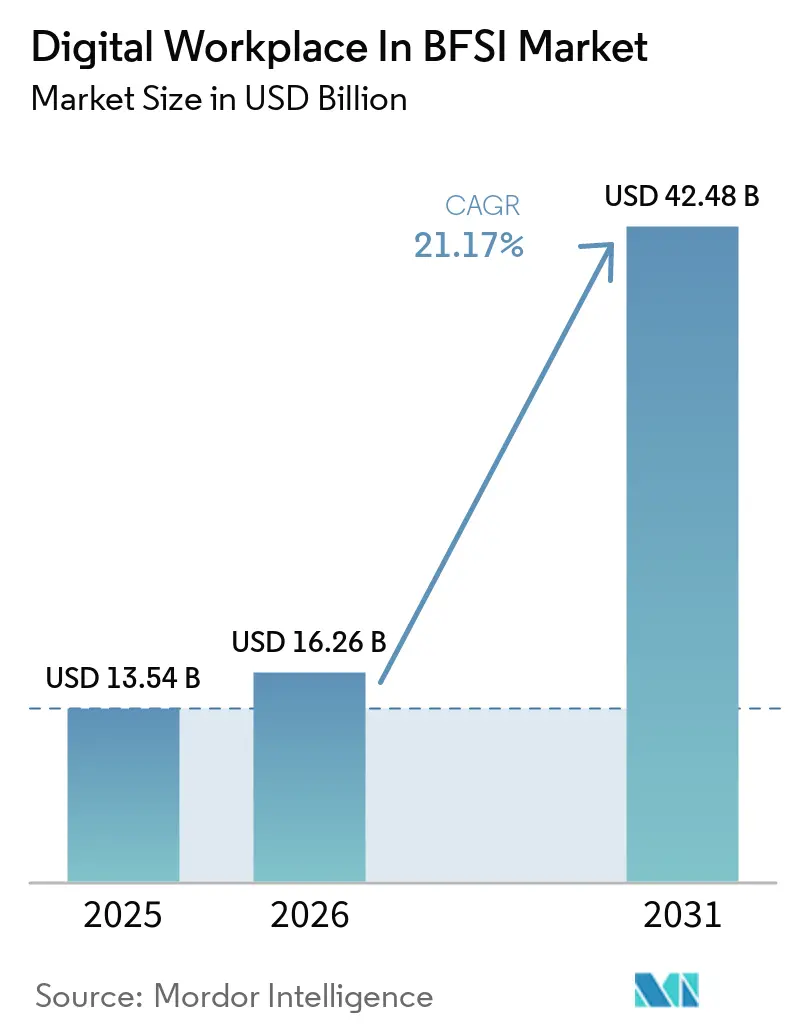
The Digital workplace in BFSI market size is projected to be USD 13.54 billion in 2025, USD 16.26 billion in 2026, and reach USD 42.48 billion by 2031, growing at a CAGR of 21.17% from 2026 to 2031. The market is expanding as banks, insurers, and capital markets firms redesign work around distributed teams, AI-assisted processes, and cloud-native infrastructure. Compliance obligations have also pushed workplace spending higher because firms now need collaboration, governance, identity, and archiving tools that can support regulated communications across digital channels. Competitive positioning is becoming more layered as hyperscalers move deeper into sector-specific workplace orchestration and global IT services firms compete on implementation depth, managed service breadth, and regulated delivery experience. Platform consolidation is becoming more visible as vendors package collaboration, AI assistance, identity control, and compliance management into broader suites for regulated institutions. Legacy core integration and rising cybersecurity exposure still slow some rollouts, yet these same constraints are also directing spending toward security-first and compliance-ready workplace architectures.
Key Report Takeaways
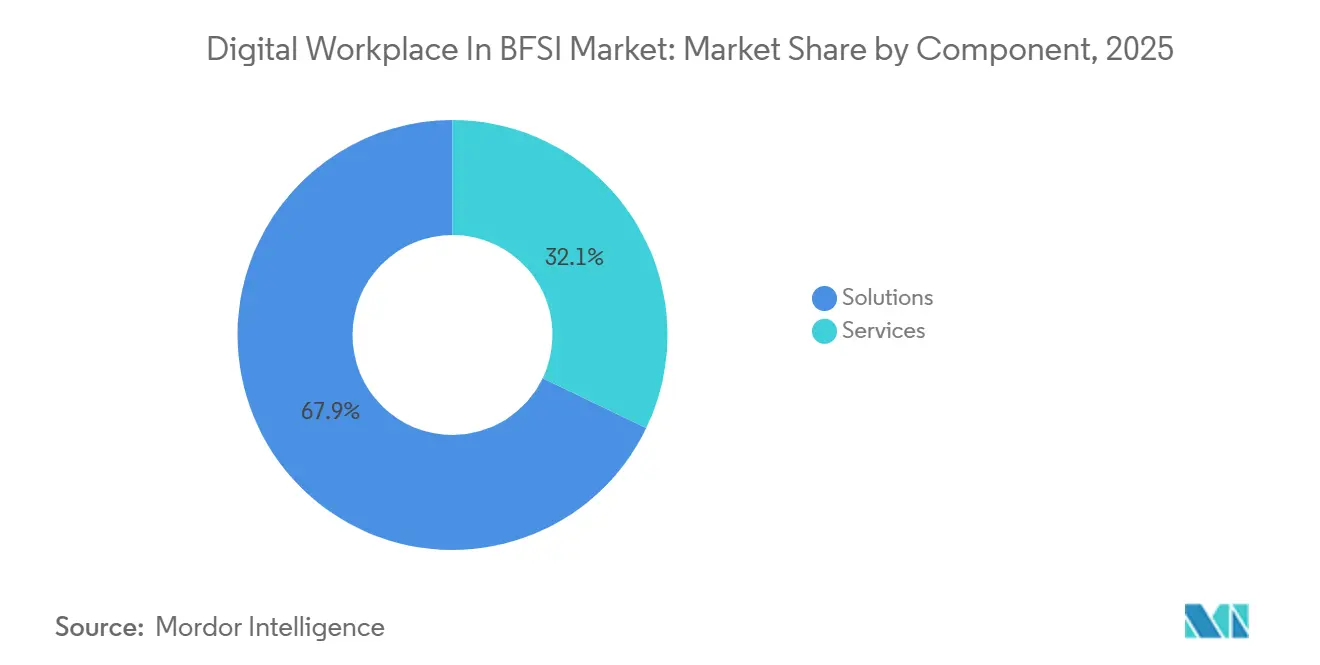
- By component, solutions held 67.88% of revenue in 2025, while the source text did not provide a quantified fastest-growing CAGR for services.
- By deployment mode, cloud accounted for 56.34% of the Digital workplace in BFSI market size in 2025 and is projected to expand at a 22.65% CAGR through 2031.
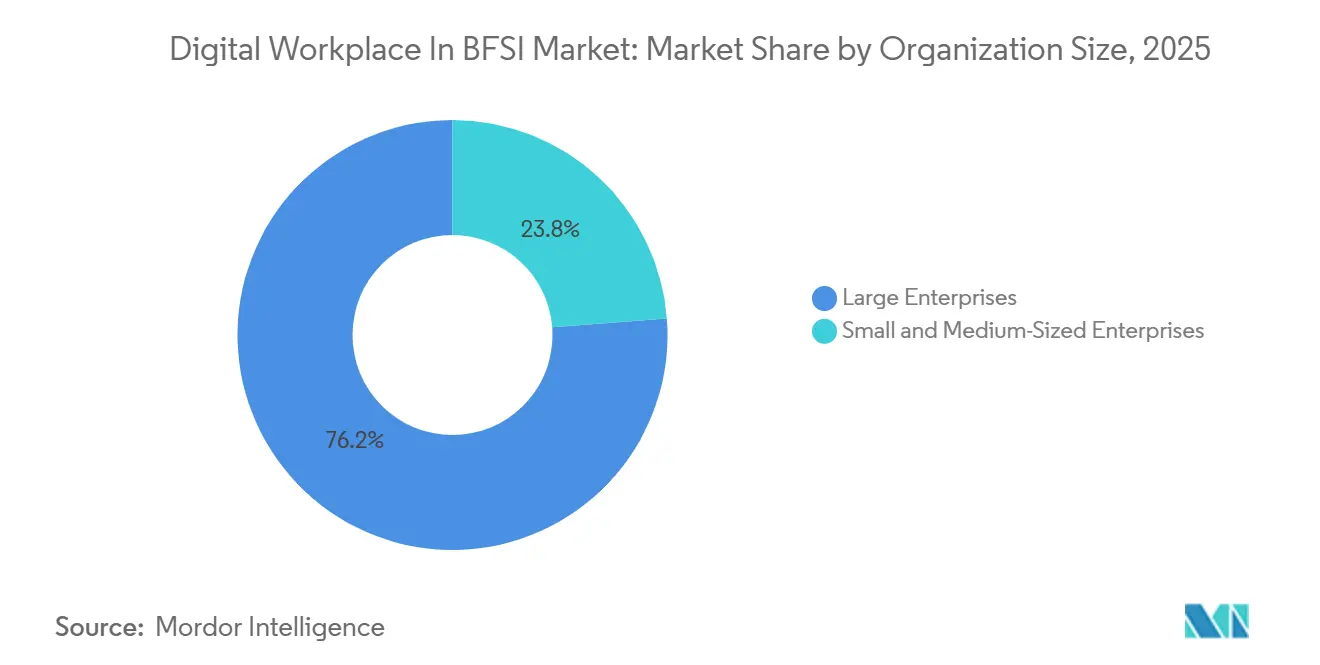
- By organization size, large enterprises held 76.22% of the Digital workplace in BFSI market share in 2025, while small and medium-sized enterprises are projected to record the highest CAGR at 22.67% through 2031.
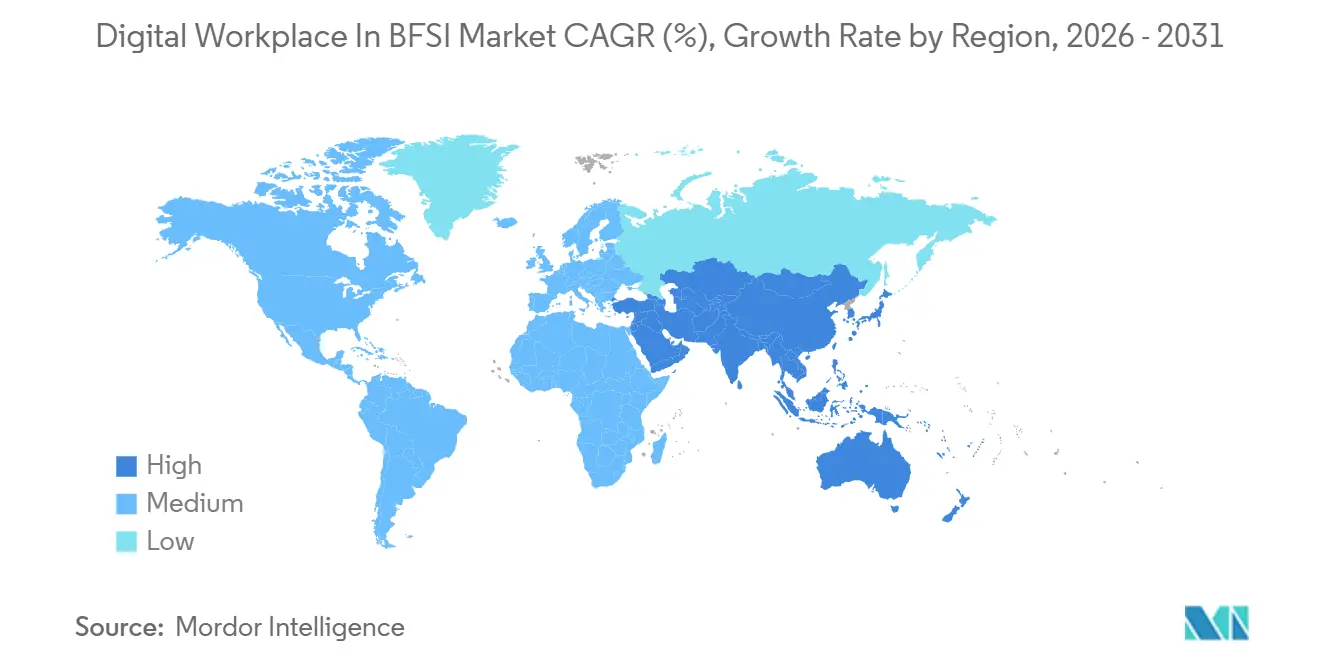
- By geography, North America held 39.22% of revenue in 2025, while Asia-Pacific is projected to expand at the highest CAGR of 22.87% through 2031.
Note: Market size and forecast figures in this report are generated using Mordor Intelligence’s proprietary estimation framework, updated with the latest available data and insights as of January 2026.
Market Trends and Insights
Drivers Impact Analysis of Digital Workplace In BFSI Market*
| Driver | (~) % Impact on CAGR Forecast | Geographic Relevance | Impact Timeline |
|---|---|---|---|
| GenAI-Enabled Employee Experience and Knowledge Search | +4.3% | Global, led by North America and Asia-Pacific | Short term (≤ 2 years) |
| Hybrid and Remote Work Adoption Across BFSI | +3.7% | Global, particularly North America and Europe | Short term (≤ 2 years) |
| Cloud-First Workplace Modernization in Regulated Banking Environments | +3.4% | Global, with early gains in North America and Western Europe | Medium term (2-4 years) |
| Zero-Trust Access and Identity-Centric Workplace Security | +2.9% | Global, concentrated in the European Union, North America, and India | Medium term (2-4 years) |
| Intelligent Automation of Branch, Back-Office, and Contact Center Workflows | +2.5% | Global, with Asia-Pacific and North America as primary adoption centers | Medium term (2-4 years) |
| Audit-Ready Collaboration and Compliance Archiving | +1.8% | North America and the European Union, with spillover to Asia-Pacific | Medium term (2-4 years) |
| Source: Mordor Intelligence | |||
GenAI-Enabled Employee Experience and Knowledge Search
GenAI has moved from pilot use to live deployment in the Digital workplace in BFSI market in 2026, especially in knowledge retrieval and employee support workflows. Broadridge reported that active AI use in financial services rose to 80% in 2026 from 31% in 2025, and 26% of firms had already deployed agentic AI, with 51% of those users operating beyond pilot stage.[1]That shift is changing the economics of workplace adoption because firms that embed AI into daily work can shorten ramp times for new employees and reduce the delay involved in finding internal policy, product, and process information. In the Digital workplace in BFSI market, this is pushing demand toward governed search, internal assistance tools, and workflow-linked employee platforms rather than stand-alone chat features. BankUnited showed this direction in 2025 when its SAVI solution, built on AWS Bedrock and Anthropic Claude, reduced back-office support calls by 40% and returned answers from 400 internal documents in under 10 seconds with 95% accuracy. The Digital workplace in BFSI market is therefore moving toward practical AI tools that improve employee execution quality while still fitting regulated operating environments.
Hybrid and Remote Work Adoption Across BFSI
Hybrid work has become a settled operating model in the Digital workplace in BFSI market rather than a temporary arrangement. That change is forcing vendors and financial institutions to support secure access, workflow continuity, and audit-ready collaboration across offices, homes, branches, and mobile work settings. Nubank announced a formal structured hybrid model for July 2026 after 5 years of remote-first operations, during which it expanded from 59 million to 122 million customers.[2] The Digital workplace in BFSI market is responding to that pattern with stronger demand for unified communications, secure endpoint access, and employee support platforms that work consistently across locations. This also affects talent economics because institutions with weak digital work environments face more difficulty retaining skilled technology and operations staff in competitive labor markets. The Digital workplace in BFSI market is therefore being shaped not only by infrastructure change, but also by workforce expectations that now treat flexibility and seamless digital tools as part of normal employment conditions.
Cloud-First Workplace Modernization In Regulated Banking Environments
Cloud adoption in the Digital workplace in BFSI market is moving beyond infrastructure refresh and becoming a practical route to compliance and AI enablement. AWS described cloud-native microservices and agentic AI as an architecture that changes technology from a limiting factor into a direct enabler of new banking service models.[3] Finastra reported in 2026 that 29% of respondents across 11 global markets viewed cloud adoption as a primary transformation lever, while security investment was projected to increase by 40% in the same year. In the Digital workplace in BFSI market, cloud platforms are also becoming compliance tools because vendors are building recordkeeping, governance, and resilience capabilities directly into collaboration environments. Google Workspace expanded DORA and SEC 17a-4 compliance capabilities to 13 international markets in 2026, which shows how cloud collaboration is being positioned as regulated infrastructure rather than simple productivity software. The Digital workplace in BFSI market benefits from this model because institutions can improve employee experience and control structures faster even when larger core modernization programs still take years to complete.
Zero-Trust Access and Identity-Centric Workplace Security
Identity-led security has become a core requirement in the Digital workplace in BFSI market as workforces spread across more locations and AI agents create new access layers. Thales found in 2025 that 93% of BFSI organizations had prioritized modernization of workforce identity, and identity security budgets were expected to grow by more than 10% within 12 months. The Digital workplace in BFSI market is also being pushed by the rise of non-human identities because AI agents, APIs, and service accounts can become overlooked control gaps if governance is incomplete. Thales reported in 2026 that daily AI-enabled bot attacks against financial services rose from 2 million to 25 million in 1 year, and 46% of account takeover attacks targeted the sector. This makes identity governance a revenue-protecting function as much as a compliance measure in the Digital workplace in BFSI market. DORA in the EU and the RBI Master Direction on IT Governance in India have strengthened this shift because regulated firms now need resilient and testable control frameworks across identity, endpoint, and collaboration layers.
Restraints Impact Analysis of Digital Workplace In BFSI Market*
| Restraint | (~) % Impact on CAGR Forecast | Geographic Relevance | Impact Timeline |
|---|---|---|---|
| Legacy Core System Integration Complexity | -2.8% | Global, most acute in Europe and North America where mainframe infrastructure is most entrenched | Long term (≥ 4 years) |
| Heightened Cybersecurity, Privacy, and Data Residency Exposure | -2.1% | Global, especially the European Union, Asia-Pacific, and the United States | Medium term (2-4 years) |
| User Adoption Friction For New Digital Experience Tools | -1.5% | Global, most pronounced in traditional banking markets with older employee demographics | Short term (≤ 2 years) |
| Vendor Sprawl And Tool Overlap Driving Governance Burden | -0.9% | Global, most significant in large multi-entity financial conglomerates | Medium term (2-4 years) |
| Source: Mordor Intelligence | |||
Legacy Core System Integration Complexity
Legacy core banking infrastructure remains the largest structural drag on the Digital workplace in BFSI market because workplace tools often depend on reliable access to live process and customer data. DXC Technology stated in 2025 that 98% of banks planned to upgrade their core systems within 3 years, yet many still manage 10 to 15 satellite systems around the core through fragile APIs, batch interfaces, and inconsistent data models. In the Digital workplace in BFSI market, that complexity slows the rollout of collaboration, automation, and AI tools because data and process dependencies are not resolved at the same pace as workplace programs. IBM and ServiceNow expanded their collaboration in June 2026 to address this barrier through joint application modernization and enterprise data governance solutions. The Digital workplace in BFSI market still advances in institutions with partial modernization, but the quality of value captured from new workplace tools tends to rise only after cleaner APIs and more stable integration layers are in place. This keeps legacy integration as a long-duration restraint even when software budgets remain healthy.
Heightened Cybersecurity, Privacy, and Data Residency Exposure
Cybersecurity and data residency risk continue to slow parts of the Digital workplace in BFSI market even as institutions keep increasing related spending. Finastra reported that financial institutions expected security investment to rise by 40% in 2026, which reflects both rising threat intensity and expanding compliance obligations. In the Digital workplace in BFSI market, the challenge is not only external attack activity, but also the growing governance burden created by AI use inside everyday employee tools. Thales identified AI as a new category of insider threat in 2026 because employees can expose sensitive financial data to external model environments if controls are weak or applied too late. Geographic rules add another layer because EU institutions face DORA obligations, while firms in Asia-Pacific and the United States manage a more fragmented mix of localization and privacy expectations. This means the Digital workplace in BFSI market rewards institutions that build data loss prevention, AI governance, and jurisdiction-aware controls into deployments from the start rather than after wider rollout.
*Our forecasts treat driver/restraint impacts as directional, not additive. The impact forecasts reflect baseline growth, mix effects, and variable interactions.
Digital Workplace In BFSI Market Segment Analysis
By Component:
Solution Platforms Lead as AI Moves Into Daily WorkSolutions accounted for 67.88% of revenue in 2025, which shows that the core spend in the Digital workplace in BFSI market still sits with software platforms rather than service layers. That position reflects the need for integrated communication, security, workflow, and employee support functions inside the same operating environment. In the Digital workplace in BFSI market, unified communication and collaboration platforms form the basic layer because hybrid work, recordkeeping, and employee coordination all depend on them. FINRA Rule 4511 and SEC 17a-4 requirements have also raised the compliance weight of these platforms, since digitally native communication channels now need auditable capture and retention support. This has made solution procurement more focused on governance outcomes rather than only user convenience.
Employee experience platforms and intranet tools are also gaining traction in the Digital workplace in BFSI market because institutions are embedding GenAI-based search directly into daily workflows. BankUnited provided a clear example in 2025 when its SAVI deployment reduced support calls by 40% and returned answers from 400 internal documents in under 10 seconds with 95% accuracy. Virtual desktop infrastructure and cloud PC products are expanding because remote and branch-based staff need secure access to regulated systems without device dependency. Enterprise mobility management and unified endpoint management are moving higher in buying priorities as firms standardize distributed security under DORA and related frameworks. The services segment still matters in the Digital workplace in BFSI industry because implementation, managed support, and consulting remain necessary in complex multi-vendor programs, yet the larger revenue base stays with solutions because that is where the central software stack is purchased and governed.
By Deployment Mode:
Cloud Consolidates as The Preferred ArchitectureCloud held 56.34% of the Digital workplace in BFSI market size in 2025 and is projected to grow at 22.65% CAGR through 2031, which makes it both the leading and fastest-growing deployment model in the source text. This advantage goes beyond cost and speed because cloud environments now deliver governance, resilience, and AI readiness in a more packaged form. In the Digital workplace in BFSI market, vendors such as Microsoft, Google, and AWS increasingly provide embedded compliance and control features that would otherwise require substantial in-house engineering effort. Finastra reported in 2026 that 29% of financial institutions prioritized cloud adoption as a primary transformation lever. That result fits the broader direction of the Digital workplace in BFSI market, where firms want faster workplace gains without waiting for complete back-end renewal.
Cloud is also strengthening its position in the Digital workplace in BFSI market because compliance capabilities are expanding across jurisdictions. Google Workspace extended DORA and SEC 17a-4 support to 13 international markets in 2026, which shows that collaboration platforms are being treated as regulated infrastructure. On-premises deployment still retains a meaningful role among institutions with strict data residency rules and heavy legacy estates, especially in parts of Europe and Asia. Hybrid deployment is gaining traction among mid-sized institutions that need to connect older workloads with cloud-based employee experience tools during phased modernization. This creates a middle path for firms that cannot move everything at once, but still need visible improvements in the Digital workplace in BFSI industry while core programs continue over several years.
By Organization Size:
Large Enterprises Dominate While SMEs AccelerateLarge enterprises held 76.22% of the Digital workplace in BFSI market share in 2025, while SMEs are projected to expand at 22.67% CAGR through 2031. The scale gap reflects differences in workforce size, geographic spread, compliance complexity, and spending capacity. In the Digital workplace in BFSI market, large institutions have been quicker to fund broad workplace programs that combine collaboration, identity, archiving, endpoint management, and AI assistance in a single governed framework. These firms also create reference deployments that shape buying confidence for the rest of the market. Their size makes workplace modernization harder to execute, but it also gives them the budget and operating need to move first on integrated platforms.
SMEs are still the faster-growing part of the Digital workplace in BFSI market because cloud subscription models have lowered the cost of access to regulated collaboration and productivity tools. Smaller banks, lenders, and insurers can now adopt capabilities that previously required a much heavier infrastructure base and internal support model. In the Digital workplace in BFSI market, that change matters because it widens adoption beyond Tier-1 banks and allows more regional and specialist institutions to modernize employee workflows. Lloyds Banking Group showed the enterprise end of the spectrum in 2026 when its Microsoft 365 E7 rollout covered 40,000 employees and achieved 97% active Copilot usage. nCino added another demand signal in 2026 when it reported that 84% of bankers said AI had significantly changed their roles and 89% expected to work alongside AI agents within the next 5 years, which supports continued SME uptake as these tools become easier to deploy and govern.
Geography Analysis
North America Digital Workplace in BFSI Market
North America held 39.22% of the Digital workplace in BFSI market share in 2025, which made it the largest regional contributor in the source text. The region benefits from deep capital markets infrastructure, a mature cloud ecosystem, and strict recordkeeping expectations across financial communications. In the Digital workplace in BFSI market, those conditions make workplace software part of operational control and supervisory readiness rather than a simple productivity purchase. North American institutions also tend to move early on enterprise AI and identity-led security, which supports demand for governed collaboration, automation, and endpoint management. The Digital workplace in BFSI market therefore remains strongest in North America where compliance pressure and technology budgets reinforce each other.
Europe and South America Digital Workplace in BFSI Market
Europe represented the second-largest regional block in the source material, with Germany, the United Kingdom, and France serving as the core adoption centers. DORA has been a major spending catalyst because it has shifted workplace security, resilience, and incident readiness from discretionary investment to regulatory requirement across EU-regulated firms. The United Kingdom stands out for large-scale deployment examples, and Lloyds Banking Group rolled out Microsoft 365 E7 in 2026 with 40,000 Copilot licenses and 97% active usage. South America is a smaller contributor, but digitally native players are shaping regional workplace expectations around hybrid work and cloud-based operations, with Nubank formalizing a structured hybrid model from July 2026 after years of remote-first scale-up.
APAC and MEA Digital Workplace in BFSI Market
Asia-Pacific is projected to grow at 22.87% CAGR from 2026 to 2031, which makes it the fastest-growing geography in the Digital workplace in BFSI market. Growth is being driven by banking digitization, regulatory modernization, and rising enterprise AI use across Japan, India, and Southeast Asia. In Japan, enterprise deployments show that workplace AI is moving beyond pilot use into broader operational adoption. SBI Group became the first Japanese financial group to adopt Anthropic AI transformation enterprise-wide in June 2026 across banking, securities, insurance, and asset management divisions. The Middle East is also gaining momentum through targeted digital transformation partnerships, while Africa remains an earlier-stage opportunity where mobile-first financial services can support adoption with fewer legacy constraints than older banking markets. The Digital workplace in BFSI market is therefore broadening geographically, but Asia-Pacific stands out for the pace at which modernization, AI deployment, and workplace redesign are coming together.
Competitive Landscape
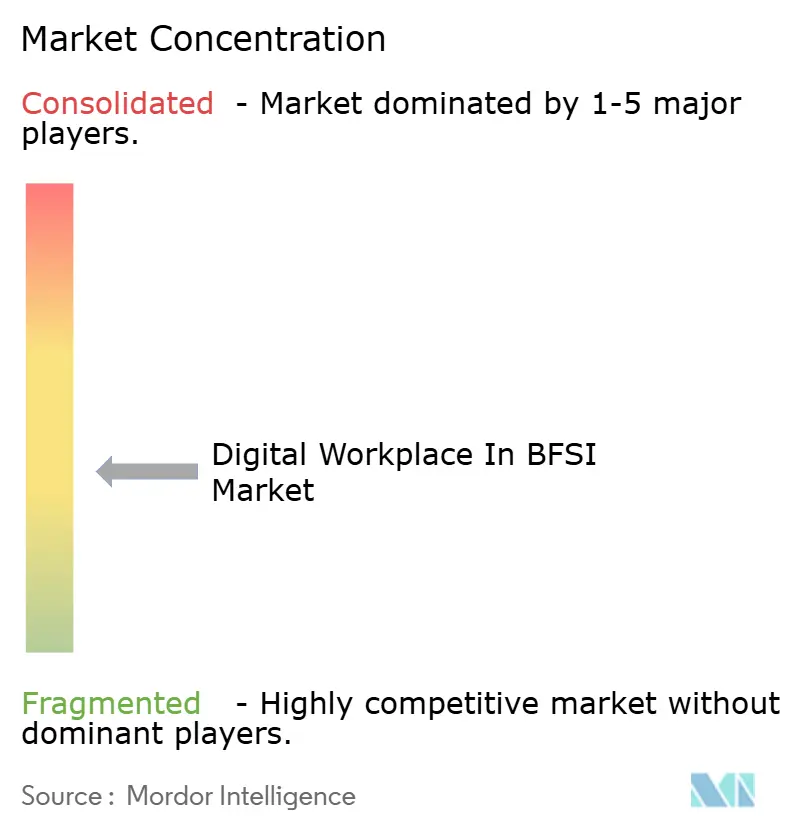
The global Digital workplace in BFSI market is moderately concentrated at the platform layer and highly fragmented across implementation, niche compliance, and workflow automation segments. No single vendor holds a commanding position across the full stack, which keeps competition active across hyperscalers, services firms, and specialist software providers. Microsoft leads the platform tier in the Digital workplace in BFSI market through bundled collaboration, AI assistance, identity, endpoint, and information governance capabilities. That position strengthened in May 2026 when Microsoft launched Microsoft 365 E7, which brought Copilot, Agent 365, Microsoft Entra Suite, and advanced Purview, Intune, and Defender features into one compliance-focused workplace suite. In the Digital workplace in BFSI market, that kind of packaging matters because many buyers are trying to reduce tool overlap while improving control over AI and communications risk.
ServiceNow has built a strong place in the Digital workplace in BFSI market as an orchestration and governance layer that can sit across multiple platforms. Its position was reinforced in May 2026 when it expanded its strategic partnership with Microsoft and integrated AI Control Tower with Microsoft Agent 365 to govern AI agent sprawl in enterprise environments. ServiceNow also benefits from a broader partnership network that links it to modernization, security, and workflow transformation agendas across regulated clients. IBM and ServiceNow deepened that model in June 2026 by expanding their collaboration around legacy application modernization and enterprise data governance, which directly addressed a known deployment barrier in the Digital workplace in BFSI market. Cisco also extended its relationship with ServiceNow in April 2025 to simplify and secure AI adoption at enterprise scale, which showed that security and workflow governance are increasingly being sold as linked priorities.
The services layer of the Digital workplace in BFSI market remains crowded, with firms such as TCS, Accenture, Cognizant, Capgemini, HCL Technologies, DXC Technology, and NTT DATA competing on domain expertise, delivery reach, and managed service depth. At the same time, niche vendors continue to win space by solving narrow but costly problems. Fiserv entered the Digital workplace in BFSI market more directly in 2026 with agentOS, which it presented as the first agentic AI operating system for banking and paired with a marketplace covering compliance, AML triage analysis, deposit operations, and reconciliation workflows. Theta Lake is another focused example, addressing digital communications governance gaps through Webex Compliance Hub for Cisco, which expanded compliance and security capabilities within workplace communications.
Digital Workplace In BFSI Industry Leaders
-
IBM Corporation
-
Accenture plc
-
Microsoft Corporation
-
Cognizant Technology Solutions Corporation
-
Tata Consultancy Services Limited
- *Disclaimer: Major Players sorted in no particular order
Digital Workplace In BFSI Market Companies Covered in this Report
- Microsoft Corporation
- IBM Corporation
- Accenture plc
- Cognizant Technology Solutions Corporation
- Tata Consultancy Services Limited
- Wipro Limited
- HCL Technologies Limited
- DXC Technology Company
- NTT DATA Group Corporation
- Capgemini SE
- Atos SE
- Cisco Systems, Inc.
- Cloud Software Group
- Broadcom Inc.
- ServiceNow, Inc.
- Zoom Communications, Inc.
- Google LLC
- Amazon Web Services, Inc.
- Oracle Corporation
- SAP SE
- Unisys Corporation
Recent Industry Developments in Digital Workplace In BFSI Market
- June 2026: IBM and ServiceNow expanded their strategic collaboration to address legacy application modernization and enterprise data governance at scale, combining IBM's watsonx data capabilities and AI coding tools with ServiceNow's Workflow Data Fabric. Joint solutions targeting BFSI enterprise customers, including autonomous IT operations, are expected to be available in H2 2026 and directly address the legacy integration barriers that constrain digital workplace rollouts.
- June 2026: SBI Group became the first Japanese financial group to adopt Anthropic AI transformation enterprise-wide, implementing Claude-based AI capabilities across banking, securities, insurance, and asset management divisions under explicit safety and regulatory governance controls, a strategic signal that Asia-Pacific financial institutions are moving beyond isolated GenAI pilots to enterprise-scale digital workplace integration.
- May 2026: ServiceNow expanded its strategic partnership with Microsoft at Knowledge 2026, integrating AI Control Tower with Microsoft Agent 365 to govern AI agent sprawl across enterprise digital workplace environments, with ServiceNow AI specialists available in the Microsoft Agent 365 Marketplace for BFSI customers.
- May 2026: Microsoft launched Microsoft 365 E7 at USD 99 per user per month, bundling Copilot, Agent 365, Microsoft Entra Suite, and M365 E5 with advanced Defender, Intune, and Purview capabilities into a compliance-integrated AI workplace suite, making it the first hyperscaler to deliver a single-SKU governance-to-collaboration stack targeting regulated industries. Agent 365 also launched as a standalone product at USD 15 per user per month.
Global Digital Workplace In BFSI Market Report Scope
The BFSI (Banking, Financial Services, and Insurance) sector is increasingly adopting digital workplace solutions, utilizing a comprehensive suite of technologies and services. These tools are designed to establish secure and collaborative environments for employees, agents, and partners, regardless of whether they operate in-office or remotely.
The Digital Workplace in BFSI Market Report is Segmented by Component (Solutions [Unified Communication and Collaboration, Unified Endpoint Management, Enterprise Mobility and Management, Employee Experience Platforms and Intranet, Workflow Automation and Knowledge Management, and Virtual Desktop Infrastructure and Cloud PC] and Services), Deployment Mode (Cloud, On-Premises, and Hybrid), Organization Size (Large Enterprises and Small and Medium-Sized Enterprises), and Geography (North America, South America, Europe, Asia-Pacific, and Middle East, Africa). The Market Forecasts are Provided in Terms of Value (USD).
Segmentation Overview
| Solutions | Unified Communication and Collaboration |
| Unified Endpoint Management | |
| Enterprise Mobility and Management | |
| Employee Experience Platforms and Intranet | |
| Workflow Automation and Knowledge Management | |
| Virtual Desktop Infrastructure and Cloud PC | |
| Services |
| Cloud |
| On-Premises |
| Hybrid |
| Large Enterprises |
| Small and Medium-Sized Enterprises |
| North America | United States |
| Canada | |
| Mexico | |
| South America | Brazil |
| Argentina | |
| Chile | |
| Colombia | |
| Rest of South America | |
| Europe | Germany |
| United Kingdom | |
| France | |
| Italy | |
| Spain | |
| Netherlands | |
| Nordics | |
| Russia | |
| Rest of Europe | |
| Asia-Pacific | China |
| Japan | |
| India | |
| South Korea | |
| Australia and New Zealand | |
| Southeast Asia | |
| Rest of Asia-Pacific | |
| Middle East | Saudi Arabia |
| United Arab Emirates | |
| Turkey | |
| Israel | |
| Rest of Middle East | |
| Africa | South Africa |
| Egypt | |
| Nigeria | |
| Kenya | |
| Rest of Africa |
| By Component | Solutions | Unified Communication and Collaboration |
| Unified Endpoint Management | ||
| Enterprise Mobility and Management | ||
| Employee Experience Platforms and Intranet | ||
| Workflow Automation and Knowledge Management | ||
| Virtual Desktop Infrastructure and Cloud PC | ||
| Services | ||
| By Deployment Mode | Cloud | |
| On-Premises | ||
| Hybrid | ||
| By Organization Size | Large Enterprises | |
| Small and Medium-Sized Enterprises | ||
| By Geography | North America | United States |
| Canada | ||
| Mexico | ||
| South America | Brazil | |
| Argentina | ||
| Chile | ||
| Colombia | ||
| Rest of South America | ||
| Europe | Germany | |
| United Kingdom | ||
| France | ||
| Italy | ||
| Spain | ||
| Netherlands | ||
| Nordics | ||
| Russia | ||
| Rest of Europe | ||
| Asia-Pacific | China | |
| Japan | ||
| India | ||
| South Korea | ||
| Australia and New Zealand | ||
| Southeast Asia | ||
| Rest of Asia-Pacific | ||
| Middle East | Saudi Arabia | |
| United Arab Emirates | ||
| Turkey | ||
| Israel | ||
| Rest of Middle East | ||
| Africa | South Africa | |
| Egypt | ||
| Nigeria | ||
| Kenya | ||
| Rest of Africa | ||
Key Questions Answered in the Report
What is the size of the digital workplace in BFSI market?
The Digital workplace in BFSI market was valued at USD 13.54 billion in 2025, reached USD 16.26 billion in 2026, and is forecast to reach USD 42.48 billion by 2031 at a CAGR of 21.17%.
Why are banks and insurers spending more on workplace platforms?
Spending is rising because firms need to support hybrid work, AI-assisted workflows, stronger identity control, and audit-ready communications in regulated environments.
Which deployment model is leading adoption?
Cloud led with 56.34% share in 2025 and is projected to expand at a 22.65% CAGR through 2031 because it supports faster modernization and embedded compliance features.
Which type of institution is growing fastest in adoption?
Small and medium-sized enterprises are projected to record the highest CAGR at 22.67% through 2031 as cloud-based platforms reduce the cost of regulated workplace deployment.
Which region offers the strongest growth outlook?
Asia-Pacific is projected to grow at 22.87% CAGR through 2031, supported by banking digitization, enterprise AI adoption, and continued workplace modernization.
What is the biggest obstacle to wider rollout?
Legacy core integration remains the biggest barrier because workplace tools often depend on real-time data, stable APIs, and consistent process links that many older banking systems still lack.