
Colombia Digital Workplace Market Size and Share
Market Overview
| Study Period | 2020 - 2031 |
|---|---|
| Forecast Data Period | 2026 - 2031 |
| Base Year Market Size (2025) | USD 0.53 Billion |
| Market Size (2026) | USD 0.64 Billion |
| Market Size (2031) | USD 1.7 Billion |
| Growth Rate (2026 - 2031) | 21.50 % |
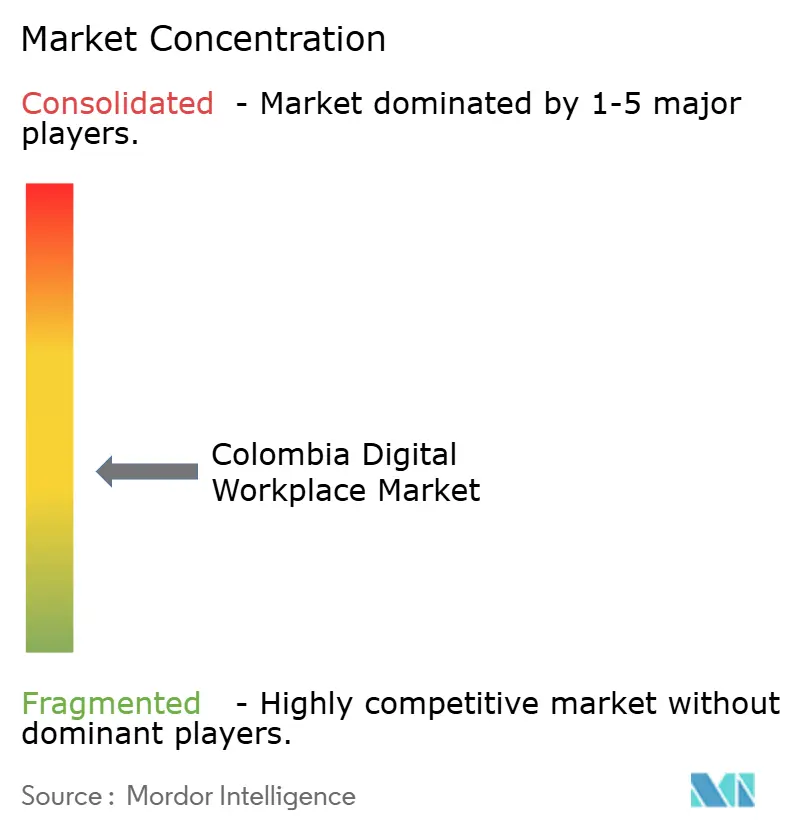
| Market Concentration | Medium |
Major Players *Disclaimer: Major Players sorted in no particular order Image © Mordor Intelligence. Reuse requires attribution under CC BY 4.0. | |
Colombia Digital Workplace Market Analysis by Mordor Intelligence
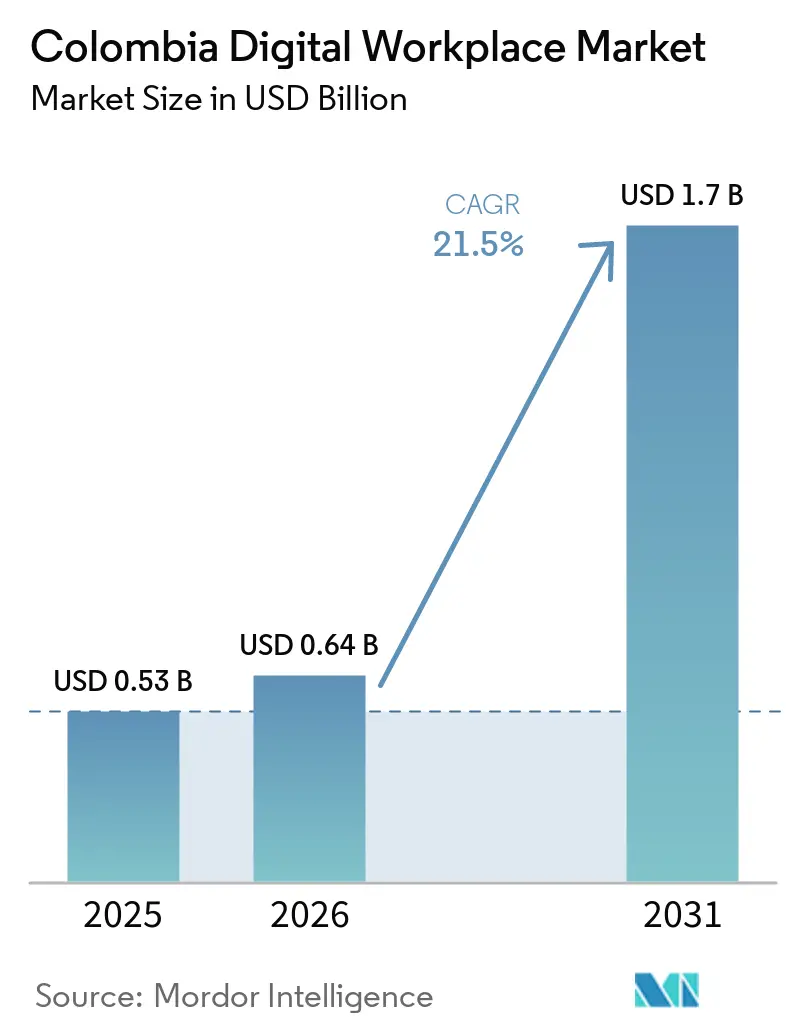
The Colombia digital workplace market size was valued at USD 0.53 billion in 2025 and is forecast to reach USD 1.70 billion by 2031, growing at a CAGR of 21.50% during 2026-2031. The Colombia digital workplace market is moving beyond the short-term remote work cycle and is now being shaped by labor compliance, enterprise AI adoption, and the need to standardize secure collaboration across distributed teams. Demand is also rising because many organizations now want platforms that connect communication, workflow automation, endpoint security, and knowledge access in one operating environment. The strongest spending continues to come from large organizations and regulated sectors, where digital workplace programs are tied to process modernization, governance, and long-term platform contracts. Healthcare and SMEs are gaining speed because interoperability mandates and lower SaaS entry costs are bringing more institutions into formal digital workflow environments. The Colombia digital workplace market also remains open to further expansion as cloud migration, AI-enabled work tools, and public digital modernization continue to reinforce each other across the business base.
Key Report Takeaways
- By component, solutions held 68.43% of the Colombia digital workplace market share in 2025, while solutions are also projected to expand at a 21.76% CAGR through 2031.
- By deployment mode, cloud accounted for 63.27% of the Colombia digital workplace market size in 2025 and is expected to advance at a 21.99% CAGR during 2026-2031.
- By organization size, large enterprises captured 60.86% share in 2025, while SMEs are forecast to record the fastest CAGR at 22.26% through 2031.
- By end-user industry, BFSI represented 24.54% share of the Colombia digital workplace market size in 2025, while healthcare is projected to post the highest CAGR at 22.34% over 2026-2031.
Note: Market size and forecast figures in this report are generated using Mordor Intelligence’s proprietary estimation framework, updated with the latest available data and insights as of January 2026.
Colombia Digital Workplace Market Trends and Insights
Drivers Impact Analysis*
| Driver | (~) % Impact on CAGR Forecast | Geographic Relevance | Impact Timeline |
|---|---|---|---|
| Rising Hybrid Work Demand Across Distributed Teams | +3.5% | National, concentrated in Bogotá, Medellín, and Cali | Short term (≤ 2 years) |
| Cloud-First Workplace Standardization in Colombian Enterprises | +2.8% | National, with early gains in Bogotá and Medellín | Medium term (2-4 years) |
| Accelerating Employee Experience and Productivity Priorities | +2.2% | National | Medium term (2-4 years) |
| GenAI Assisted Workflow Automation and Knowledge Search | +3.2% | National, strongest in IT, BFSI, and professional services | Short term (≤ 2 years) |
| Public Sector Digitization and E-Workplace Modernization | +2.0% | National, with early gains in Bogotá and departmental capitals | Medium term (2-4 years) |
| Mobile-First Workforce Enablement in Field Operations | +1.5% | National, strongest in logistics, retail, and energy | Long term (≥ 4 years) |
| Source: Mordor Intelligence | |||
Rising Hybrid Work Demand Across Distributed Teams
Hybrid work demand in the Colombia digital workplace market is now tied more closely to operating rules than to temporary workplace flexibility. Colombia’s 2025 labor reform formally recognized 6 telework modalities, including hybrid, transnational, and temporary or emergent work, which has pushed employers to treat remote work governance as a formal business process rather than an informal arrangement. That shift is increasing demand for remote access control, endpoint administration, digital HR workflows, and collaboration systems that can support different work formats under one policy structure. It also favors platform vendors that can connect employee identity, communication, workflow, and security inside a common licensing framework.[1] For multinational employers, the same regulatory change is making local compliance a platform decision, which supports longer contract cycles in the Colombia digital workplace market.
GenAI Assisted Workflow Automation And Knowledge Search
Generative AI is becoming one of the clearest near-term growth levers in the Colombia digital workplace market because it is expanding the use case for workplace software beyond communication alone. SAP reported that Colombia ranked 3rd in South America for planned AI investment in 2025, while 44% of surveyed business leaders had already seen measurable results from AI initiatives, and 54% planned to raise AI spending.[2] Microsoft stated that 76% of Colombian business leaders planned to hire AI-focused roles within 12-18 months, and 90% intended to incorporate digital agents into their teams. Those figures show that AI demand is moving from pilot activity to workforce design, and that change is raising demand for AI-enabled meeting tools, enterprise search, workflow summaries, and automated knowledge retrieval. The Colombia digital workplace market is therefore benefiting not only from AI adoption itself, but also from the need to manage AI use inside approved and auditable enterprise environments.
Cloud-First Workplace Standardization In Colombian Enterprises
Cloud-first standardization is giving the Colombia digital workplace market a durable base for renewals, upgrades, and wider deployment across business functions. The U.S. International Trade Administration identified cloud computing, AI, and cybersecurity as core pillars within Colombia’s national digital strategy for 2023-2026, which lowers institutional hesitation around cloud-first technology investments.[3] That policy environment supports broader adoption of cloud-native collaboration, workflow, and endpoint tools because the cloud is being treated as standard operating infrastructure rather than a discretionary innovation layer. In practice, this favors vendors that can integrate productivity software, identity management, compliance controls, and analytics in one environment. The result is a stronger spending base for the Colombia digital workplace market, especially among organizations that want to scale digital work without repeated on-premises infrastructure expansion.
Public Sector Digitization And E-Workplace Modernization
Public sector modernization remains an important demand anchor for the Colombia digital workplace market because government programs often shape enterprise standards for interoperability, data handling, and workflow management. Colombia’s digital policy framework has placed cloud, cybersecurity, and AI at the center of public modernization efforts, which reinforces the need for unified workplace systems across agencies and contractors. Microsoft’s role in regulated institutional deployments, including public-facing productivity initiatives and health data infrastructure, shows how government-backed adoption can strengthen confidence in large enterprise workplace platforms. This also creates a follow-on effect in the private sector because suppliers serving public institutions often need compatible collaboration, document, and compliance workflows. In the Colombia digital workplace market, that pattern supports broader demand for platforms that are already trusted in regulated operating environments.
Restraints Impact Analysis*
| Restraint | (~) % Impact on CAGR Forecast | Geographic Relevance | Impact Timeline |
|---|---|---|---|
| Uneven Rural Connectivity and Last-Mile Broadband Gaps | -2.1% | Rural and semi-urban Colombia, especially Pacific and Amazonian regions | Long term (≥ 4 years) |
| Data Privacy, Cross-Border Data Flow, and Compliance Complexity | -1.5% | National, with highest exposure in BFSI and healthcare | Medium term (2-4 years) |
| Cybersecurity Readiness Gaps in Mid-Market Deployments | -1.8% | National, concentrated among SMEs | Short term (≤ 2 years) |
| Integration Friction With Legacy Enterprise Applications | -1.2% | National, highest in manufacturing and public sector | Medium term (2-4 years) |
| Source: Mordor Intelligence | |||
Uneven Rural Connectivity And Last-Mile Broadband Gaps
Connectivity quality remains one of the clearest structural limits on wider adoption in the Colombia digital workplace market. The OECD reported in March 2026 that rural fixed broadband speeds in Colombia were 43% below the OECD rural average, while rural mobile download speeds were 78% lower than the OECD rural benchmark. This means access coverage alone does not guarantee reliable use of cloud collaboration, AI-assisted work tools, or virtual desktop environments in remote locations. As a result, the Colombia digital workplace market continues to develop at different speeds, with stronger deployment depth in major cities and lighter mobile-led usage outside them. The gap does not stop adoption entirely, but it does reduce the practical scope of high-performance digital workplace tools in field-heavy operations and smaller regional business centers.
Cybersecurity Readiness Gaps In Mid-Market Deployments
Cybersecurity readiness gaps remain a direct restraint on the Colombia digital workplace market because many mid-sized firms still struggle to balance collaboration expansion with secure deployment. The Bogotá Chamber of Commerce stated that SMEs account for more than 90% of Colombia’s business ecosystem, and ransomware, phishing, and unauthorized account access represented 79.83% of incidents tracked by ColCERT in 2025. This threat mix raises the cost of digital workplace rollout because collaboration, endpoint, and identity layers increasingly need to be procured together rather than separately. It also gives larger vendors an advantage because integrated security bundles are easier for smaller organizations to adopt than fragmented point solutions. In the Colombia digital workplace market, this dynamic may slow some mid-market purchases in the short term, even while it creates a longer-term opportunity for vendors that can package security, governance, and collaboration in one offer.
*Our forecasts treat driver/restraint impacts as directional, not additive. The impact forecasts reflect baseline growth, mix effects, and variable interactions.
Segment Analysis
By Component: Solutions Anchor Market Spend Across Maturity Stages
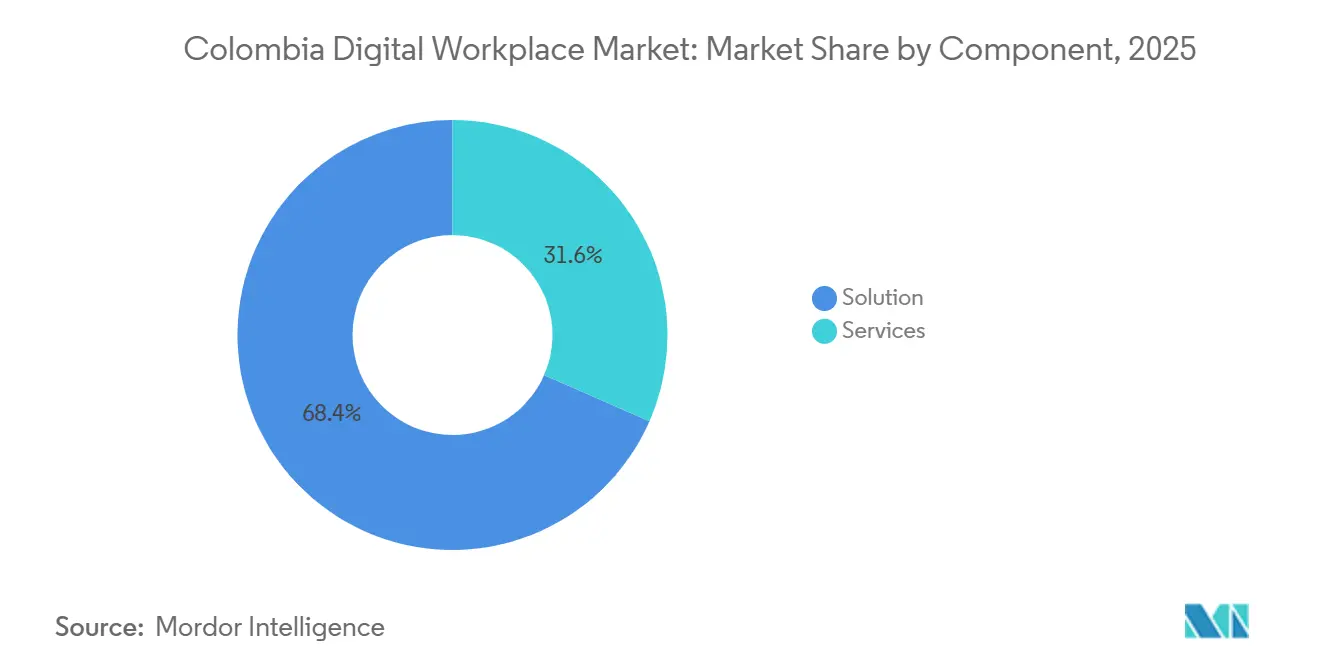
Solutions held 68.43% of the Colombia digital workplace market share in 2025, and this segment is projected to expand at a 21.76% CAGR through 2031. This lead shows that enterprise buyers continue to place most spending on the platform layer, where communication, workflow, knowledge access, employee apps, and endpoint functions can be delivered together. The strongest demand remains tied to unified communication and collaboration, workflow automation, and knowledge management because these functions address the daily operating needs of distributed teams. The Colombia digital workplace industry is also leaning toward suites that embed AI features inside existing workplace products, which makes upgrades easier than full platform replacement. That pattern supports incumbent vendors because many organizations prefer to extend a familiar environment rather than rework their entire collaboration stack.
Services accounted for a smaller share, but they remain essential to deployment quality in the Colombia digital workplace market because migration, integration, and policy rollout still require specialist support. Organizations moving into virtual desktop environments, unified endpoint management, and workflow redesign often need consulting, managed services, and post-deployment support to reach usable scale. This gives service providers an important role even when software licenses account for most reported revenue. Employee experience platforms and intranet tools are also gaining relevance because employers want better internal communication, self-service access, and workforce feedback across hybrid work models. Over time, the shift from perpetual software ownership to recurring subscription models should keep solutions in the lead, while services continue to shape deployment speed, vendor choice, and long-term account expansion.
By Deployment Mode: Cloud Consolidates As Hybrid Architectures Mature
Cloud represented 63.27% of the Colombia digital workplace market size in 2025 and is projected to grow at a 21.99% CAGR through 2031. This makes cloud both the largest and fastest-growing deployment model in the Colombia digital workplace market, which reflects a clear preference for scalable and easier-to-manage operating environments. The appeal is strongest in sectors that need frequent updates, shared access, and cross-site coordination, including BFSI, healthcare, and IT and telecom. National digital policy has also supported cloud adoption by placing cloud infrastructure alongside AI and cybersecurity as core pillars of digital development. In practice, cloud adoption is helping enterprises move workplace software away from isolated function tools and toward common platforms that support identity, communication, workflow, and reporting together.
On-premises systems continue to matter in regulated environments, especially where data control and legacy application dependencies remain strong. Even so, the difference between cloud and on-premises is becoming less rigid because hybrid architecture now serves as a practical transition model. Many organizations are pairing cloud collaboration suites with legacy ERP or line-of-business systems rather than replacing everything at once. This lowers disruption and gives IT teams time to test security, governance, and user adoption before larger migration steps. In the Colombia digital workplace industry, that middle path is likely to remain important for public sector bodies, healthcare institutions, and enterprises with long application histories.
By Organization Size: Large Enterprises Lead, But SME Momentum Is Structural
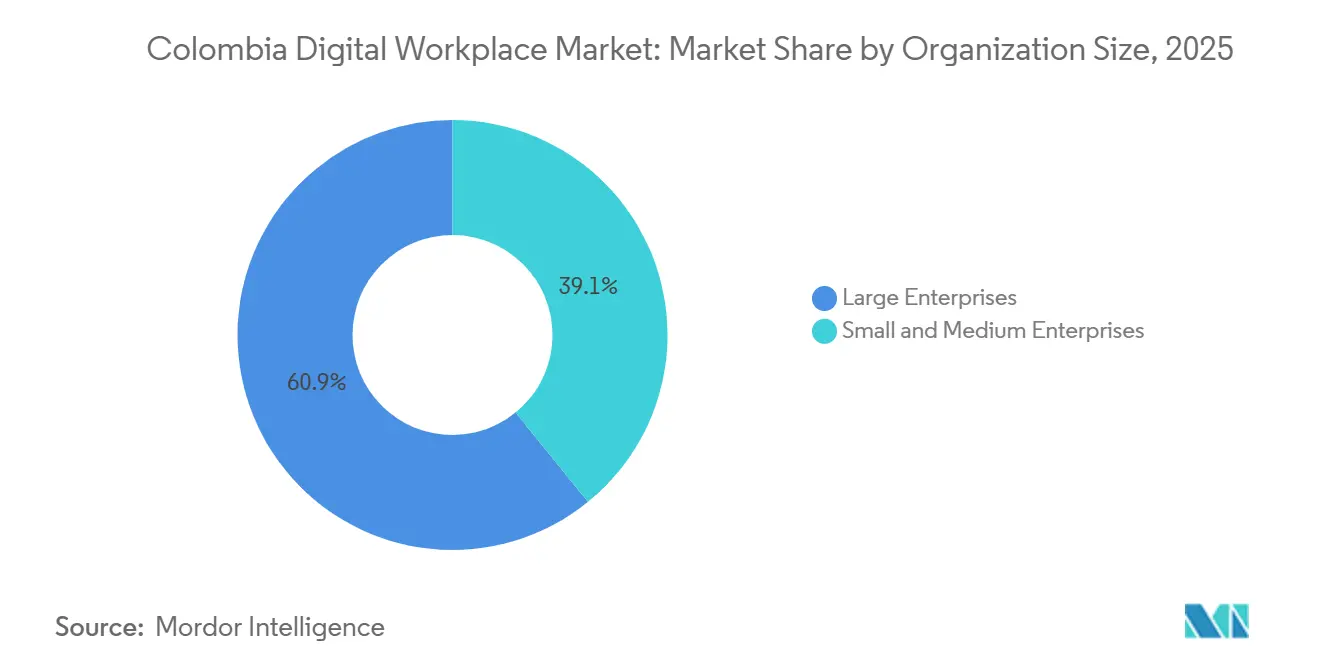
Large enterprises held 60.86% share of the Colombia digital workplace market in 2025, reflecting their higher technology budgets, broader user bases, and capacity to manage multi-year transformation programs. These organizations usually operate across several sites, functions, and security layers, so they gain more immediate value from unified workplace platforms. They are also better positioned to adopt AI-enabled features because they can fund change management, policy enforcement, and role-based access at scale. SAP’s 2025 survey found that 44% of Colombian business leaders had already recorded measurable returns from AI initiatives, which supports ongoing platform upgrades among larger buyers. In the Colombia digital workplace market, this helps explain why large enterprises continue to dominate current revenue even as the adoption base broadens.
SMEs are projected to grow at the fastest pace, with a 22.26% CAGR during 2026-2031. Their momentum is structural because SaaS delivery lowers entry costs, shortens deployment time, and makes enterprise-grade tools available without heavy infrastructure investment. The 2025 labor reform also pushes many smaller employers to formalize remote work processes, which raises demand for digital HR tools, secure access, and workflow oversight. At the same time, AI training and experimentation are moving beyond the largest companies, which increases interest in knowledge management and automation features inside standard workplace suites. That mix of compliance pressure and lower software entry barriers is making SMEs a major expansion layer for the Colombia digital workplace market.
By End-User Industry: BFSI Commands Scale, Healthcare Carries Velocity
BFSI captured 24.54% of the Colombia digital workplace market size in 2025, which makes it the largest end-user segment by current revenue. Financial institutions are under steady pressure to improve workflow control, secure collaboration, and data handling because their operating models depend on high-volume, regulated processes. The launch and rapid scaling of Bre-B, Colombia’s interoperable instant payments system, which has processed more than 500 million transactions since its October 2025 launch, adds to this pressure by increasing the need for faster internal coordination and event-driven workflows. BFSI also stands out because AI use in customer service and process layers is already material, which supports further investment in integrated workplace and decision-support systems. In the Colombia digital workplace market, BFSI therefore combines regulatory need, data intensity, and technology readiness in a way few other sectors do.
Healthcare is projected to expand at the fastest rate, with a 22.34% CAGR over 2026-2031. The main reason is the national HL7 FHIR interoperability framework, which became mandatory for more than 9,000 healthcare providers on April 15, 2026. HL7 International stated that the platform is expected to process 400 million FHIR documents annually, which creates direct need for standardized workflow tools, secure collaboration, and data-ready workplace environments. IT and telecom remains an important demand base because it acts as both end user and integration channel, while government, manufacturing, retail, education, energy, legal, and other services each add distinct workflow needs across the Colombia digital workplace market. This spread across verticals lowers overdependence on any single sector, even though BFSI and healthcare set the pace for spending and growth.
Geography Analysis
The Colombia digital workplace market is concentrated in urban business centers, and Bogotá remains the largest demand hub because it combines government agencies, financial institutions, multinational offices, and the country’s deepest pool of large enterprise technology spending. Global vendors also continue to use Bogotá as their main country launch and ecosystem location, which strengthens the city’s role in procurement, partner development, and high-value enterprise deals. SAP House Colombia 2026 brought more than 600 attendees and 40 partners to Bogotá, while Oracle held its first large-scale SuiteConnect event in the country, showing that leading vendors view the capital as the primary market-making center for Colombia. Bogotá, therefore, sets the pace for the Colombia digital workplace market in both spending depth and platform complexity. Its concentration of regulated sectors also makes it the first destination for many compliance-led workplace investments.
Medellín is the second major demand center in the Colombia digital workplace market because its business base blends manufacturing, technology services, and innovation-led employers. That mix creates stronger demand for advanced collaboration, workflow automation, digital engineering support, and desktop virtualization than the national average would suggest. Cali and Barranquilla are at an earlier stage, but both are gaining relevance as local enterprise bases expand and digital tools become more affordable through SaaS delivery. These cities do not mirror Bogotá’s enterprise profile, and their demand is more closely linked to sector-specific needs such as logistics coordination, plant operations, field mobility, and distributed service management. This gives the Colombia digital workplace market a more diverse regional demand pattern than a finance-centered model alone would produce.
The urban-rural divide remains the most important geographic constraint on the Colombia digital workplace market because usage quality depends on bandwidth consistency, not only on access coverage. The OECD’s 2026 review showed that rural fixed broadband and mobile performance still trails benchmark rural levels by a wide margin, which limits the practical use of richer digital workplace applications outside the main urban network. This keeps enterprise-grade deployments concentrated in major cities and departmental capitals where fiber and stable mobile coverage are more dependable. In rural and dispersed settings, mobile-first workplace access is more realistic than full desktop-style collaboration environments. That is pushing vendors in the Colombia digital workplace market to improve offline capability, lighter interfaces, and field-friendly workflow design.
Competitive Landscape
The Colombia digital workplace market remains moderately fragmented overall, even though a small group of global platform vendors holds the strongest positions in enterprise accounts. Microsoft, Google, SAP, and IBM benefit from broad product portfolios, cloud ties, and established enterprise relationships that make workplace software easier to bundle with security, analytics, and infrastructure services. This gives them an advantage in large tenders where buyers prefer fewer vendors and clearer accountability. At the same time, the Colombia digital workplace market is not dominated by a single platform because systems integrators, sector specialists, and local service partners still shape implementation outcomes across many verticals. That balance between strong platform vendors and a wider service ecosystem keeps competition active rather than closed.
Microsoft’s position is strengthened by its role in regulated environments, including support for Colombia’s national HL7 FHIR health interoperability platform through Azure Health Data Services. Cisco and ServiceNow also moved to strengthen their proposition in 2025 through a joint AI security framework that combined Cisco AI Defense with ServiceNow governance capabilities, which directly addresses enterprise concern around controlled AI use in workplace environments. IBM and ServiceNow expanded their collaboration in June 2026 to address AI-ready data access and legacy application modernization, which is especially relevant in large Colombian organizations where older application estates still slow workplace transformation. These moves show that competitive advantage in the Colombia digital workplace market is now tied as much to integration and governance as to core collaboration features. Vendors that can reduce complexity while adding AI control are in a stronger position to defend and expand accounts.
Competition is also intensifying in the mid-market and in sector-specific projects, where integrators such as Accenture, Tata Consultancy Services, Capgemini, NTT DATA, DXC Technology, and Wipro compete on localization, implementation depth, and industry workflow knowledge. SAP and Deloitte opened the first AppHaus in Colombia and the Andean region in November 2025, which signals a stronger local co-innovation model designed to lock in customers earlier in the project cycle. The Colombia digital workplace market still offers open space in SME managed workplace services and in healthcare rollout, where compliance-driven demand is rising faster than fully scaled delivery capacity. Local managed service providers are also becoming more relevant because they can bundle labor compliance support, sector workflow adaptation, and platform management for organizations with smaller IT teams. This means the competitive picture is likely to stay mixed, with global vendors controlling platform direction while partners and local specialists influence adoption at the account level.
Colombia Digital Workplace Industry Leaders
-
Microsoft Corporation
-
International Business Machines Corporation
-
Cisco Systems, Inc.
-
Accenture plc
-
Citrix Systems, Inc.
- *Disclaimer: Major Players sorted in no particular order
Recent Industry Developments
- June 2026: IBM and ServiceNow announced an expanded collaboration targeting the AI-ready data problem and legacy application modernization, combining IBM's AI, data, and automation capabilities, including IBM Bob coding agent, watsonx.data, and Enterprise Application Runtimes, with the ServiceNow AI Platform. Joint solutions are expected to be available in H2 2026 and directly address the legacy integration challenge that constrains digital workplace deployment in Colombia's large-enterprise manufacturing and public-sector clients.
- February 2026: Oracle NetSuite announced a suite of AI-powered innovations for the Colombian market at SuiteConnect Bogotá 2026, its first large-scale product event in the country. Announcements included AI-assisted field service operations, predictive analytics, and DIAN-compliant localization for the NetSuite Next ERP platform, addressing both workplace productivity and regulatory compliance needs simultaneously.
- November 2025: SAP and Deloitte inaugurated the first AppHaus in Colombia and the Andean region on November 19, 2025, in Bogotá. The co-innovation center, built on SAP Business Technology Platform, provides a dedicated collaborative design environment for joint client solution development, the first such space in the region.
- October 2025: Banco de la República and ACI Worldwide launched Bre-B, Colombia's interoperable instant payments system, which surpassed 500 million transactions by April 2026. Bre-B's rapid adoption is accelerating BFSI demand for event-driven workflow automation and notification infrastructure compatible with real-time payment processing.
Colombia Digital Workplace Market Report Scope
The Colombia Digital Workplace Market refers to the market for digital tools, platforms, and services that enable employees in Colombia to communicate, collaborate, and work effectively across office, remote, and hybrid environments. It includes cloud-based productivity suites, collaboration software, unified communications, employee experience platforms, and endpoint management solutions.
The Colombia Digital Workplace Market Report is Segmented by Component (Solutions and Services), Deployment Mode (Cloud, On-Premises, and Hybrid), Organization Size (Large Enterprises and Small and Medium-Sized Enterprises), End-User Industry (IT and Telecommunications, BFSI, Healthcare, Manufacturing, Retail, Government and Public Sector, Education, Energy and Utilities, and Legal and Professional Services). The Market Forecasts are Provided in Terms of Value (USD).
| Solutions | Unified Communication and Collaboration |
| Unified Endpoint Management | |
| Enterprise Mobility and Management | |
| Employee Experience Platforms and Intranet | |
| Workflow Automation and Knowledge Management | |
| Virtual Desktop Infrastructure and Cloud PC | |
| Services |
| Cloud |
| On-Premises |
| Hybrid |
| Large Enterprises |
| Small and Medium-Sized Enterprises |
| IT and Telecommunications |
| BFSI |
| Healthcare |
| Manufacturing |
| Retail |
| Government and Public Sector |
| Education |
| Energy and Utilities |
| Legal and Professional Services |
| Other End-User Industries |
| By Component | Solutions | Unified Communication and Collaboration |
| Unified Endpoint Management | ||
| Enterprise Mobility and Management | ||
| Employee Experience Platforms and Intranet | ||
| Workflow Automation and Knowledge Management | ||
| Virtual Desktop Infrastructure and Cloud PC | ||
| Services | ||
| By Deployment Mode | Cloud | |
| On-Premises | ||
| Hybrid | ||
| By Organization Size | Large Enterprises | |
| Small and Medium-Sized Enterprises | ||
| By End-User Industry | IT and Telecommunications | |
| BFSI | ||
| Healthcare | ||
| Manufacturing | ||
| Retail | ||
| Government and Public Sector | ||
| Education | ||
| Energy and Utilities | ||
| Legal and Professional Services | ||
| Other End-User Industries |
Key Questions Answered in the Report
What is the current and future size of the Colombia digital workplace space?
The Colombia digital workplace market was valued at USD 0.53 billion in 2025 and is forecast to reach USD 1.70 billion by 2031, growing at a CAGR of 21.50% during 2026-2031.
Which segment leads by component in Colombia?
Solutions lead by component, holding 68.43% share in 2025, supported by strong demand for unified communication, workflow automation, and knowledge management tools.
Which deployment model is expanding the fastest in Colombia?
Cloud is both the largest and fastest-growing deployment model, with 63.27% share in 2025 and a projected 21.99% CAGR through 2031.
Why is healthcare growing so quickly in Colombia's digital workplace environment?
Healthcare is expected to post a 22.34% CAGR because Colombia's national HL7 FHIR interoperability mandate is pulling providers into standardized digital workflow environments.
Why does BFSI remain the largest user segment?
BFSI led with 24.54% share in 2025 because financial institutions face strong pressure to improve secure collaboration, workflow speed, and compliance-ready data handling.
What is the main challenge limiting wider adoption across Colombia?
The biggest structural constraint is uneven rural connectivity, since rural broadband quality still falls well below benchmark levels for enterprise-grade cloud collaboration and AI-led tools.