
Cylinder Deactivation System Market Size and Share
Market Overview
| Study Period | 2019 - 2030 |
|---|---|
| Market Size (2025) | USD 5.11 Billion |
| Market Size (2030) | USD 7.03 Billion |
| Growth Rate (2025 - 2030) | 6.58 % |
| Fastest Growing Market | Asia Pacific |
| Largest Market | North America |
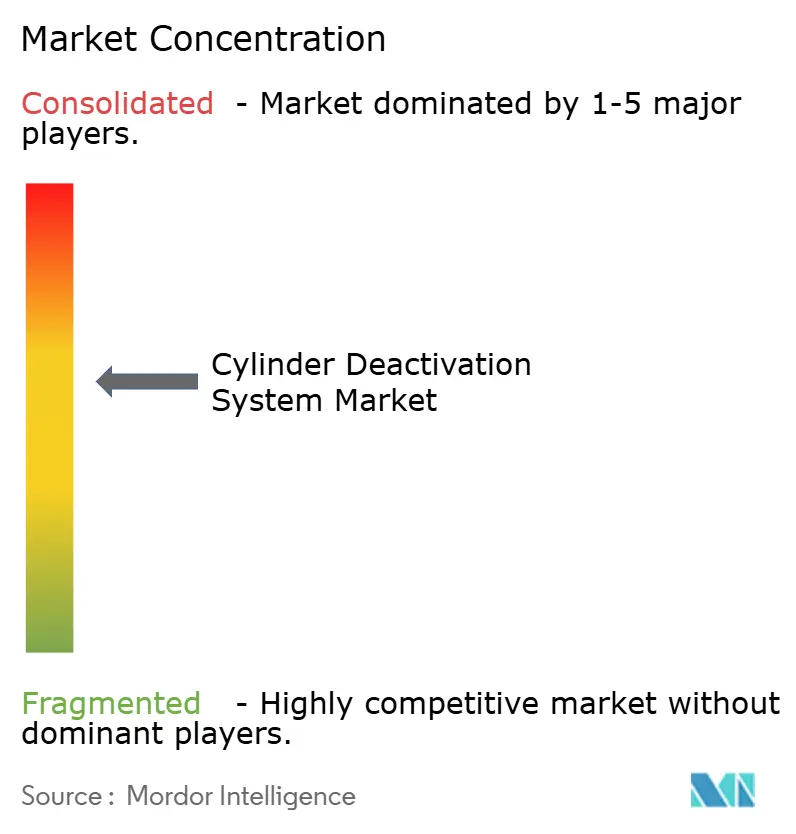
| Market Concentration | Medium |
Major Players *Disclaimer: Major Players sorted in no particular order Image © Mordor Intelligence. Reuse requires attribution under CC BY 4.0. | |

Cylinder Deactivation System Market Analysis by Mordor Intelligence
The cylinder deactivation system market size reached USD 5.11 billion in 2025 and is projected to advance to USD 7.03 billion by 2030, registering a 6.58% CAGR through the forecast period. Continued tightening of global CO₂ and fuel-economy regulations, mainly the European Union’s 95 g CO₂/km fleet target and the United States CAFE requirement of 40.5 mpg by 2026, anchors demand for cost-effective engine efficiency technologies. Automakers value cylinder deactivation because it yields 5-8% fuel savings without the capital intensity of a full hybrid powertrain. At the same time, valvetrain suppliers maintain healthy margins by bundling hardware with proprietary control software. Adoption accelerates in mild-hybrid architectures that leverage 48 V electrical systems to smooth NVH and extend the operating envelope. Commercial-vehicle programs now deploy the technology for thermal management of SCR aftertreatment. Competitive intensity rises as post-2025 patent expiries lower entry barriers and AI-based skip-fire algorithms redefine system performance expectations.
Key Report Takeaways
- By component, valve solenoids held the largest 42.22% share of the cylinder deactivation system market in 2024, while engine control units are forecast to grow at a 7.32% CAGR through 2030.
- By actuation method, hydraulic systems commanded 52.81% of the 2024 cylinder deactivation system market size, whereas electric actuation is projected to expand at a 7.98% CAGR to 2030..
- By fuel type, gasoline applications captured 56.35% of the 2024 cylinder deactivation system market share, yet diesel programs are set to register the fastest 7.23% CAGR through 2030.
- By cylinders deactivated, four-cylinder solutions led with 42.51% share in 2024, while six-cylinder systems exhibit the highest projected 7.74% CAGR to 2030.
- By application, start-stop integrations accounted for 52.18% of the cylinder deactivation system market size in 2024. Extended idling plus thermal-management solutions are advancing at a 7.84% CAGR over the same horizon.
- By geography, North America dominated with a 36.31% share in 2024, whereas Asia-Pacific is poised to grow fastest at an 8.34% CAGR through 2030.
Global Cylinder Deactivation System Market Trends and Insights
Drivers Impact Analysis*
| Driver | (~) % Impact on CAGR Forecast | Geographic Relevance | Impact Timeline |
|---|---|---|---|
| Stricter Global CO₂ / CAFE Standards | +1.8 % | Europe, North America | Medium term (2-4 years) |
| OEM Quest For Cost-Effective Mpg Gains | +1.5 % | North America, emerging markets | Short term (≤ 2 years) |
| Growth of 48 V Mild-Hybrid Platforms | +1.2 % | Europe, Asia-Pacific | Medium term (2-4 years) |
| Heavy-Duty Diesel CDA for SCR Thermal Control | +0.9 % | North America, Europe | Long term (≥ 4 years) |
| Post-2025 Expiry of Key CDA Valvetrain Patents | +0.7% | Global, with fastest uptake in Asia-Pacific | Short term (≤ 2 years) |
| AI-Enabled Dynamic Skip-Fire Algorithms | +0.6% | North America and Europe premium segments | Long term (≥ 4 years) |
| Source: Mordor Intelligence | |||
Stricter Global CO₂ / CAFÉ Standards
Governments now impose escalating monetary penalties for non-compliance, including an EU surcharge of EUR 95 for every gram of CO₂ above the fleet target[1]. Cylinder deactivation, therefore, offers automakers an immediate path to avoid fines by harvesting 5-8% efficiency from existing combustion architectures. OEM program managers increasingly prioritize the feature for light-truck and SUV portfolios, where large displacement engines amplify the absolute fuel-saving potential. Regulatory auditors accept the technology under standard certification cycles, and its integration aligns with ISO 14001 environmental-management commitments across global manufacturing footprints. The policy environment thus continues to propel the cylinder deactivation system market.
OEM Quest for Cost-Effective Mpg Gains Vs. Full Electrification
Cylinder deactivation hardware typically adds USD 100-600 to engine bill-of-material cost, far below the multi-thousand-dollar premium of full hybrid systems. The cost advantage resonates in price-sensitive vehicle segments and in regions where public charging infrastructure remains sparse. Automakers view the feature as a hedge: it prolongs ICE competitiveness while electrification economics continue to evolve, keeping the cylinder deactivation system market relevant even as battery prices fall.
Growth of 48 V Mild-Hybrid & Start-Stop Architectures
Academic testing confirms that the electric motor assistance in 48 V systems trims torque deviation during firing-pattern. The electrical headroom also powers faster actuator response, enabling more cylinders to be skipped at lower load without perceptible vibration. European premium brands lead adoption, and the architecture now cascades into high-volume C-segment models across Asia-Pacific. Suppliers package cylinder deactivation control inside the same ECU that governs belt-starter-generators, allowing OEMs to amortize electronics cost over multiple efficiency functions and strengthening the value proposition of the cylinder deactivation system market.
Heavy-Duty Diesel CDA for SCR Thermal Management
Bench studies show that deactivating half the cylinders elevates SCR inlet temperature from 200 °C to more than 250 °C, boosting NOₓ conversion by 77% under idle and low-load conditions. Fleet operators report fewer forced DPF regenerations and lower DEF consumption, translating into measurable operating-cost reductions. Phase 2 EPA and forthcoming Euro VII rules tighten real-world emissions, and cylinder deactivation now appears on option lists for long-haul, construction, and agricultural engines. The commercial-vehicle channel thus supplements light-duty demand and diversifies the revenue streams of the cylinder deactivation system market.
Restraints Impact Analysis*
| Restraint | (~) % Impact on CAGR Forecast | Geographic Relevance | Impact Timeline |
|---|---|---|---|
| Field Failures – Lifter Collapse and Oil-Consumption Recalls | -1.2% | North America primarily, with spillover to global markets | Short term (≤ 2 years) |
| Rapid EV / Hybrid Cost Downs Pressuring ICE Investments | -0.9% | Global, with strongest impact in Europe and China | Medium term (2-4 years) |
| Regulatory Moves Targeting Aftermarket CDA-Disable Kits | -0.6% | North America and Europe enforcement regions | Long term (≥ 4 years) |
| Shift To 3-Cyl Turbo Downsizing Limits CDA Benefits | -0.4% | Europe and Asia-Pacific small engine markets | Medium term (2-4 years) |
| Source: Mordor Intelligence | |||
Field Failures – Lifter Collapse and Oil-Consumption Recalls
Early-generation hydraulic lifters occasionally suffered oil-pressure-related failures that prompted warranty campaigns. Although redesigned components mitigate the root cause, residual customer skepticism lingers in North America. Several OEMs responded with extended powertrain warranties and software updates that restrict deactivation in specific load zones, actions that safeguard brand reputation but temporarily slow option-take rates. Suppliers counter the concern by adopting cleaner oil-flow paths and hardened lifter surfaces to rebuild confidence and stabilize the cylinder deactivation system market trajectory.
Rapid EV / Hybrid Cost Downs Pressuring ICE Investments
Lithium-ion battery pack pricing has fallen annually, narrowing the upfront-cost gap between BEVs and ICE powertrains. European and Chinese regulators promote zero-tailpipe-emission vehicles through purchase incentives and ZEV credits. Capital allocation, therefore, tilts toward dedicated electric platforms, potentially compressing automaker budgets for incremental ICE enhancements. Cylinder deactivation must continue to prove payback in hybrid and range-extender configurations to retain engineering priority. This dynamic tempers long-range demand elasticity in the cylinder deactivation system market.
*Our forecasts treat driver/restraint impacts as directional, not additive. The impact forecasts reflect baseline growth, mix effects, and variable interactions.
Segment Analysis
By Component: Engine Control Units Gain Momentum
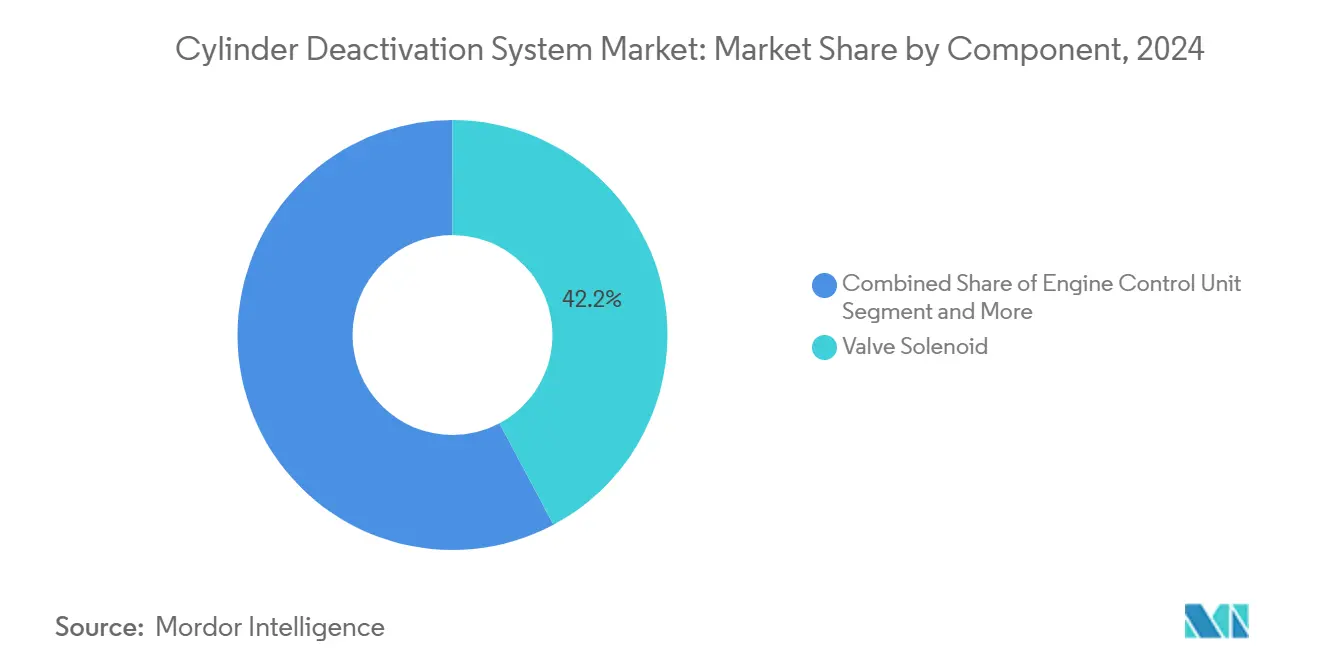
Valve solenoids preserved a 42.22% share of the cylinder deactivation system market in 2024. Engine control units are forecast to record a 7.32% CAGR between 2025 and 2030, outpacing hardware. Machine-learning firmware embedded in the ECU now monitors combustion stability, exhaust-gas temperature, and driver behavior in real time, adjusting skip patterns on the fly. Suppliers position these ECUs as cross-platform modules that can govern gasoline, diesel, hybrid, and alternative-fuel programs, improving economies of scale. Valve solenoids still anchor the bill of material, but their design evolves toward faster response and fault-tolerant operation that withstands higher duty cycles in skip-fire strategies.
Greater software content shifts profit pools toward companies that can bundle algorithms, calibration services, and data analytics. Control-logic upgrades become revenue opportunities throughout the vehicle life cycle as OEMs migrate to over-the-air update capability. That development reinforces the strategic importance of ECU providers inside the cylinder deactivation system market while encouraging mechanical suppliers to acquire or partner for software expertise.

By Actuation Method: Electric Systems Scale Quickly
Hydraulic devices retained 52.81% cylinder deactivation system market share in 2024, yet electric actuators are projected to expand at a 7.98% CAGR through 2030. Proof-of-concept programs demonstrate 5 ms response times for coil-based mechanisms, versus 15 ms for oil-fed lifters, allowing finer control of firing sequences [2]. Electric designs also eliminate the high-pressure oil rails that complicate thermal-management strategies during cold starts.
Tier-1 suppliers now offer unified product lines where identical finger followers can accept either solenoid or hydraulic cartridges, permitting OEMs to balance cost and performance variant by variant. In North America, legacy truck engines continue with hydraulic lifters because tooling amortization is fully recovered, though mid-cycle upgrades add electric exhaust deactivation on select trims. Across Asia-Pacific, greenfield engine plants increasingly specify all-electric valvetrains, accelerating the regional share shift. The convergence of 48 V electrical architecture, diagnostic granularity, and fail-safe default-open logic positions electric actuation as the long-term baseline within the cylinder deactivation system market.
By Fuel Type: Diesel Programs Broaden Addressable Market
Gasoline engines captured 56.35% of the cylinder deactivation system market in 2024, but diesel implementations are on track for a 7.23% CAGR to 2030 as fleet operators prioritize aftertreatment thermal stability. CDA enables diesel engines to keep SCR substrates above 250 °C during low-load operation, cutting NOₓ by up to 77%. Given the steep penalties attached to Euro VII enforcement, OEMs are rapidly integrating deactivation into medium- and heavy-duty platforms.
Light-duty gasoline applications remain stable because American pickup and SUV buyers demand towing capacity and V8 driving character, which align well with skip-fire logic. Hybrid powertrains further integrate CDA by allowing the engine to deactivate multiple cylinders even during moderate acceleration, with the traction motor covering the torque shortfall. LPG and CNG engines in urban bus fleets represent an emerging niche segment, where CDA maintains catalyst light-off during idle stops. These trends collectively support diversified growth across the cylinder deactivation system industry.
By Cylinders Deactivated: Six-Cylinder Solutions Lead Growth
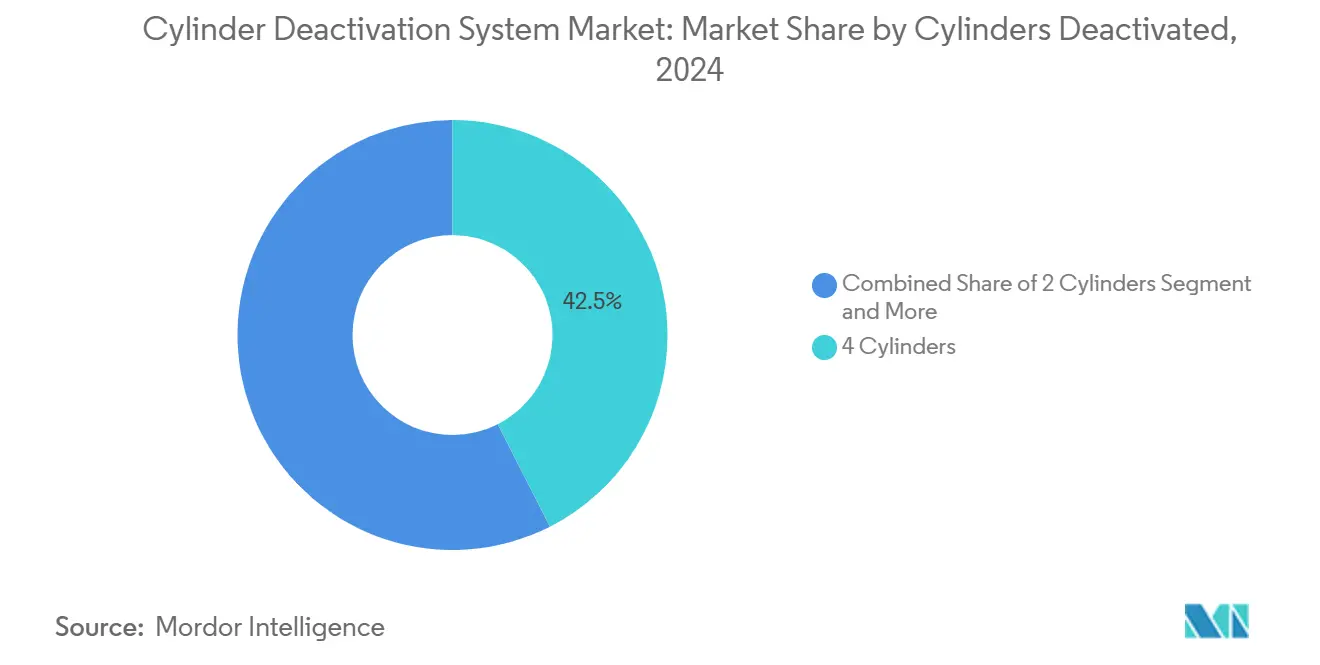
Four-cylinder patterns still held 42.51% share in 2024, yet six-cylinder systems are forecast to advance at 7.74% CAGR, reflecting luxury-vehicle migration to inline-six and V6 layouts. Advanced ECUs can stagger firing orders so that only two or three cylinders ignite under steady-cruise demand, preserving smoothness while extracting double-digit fuel savings. Dynamic skip-fire extends applicability to V8 and V12 engines, where premium automakers leverage the feature to retain large-displacement performance branding without breaching fleet-average CO₂ ceilings.
System suppliers respond with scalable oil-routing galleries and lifter cartridges that fit four- and six-cylinder heads, simplifying logistics. Software portfolios now include cylinder-selection heuristics trained on cloud-derived duty-cycle data, giving six-cylinder packages a rapid calibration head-start. The hierarchy signals a profitable path for vendors that can optimize hardware and algorithms across multiple cylinder counts, reinforcing competitive positioning in the cylinder deactivation system market.
By Application: Thermal-Management Use Cases Accelerate
Start-stop integrations accounted for 52.18% of the cylinder deactivation system market in 2024 as OEMs bundled CDA into city-driving fuel-economy packages. Extended idling and thermal-management functions, however, are projected to expand at a 7.84% CAGR through 2030 due to stringent real-world NOₓ limits. Heavy-duty trucks running hotel loads can deactivate two cylinders to raise exhaust heat for continuous SCR activity without elevating engine speed, saving diesel and reducing aftertreatment service intervals.
Electric-thermal management in plug-in hybrids also benefits: brief combustion cycles during battery-depletion phases can occur with half the cylinders closed, mitigating cold-start emissions spikes and speeding catalyst light-off. Cabin-heating demands in cold climates trigger similar strategies, showing the multifunctional value of CDA beyond simple consumption reduction. These broader roles entrench deactivation as a staple of holistic powertrain optimization and underpin sustained expansion of the cylinder deactivation system market.
Geography Analysis
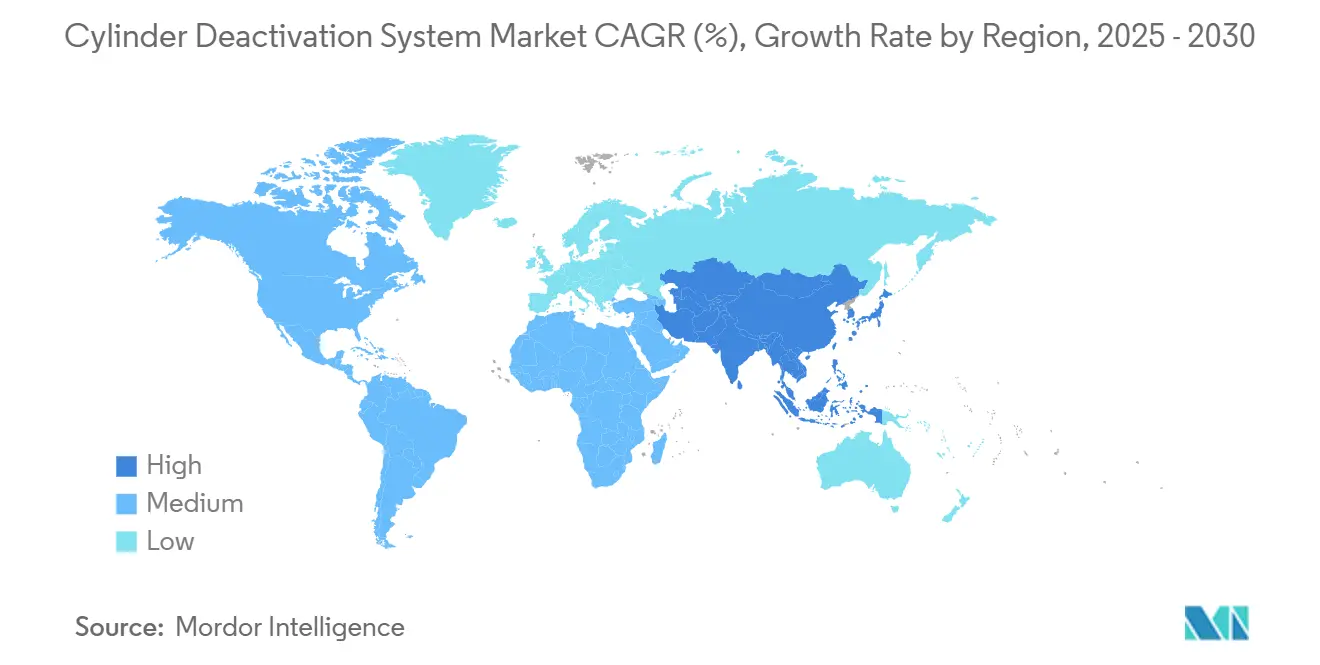
North America retained a 36.31% share of the cylinder deactivation system market in 2024. Pickup and SUV dominance, coupled with CAFE regulations that mandate 40.5 mpg by 2026, sustains OEM focus on valvetrain efficiency upgrades. Regional growth nonetheless faces near-term headwinds from earlier reliability controversies that dented consumer sentiment, prompting manufacturers to extend warranties and recalibrate marketing. Enforcement actions against aftermarket turn-off devices further shape market behavior by reducing illicit workarounds of factory-fitted systems.
Asia-Pacific is forecast to post the fastest 8.34% CAGR over 2025-2030, buoyed by high vehicle production volumes and the continued prevalence of internal combustion drivelines. Chinese OEMs integrate cylinder deactivation to qualify for domestic Stage 6b fuel-consumption credits, while Indian programs adopt the feature to future-proof engines ahead of Bharat VII emissions legislation. Lower labor costs and local component ecosystems improve price competitiveness, drawing multinational suppliers to establish joint ventures and technical centers throughout the region.
Europe holds a significant but moderately growing share as the block balances ICE phase-down policies with near-term CO₂ compliance needs. Cylinder deactivation now pairs standard with 48 V mild-hybrids across B- and C-segment models, allowing brands to prolong platform life cycles until dedicated BEV architectures scale profitably. Euro VII draft texts highlight real-world NOₓ performance, further elevating CDA’s relevance for diesel vans and regional-delivery trucks. Meanwhile, South America, the Middle East & Africa remain nascent markets where the technology’s cost-benefit ratio can offset fuel-quality variability and infrastructure gaps, laying a foundation for long-term growth in the cylinder deactivation system market.
Competitive Landscape
The cylinder deactivation system market exhibits moderate concentration. Eaton, Schaeffler, and BorgWarner each provide comprehensive portfolios spanning hydraulic and electric actuation alongside control electronics, leveraging decades of valvetrain intellectual property. Eaton recently showcased modular lifter families compatible with oil and coil actuation, reducing OEM validation cycles. Schaeffler’s 2025 merger with Vitesco expands its footprint in integrated 48 V solutions, offering e-rocker assemblies that merge electric deactivation with variable valve lift [3].
Emerging competitors such as Tula Technology introduce algorithmic skip-fire controls licensed as software-only solutions, challenging hardware incumbents by claiming additional fuel savings without mechanical complexity. Traditional suppliers respond by embedding AI inference engines inside next-generation ECUs, enabling cloud-assisted calibration and over-the-air feature upgrades. Patent expirations after 2025 invite new entrants, but manufacturing precision and supply-chain maturity remain substantial entry barriers, preserving incumbents’ advantaged cost position.
Strategic alliances broaden as driveline companies seek to bundle deactivation with complementary systems. BorgWarner’s intelligent Cam Torque Actuation now couples phasers with CDA logic, offering OEMs combined valve-timing and cylinder-shutdown control from a single provider. Meanwhile, electric-vehicle pivot strategies diversify revenue: suppliers market CDA kits for range-extender hybrids and hydrogen engines, ensuring relevance across multiple propulsion roadmaps and reinforcing resilience of the cylinder deactivation system industry.
Cylinder Deactivation System Industry Leaders
-
Eaton.
-
Robert Bosch GmbH
-
Continental AG
-
BorgWarner Inc.
-
Schaeffler AG
- *Disclaimer: Major Players sorted in no particular order
Recent Industry Developments
- July 2024: Cummins Valvetrain Technologies reports favorable outcomes from additional on-road testing of its Jacobs® cylinder deactivation (CDA) technology, which improves fuel efficiency and reduces emissions in heavy-duty road vehicles.
- May 2024: Schaeffler showcased its exhaust-valve e-Rocker systems for BMW B58 engines at the Automotive Engineering Exposition in Yokohama. The demonstration featured the integration of exhaust deactivation technology with electrified auxiliary systems.
Global Cylinder Deactivation System Market Report Scope
| Valve Solenoid |
| Engine Control Unit (ECU) |
| Electronic Throttle Control and Others |
| Hydraulic |
| Electric |
| Mechanical |
| Gasoline |
| Diesel |
| LPG / CNG |
| 2 Cylinders |
| 4 Cylinders |
| 6 Cylinders |
| 8 Cylinders |
| Start-Stop Systems |
| Idle-Stop Systems |
| Extended Idling / Thermal-Mgmt Systems |
| North America | United States |
| Canada | |
| Rest of North America | |
| South America | Brazil |
| Argentina | |
| Rest of South America | |
| Europe | United Kingdom |
| Germany | |
| Spain | |
| Italy | |
| France | |
| Russia | |
| Rest of Europe | |
| Asia Pacific | India |
| China | |
| Japan | |
| South Korea | |
| Rest of Asia Pacific | |
| Middle East and Africa | United Arab Emirates |
| Saudi Arabia | |
| Turkey | |
| Egypt | |
| South Africa | |
| Rest of Middle East & Africa |
| By Component | Valve Solenoid | |
| Engine Control Unit (ECU) | ||
| Electronic Throttle Control and Others | ||
| By Actuation Method | Hydraulic | |
| Electric | ||
| Mechanical | ||
| By Fuel Type | Gasoline | |
| Diesel | ||
| LPG / CNG | ||
| By Cylinders Deactivated | 2 Cylinders | |
| 4 Cylinders | ||
| 6 Cylinders | ||
| 8 Cylinders | ||
| By Application | Start-Stop Systems | |
| Idle-Stop Systems | ||
| Extended Idling / Thermal-Mgmt Systems | ||
| By Geography | North America | United States |
| Canada | ||
| Rest of North America | ||
| South America | Brazil | |
| Argentina | ||
| Rest of South America | ||
| Europe | United Kingdom | |
| Germany | ||
| Spain | ||
| Italy | ||
| France | ||
| Russia | ||
| Rest of Europe | ||
| Asia Pacific | India | |
| China | ||
| Japan | ||
| South Korea | ||
| Rest of Asia Pacific | ||
| Middle East and Africa | United Arab Emirates | |
| Saudi Arabia | ||
| Turkey | ||
| Egypt | ||
| South Africa | ||
| Rest of Middle East & Africa | ||
Key Questions Answered in the Report
How large is the cylinder deactivation system market in 2030?
Forecasts indicate the cylinder deactivation system market will reach USD 7.03 billion by 2030, up from USD 5.11 billion in 2025.
Which component segment is growing fastest?
Electronic control units are expected to expand at a 7.32% CAGR through 2030 as software complexity rises.
Why is diesel cylinder deactivation gaining momentum?
Diesel programs use cylinder deactivation to keep SCR exhaust temperatures above 250 °C, improving NOₓ conversion by up to 77% and supporting Euro VII compliance.
What region is expected to record the highest growth rate?
Asia-Pacific is projected to post an 8.34% CAGR through 2030, driven by high vehicle output in China and sustained ICE demand in India.
How do 48 V mild-hybrids influence adoption?
The 48 V electrical network supplies rapid torque fill and actuator power, reducing NVH during cylinder shutdown and broadening use across mainstream vehicle segments.