
Gasoline Direct Injection Market Size and Share
Market Overview
| Study Period | 2019 - 2031 |
|---|---|
| Market Size (2026) | USD 10.19 Billion |
| Market Size (2031) | USD 14.71 Billion |
| Growth Rate (2026 - 2031) | 7.61 % |
| Fastest Growing Market | Asia Pacific |
| Largest Market | Asia Pacific |
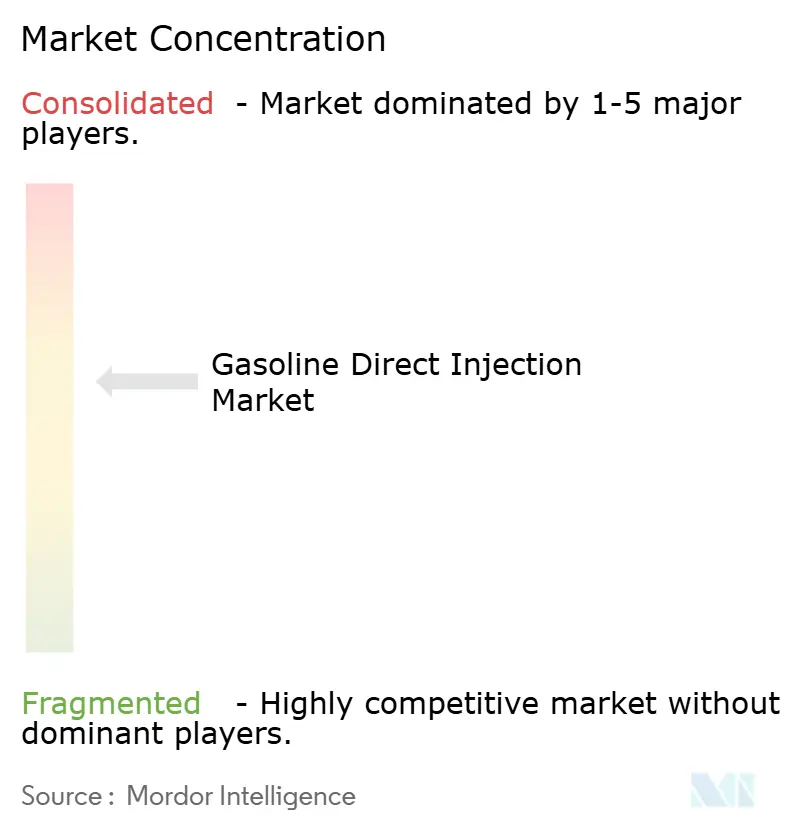
| Market Concentration | Medium |
Major Players *Disclaimer: Major Players sorted in no particular order Image © Mordor Intelligence. Reuse requires attribution under CC BY 4.0. | |
Gasoline Direct Injection Market Analysis by Mordor Intelligence
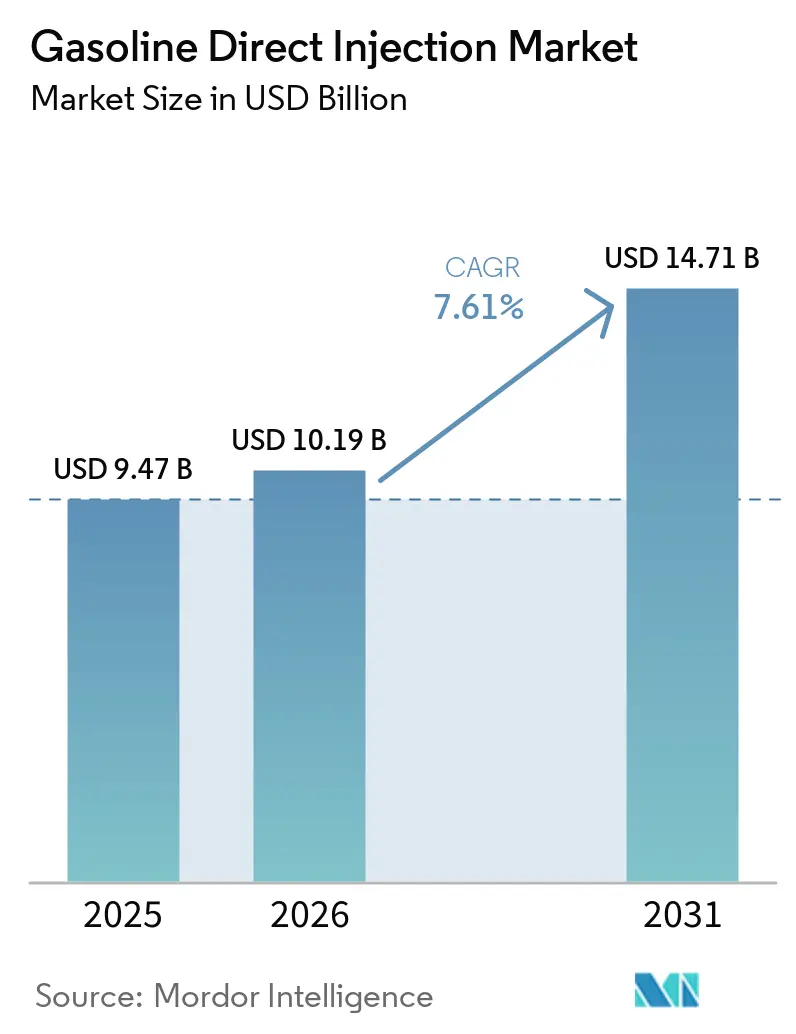
The Gasoline Direct Injection Market size was valued at USD 9.47 billion in 2025 and is estimated to grow from USD 10.19 billion in 2026 to reach USD 14.71 billion by 2031, at a CAGR of 7.61% during the forecast period (2026-2031). This growth path reflects automakers’ tactical use of high-pressure injection to balance stricter emission limits with uneven electric-vehicle adoption. Regulatory convergence around real-driving-emissions testing, particulate-number thresholds, and on-board fuel-consumption monitoring is accelerating GDI upgrades, especially the move to 350-bar systems. Hybridization is another lifeline because mild-hybrid and plug-in configurations now account for a rising share of installations, allowing the gasoline direct-injection market to keep pace even as pure-ICE volumes plateau. Demand is also propped up by SUV and pickup popularity in North America and by sustained gasoline-vehicle production in India, Southeast Asia, and Brazil, where charging networks lag policy ambition.
Key Report Takeaways
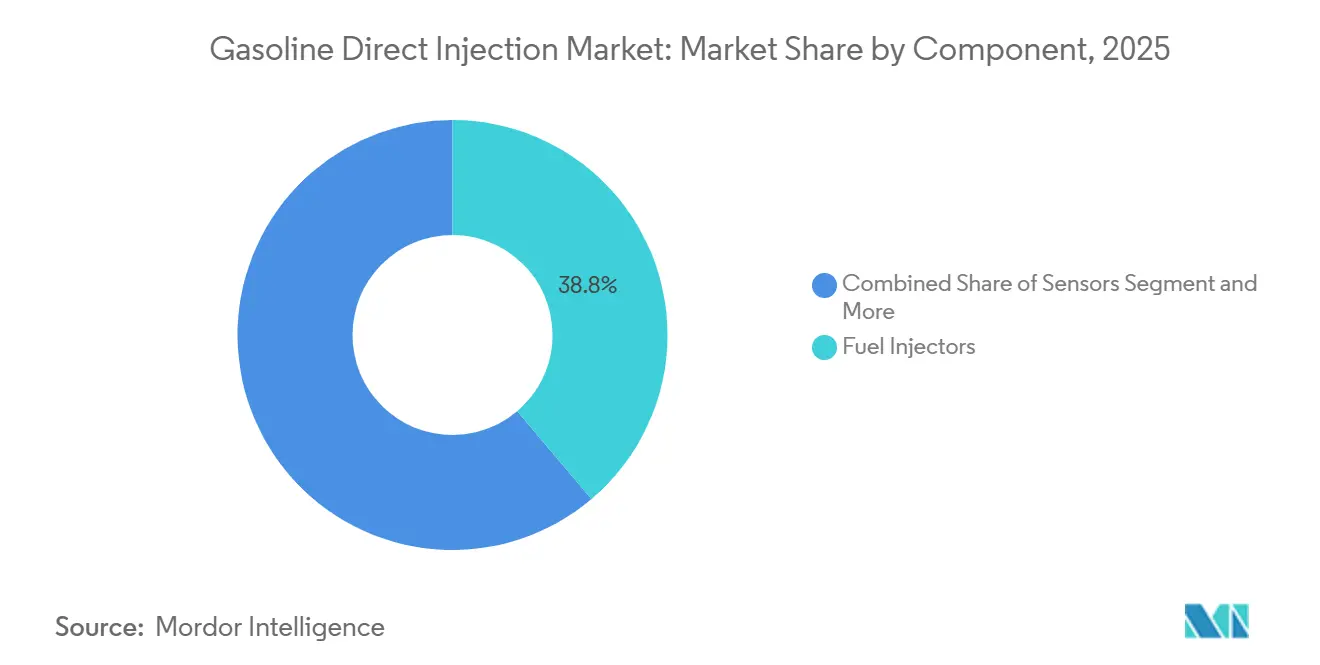
- By component, fuel injectors held 38.81% of the gasoline direct injection market share in 2025, while sensors are advancing at a 7.63% CAGR through 2031.
- By engine type, inline-4 units dominated with 67.73% share of the gasoline direct injection market in 2025; inline-3 layouts are forecast to expand at a 7.66% CAGR to 2031.
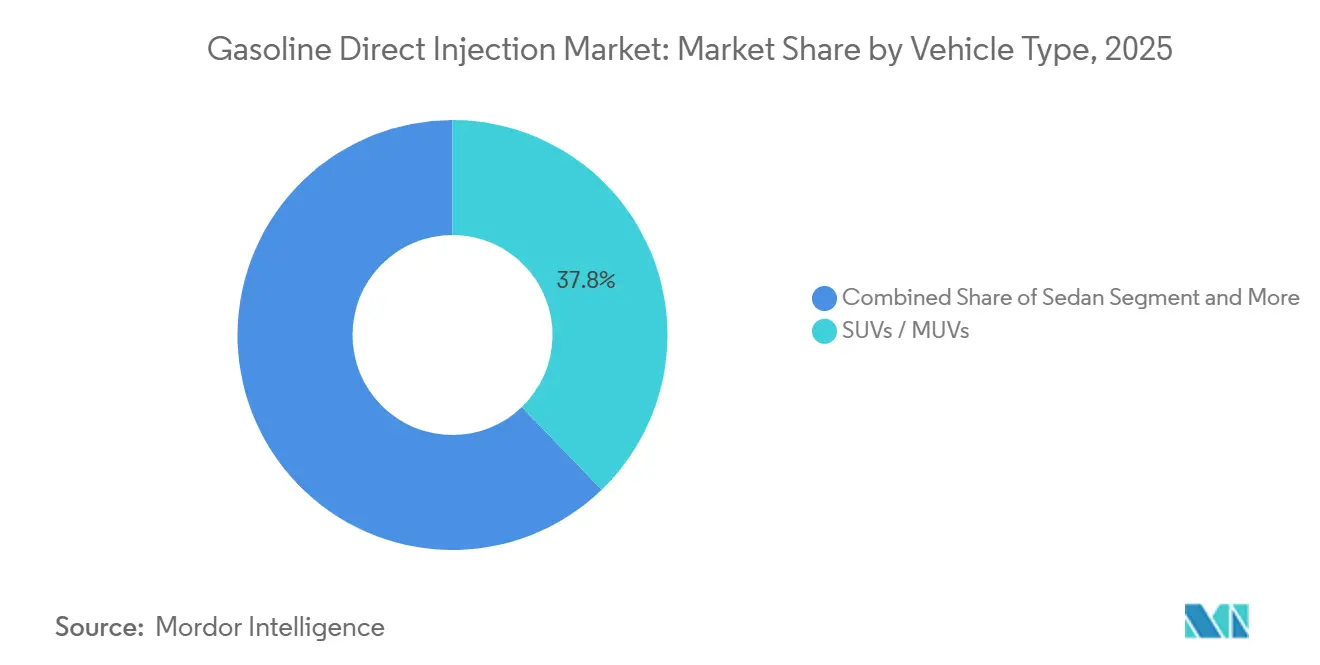
- By vehicle type, SUVs and MUVs led with 37.75% share in 2025 and are projected to grow at a 7.69% CAGR during the period.
- By sales channel, the OEM segment captured 78.83% share of the gasoline direct injection market in 2025, whereas the aftermarket is set to rise at a 7.75% CAGR through 2031.
- By geography, Asia-Pacific accounted for 36.48% of 2025 revenue and is poised to post a 7.71% CAGR to 2031.
Note: Market size and forecast figures in this report are generated using Mordor Intelligence’s proprietary estimation framework, updated with the latest available data and insights as of January 2026.
Global Gasoline Direct Injection Market Trends and Insights
Drivers Impact Analysis*
| Driver | (~) % Impact on CAGR Forecast | Geographic Relevance | Impact Timeline |
|---|---|---|---|
| Stricter Emission and Fuel-Economy Standards | +2.1% | Global, with peak enforcement in EU, China, and North America | Medium term (2-4 years) |
| OEM Engine Downsizing and Turbocharging | +1.8% | Global, led by Europe and Asia-Pacific A/B-segment platforms | Short term (≤ 2 years) |
| Growing Gasoline-Vehicle Production | +1.6% | Asia-Pacific core (India, ASEAN), spill-over to Middle East and Africa | Long term (≥ 4 years) |
| Integration Of GDI | +1.4% | Global, with concentration in China, Europe, and Japan | Medium term (2-4 years) |
| High-Pressure Injection Systems | +1.2% | Global, with early adoption in premium and performance segments | Medium term (2-4 years) |
| Edge-Computing ECUs and OTA Fuel Mapping | +0.9% | North America and EU core, expanding to China and premium Asia-Pacific segments | Long term (≥ 4 years) |
| Source: Mordor Intelligence | |||
Stricter Emission & Fuel-Economy Standards
New standards such as Euro 7 PN10, China’s GB 19578-2024, and the U.S. EPA Tier 3 rule are forcing OEMs to adopt multi-pulse strategies and gasoline particulate filters [1]. On-board fuel-consumption monitoring makes every vehicle a rolling audit, creating a compliance premium for closed-loop, high-pressure systems. Suppliers are responding by adding redundant lambda probes and particulate sensors, raising sensor content per vehicle. Bharat Stage VI Phase 3 will extend this standard to India in 2027, tightening particulate limits and mandating real-driving-cycle emissions testing. The synchronous effect across regions compresses development timelines and pushes Tier-1s to expand 350-bar injector capacity [2].
OEM Engine Downsizing & Turbocharging
Three-cylinder and small four-cylinder turbos are rapidly replacing larger-displacement units as automakers chase fleet CO₂ targets without incurring full-hybrid costs. Stellantis’s 2.0-liter Hurricane 4 and Toyota’s 2.0-liter turbo show how 350-bar direct injection, pre-chamber ignition, and synthetic-fuel readiness can deliver V6-level output with double-digit fuel savings. Inline-3 engines, despite NVH challenges, now power mainstream A/B-segment models in China and Europe. Variable-displacement fuel pumps and piezoelectric injectors support the high pressure and multiple injections these downsized engines require, keeping the gasoline direct injection market relevant in segments that might otherwise migrate straight to battery-electric alternatives.
Growing Gasoline-Vehicle Production in Asia-Pacific
In fiscal 2024-25, India experienced significant passenger-vehicle sales, with utility vehicles dominating the market and driving demand for GDI powertrains optimized for E20 ethanol. During 2025, China's hybrid exports demonstrated substantial growth, highlighting the ongoing reliance of electrified vehicles on gasoline engines for range extension. Southeast Asian governments, balancing emission targets with affordability, enable automakers to retain combustion platforms while focusing on localized component sourcing. These production hubs are extending the commercial viability of the gasoline direct injection market, surpassing projections based solely on domestic demand in Europe or China.
High-Pressure (≥350 bar) Injection Systems
High pressures significantly enhance atomization and effectively reduce particulate emissions, aligning with the latest emission standards such as Euro 7 and China VI-b. Bosch’s HDEV6 and Continental’s Smart CR incorporate advanced piezo actuation and in-body sensing technologies to achieve rapid response times, enabling multiple injection schedules during cold starts. Denso’s variable-displacement pumps minimize energy losses, meeting OEM efficiency targets without requiring hardware modifications. Emerging prototypes with higher-pressure capabilities show potential for further soot reduction but require advanced materials for injector tips and seals, driving research and development efforts among top suppliers.
Restraints Impact Analysis*
| Restraint | (~) % Impact on CAGR Forecast | Geographic Relevance | Impact Timeline |
|---|---|---|---|
| Rapid Electrification Of Passenger Vehicles | -1.4% | EU and China core, spreading to North America and Asia-Pacific urban centers | Long term (≥ 4 years) |
| High Cost & Maintenance Complexity | -0.8% | Global, with acute impact in price-sensitive Asia-Pacific and South America markets | Short term (≤ 2 years) |
| Intake-Valve Carbon Build-Up Warranty Risk | -0.7% | North America and Europe, spreading to mature Asia-Pacific markets | Short term (≤ 2 years) |
| Future PN Regulations Raising Compliance Costs | -0.6% | EU (Euro 7), China (National VII), India (BS VI Stage 3), with delayed impact in other regions | Medium term (2-4 years) |
| Source: Mordor Intelligence | |||
Rapid Electrification of Passenger Vehicles
EVs are expected to significantly reduce daily oil consumption in the coming years, thereby shrinking the market for internal combustion engines (ICE). China's NEV credit is projected to increase substantially in the near future. Meanwhile, Europe aims to achieve a dominant EV market share within the next decade, and the U.S. targets a significant shift toward EV adoption during the same period. These initiatives are steering R&D investments towards battery systems, sidelining next-gen injectors. This trend limits growth for the gasoline direct injection market, even as hybrids continue to utilize the technology. Suppliers are now tasked with a strategic shift: safeguarding their combustion revenue streams while expanding their electric-drive product offerings.
Intake-Valve Carbon Build-Up Warranty Risk
GDI engines experienced carbon deposits, leading to misfire codes appearing relatively early in their service life. While walnut-shell blasting offers a solution, it often pushes many claims into the OEM warranty window due to its cost. On the other hand, chemical cleaners loaded with high polyetheramine offer only partial relief, raising concerns about seal compatibility. Introducing dual-injection architectures, which incorporate port injectors to clean valves, addresses the carbon deposit issue but adds additional expenses to the bill of materials. As a result, the pressure from warranty reserves has tempered the aggressive rollout of budget-friendly GDI variants, especially in regions with extended statutory guarantees.
*Our forecasts treat driver/restraint impacts as directional, not additive. The impact forecasts reflect baseline growth, mix effects, and variable interactions.
Segment Analysis
By Component: Sensors, Capture, Compliance, Spend
Sensor suites gained momentum because Euro 7 and U.S. OBD III rules require real-time monitoring of fuel-air ratios and particulate output. Fuel injectors still accounted for 38.81% of 2025 revenue due to their high unit pricing, but sensor sales will outpace all other components at a 7.63% CAGR. That trajectory lifts the gasoline direct injection market size for sensors as OEMs deploy wideband lambda probes, PM sensors, and on-rail pressure transducers.
In premium cars, piezoelectric injectors are steadily replacing their solenoid counterparts. Continental's rail-pressure sensors offer high accuracy across a wide temperature range. These sensors back adaptive maps housed in advanced electronic control units. Additionally, as oxygen sensors age and mass airflow systems become fouled, they hinder limp-home strategies. This has spurred a growing aftermarket demand, generating service revenue that bolsters the gasoline direct injection market throughout a vehicle's lifecycle.

By Engine Type: Inline-3 Gains in A/B Segments
Inline-4 engines held 67.73% of the 2025 segment value, but tough fleet-average CO₂ caps in China and Europe make three-cylinder turbos the growth story, lifting their share of the gasoline direct-injection market through 2031. Stellantis and Toyota examples show how 350-bar GDI and pre-chamber ignition can deliver V6 performance from small blocks.
NVH hurdles that once limited the inline-3's appeal are mitigated by balance shafts and active mounts, which are growing at a 7.66% CAGR through 2031. Ford’s 1.0-liter EcoBoost and Volkswagen’s 1.0-liter TSI set early benchmarks, encouraging suppliers to scale crankshafts, pumps, and injectors for high BMEP operation. V6 and V8 designs retreat to pickups and performance SUVs, where towing and brand heritage still command premium pricing.
By Vehicle Type: SUVs Drive Volume and Innovation
SUVs and MUVs captured 37.75% of the 2025 segment revenue and will grow fastest at 7.69% through 2031, reinforcing their pull on the gasoline direct injection market. Higher average transaction prices allow automakers to absorb the costs of particulate filters and 350-bar systems, protecting margins while meeting emission rules.
In North America, annual pickup sales remain significant, with a preference for GDI engines, especially for towing, where the loss of battery-electric range is pronounced. In recent years, utility vehicles in India have dominated the passenger-vehicle market, solidifying demand for turbocharged GDI powertrains compatible with E20 fuel. While hatchbacks and sedans are losing ground to crossovers, they still hold significance in Europe and Japan, where urban parking limitations and tax classifications influence vehicle selection.
By Sales Channel: Aftermarket Gains from Aging Fleet
OEM purchases accounted for 78.83% of 2025 segment sales, but the aftermarket segment will post a 7.75% CAGR as early-generation GDI fleets reach injector-failure age. Carbon-cleaning services, injector replacements, and sensor swaps feed independent shops and dealership parts counters, expanding the gasoline direct-injection market size on the service side.
Enthusiasts and fleets managing high-mileage assets are the primary targets for dual-injection retrofit kits, which are priced at a premium and introduce port injectors to combat carbon deposits. On the other hand, OEMs are focusing on hybrid initiatives. Notably, Hyundai's turbo GDI system and Audi's MHEV Plus integrate GDI into electrified architectures, ensuring the technology's relevance even as adoption of battery-electric systems rises.
Geography Analysis
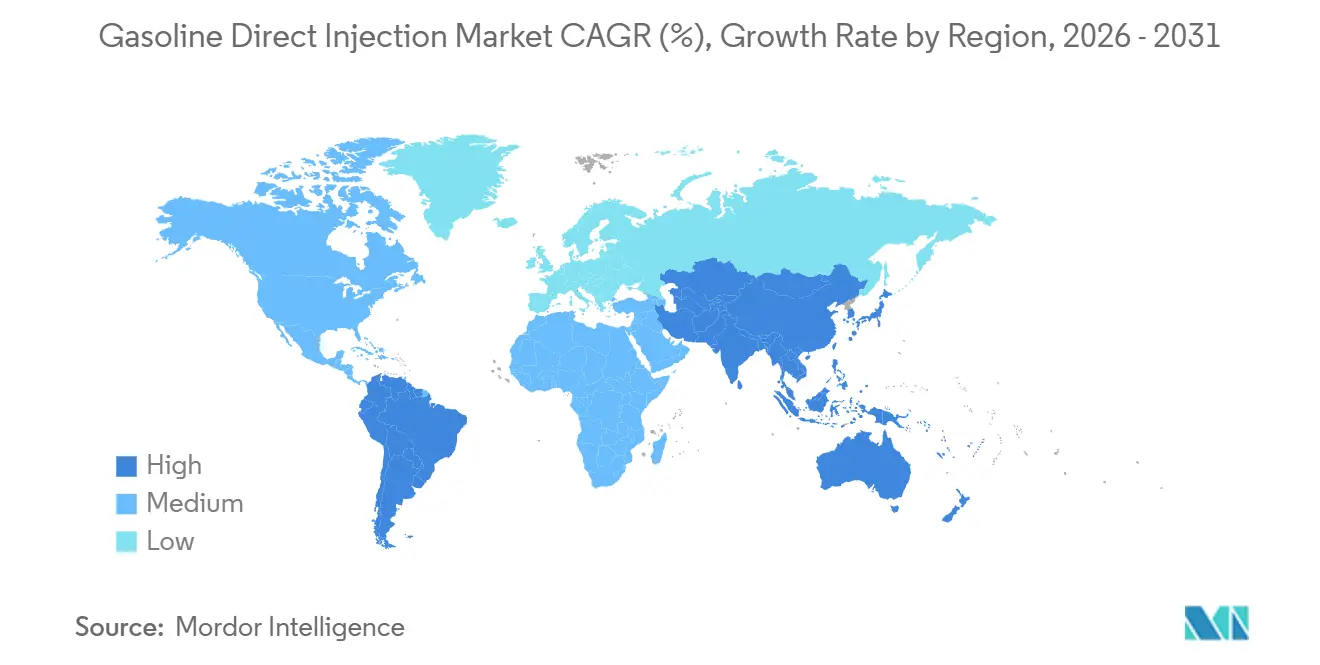
Asia-Pacific generated 36.48% of 2025 regional revenue, and a 7.71% CAGR to 2031 makes it the geographic engine for the gasoline direct injection market. India’s record passenger-vehicle sales, the E20 rollout, and sustained SUV demand are forcing local suppliers to adopt corrosion-resistant injectors and adaptive ethanol mapping. China's hybrid exports surged in the early part of 2025, underscoring the pivotal role of Gasoline Direct Injection (GDI) in range-extender designs, especially in regions with underdeveloped charging infrastructure.
In 2025, Europe commanded a notable share of the market. However, the costs associated with Euro 7 compliance and stringent EV mandates have tempered volume growth. In response, Original Equipment Manufacturers (OEMs) are integrating GDI with 48-V mild hybrids. This combination facilitates engine-off coasting and immediate restarts, enhancing efficiency without the need for plug-in components. North America is adopting a similar approach, especially in premium SUVs and pickups. Here, the demands of towing duty cycles validate the use of gasoline engines, bolstering the market share of gasoline direct injection, high-pressure injectors, and particulate filters.
South America, spearheaded by Brazil's flex-fuel vehicles, alongside the Middle East and Africa, rounds out the remaining revenue contributions. In Brazil, the use of gasoline blended with ethanol requires injectors to deliver higher flow rates to compensate for ethanol's lower energy density. This requirement bolsters the dedicated flex-fuel GDI production lines. Meanwhile, in the Gulf Cooperation Council nations, where electrification is still gaining momentum, imported gasoline SUVs benefit from robust aftermarket networks. These networks not only extend the system's lifespan but also generate additional revenue for the gasoline direct-injection market.
Competitive Landscape
Robert Bosch, Denso, and Continental dominate the injector and system revenue landscape. However, competition intensifies as Hitachi Astemo and BorgWarner establish localized production in Asia and North America. Investment trends spotlight advanced systems, over-the-air-updatable ECUs, and dual-injection architectures designed to reduce carbon buildup. Continental's recent expansion in Newport News underscores the capital intensity required to navigate shrinking tooling cycles amid a rapid shift towards electrification.
BorgWarner's projected future net sales, with a notable share from eProducts, illustrate the balancing act of legacy powertrain suppliers straddling both combustion and electric portfolios. Bosch's innovative Smart CR injector integrates a piezo position sensor into its body, streamlining wiring and facilitating predictive diagnostics. Meanwhile, Denso zeroes in on variable-displacement pumps to minimize parasitic loss. The startup scene buzzes with activity around retrofit kits, flex-fuel variants, and promising high-pressure prototypes, eyeing future regulatory advantages.
Software emerges as the pivotal factor in competitive differentiation. Suppliers are embedding machine-learning algorithms that fine-tune injection timing based on knock-sensor feedback and exhaust-gas-recirculation flow. This innovation translates to measurable boosts in real-world fuel economy, all without the need for hardware changes—the heightened bar set by ISO 26262 functional safety standards benefits established players with robust validation capabilities. Additionally, regional content mandates in India and Brazil complicate sourcing dynamics, prompting global entities to pursue joint ventures or greenfield plants to safeguard their foothold in the gasoline direct-injection market.
Gasoline Direct Injection Industry Leaders
-
Robert Bosch GmbH
-
Denso Corporation
-
Continental AG
-
Aptiv PLC
-
Magneti Marelli S.p.A.
- *Disclaimer: Major Players sorted in no particular order
Recent Industry Developments
- April 2025: Kia unveiled a 2.5-liter turbocharged T-GDI engine targeting a 5% thermal efficiency gain and 12% power increase. It is slated for hybrids, ICE models, and range-extender generators.
- February 2025: BorgWarner extended wastegate turbocharger contracts with a major North American OEM through 2028, incorporating electrically actuated systems for midsized gasoline engines.
- February 2025: The Aeromotive Group acquired VaporWorx to deepen its aftermarket fuel-delivery portfolio with electronic fuel-control systems, retaining founder Carl Casanova as engineering director.
Global Gasoline Direct Injection Market Report Scope
The scope of the report includes Component (Fuel Injectors and More), Engine Type (Inline-3 and More), Vehicle Type (Hatchback and More), Sales Channel (OEM and Aftermarket), and Geography.
| Fuel Injectors |
| Engine Control Units (ECUs) |
| Sensors |
| Fuel Pumps |
| Fuel Rails |
| Inline-3 (I3) |
| Inline-4 (I4) |
| V6 |
| V8 |
| Hatchback |
| Sedan |
| SUVs/MUVs |
| Van |
| Pick-up Truck |
| OEM |
| Aftermarket |
| North America | United States |
| Canada | |
| Rest of North America | |
| South America | Brazil |
| Argentina | |
| Rest of South America | |
| Europe | United Kingdom |
| Germany | |
| Spain | |
| Italy | |
| France | |
| Russia | |
| Rest of Europe | |
| Asia-Pacific | India |
| China | |
| Japan | |
| South Korea | |
| Rest of Asia-Pacific | |
| Middle East and Africa | United Arab Emirates |
| Saudi Arabia | |
| Turkey | |
| Egypt | |
| South Africa | |
| Rest of Middle East and Africa |
| By Component | Fuel Injectors | |
| Engine Control Units (ECUs) | ||
| Sensors | ||
| Fuel Pumps | ||
| Fuel Rails | ||
| By Engine Type | Inline-3 (I3) | |
| Inline-4 (I4) | ||
| V6 | ||
| V8 | ||
| By Vehicle Type | Hatchback | |
| Sedan | ||
| SUVs/MUVs | ||
| Van | ||
| Pick-up Truck | ||
| By Sales Channel | OEM | |
| Aftermarket | ||
| By Geography | North America | United States |
| Canada | ||
| Rest of North America | ||
| South America | Brazil | |
| Argentina | ||
| Rest of South America | ||
| Europe | United Kingdom | |
| Germany | ||
| Spain | ||
| Italy | ||
| France | ||
| Russia | ||
| Rest of Europe | ||
| Asia-Pacific | India | |
| China | ||
| Japan | ||
| South Korea | ||
| Rest of Asia-Pacific | ||
| Middle East and Africa | United Arab Emirates | |
| Saudi Arabia | ||
| Turkey | ||
| Egypt | ||
| South Africa | ||
| Rest of Middle East and Africa | ||
Key Questions Answered in the Report
What is the projected value of the gasoline direct injection market by 2031?
The gasoline direct injection market size is forecast to reach USD 14.71 billion by 2031, advancing at a 7.61% CAGR over 2026-2031.
Which component segment is growing fastest through 2031?
Sensors are the fastest-growing component, expected to post a 7.63% CAGR as stricter emission rules mandate real-time particulate and fuel-consumption monitoring.
Which engine configuration is gaining the most share?
Inline-3 turbocharged engines are set to expand at a 7.66% CAGR to 2031 because they help automakers meet fleet CO₂ targets without full electrification.
How large is Asia-Pacific’s role in the gasoline direct injection market?
Asia-Pacific held 36.48% of global revenue in 2025 and is expected to grow at 7.71% CAGR through 2031, led by India and China.
Why are high-pressure (≥350 bar) systems important?
Pressures of 350 bar and above improve atomization, reduce particulate emissions, and help vehicles meet Euro 7 and China VI-b limits, thereby sustaining GDI relevance in stricter regulatory environments.
What risk does intake-valve carbon buildup pose?
Carbon deposits can trigger misfire codes within 30,000 miles, leading to costly walnut-shell cleaning and higher warranty reserves, so some OEMs adopt dual-injection systems despite added cost.