
Automotive Active Purge Pump Market Size and Share
Market Overview
| Study Period | 2019 - 2031 |
|---|---|
| Market Size (2026) | USD 0.77 Billion |
| Market Size (2031) | USD 1.04 Billion |
| Growth Rate (2026 - 2031) | 6.11 % |
| Fastest Growing Market | Asia Pacific |
| Largest Market | Europe |
| Market Concentration | Medium |
Major Players *Disclaimer: Major Players sorted in no particular order Image © Mordor Intelligence. Reuse requires attribution under CC BY 4.0. | |
Automotive Active Purge Pump Market Analysis by Mordor Intelligence
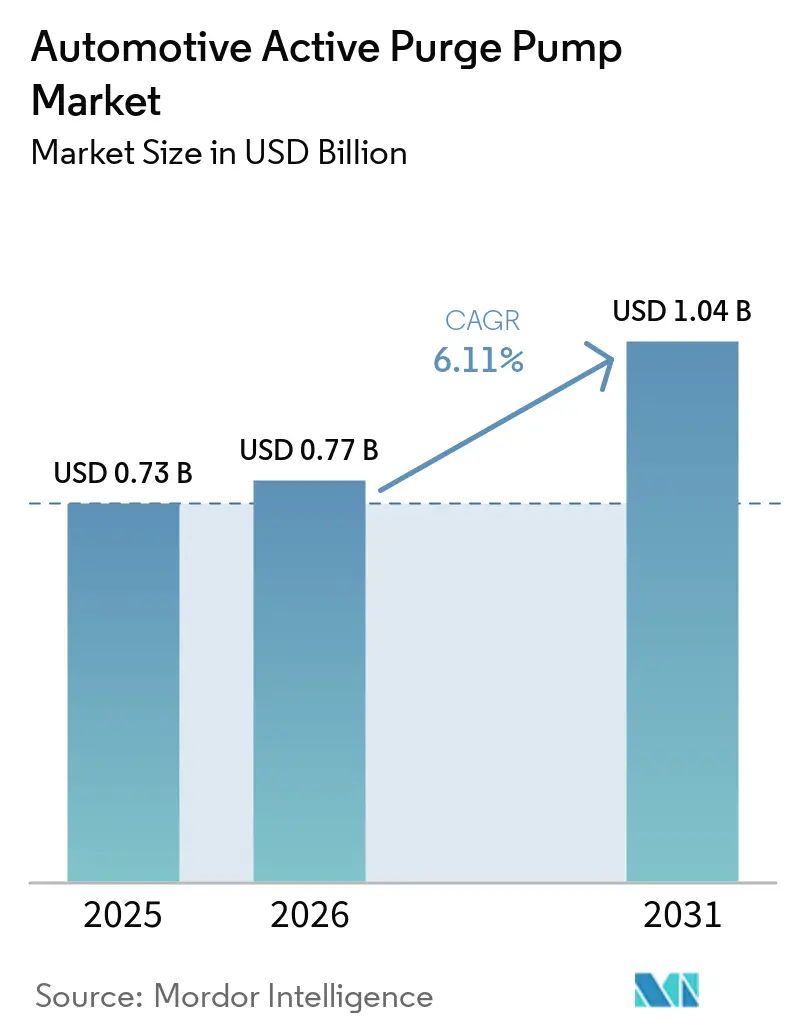
The Automotive Active Purge Pump Market size was USD 0.73 billion in 2025, is expected to grow to USD 0.77 billion in 2026, and is forecast to reach USD 1.04 billion by 2031, at an 6.11% CAGR over 2026-2031. Regulatory pressure on evaporative emissions, the large installed base of turbo-GDI engines, and the need to manage pressurized fuel tanks in plug-in hybrids sustain modest expansion despite the drag from battery-electric penetration. Suppliers increasingly deliver integrated pump-valve-sensor modules that reduce assembly complexity, while rare-earth magnet shortages and rising polymer-quality requirements are shaping sourcing strategies. Automakers also weigh the total cost of ownership, benefit from richer diagnostics that curb warranty claims. Together, these dynamics maintain a measured but resilient trajectory for the automotive active purge pump market.
Key Report Takeaways
- By component, DC motors led with 41.27% of the automotive active purge pump market share in 2025, while sensors are projected to record the fastest CAGR at 6.13% through 2031.
- By material type, non-metal materials held 63.37% revenue share in 2025 and will expand at a 6.16% CAGR to 2031.
- By manufacturing process, injection molding accounted for 52.43% of the automotive active purge pump market size in 2025 and is expected to rise at a 6.25% CAGR over 2026-2031.
- By vehicle type, passenger cars captured 65.61% volume share in 2025; medium and heavy commercial vehicles are forecast to grow at the highest CAGR of 6.19% through 2031.
- By distribution channel, the OEM channel accounted for 71.25% of 2025 shipments, while the aftermarket is poised for a 6.24% CAGR through 2031.
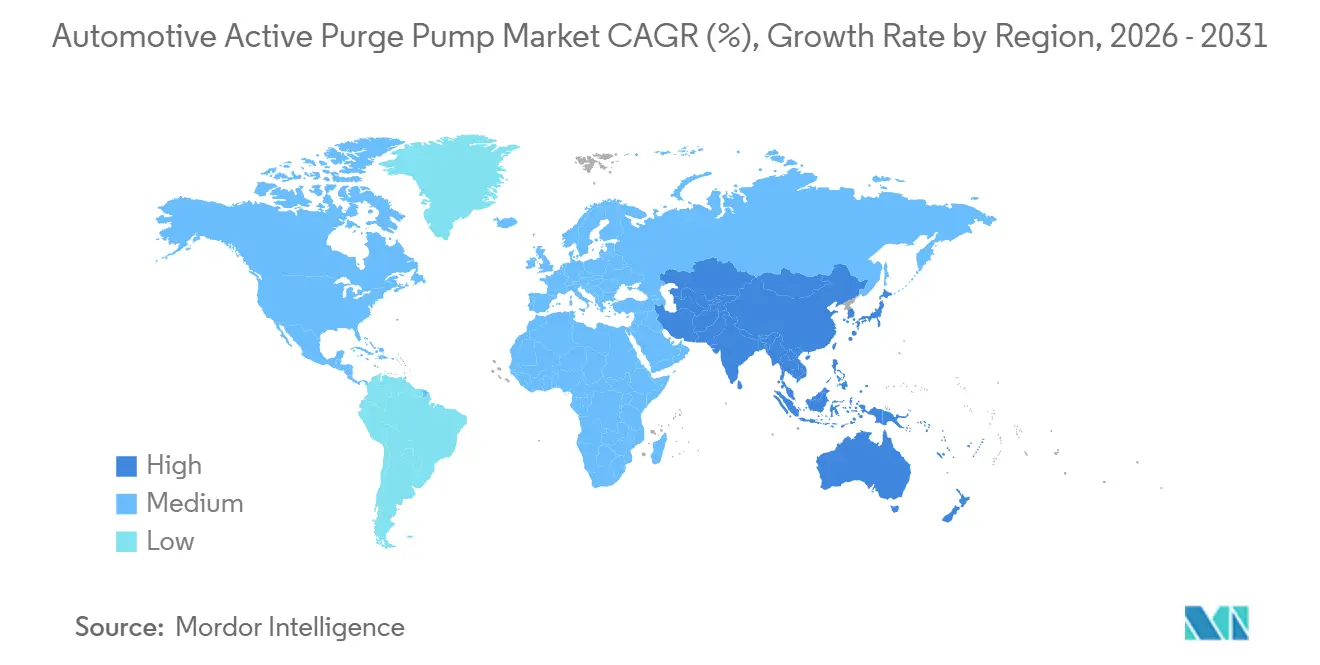
- By geography, Europe accounted for 38.73% of the automotive active purge pump market share in 2025, while Asia-Pacific is projected to expand at the fastest CAGR of 6.22% through 2031.
Note: Market size and forecast figures in this report are generated using Mordor Intelligence’s proprietary estimation framework, updated with the latest available data and insights as of January 2026.
Market Trends and Insights
Drivers Impact Analysis of Automotive Active Purge Pump Market*
| Driver | (~) % Impact on CAGR Forecast | Geographic Relevance | Impact Timeline |
|---|---|---|---|
| Stricter Evaporative-Emission Regulations (EPA Tier-3, Euro 6e etc.) | +0.4% | Global, with highest enforcement in North America and EU | Medium term (2-4 years) |
| Turbo/GDI Engines Create Low-Vacuum Need for Active Purge | +0.3% | North America, Europe, Asia Pacific core markets (China, Japan, South Korea) | Short term (≤ 2 years) |
| Passenger-Vehicle Production Growth in Asia and MENA | +0.2% | Asia Pacific (India, China) and MENA (Egypt, Saudi Arabia, UAE) | Medium term (2-4 years) |
| Pressurized Fuel Tanks in PHEVs Demand Active Purge Pumps | +0.2% | Global, concentrated in premium segments and EU/China PHEV incentive zones | Long term (≥ 4 years) |
| Software-Defined Vehicle Architecture Enables Predictive Purge Diagnostics | +0.1% | Global, early adoption in premium OEMs (BMW, Mercedes, Audi, Tesla ICE hybrids) | Long term (≥ 4 years) |
| Multi-Function Pump Modules Cut Component Count and Cost | +0.1% | Global, driven by tier-1 suppliers (Continental, Bosch, Denso) | Medium term (2-4 years) |
| Source: Mordor Intelligence | |||
Stricter Evaporative-Emission Regulations Drive Active-Purge Adoption
EPA Tier 3 limits of 0.300 g/test and Euro 7’s 1.5 g/test cap now apply to nearly all light- and medium-duty vehicles, requiring automakers to specify controlled-flow pumps capable of generating negative tank pressure and to continually log purge data [1]“Tier 3 Motor Vehicle Emission and Fuel Standards,” U.S. Environmental Protection Agency, epa.gov . Commission Implementing Regulation (EU) 2025/1707 further requires on-board monitoring of valve duty cycle and canister load, effectively embedding pressure and flow sensors in every module sold into Europe. California’s 2026 certification protocol sets a 48 SCFH purge-flow benchmark for PHEVs, a rate that passive systems cannot match routinely. These overlapping mandates create a stable baseline of demand that counters the gradual loss of internal-combustion production. Compliance penalties that can exceed USD 3,000 per vehicle motivate OEMs to upgrade purge architectures rather than risk recalls.
Turbo/GDI Engines Generate Low-Vacuum Conditions
Modern turbocharged direct-injection engines lack the manifold vacuum once used to draw hydrocarbons through a carbon canister. Stellantis’s 1.3 L T4 and Acura’s 1.5 L L15CA engines both operate with near-atmospheric intake pressures during wide-open throttle, eliminating reliable passive purge events. Active purge pumps supply a steady 50 L/min airflow independent of engine load, preserving catalyst durability and meeting leak-detection thresholds. In 2025, turbo-GDI engines represented over 40% of gasoline output across the United States, Europe, and China, and each installation now defaults to an active pump. The configuration also supports precise flow control demanded by on-board diagnostics.
Passenger-Vehicle Production Momentum in Asia and MENA
China accounts for more than 30% of global vehicle production, or 55% of Asia’s output, with production reaching over 30 million units in 2025. Significant investments in vehicle production are expected in India over the next few years, and Indian production could exceed six million units annually in the near term. Expansion programs such as Saudi Arabia’s TASARU supplier hub and Egypt’s Auto Industry Development Program draw tier-1 and tier-2 component plants that include evaporative modules. Even as BEV incentives accelerate, most output across emerging markets retains gasoline engines that demand active purge solutions.
Pressurized Fuel Tanks in Plug-In Hybrids
PHEVs spend days in electric mode, allowing vapor pressure to rise and canister loading to approach saturation. Research published in 2026 showed that a 50 L/min pump paired with rapid-response valves captured 95% of vapors during a 7-day soak. Porsche’s 2026 Panamera PHEV met a 0.1332-g two-day evaporative result against a 0.3-g threshold by adding an active pump and stainless-steel tank. California mandates a 300-bed-volume purge for PHEVs from 2026 onward, effectively requiring similar architectures in 14 aligned states.
Restraints Impact Analysis of Automotive Active Purge Pump Market*
| Restraint | (~) % Impact on CAGR Forecast | Geographic Relevance | Impact Timeline |
|---|---|---|---|
| BEV Penetration Eliminates Need for Purge Pumps | -0.5% | Global, most acute in Europe, China, and California ZEV mandate states | Medium term (2-4 years) |
| Higher BOM Cost vs. Passive EVAP Valves | -0.2% | Global, particularly price-sensitive markets in South America, Southeast Asia, Africa | Short term (≤ 2 years) |
| Rare-Earth Magnet Supply Constraints for BLDC Motors | -0.1% | Global, with supply chain concentrated in China | Short term (≤ 2 years) |
| Emerging Sealed Fuel-System Tech May Bypass Purge Pumps | -0.1% | North America and EU, early-stage R&D in premium OEMs | Long term (≥ 4 years) |
| Source: Mordor Intelligence | |||
BEV Penetration Compresses Addressable Volume
Battery-electric vehicles do not require purge pumps, and their share already exceeds 30% in China and 15% in Europe. California’s roadmap locks in 100% zero-emission light-duty sales by 2035. As battery costs trend below USD 80 per kWh, mainstream OEMs divert R&D funds from ICE compliance to BEV acceleration. The resulting structural decline subtracts exponentially from the global CAGR of the automotive active purge pump market.
Higher Bill-of-Materials Cost in Price-Sensitive Regions
An active purge module with a brushless motor, dual sensors, and an integrated ECU can cost USD 25-35 at OEM volume, almost double a passive solenoid-valve system. In markets where gasoline vehicles already struggle to meet affordability targets, cost premiums delay adoption until regulators enforce tighter evaporative limits. This price headwind is most visible in Brazil, Indonesia, and Nigeria, trimming growth significantly through 2028.
*Our forecasts treat driver/restraint impacts as directional, not additive. The impact forecasts reflect baseline growth, mix effects, and variable interactions.
Automotive Active Purge Pump Market Segment Analysis
By Component:
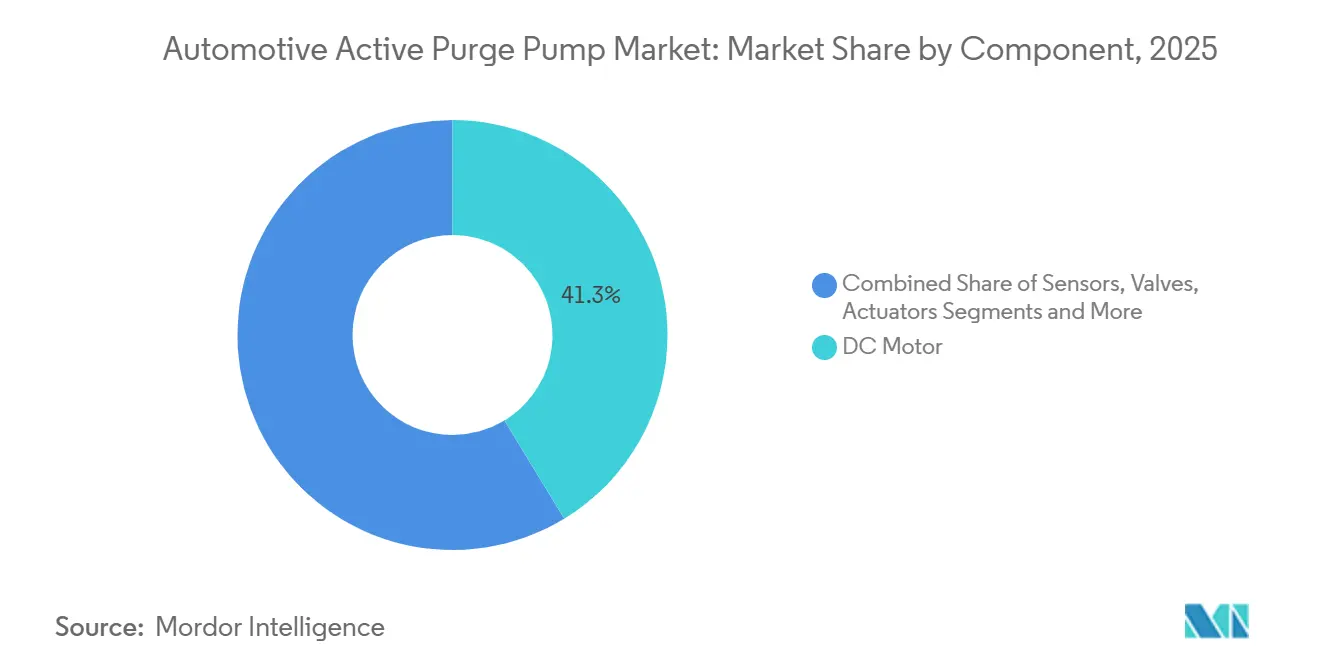
Sensors Capture Incremental ValueDC motors still constitute the single largest bill-of-materials item, accounting for 41.27% in 2025. Yet motor volumes plateau as multi-function assemblies reduce part count and as battery-electric substitution removes gasoline systems entirely. Actuators, valves, and vapor canisters track vehicle build rates closely, but only sensors experience structural content growth because diagnostic depth is now codified in regulations. These shifts reinforce sensor leadership in component revenue through 2031.
The sensors are projected to expand at a 6.13% CAGR through 2031 as every European-bound module must record purge-valve duty cycle and canister-vent pressure in accordance with Regulation 2025/1707. The automotive active purge pump market size for sensor-rich modules is therefore rising faster than pump hardware volumes alone would suggest. Continental’s dual-pressure architecture and Standard Motor Products’ CP122 aftermarket pump exemplify designs that embed flow and temperature sensing for real-time diagnostics.



By Material Type:
Plastics Remain DominantNon-metal materials accounted for 63.37% of 2025 shipments, with polypropylene and polyamide favored for housings, ports, and covers. Injection-molded plastics reduce mass and allow complex geometries that lower assembly steps, supporting the 6.16% CAGR forecast for the segment. However, Denso’s 4.3-million-unit recall tied to low-density impellers highlighted the quality risks that surface when cycle times are shortened without rigorous validation.
Metal content, mainly stainless steel and aluminum, retains critical roles in high-pressure or high-temperature sites such as pump impellers and tank interfaces. Porsche’s stainless PHEV tank illustrates how premium applications continue to rely on metal to guarantee durability. Over the forecast, bio-based composites may enter the value chain, yet widespread adoption will hinge on proven fuel compatibility and stable resin pricing.
By Manufacturing Process:
Injection Molding AcceleratesInjection molding captured roughly 52.43% of the 2025 volume and will outgrow vacuum forming at a 6.25% CAGR owing to ±0.1 mm tolerances and integrated sensor bosses that downstream processes cannot replicate. Multi-cavity tools amortize mold costs over millions of units, delivering low marginal cost once capital is in place. Conversely, vacuum forming remains attractive for large canister shells where tooling costs are a priority, yet slower cycle times limit its share growth.
Cutting and machining protect niches where metals are mandatory. CNC processes enable threaded fittings and leak-tight seals vital for pumps operating across −40 °C to +120 °C. Over 2026-2031, OEM desire for single-assembly EVAP modules will continue to channel new projects toward injection-molded plastic housings with over-molded metal inserts.
By Vehicle Type:
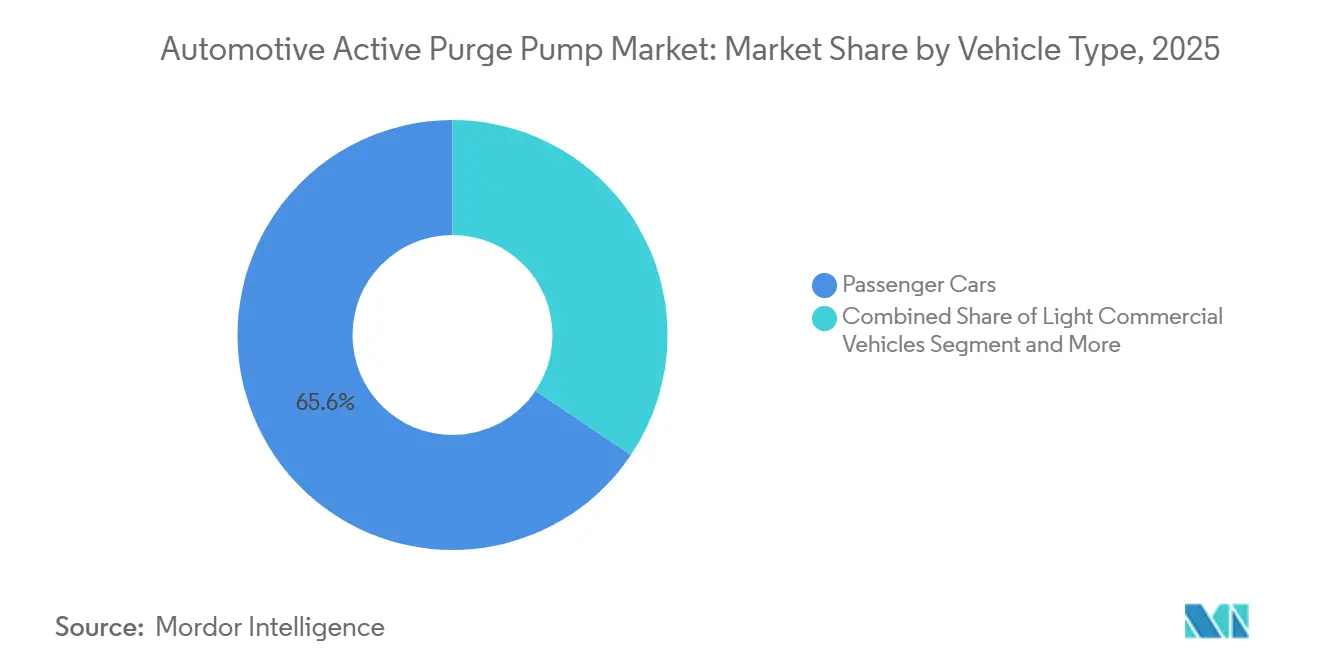
Regulation Pulls Commercial Trucks ForwardPassenger cars led 2025 volumes at 65.61%, reflecting longstanding fitment rates in turbo-GDI sedans, hatchbacks, and SUVs. The automotive active purge pump market share for medium and heavy commercial vehicles, however, rises fastest at a 6.19% CAGR because Euro 7 extends the 1.5 g/test limit to trucks above 3.5 t from 2027. Fleet operators, therefore, specify purge pumps in new builds and accelerate retrofits for older diesel-gasoline dual-fuel trucks across Europe and export fleets in North Africa.
Light commercial vehicles maintain steady demand as urban emission zones favor gasoline over diesel, yet retain combustion drivetrains. Combined, regulatory uniformity across vehicle classes ensures that commercial-vehicle fitment offsets part of the passenger-car volume lost to BEVs.
By Distribution Channel:
Aftermarket Closes the GapThe OEM channel maintained 71.25% shipment share in 2025 due to embedded contracts with Continental, Bosch, Denso, and BorgWarner. Nonetheless, the aftermarket grows faster, at a 6.24% CAGR, as the first turbo-GDI cohorts from 2017-2022 age past 100,000 km. Standard Motor Products’ expansion to more than 1,200 purge-pump part numbers highlights how independent garages now access sensor-equipped replacements that previously required dealer tools.
In North America and Europe, independent service labor rates undercut dealer pricing by 20-30%, attracting cost-conscious owners and redirecting revenue from OEM service networks. Online parts portals also improve availability in emerging markets, allowing local shops to procure purge modules within days instead of months.
Geography Analysis
Europe Automotive Active Purge Pump Market
Europe accounted for 38.73% of global revenue in 2025, as Euro 7 and Regulation 2025/1707 mandate continuous evaporative monitoring, thereby sustaining demand for sensor-dense modules even as BEV share exceeds 15% [2]“New Passenger Car Registrations 2025,” European Automobile Manufacturers Association, acea.auto. Germany, France, and the United Kingdom anchor volume through premium OEMs that widely deploy turbo-GDI and PHEV architectures. Supply resilience benefits from Bosch, Continental, and Denso plants across Poland and Czechia that serve both regional assembly and global export programs.
APAC Automotive Active Purge Pump Market
Asia-Pacific delivers the highest 6.22% CAGR through 2031. According to OICA’s 2025 passenger car production data, China produced around 30.3 million passenger cars, significantly ahead of Japan (7.2 million), India (5.4 million), and South Korea (3.8 million). Although China pushes hard toward BEV, its sheer production scale maintains absolute ICE volumes. Japanese and Korean suppliers face cost pressures and quality scrutiny following Denso’s plastic impeller issues. Yet, multibillion-dollar capacity expansions by Toyota, Honda, and Suzuki signal long-term demand for components.
The Americas and MEA Automotive Active Purge Pump Market
North America posts stable mid-single-digit growth on the back of EPA Tier 3 enforcement and an SUV-heavy model mix. Standard Motor Products manufactures purge pumps in South Carolina, Kansas, and Mexico to supply both OE service contracts and independent installers. BEV momentum is strong but uneven; a large pickup and SUV segment ensures sustained gasoline demand well beyond 2030. South America, Africa, and the Middle East each trail in volume yet grow at or above the global average, where new industrial policies, such as Egypt’s supplier incentives and Saudi Arabia’s TASARU hub, stimulate local assembly projects that include evaporative-control systems.

Competitive Landscape
The market shows moderate consolidation: Continental, Bosch, Denso, and BorgWarner together supply a majority of global OEM programs. Continental’s patent-protected Active Purge Pump integrates a 50,000-rpm brushless motor, dual pressure sensors, and control electronics into a single housing, offering predictive diagnostics that reduce warranty incidents [3]“Integrated Active Purge Module Product Brief 2026,” Continental AG, continental-automotive.com . Bosch balances its legacy EVAP strength with a 2026 e-axle joint venture in India, allocating EUR 6 billion to electrification while still leveraging shared magnet and electronics supply chains. BorgWarner invested EUR 3 billion through 2030 and acquired Hubei Surpass Sun Electric to enlarge its e-propulsion and auxiliary pump portfolio.
Rare-earth magnet constraints since China’s 2025 export controls induced lead-time spikes, prompting Ford’s brief Explorer production pause in May 2025. Suppliers explore magnet-free or recycled-magnet motors, with ZF’s I²SM, BorgWarner’s wireless excitation, and Niron Magnetics’ iron-nitride concepts targeting 2028 commercialization.
In the aftermarket, Standard Motor Products and Transtar Aftermarket Solutions exploit service lane transitions. SMP’s 1,200-part-number line now covers late-model GM, Ford, and Nissan platforms, with shipments from three North American plants, enabling 48-hour replenishment to most workshop locations. Competitive intensity is projected to rise as BEV diffusion compresses addressable ICE volumes. Tier-1 suppliers must blend cost leadership with diagnostic sophistication, while aftermarket specialists scale catalog depth and logistics speed to secure growing replacement demand.
Automotive Active Purge Pump Industry Leaders
Continental AG
Robert Bosch GmbH
Denso Corporation
Schaeffler Group
Johnson Electric Holdings
- *Disclaimer: Major Players sorted in no particular order

Automotive Active Purge Pump Market Companies Covered in this Report
- Continental AG
- Robert Bosch GmbH
- Denso Corporation
- Johnson Electric Holdings
- Agilent Technologies
- Rheinmetall Automotive AG
- Valeo SA
- Hella GmbH & Co. KGaA
- Magna International
- BorgWarner Inc.
- AISIN Corporation
- Hitachi Astemo
- Youngshin Precision
- Mikuni Corporation
- Eagle Industry Co.
- Standard Motor Products
- Schaeffler Group

Recent Industry Developments in Automotive Active Purge Pump Market
- July 2025: GMB Korea localized the active purge pump for hybrid vehicles, marking Korea’s first domestic development of the component.
- August 2023: Vitesco Technologies partnered with Cebi Group to co-develop washer and purge modules for future Euro-7 programs.


Global Automotive Active Purge Pump Market Report Scope
The scope of the report includes Component (DC Motor and More), Material Type (Metal and Non-Metal), Manufacturing Process (Cutting and More), Vehicle Type (Passenger Cars and More), Distribution Channel (OEM and Aftermarket), and Geography.
| DC Motor |
| Sensors |
| Actuators |
| Valves |
| Vapor Canister |
| Metal |
| Non-Metal |
| Cutting |
| Vacuum Forming |
| Injection Molding |
| Passenger Cars |
| Light Commercial Vehicles (LCVs) |
| Medium and Heavy Commercial Vehicles (MHCVs) |
| OEM |
| Aftermarket |
| North America | United States |
| Canada | |
| Rest of North America | |
| South America | Brazil |
| Argentina | |
| Rest of South America | |
| Europe | United Kingdom |
| Germany | |
| Spain | |
| Italy | |
| France | |
| Russia | |
| Rest of Europe | |
| Asia-Pacific | India |
| China | |
| Japan | |
| South Korea | |
| Rest of Asia-Pacific | |
| Middle East and Africa | United Arab Emirates |
| Saudi Arabia | |
| Turkey | |
| Egypt | |
| South Africa | |
| Rest of Middle East and Africa |
| By Component | DC Motor | |
| Sensors | ||
| Actuators | ||
| Valves | ||
| Vapor Canister | ||
| By Material Type | Metal | |
| Non-Metal | ||
| By Manufacturing Process | Cutting | |
| Vacuum Forming | ||
| Injection Molding | ||
| By Vehicle Type | Passenger Cars | |
| Light Commercial Vehicles (LCVs) | ||
| Medium and Heavy Commercial Vehicles (MHCVs) | ||
| By Distribution Channel | OEM | |
| Aftermarket | ||
| By Geography | North America | United States |
| Canada | ||
| Rest of North America | ||
| South America | Brazil | |
| Argentina | ||
| Rest of South America | ||
| Europe | United Kingdom | |
| Germany | ||
| Spain | ||
| Italy | ||
| France | ||
| Russia | ||
| Rest of Europe | ||
| Asia-Pacific | India | |
| China | ||
| Japan | ||
| South Korea | ||
| Rest of Asia-Pacific | ||
| Middle East and Africa | United Arab Emirates | |
| Saudi Arabia | ||
| Turkey | ||
| Egypt | ||
| South Africa | ||
| Rest of Middle East and Africa | ||


Key Questions Answered in the Report
How large is the automotive active purge pump market in 2026?
The automotive active purge pump market size stands at USD 0.77 billion in 2026, on track to reach USD 1.04 billion by 2031.
Which component segment is expanding fastest?
Sensors are the fastest-growing component, advancing at a 6.13% CAGR through 2031 as regulations mandate real-time evaporative diagnostics.
Why are medium and heavy trucks adopting active purge pumps?
Euro 7 applies a 1.5 g/test evaporative limit to trucks above 3.5 t from 2027, making active pumps the most practical path to compliance.
What is driving aftermarket growth for purge pumps?
Turbo-GDI vehicles sold between 2017 and 2022 are entering their second ownership cycle, boosting replacement demand that favors independent service networks with lower labor costs.
How do rare-earth magnet shortages affect the market?
Chinese export controls on NdFeB magnets in 2025 lengthened lead times for brushless DC motors, prompting suppliers to explore magnet-free designs and recycled material streams.
Which region will post the highest growth through 2031?
Asia-Pacific leads with a projected 6.22% CAGR as China and India sustain large ICE and hybrid vehicle outputs despite accelerating BEV adoption.
Page last updated on:





