
Cross-Border Fiber Backbone Connectivity Market Size and Share
Market Overview
| Study Period | 2020 - 2031 |
|---|---|
| Market Size (2026) | USD 22.65 Billion |
| Market Size (2031) | USD 36.89 Billion |
| Growth Rate (2026 - 2031) | 10.25 % |
| Fastest Growing Market | Africa |
| Largest Market | North America |
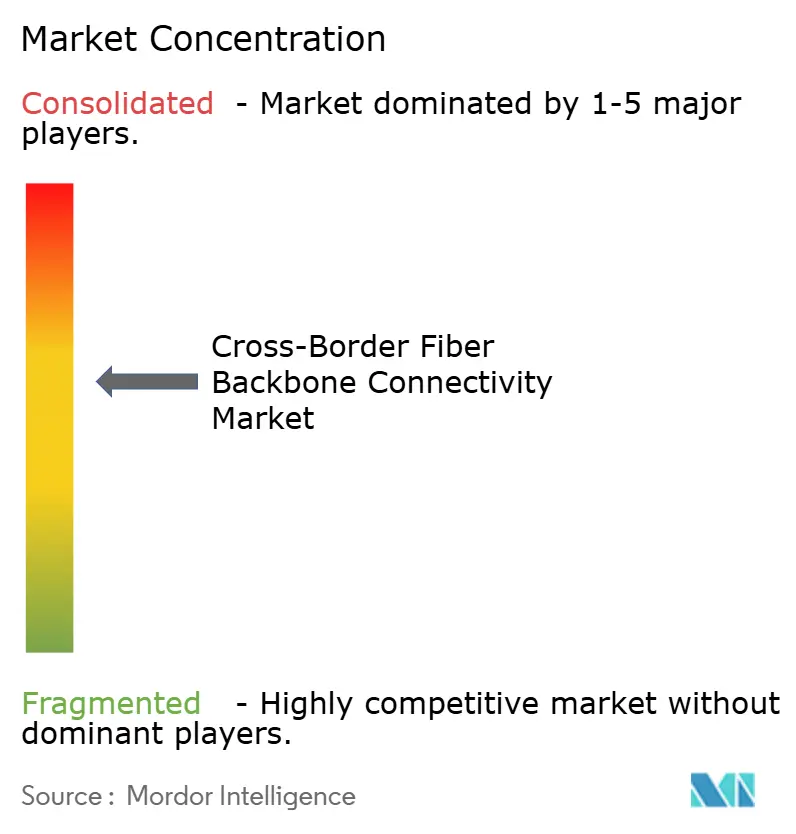
| Market Concentration | Medium |
Major Players *Disclaimer: Major Players sorted in no particular order Image © Mordor Intelligence. Reuse requires attribution under CC BY 4.0. | |
Cross-Border Fiber Backbone Connectivity Market Analysis by Mordor Intelligence
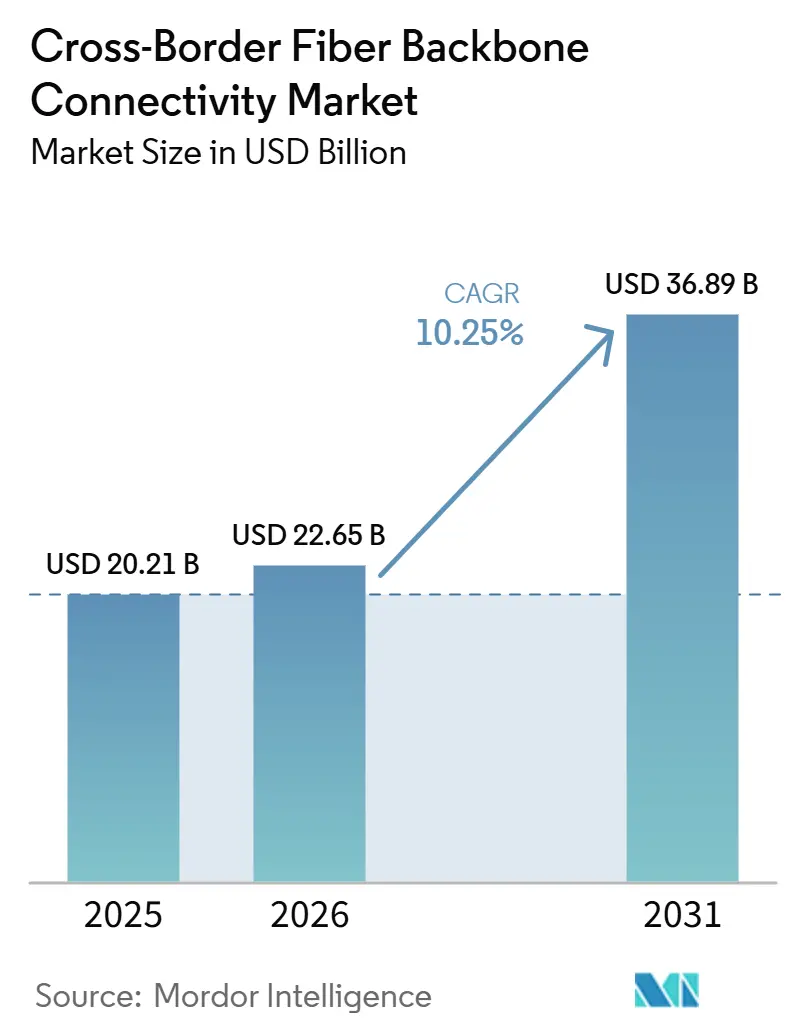
The Cross-Border Fiber Backbone Connectivity Market size was valued at USD 20.21 billion in 2025 and is estimated to grow from USD 22.65 billion in 2026 to reach USD 36.89 billion by 2031, at a CAGR of 10.25% during the forecast period (2026-2031). The market is expanding as cloud platforms, digital infrastructure operators, and telecom carriers continue to add new long-haul routes, landing capacity, and interconnection links between major data hubs. Demand is also rising because operators now need more resilient route design, stronger control over traffic flows, and lower latency between data centers, exchanges, and cloud regions. Government oversight is becoming more important, especially where cable landing approvals, trusted vendor rules, and open-access conditions now shape project timing and ownership structures. The competitive focus in the cross-border fiber backbone connectivity market is moving beyond basic route expansion and toward corridor diversity, private capacity control, and direct integration with data center ecosystems. This is creating room for new investment models, especially in hybrid networks and shared infrastructure, while also raising execution pressure on carriers that still rely mainly on legacy transit relationships.
Key Report Takeaways
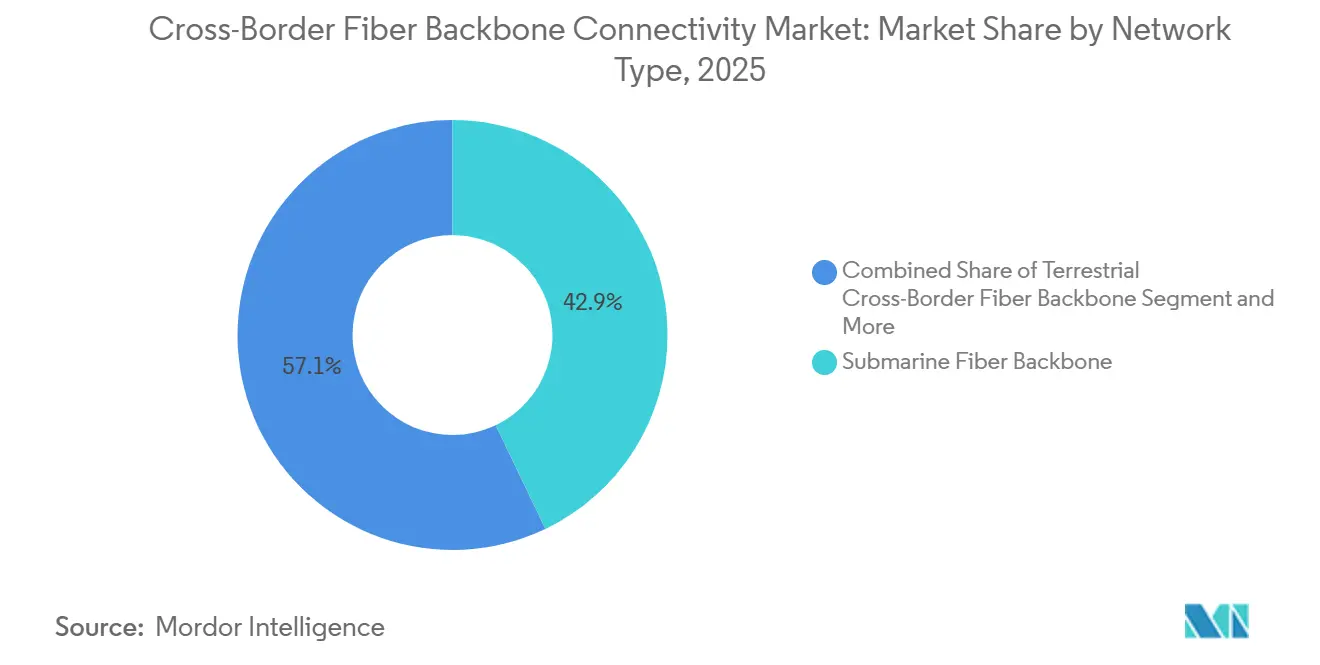
- By network type, submarine fiber backbone held 42.89% revenue share in the cross-border fiber backbone connectivity market in 2025, while the hybrid terrestrial-submarine backbone is projected to expand at a 14.87% CAGR through 2031.
- By ownership type, single ownership accounted for 38.11% revenue share in the cross-border fiber backbone connectivity market in 2025, while wholesale neutral host ownership is projected to expand at a 12.99% CAGR through 2031.
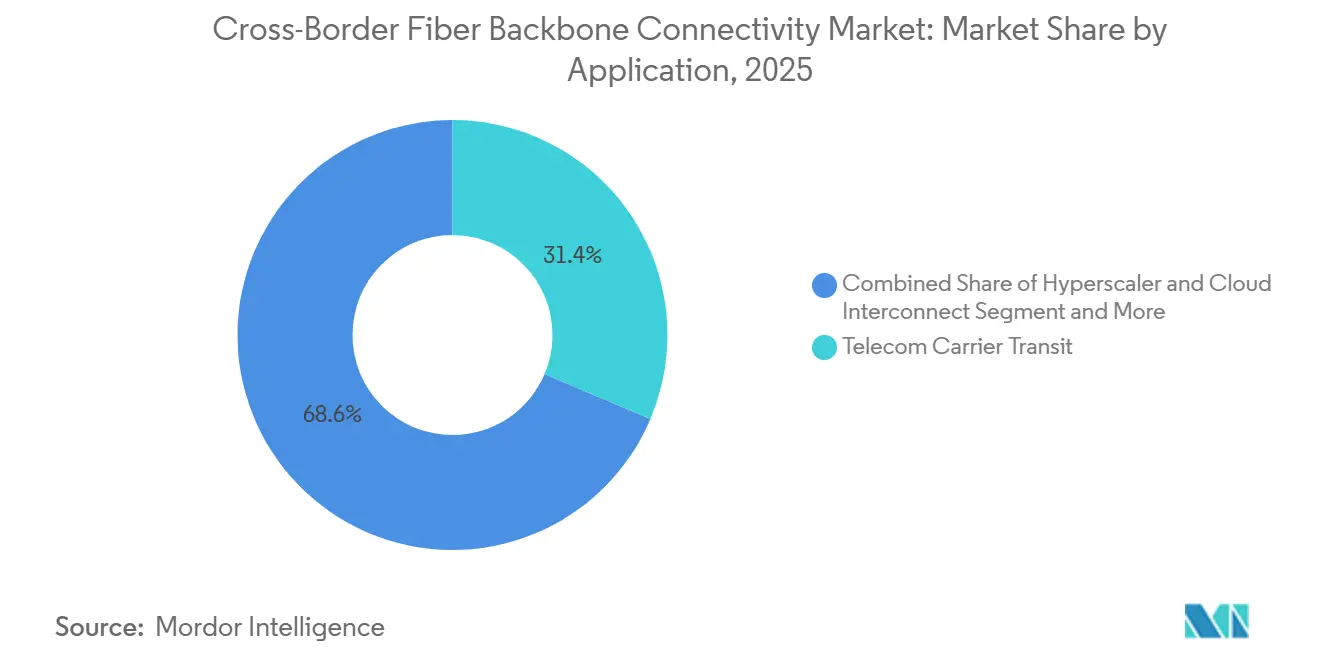
- By application, telecom carrier transit held 31.39% revenue share in the cross-border fiber backbone connectivity market in 2025, while hyperscaler and cloud interconnect is projected to expand at a 15.21% CAGR through 2031.
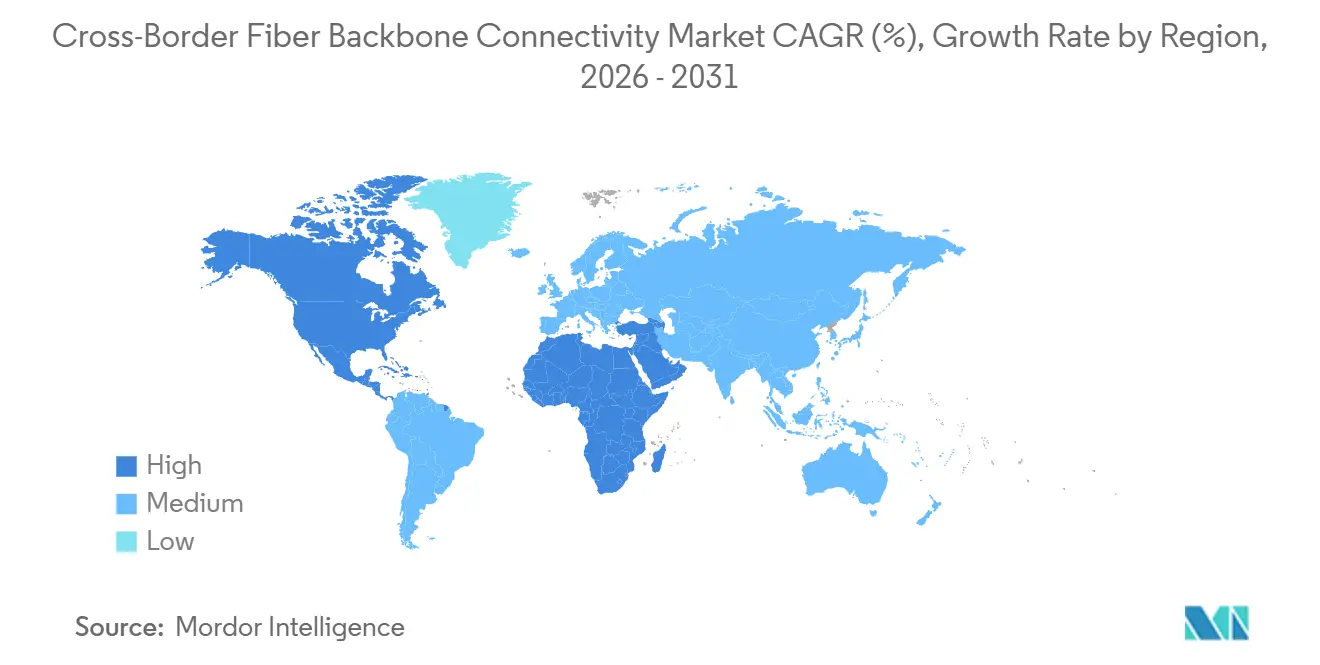
- By geography, North America held 34.65% revenue share in the cross-border fiber backbone connectivity market in 2025, while Africa is projected to expand at a 17.43% CAGR through 2031.
Note: Market size and forecast figures in this report are generated using Mordor Intelligence’s proprietary estimation framework, updated with the latest available data and insights as of January 2026.
Market Trends and Insights
Drivers Impact Analysis of Cross-Border Fiber Backbone Connectivity Market*
| Driver | (~) % Impact on CAGR Forecast | Geographic Relevance | Impact Timeline |
|---|---|---|---|
| Hyperscaler Route Ownership And Direct Capacity Procurement | +2.8% | Global, concentrated in transatlantic, transpacific, and North America core corridors | Short term (≤ 2 years) |
| AI, Cloud, And Data Center Interconnection Density | +2.4% | Global, with primary nodes in North America, Western Europe, and Asia-Pacific | Medium term (2-4 years) |
| Cross-Border Data Sovereignty And Sovereign Connectivity Mandates | +1.7% | EU, Southeast Asia, Middle East, India | Medium term (2-4 years) |
| Terrestrial Diversification Away From Geopolitical Chokepoints | +1.3% | Red Sea corridor, Baltic Sea, Middle East, Central Asia | Short term (≤ 2 years) |
| Government-Backed Digital Corridor Programs | +0.9% | Africa, Central Asia, South America, Pacific island nations | Medium term (2-4 years) |
| Multi-Homed Resilience For Financial And Critical Infrastructure Traffic | +0.6% | North America, United Kingdom, Singapore, Japan, UAE | Medium term (2-4 years) |
| Source: Mordor Intelligence | |||
Hyperscaler Route Ownership And Direct Capacity Procurement
The cross-border fiber backbone connectivity market is being reshaped by buyers who now want direct control over route design, cable capacity, and landing strategy, rather than relying solely on wholesale carrier supply. That shift is visible in large, operator-led backbone projects and in private or anchor-backed systems that are built around traffic assurance from the start. Meta completed the core 2Africa system in November 2025, creating a 33-country open-access route that materially expands international backbone capacity across Africa, Europe, and Asia.[1]Meta Engineering, “Announcing the Completion of the Core 2Africa System, Building the Future of Connectivity Together,” Meta Engineering Blog, engineering.fb.com Colt also expanded its route position in 2026 by combining subsea capacity on Juno and Marea with new terrestrial links, which shows how private route access and long-term capacity rights now influence corridor strategy.[2]Colt Technology Services, “Colt Announces New Subsea and Terrestrial Network Routes Connecting US West Coast and Asia to Meet Continued Rise in Demand for AI Capacity,” Colt Technology Services, colt.net As this pattern spreads, the cross-border fiber backbone connectivity market is seeing a steady shift from short-term capacity purchases toward long-term infrastructure commitments. That change is strengthening route ownership as a commercial advantage and making carrier relationships more selective across the highest-density corridors.
AI, Cloud, And Data Center Interconnection Density
The cross-border fiber backbone connectivity market is also benefiting from the growing need to connect cloud regions, AI clusters, carrier hotels, and cable landing stations with higher speed and lower latency. Lumen said in February 2026 that it had nearly USD 13 billion in contracted deals tied to its Private Connectivity Fabric strategy, which shows how AI-related demand is supporting new backbone builds across long-haul corridors. Zayo also launched its largest route-mile expansion program after securing an anchor customer for critical AI corridors, indicating continued demand for intercity and cross-border capacity to support large data traffic flows. NTT DOCOMO BUSINESS and NTT Com Asia added APN InterLink in Hong Kong in October 2025, using All-Photonic Network technology on the ASE cable between Tokyo and Hong Kong for latency-sensitive traffic. Arelion also expanded its Danish network in April 2026 to support new landings and AI workloads, linking backbone planning more closely to data center growth patterns. These moves show that the cross-border fiber backbone connectivity market is no longer driven only by general internet growth, because route demand now follows the physical concentration of compute, storage, and cloud exchange points.
Cross-Border Data Sovereignty And Sovereign Connectivity Mandates
Data sovereignty rules are turning compliance into a practical route selection issue in the cross-border fiber backbone connectivity market. The FCC updated its submarine cable landing license rules in August 2025, and the changes tightened national security review of ownership, control, and foreign-adversary exposure for U.S.-landing systems.[3]Federal Communications Commission, “FCC Acts to Accelerate Submarine Cable Buildout and Security,” FCC, fcc.gov In Europe, HaDEA opened new CEF-Digital calls in March 2026 that linked grant support to resilience, trusted supply conditions, and digital gateway priorities. Finland also proposed national legislation in 2025 to complement the EU Gigabit Infrastructure Act, which signals that cross-border permitting and deployment rules are becoming more coordinated within the region. As a result, operators with cleaner ownership structures and stronger regulatory alignment are likely to move faster on approvals and partner selection. This is giving the cross-border fiber backbone connectivity market a stronger policy layer, where route eligibility now matters almost as much as route economics.
Terrestrial Diversification Away From Geopolitical Chokepoints
The cross-border fiber backbone connectivity market is seeing more investment in land-based alternatives as operators try to reduce dependence on a small number of exposed subsea paths. EXA Infrastructure and Socar Fiber announced a new 1,850km terrestrial cable across Turkey, Greece, and Georgia, and the route was designed to support a more diverse Europe-to-Asia path. PCCW Global, Sparkle, Telecom Egypt, and ZOI also signed an MoU in June 2025 for AAE-2, a next-generation system that links Hong Kong and Singapore to Italy through secure terrestrial corridors across Thailand, the Arabian Peninsula, and Egypt. These projects show that route protection is no longer treated as a secondary engineering choice in the cross-border fiber backbone connectivity market. It is now part of initial system design, capital planning, and customer positioning. That favors hybrid architectures that can shift traffic between subsea and terrestrial assets with less operational strain.
Restraints Impact Analysis of Cross-Border Fiber Backbone Connectivity Market*
| Restraint | (~) % Impact on CAGR Forecast | Geographic Relevance | Impact Timeline |
|---|---|---|---|
| High Capex For Long-Haul Civil Works And Landing Integration | -1.5% | Global, most acute in Sub-Saharan Africa, Central Asia, and Pacific island nations | Long term (≥ 4 years) |
| Permitting Delays Across Multiple Jurisdictions | -1.2% | Global, North America, EU, Southeast Asia, Middle East | Medium term (2-4 years) |
| Cross-Border Regulatory Fragmentation And Licensing Complexity | -1.0% | EU, Asia-Pacific, Africa | Medium term (2-4 years) |
| Security Risks, Sabotage Exposure, And Route Repair Bottlenecks | -0.7% | Red Sea corridor, Baltic Sea, Pacific chokepoints | Short term (≤ 2 years) |
| Source: Mordor Intelligence | |||
High Capex For Long-Haul Civil Works And Landing Integration
The cross-border fiber backbone connectivity market still has a high entry barrier because backbone construction requires significant upfront investment in marine works, landing stations, terrestrial backhaul, and cross-border integration. Smaller operators can participate in capacity resale, but they often struggle to fund full system ownership on new international routes. This cost structure is one reason investment continues to cluster around corridors with already visible traffic demand and clearer monetization paths. It also explains why the cross-border fiber backbone connectivity market is attracting more infrastructure funds, larger carriers, and cloud-backed projects than smaller regional builders. Where public support exists, grant conditions can ease some of the financing burden, but they also add access, compliance, and reporting obligations.[4]European Health and Digital Executive Agency, “New CEF-Digital Calls Open for Proposals in Digital Global Gateways,” European Commission, hadea.ec.europa.eu The result is a market where route diversification often advances first on strategically important corridors and only later reaches thinner cross-border paths.
Permitting Delays Across Multiple Jurisdictions
Permitting remains a practical bottleneck because a single international route often depends on approvals from maritime, telecom, environmental, land, and security authorities across several territories. That slows the cross-border fiber backbone connectivity market even when financing and customer demand are already in place. Finland’s 2025 legislative proposal around the EU Gigabit Infrastructure Act showed that governments are still working to simplify deployment rules for very high-capacity networks. HaDEA’s 2026 digital gateway calls also highlighted how resilience criteria and trusted vendor conditions can lengthen project preparation even while public support is available. These delays matter because many corridor decisions are now linked to fast-moving AI and cloud demand cycles. In practice, the cross-border fiber backbone connectivity market can lose timing advantage when route readiness lags far behind customer capacity planning.
*Our forecasts treat driver/restraint impacts as directional, not additive. The impact forecasts reflect baseline growth, mix effects, and variable interactions.
Cross-Border Fiber Backbone Connectivity Market Segment Analysis
By Network Type:
Submarine Backbone Dominated While Hybrid Routes Gained GroundSubmarine backbone held 42.89% of the cross-border fiber backbone connectivity market share in 2025, reflecting the role of subsea routes in carrying large volumes of intercontinental traffic over long distances. The segment remains central to the cross-border fiber backbone connectivity market because major cloud, carrier, and infrastructure operators still depend on deepwater systems to connect the largest demand centers. Meta’s completion of the core 2Africa system in November 2025 added to the list of the most important recent examples of large-scale subsea expansion, with a 33-country design and open-access positioning across Africa, Europe, and Asia. The subsea build cycle is also becoming increasingly technology-driven, helping extend the useful life and improve capacity efficiency of core backbone routes. NTT developed a 192-core multicore optical fiber submarine cable system in March 2026, with a design aimed at a 4x increase in transmission capacity over conventional single-fiber cable systems. That matters for the cross-border fiber backbone connectivity market because capacity growth now has to align with denser cloud traffic, more direct data center interconnection, and rising demand for route diversity. The terrestrial backbone still plays an important supporting role in landlocked and near-border corridors where short-haul international traffic needs lower latency and easier physical access. It also gives operators more flexibility between inland data centers and coastal landing stations. Even so, terrestrial-only routes remain more exposed to rights-of-way issues, border procedures, and variations in local permitting. That keeps submarine systems at the center of long-haul route planning even as supporting land segments become more valuable.
The hybrid terrestrial-submarine backbone is projected to grow at a 14.87% CAGR from 2026 to 2031, and the cross-border fiber backbone connectivity market for this network type is growing as operators now seek redundancy built into system design from the start. Hybrid architecture helps carriers and infrastructure owners combine deepwater reach with land-based bypass options across exposed or congested corridors. EXA Infrastructure and Socar Fiber moved in that direction with their planned cable across Turkey, Greece, and Georgia, which was positioned as a new terrestrial alternative for Europe-to-Asia traffic. Colt’s 2026 route expansion followed a similar logic by combining subsea assets such as Juno and Marea with new terrestrial fiber builds between landing stations. In the cross-border fiber backbone connectivity market, this model is attractive because it reduces reliance on a single route type and supports more flexible restoration planning. It also gives operators more room to match route design with traffic class, customer contracts, and regulatory constraints. Hybrid systems are therefore moving from a resilience add-on to a mainstream deployment choice. That shift is likely to support new investment across Europe-to-Asia, Africa-facing, and transpacific corridor extensions. It also gives neutral infrastructure owners a broader platform to sell capacity across multiple path options rather than a single physical alignment. For the cross-border fiber backbone connectivity market, a wider route logic improves both customer appeal and long-term asset relevance.



By Ownership Type:
Single Ownership Led While Neutral Host Models ExpandedSingle ownership is expected to account for 38.11% of the market in 2025, reflecting operators’ preference for full control over architecture, provisioning, and traffic policy. In the cross-border fiber backbone connectivity market, the model attracts large buyers seeking predictable capacity rights, limited third-party dependence, and simplified equipment choices across landing stations and backbone nodes, especially for private cloud and AI-oriented interconnection. It also supports direct route ownership and faster service customization by aligning network design, maintenance policies, and commercial terms under a single owner. However, repeated control by a few large players can concentrate high-value corridors and widen the gap between physical asset owners and capacity resellers or aggregators. The market continues to reward scale, funding depth, and technical integration, while consortium and shared-access models remain relevant where capital intensity, route sensitivity, or policy requirements limit sole control.
The need for Wholesale neutral host ownership is projected to grow at a CAGR of 12.99% through 2031, as shared infrastructure improves asset utilization across buyers in the cross-border fiber backbone connectivity market. Nokia states that neutral hosts accounted for 9% of global telecom services revenue in 2024, underscoring the model’s commercial relevance before wider adoption in long-haul fiber and cross-border systems. Neutral platforms can sell dark fiber, wavelengths, or managed capacity without competing for end-user business, making them useful where multiple carriers need access but no single carrier wants to fund an entire route. Public connectivity programs also favor open-access structures, strengthening policy support. Consortium ownership remains relevant, and the AAE-2 MoU, expected in June 2025, indicates that capital-intensive and strategically sensitive systems can benefit from shared sponsorship. The market is applying cooperative structures more selectively, with neutral and consortium models gaining relevance where route redundancy, policy compliance, and efficient capacity sharing outweigh complete control.
By Application:
Carrier Transit Anchored Revenue While Hyperscaler Interconnect Advanced FastestTelecom carrier transit is expected to account for 31.39% of the cross-border fiber backbone connectivity market size in 2025, remaining the largest revenue anchor as operators, enterprises, and regional service providers rely on transit for international reach rather than direct long-haul capacity. GTT stated that its Tier-1 backbone is expected to exceed 700 Tbps by 2025, with 2026 expansion planned across South America, Asia-Pacific, and South Asia. This scale reinforces carrier transit’s role, where route aggregation and global reach outweigh private path control. The segment also supports high-value traffic, including financial connectivity requiring stable, low-latency paths. euNetworks is expected to deploy its longest operational hollow-core fiber route for Euronext in January 2025, underscoring premium traffic value within the transit layer. Carrier transit remains commercially resilient by combining scale, reach, and operational familiarity while enabling smaller operators and enterprises to procure international connectivity without dedicated route ownership.
Hyperscaler and cloud interconnect is projected to grow at a 15.21% CAGR from 2026 to 2031, making it the fastest-growing application area in the cross-border fiber backbone connectivity market. Demand is rising for direct connectivity between cloud regions, AI campuses, and major exchange or landing locations. NTT DOCOMO BUSINESS and NTT Com Asia are expected to launch APN InterLink in Hong Kong in October 2025, using a photonics-based architecture over the ASE cable to support high-capacity, latency-sensitive traffic between Tokyo and Hong Kong. Lumen’s Private Connectivity Fabric pipeline also signals strong demand for dedicated, high-bandwidth AI and cloud links. This application is expanding faster as large buyers seek greater control over latency, route quality, and service assurance than traditional managed transit can provide. As demand concentrates in high-value compute corridors, hyperscaler interconnect is becoming both a growth engine and a key influence on network design.
Geography Analysis
North America Cross-Border Fiber Backbone Connectivity Market
North America held 34.65% of the cross-border fiber backbone connectivity market share in 2025, and the region kept that lead because it remains the main origin and destination point for many cloud-led backbone investments. The regional build cycle is still active, with Lumen adding 34 million new intercity fiber miles by 2028 and targeting a larger footprint by 2031 through contracts linked to AI and cloud connectivity. Zayo also moved ahead with the largest route-mile expansion program in its history after winning an anchor customer commitment for critical AI corridors. These investments show that the cross-border fiber backbone connectivity market in North America is being shaped by more than simple traffic growth, as route planning is now closely tied to where AI and cloud demand are physically concentrated. The region also carries added policy weight because the FCC’s August 2025 licensing reforms tightened national security review on U.S.-landing cable systems. That makes North America one of the most active and closely watched parts of the cross-border fiber backbone connectivity market. It combines scale, access to funding, landing infrastructure, and regulatory scrutiny in a way few other regions match.
Europe and APAC Cross-Border Fiber Backbone Connectivity Market
Europe and Asia-Pacific remain central to the cross-border fiber backbone connectivity market because both regions combine mature backbone demand with active route redesign. EXA Infrastructure launched Project Visegrád in September 2025 to connect major Central European cities into its wider hyperscale backbone, and the first routes entered service in mid-2026. RETN added the Tallinn-Cēsis route in February 2026, giving the Nordic and Baltic corridor a new physically independent path with 40Tbps of capacity. In the Asia-Pacific region, Colt secured capacity on NTT’s Juno trans-Pacific system in 2026, adding a new route between Tokyo and Los Angeles and expanding its backbone reach across major trade lanes. The policy backdrop is also moving, with Finland’s 2025 action on the EU Gigabit Infrastructure Act showing continued effort to reduce deployment friction for very high-capacity networks. Together, these developments keep Europe and the Asia-Pacific at the center of corridor diversification, route resilience, and high-density interconnection planning in the cross-border fiber backbone connectivity market.
MEA and South America Cross-Border Fiber Backbone Connectivity Market
Africa is projected to grow at a 17.43% CAGR from 2026 to 2031, making it the fastest-growing regional cluster in the cross-border fiber backbone connectivity market. Much of that momentum comes from large backbone additions that improve route access, international reach, and landing diversity across the continent. Meta completed the core 2Africa system in November 2025, connecting 33 countries and extending open-access international capacity across Africa, Europe, and Asia. The Medusa system also landed in Nador in December 2025, supporting Morocco’s role in Mediterranean connectivity and strengthening links across Southern Europe and North Africa. The Middle East is also becoming more important as operators pursue bypass routes and alternative landings to reduce dependence on exposed corridors. South America is still smaller in relative terms, but the cross-border fiber backbone connectivity market there is benefiting from stronger international route attention and broader interest in diversified intercontinental links. As more neutral and carrier-led backbone systems expand into the region, the market is likely to play a greater role in hub connectivity rather than remain mostly traffic-adjacent. That gives the broader Middle East, Africa, and South America group a stronger position in long-term route balancing. It also means growth in the cross-border fiber backbone connectivity market is becoming less concentrated in only the historic North Atlantic core.

Competitive Landscape
The cross-border fiber backbone connectivity market is competitive but uneven, with stronger concentration at the asset layer than at the service layer. Large operators with capital access, route rights, and landing infrastructure hold an advantage in new corridor development and system expansion. Service competition remains broad, as carriers, backbone providers, and infrastructure owners differentiate through route diversity, latency, and depth of interconnection. Lumen, Zayo, Colt, GTT, EXA Infrastructure, Meta, NTT, and RETN hold distinct positions across hyperscale-linked infrastructure, Tier-1 transit, regional route specialization, and photonics-led interconnect services. Operators increasingly compete on landing locations, traffic design, and alignment with security and resilience requirements, rather than just distance and price.
Strategic moves expected in 2025 and 2026 indicate that route extension, corridor protection, and data center alignment will shape the market. GTT is expected to expand its Tier-1 backbone capacity to more than 700 Tbps and grow PoPs across South America, Asia-Pacific, and South Asia in 2026. Zayo’s AI corridor expansion highlights the importance of anchor-demand-led builds. Colt is expected to expand its subsea and terrestrial routes in 2026 by combining Juno and Marea capacity with new land builds between landing points. EXA Infrastructure’s Project Visegrád is set to strengthen its Central European backbone and connect the corridor more closely to Berlin, Frankfurt, and Vienna. These moves tie competitive advantage to path control and proximity to compute-heavy demand clusters.
The market is also differentiating through technical specialization and route resilience. NTT’s planned APN InterLink launch in Hong Kong and the development of its multicore submarine cable in 2026 underscore the growing role of optical performance and service architecture in premium positioning. RETN strengthened its Nordic-Baltic position with the Tallinn-Cēsis route and is expected to expand its European backbone through a cross-Romania route connecting Moldova and Ukraine. PCCW Global and its partners are using the AAE-2 design to create an Asia-Africa-Europe path through more secure terrestrial corridors. Companies now compete to control route logic, secure key landings, and align infrastructure with cloud, AI, finance, and public-sector traffic needs. The market remains open to capable players but favors operators with strong physical assets and clear corridor strategies.
Cross-Border Fiber Backbone Connectivity Industry Leaders
Arelion AB
Colt Technology Services Group Limited
Zayo Group Holdings, Inc.
EXA Infrastructure Services UK Limited
RETN Limited
- *Disclaimer: Major Players sorted in no particular order
Cross-Border Fiber Backbone Connectivity Market Companies Covered in this Report
- Arelion AB
- Colt Technology Services Group Limited
- Zayo Group Holdings, Inc.
- EXA Infrastructure Services UK Limited
- RETN Limited
- Tata Communications Limited
- NTT DOCOMO BUSINESS, Inc.
- Orange Wholesale (Orange S.A.)
- Telecom Italia Sparkle S.p.A.
- PCCW Global Limited
- Lumen Technologies, Inc.
- GTT Communications, Inc.
- GlobalConnect A/S
- Cogent Communications Holdings, Inc.
- Deutsche Telekom AG
- Telefónica Global Solutions, S.L.U.
- Singapore Telecommunications Limited
- SubCom, LLC
- NEC Corporation
- Alcatel Submarine Networks SAS
- Infinera Corporation
- Prysmian S.p.A.
- Seaborn Networks
- HMN Technologies Co., Ltd.
- Ciena Corporation
- Nokia Corporation

Recent Industry Developments in Cross-Border Fiber Backbone Connectivity Market
- May 2026: RETN launched a new cross-Romania backbone route, connecting Drobeta, Bucharest, Iași, and Chișinău, linking Moldova and Ukraine into its European backbone and providing a physically independent alternative to established regional IP transit corridors in Eastern Europe.
- April 2026: Arelion upgraded its Nørre Nebel cable landing station in Denmark and enhanced capacity across its Danish network to support additional cable landings and AI workloads, as part of its ongoing Nordic AI superhighway strategy connecting data center clusters in Jutland and Copenhagen.
- April 2026: GTT Communications announced its 2026 strategy following 2025 investments that expanded its global Tier-1 backbone to more than 700Tbps and placed it in the world’s third-largest position per CAIDA's ranking. The 2026 plan included deeper PoP expansion across South America, Asia-Pacific, and South Asia, alongside an AI-enabled network security framework through GTT Envision.


Global Cross-Border Fiber Backbone Connectivity Market Report Scope
The cross-border fiber backbone connectivity market covers terrestrial, submarine, and hybrid optical fiber backbone networks that connect telecommunications infrastructure across borders for secure, high-capacity, low-latency data transmission. The revenue is generated from wholesale bandwidth and capacity leasing, including dark fiber, wavelengths, and IRUs, international transport and carrier transit, data center and cloud interconnection, managed network services, and infrastructure deployment and operation under single-ownership, consortium, and wholesale neutral host models, serving telecom operators, hyperscalers, data center operators, governments, financial institutions, and other enterprises. The cross-border fiber backbone connectivity market is segmented by network type (terrestrial cross-border fiber backbone, submarine fiber backbone, and hybrid terrestrial-submarine backbone), ownership type (single ownership, consortium ownership, wholesale neutral host ownership), application (hyperscaler and cloud interconnect, telecom carrier transit, data center interconnect, government and defense connectivity, financial services and low-latency trading connectivity, and other applications), and geography (North America, South America, Europe, Asia-Pacific, Middle East, and Africa). The market forecasts are provided in value (USD).
| Terrestrial Cross-Border Fiber Backbone |
| Submarine Fiber Backbone |
| Hybrid Terrestrial-Submarine Backbone |
| Single Ownership |
| Consortium Ownership |
| Wholesale Neutral Host Ownership |
| Hyperscaler and Cloud Interconnect |
| Telecom Carrier Transit |
| Data Center Interconnect |
| Government and Defense Connectivity |
| Financial Services and Low-Latency Trading Connectivity |
| Other Applications |
| North America | United States |
| Canada | |
| Mexico | |
| South America | Brazil |
| Argentina | |
| Rest of South America | |
| Europe | Germany |
| United Kingdom | |
| France | |
| Rest of Europe | |
| Asia-Pacific | China |
| Japan | |
| India | |
| South Korea | |
| Rest of Asia-Pacific | |
| Middle East | Saudi Arabia |
| United Arab Emirates | |
| Rest of the Middle East | |
| Africa | South Africa |
| Nigeria | |
| Rest of Africa |
| By Network Type | Terrestrial Cross-Border Fiber Backbone | |
| Submarine Fiber Backbone | ||
| Hybrid Terrestrial-Submarine Backbone | ||
| By Ownership Type | Single Ownership | |
| Consortium Ownership | ||
| Wholesale Neutral Host Ownership | ||
| By Application | Hyperscaler and Cloud Interconnect | |
| Telecom Carrier Transit | ||
| Data Center Interconnect | ||
| Government and Defense Connectivity | ||
| Financial Services and Low-Latency Trading Connectivity | ||
| Other Applications | ||
| By Geography | North America | United States |
| Canada | ||
| Mexico | ||
| South America | Brazil | |
| Argentina | ||
| Rest of South America | ||
| Europe | Germany | |
| United Kingdom | ||
| France | ||
| Rest of Europe | ||
| Asia-Pacific | China | |
| Japan | ||
| India | ||
| South Korea | ||
| Rest of Asia-Pacific | ||
| Middle East | Saudi Arabia | |
| United Arab Emirates | ||
| Rest of the Middle East | ||
| Africa | South Africa | |
| Nigeria | ||
| Rest of Africa | ||


Key Questions Answered in the Report
What is the cross-border fiber backbone connectivity market size in 2026 and what is it expected to reach by 2031?
The cross-border fiber backbone connectivity market was valued at USD 22.65 billion in 2026 and is projected to reach USD 36.89 billion by 2031, at a CAGR of 10.25%.
Which network type currently leads global demand for backbone connectivity across borders?
Submarine backbone led in 2025 with a 42.89% share because it remains the main structure for intercontinental traffic and large-capacity international routing.
Why are hybrid backbone routes growing faster than other network types?
Hybrid terrestrial-submarine routes are projected to grow at a 14.87% CAGR because operators want better route redundancy, more corridor flexibility, and less dependence on a single path type.
Which application is expanding the fastest across long-haul international routes?
Hyperscaler and cloud interconnect is projected to grow at a 15.21% CAGR through 2031 as cloud and AI traffic requires more direct, high-capacity, low-latency links.
Which region leads today and which one is growing the fastest?
North America held the largest share at 34.65% in 2025, while Africa is projected to record the fastest growth at a 17.43% CAGR through 2031.
What is driving competition among backbone operators and infrastructure owners?
Competition is increasingly shaped by route ownership, corridor diversity, landing access, and the ability to align networks with AI, cloud, finance, and secure public-sector traffic needs.
Page last updated on:





