
Connected Tires Market Size and Share
Market Overview
| Study Period | 2019 - 2031 |
|---|---|
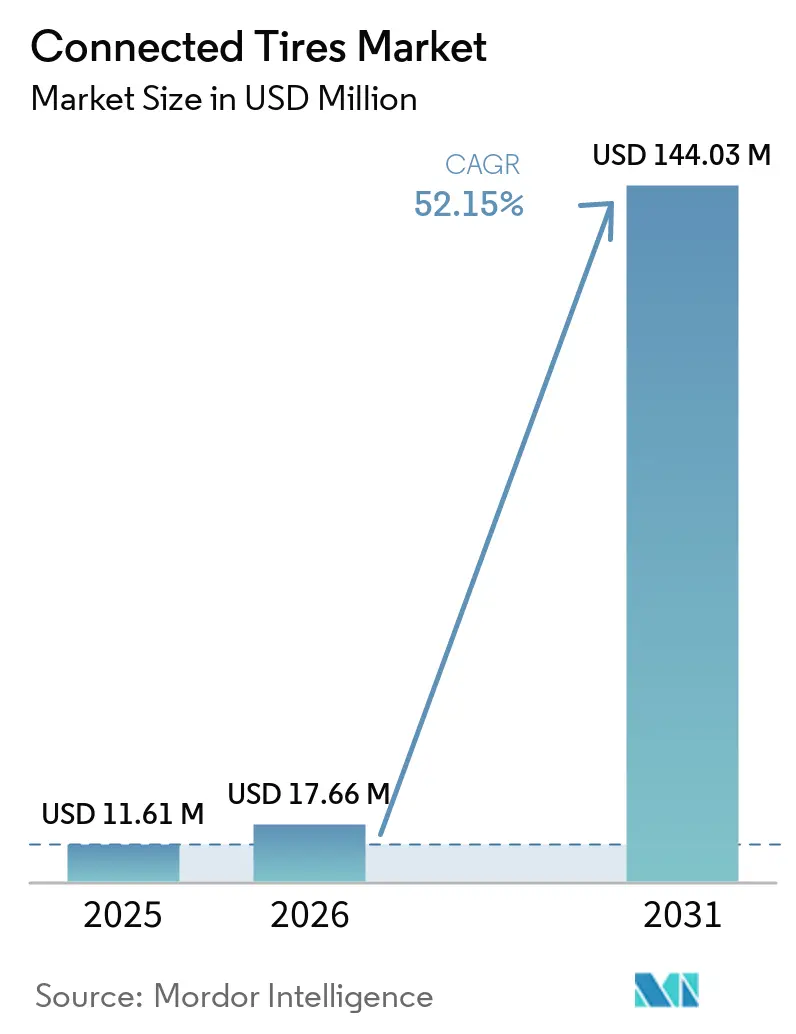
| Market Size (2026) | USD 17.66 Million |
| Market Size (2031) | USD 144.03 Million |
| Growth Rate (2026 - 2031) | 52.15 % |
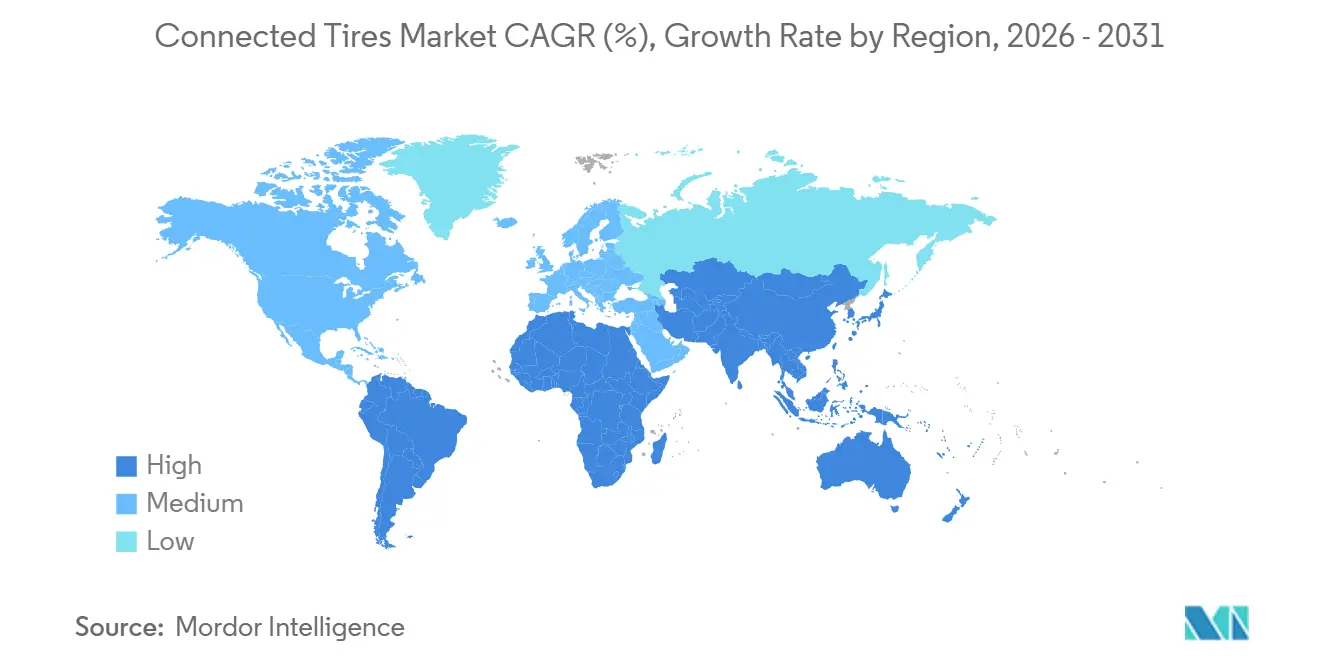
| Fastest Growing Market | South America |
| Largest Market | Asia Pacific |
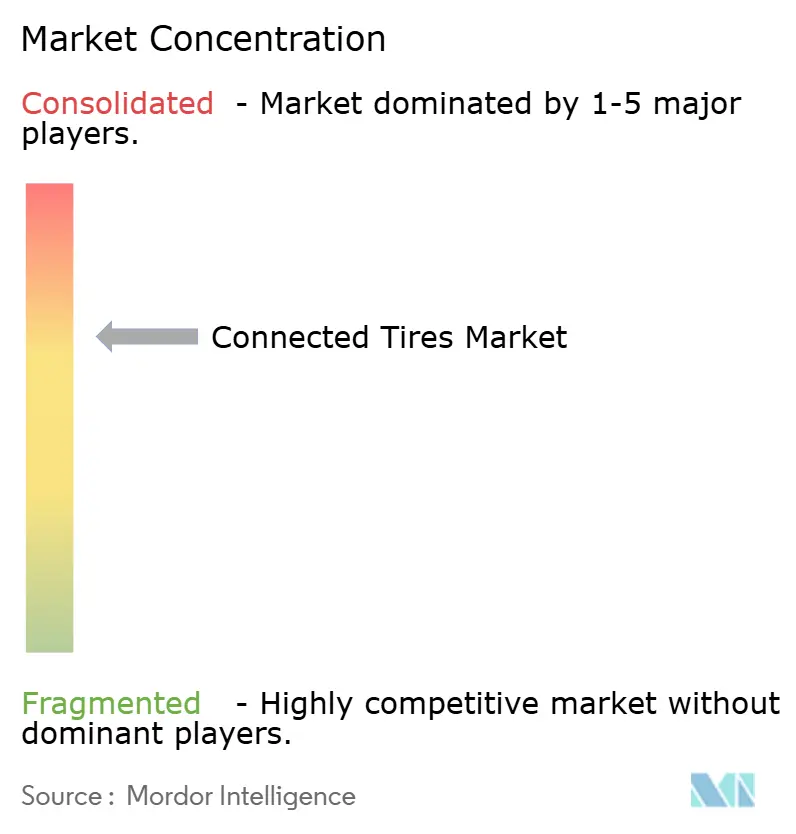
| Market Concentration | Medium |
Major Players *Disclaimer: Major Players sorted in no particular order Image © Mordor Intelligence. Reuse requires attribution under CC BY 4.0. | |
Connected Tires Market Analysis by Mordor Intelligence
The Connected Tires Market size is expected to grow from USD 11.61 million in 2025 to USD 17.66 million in 2026, and is forecast to reach USD 144.03 million by 2031, at a 52.15% CAGR over 2026-2031. Steep electrification of vehicle fleets, regulatory mandates for direct TPMS, and the economics of predictive maintenance are reshaping how tire data is captured and monetized. Battery electric vehicles impose heavier static loads and regenerative braking cycles, accelerating demand for strain-gauge- and accelerometer-equipped casings that feed torque-vectoring algorithms in real time. Commercial fleets now benchmark emergency roadside tire failures, reporting a 75% reduction after shifting to sensor-driven maintenance programs. New laws—such as the European Union’s extension of UN R141 to heavy trucks in 2024 and China’s GB 26149 standard for all new passenger cars—create a compliance floor that sustains sensor uptake regardless of propulsion type.
Key Report Takeaways
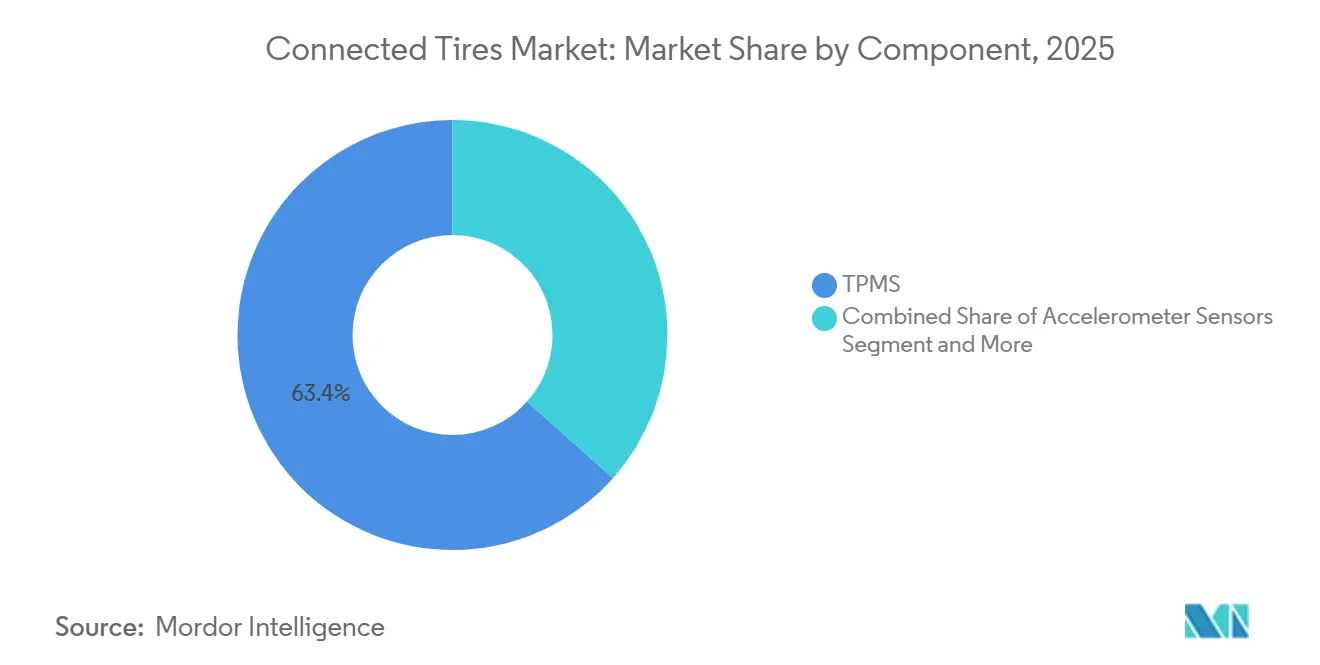
- By component, TPMS modules held 63.37% of the connected tires market share in 2025, while RFID chips are projected to expand at a 52.17% CAGR through 2031.
- Among connectivity technologies, Bluetooth accounted for 38.71% of revenue in 2025, while cellular 4G/5G is forecast to grow at a 52.21% CAGR through 2031.
- By rim size, the 18-22 inch category captured 55.66% of 2025 revenue; rim sizes above 22 inches are advancing at a 52.27% CAGR over the same horizon.
- By propulsion type, internal combustion engines accounted for 63.45% of installations in 2025, whereas battery electric vehicles will log the fastest CAGR at 52.25% to 2031.
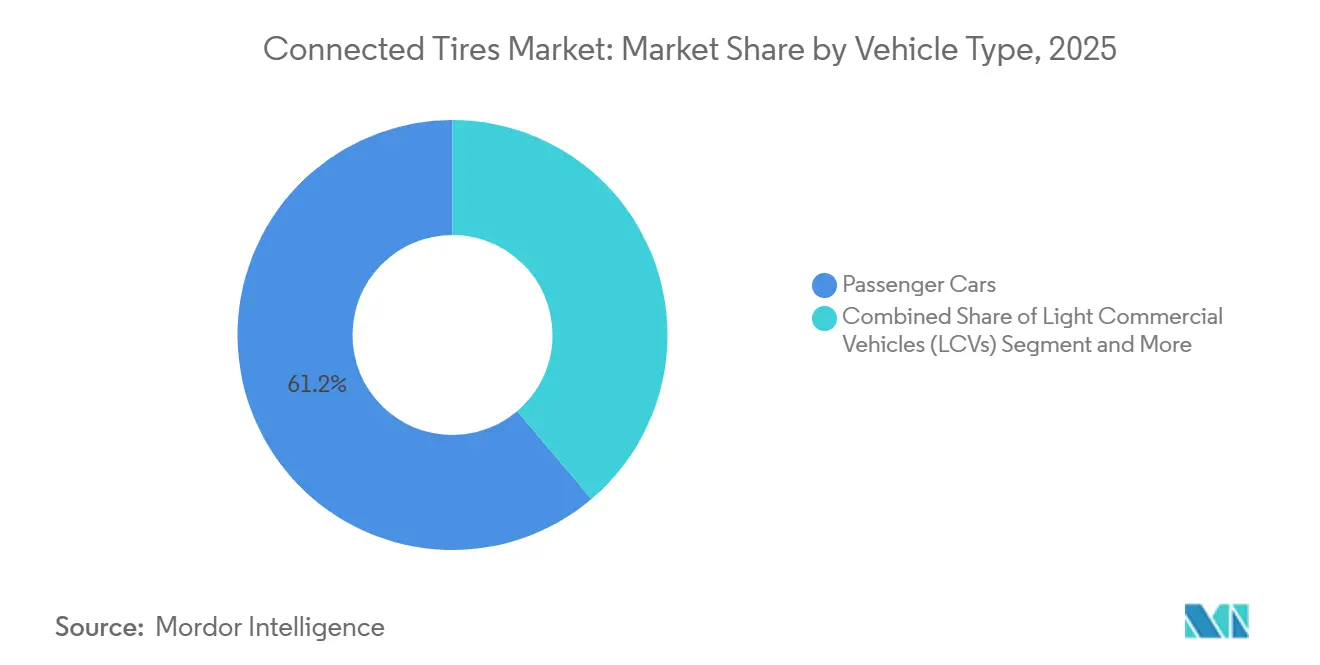
- By vehicle type, passenger cars led with 61.24% 2025 revenue; heavy commercial vehicles are on track for 52.29% CAGR through 2031.
- By sales channel, OEM integration commanded 81.35% share of the connected tires market size in 2025 and is projected to expand at a 52.31% CAGR through 2031.
- By geography, Asia-Pacific accounted for 38.81% of 2025 global revenue; South America is the fastest-growing region, at a 52.33% CAGR to 2031.
Note: Market size and forecast figures in this report are generated using Mordor Intelligence’s proprietary estimation framework, updated with the latest available data and insights as of January 2026.
Market Trends and Insights
Drivers Impact Analysis of Connected Tires Market*
| Driver | (~) % Impact on CAGR Forecast | Geographic Relevance | Impact Timeline |
|---|---|---|---|
| EV-Driven Demand For Load-Bearing Smart Tires | +12.5% | Global, with concentration in China, EU, North America | Medium term (2-4 years) |
| Fleet Focus On Predictive Maintenance & Uptime | +10.8% | North America, EU, Asia-Pacific commercial corridors | Short term (≤ 2 years) |
| Regulatory Mandates For TPMS Adoption | +9.2% | EU (UN R141), China (GB 26149), US (FMVSS 138) | Short term (≤ 2 years) |
| OEM Shift To Mileage-Based "Tire-As-A-Service" | +7.6% | North America, EU, early adoption in Brazil | Medium term (2-4 years) |
| Integration With In-Wheel Motor Torque-Vectoring | +6.4% | Asia-Pacific (China, Japan, South Korea), EU premium segment | Long term (≥ 4 years) |
| Airless/SMA Tires Enable Persistent Sensing | +5.7% | North America (NASA aerospace), EU premium, Asia-Pacific trials | Long term (≥ 4 years) |
| Source: Mordor Intelligence | |||
EV-Driven Demand for Load-Bearing Smart Tires
Battery electric vehicles add 20-30% weight compared with comparable ICE platforms, increasing tire stress and asymmetric wear. Embedded strain gauges and tri-axial accelerometers now stream deformation data every 5 milliseconds to vehicle ECUs, letting software adjust torque and damping before wear accelerates. Pirelli’s Cyber Tire cut emergency stopping distances by 10 feet at 70 mph in road tests and will debut on Aston Martin’s 2027 lineup [1]Cyber Tyre Technology Overview,” Pirelli, pirelli.com. As premium EVs scale globally, tire telemetry emerges as a frontline differentiator for extending range and curbing warranty costs.
Fleet Focus on Predictive Maintenance & Uptime
Fleets operating Class 7-8 vehicles face significant fines for each tire violation, and a single roadside failure leads to a noticeable increase in their insurance premiums. Michelin's Smart Predictive Tire, unveiled in March 2026, demonstrated a substantial reduction in on-road incidents and improved fuel efficiency during pilot tests on U.S. interstates [2]“Smart Predictive Tire for Heavy-Duty Fleets,” Michelin, michelin.com . Continental's ContiConnect, now monitoring a large number of connected tires, offers a relatively short payback period. This has encouraged long-haul carriers to shift from reactive tire replacements to AI-scheduled rotations, significantly reducing their downtime.
Regulatory Mandates for TPMS Adoption
The EU’s UN R141 expansion in 2024 demands direct TPMS on new heavy trucks, closing previous dual-axle exemptions. China’s GB 26149 compels in-tire sensors on every new passenger vehicle, while NHTSA’s FMVSS 138 is reviewing the inclusion of medium-duty classes [3]“TPMS Standards,” National Highway Traffic Safety Administration, nhtsa.gov . These overlapping statutes erase regional loopholes and accelerate hardware adoption, even as software-only systems like NIRA Dynamics’ indicator satisfy minimal thresholds in some markets.
OEM Shift to Mileage-Based “Tire-as-a-Service”
Goodyear's pilots reveal that sensor-enabled contracts can significantly extend tire life. These contracts also transform traditional one-time product sales into recurring revenue that is closely tied to vehicle usage. Meanwhile, Nexen's fleet trials in South Korea achieved notable reductions in tire budgets, thanks to real-time wear analytics. The reliance on RFID and cellular links for accurate, tamper-proof mileage logs has driven a considerable increase in chip shipments to OEM production lines, a trend observed since early 2025.
Restraints Impact Analysis of Connected Tires Market*
| Restraint | (~) % Impact on CAGR Forecast | Geographic Relevance | Impact Timeline |
|---|---|---|---|
| High Sensor-Package Cost & Harsh-Duty Reliability | -6.8% | Global, acute in price-sensitive Asia-Pacific and South America segments | Short term (≤ 2 years) |
| Fragmented Connectivity Standards & Interfaces | -4.3% | Global, particularly EU (ETSI), North America (SAE), China (GB standards) | Medium term (2-4 years) |
| Cyber-Security Liability At The Tire Edge | -3.9% | EU (ISO/SAE 21434, UNECE R155), North America (NHTSA oversight) | Medium term (2-4 years) |
| Data-Ownership Disputes Slow Ecosystem Uptake | -3.2% | EU (Data Act), North America (state-level privacy laws), China (PIPL) | Long term (≥ 4 years) |
| Source: Mordor Intelligence | |||
High Sensor-Package Cost & Harsh-Duty Reliability
Costing within a moderate range, multifunction TPMS modules increase the price of a mid-tier tire by a small percentage, which dissuades cost-sensitive OEMs. In extreme climates with significant temperature fluctuations, battery lives diminish, leading to a notable failure rate in older sensors. TDK and Goodyear have developed a piezoelectric energy-harvesting prototype to reduce reliance on batteries, but its commercial success is contingent on achieving highly competitive price points.
Fragmented Connectivity Standards & Interfaces
Passenger cars toggle among Bluetooth LE, 315-MHz RF, and proprietary links, while fleets pivot to cellular 5G for OTA updates. ISO 15638-23 offers a commercial-vehicle baseline, but passenger-car schemas remain disjointed, saddling integrators with USD 50-150 per truck in API bridge costs. Michelin’s RFID API even levies EUR 1 per call beyond set thresholds, erecting new budget hurdles.
*Our forecasts treat driver/restraint impacts as directional, not additive. The impact forecasts reflect baseline growth, mix effects, and variable interactions.
Connected Tires Market Segment Analysis
By Component:
RFID Chips Propel Circular-Economy ComplianceRFID chips are on track for a 52.17% CAGR during the forecast period (2026-2031), the fastest in the component mix, as the EU Digital Product Passport mandates serialized tire tracking by 2028. Michelin and Beontag have embedded more than 50 million Gen4 UHF TireTags, with a target of 100 million by year-end 2026. TPMS still commands 63.37% of 2025 revenue, yet battery replacement cycles and unit-cost pressures tilt future gains toward passive, maintenance-free RFID. The connected tires market size for RFID is expected to outpace TPMS revenues in the latter half of the forecast window, reflecting OEM preference for dual-purpose identification and telemetry. Accelerometer and strain-gauge packages remain premium EV features but will proliferate once system-on-chip designs lower ASPs. As integrated ICs merge pressure, temperature, and motion in 4 mm footprints, the component boundary blurs, anchoring RFID for identity and TPMS modules for live data streams.
Sensor convergence is shrinking SKU counts; Infineon’s SP490-01-11 embeds a Cortex-M0+, a MEMS pressure die, a z-axis accelerometer, and a 315-MHz transmitter, promising 10-year battery life under cryptographic load. NXP’s NTM88Kxx5S ups dual-axis tolerance to ±550 g, suiting waste-haulers and tractors that generate high-g spikes. At the same time, graphene-based strain gauges tested at 800% stretch open pathways for ultra-flexible casings, though commercialization remains post-2030. Component winners will fuse multifunction silicon with passive RFID, a model that addresses regulatory and fleet asset-tracking requirements in a single tire.



By Connectivity Technology:
Cellular Closes the Range GapCellular 4G/5G will post a 52.21% CAGR as fleets demand OTA firmware updates, geofenced alerts, and cloud analytics, all of which are unsupported by Bluetooth’s 10-meter ceiling. Although Bluetooth led 38.71% 2025 revenue, its foothold is mostly smartphone-paired passenger TPMS. Pirelli’s Bari pilot streams friction data over 5G to traffic-control centers 1.5 miles away, validating wide-area V2X alerts. Academic head-to-heads show LoRa achieves 98% packet delivery on low-bandwidth pressure pings but chokes on accelerometer video streams, which 5G handles elegantly. Wi-Fi remains workshop-bound, while DSRC recedes in North America, where C-V2X garners spectrum re-allocations.
Hybrid chips now ship with multi-mode radios. Infineon’s SP490 integrates RF 315-MHz and Bluetooth LE; Quectel’s AG35 4G Cat 4 module nests a TPMS API that OEMs can unlock via firmware. As subscriber price curves drop below USD 1 per month for pooled SIMs, the connected tires market converges on cellular for fleets and on Bluetooth for cost-constrained private cars. Legacy 315-MHz solutions will linger as ultra-low-power fallbacks but face de facto obsolescence once 5G RedCap modules hit sub-USD 4 pricing.
By Rim Size:
Premium EVs Stretch Above 22 InchesThe 18-22-inch segment accounted for 55.66% of the 2025 segmental revenue, benefiting from crossover and luxury sedans. Yet rims above 22 inches are projected to grow at a 52.27% CAGR as demand for premium EVs broadens contact patches. The connected-tires market share in the ≥22-inch bracket is thus expected to double by 2031. Pirelli’s SCORPION XTM AT ELECT offers multiple 22-24 inch SKUs as OE on Rivian’s R1 line, making larger wheel arches synonymous with embedded-sensor real estate. Higher sidewalls house larger RFID antennas, improving read accuracy through dense treads.
Compact 12-17-inch wheels remain the baseline for entry-level ICEs, but cost sensitivity limits sensor sophistication to pressure-only modules. TPMS regulations ensure basic compliance, yet the technology roadmap points toward larger wheels, where OEMs extract additional value from real-time deformation data. As global BEV penetration climbs toward 40% of sales by 2031, rim size inflation continues, lifting ASPs and sensor attach rates in lockstep.
By Propulsion Type:
BEVs Double-Down on TelemetryBEVs face instant torque and battery mass, elevating tire stress. They will chart a 52.25% CAGR, strengthening their position as the fastest-growing segment. While ICE vehicles accounted for 63.45% of the share in 2025, OEM engineering roadmaps now gridlock tire data directly into motor controllers and battery‐thermal software. The connected tires market size for BEVs is set to leapfrog ICE allocations midway through the forecast, echoing EV drivetrain ascent. Plug-in hybrids serve as transitional niches, combining TPMS utility with moderate acceleration-load profiles, whereas fuel-cell pilots restrict sensor adoption to demonstration fleets in Europe and Japan.
In-wheel architectures like Elaphe’s Sonic X remove differentials and rely on millisecond tire-slip metrics for torque vectoring. This integration tightens sensor latency budgets to the tens-of-microseconds range, reinforcing demand for on-tire microcontrollers. The propulsion split illustrates synergy: as OEMs electrify, they simultaneously upgrade tire telemetry to safeguard range and driveability, accelerating sensor standardization.
By Vehicle Type:
Heavy Commercial Fleets Unlock ROIPassenger cars accounted for 61.24% of revenue in 2025, owing to regulatory TPMS baselines, while heavy commercial vehicles are projected to grow fastest at a 52.29% CAGR. Fleets document 12-18 month paybacks and 75% fewer roadside events, positioning connected rubber as an operational imperative. The connected tires industry narrative thus shifts from safety compliance in light vehicles to uptime economics in HCVs. Light commercial vans and urban buses adopt mid-tier sensors when telematics platforms already manage dispatch and maintenance cycles.
Revvo’s deployment across 40 municipal refuse trucks recorded puncture detection within 48 hours, trimming downtime 60%. Continental’s 47 Truck Center hubs in Brazil expand support, illustrating service-infrastructure scaling in growth markets. Passenger-car uptake stratifies between premium trims that bundle wear-and-friction feeds and mass-market trims that default to indirect software solutions to conserve BOM dollars. Value propositions thus bifurcate along cost and utilization axes.
By Sales Channel:
OEM Factory Fit PrevailsOEM accounted for 81.35% in 2025 sales and will grow at 52.31% CAGR, dwarfing the aftermarket. Embedding sensors during vulcanization slashes per-unit cost to USD 50-100 and ties telemetry seamlessly into vehicle CAN buses. Aftermarket retrofits cost up to USD 200, face compatibility hurdles, and lack integrated OTA security updates, hampering consumer appeal. The connected tires market size for factory-fit sensors, therefore, expands in lockstep with vehicle production, while aftermarket demand skews to replacement and calibration services.
OEM control also underpins emerging tire-as-a-service plans where mileage data feeds automatic invoicing—EU Digital Product Passport regulations further bias toward factory serialization, disincentivizing post-sale add-ons that complicate compliance workflows. Independent retailers pivot to sensor-swap support, carving a niche but conceding primary volume growth to automakers and their tier-one tire partners.
Geography Analysis
APAC Connected Tires Market
Asia-Pacific led with 38.81% revenue in 2025, propelled by China’s nationwide TPMS mandate and the world’s highest EV production rates. Bridgestone and Yokohama embed RFID tags at the factory to comply with future circular-economy rules. At the same time, Nexen pilots mileage-based contracts that cut South Korean fleet tire budgets by up to 18%. India’s regulatory lag confines adoption to premium SUVs and high-utilization logistics trucks; nonetheless, policy drafts signal a forthcoming direct-sensor requirement that could unlock latent demand by 2028. Connectivity fragmentation and data-localization laws in China spawn region-specific firmware but do not slow net sensor volumes.
South America Connected Tires Market
South America is the fastest climber, forecast for 52.33% CAGR to 2031. Continental has equipped several thousand connected tires on numerous vehicles in Brazil and established multiple ContiConnect truck hubs, positioning Brazil as one of its largest markets for smart tires. Michelin is set to launch its SmartLoad AI in São Paulo in the near future, introducing digital-twin lifespan forecasts to lane-kilometer billing, a move that resonates with haulers contending with the region's tropical heat. In Argentina, with its mining-centric focus, a single remote blowout can halt operations for extended periods, driving the swift adoption of sensors despite the nation's economic fluctuations.
North America and EMEA Connected Tires Market
While North America and Europe boast nearly universal adoption of TPMS, the focus is shifting towards advanced features like tread-depth monitoring, V2X communication, and over-the-air security. The EU Data Act, set to take effect in the coming years, grants drivers the right to export raw sensor data, paving the way for third-party analytics ventures. In the United States, fleets are increasingly adopting tire-as-a-service models offered by major manufacturers, with documented short-term paybacks prompting financial decision-makers to retrofit heavy-duty vehicles. The Middle East and Africa, while trailing in volume, utilize sensors to address challenges posed by extreme temperatures, where blowouts pose significant safety risks. Regional differences reflect the interplay among regulation, fleet maturity, and cellular coverage economics.

Competitive Landscape
Major tire players—Bridgestone, Michelin, Continental, Goodyear, and Pirelli—command a significant share of the global connected-tire production. They achieve this dominance through vertical integration, securing OEM contracts, and leveraging proprietary data platforms. In 2024, Goodyear inked a deal with TDK to focus on battery-free piezo-harvesting sensor nodes. Meanwhile, Pirelli's Cyber Tire collaborates with Bosch's ESP for rapid torque adjustments. Continental is making strides in fleet SaaS with ContiConnect, monitoring a substantial number of live tires and broadening its services in South America. Michelin is harnessing RFID technology and subscription billing, using advanced tags to align inventory management with circular-economy principles.
In the semiconductor arena, vendors are vying for supremacy in integration and security. Infineon's SP490 integrates an MCU, MEMS, and RF into a compact package, incorporating hardware AES to comply with UNECE R155 standards. NXP's NTM88Kxx5S targets high-g applications, boasting high-sensitivity accelerometers and adjustable RF output. Software firms like NIRA Dynamics are making waves, with their indirect-sensing IP now featured in a vast number of vehicles, catering to budget-conscious OEMs.
Emerging players, such as The SMART Tire Company, are leveraging NASA's alloy patents, teasing lunar rover tires, and attracting high-end EV brands. The landscape is moderately concentrated but dynamic, with no single player holding sway in every region or component. Differentiation hinges on energy independence, cybersecurity credentials, and the ability to monetize data.
Connected Tires Industry Leaders
Bridgestone Corporation
Michelin
Continental AG
Goodyear
Pirelli
- *Disclaimer: Major Players sorted in no particular order
Connected Tires Market Companies Covered in this Report
- Bridgestone
- Michelin
- Continental
- Goodyear
- Pirelli
- Hankook
- Yokohama
- Sumitomo Rubber (SRI)
- Sensata Technologies
- Schrader Electronics
- NXP Semiconductors
- DENSO
- Huf Hülsbeck & Fürst
- Aptiv
- Infineon
- NIRA Dynamics
- Revvo Technologies
- The SMART Tire Company
- BANF
- Alligator Ventilfabrik

Recent Industry Developments in Connected Tires Market
- May 2026: Pirelli, Pagani Automobili, and Bosch Engineering completed a journey of more than 1,500 kilometers across Europe in a Pagani Utopia Roadster equipped with Cyber Tire technology as standard. These companies are the first to integrate Pirelli Cyber Tire technology with vehicle dynamics systems. This digital ecosystem transforms the tire from a passive component into an active sensor that transmits real-time data on tire and road conditions, thereby enhancing driving safety.
- May 2026: Michelin’s new Tire Digital Twin software enables predictive maintenance and improves vehicle performance by combining 130 years of tire physics expertise with advanced mathematical modeling, AI, and data science algorithms. The software converts in-vehicle data into actionable real-time insights and provides recommendations to drivers without relying on physical tire sensors. Michelin’s Tire Digital Twin technology creates a dynamic virtual replica of each tire. It continuously analyzes and predicts tire conditions by considering tire pressure, wear, load, grip, and driving conditions, while comparing these factors with in-vehicle data.


Global Connected Tires Market Report Scope
The scope of the report includes Component (TPMS and More), Connectivity Technology (Bluetooth and More), Rim Size (12-17 Inches and More), Propulsion Type (ICE and More), Vehicle Type (Passenger Cars and More), Sales Channel (OEM and Aftermarket), and Geography.
| TPMS |
| Accelerometer Sensors |
| Strain-Gauge Sensors |
| RFID Chips |
| Bluetooth |
| Cellular (4G/5G) |
| Wi-Fi |
| V2X |
| 12–17 Inches |
| 18–22 Inches |
| Above 22 Inches |
| Internal Combustion Engine |
| Battery Electric Vehicle (BEV) |
| Plug-in Hybrid EV (PHEV) |
| Hybrid EV (HEV) |
| Fuel Cell EV (FCEV) |
| Passenger Cars |
| Light Commercial Vehicles (LCVs) |
| Heavy Commercial Vehicles (HCVs) |
| Buses & Coaches |
| OEM |
| Aftermarket |
| North America | United States |
| Canada | |
| Rest of North America | |
| South America | Brazil |
| Argentina | |
| Rest of South America | |
| Europe | United Kingdom |
| Germany | |
| Spain | |
| Italy | |
| France | |
| Russia | |
| Rest of Europe | |
| Asia-Pacific | India |
| China | |
| Japan | |
| South Korea | |
| Rest of Asia-Pacific | |
| Middle East and Africa | United Arab Emirates |
| Saudi Arabia | |
| Turkey | |
| Egypt | |
| South Africa | |
| Rest of Middle East and Africa |
| By Component | TPMS | |
| Accelerometer Sensors | ||
| Strain-Gauge Sensors | ||
| RFID Chips | ||
| By Connectivity Technology | Bluetooth | |
| Cellular (4G/5G) | ||
| Wi-Fi | ||
| V2X | ||
| By Rim Size | 12–17 Inches | |
| 18–22 Inches | ||
| Above 22 Inches | ||
| By Propulsion Type | Internal Combustion Engine | |
| Battery Electric Vehicle (BEV) | ||
| Plug-in Hybrid EV (PHEV) | ||
| Hybrid EV (HEV) | ||
| Fuel Cell EV (FCEV) | ||
| By Vehicle Type | Passenger Cars | |
| Light Commercial Vehicles (LCVs) | ||
| Heavy Commercial Vehicles (HCVs) | ||
| Buses & Coaches | ||
| By Sales Channel | OEM | |
| Aftermarket | ||
| By Geography | North America | United States |
| Canada | ||
| Rest of North America | ||
| South America | Brazil | |
| Argentina | ||
| Rest of South America | ||
| Europe | United Kingdom | |
| Germany | ||
| Spain | ||
| Italy | ||
| France | ||
| Russia | ||
| Rest of Europe | ||
| Asia-Pacific | India | |
| China | ||
| Japan | ||
| South Korea | ||
| Rest of Asia-Pacific | ||
| Middle East and Africa | United Arab Emirates | |
| Saudi Arabia | ||
| Turkey | ||
| Egypt | ||
| South Africa | ||
| Rest of Middle East and Africa | ||


Key Questions Answered in the Report
What is the estimated value of the connected tires market today and how large will it be by 2031?
The connected tires market size is USD 17.66 million in 2026 and is projected to reach USD 144.03 million by 2031, reflecting a 52.15% CAGR during 2026-2031.
Which sales channel currently generates the highest revenue?
OEM factory-fit installations captured 81.35% of 2025 revenue and are forecast to keep dominating as automakers embed sensors during tire manufacturing.
Why are heavy commercial fleets moving quickly toward connected tires?
Fleets report 12-18 month paybacks and up to 75% cuts in emergency roadside failures after switching to sensor-enabled predictive maintenance, making the economic case compelling.
How do regulations affect adoption of connected tires?
Mandatory direct-TPMS rules such as the EU’s UN R141 extension to heavy trucks (2024) and China’s GB 26149 for passenger cars compel OEMs to integrate hardware sensors in all new vehicles.
Which component category is expected to grow the fastest?
RFID chips lead future growth with a 52.17% CAGR as the EU Digital Product Passport will require serialized tire tracking between 2028 and 2030.
What connectivity option do fleet operators prefer and why?
Cellular 4G/5G is gaining favor thanks to over-the-air firmware updates and geofenced alerts that short-range Bluetooth cannot support, driving a projected 52.21% CAGR for cellular links.
Page last updated on:


 Your data is secure and never sold or shared.


