
United States Tire Market Size and Share
Market Overview
| Study Period | 2019 - 2031 |
|---|---|
| Forecast Data Period | 2026 - 2031 |
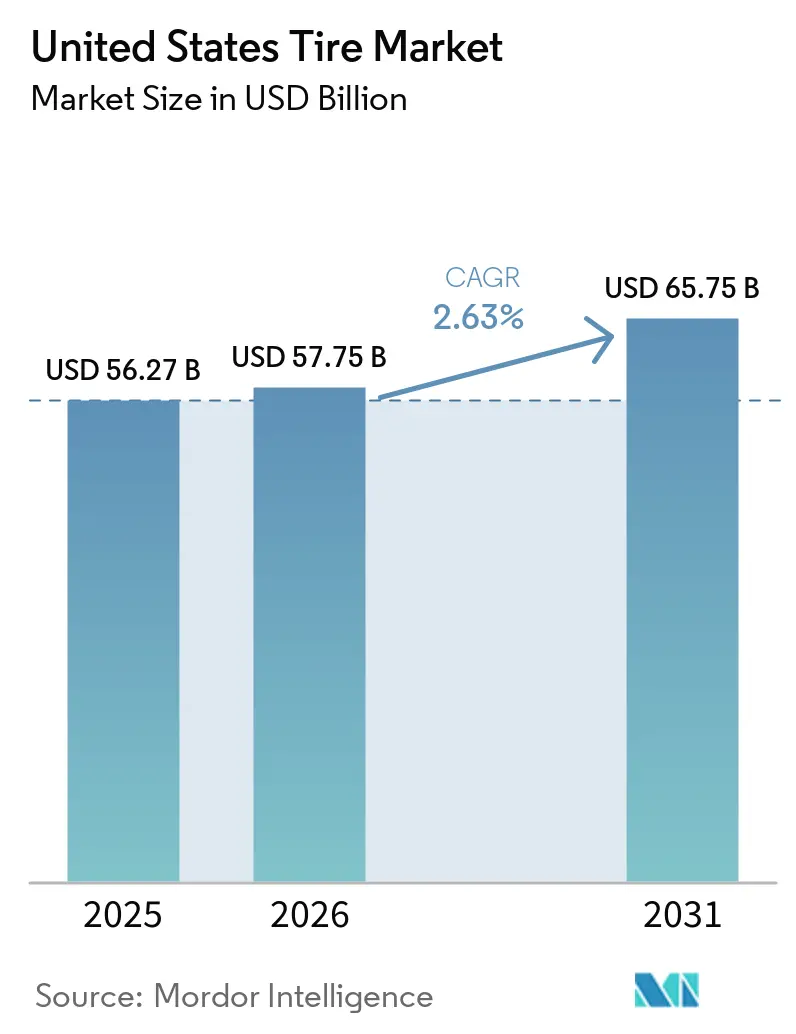
| Base Year Market Size (2025) | USD 56.27 Billion |
| Market Size (2026) | USD 57.75 Billion |
| Market Size (2031) | USD 65.75 Billion |
| Growth Rate (2026 - 2031) | 2.63 % |
| Market Concentration | Medium |
Major Players *Disclaimer: Major Players sorted in no particular order Image © Mordor Intelligence. Reuse requires attribution under CC BY 4.0. | |
United States Tire Market Analysis by Mordor Intelligence
The United States tire market size was valued at USD 56.27 billion in 2025 and is estimated at USD 57.75 billion in 2026, and is projected to reach USD 65.75 billion by 2031, at a CAGR of 2.63% during the forecast period (2026-2031). Federal fuel-efficiency mandates under NHTSA's 2024–2026 and 2027-plus Corporate Average Fuel Economy rules now explicitly model low rolling-resistance tires as a compliance pathway, embedding tire technology directly into automaker regulatory strategies and accelerating the transition from bias to advanced radial designs. Meanwhile, state-level recycled-rubber procurement mandates—California's USD 1.75 per-tire fee funding a Five-Year Plan through 2030, Washington's fee rising from USD 1 to USD 5 in 2026, and Connecticut's new manufacturer-funded stewardship program—are compelling producers to reformulate compounds and invest in circular supply chains.
Key Report Takeaways
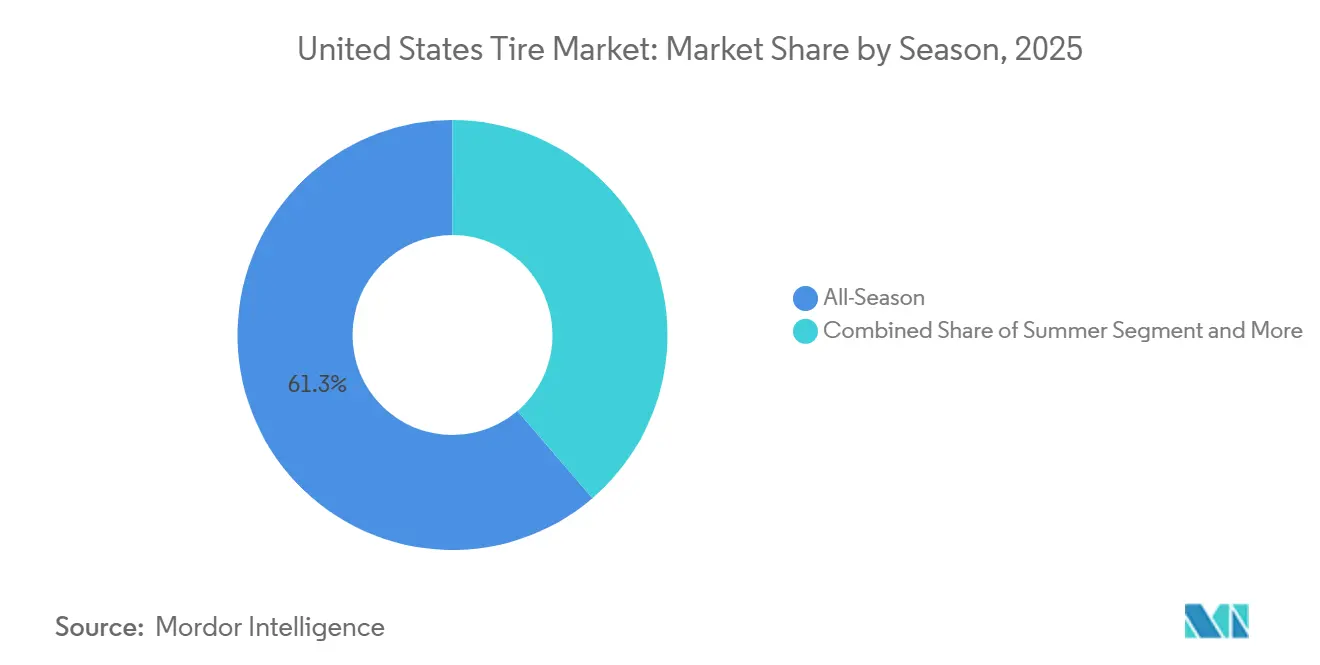
- By season, all-season products led with 61.28% of the United States tire market share in 2025; winter tires are forecast to expand at a 2.65% CAGR through 2031.
- By tire design, radial construction commanded 89.92% of the United States tire market share in 2025, while airless formats posted the highest 2.67% CAGR to 2031.
- By vehicle type, passenger cars accounted for a 65.37% share of the United States tire market size in 2025 and advanced at a 2.76% CAGR through 2031.
- By application, on-road fitments captured a 74.36% of the United States tire market share in 2025; off-road demand is accelerating at a 2.68% CAGR to 2031.
- By end user, OEM channels held 81.21% of the United States tire market share in 2025, whereas aftermarket turnover registers a 2.78% CAGR through 2031.
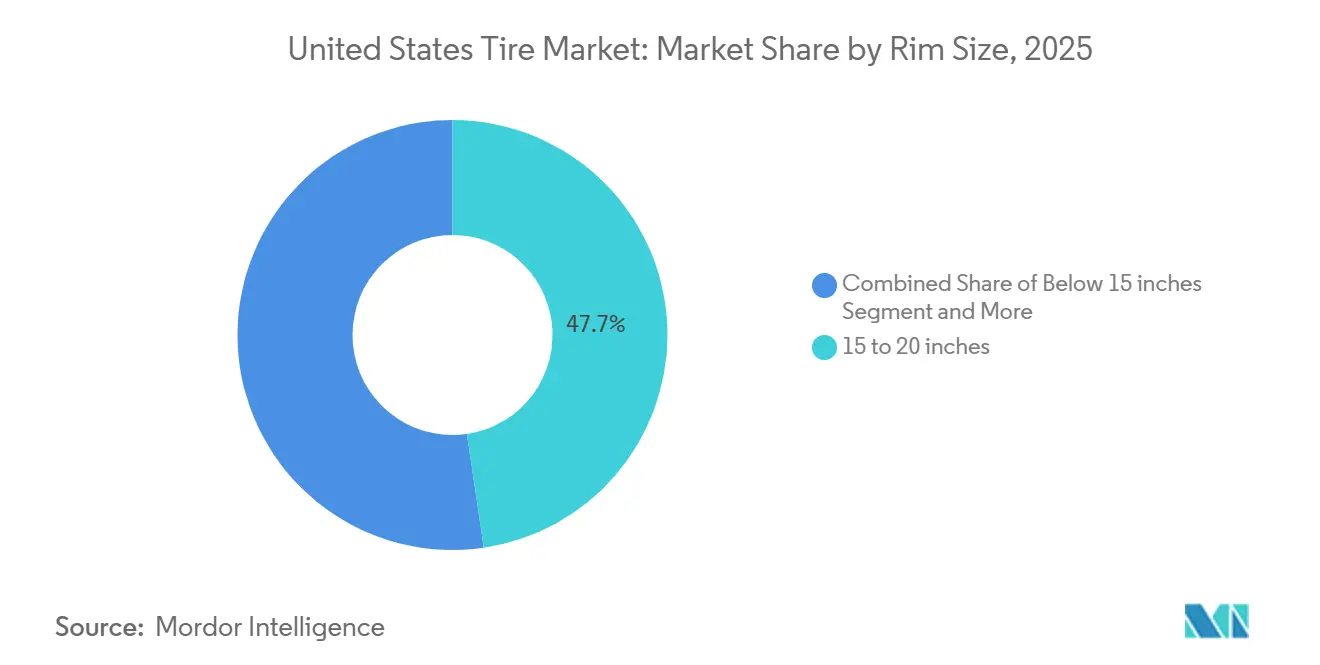
- By rim size, the 15 to 20-inch category led with 47.68% of the United States tire market share in 2025; wheels above 20 inches rose fastest at a 2.71% CAGR.
- By propulsion, ICE vehicles retained 88.71% of the United States tire market share in 2025; battery electric vehicles recorded a 2.72% CAGR to 2031.
Note: Market size and forecast figures in this report are generated using Mordor Intelligence’s proprietary estimation framework, updated with the latest available data and insights as of January 2026.
United States Tire Market Trends and Insights
Drivers Impact Analysis*
| Driver | (~) % Impact on CAGR Forecast | Geographic Relevance | Impact Timeline |
|---|---|---|---|
| Aging Vehicle Fleet and Higher VMT | +0.4% | National, concentrated in Sun Belt states | Medium term (2-4 years) |
| SUV and Light-Truck Mix Lifts | +0.3% | National, strongest in suburban markets | Long term (≥ 4 years) |
| Corporate and Federal Fuel-Efficiency Rules | +0.2% | National, early adoption in California | Medium term (2-4 years) |
| Surge of Tire E-Commerce and Mobile Installers | +0.2% | Urban centers, expanding to rural markets | Short term (≤ 2 years) |
| Domestic EV-Tire Capacity Unlocks High-Margin Niche | +0.1% | Regional, concentrated in manufacturing hubs | Long term (≥ 4 years) |
| State-Level Recycled-Rubber | +0.1% | California, expanding to Northeast states | Medium term (2-4 years) |
| Source: Mordor Intelligence | |||
Aging Vehicle Fleet and Higher VMT Boost Replacement Demand
The climbing average vehicle age to 12.5 years extends the domestic parc, yet lifts tire turnover as suspension wear accelerates tread degradation. Vehicle miles traveled rebounded exponentially in 2024, matching pre-pandemic levels and compounding usage intensity[1]“Traffic Volume Trends December 2024,” Federal Highway Administration, fhwa.dot. gov. The Federal Highway Administration forecasts total United States vehicle miles traveled will grow 0.5–0.6% annually from 2019 through 2050, with light-duty vehicles advancing 0.4–0.5%, single-unit trucks 1.9–2.1%, and combination trucks 1.1–1.3%. This divergence matters because commercial segments generate disproportionate replacement cycles—a single-unit delivery van or Class 8 tractor accumulates mileage three to five times faster than a passenger sedan, compressing tire life and multiplying annual purchases per vehicle. Simultaneously, the average age of light-duty vehicles on United States roads has climbed past 12 years, a record driven by pandemic-era supply-chain disruptions, elevated new-vehicle prices, and improved durability that defers scrapping.
SUV and Light-Truck Mix Lifts Average Rim Size And ASP
Currently, three-fifths of new vehicles produced in the United States are SUVs and light trucks, which typically utilize 17 to 20-inch rims, compared to the 15 to 16-inch rims that are standard for sedans. These larger rim formats not only command higher average prices but also consistently contribute to increased revenue per unit. As automakers continue to phase out several sedan lines, the larger wheel size has shifted from being a premium feature to becoming the new standard. This transition has significantly improved manufacturer profit margins while also raising the replacement costs borne by consumers, thereby driving substantial value expansion within the United States tire market.
Corporate and Federal Fuel-Efficiency Rules Favor Low-RR Radials
The 50.4 mpg CAFE mandate, effective 2031, positions low rolling-resistance tires as mandatory compliance components[2]“Final CAFE Standards Model Year 2031,” National Highway Traffic Safety Administration, nhtsa.gov . This regulatory embedding transforms tires from a commodity input into a strategic compliance lever, incentivizing OEMs to specify advanced radial designs with silica-reinforced tread compounds, optimized belt packages, and aerodynamic sidewall profiles. The EPA's SmartWay program, which updated its verified low-RR tire list in January 2025 and revised retread protocols in February 2022 to equate retread targets with new-tire benchmarks, provides a parallel certification framework that fleet operators use to qualify for fuel-tax credits and sustainability reporting.
Surge of Tire E-Commerce and Mobile Installers Widens Reach
Online channels are increasingly capturing market share by offering competitive prices along with convenient doorstep services. Mobile installers now provide on-site mounting and balancing services, which minimize downtime for consumers and enhance accessibility for both fleet operators and time-constrained drivers. Additionally, data-driven platforms are optimizing inventory management and routing processes, thereby exerting pressure on traditional retail margins. Within the United States tire market, direct-to-consumer brands are not only achieving a cost advantage but are also accumulating valuable first-party customer data, fundamentally transforming the competitive dynamics of the market.
Restraints Impact Analysis*
| Restraint | (~) % Impact on CAGR Forecast | Geographic Relevance | Impact Timeline |
|---|---|---|---|
| Natural and Synthetic-Rubber Price Volatility | -0.2% | Global supply chains, regional processing | Short term (≤ 2 years) |
| Import Tariffs/Trade Frictions Inflate Landed Costs | -0.1% | National, concentrated at major ports | Medium term (2-4 years) |
| Faster EV Tire Wear | -0.1% | EV adoption centers, premium markets | Medium term (2-4 years) |
| Urban Shift to Ride-Sharing and Micromobility | -0.1% | Metropolitan areas, dense urban centers | Long term (≥ 4 years) |
| Source: Mordor Intelligence | |||
Natural and Synthetic-Rubber Price Volatility
Natural-rubber spot prices reached 205–206 U.S. cents per kilogram in February through April 2026, approaching one-year highs, as the Association of Natural Rubber Producing Countries projected 2026 global demand of 15.6 million tons against production of 15.2 million tons—the sixth consecutive annual deficit. Seasonal supply constraints during Southeast Asia's February-to-May wintering period, weather disruptions, leaf-blight disease outbreaks, and aging plantations with declining yields compound the structural imbalance, while speculative positioning in futures markets amplifies price swings.
Faster EV Tire Wear Raises Warranty and Brand-Image Risk
Instant torque and the additional weight of heavier batteries are reducing the lifespan of EV tires by approximately one-third. This situation is placing increased pressure on warranty reserves and poses a risk to the reputations of premium brands. Tire manufacturers are currently facing a critical challenge: they must either develop innovative compounds specifically designed for EVs, which may lead to compromises in certain performance metrics, or absorb the financial impact of higher warranty claims. Moreover, negative feedback from influential early adopters has the potential to spread rapidly through social media platforms, creating significant risks to future revenue streams within the United States tire market.
*Our forecasts treat driver/restraint impacts as directional, not additive. The impact forecasts reflect baseline growth, mix effects, and variable interactions.
Segment Analysis
By Season: All-Season Convenience Under Pressure From Winter Demand
In 2025, all-season tires dominated the United States market, capturing a robust 61.28% share. Meanwhile, winter tire units, although accounting for a smaller segment, are experiencing a notable CAGR of 2.65%, driven by heightened safety awareness and increasingly severe storms reshaping consumer preferences.
Winter tires are now expanding their presence beyond the traditional snowbelt regions, reaching temperate areas that are encountering unpredictable weather patterns. The introduction of the Three Peak Mountain Snowflake certification in 2024 has distinctly differentiated product offerings. As climate variability continues to influence the market, manufacturers of all-season tires are incorporating snow-capable features into their products. This trend indicates a gradual blurring of seasonal boundaries within the tire market.



By Tire Design: Radial Supremacy Meets Airless Momentum
In 2025, radials held a dominant 89.92% share of the United States tire market, which reflects decades of strategic optimization and global scaling. At the same time, airless tire models, despite maintaining a modest share of less than 1%, demonstrated growth with a CAGR of 2.67%, targeting commercial applications that emphasize puncture resilience.
Michelin's UPTIS and Bridgestone's Air Free concepts provide insights into the pathway toward market acceptance. Although current manufacturing costs and ride comfort limitations are restricting widespread adoption, advancements in technology indicate the potential for achieving long-term parity. This development could lead to a significant transformation in the United States tire market landscape.
By Vehicle Type: Passenger Car Leadership Persists
In 2025, passenger cars commanded a dominant 65.37% share of the United States tire market, experiencing a surprising surge with a 2.76% CAGR, driven by the dual forces of electrification and a heightened demand for premium retrofits. While commercial light trucks, supported by e-commerce logistics, enjoyed growth, they lagged behind in pace.
As fleets electrify, there is a pronounced shift towards high-performance compounds, essential for handling added weight and torque. Meanwhile, ride-share and subscription services are redefining purchase priorities, placing a premium on longevity over traditional individual owner preferences. These evolving dynamics not only bolster the passenger segment's dominance but also strengthen the overall United States tire market landscape.
By Application: On-Road Core Faces Off-Road Upswing
In 2025, on-road duty cycles commanded a dominant 74.36% share of the United States tire market, underscoring the importance of highway and urban travel. Meanwhile, off-road segments, including construction, recreation, and industrial uses, experienced a growth rate of 2.68% CAGR.
As consumers increasingly prioritize versatility, the demand for hybrid all-terrain patterns is bridging the gap between on-road and off-road categories. In the United States tire market, regulatory constraints on ground disturbance are spurring innovations in tread ecodesign, seamlessly integrating environmental stewardship as a market feature.
By End User: OEM Scale Meets Aftermarket Agility
In 2025, OEM fitments commanded a dominant 81.21% share of the United States tire market, highlighting the significance of relationships with automakers. Meanwhile, supported by e-commerce, mobile installations, and an expanded brand array, aftermarket revenues are experiencing growth, with a CAGR of 2.78%.
Manufacturers manage the guaranteed volumes from factory contracts alongside the appeal of higher margins and direct data insights from replacement channels. The growth of digital retail has reduced entry barriers for emerging brands, intensifying competition in the United States tire market.
By Rim Size: Mainstream 15 to 20 Inch Segment Shifts Upscale
In 2025, rims measuring between 15 and 20 inches accounted for 47.68% of the tire market share in the United States. Meanwhile, wheels exceeding 20 inches, a popular choice for luxury SUVs, are witnessing a growth rate of 2.71% CAGR, surpassing market averages.
These larger wheels not only enhance a vehicle's aesthetics but also improve handling, allowing manufacturers to command higher premiums and boost profitability. The intricate production process, coupled with elevated raw material costs, favors established players with extensive tooling capabilities, amplifying their advantages in the expansive United States tire market.
By Propulsion: ICE Dominance Encounters EV Growth
In 2025, internal combustion engine platforms captured 88.71% of the United States tire market share, while battery electric units are projected to grow at a 2.72% CAGR, driven by federal incentives and the expansion of charging infrastructure.
Electric vehicle tire engineering focuses on noise reduction, improved load ratings, and energy efficiency, leading to the introduction of dedicated product lines. To sustain their position in this critical growth segment of the United States tire market, manufacturers need to implement parallel R&D roadmaps to avoid losing market share.
Geography Analysis
The United States tire market shows regional demand variations influenced by climate, vehicle preferences, and policies, complicating distribution strategies. Coastal states like California, Washington, and New York lead in electric vehicle adoption, with California accounting for 35% of United States BEV registrations. This drives demand for EV-specific tires, balancing low rolling resistance and wear mitigation. California's USD 1.75 per-tire recycling fee and its 2025–2030 Five-Year Plan mandating recycled content procurement encourage circular supply chains. Washington's fee increase to USD 5 in 2026 reflects similar priorities. The Sun Belt states, including Texas and Florida, favor light trucks and SUVs due to year-round driving conditions, boosting demand for all-season tires. Texas attracts manufacturing investments due to its oil economy and tax benefits, with states like Colorado and Georgia also offering incentives and skilled labor access.
Midwest and Great Plains regions, with harsh winters and agricultural activities, sustain demand for winter tires and off-road products, though population stagnation limits growth. The Mountain West, including Colorado and Montana, supports niche demand for studded and all-terrain tires due to winter tourism and resource extraction. FHWA forecasts 1.9–2.1% annual VMT growth for single-unit trucks and 1.1–1.3% for combination trucks, highlighting concentrated commercial activity in metro corridors and interstate routes. This clustering enables fleet operators to negotiate contracts and demand timely deliveries. State-level policy fragmentation adds complexity. Connecticut's HB 5157 shifts recycling costs to producers, setting a precedent for other Northeastern states. Chain laws in mountainous states sustain seasonal demand, while varying studded-tire regulations require region-specific SKUs and consumer education.
Import tariffs and trade frictions disproportionately affect coastal ports like Los Angeles, which handle most tire imports. The temporary 15% Section 122 surcharge, active until mid-2026, impacts distributors lacking inventory depth. Domestic manufacturing expansions by Goodyear, Hankook, and Bridgestone are concentrated in the Southeast and South-Central regions, leveraging lower costs and proximity to automaker plants in states like Alabama and Tennessee. This shift reduces ocean freight and tariff risks while enabling just-in-sequence deliveries to original equipment customers, optimizing inventory costs and improving supply-chain coordination.
Competitive Landscape
The United States tire market operates as a fragmented oligopoly, with the top five players holding significant shares but facing margin pressures from low-cost imports and niche disruptors. Market concentration is moderate, as no single manufacturer controls over 20% of volume. Regional brands, private-label suppliers, and specialty producers prevent pricing discipline. Key strategies include capacity expansions in premium and EV-specific segments (e.g., Goodyear's USD 320 million Lawton investment), vertical integration into digital services (e.g., Continental's ContiConnect-Samsara partnership), and M&A for adjacent capabilities (e.g., Michelin's USD 220 million Flexitallic acquisition). Opportunities exist in airless-tire commercialization, domestic EV-tire manufacturing to bypass tariffs, and circular-economy models monetizing tire casings through retreading and material recovery. Disruptors like Enso (USD 700–750 million Phase 1 plant) and technology suppliers such as Cabot (Propel E8 carbon black) are advancing low rolling resistance solutions.
Technology innovation focuses on compounds and automation. Pirelli's asymmetric-profile patent (U.S. 12,246,557 B2, granted March 2025) reduces rolling resistance using lateral conicity force. Apollo's low-RR formulation (U.S. 20240174836A1, May 2024) blends silica, kaolin, and recycled carbon black to lower hysteresis. Michelin employs AI to design the Alpin 7 tread compound and partially in CrossClimate 3, compressing R&D timelines and exploring new compound permutations. Bridgestone's third-generation Air Free, entering real-world testing in 2026, uses AI-driven structural optimization to design thermoplastic-resin spokes, replacing compressed air. This innovation requires new production lines and quality-control protocols.
Competitive intensity is rising as tariffs, including Section 301's 25% and antidumping rates of 61–76%, push effective duties above 100% for some Chinese suppliers. Distributors are diversifying sourcing, creating opportunities for domestic producers investing in automation to offset higher U.S. labor costs. The industry faces challenges in balancing capital-intensive expansions, such as Hankook's USD 1.6 billion and Enso's USD 700–750 million commitments, with uncertain demand shaped by EV adoption rates, trade-policy volatility, and consumer willingness to pay premiums for sustainability attributes offering intangible benefits.
United States Tire Industry Leaders
Bridgestone Corporation
Michelin SCA
Goodyear Tire & Rubber Co.
Continental AG
Hankook Tire & Technology
- *Disclaimer: Major Players sorted in no particular order


Recent Industry Developments
- June 2026: Italian tyre manufacturer Pirelli (PIRC.MI) announced a multi-year investment plan for the United States valued at approximately USD 1 billion to USD 1.2 billion, aimed at increasing production capacity, including for its Cyber Tyres. The plan was to be submitted for board approval at an upcoming meeting.
- May 2026: Continental announced the construction of a highly automated finished-goods warehouse in Mount Vernon, Illinois, with an investment of approximately USD 76 million. The facility, capable of storing 500,000 passenger car tires, will serve growing North American demand. Construction begins in summer 2026, with operations scheduled for 2027.
- January 2025: Michelin unveiled Primacy 5, offering an 18% longer lifespan than its predecessor and improved wet braking; 87 sizes roll out in 2025.


United States Tire Market Report Scope
The United States tire market is segmented by season, tire design, vehicle type, application, end user, rim size, and propulsion. By season, the market is segmented into summer, winter, and all-season tires. By tire design, the market is segmented into radial, bias, and non-pneumatic/airless tires. By vehicle type, the market is segmented into two-wheelers, passenger cars, light commercial vehicles, heavy commercial trucks and buses, and off-the-road and specialty vehicles, including OTR, agriculture, mining, and racing applications. By application, the market is segmented into on-road and off-road. By end user, the market is segmented into OEM and aftermarket. By rim size, the market is segmented into below 15 inches, 15 to 20 inches, and above 20 inches. By propulsion, the market is segmented into internal-combustion vehicles, battery-electric vehicles, and hybrid and fuel-cell vehicles. The report offers market size and forecasts in value (USD) and volume (Units) for all the above-mentioned segments.
| Summer |
| Winter |
| All-Season |
| Radial |
| Bias |
| Non-pneumatic/Airless |
| Two-Wheelers |
| Passenger Cars |
| Light Commercial Vehicles |
| Heavy Commercial Trucks and Buses |
| Off-the-Road and Specialty (OTR, Agriculture, Mining, Racing) |
| On-Road |
| Off-Road |
| OEM |
| Aftermarket |
| Below 15 inches |
| 15 to 20 inches |
| Above 20 inches |
| Internal-Combustion Vehicles |
| Battery-Electric Vehicles |
| Hybrid and Fuel-Cell Vehicles |
| By Season | Summer |
| Winter | |
| All-Season | |
| By Tire Design | Radial |
| Bias | |
| Non-pneumatic/Airless | |
| By Vehicle Type | Two-Wheelers |
| Passenger Cars | |
| Light Commercial Vehicles | |
| Heavy Commercial Trucks and Buses | |
| Off-the-Road and Specialty (OTR, Agriculture, Mining, Racing) | |
| By Application | On-Road |
| Off-Road | |
| By End User | OEM |
| Aftermarket | |
| By Rim Size | Below 15 inches |
| 15 to 20 inches | |
| Above 20 inches | |
| By Propulsion | Internal-Combustion Vehicles |
| Battery-Electric Vehicles | |
| Hybrid and Fuel-Cell Vehicles |


Key Questions Answered in the Report
What is the current value of the United States tire market?
The United States tire market size reached USD 56.27 billion in 2025.
How fast is demand for EV-specific tires growing?
Battery electric vehicle fitments are advancing at a 2.72% CAGR through 2031.
Which rim size category is expanding the quickest?
Wheels above 20 inches post the fastest 2.71% CAGR on rising luxury SUV adoption.
Why are winter tires gaining share?
More severe weather events and broader 3PMSF availability lift winter tire sales at a 2.65% CAGR.
How do state recycling fees affect pricing?
California’s USD 1.75 per-tire fee funds recovery rates and adds a modest cost that manufacturers pass through in California and sometimes nationwide.
Which distribution channel is growing fastest?
The aftermarket, supported by e-commerce and mobile installation, records a 2.78% CAGR to 2031.
Page last updated on:





