
Market Overview
| Study Period | 2020 - 2031 |
|---|---|
| Forecast Data Period | 2026 - 2031 |
| Base Year Market Size (2025) | USD 35.54 Billion |
| Market Size (2026) | USD 39.05 Billion |
| Market Size (2031) | USD 62.61 Billion |
| Growth Rate (2026 - 2031) | 9.89 % |
| Market Concentration | Medium |
Major Players *Disclaimer: Major Players sorted in no particular order Image © Mordor Intelligence. Reuse requires attribution under CC BY 4.0. | |
Europe ADAS Market Analysis by Mordor Intelligence
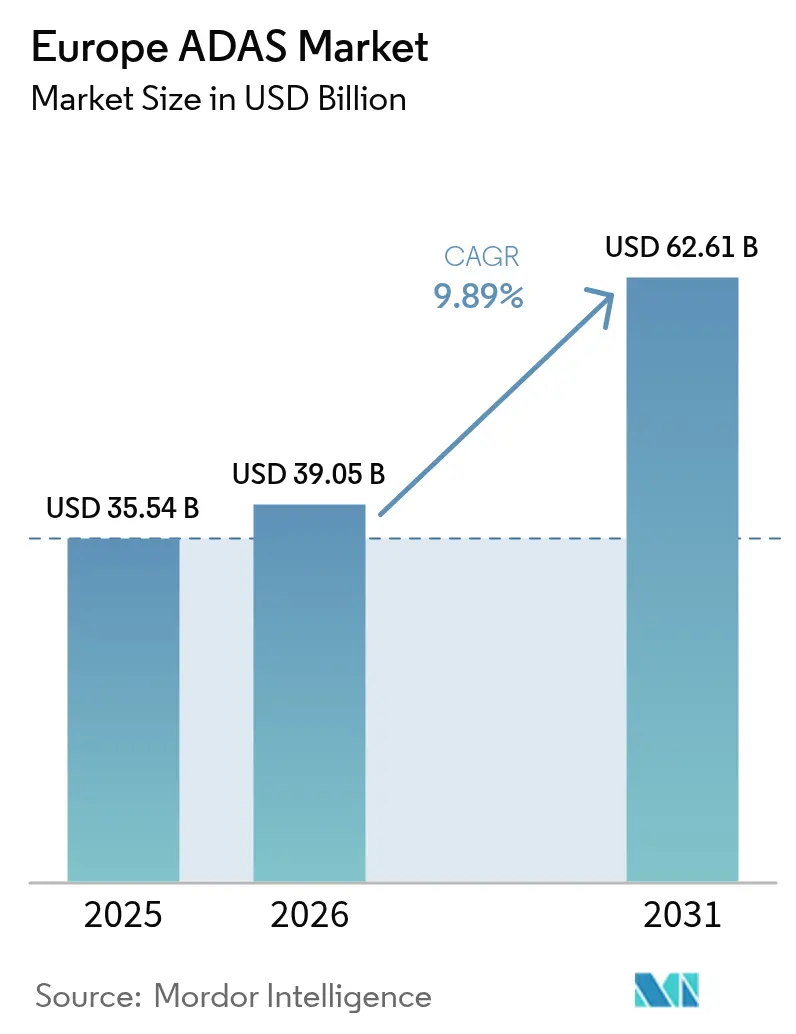
The Europe ADAS Market size was valued at USD 35.54 billion in 2025 and estimated to grow from USD 39.05 billion in 2026 to reach USD 62.61 billion by 2031, at a CAGR of 9.89% during the forecast period (2026-2031). Mandatory safety regulations, rapid sensor cost declines, and expanding over-the-air business models collectively reinforce steady demand while creating new profit pools for suppliers of software-defined architectures. Increasing alignment between European Commission mandates and the Euro NCAP 2030 roadmap compresses the traditional “premium-to-mass” trickle-down cycle, making automatic emergency braking, lane-keeping, and driver-monitoring functions standard even on entry-level trims. Competitive intensity rises as semiconductor-centric entrants challenge Tier 1 incumbents with integrated hardware–software platforms that simplify system validation and shorten OEM sourcing cycles. Germany’s early approval of Level 3 highway automation and Spain’s fleet electrification incentives showcase how regulation and industrial policy jointly accelerate penetration across passenger and commercial vehicle classes. Heightened demand for multi-modal sensor fusion that maintains performance in snow, fog, and nighttime conditions supports the shift from single-sensor redundancies to cohesive perception stacks that include radar, camera, and LiDAR in the same enclosure.
Key Report Takeaways
- By system type, automatic emergency braking captured 22.74% of the European ADAS market share in 2025, while night-vision systems are advancing at a 10.04% CAGR to 2031.
- By sensor type, radar retained 37.10% of the European ADAS market share in 2025; LiDAR adoption is projected to climb 10.06% annually through 2031.
- By vehicle type, passenger cars commanded 72.80% of the European ADAS market share in 2025, whereas medium and heavy commercial vehicles are poised for a 10.08% CAGR to 2031.
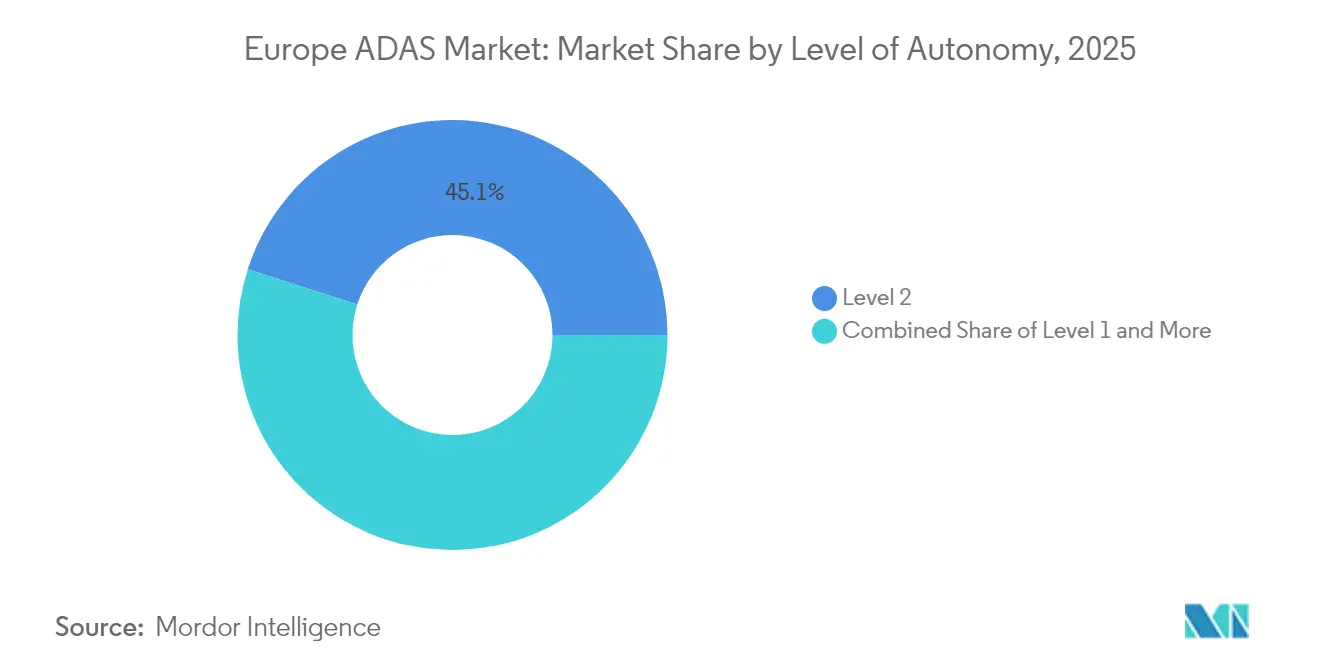
- By level of autonomy, Level 2 systems accounted for 45.05% of the European ADAS market share in 2025, but Level 3 volumes are forecast to grow 10.03% annually due to German and pan-EU approvals.
- By sales channel, OEM factory-fit channels supplied 82.92% of the European ADAS market share in 2025, with aftermarket retrofit solutions tracking a 9.98% CAGR through 2031 as fleet operators modernize legacy assets.
- By geography, Germany accounted for 28.40% of the European ADAS market share in 2025, while Spain registered the highest CAGR of 9.96% till 2031.
Note: Market size and forecast figures in this report are generated using Mordor Intelligence’s proprietary estimation framework, updated with the latest available data and insights as of 2026.
Market Trends and Insights
Drivers Impact Analysis of Europe ADAS Market*
| Driver | (~) % Impact on CAGR Forecast | Geographic Relevance | Impact Timeline |
|---|---|---|---|
| EU General Safety Regulation 2024 Mandate | +2.8% | EU-wide, with Germany and France leading implementation | Short term (≤ 2 years) |
| EURO NCAP 2030 Vision Roadmap | +2.1% | EU core markets, extending to UK and Switzerland | Medium term (2-4 years) |
| Mass-Market Level 2 Feature Bundling Surge | +1.9% | Germany, France, Italy primary markets | Medium term (2-4 years) |
| 77 GHz Radar Cost Decline | +1.7% | Global, with European OEMs as early adopters | Short term (≤ 2 years) |
| OTA-Based ADAS Feature Monetization Models | +1.2% | Premium markets: Germany, UK, Nordics | Long term (≥ 4 years) |
| Digital-Twin Homologation Frameworks | +0.8% | Germany, Netherlands, Sweden pilot programs | Long term (≥ 4 years) |
| Source: Mordor Intelligence | |||
EU General Safety Regulation 2024 Mandate
The regulation requires automatic emergency braking, lane departure warning, and driver drowsiness detection across every new vehicle category sold in the bloc. Entry-level passenger cars, motorcycles, and agricultural machinery must meet identical baseline safety specifications, forcing OEMs to accelerate procurement schedules that have already filled Tier 1 order books through 2026. Non-compliant models lose type approval, creating a hard stop on regional market access and giving early certified suppliers guaranteed volume visibility [1]“General Safety Regulation,” European Commission, ec. europa.eu .
EURO NCAP 2030 Vision Roadmap Alignment
Euro NCAP’s staged roadmap sets performance thresholds higher than legislative minima, requiring OEMs to demonstrate cyclist, pedestrian, and motorcyclist recognition in complex mixed-traffic conditions. These protocols reward systems that fuse radar, camera, and LiDAR inputs to handle adverse weather, nighttime, and construction zones. Ratings directly influence fleet procurement and insurance pricing, pushing manufacturers toward continuous sensor and software upgrades that favor suppliers with iterative validation capacity[2]“Roadmap 2030,” Euro NCAP, euroncap.com .
Mass-Market Level 2 Feature Bundling Surge
Volume brands such as Renault package adaptive cruise control, lane centering, and emergency braking as default on B-segment hatchbacks, proving that bundling lowers per-sensor cost and widens the revenue base for subscription-driven feature unlocks. BMW’s Personal Pilot illustrates an upsell ladder in which entry functionality ships standard, while premium modules monetize through over-the-air activation throughout the vehicle life cycle[3]“Personal Pilot Announcement,” BMW Group, bmwgroup.com .
77 GHz Radar Cost Decline & Platform Standardization
Switching from 24 GHz to 77 GHz modules improves range and resolution while benefiting from semiconductor process shrinkage that cuts the bill-of-material cost. Continental’s expansion of 77 GHz capacity signals confidence that radar remains the backbone of highway automation even as LiDAR prices fall [4]“77 GHz Radar Expansion,” Continental AG, continental.com .
Restraints Impact Analysis of Europe ADAS Market*
| Restraint | (~) % Impact on CAGR Forecast | Geographic Relevance | Impact Timeline |
|---|---|---|---|
| High Incremental Cost | -1.8% | Eastern Europe, Southern Italy, Spain budget segments | Short term (≤ 2 years) |
| Sensor Performance Loss | -1.4% | Nordic countries, Alpine regions, UK | Medium term (2-4 years) |
| GDPR Compliance Cost | -0.9% | EU-wide, particularly Germany and France | Medium term (2-4 years) |
| Gallium Export Controls Hitting Lidar Supply | -0.7% | Global supply chain, European OEM impact | Short term (≤ 2 years) |
| Source: Mordor Intelligence | |||
High Incremental Cost For Entry-Level Vehicles
City-car platforms now face an added cost due to the integration of ADAS hardware and electronics. This development forces OEMs to either absorb the margin pressure or potentially alienate budget-conscious buyers in Eastern Europe and southern markets. Meanwhile, smaller manufacturers, without the advantage of global scale, find it challenging to distribute engineering overheads. As a result, they face an extended affordability gap, awaiting a significant drop in semiconductor prices.
Sensor Performance Loss In Snow/Fog Conditions
Camera detection ranges fall by half in heavy snow, and radar accuracy drops in dense fog, leading to consumer frustration and potential liability. Nordic field tests reveal elevated deactivation rates that undermine trust in assisted-driving promises, spurring investment in thermal imaging and advanced radar while highlighting the cost–benefit tension for mass-market trims.
*Our forecasts treat driver/restraint impacts as directional, not additive. The impact forecasts reflect baseline growth, mix effects, and variable interactions.
Europe ADAS Market Segment Analysis
By System Type:
Emergency Braking Leads Safety EvolutionAutomatic emergency braking held 22.74% of the European ADAS market share in 2025, a position cemented when the 2024 General Safety Regulation made the feature mandatory across new registrations. The Europe ADAS market size for night-vision solutions is forecast to grow exponentially by 2031, translating into a 10.04% CAGR as thermal cameras mitigate fog and darkness and help brands differentiate in premium tiers. Forward-collision warning, lane-departure warning, and adaptive cruise control continue to ship in volume bundles, reinforcing pathway migration from reactive to predictive functions that anticipate driver intent.
OEM roadmaps increasingly fuse parking, blind-spot, and drowsiness modules into unified domain controllers that consolidate ECUs and cut wiring complexity. GDPR-compliant drowsiness monitoring expands slowly due to privacy safeguards, yet remains critical for Euro NCAP scoring. Adaptive lighting systems add matrix-LED capabilities that optimize beam patterns without blinding oncoming traffic, positioning illumination control as a safety and energy efficiency play. These converging trends confirm the European ADAS market as a hardware-software ecosystem in which modular safety building blocks become firmware features upgradeable over a vehicle’s lifetime.




By Sensor Type:
Radar Dominance Faces LiDAR ChallengeRadar sensors retained 37.10% of the European ADAS market share in 2025, benefiting from USD 32 mid-range module pricing, robust all-weather performance, and regulatory familiarity. The Europe ADAS market size for LiDAR is projected to grow significantly by 2031, riding a 10.06% CAGR once unit pricing falls toward USD 500 and Euro NCAP stresses vulnerable road-user protection. Cameras remain indispensable for lane-line and traffic-sign recognition, yet face snow occlusion issues that elevate the value proposition of thermal and radar fusion.
Continental’s 77 GHz MIMO radar arrays deliver finer resolution while conserving package space, protecting the radar’s core highway role. Simultaneously, Valeo’s solid-state LiDAR price cuts push the sensor into high-volume C-segment crossovers, a milestone that rebalances sensory hierarchies. Integrated perception stacks merge radar velocity, camera semantics, and LiDAR depth into single ECUs, lowering latency and creating redundancy demanded for Level 3 approvals. This integration accelerates supplier consolidation inside the European ADAS market, with OEMs favoring turnkey sensor suites that minimize validation loops.
By Vehicle Type:
Commercial Fleets Drive AdoptionPassenger cars delivered 72.80% of the European ADAS market share in 2025. Yet, the European ADAS market size for medium and heavy commercial vehicles is poised to rise at a 10.08% CAGR on safety-driven fleet upgrades. Logistics operators quantify return on investment through lower accident downtime and reduced insurance premiums, allowing faster payback than in retail passenger segments. Two-wheeler adoption picks up as regulators extend safety mandates, though its absolute volume remains small.
ZF’s OnGuardMAX emergency braking illustrates how truck-specific kinematics trigger tailored ADAS calibration distinct from car applications. Fleet purchasing centralizes decision-making, bringing bulk orders that support supplier scale. Passenger-car programs prioritize comfort add-ons such as automated parking, whereas commercial platforms focus squarely on collision avoidance and lane-keeping to protect cargo and drivers. As the driver shortage intensifies, fleets turn to ADAS not only for safety, but also to uplift job satisfaction and retain scarce labor.
By Level of Autonomy:
Level 3 Breakthrough AcceleratesLevel 2 solutions represented 45.05% of the European ADAS market share in 2025, but Level 3 programs now move from pilot to series production on German Autobahns with a robust CAGR of 10.03% through 2031. The Europe ADAS market share for Level 3 vehicles is expected to rise materially once Mercedes-Benz DRIVE PILOT, approved for 95 km/h operation, expands beyond its initial tranche of S-Class and EQS units. BMW Personal Pilot targets dense traffic up to 60 km/h, underscoring how OEMs segment operational design domains to manage liability and cost.
Level 2+ bridges the gap for brands that cannot yet assume full system liability but still need hands-off capability during monotone highway stretches. Regulatory alignment across France, Italy, and Spain shortens homologation cycles, making Level 3 the new competitive yardstick in premium sales pitches. Even so, cost and functional-safety demands keep Level 4 aspirations confined to geo-fenced pilots, reinforcing that Europe's ADAS market growth remains tethered to incremental autonomy layers.
By Sales Channel:
Aftermarket Retrofit Gains MomentumOEM factory installations captured 82.92% of the European ADAS market share 2025 because sensors, wiring, and domain controllers integrate most efficiently at build. Though smaller, the aftermarket retrofit expands at a 9.98% CAGR as insurers adjust premiums to reflect ADAS presence, prompting fleets to upgrade rather than replace assets. Valeo SafeSide packages radar, camera, and HMI modules in a kit calibrated for vans and rigid trucks, while Continental offers dealer-installed blind-spot detection for older city buses.
Installation complexity remains a hurdle. Workshops require precise alignment rigs and software authorization certificates, spawning a service ecosystem of ADAS-calibration specialists. OTA update support further tightens ties between retrofit suppliers and fleets, unlocking subscription revenue even on legacy vehicles. As compliance deadlines approach, retrofit demand shores up long-tail vehicles, supporting total Europe ADAS market expansion beyond new-car production alone.
Geography Analysis
Germany ADAS Market
Germany held 28.40% of the European ADAS market share in 2025, thanks to its dense cluster of premium OEMs, suppliers, and regulatory bodies coordinating early Level 3 approvals. Mercedes-Benz and BMW used these rulings to commercialize conditional automation, compelling domestic suppliers such as Bosch, Continental, and ZF to align roadmaps with higher compute loads, triple redundancy, and cybersecurity-by-design. Government-funded pilot corridors helped validate sensor fusion in real-world mixed traffic, reinforcing Germany’s lead in revenue and influencing EU policy harmonization.
Spain ADAS Market
Spain is the fastest-growing geography, posting a 9.96% CAGR through 2031 as its fleet electrification subsidies explicitly require advanced driver-assist kits on commercial vehicles and public buses. Spanish logistics players leverage ADAS to cut operating costs, while municipal tender rules stipulate collision-mitigation systems on new electric refuse trucks and ride-hail vans. EU structural funds further subsidize domestic Tier 2 electronics plants, lowering unit costs and enhancing local sourcing resilience. The country thus moves from technology adopter to partial contributor, adding depth to the broader European ADAS market.
Europe ADAS Market
France and Italy retain significant footprints backed by Valeo’s sensor plants and Stellantis’ STLA AutoDrive program, respectively. The United Kingdom sustains Euro NCAP alignment post-Brexit to preserve export continuity, although parallel work on autonomous-vehicle legislation could introduce divergence after 2026. Nordic markets focus on weather-resilient sensors, creating niche demand for thermal imaging and high-performance radar. Eastern Europe, while price-sensitive, benefits from growing component manufacturing that feeds Western OEM plants, reinforcing the continent’s integrated supply web. Collectively, these dynamics ensure that Europe's ADAS market penetration follows a spectrum rather than a single curve, but regulation keeps minimum feature levels rising everywhere.
Regulatory Landscape
EU type-approval and safety rules remain the main anchor for ADAS demand in Europe, led by Regulation (EU) 2019/2144 (General Safety Regulation 2), which requires intelligent speed assistance and driver drowsiness and attention warning on new vehicles. In 2026, the European Commission advanced implementation detail through Commission Implementing Regulation (EU) 2026/481 (dated 3 March 2026) on type-approval procedures for automated driving systems, supporting a more uniform compliance pathway for ADS features.
UNECE WP.29 provides the technical standards backbone for EU and pan-European regulatory alignment, including UN Regulation No. 171 for Driver Control Assistance Systems. In June 2026, UNECE WP.29 approved a global framework enabling fully autonomous driving systems, raising the emphasis on system-level safety processes. Separately, Commission Delegated Regulation (EU) 2026/1188 entered into force in July 2026 and updated type-approval requirements for small-series and special-purpose vehicles, with dated compliance milestones for advanced driver distraction warning requirements (7 July 2026 for new types, and 7 July 2028 for new vehicles).
Value Chain Analysis
The European ADAS value chain runs from sensor and compute silicon suppliers (radar, camera, LiDAR, SoCs/MCUs) to Tier 1 integrators building sensor modules and domain or vehicle computers, and then to OEMs that integrate these stacks into vehicle E/E architectures and manage safety validation for EU type-approval and Euro NCAP protocols. Recent sourcing patterns show OEMs and Tier 1s tightening software and platform linkages: Volkswagen Group deepened platform collaborations with Mobileye (MQB, March 2024) and later expanded cooperation with Valeo and Mobileye for enhanced Level 2+ functions on future MQB vehicles (March 2025). This reflects growing use of pre-integrated packages for perception software, sensor suites, and centralized compute.
Upstream dependencies on semiconductors and critical materials remain a structural constraint, shaping inventory and localization decisions across the chain. Reported disruptions in 2025, including rare-earth-related import impacts on German supply and chip supply disputes affecting European automakers, point to risk concentration outside Europe for inputs that support radar, power electronics, and high-reliability compute. At the same time, partnerships such as Bosch and CARIAD (Volkswagen Group) focusing on AI-based automated driving stacks indicate value capture shifting toward software and continuous updates, with validation toolchains and compliance documentation playing a larger role in supplier differentiation.
Competitive Landscape
The competitive field blends traditional Tier 1 dominance with a surge of chip-centric challengers. Bosch, Continental, ZF, and Valeo still control broad portfolios, ranging from radars to domain controllers, preserving share through decades-old OEM ties. They respond to software disruption by forging alliances: Bosch partners with Volkswagen’s CARIAD unit on scalable perception stacks, while ZF integrates NVIDIA Drive for compute power in its ProAI controller, which has been shipping since 2024.
Semiconductor players Mobileye, Qualcomm, and NVIDIA supply turnkey “system-on-module” solutions that bundle SoCs, software, and reference sensors, allowing mid-tier OEMs to cut time-to-market. Their entry intensifies price competition and accelerates platform convergence around centralized compute zones. The strategic twist is revenue migration toward software licensing, data analytics, and over-the-air feature sales, pushing hardware margins downward.
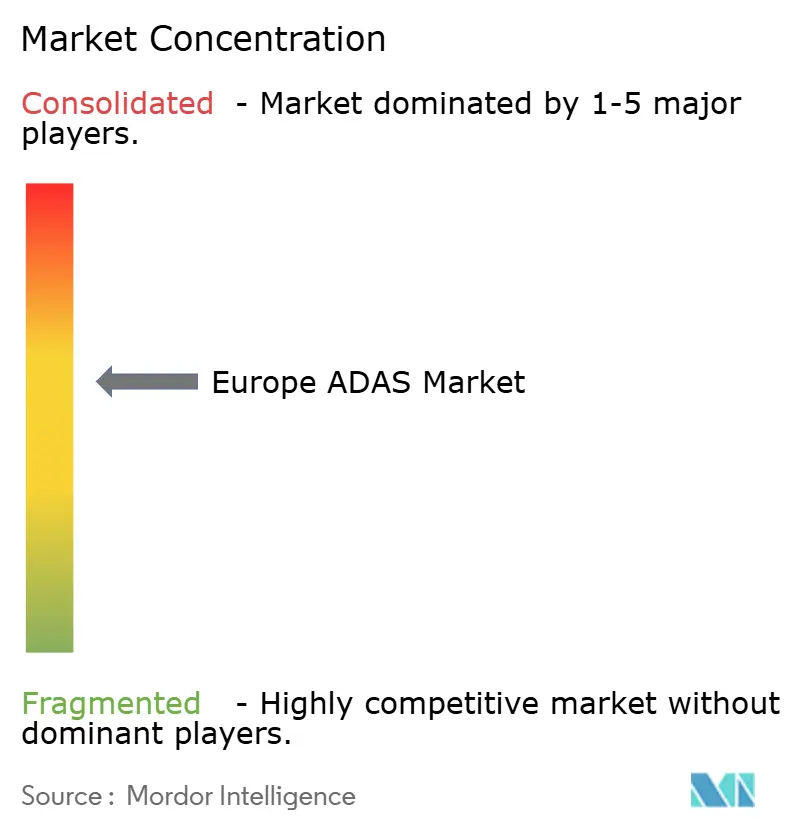
Consolidation is evident as smaller lidar and software startups license IP or accept acquisition offers to navigate Euro NCAP testing costs. Traditional suppliers expand into retrofit and insurance-data services, diversifying income against margin squeeze in original equipment. These moves yield a moderately concentrated Europe ADAS market in which the top five vendors hold about 60% combined share. At the same time, niche specialists survive by focusing on sensors for adverse-weather regions or cybersecurity compliance modules.
Europe ADAS Industry Leaders
Autoliv AB
Continental AG
Delphi Automotive
ZF Friedrichshafen AG
Robert Bosch GmbH
- *Disclaimer: Major Players sorted in no particular order
Europe ADAS Market Companies Covered in this Report
- Robert Bosch GmbH
- Continental AG
- ZF Friedrichshafen AG
- Valeo SA
- Aptiv PLC
- Autoliv Inc.
- Denso Corporation
- Hella KGaA Hueck & Co.
- Mobileye (NXP/Intel)
- Infineon Technologies AG
- Magna International Inc.
- NXP Semiconductors NV
- STMicroelectronics N.V.
- Panasonic Corp.
- Renesas Electronics Corp.
- Hyundai Mobis Co. Ltd.
- Veoneer AB
- Texas Instruments Inc.
- Innoviz Technologies Ltd.
- Ibeo Automotive Systems GmbH

Market Opportunities and Future Outlook
Regulation-driven feature expansion creates near-term whitespace in scalable driver monitoring and distraction-warning implementations, especially where OEMs and suppliers can offer compliant, GDPR-aware sensing and software packages across high-volume platforms. Dated regulatory actions in 2026 reinforce this opening: Commission Delegated Regulation (EU) 2026/1188 sets ADDW compliance timing milestones (7 July 2026 for new types, and 7 July 2028 for new vehicles), and Commission Implementing Regulation (EU) 2026/481 standardizes ADS type-approval procedures, enabling wider commercialization of features such as automated parking under clearer approval processes.
Software-defined, centralized compute and pre-integrated sensor-fusion stacks are also active opportunity areas as OEMs aim to shorten validation cycles and roll out modular features through factory-fit and updates. Supplier investment and platform moves support this direction, including Harman Internationals March 2026 investment in Hungary to expand R&D for autonomous driving software and hardware and upgrade manufacturing capabilities, along with Volkswagen Group collaborations with Mobileye and Valeo on MQB driver-assistance stacks. These efforts favor vendors that can deliver end-to-end packages (sensors, compute, perception software, and toolchains) and support cross-border testing and homologation alignment within Europe.
Recent Industry Developments in Europe ADAS Market
- April 2026: Robert Bosch GmbH expanded its strategic partnership with Qualcomm Technologies to include ADAS solutions, pairing Bosch vehicle computer architecture with the Snapdragon Ride platform. This update supports Bosch's ability to supply scalable, centralized compute building blocks that OEMs can reuse across model lines, while enabling faster software-feature integration.
- February 2025: Stellantis launched the STLA AutoDrive platform across brands including Peugeot, Opel, and Fiat, bundling adaptive cruise control and lane centering with a pathway for subscription-based upgrades. This broadened Level 2+ availability on mainstream nameplates and increased the focus on software monetization and update capability in OEM ADAS strategies.
- September 2024: ZF and Farizon signed an MoU at IAA Transportation under which ZF supplies ADAS alongside electrified driveline solutions for Farizons new-energy trucks. The agreement extends European supplier ADAS know-how into commercial-vehicle programs, supporting scale benefits and cross-regional learning for safety systems.


Europe ADAS Market Report Scope and Research Methodology
Market Definition and Coverage
For this study, the Europe ADAS market includes revenues generated from advanced driver assistance functions fitted in vehicles sold and used across European countries, covering key ADAS features and the related sensing stack that enables these functions.
Scope exclusions: Excludes fully autonomous driving stacks and robotaxi style operations where the driving task is handled without a human driver for extended periods.
Segments Covered in This Report
- By System Type
- Parking Assist Systems
- Adaptive Front-Lighting
- Night Vision Systems
- Blind-Spot Detection
- Automatic Emergency Braking
- Forward Collision Warning
- Driver Drowsiness Alert
- Traffic Sign Recognition
- Lane Departure Warning
- Adaptive Cruise Control
- By Sensor Type
- Radar
- LiDAR
- Camera
- Ultrasonic
- Infra-red
- By Vehicle Type
- Two-Wheelers
- Passenger Cars
- Medium & Heavy Commercial Vehicles
- By Level of Autonomy
- Level 1
- Level 2
- Level 3
- Level 4
- Level 5
- By Sales Channel
- OEM-Fitted
- Aftermarket Retrofit
- By Geography
- Germany
- United Kingdom
- France
- Italy
- Spain
- Russia
- Rest of Europe
Data Sources, Market Sizing, and Validation
Desk Research
We start with desk research to set the base demand pool for ADAS in Europe and to understand what is being mandated versus chosen by buyers. Public sources used for grounding include European Commission mobility and safety releases, UNECE vehicle regulation documents, Euro NCAP test protocols, and ACEA vehicle registration statistics, which help us align feature adoption to the on-road and new vehicle parc.
After that, we review company filings, investor presentations, and reputable industry press to map which ADAS functions are shipping at scale and how attach rates are changing by vehicle class. In parallel, paid subscriptions for company financials and intelligence, news and financials, and patent databases are used to cross-check supplier exposure and technology direction without relying on any single data point. The sources listed here are illustrative only, and many other public and paid references are used for data collection, validation, and clarification throughout the work.
Primary Interviews and Surveys
To close information gaps, we conduct interviews and surveys with OEM side product owners, component and module suppliers, integration partners, and aftermarket channel contacts across Europe. Inputs from these discussions are used to validate which ADAS functions are counted as standard fitment versus optional packages, and to sanity check price progression and penetration assumptions by country and vehicle type.
Distribution of primary research fieldwork respondents
| Company type | Respondent position |
|---|---|
| Top tier: 34% | CXOs: 12% |
| Mid tier: 49% | Functional/Unit leaders: 33% |
| Smaller Players: 17% | Managers: 55% |
Market-Sizing & Forecasting
Sizing starts with a top-down build where new vehicle registrations, model mix, and expected ADAS fitment rates are reconstructed by country, then translated into value using typical system prices. To keep the totals grounded, we corroborate this with selective bottom-up checks such as sampled feature level ASP multiplied by estimated installed volumes, and a supplier revenue cross check where public disclosures allow it.
For Europe, inputs that are used repeatedly in the model include the pace of General Safety Regulation-related fitment, Euro NCAP scoring changes that increase adoption of features like AEB and driver monitoring, radar and camera penetration trends, and the share shift toward higher trim levels that carry bundled safety packs. We also review the commercial vehicle mix because its ADAS take-up can move differently than passenger cars in some markets. For forecasting, scenario analysis is applied around regulatory timing, new model launch cycles, and sensor price erosion, and the final curve is aligned to what interviewees describe as achievable roll out plans over the forecast window. Where feature level data is missing for smaller countries, we use proxy adoption from similar vehicle mix markets and then re-check totals against regional registration shares.
Data Validation & Update Cycle
We run triangulation across model outputs, independent demand signals, and what industry contacts report for real world fitment trends. Large variances are flagged, and the drivers are reviewed, which usually comes down to whether a function is treated as bundled versus stand-alone, and whether the assumed ASP path matches current sourcing behavior.
Before sign off, the work is reviewed in multiple steps, including internal checks on formulas, outlier detection across countries, and a consistency scan against regulation-led adoption milestones. Reports are refreshed annually, and interim updates are triggered when material events occur, such as major mandate changes or sharp shifts in production volumes. Right before delivery, an analyst performs a fresh pass so clients receive the latest updated view.
Mordor Intelligence's Europe Adas Market Size Compared With Other Published Estimates
Published estimates for Europe ADAS do not always match, and the difference is usually not from math errors. It typically comes down to what is counted and how the demand pool is built. In practice, the biggest swings come from whether a study treats ADAS as a feature revenue, a component revenue, or a broader autonomy stack revenue, and then how it converts units into USD.
Robotaxi hardware and full self driving compute stacks are often pulled into some totals, but that item sits outside Mordor Intelligence's scope for this Europe ADAS report, which keeps the model tied to driver assistance functions shipping in regular passenger and commercial vehicles. Other gaps come from using aggressive feature penetration assumptions without checking against Europe specific safety scoring and mandate timing, and from applying one blended ASP curve across radar, camera, and LiDAR instead of reflecting different price erosion patterns and option take rates by vehicle class.
Benchmark comparison
| Source | Market Size | Gaps in Research Methodology |
|---|---|---|
| Mordor Intelligence | USD 35.54 B (2025) | |
| Regional Consultancy A | USD 80.54 B (2032) | Uses a longer horizon and appears to include broader autonomy and platform level content, which can inflate totals when Level 3 plus stacks are counted alongside ADAS functions. |
| Industry Report B | USD 6.90 B (2024) | Looks closer to a narrower definition that may emphasize a limited set of ADAS features or selected countries, and it may under count bundled feature revenue when ADAS is sold as part of trim packages. |
Looking across the three figures, most of the spread can be explained by scope width and by how feature penetration and pricing are treated over time. When the definition stays centered on shipping driver assistance functions, and assumptions are checked against Europe specific regulation and adoption signals, the market size is easier to trace and repeat year after year.


Key Questions Answered in the Report
What is the projected value of the European ADAS market by 2031?
The market is forecast to reach USD 62.61 billion by 2031 based on a 9.89% CAGR.
Which ADAS system leads current adoption across Europe?
Automatic emergency braking leads with 22.74% share of 2025 installations.
Why is Spain showing the fastest growth in ADAS adoption?
Aggressive fleet electrification policies and mandatory safety requirements push Spain toward a 9.96% CAGR through 2031.
How quickly are Level 3 systems expected to scale?
Level 3 volumes are projected to rise 10.03% annually as regulatory approvals spread and OEM programs mature.
Which sensor technology is poised for the highest growth rate?
LiDAR is on track for a 10.06% CAGR once unit pricing approaches mainstream affordability.
What is driving aftermarket ADAS retrofit demand?
Insurance premium reductions and impending regulatory deadlines motivate fleets to upgrade legacy vehicles at a 9.98% CAGR.
Page last updated on:





