
Thailand UEM Market Size and Share
Market Overview
| Study Period | 2020 - 2031 |
|---|---|
| Forecast Data Period | 2026 - 2031 |
| Base Year Market Size (2025) | USD 45.62 Million |
| Market Size (2026) | USD 58.61 Million |
| Market Size (2031) | USD 230.48 Million |
| Growth Rate (2026 - 2031) | 31.50 % |
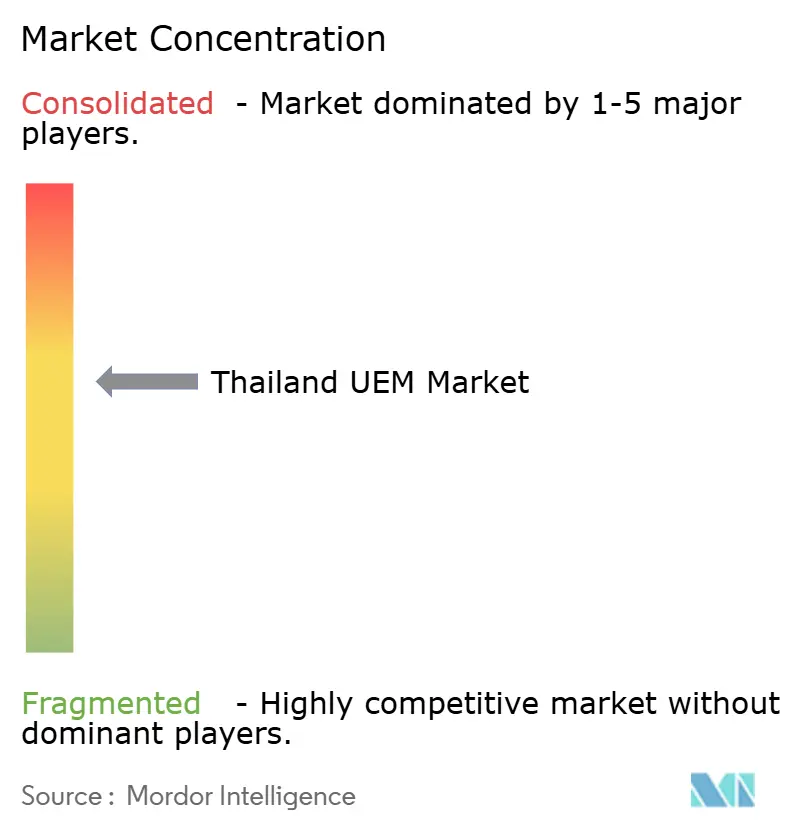
| Market Concentration | Medium |
Major Players *Disclaimer: Major Players sorted in no particular order Image © Mordor Intelligence. Reuse requires attribution under CC BY 4.0. | |
Thailand UEM Market Analysis by Mordor Intelligence
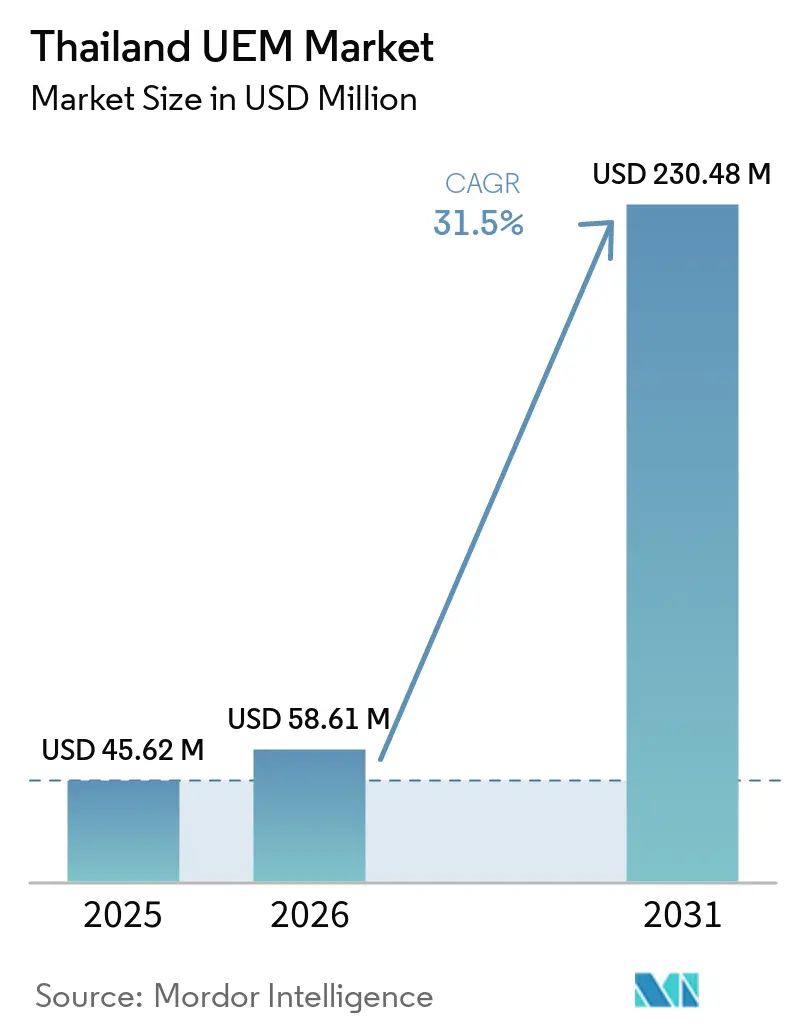
The Thailand UEM market size was valued at USD 45.62 million in 2025 and estimated to grow from USD 58.61 million in 2026 to reach USD 230.48 million by 2031, at a CAGR of 31.50% during the forecast period (2026-2031). The Thailand UEM market is moving on the back of stronger enterprise demand for centralized and policy-based control across mobile, desktop, shared, and connected devices as workforces, applications, and cloud environments spread across more locations. The Thailand UEM market is also benefiting from an unusually heavy cycle of digital infrastructure spending, which is expanding data center capacity, increasing cloud usage, and increasing the number of endpoints enterprises must secure and manage through a single operating model. As that endpoint base grows, unified endpoint management is shifting from a useful IT tool to a core control layer for compliance, security, and day-to-day device operations across regulated and multi-site organizations. At the same time, legacy system integration, skill shortages, and budget constraints in the mid-market are slowing some buying cycles, even as smaller organizations are preparing for the next phase of expansion in the Thailand UEM market.
Key Report Takeaways
- By component, solutions held 67.81% of Thailand UEM market share in 2025, and the same segment is projected to expand at a 32.69% CAGR through 2031.
- By deployment mode, cloud-based deployment accounted for 63.58% of revenue in 2025 and is projected to grow at a 32.27% CAGR through 2031.
- By organization size, large enterprises captured 69.47% of revenue in 2025, while small and medium enterprises are projected to record the highest CAGR at 32.16% through 2031.
- By end-user industry, IT and telecommunications held a 21.64% Thailand UEM market share in 2025, while healthcare and life sciences are projected to expand at a 32.55% CAGR through 2031.
Note: Market size and forecast figures in this report are generated using Mordor Intelligence’s proprietary estimation framework, updated with the latest available data and insights as of January 2026.
Thailand UEM Market Trends and Insights
Drivers Impact Analysis*
| Driver | (~) % Impact on CAGR Forecast | Geographic Relevance | Impact Timeline |
|---|---|---|---|
| Increasing Enterprise Mobility Requirements Across Thai Organizations | +7.5% | National, with early concentration in the Bangkok Metropolitan Area and EEC | Short term (≤ 2 years) |
| Growing Endpoint Security Priorities in Regulated Industries | +5.8% | National, strongest in Bangkok for BFSI and in major healthcare and manufacturing clusters | Short term (≤ 2 years) |
| Expansion of Cloud-Managed IT Operations in Thailand | +4.9% | National, with investment hotspots in Bangkok and the EEC | Medium term (2-4 years) |
| Rising BYOD and COPE Adoption in Large Enterprises | +4.2% | National, with the strongest uptake in Bangkok-headquartered multinationals and conglomerates | Short term (≤ 2 years) |
| Accelerating Demand for Centralized Device Lifecycle Control | +2.4% | National, with high relevance in manufacturing and logistics hubs | Medium term (2-4 years) |
| Rising Need for Secure Remote Workforce Enablement | +2.1% | National, particularly relevant for IT services and professional services | Short term (≤ 2 years) |
| Source: Mordor Intelligence | |||
Increasing Enterprise Mobility Requirements Across Thai Organizations
Enterprise mobility is no longer treated as a side initiative in Thailand, as mobile access, remote workflows, and multi-device operations are now directly tied to core business delivery across banking, telecom, healthcare, manufacturing, and public services. The Thailand UEM market is benefiting from this shift because organizations that once managed smartphones and laptops with separate tools now need a single policy layer to manage mobile devices, PCs, shared endpoints, and connected assets consistently. The EEC digital infrastructure agenda is reinforcing that need, because smart city systems, industrial connectivity, and digital service platforms all depend on large volumes of connected endpoints that must be provisioned, monitored, and secured under common controls. The same pattern is supported by Thailand’s digital data infrastructure roadmap, which places data governance, capacity development, and broader digital readiness at the center of national modernization efforts across regions. That combination is pushing enterprises away from fragmented mobile device management stacks and toward broader platform consolidation, because point tools create policy gaps once device fleets spread across sites, operating systems, and operating teams. The result is a stronger structural base for the Thailand UEM market, as mobility growth creates ongoing demand for centralized policy enforcement rather than one-time software purchases.
Growing Endpoint Security Priorities in Regulated Industries
Security priorities in regulated sectors are driving endpoint control to the forefront as a buying requirement, especially in banking, healthcare, and government-linked environments, where device misuse can trigger operational disruptions, audit findings, and reputational damage. The Thailand UEM market is gaining from this pressure because endpoint governance now sits much closer to identity control, access management, and data protection than it did in earlier mobility rollouts. Krungsri’s Microsoft 365 E3 deployment with Kyndryl demonstrates how Thai financial institutions are moving device management and workplace security into a more formal enterprise governance model aligned with regulatory expectations and workforce-wide controls.[1] Healthcare is moving in the same direction because broader digital health programs are increasing the number of clinical and administrative devices that must be configured, updated, and restricted from a central console. This environment underscores the value of compliance baselines, remote policy updates, encryption enforcement, and audit visibility, capabilities that are central to modern UEM platforms. It also means that vendor selection in the Thailand UEM market is being shaped less by convenience and more by the ability to reduce device-related control gaps in sectors where oversight has become more active.
Expansion of Cloud-Managed IT Operations in Thailand
Cloud-managed IT is becoming the default path for many Thai enterprises, as local and regional infrastructure investments are reducing the concerns that once slowed SaaS-based endpoint management adoption. Microsoft’s plan to invest more than USD 1 billion in cloud and AI infrastructure in Thailand from 2026 to 2028 strengthens the case for cloud-native UEM by improving local ecosystem support, enterprise confidence, and alignment with widely used Microsoft software environments. The Thailand UEM market is benefiting directly from this trend because cloud deployment reduces on-premises hardware burdens, speeds policy rollout across distributed devices, and provides enterprises with a simpler path to scale endpoint governance. Once enterprises move their identity, productivity, and collaboration environments to cloud platforms, they are more likely to standardize on endpoint management within the same ecosystem, which elevates the position of hyperscale-affiliated vendors. That co-selection effect is helping the Thailand UEM market grow faster in cloud deployments than in traditional on-premise environments.
Rising BYOD and COPE Adoption in Large Enterprises
Bring-your-own-device and corporate-owned personally enabled policies are spreading across large enterprises because they give employers more flexibility while still supporting employee convenience and multi-location work models. The Thailand UEM market is responding to this change because mixed-ownership environments need clear separation between personal and work data, stronger enrollment controls, and automated policy rules that can adapt by user role and device posture. Krungsri’s enterprise use of Microsoft 365 E3 highlights how Thai organizations are combining identity, productivity, and device governance in a single workplace stack that supports conditional access and broader Zero Trust practices. The operational challenge is not just licensing; many internal IT teams still struggle with compliance profiles, access rules, and device onboarding across mixed fleets with different ownership models. That gap is raising demand for implementation support and managed services, especially in large organizations with branch networks, contractors, and partner ecosystems. It is also extending the influence of the Thailand UEM market beyond headquarters, because suppliers and subsidiaries often need compatible device policies to maintain secure data exchange with major enterprises.
Restraints Impact Analysis*
| Restraint | (~) % Impact on CAGR Forecast | Geographic Relevance | Impact Timeline |
|---|---|---|---|
| Integration Complexity with Legacy Enterprise Systems | -4.8% | National, most acute in mid-market manufacturing, government, and legacy banking environments | Medium term (2-4 years) |
| Budget Constraints Among Small and Medium Enterprises | -3.5% | National, strongest in provincial SME clusters and non-EEC regions | Long term (≥ 4 years) |
| Data Privacy and Compliance Concerns Around Device Monitoring | -2.1% | National, with heightened sensitivity in healthcare and HR-intensive industries | Medium term (2-4 years) |
| Limited Internal UEM Skill Availability | -1.8% | National, with the sharpest gap outside Bangkok’s enterprise IT talent pool | Medium term (2-4 years) |
| Source: Mordor Intelligence | |||
Integration Complexity with Legacy Enterprise Systems
The largest brake on adoption in the Thailand UEM market is the difficulty of integrating modern cloud-native endpoint platforms into older enterprise environments built around on-prem systems and separate operational silos. Many large Thai organizations still rely on legacy directories, older ERP systems, proprietary network controls, and customized internal workflows that do not easily align with policy-based endpoint orchestration. That makes UEM projects more demanding, because device management often has to connect to identity services, SIEM tools, ticketing systems, and access controls before policy automation can operate reliably. ThaiCERT’s 2025 advisory on critical Ivanti EPMM vulnerabilities also underscored the additional security and patching burden on on-premises endpoint management environments, which can add risk to already complex migration decisions. Enterprises therefore face a two-part problem: modernizing architecture and managing active risk in inherited systems while keeping device operations uninterrupted. This slows deal conversion in the Thailand UEM market, stretches implementation timelines, and raises total ownership cost beyond the software fee alone.
Budget Constraints Among Small and Medium Enterprises
Budget pressure remains a real limit for smaller organizations, because many Thai SMEs are adding digital tools faster than they are adding formal IT security staff or enterprise software budgets. The Thailand UEM market still has headroom in this segment, but many firms outside major metro areas treat device management subscriptions as recurring expenses competing with core productivity and operating needs. Thailand’s digital data infrastructure roadmap points to wider efforts to improve governance and digital capacity across regions, yet those same regions often have thinner technical teams and lower near-term ability to absorb enterprise-grade management platforms. This keeps adoption uneven, because the operational need for control is rising even where readiness to pay remains limited. Over time, unmanaged endpoint costs will become harder to ignore as device fleets expand and compliance expectations spread across supply chains and customer relationships. Vendors that simplify pricing, bundle lighter features into broader software suites, or align subscriptions with cash flow patterns are likely to unlock a larger share of the SME opportunity in the Thailand UEM market.
*Our forecasts treat driver/restraint impacts as directional, not additive. The impact forecasts reflect baseline growth, mix effects, and variable interactions.
Segment Analysis
By Component: Software-Led Platforms Set the Standard for Enterprise Deployments
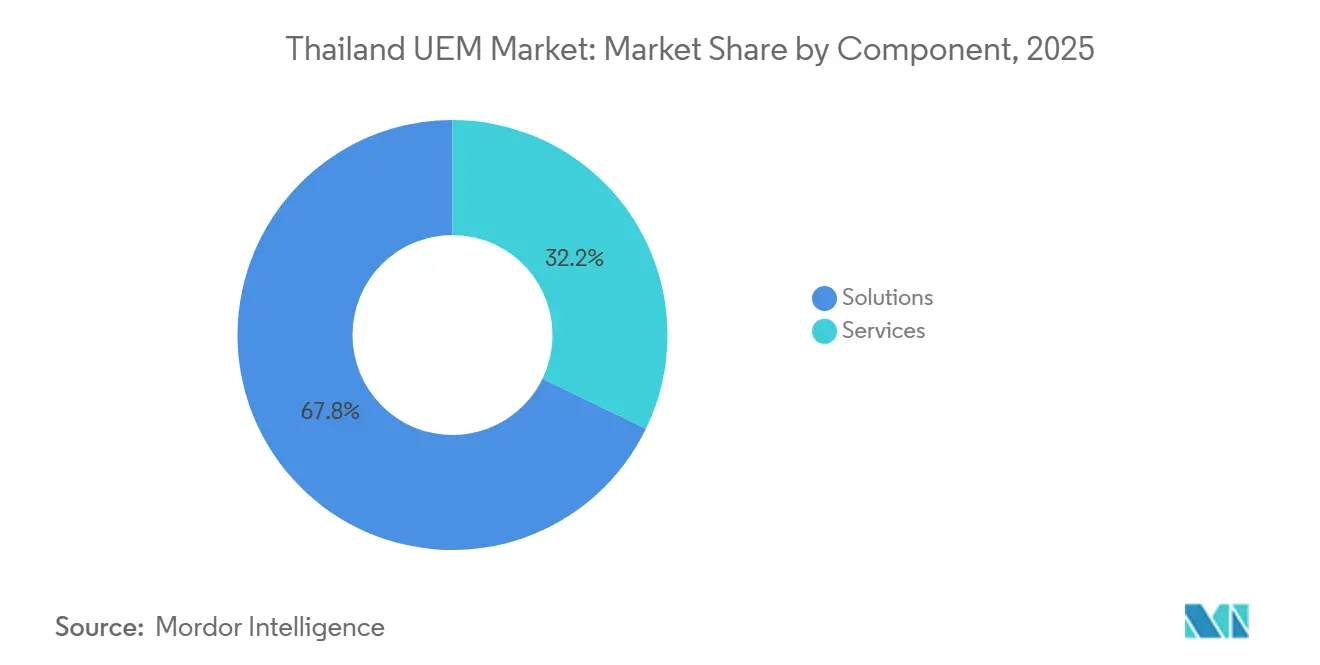
Solutions held 67.81% of the Thailand UEM market share in 2025, and the same segment is projected to grow at a 32.69% CAGR from 2026 to 2031. That lead reflects a clear enterprise preference for platform software during initial rollout cycles, because buyers first need a control layer that can enroll devices, set policies, secure access, and maintain visibility across mixed endpoint estates. Device management remained the largest sub-segment inside solutions, as organizations prioritized over-the-air configuration, remote wipe, policy enforcement, and lifecycle control for smartphones, laptops, tablets, kiosks, and shared devices. Security and compliance management is becoming more influential within the revenue mix, because regulated organizations increasingly need proof that endpoint policies can be enforced and audited across users, apps, and device states. Application management also has a direct operating role, since Thai IT teams need to push, update, and retire business apps without depending on physical access to devices scattered across branches, clinics, warehouses, or field teams.
Content management and analytics functions remain smaller in revenue terms, but they are becoming more strategic as enterprises ask endpoint platforms to support policy intelligence, workflow automation, and lower-touch administration. IBM’s 2025 release of AI-powered policy recommendations for MaaS360 showed how vendors are moving beyond basic control toward systems that can surface compliance risks and recommend stronger configurations with less manual effort.[2] Services accounted for the remaining component revenue and continue to expand because implementation, policy tuning, integration work, and managed administration are still difficult for many internal teams to handle alone. This is one place where the Thailand UEM industry is widening, because software demand naturally pulls consulting, deployment, and managed support around it once device estates become more distributed and more regulated. Even so, platform spending should continue to set the tone, because enterprises usually need a strong software base before they can outsource operations or optimize workflows in a consistent way.
By Deployment Mode: Cloud Infrastructure Investment Accelerates Platform Migration
Cloud-based deployment accounted for 63.58% of revenue in 2025, and the Thailand UEM market for cloud-based deployment is projected to grow at a 32.27% CAGR through 2031. This lead reflects the practical advantages of cloud delivery in Thailand, where enterprises want faster implementation, lower infrastructure overhead, and easier device policy distribution across branches and mobile workforces. Microsoft’s infrastructure commitment in Thailand is reinforcing that migration path by bolstering broader cloud confidence and tighter alignment among Microsoft 365, Azure, and Intune in enterprise buying decisions. Cloud deployment also gives organizations a cleaner route to scale UEM without building or refreshing their own server stack, which matters in a market where many buyers want control capabilities but do not want new infrastructure complexity. For the Thailand UEM market, that means cloud is not only the largest deployment model, it is also the model most closely matched to the country’s broader digital infrastructure cycle.
On-premises deployment still has a meaningful role in highly controlled environments, especially where legacy authentication systems, internal hosting policies, or stricter operational isolation remain in place. That model is likely to stay relevant in parts of government, defense, and older large-enterprise estates, but it faces more friction from hardware upkeep, slower upgrades, and heavier patching obligations. ThaiCERT’s 2025 alert on critical Ivanti EPMM vulnerabilities sharpened that concern by showing how on-premise endpoint management environments can carry their own security burden when patching and configuration discipline slip. Hybrid deployment is therefore gaining attention among enterprises in transition, because it gives them a way to support older devices and directories while extending cloud policies to new endpoints. That intermediate model should remain useful as the Thailand UEM market continues shifting toward cloud-first operating patterns without forcing every enterprise to move all device governance in a single step.
By Organization Size: Large Enterprises Lead, But SMEs Define the Growth Horizon
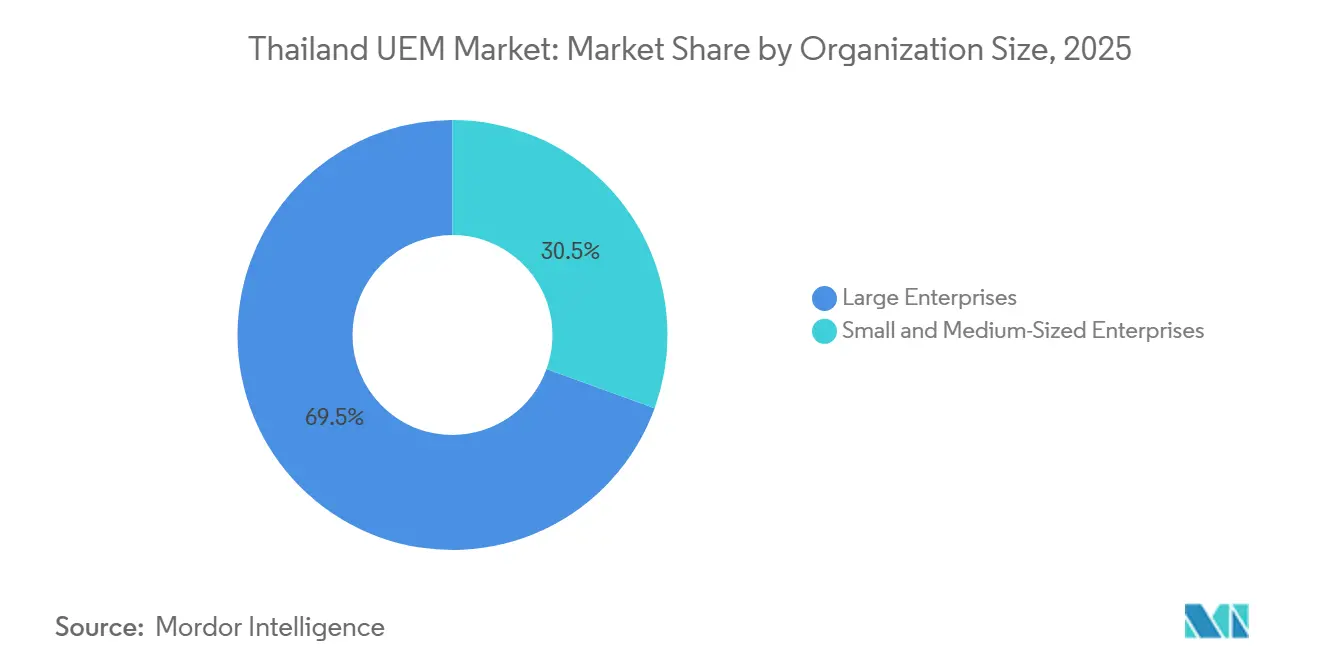
Large enterprises accounted for 69.47% of revenue in 2025, underscoring how strongly the Thailand UEM market remains anchored in banking, telecommunications, large manufacturing groups, and other organizations with broad device estates and formal compliance obligations. These buyers usually run multi-OS fleets, branch-heavy operating models, and layered security structures, which makes broad platform adoption more practical than piecemeal tools. Enterprise-grade workplace modernization programs also reinforce this lead, as shown by Krungsri’s use of Microsoft 365 E3 with Kyndryl to support device management and workforce security in a regulated banking environment. Large accounts also matter beyond their own spending because they serve as reference customers that help vendors build channel relationships, expand delivery capacity, and sustain renewal momentum in Thailand. In that sense, the current shape of the Thailand UEM market is still being defined by large organizations that can invest early, standardize faster, and absorb more complex rollouts.
Small and medium enterprises, however, are projected to expand at a 32.16% CAGR from 2026 to 2031, which makes them the strongest growth pool by organization size. This pattern reflects a delayed adoption curve rather than weak need, because many SMEs already rely on mobile-first operations, cloud apps, and distributed work practices but have not yet formalized endpoint governance. The Thailand UEM market size for SMEs should rise as subscription models become easier to absorb and as unmanaged endpoints create more visible support, security, and compliance costs. Regional digital capacity efforts and industrial modernization programs should also support this segment over time, especially in manufacturing and logistics clusters outside Bangkok where device fleets are expanding faster than IT headcount. That is why the mid-market is likely to become the most important expansion theme for the Thailand UEM market in the second half of the forecast period, even though large enterprises still dominate today’s revenue base.
By End-User Industry: IT And Telecommunications Anchors Demand as Healthcare Accelerates
IT and telecommunications held the largest end-user industry share at 21.64% in 2025, reflecting the sector’s dual role as both a direct user of endpoint platforms and an indirect route to market through system integration, managed services, and enterprise connectivity relationships. These organizations often deploy UEM internally while packaging related services into broader customer contracts, which gives the Thailand UEM market a built-in channel within the same vertical that drives adoption. BFSI remains one of the most important demand centers after telecom, because banks and financial institutions need stronger device governance, tighter identity integration, and clearer policy enforcement across employee endpoints. Krungsri’s Microsoft 365 E3 deployment with Kyndryl is a good example of how workplace modernization and endpoint control are being tied together in regulated Thai financial environments. Government and defense also support demand, though their contributions are moderated by longer procurement cycles and more layered approval structures.
Healthcare and life sciences are forecast to post the fastest CAGR of 32.55% through 2031, indicating a strong rise in device governance needs across hospitals, clinical workflows, and broader digital health operations. The Thailand UEM market is gaining from that shift because healthcare device fleets often combine mobility, shared usage, application sensitivity, and strict access requirements in a single operating environment. Manufacturing is also becoming more important, especially in the EEC corridor where rugged devices, operational technology endpoints, and multi-site production workflows require more centralized control and visibility. Advantech’s 2025 partnership with SOTI reflects that direction, because it linked endpoint management and visibility tools to ruggedized IoT and mobile hardware used in enterprise field and industrial environments. Retail and e-commerce, education, transportation and logistics, energy and utilities, and other verticals continue to add demand through use cases such as point-of-sale management, associate mobility, fleet coordination, shared-device control, and branch-level application rollout.
Geography Analysis
Bangkok and the wider Central region remained the largest deployment base for the Thailand UEM market in 2026, while the EEC is expected to generate the strongest incremental demand through 2031. The capital region continues to anchor spending because it houses the headquarters of major banks, telecom operators, industrial groups, and service providers that manage the country’s largest endpoint estates. Microsoft’s investment plan in Thailand, together with partnerships involving AIS, Gulf Development, True Corporation, and CP Group, strengthens that concentration because large enterprise cloud and AI activity still clusters around the country’s biggest commercial base.[3] For the Thailand UEM market, this means current demand remains strongest where enterprise IT leadership, cloud adoption, and compliance requirements are already well developed.
The Eastern Economic Corridor is the clearest high-growth geography because it combines industrial expansion, logistics intensity, digital infrastructure planning, and increasing demand for rugged and connected endpoints across multi-site operations. EECO’s 2026 digital forum made that link explicit by positioning endpoint-ready digital infrastructure as part of the region’s effort to attract deeper technology and data center investment. This matters for the Thailand UEM market because manufacturing and logistics environments in the EEC do not only need smartphone and laptop control, they also need governance for operational devices, warehouse endpoints, and shared terminals that move across different facilities. The regional opportunity is still underpenetrated, which gives specialized vendors room to build stronger use-case positions before deployment models become more standardized. In practical terms, the EEC should add a larger share of new endpoint management demand than many mature metro accounts, because its device base is still expanding and its operating models are becoming more digital at the same time.
Provincial Thailand remains earlier in the adoption curve, but it is becoming more relevant as healthcare digitization, public service modernization, and broader digital capacity building spread beyond major urban centers. The World Bank’s digital data infrastructure roadmap supports that long-range view because it addresses governance and capability development across the country rather than in Bangkok alone. That broader regional push should gradually widen the addressable base for the Thailand UEM market as organizations outside the main metro core accumulate larger managed device fleets and face similar policy and security expectations. Over time, the market’s geographic story is likely to shift from metro concentration alone to a more layered structure where Bangkok leads installed base, the EEC drives the fastest industrial expansion, and provincial regions add steady demand through public and service-sector digitization.
Competitive Landscape
The Thailand UEM market in 2026 remained moderately concentrated at the platform level, with Microsoft, IBM, and SAP SE holding the strongest enterprise presence. Microsoft has a structural advantage because Intune sits within widely used Microsoft 365 enterprise environments, reducing the friction of separate procurement for organizations that already depend on Microsoft productivity and identity tools. That position is being reinforced by the company’s more than USD 1 billion Thailand investment program for 2026 to 2028, which increases confidence in local cloud alignment and long-term ecosystem support. In the Thailand UEM market, bundled platform economics and cloud ecosystem fit are becoming just as important as pure device management capability.
Broadcom’s acquisition of VMware changed renewal behavior and prompted some enterprises to reassess their endpoint management dependencies, creating space for competitors to position themselves as more flexible alternatives. Ivanti moved into that opening with its Autonomous Endpoint Management platform in Q1 2026, adding AI-driven predictive patching, automated compliance workflows, and cross-deployment management features for enterprise IT teams.[4] IBM continues to compete through automation-led differentiation, with MaaS360 adding AI-powered policy recommendation features that reduce manual compliance work and improve policy tuning. Specialized vendors such as SOTI and Jamf also remain relevant where rugged devices, field mobility, or Apple-heavy endpoint estates create needs that general-purpose platforms do not always serve as well. This keeps the Thailand UEM market active and competitive even though the largest installed bases still sit with a limited group of global vendors.
Local access still matters, because channel presence, distributor support, and implementation capacity can decide whether a vendor converts pipeline into live enterprise accounts. VST ECS Thailand’s role as an authorized Broadcom and VMware distributor shows how local commercial structure can protect installed bases and influence enterprise buying comfort around platform continuity. Strategic moves are also extending competition into adjacent device categories, as seen in Advantech’s partnership with SOTI to connect endpoint management with ruggedized IoT, tablet, and mobile terminal deployments in enterprise settings. The clearest white space in the Thailand UEM market remains SME-tier cloud UEM, healthcare device governance, and operational endpoint control in the EEC, where no single provider has yet built unchallenged leadership across software, services, and distribution.
Thailand UEM Industry Leaders
-
Microsoft Corporation
-
IBM Corporation
-
Ivanti, Inc.
-
SOTI Inc.
-
SAP SE
- *Disclaimer: Major Players sorted in no particular order
Recent Industry Developments
- March 2026: Microsoft announced a USD 1 billion+ investment in cloud and AI data center infrastructure in Thailand for 2026-2028, encompassing partnerships with AIS, Gulf Development, True Corporation, and CP Group. The investment directly supports Intune and Azure-based endpoint management deployments across Thai enterprises.
- January 2026: Ivanti launched its Autonomous Endpoint Management (AEM) platform, integrating AI-driven predictive patching, automated compliance workflows, and cross-deployment unified management for enterprise IT and security operations. AEM targets organizations seeking to move from reactive to proactive endpoint lifecycle management.
- August 2025: Advantech announced a strategic partnership with SOTI, integrating SOTI MobiControl and SOTI XSight into Advantech's IoT device portfolio. The agreement enables enterprises to apply intelligent endpoint management to ruggedized edge computing platforms, tablets, and mobile terminals, a use case directly relevant to Thailand's EEC manufacturing base.
- May 2025: IBM released AI-powered policy recommendations for IBM MaaS360, leveraging IBM WatsonX to continuously evaluate device configurations, flag vulnerabilities, and aggregate anonymized community-sourced policy benchmarks across the MaaS360 customer base.
Thailand UEM Market Report Scope
The Thailand UEM market focuses on solutions that enable organizations to manage and secure various endpoints, including desktops, laptops, smartphones, tablets, and IoT devices, from a unified platform. The report examines the market's scope, including key drivers, challenges, and opportunities, while analyzing trends and technological advancements shaping the industry. It also evaluates the competitive landscape, regulatory environment, and adoption rates across different sectors.
The Thailand UEM Market Report is Segmented by Component [Solutions (Device Management, Application Management, Content Management, Security and Compliance Management, and Analytics and Automation), and Services], Deployment Mode (Cloud-Based, On-Premise, and Hybrid), Organization Size (Large Enterprises, and Small and Medium Enterprises), and End-User Industry (IT and Telecommunications, BFSI, Government and Defense, Healthcare and Life Sciences, Manufacturing, Retail and E-Commerce, Education, Transportation and Logistics, Energy and Utilities, and Other End-User Industries). The Market Forecasts are Provided in Terms of Value (USD).
| Solutions | Device Management |
| Application Management | |
| Content Management | |
| Security and Compliance Management | |
| Analytics and Automation | |
| Services |
| Cloud-Based |
| On-Premise |
| Hybrid |
| Large Enterprises |
| Small and Medium Enterprises |
| IT and Telecommunications |
| BFSI |
| Government and Defense |
| Healthcare and Life Sciences |
| Manufacturing |
| Retail and E-Commerce |
| Education |
| Transportation and Logistics |
| Energy and Utilities |
| Other End-User Industries |
| By Component | Solutions | Device Management |
| Application Management | ||
| Content Management | ||
| Security and Compliance Management | ||
| Analytics and Automation | ||
| Services | ||
| By Deployment Mode | Cloud-Based | |
| On-Premise | ||
| Hybrid | ||
| By Organization Size | Large Enterprises | |
| Small and Medium Enterprises | ||
| By End-User Industry | IT and Telecommunications | |
| BFSI | ||
| Government and Defense | ||
| Healthcare and Life Sciences | ||
| Manufacturing | ||
| Retail and E-Commerce | ||
| Education | ||
| Transportation and Logistics | ||
| Energy and Utilities | ||
| Other End-User Industries |
Key Questions Answered in the Report
What is the size of the Thailand UEM market?
The Thailand UEM market size was USD 45.62 million in 2025, is valued at USD 58.61 million in 2026, and is forecast to reach USD 230.48 million by 2031 at a 31.50% CAGR.
Which deployment model leads demand in Thailand?
Cloud-based deployment led with 63.58% of revenue in 2025 and is also the fastest-growing model, supported by lower infrastructure burden and stronger alignment with enterprise cloud rollouts.
Which customer group is driving the most current spending?
Large enterprises led with 69.47% of revenue in 2025 because they manage larger device estates, more stringent compliance requirements, and more complex multi-site operations than smaller organizations.
Which end-user vertical is expanding the fastest?
Healthcare and life sciences is projected to grow at a 32.55% CAGR through 2031 as digital health programs increase the number of managed and security-sensitive devices across care settings.
Why is Microsoft so well positioned in Thailand?
Microsoft benefits from Intune bundling within Microsoft 365, strong enterprise account presence, and a USD 1 billion+ Thailand infrastructure commitment that supports broader cloud and endpoint adoption.
What is the main barrier to wider adoption?
The biggest barrier is legacy integration complexity, followed by SME budget limits, because many organizations still need to connect endpoint platforms with older directories, security tools, and internal workflows before scaling.