
Carbon-Aware Computing Platform Market Size and Share
Market Overview
| Study Period | 2020 - 2031 |
|---|---|
| Market Size (2026) | USD 1.56 Billion |
| Market Size (2031) | USD 2.95 Billion |
| Growth Rate (2026 - 2031) | 13.58 % |
| Fastest Growing Market | Asia-Pacific |
| Largest Market | North America |
| Market Concentration | Medium |
Major Players *Disclaimer: Major Players sorted in no particular order Image © Mordor Intelligence. Reuse requires attribution under CC BY 4.0. | |
Carbon-Aware Computing Platform Market Analysis by Mordor Intelligence
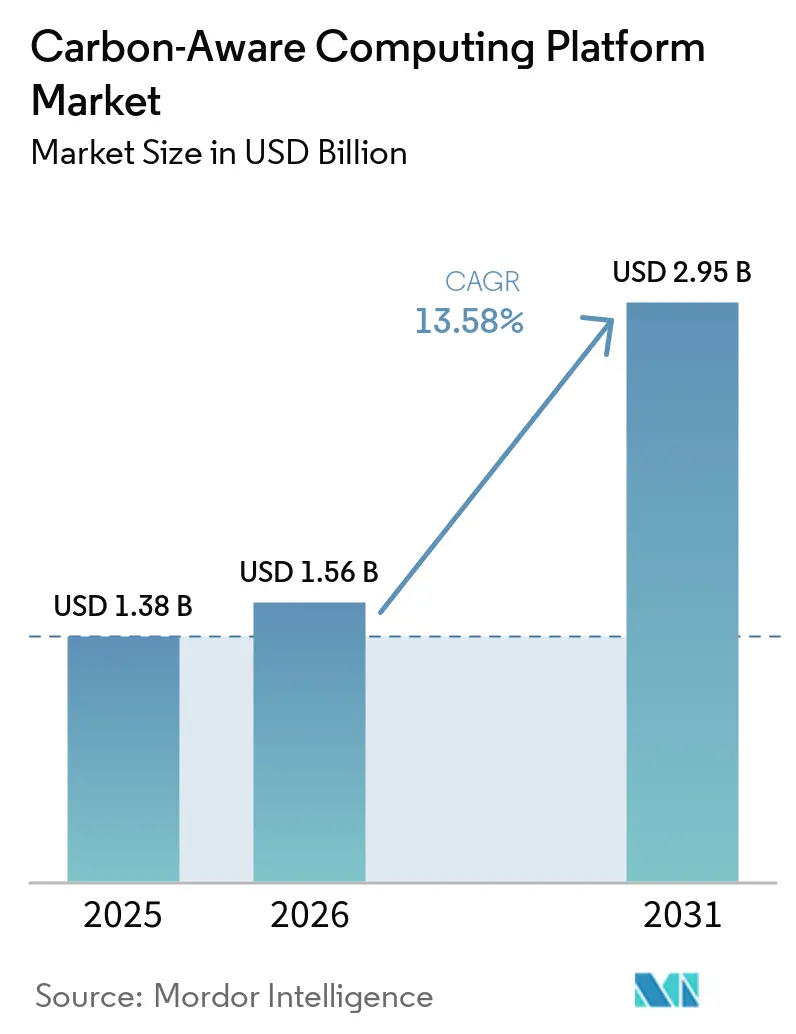
The carbon-aware computing platform market size is projected to be USD 1.38 billion in 2025, USD 1.56 billion in 2026, and reach USD 2.95 billion by 2031, growing at a CAGR of 13.58% from 2026 to 2031. The rapid rise in AI computing is shaping demand as power use in data centers has shifted from an efficiency issue to a direct operating and reporting concern for enterprises. Buyers are also treating workload-level emissions tracking as a practical control layer, since GPU-heavy environments make broad power averages less useful for real operating decisions. Cost discipline is reinforcing adoption because cloud teams increasingly want tools that can reduce both spending and carbon output without disrupting service levels. Disclosure requirements and audit-ready reporting needs are pushing more enterprises to connect carbon data with finance, procurement, and governance systems. Competition is therefore tightening between hyperscalers that bundle native tools and specialist vendors that offer deeper integration, while limitations in forecast accuracy and data residency continue to slow broader rollout.
Key Report Takeaways
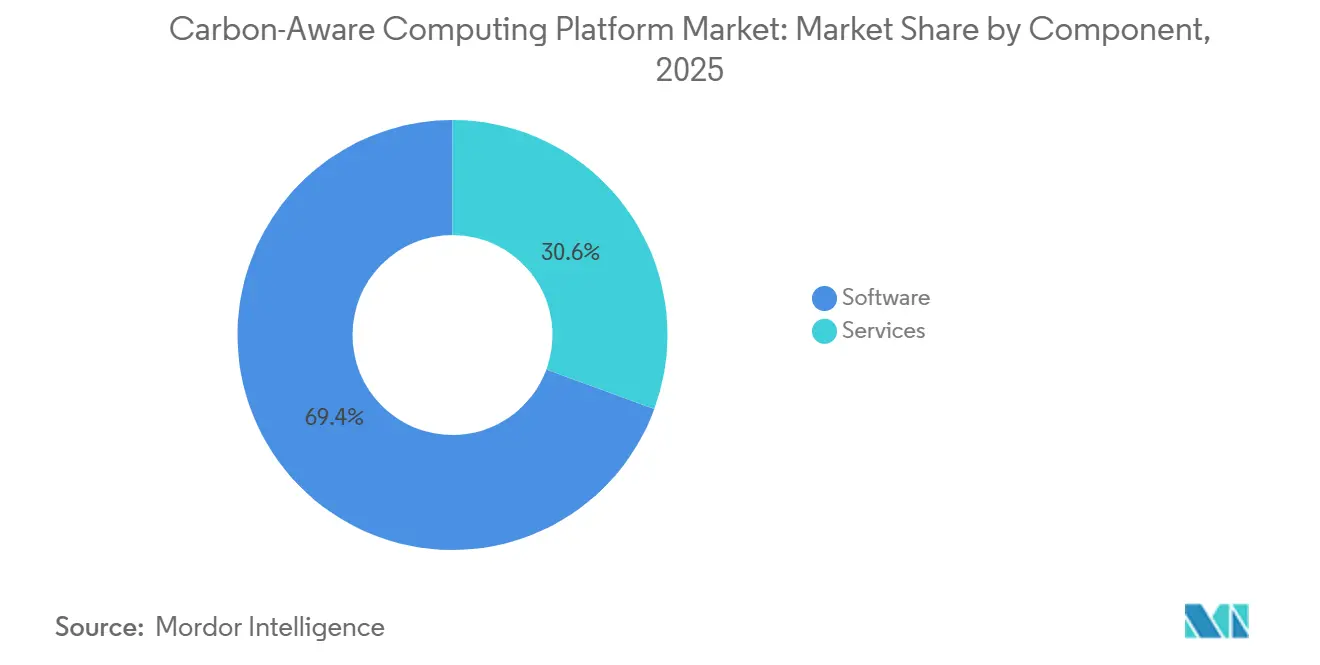
- By component, software led with 69.41% share in 2025, while services are projected to expand at a 15.49% CAGR through 2031.
- By application, cloud infrastructure monitoring and optimization accounted for 38.65% share of the carbon-aware computing platform market size in 2025, while AI and high-performance compute emissions optimization is expected to grow at a 14.55% CAGR through 2031.
- By deployment mode, cloud-based deployment held 72.66% share in 2025, while hybrid is projected to record the fastest CAGR at 14.91% through 2031.
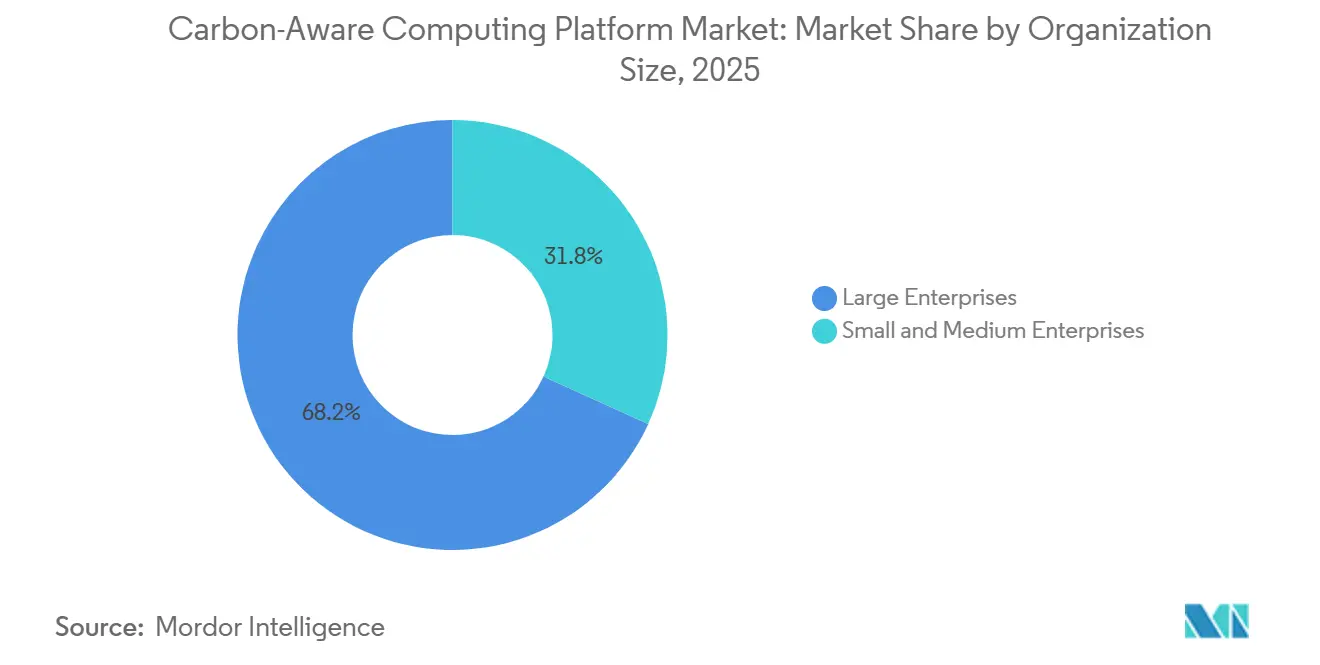
- By organization size, large enterprises captured 68.21% share in 2025, while small and medium enterprises are expected to expand at a 15.28% CAGR through 2031.
- By end-user, information technology and telecom held 28.32% of the carbon-aware computing platform market share in 2025, while BFSI is projected to advance at a 13.87% CAGR through 2031.
- By geography, North America held 36.71% of the carbon-aware computing platform market share in 2025, while Asia-Pacific is projected to grow at a 14.24% CAGR through 2031.
Note: Market size and forecast figures in this report are generated using Mordor Intelligence’s proprietary estimation framework, updated with the latest available data and insights as of January 2026.
Market Trends and Insights
Drivers Impact Analysis of Carbon-Aware Computing Platform Market*
| Driver | (~) % Impact on CAGR Forecast | Geographic Relevance | Impact Timeline |
|---|---|---|---|
| AI and GPU Workload Energy Intensity Rising | +3.5% | Global, concentrated in North America and Asia-Pacific | Short term (≤ 2 years) |
| Net Zero and ESG Reporting Requirements | +2.8% | Global, with early compliance pressure in North America and Europe | Short term (≤ 2 years) |
| Carbon-Aware Scheduling Reduces Cloud Opex | +2.2% | Global, especially North America and Europe | Medium term (2-4 years) |
| Renewable-Powered Cloud Region Expansion | +1.7% | Global, with stronger near-term relevance in Europe and Asia-Pacific | Medium term (2-4 years) |
| FinOps and Sustainability Convergence | +1.4% | North America and Europe, with spillover to Asia-Pacific | Medium term (2-4 years) |
| Demand for Audit-Ready Emissions Attribution | +1.0% | Global, strongest in highly regulated operations | Long term (≥ 4 years) |
| Source: Mordor Intelligence | |||
AI and GPU Workload Energy Intensity Rising
The carbon-aware computing platform market is gaining direct support from the power profile of AI infrastructure, because GPU clusters now shape the operating footprint of modern compute estates. Research cited in the user draft showed that GPUs accounted for 60% of power in multi-GPU servers and 41% of total power across AI clusters, which means a large share of emissions now comes from a narrow set of compute assets. Separate work on H100 systems found that nameplate thermal design assumptions can overstate actual production power draw by up to 24%, making specification-based accounting less reliable than live telemetry. That gap matters for the carbon-aware computing platform market because buyers increasingly need platform outputs that reflect real workloads rather than static hardware labels. Google also stated that its Ironwood TPUs delivered a 3.7x improvement in compute carbon intensity compared to the prior generation, underscoring why software platforms must keep pace with changing chip efficiency curves as fleets refresh.
Net Zero and ESG Reporting Requirements
Tighter reporting requirements are also boosting the carbon-aware computing platform market, as enterprises now need emissions records that can withstand internal control and external review. The Software Carbon Intensity standard, formalized as ISO/IEC 21031:2024, provides organizations with a structured way to measure software-related emissions, making carbon data more usable in governance processes. SAP stated in 2026 that new Sustainability AI Agents in the SAP Sustainability Control Tower would automate scope alignment, emissions factor mapping, and disclosure preparation, indicating that enterprise buyers are moving from manual reporting to system-based reporting workflows. AWS also launched a standalone Sustainability console with Scope 1, Scope 2, and Scope 3 reporting, which indicates that workload emissions data is becoming a standard procurement expectation rather than a niche feature. In the carbon-aware computing platform market, this shifts demand toward vendors that can connect measurement, attribution, and disclosure outputs without creating parallel reporting processes.
Carbon-Aware Scheduling Reduces Cloud Opex
The carbon-aware computing platform market is benefiting from a clearer financial case, as carbon-aware scheduling now shows measurable savings rather than only environmental value. CarbonFlex, an AWS ParallelCluster extension referenced in the user draft, achieved a 57% reduction in carbon emissions versus a carbon-agnostic baseline and performed within 2.1% of an oracle scheduler with perfect future knowledge. Research on LLM inference orchestration also found 35% to 52% reductions in carbon emissions for flexible workloads, while maintaining 99.7% or higher SLA compliance and generating 2% to 5% net cost savings in renewable-rich regions. These results matter for the carbon-aware computing platform market because they shift the conversation from reporting to operational returns, broadening interest beyond sustainability teams. The FinOps Foundation reported that 53% of European FinOps practices now report cloud carbon, which suggests that cost and carbon are being handled within the same operating model more often than before.
Renewable-Powered Cloud Region Expansion
The carbon-aware computing platform market is also being supported by the wider spread of cleaner cloud capacity, because scheduling only becomes useful at scale when regions offer meaningful differences in power mix. Microsoft confirmed in February 2026 that it had matched 100% of its global electricity consumption with renewable energy and linked that milestone to a 10.5 GW framework agreement with Brookfield. Amazon stated in 2026 that it planned to invest EUR 33.7 billion (USD 38.1 billion) in Spain's data center infrastructure, supported by 100 solar and wind projects, expanding the pool of lower-carbon compute capacity available to workload routing strategies. Google broke ground on a new data center in Horndal, Sweden, in June 2026 with support from more than 700 MW of renewable energy under long-term power purchase agreements.[1] In the carbon-aware computing platform market, more renewable-backed regions increase the practical value of routing decisions, as low-carbon windows become easier to identify and use.
Restraints Impact Analysis of Carbon-Aware Computing Platform Market*
| Restraint | (~) % Impact on CAGR Forecast | Geographic Relevance | Impact Timeline |
|---|---|---|---|
| Limited Carbon Intensity Forecast Accuracy | -1.5% | Global, most acute in Asia-Pacific and Africa where grid mix data is sparse | Short term (≤ 2 years) |
| Integration Complexity Across Hybrid Estates | -1.3% | Global, strongest in enterprises with large legacy on-premises estates | Medium term (2-4 years) |
| Data Residency Constraints Limit Cross-Region Workload Shifting | -1.0% | Europe, Singapore, India, and Japan | Medium term (2-4 years) |
| Performance Risk From Aggressive Job Deferral Policies | -0.8% | Global, especially customer-facing deployments in North America and Europe | Short term (≤ 2 years) |
| Source: Mordor Intelligence | |||
Limited Carbon Intensity Forecast Accuracy
The carbon-aware computing platform market still faces a fundamental data limitation, as scheduling quality depends on confidence in forward carbon-intensity signals. Electricity Maps discontinued its marginal carbon intensity signal in 2025 due to concerns about its veracity and verifiability, narrowing one of the more precise signal options used for fine-grained scheduling. The CarbonX research cited in the user draft also noted that parts of sub-Saharan Africa and Southeast Asia still lack usable source-mix data at the sub-annual level, which restricts forecast applicability across a large share of global compute locations. Oxford research further showed that balancing forecast accuracy with the carbon cost of producing the forecast remains unresolved, indicating the prediction layer is still technically immature. In the carbon-aware computing platform market, this keeps some enterprises cautious because a weak forecast can shift workloads without delivering a clear real-world carbon benefit.
Integration Complexity Across Hybrid Estates
The carbon-aware computing platform market is also slowed by implementation complexity, because most large buyers run mixed estates rather than a single cloud environment. Hybrid estates combine public and private clouds, virtualization layers, and on-premises assets, making it difficult to apply a single scheduling and attribution logic across the full stack. The Open Compute Project published a carbon disclosure base specification in 2025, indicating that common reporting structures are still being built rather than fully established. IBM also stated that it is working to report a full Scope 3 category inventory for calendar year 2025 emissions in 2026, which underlines that even major technology vendors are still expanding cross-estate attribution coverage. This increases deployment time, integration costs, and operational friction in the carbon-aware computing platform market, especially for buyers with large brownfield estates.
*Our forecasts treat driver/restraint impacts as directional, not additive. The impact forecasts reflect baseline growth, mix effects, and variable interactions.
Carbon-Aware Computing Platform Market Segment Analysis
By Component:
Software Anchors Revenue, Services Scale FastestSoftware accounted for 69.41% of the carbon-aware computing platform market in 2025, keeping this segment at the center of current revenue growth. The software-heavy mix reflects the commercial structure of the carbon-aware computing platform market, where subscription products handle continuous monitoring, reporting, and scheduling logic. Buyers prefer software first because emissions tracking must run continuously across workloads, regions, and reporting periods, rather than being refreshed only during annual reviews. This also suits enterprises that want one system to connect workload telemetry with sustainability dashboards and governance records. As a result, software remains the basic control layer through which the carbon-aware computing platform market is being deployed across large cloud estates.
The services segment is projected to grow at a 15.49% CAGR from 2026 to 2031, indicating that implementation depth is becoming increasingly valuable as deployments scale. Much of that demand comes from connecting scheduling APIs with cloud cost tools, ERP sustainability modules, and greenhouse gas inventory systems that were not designed together at the start. SAP stated that new Sustainability AI Agents will become generally available within SAP Sustainability Control Tower by the end of 2026, and that announcement supports the view that integration work will rise as automation features spread into large enterprise environments.[2] Services also remain important because factor libraries, region mappings, and reporting templates must be updated as rules and data sources change. Within the carbon-aware computing platform industry, managed services and support work play a durable role even as core software becomes more standardized.
By Application:
Infrastructure Monitoring Leads, AI Workloads Shift Competitive PrioritiesCloud infrastructure monitoring and optimization accounted for 38.65% of the carbon-aware computing platform market in 2025, making it the largest application by current revenue. This lead is logical because visibility comes before intervention, and most enterprises first need reliable data on where emissions sit across regions, services, and workloads. The large cloud providers have already normalized dashboard-based attribution, meaning the carbon-aware computing platform market now builds on a visibility baseline rather than starting from zero measurement. That pushes differentiation toward deeper telemetry, stronger workload recommendations, and more usable cost-carbon trade-off controls. Monitoring, therefore, remains the anchor application even as more advanced optimization use cases expand.
AI and high-performance compute emissions optimization is projected to grow at a 14.55% CAGR through 2031, which makes it the most dynamic application area in the carbon-aware computing platform market. Microsoft Research described a framework that jointly schedules AI training jobs, routes inference workloads, and dispatches battery storage and on-site generation under carbon-budget constraints, demonstrating that optimization is moving beyond simple time shifting. The Open Compute Project also released a carbon disclosure base specification in 2025, which supports a broader shift toward standardized carbon information across the data center supply chain. That matters because reporting and compliance tools can expand more quickly when operational and embodied carbon data are structured more consistently. In the carbon-aware computing platform market, the center of gravity is slowly moving from passive visibility to active control over AI-heavy workloads.
By Deployment Mode:
Cloud-Native Installs Lead, Hybrid Emerges as the Enterprise Growth EngineCloud-based deployment held a 72.66% share in 2025, reflecting where the carbon-aware computing platform market has found the easiest operating fit. Carbon-aware platforms work best when they can access cloud provider APIs, real-time emissions feeds, and flexible compute resources without heavy local customization. This favors cloud delivery because vendors can push updates faster, collect telemetry more consistently, and support cross-region workload decisions with less deployment friction. The cloud model also fits enterprises that want faster rollout across business units and geographies. For these reasons, the carbon-aware computing platform market remains strongly cloud-led at the current stage of adoption.
Hybrid deployment is projected to expand at a 14.91% CAGR through 2031, as many large organizations cannot migrate all workloads to the public cloud. Latency requirements, data sovereignty, contractual restrictions, and sunk infrastructure costs still keep part of the workload base in private environments. AWS launched AWS European Sovereign Cloud in Germany in January 2026 as a fully independent cloud, highlighting how residency and jurisdiction needs are shaping deployment choices in the market. On-premises deployment, therefore, remains relevant for regulated users who need local control even while they adopt carbon measurement and optimization practices. Within the carbon-aware computing platform industry, hybrid growth is likely to remain strong because buyers want a common reporting framework across all compute locations, not just public cloud.
By Organization Size:
Enterprises Set the Baseline, SMEs Drive Next-Wave AdoptionLarge enterprises held a 68.21% share in 2025, making them the primary revenue base for the carbon-aware computing platform market. These buyers run the largest compute footprints, the most complex multi-cloud estates, and the broadest sustainability governance structures. They also have the strongest need for audit-ready attribution because emissions data must move across finance, procurement, risk, and reporting teams. That buying profile favors vendors with greater integration depth, stronger policy controls, and greater enterprise support capacity. Large enterprises, therefore, continue to define feature expectations across the carbon-aware computing platform market.
Small and medium enterprises are projected to grow at a 15.28% CAGR from 2026 to 2031, which shows that adoption is broadening beyond the earliest large-account base. Open-source and Kubernetes-native tools are lowering entry barriers for smaller organizations that need practical controls without a full enterprise stack. The compute-gardener-scheduler example cited in the user draft showed that job deferral based on carbon and cost signals can be implemented through lighter deployment models. The FinOps Foundation also found that a rising share of teams now report cloud carbon, which supports the view that smaller buyers increasingly accept emissions work when it is tied to cost discipline. In the carbon-aware computing platform market, this next wave is likely to favor simpler products, shorter deployment cycles, and pricing that aligns with smaller compute estates.
By End-User:
IT and Telecom Anchor Volume, BFSI Gains on Control RequirementsInformation technology and telecom accounted for 28.32% of the carbon-aware computing platform market share in 2025, keeping this sector as the core demand center. The sector leads because it both operates digital infrastructure and sells infrastructure-enabled services to downstream customers. Hyperscalers, cloud service providers, and managed service firms use carbon tracking internally and embed related outputs into customer-facing tools. That dual role gives the sector a natural advantage in early deployment and fast feedback on product design. The carbon-aware computing platform market, therefore, continues to draw its base volume from organizations closest to cloud and data center operations.
BFSI is projected to expand at a 13.87% CAGR through 2031, underscoring the growing relevance of carbon governance in sectors that require strong controls, documentation, and audit trails. Financial institutions need emissions records that can sit beside established reporting and risk processes, so generic dashboards are often not enough for scaled adoption. IBM’s sustainability reporting work and enterprise carbon accounting capabilities show why buyers in this segment lean toward tools that can support formal inventory building and governance workflows. SAP’s sustainability automation direction points to the same need for workflow discipline and disclosure-readiness in large, regulated organizations. Healthcare, manufacturing, government, retail, and e-commerce are also advancing as cloud adoption deepens and carbon data becomes more closely tied to operational accountability across the carbon-aware computing platform market.
Geography Analysis
North America Carbon-Aware Computing Platform Market
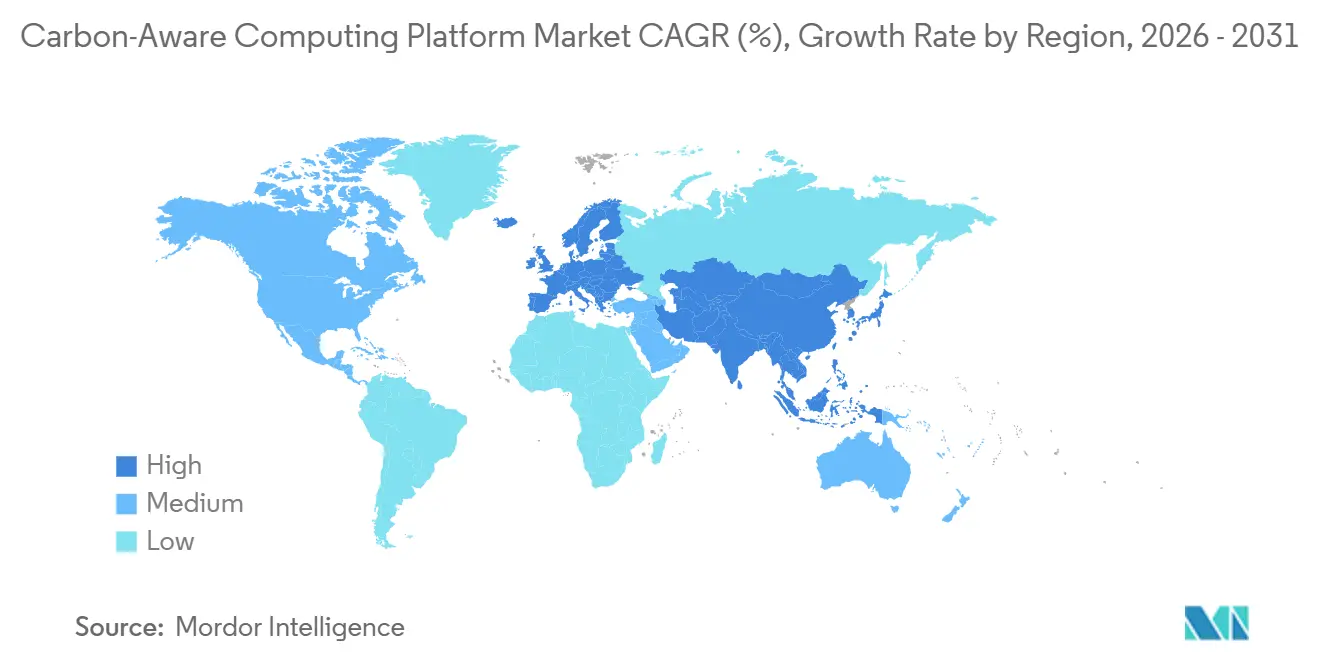
North America held a 36.71% share in 2025, ranking it at the forefront of the carbon-aware computing platform market by current regional revenue. The region combines the largest installed hyperscale cloud base with a high concentration of AI infrastructure and enterprise software spending. EPRI stated that data centers currently consume 4% to 5% of U.S. electricity and could reach 17% by 2030, underscoring the importance of compute-related power management. Microsoft also confirmed in February 2026 that it had matched 100% of its global electricity consumption with renewable energy, showing how major vendors are aligning infrastructure expansion with cleaner power sourcing. AWS added a standalone Sustainability console in March 2026, further raising expectations for native emissions visibility across its commercial cloud regions.
Europe Carbon-Aware Computing Platform Market
Europe remained the second-largest regional market, and the carbon-aware computing platform market there is shaped by strong disclosure pressure and tighter governance expectations. The FinOps Foundation reported that 53% of European FinOps practices now report cloud carbon, suggesting a more mature operating approach to carbon accountability than in many other regions. AWS also launched the European Sovereign Cloud in Germany in January 2026, which shows that residency requirements are becoming part of the practical design boundary for emissions-aware workload movement.[3] This combination of reporting maturity and jurisdiction sensitivity keeps Europe important for both platform adoption and deployment model innovation in the carbon-aware computing platform market.
APAC, MEA and South America Carbon-Aware Computing Platform Market
Asia-Pacific is projected to grow at a 14.24% CAGR through 2031, making it the fastest-growing regional market for carbon-aware computing platforms. Growth is supported by new hyperscaler capacity, expanding AI workloads, and a wider regional push to improve data center efficiency. Fujitsu and the University of Tokyo started Japan’s first cloud-connected inter-regional workload shift trial in December 2025 based on real-time grid conditions, which provides a direct example of carbon-aware operations moving from concept to live testing. Japan and Australia show stronger compliance-led demand, while India and Southeast Asia are being lifted more by infrastructure expansion and the need to manage rising compute intensity. South America, the Middle East, and Africa remain earlier-stage markets, but they are strategically relevant because future cloud build-outs and renewable-backed data center capacity can widen the addressable footprint of the carbon-aware computing platform market.
Competitive Landscape
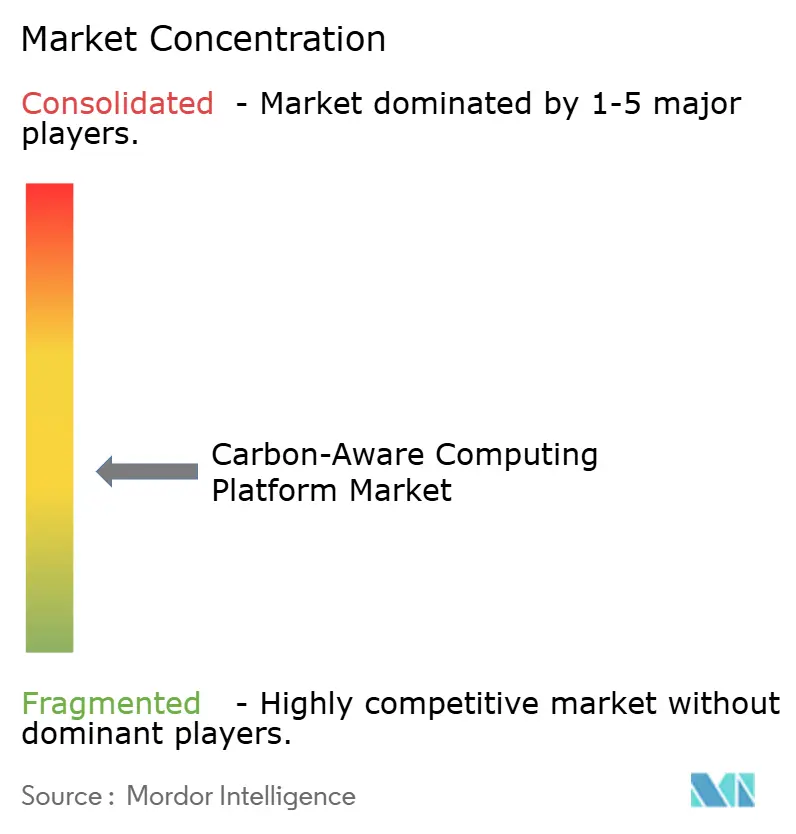
The carbon-aware computing platform market has a two-layer structure, with a concentrated group of hyperscalers and large enterprise software vendors at the top, and a broader field of specialist providers. Microsoft, Google, and AWS already embed carbon attribution and related optimization features into their cloud environments, which gives them a major distribution advantage. AWS strengthened that position in March 2026 when it launched the AWS Sustainability console as a standalone service, offering Scope 1, Scope 2, and Scope 3 reporting, plus programmatic access. SAP is also pushing the carbon-aware computing platform market toward more automated enterprise workflows through Sustainability AI Agents that connect scope alignment, factor mapping, and disclosure preparation. This means competition is moving beyond visibility alone toward workflow integration, deeper automation, and decision support.
Specialist vendors still hold room to compete in the carbon-aware computing platform market because signal quality, API flexibility, and regional data coverage remain uneven. WattTime released its 2026-03-01 emissions model for North America and said it delivered 25% more carbon-reduction opportunities through improved curtailment signals, demonstrating that niche providers can still outperform on technical precision within defined geographies. Electricity Maps remains relevant as a signal source even after discontinuing its marginal intensity feed, because buyers still need wide regional coverage and verifiable grid data. The Green Software Foundation’s Carbon Aware SDK also matters because it abstracts across data sources and supports a more standardized integration layer. As that layer becomes easier to replicate, specialists are likely to compete more on forecast quality, sector fit, and implementation speed.
The carbon-aware computing platform market is therefore moderately consolidated at the platform layer, but not yet dominated by a small set of vendors across the full value chain. Large suite vendors have scale, embedded customer relationships, and strong governance features, while specialists still hold technical advantages in selected workloads and regions. Strategic moves in 2026 underline this split, including Microsoft’s renewable matching milestone, AWS’s standalone sustainability tooling, and SAP’s move toward agent-led sustainability workflows.[4] Over time, the strongest positions are likely to come from vendors that can link accurate workload telemetry with governance-ready reporting and practical optimization inside everyday cloud operations.
Carbon-Aware Computing Platform Industry Leaders
-
IBM Corporation
-
Schneider Electric SE
-
Siemens AG
-
SAP SE
-
Oracle Corporation
- *Disclaimer: Major Players sorted in no particular order
Carbon-Aware Computing Platform Market Companies Covered in this Report
- Microsoft Corporation
- Google LLC
- Amazon Web Services, Inc.
- IBM Corporation
- Schneider Electric SE
- Siemens AG
- Hewlett Packard Enterprise Company
- Cisco Systems, Inc.
- Oracle Corporation
- SAP SE
- Salesforce, Inc.
- VMware, Inc.
- Accenture plc
- Carbon Aware Cloud Limited
- Electricity Maps ApS
- WattTime, Inc.
- NTT DATA Group Corporation
- Dell Technologies Inc.
- ServiceNow, Inc.
- Cloud Bolt Software, Inc.
- Flexera Holdings LLC
Recent Industry Developments in Carbon-Aware Computing Platform Market
- June 2026: Google broke ground on a new data center in Horndal, Sweden, supported by more than 700 MW of renewable energy through long-term power purchase agreements, including wind projects, advancing Google's 24/7 carbon-free energy target and expanding the supply of low-carbon European compute capacity available for carbon-aware workload routing.
- May 2026: SAP announced that new Sustainability AI Agents within SAP Sustainability Control Tower will become generally available by the end of 2026, automating CSRD-aligned scope alignment, emissions factor mapping, and disclosure preparation workflows for large enterprise clients.
- March 2026: AWS launched the AWS Sustainability console as a standalone service, providing Scope 1-3 carbon emissions reporting, programmatic API access, and configurable CSV exports across all commercial AWS regions, replacing the legacy Customer Carbon Footprint Tool ahead of its June 30, 2026, deprecation.
- February 2026: Microsoft confirmed it had matched 100% of its global electricity consumption with renewable energy, fulfilling a 2025 milestone commitment toward its 2030 carbon-negative goal, citing a 10.5 GW framework agreement with Brookfield as a long-term signal for renewable energy market development.
Global Carbon-Aware Computing Platform Market Report Scope
The carbon-aware computing platform market encompasses software that fine-tunes IT operations based on real-time carbon intensity metrics. Such platforms allow businesses to time-shift or relocate computing tasks to areas or periods with lower emissions, thereby lessening the carbon footprint of their digital operations. They seamlessly connect with cloud, data center, and edge environments to track energy consumption and emissions. Moreover, these solutions deliver analytics and automation to harmonize performance, cost, and sustainability goals.
The Carbon-Aware Computing Platform Market Report is Segmented by Component (Software, and Services [Implementation and Integration Services, and Support and Maintenance Services]), Application (Cloud Workload Scheduling, Cloud Infrastructure Monitoring and Optimization, AI and High-Performance Compute Emissions Optimization, Sustainability Reporting and Compliance, and Other Applications), Deployment Mode (Cloud-Based, On-Premises, and Hybrid), Organization Size (Large Enterprises, and Small and Medium Enterprises), End-User (Information Technology and Telecom, Banking, Financial Services, and Insurance, Healthcare and Life Sciences, Manufacturing, Government and Public Sector, Retail and E-Commerce, and Other End-Users), and Geography (North America, South America, Europe, Asia-Pacific, Middle East, and Africa). The Market Forecasts are Provided in Terms of Value (USD).
Segmentation Overview
| Software | |
| Services | Implementation and Integration Services |
| Support and Maintenance Services |
| Cloud Workload Scheduling |
| Cloud Infrastructure Monitoring and Optimization |
| AI and High-Performance Compute Emissions Optimization |
| Sustainability Reporting and Compliance |
| Other Applications |
| Cloud-Based |
| On-Premises |
| Hybrid |
| Large Enterprises |
| Small and Medium Enterprises |
| Information Technology and Telecom |
| Banking, Financial Services, and Insurance |
| Healthcare and Life Sciences |
| Manufacturing |
| Government and Public Sector |
| Retail and E-Commerce |
| Other End-Users |
| North America | United States |
| Canada | |
| Mexico | |
| South America | Brazil |
| Argentina | |
| Rest of South America | |
| Europe | Germany |
| United Kingdom | |
| France | |
| Italy | |
| Spain | |
| Russia | |
| Rest of Europe | |
| Asia-Pacific | China |
| India | |
| Japan | |
| South Korea | |
| Australia | |
| Rest of Asia-Pacific | |
| Middle East | Saudi Arabia |
| United Arab Emirates | |
| Turkey | |
| Rest of Middle East | |
| Africa | South Africa |
| Nigeria | |
| Rest of Africa |
| By Component | Software | |
| Services | Implementation and Integration Services | |
| Support and Maintenance Services | ||
| By Application | Cloud Workload Scheduling | |
| Cloud Infrastructure Monitoring and Optimization | ||
| AI and High-Performance Compute Emissions Optimization | ||
| Sustainability Reporting and Compliance | ||
| Other Applications | ||
| By Deployment Mode | Cloud-Based | |
| On-Premises | ||
| Hybrid | ||
| By Organization Size | Large Enterprises | |
| Small and Medium Enterprises | ||
| By End-User | Information Technology and Telecom | |
| Banking, Financial Services, and Insurance | ||
| Healthcare and Life Sciences | ||
| Manufacturing | ||
| Government and Public Sector | ||
| Retail and E-Commerce | ||
| Other End-Users | ||
| By Geography | North America | United States |
| Canada | ||
| Mexico | ||
| South America | Brazil | |
| Argentina | ||
| Rest of South America | ||
| Europe | Germany | |
| United Kingdom | ||
| France | ||
| Italy | ||
| Spain | ||
| Russia | ||
| Rest of Europe | ||
| Asia-Pacific | China | |
| India | ||
| Japan | ||
| South Korea | ||
| Australia | ||
| Rest of Asia-Pacific | ||
| Middle East | Saudi Arabia | |
| United Arab Emirates | ||
| Turkey | ||
| Rest of Middle East | ||
| Africa | South Africa | |
| Nigeria | ||
| Rest of Africa | ||
Key Questions Answered in the Report
What is the current and forecast value of the carbon-aware computing platform space?
The carbon-aware computing platform market size was USD 1.38 billion in 2025, stood at USD 1.56 billion in 2026, and is forecast to reach USD 2.95 billion by 2031 at a 13.58% CAGR.
What is driving adoption of carbon-aware computing platforms?
The main drivers are rising AI and GPU power intensity, stronger reporting requirements, measurable cloud cost savings from carbon-aware scheduling, and the spread of renewable-backed cloud regions.
Which component leads revenue in this space?
Software led with 69.41% share in 2025 because enterprises need continuous monitoring, reporting, and scheduling rather than one-time project support.
Which application is growing the fastest?
AI and high-performance compute emissions optimization is the fastest-growing application, with a projected 14.55% CAGR through 2031.
Which organizations are adopting these platforms the fastest?
Small and medium enterprises are projected to grow the fastest at a 15.28% CAGR, although large enterprises still held the largest share at 68.21% in 2025.
Which region is expanding the quickest?
Asia-Pacific is the fastest-growing region with a projected 14.24% CAGR through 2031, while North America remained the largest regional market in 2025 with 36.71% share.