
South Korea Turning Centers Market Size and Share
Market Overview
| Study Period | 2020 - 2031 |
|---|---|
| Forecast Data Period | 2026 - 2031 |
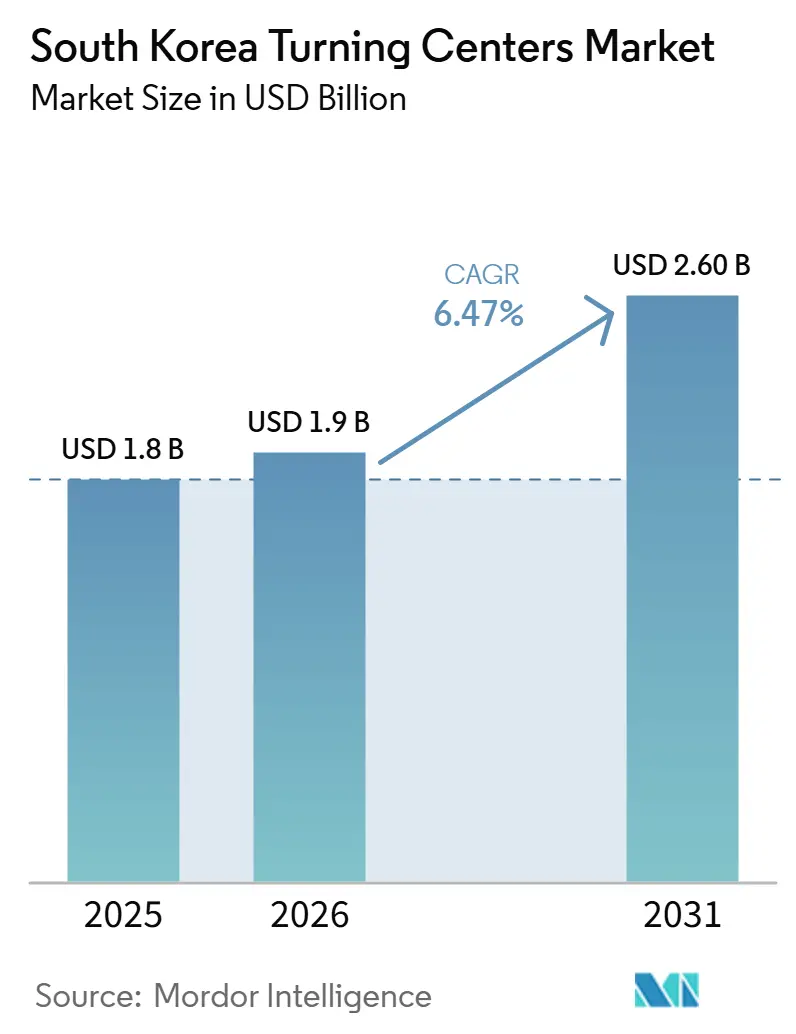
| Base Year Market Size (2025) | USD 1.8 Billion |
| Market Size (2026) | USD 1.9 Billion |
| Market Size (2031) | USD 2.60 Billion |
| Growth Rate (2026 - 2031) | 6.47 % |
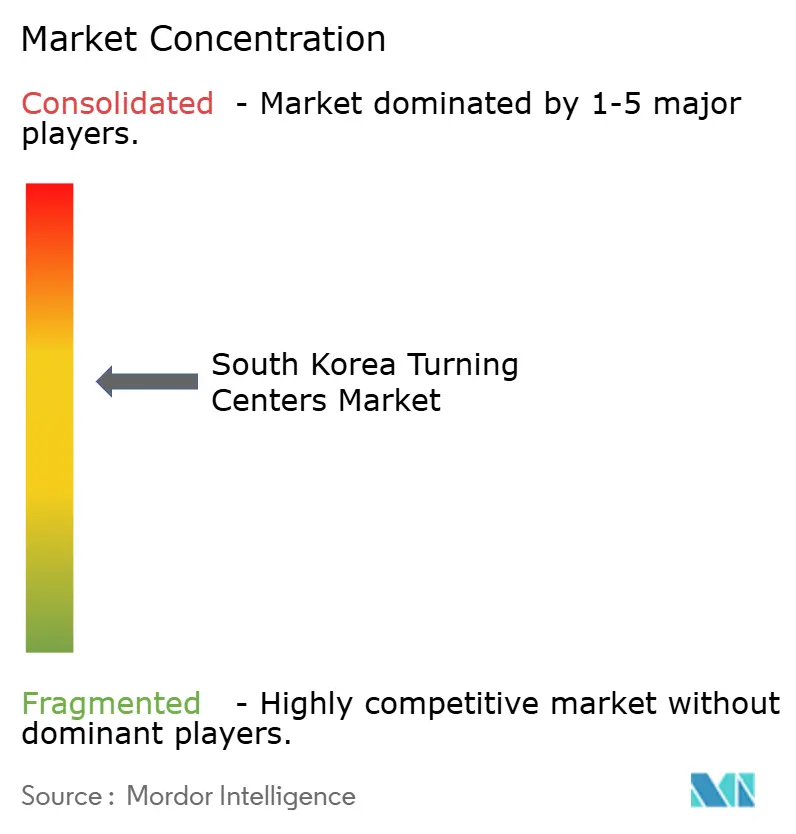
| Market Concentration | Medium |
Major Players *Disclaimer: Major Players sorted in no particular order Image © Mordor Intelligence. Reuse requires attribution under CC BY 4.0. | |
South Korea Turning Centers Market Analysis by Mordor Intelligence
The South Korea Turning Centers Market size is expected to grow from USD 1.8 billion in 2025 to USD 1.9 billion in 2026 and is forecast to reach USD 2.60 billion by 2031 at 6.47% CAGR over 2026-2031.
The South Korea turning centers market is supported by overlapping capital spending cycles in automotive production, semiconductor equipment manufacturing, and shipbuilding, which keeps demand distributed across multiple manufacturing bases. From January to April 2026, Korea Machine Tool Manufacturers' Association data showed total machine tool orders of KRW 1.2 trillion (USD 830 million), while overseas orders rose 23.3% year over year to KRW 798.1 billion (USD 553.8 million), which points to stronger external demand for Korean machine tools as well as local replacement demand. The South Korea turning centers market also benefits from a broader industrial footprint across Gyeonggi, Ulsan, South Gyeongsang, North Chungcheong, and Wonju, which reduces dependence on a single manufacturing corridor and gives buyers a wider base of end-use programs to serve. Government-backed smart factory policy is also pushing manufacturers toward CNC systems with connectivity, monitoring, and data capabilities, thereby increasing replacement demand for older turning equipment and supporting a steady upgrade path across small- and mid-sized plants. Competitive conditions remain balanced between domestic OEMs that are well placed in automotive and electronics supply chains and foreign suppliers that still hold an advantage in the most demanding precision applications, so the South Korea turning centers market continues to expand through both installed base renewal and higher-specification purchases.
Key Report Takeaways
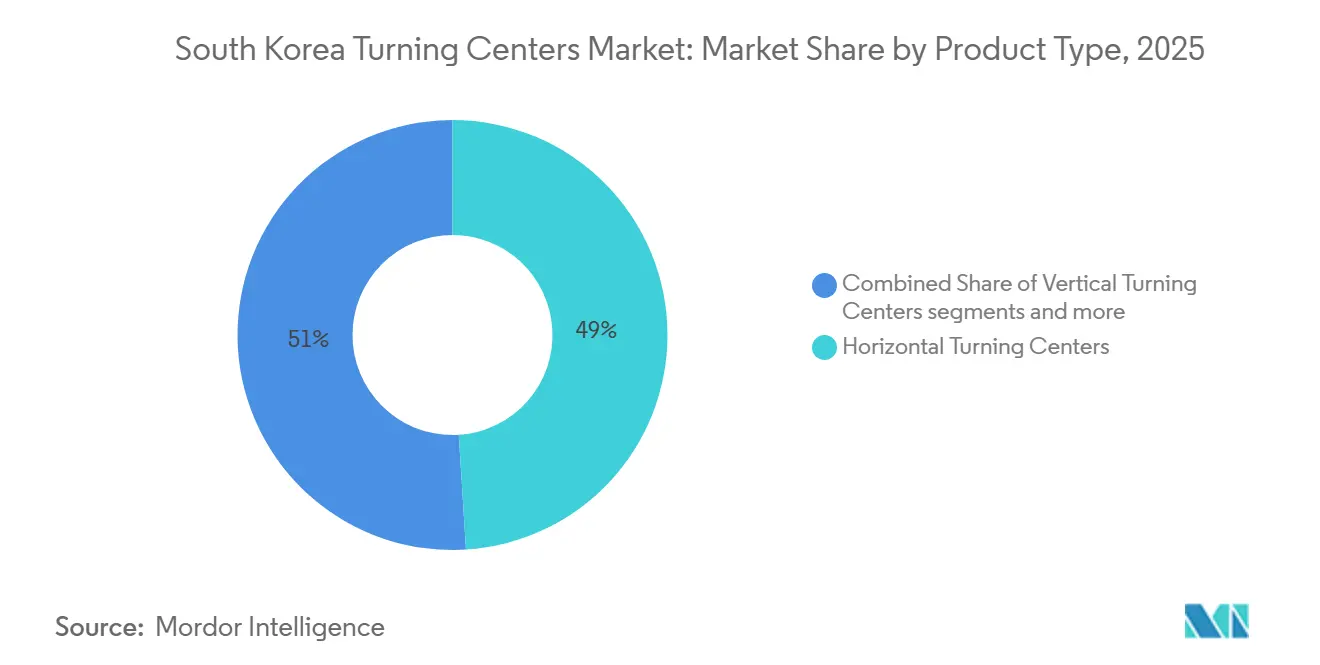
- By product type, horizontal turning centers held 49.0% of the South Korea turning centers market size in 2025, while multi-tasking turning centers are forecast to expand at an 8.5% CAGR through 2031.
- By axis configuration, 4-axis machines accounted for 51.5% of the South Korea turning centers market share in 2025, while 5-axis and above machines are projected to grow at a 9.8% CAGR through 2031.
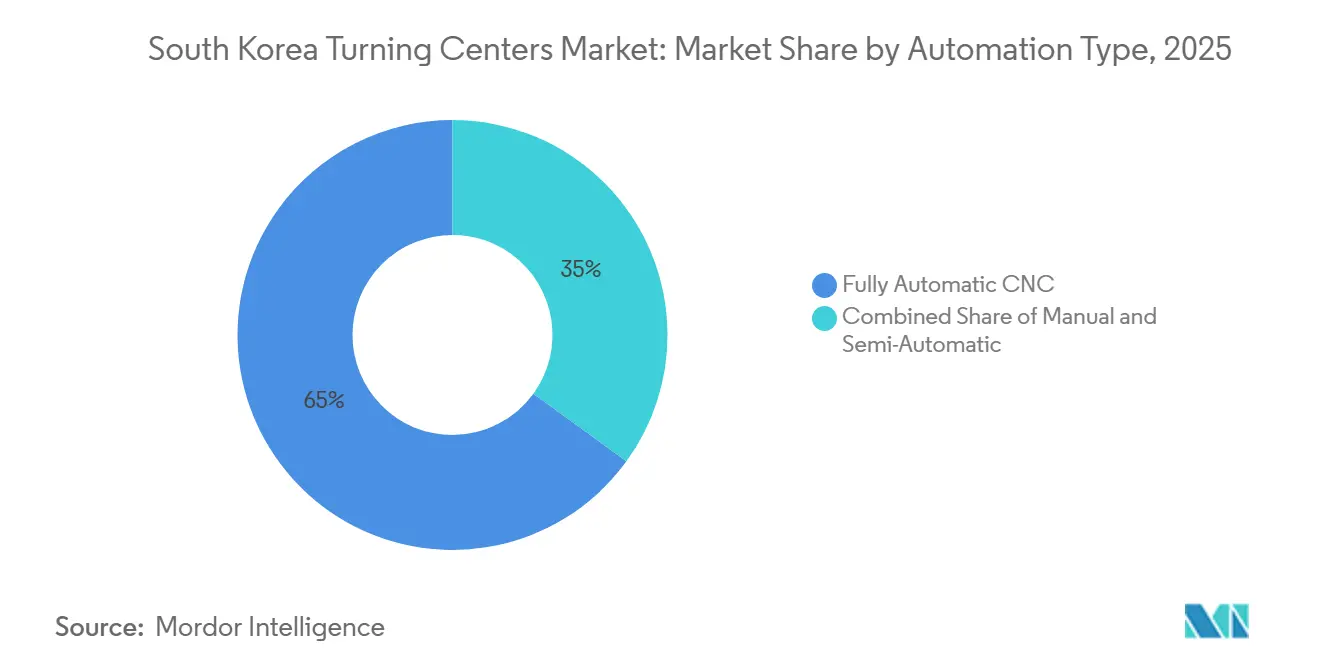
- By automation type, fully automatic CNC machines held 65.0% of the market in 2025 and also recorded the highest projected CAGR of 7.8% through 2031.
- By end-user industry, electrical, electronics, and semiconductor equipment accounted for 44.0% of the market in 2025 and is expected to advance at a 9.2% CAGR through 2031.
Note: Market size and forecast figures in this report are generated using Mordor Intelligence’s proprietary estimation framework, updated with the latest available data and insights as of January 2026.
South Korea Turning Centers Market Trends and Insights
Drivers Impact Analysis*
| Driver | (~) % Impact on CAGR Forecast | Geographic Relevance | Impact Timeline |
|---|---|---|---|
| Precision Turning Demand from Semiconductor Equipment Manufacturing | +1.5% | Gyeonggi Province, including Yongin and Icheon, and North Chungcheong Province, including Cheongju | Short term (≤ 2 years) |
| Automotive Retooling Linked to Hyundai, Kia, and Genesis EV Expansion | +1.4% | Ulsan Metropolitan City, Hwaseong, and Gwangmyeong in Gyeonggi Province | Medium term (2-4 years) |
| IoT-Enabled Turning Center Uptake Under the Smart Factory Initiative | +1.0% | National, with early gains in Gyeongbuk, Jeonnam, and Jeonbuk | Medium term (2-4 years) |
| Heavy Turning Center Demand from Shipbuilding Recovery | +0.9% | Geoje, Ulsan, and the Busan coastal industrial corridor | Short term (≤ 2 years) |
| Aerospace MRO and Component Manufacturing Expansion | +0.7% | Changwon and Sacheon in South Gyeongsang Province | Medium term (2-4 years) |
| Precision Turning Adoption in Medical Device Cluster Development | +0.5% | Wonju in Gangwon Province, and Busan Metropolitan City | Long term (≥ 4 years) |
| Source: Mordor Intelligence | |||
Precision Turning Demand Boosted by Samsung and SK Hynix Semiconductor Equipment Manufacturing
Semiconductor equipment demand is driving the South Korea turning centers market, as local subcontractors need to machine housings, vacuum chamber parts, and structural assemblies to tighter tolerances. SK hynix announced a new investment of KRW 21.6 trillion (USD 15 billion) for the first fab in the Yongin Semiconductor Cluster in February 2026, bringing the cumulative first-fab investment to KRW 31 trillion (USD 21.5 billion). That level of fab investment extends demand well beyond cleanroom construction, because equipment suppliers and component makers must expand machining capacity in advance of tool installation and later maintenance cycles. The South Korea turning centers market is therefore gaining support not only from semiconductor output growth, but from the much larger ecosystem of process equipment, transport modules, chamber structures, and precision fixtures built around those fabs. The concentration of activity in Yongin and Cheongju also strengthens regional procurement corridors, enabling machine shops to justify higher-specification turning platforms with better repeatability and more stable thermal performance. This helps explain why precision-oriented machine categories are gaining ground faster than standard production systems in the South Korea turning centers market.
Automotive Turning Center Retooling Driven by Hyundai, Kia, and Genesis EV Expansion
Automotive retooling is driving one of the most visible equipment upgrade cycles in the South Korea turning centers market, as EV drivetrains require different shafts, housings, and e-axle machining patterns than internal combustion parts. Hyundai Motor Group announced a KRW 125.2 trillion (USD 86.9 billion) domestic investment plan for 2026 to 2030 in November 2025, including KRW 36.2 trillion (USD 25.1 billion) for capital expenditure on production facilities and KRW 38.5 trillion (USD 26.7 billion) for research and development. In the same month, Kia opened EVO Plant East in Hwaseong with an annual PBV capacity of 100,000 units. Also, Kia broke ground on EVO Plant West, designed for 150,000 units per year, with a total investment of over KRW 4 trillion (USD 2.8 billion) across the two facilities. Hyundai Motor Group also targets annual EV production of 1.51 million units in Korea and 3.64 million units globally by 2030, providing suppliers with a long planning horizon for machining line upgrades. South Korea turning centers market benefits because Tier 1 and Tier 2 vendors need more consolidated, precise, and faster machining cells to support this shift in platform mix. The result is a durable order stream for turning centers that can handle aluminum, steel, and mixed part programs with tighter cycle control and less manual intervention.
IoT-Enabled Turning Center Uptake Accelerated by Smart Factory Initiative
The smart factory agenda is broadening the addressable base of the South Korea turning centers market by drawing smaller manufacturers into digital equipment upgrades that were once limited to large OEM plants. The Ministry of SMEs and Startups set a target of 12,000 AI-enabled smart factories by 2030 under Smart Manufacturing Innovation 3.0. They allocated KRW 68.1 billion (USD 47.3 million) to manufacturing AI-related research and development.[1]Ministry of SMEs and Startups, Republic of Korea, “2026 Smart Manufacturing Innovation Support Program Announcement,” MSS, mss.go.kr The same policy pipeline supported a 2026 program structure comprising 400 AI-specialized smart factories, 30 autonomous factory projects, and 20 large-enterprise and SME cooperation projects, indicating a broad wave of equipment qualification and replacement activity is already underway. Government co-funding reduces the investment hurdle for shops that would otherwise keep semi-automatic or aging equipment in service for longer periods. That pushes procurement toward machines with monitoring, connectivity, and software compatibility rather than standalone machine tools with limited data functions. The South Korea turning centers market gains a steadier replacement floor from this policy, as digital compliance requirements and subsidy structures can keep orders moving even when one end-use sector slows.
Heavy Turning Center Orders Rise with Korean Shipbuilding Recovery
Shipbuilding is giving the South Korea turning centers market a separate, heavy-duty demand base, as marine shafts, propeller components, thruster housings, and rudder stocks require large-bore turning systems with long beds and high torque. OECD data showed that Korea's global shipbuilding order share recovered to 22% in 2025 after falling to 17% in 2024, and the rebound was partly tied to LNG carrier demand, where Korean yards hold a recognized technical position.[2]Organisation for Economic Co-operation and Development, “Peer Review of the Korean Shipbuilding Industry 2026, Global Perspectives, Overview of the World Market,” OECD, oecd.org That recovery matters because marine programs draw on both in-house fabrication shops and a wide supplier base, extending the impact beyond the main shipyards themselves. It also gives the South Korea turning centers market a cross-sector hedge, since marine demand does not move in lockstep with automotive production or electronics orders. IMO driven fuel efficiency requirements and fleet renewal needs continue to support vessel replacement, which keeps marine machining relevant through the forecast period. The practical result is that heavy turning equipment remains strategically important even as faster growth comes from precision and digitally integrated machine categories.
Restraints Impact Analysis*
| Restraint | (~) % Impact on CAGR Forecast | Geographic Relevance | Impact Timeline |
|---|---|---|---|
| Competition from Japanese OEMs in High Precision and Multi-Tasking Turning Centers | -1.0% | National, concentrated in automotive and electronics corridors | Medium term (2-4 years) |
| High Domestic R&D Investment Needs to Maintain Technological Edge | -0.8% | National, particularly Seoul and Gyeonggi R&D clusters | Long term (≥ 4 years) |
| Demand Cyclicality Risks in the Automotive Sector | -0.6% | Ulsan, Hwaseong, and Gwangmyeong | Medium term (2-4 years) |
| Skilled Machinist Shortage and Aging Workforce Challenges | -0.5% | National, with acute pressure in mid-tier industrial corridors | Long term (≥ 4 years) |
| Source: Mordor Intelligence | |||
Competition from Japanese OEMs in High-Precision and Multi-Tasking Turning Centers
Japanese suppliers continue to limit the upside of the South Korea turning centers market in premium machine categories because buyers still associate them with stronger spindle accuracy, deeper controller capability, and better multi-axis coordination. This matters most in semiconductor equipment, medical device, and other tolerance-sensitive applications where machine performance affects scrap rates, setup stability, and qualification time. KOMMA data show that Korean machine tool exports are growing. Yet the market narrative still points to a product mix weighted toward standard precision tiers rather than the most demanding ultra-precision classes.[3]Korea Machine Tool Manufacturers' Association, “Korean Machine Tool Orders, January to April 2026 Report,” KOMMA, komma.org Korean OEMs have strong supply chain access and service coverage, but many still depend on externally sourced controller ecosystems that are also available to competitors. That makes differentiation harder in the highest-margin part of the market, where customers are paying for process confidence rather than just machine availability. The South Korea turning centers market, therefore, remains open to foreign pressure in the premium band, even as domestic brands maintain solid positions in standard and mid-precision applications.
High Domestic R&D Investment Needs to Maintain Technological Edge
Rising technology requirements are also a constraint for the South Korea turning centers market, as precision platforms now require improvements in thermal control, adaptive machining logic, tool life management, and software integration, rather than solely mechanical rigidity. Those demands raise the cost of product development for domestic OEMs, especially for mid-sized builders that do not have the same revenue scale as larger Japanese or European peers. The move toward connected production means buyers increasingly expect embedded monitoring, data exchange, and process optimization features to be standard rather than optional. This creates a long investment cycle in which spending on controller development, mechatronics, and certification must happen years before the resulting platforms can earn a clear return. The burden is especially evident in higher-precision segments, where product credibility depends on repeatable field performance and documented compliance with standards. As a result, the South Korea turning centers market can expand while local manufacturers continue to see uneven competitive gains.
*Our forecasts treat driver/restraint impacts as directional, not additive. The impact forecasts reflect baseline growth, mix effects, and variable interactions.
Segment Analysis
By Product Type: Horizontal Machines Anchor Volume While Multi-Tasking Redefines the Precision Tier
Horizontal turning centers held 49.0% of the South Korea turning centers market share in 2025, reflecting their deep presence in automotive subassemblies and electronics-related machining programs. Their position is reinforced by a long-established installed base in Ulsan and Gyeonggi, where buyers value predictable throughput, familiarity with tooling, and lower cost per part over premium complexity. The South Korea turning centers market still relies heavily on this category because many recurring production parts do not require the higher capital cost of multi-tasking systems. That keeps horizontal machines central to both replacement demand and new-plant spending. Even when manufacturers upgrade, they often add higher-specification horizontal systems before replacing the entire process route with a more complex platform.
This installed base strength does not prevent the precision tier from moving upward, and multi-tasking turning centers are projected to grow at an 8.5% CAGR from 2026 to 2031. EV program expansion is one reason, as suppliers are being pushed to compress setups and improve geometric consistency across motor housings, shafts, and lightweight structural parts. Semiconductor equipment procurement adds another layer of support because subcontractors working around Yongin and Cheongju need more precise, consolidated machining workflows. Vertical turning centers remain relevant for large-diameter components in heavy industrial work, while the other category, including Swiss-type and gang tool machines, aligns with small-format precision work in connectors and medical devices. Wonju's medical device cluster provides that niche with a clearer long-term base, as 188 companies are already concentrated there, supporting recurring demand for small parts with tight dimensional requirements.



By Axis Configuration: 4-Axis Dominates Installed Base as 5-Axis Reshapes the Premium Segment
4-axis machines accounted for 51.5% of South Korea's turning center market in 2025, indicating that buyers still favor a balance between precision, throughput, and capital efficiency. This format fits many shaft, flange, and general rotational part families used across automotive supply chains and standard industrial programs. The South Korea turning centers market, therefore, still has a large mainstream base in which 4-axis capability is sufficient for most qualified production work. That base is difficult to displace quickly because tooling, programming habits, and operator familiarity all support continued use. It also means replacement orders often stay within the same capability band unless the part mix changes materially.
At the same time, 5-axis and above machines are forecast to grow at a 9.8% CAGR through 2031, making them the fastest-growing axis category in the South Korea turning centers market. The move is tied to part geometries that benefit from fewer refixturing steps, greater stability across multiple surfaces, and better use of limited floor space. Semiconductor equipment machining and medical device production support this shift because both require tighter tolerance control and less handling between operations. Higher axis systems are also becoming easier to justify as digital programming tools reduce setup barriers for smaller job shops participating in smart factory programs. The 3-axis category continues to play a role in cost-led, simpler turning work, but the value mix is slowly shifting upward as customers ask for more complex part completion within a single setup.
By Automation Type: Fully Automatic CNC Leads on Both Share and Growth as Smart Manufacturing Deepens
Fully automatic CNC machines commanded 65.0% of the market in 2025, underscoring the deep penetration of CNC adoption across Korea's automotive, electronics, and precision machining sectors. This segment also holds the clearest policy advantage because subsidy-backed factory upgrades tend to favor connected, monitorable, and interoperable equipment rather than manually intensive assets. The South Korea turning centers market, therefore, sees demand concentrated in the automation format that best fits smart factory procurement rules and plant modernization goals. Semi-automatic machines still serve low-volume and prototype work, where flexibility matters more than full utilization. Manual machines remain in use in pockets of the installed base, but their role continues to narrow as labor availability and data requirements move in the opposite direction.
Fully automatic CNC is also projected to record the highest growth at a 7.8% CAGR from 2026 to 2031, which means the leading format is still extending its lead. The Ministry of SMEs and Startups supports this direction through a program pipeline that includes 400 AI-specialized smart factories, 30 autonomous factory projects, and 20 cooperative large-enterprise and SME projects for 2026. Smart Manufacturing Innovation 3.0 adds a longer-term framework, aiming to reach 12,000 AI-enabled smart factories by 2030, further strengthening the replacement logic for network-ready CNC machines. In practical terms, the South Korea turning centers market is not simply about adding automation; it is moving toward machines that can be measured, integrated, and remotely supervised within broader production systems. That trend reduces the share of procurement that can go to standalone or only partially automated configurations.
By End-User Industry: Electronics and Semiconductor Equipment Claims Dominant Share and Fastest Growth
Electrical, electronics, and semiconductor equipment accounted for 44.0% of the South Korea turning centers market in 2025 and are projected to grow at a 9.2% CAGR through 2031, making this the leading end user on both present scale and future pace. Korea's role in memory semiconductors gives this segment a broader equipment ecosystem than the fab names alone suggest, as chamber frames, vacuum housings, robotic transfer modules, and support fixtures all require precision machining. SK hynix's Yongin cluster investment is important here because the KRW 31 trillion (USD 21.5 billion) for the first fab supports years of upstream and downstream procurement activity across equipment makers and subcontractors. This is one reason the South Korea turning centers market is becoming less dependent on traditional auto-led cycles than it was in earlier periods. Electronics-related buyers also tend to favor better process control and tighter qualification discipline, which supports higher-value machine purchases rather than only volume replacement.
Automotive and commercial vehicles remain the second major base, as EV retooling is creating new machining needs for motor shafts, housings, and lightweight structural parts. Aerospace and defense continue to offer a specialized opportunity for higher-precision work. However, their current scale remains below that of electronics and automotive in the South Korea turning centers market. Medical devices and surgical instruments have a longer-term horizon profile tied to Wonju's expanding cluster and the concentration of 188 companies already present there. Oil, gas, energy, and general industrial machinery add steadier but slower demand, helping balance the overall end-user mix. Taken together, this structure gives the South Korea turning centers market both a large precision-growth engine and a broader production base that can absorb cyclical pressure from any single vertical.
Geography Analysis
The South Korea turning centers market size stood at USD 1.8 billion in 2025, reached USD 1.9 billion in 2026, and is forecast to climb to USD 2.6 billion by 2031 at a 6.47% CAGR. Demand is spread across several industrial corridors rather than a single manufacturing zone, making the country-level profile more balanced than a narrow national label might suggest. Gyeonggi Province is one of the most important growth centers because it combines EV-related plant investment in Hwaseong with semiconductor equipment activity around Yongin. Hyundai Motor Group's five-year domestic investment plan reinforces this corridor and keeps machine tool demand tied to both assembly plants and local supplier networks. Ulsan remains the largest single concentration of traditional automotive turning demand, driven by its scale, a mature supplier base, and ongoing EV line conversion activity.
Gyeonggi's importance is rising because new programs there are linked to newer manufacturing technologies and higher precision requirements, rather than only replacement demand. The South Korea turning centers market in this corridor is therefore benefiting from both fresh facility spending and specification upgrades at established suppliers. North Chungcheong adds a second semiconductor-related node in Cheongju, reducing the risk that precision demand remains concentrated in a single province. Along the southern coast, the Busan and Geoje maritime belt keeps heavy turning demand active through shipbuilding and marine component machining needs. That matters because marine production requires very different machine capabilities than electronics or medical parts, broadening the product mix demanded across the South Korea turning centers market.
Gangwon Province represents a smaller but structurally durable geography because Wonju has developed a concentrated medical device base with 188 companies. This area does not yet match Gyeonggi or Ulsan in scale, but it supports a precision niche less tied to vehicle or heavy industrial cycles. South Korea turning centers market gains from this because cluster diversification improves long-term resilience and supports specialized machine demand that can carry higher value per unit. Overall, the geographic pattern shows a market with a strong automotive core, a fast-rising semiconductor corridor, a durable marine belt, and a smaller but meaningful medical device cluster.
Competitive Landscape
The South Korea turning centers market shows moderate concentration. Korean manufacturers are especially well placed to meet buyers' needs for integrated delivery, faster service response, and smoother qualification within automotive and electronics plants. This gives domestic suppliers a practical edge in repeat business even when foreign rivals remain competitive on pure technical specification. The South Korea turning centers market is therefore not defined only by machine performance, but also by service depth, line integration, and local application support. Foreign suppliers continue to matter most in the highest-precision and multitasking categories, where customers are more willing to pay for proven platform performance and tighter process control.
A clear strategic response from domestic players has been to package machines with robotic loading, pallet systems, and MES-ready connectivity, rather than compete solely on the machine body. This approach aligns with the smart factory direction in the South Korea turning centers market, as plant buyers increasingly assess the value of a production cell rather than a standalone turning center. Another important move has come from end users whose capital spending effectively shapes the competitive field for machine builders. Hyundai Motor Group's KRW 125.2 trillion (USD 86.9 billion) domestic investment plan and Kia's PBV plant rollout create long-dated procurement windows that favor suppliers able to meet EV-related quality, uptime, and integration needs. SK hynix's Yongin investment is another example, as it strengthens demand for precision equipment suppliers that can serve semiconductor-related subcontractors under tight qualification schedules.
The competitive filter is also moving upward through software, monitoring, and process control because buyers now expect better uptime visibility and easier digital integration than before. In that setting, the South Korea turning centers market rewards OEMs that can combine mechanical reliability with controller-level usability and plant-wide data compatibility. Standards and qualification costs create barriers at the premium end, reducing the number of suppliers able to compete in the most demanding applications. At the same time, a broad smart factory policy keeps pressure on all vendors to prove that their machines can fit into connected manufacturing environments rather than deliver traditional cutting performance.
South Korea Turning Centers Industry Leaders
Hyundai WIA
DN Solutions
Hwacheon Machinery Co. Ltd.
DMG Mori
Yamazaki Mazak
- *Disclaimer: Major Players sorted in no particular order

Recent Industry Developments
- June 2026: The South Korean government announced a national semiconductor ecosystem project valued at KRW 800 trillion (USD 555.1 billion), with Samsung Electronics and SK hynix each committing to building two new semiconductor fabrication plants in South Korea's southwestern Honam region. This announcement activates a multi-decade demand pipeline for precision-turned semiconductor equipment components from Korean subcontractors and machine tool operators across the semiconductor equipment supply chain.
- May 2025: Hyundai Motor Group announced its largest-ever domestic investment commitment of KRW 125.2 trillion (USD 86.9 billion) for 2026-2030, including KRW 36.2 trillion (USD 25.12 billion) in production CAPEX. Kia simultaneously opened EVO Plant East in Hwaseong, driving Tier 1 and Tier 2 automotive suppliers to accelerate the procurement of turning centers for EV drivetrain component machining.


South Korea Turning Centers Market Report Scope
The South Korea Turning Centers Market Report is Segmented by Product Type (Horizontal Turning Centers, Vertical Turning Centers, and More), by Axis Configuration (3-Axis, 4-Axis, 5-Axis and Above), by Automation Type (Manual, Semi-Automatic, Fully Automatic CNC), by End-User Industry (Automotive and Commercial Vehicles, Aerospace and Defense, and More). The Market Forecasts are Provided in Terms of Value (USD) and Volume (Units).
| Horizontal Turning Centers |
| Vertical Turning Centers |
| Multi-Tasking Turning Centers |
| Others |
| 3-Axis |
| 4-Axis |
| 5-Axis and Above |
| Manual |
| Semi-Automatic |
| Fully Automatic CNC |
| Automotive and Commercial Vehicles |
| Aerospace & Defense |
| Medical Devices and Surgical Instruments |
| Oil, Gas, and Energy |
| Electrical, Electronics and Semiconductor Equipment |
| General Industrial Machinery |
| Others |
| By Product Type | Horizontal Turning Centers |
| Vertical Turning Centers | |
| Multi-Tasking Turning Centers | |
| Others | |
| By Axis Configuration | 3-Axis |
| 4-Axis | |
| 5-Axis and Above | |
| By Automation Type | Manual |
| Semi-Automatic | |
| Fully Automatic CNC | |
| By End-User Industry | Automotive and Commercial Vehicles |
| Aerospace & Defense | |
| Medical Devices and Surgical Instruments | |
| Oil, Gas, and Energy | |
| Electrical, Electronics and Semiconductor Equipment | |
| General Industrial Machinery | |
| Others |


Key Questions Answered in the Report
What is the 2026 value of South Korea turning centers market?
The South Korea turning centers market stood at USD 1.9 billion in 2026 and is forecast to reach USD 2.6 billion by 2031 at a 6.47% CAGR.
Which product category leads sales in South Korea?
Horizontal turning centers led in 2025 with a 49.0% share because they remain the preferred format for high volume automotive and electronics machining.
Which machine type is growing fastest through 2031?
Multi-tasking turning centers are the fastest-growing product type at an 8.5% CAGR, while 5-axis and above machines lead axis configuration growth at 9.8%.
Why are semiconductor investments important for equipment suppliers?
SK hynix raised first-fab investment in the Yongin Semiconductor Cluster to KRW 31 trillion (USD 21.5 billion), which supports long duration demand for precision component machining and related turning systems.
How is government policy affecting equipment upgrades?
Smart Manufacturing Innovation 3.0 targets 12,000 AI enabled smart factories by 2030, which is pushing buyers toward fully automatic CNC machines with data and connectivity functions.
Which parts of South Korea matter most for future demand?
Gyeonggi and Ulsan remain core demand centers, while North Chungcheong strengthens semiconductor related demand and Wonju supports a growing medical device precision niche.
Page last updated on:





