
China HCM Software Market Size and Share
Market Overview
| Study Period | 2020 - 2031 |
|---|---|
| Forecast Data Period | 2026 - 2031 |
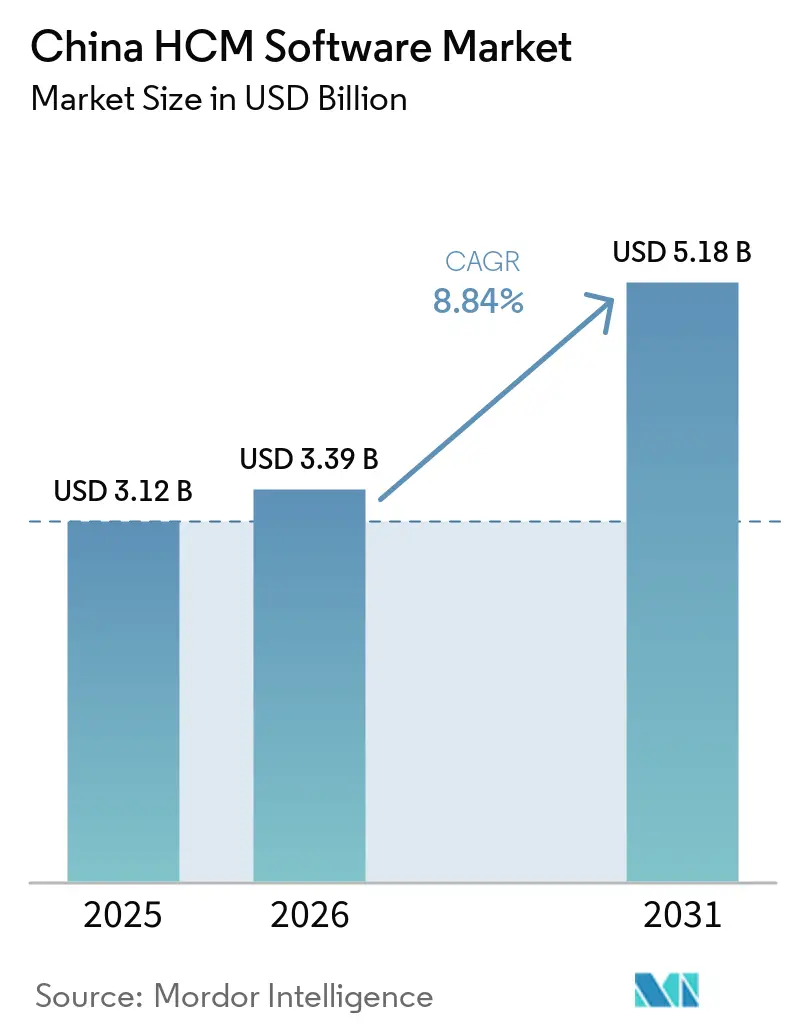
| Base Year Market Size (2025) | USD 3.12 Billion |
| Market Size (2026) | USD 3.39 Billion |
| Market Size (2031) | USD 5.18 Billion |
| Growth Rate (2026 - 2031) | 8.84 % |
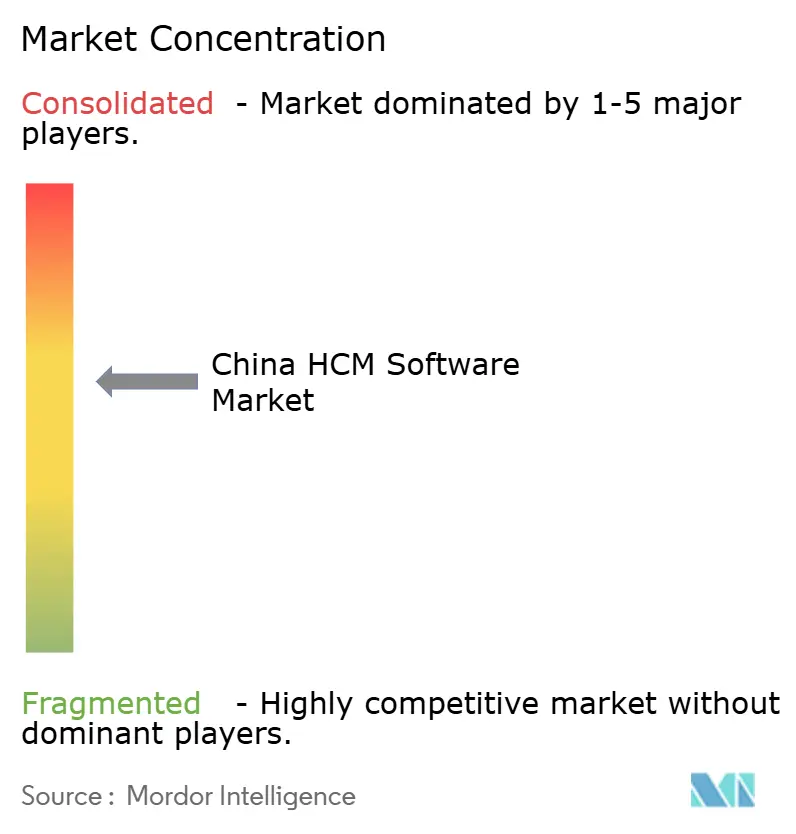
| Market Concentration | Medium |
Major Players *Disclaimer: Major Players sorted in no particular order Image © Mordor Intelligence. Reuse requires attribution under CC BY 4.0. | |
China HCM Software Market Analysis by Mordor Intelligence
The China HCM software market size reached USD 3.12 billion in 2025 and is expected to reach USD 3.39 billion in 2026 and USD 5.18 billion by 2031, growing at a CAGR of 8.84% from 2026 to 2031. Demand is consolidating around domestic cloud offerings because Xinchuang‐compliant vendors provide assured data residency and faster procurement clearance. Personal Information Protection Law audits are nudging buyers toward vendors that can certify in-country hosting, which in turn drives up cloud renewal rates. Talent shortages linked to China’s aging workforce have made AI-driven succession planning a board-level priority, raising average deal values for talent-management modules. Finally, provincial digitalization subsidies aimed at small businesses are opening a long-tail growth channel that offsets the slowing refresh cycle among early-adopter large enterprises.
Key Report Takeaways
- By component, software licenses led with 75.24% revenue share in 2025 in the China HCM software market, while services are projected to expand at a 9.62% CAGR through 2031.
- By deployment mode, cloud captured 62.82% of 2025 spending and is forecast to grow at a 9.18% CAGR, outpacing both on-premises and hybrid alternatives.
- By organization size, large enterprises accounted for 72.46% of 2025 revenue, yet small and medium enterprises are advancing at a 9.54% CAGR through 2031.
- By application, core HR contributed 27.18% of 2025 revenue, whereas talent management is moving fastest at a 9.88% CAGR to 2031.
- By end-user industry, industrial manufacturing accounted for 29.74% of 2025 revenue in the China HCM software market, and retail and e-commerce are forecast to expand at a 9.71% CAGR over the same horizon.
Note: Market size and forecast figures in this report are generated using Mordor Intelligence’s proprietary estimation framework, updated with the latest available data and insights as of January 2026.
China HCM Software Market Trends and Insights
Drivers Impact Analysis*
| Driver | (~) % Impact on CAGR Forecast | Geographic Relevance | Impact Timeline |
|---|---|---|---|
| Rising Enterprise Digital Transformation Mandates | +1.8% | National, Tier-1 and Tier-2 cities | Medium term (2-4 years) |
| Government Cloud-First Policies for Domestic Software | +2.1% | National, government and SOE sectors | Short term (≤ 2 years) |
| AI-Native Intelligent Agent Adoption in HR Workflows | +1.5% | National, BFSI and manufacturing | Medium term (2-4 years) |
| Xinchuang Compliance Push | +2.3% | National, government and central SOEs | Short term (≤ 2 years) |
| Cross-Border Expansion Requiring Global Payroll | +0.7% | Coastal provinces, Belt-and-Road corridors | Long term (≥ 4 years) |
| Analytics-Driven Workforce Planning for Aging Workforce | +0.9% | National, traditional industries | Medium term (2-4 years) |
| Source: Mordor Intelligence | |||
Rising Enterprise Digital Transformation Mandates
Corporations are accelerating refresh cycles because legacy on-premises suites cannot provide real-time analytics or comply with fast-shifting labor laws. Early adopters such as Ningbo Bank cut onboarding time by 30% after deploying an integrated platform that unifies recruitment, performance, and succession planning. Subsidized SME programs in cities like Yangzhou prove that public co-funding can offset budget limitations and stimulate first-time adoption. Retailers are buying gig-friendly scheduling modules to conform with new over-age worker protections, and manufacturers are embedding HCM with execution systems to cope with order volatility. Cloud alternatives win on both agility and lower capex, fragmenting the vendor roster and heightening price competition among SME buyers. Collectively, these initiatives boost the China HCM software market by widening the eligible customer pool and lifting average module penetration per customer.
Government Cloud-First Policies for Domestic Software
The 2026 Government Work Report codified a cloud-first stance for public-sector software, effectively channeling demand to vendors that can prove domestic hosting.[1] Beisen and Yonyou secured multiple provincial contracts on the back of this directive, each emphasizing Ministry of Industry and Information Technology certification to reassure data-sovereignty watchdogs. Hybrid rollouts remain common in SOEs that still rely on legacy ERP payroll, but even those entities now pilot cloud HCM for new hires to satisfy policy targets. Recurring subscription economics improve vendor visibility, while mandatory data-localization clauses raise switching costs, reinforcing market stickiness. For the China HCM software market, this driver cements double-digit cloud growth well into the forecast window.
AI-Native Intelligent Agent Adoption in HR Workflows
Conversational assistants embedded in HCM suites now field routine queries, schedule reviews, and predict attrition. Beisen’s AI Family 2.0 booked RMB 26 million (USD 3.6 million) in contracts within nine months of launch.[2] ICBC reports its digital HR aide resolves 70% of standard employee questions, freeing staff for strategic tasks. Kingdee’s Cosmic AI automates resume screening and interview scheduling, compressing hiring cycles. Manufacturers apply agent-driven shift optimization to tame overtime costs amid a tightening labor supply. Firms that lag on AI adoption bear escalating administrative expense, widening productivity gaps, and magnifying demand for intelligent modules across the China HCM software market.
Xinchuang Compliance Push
Domestic-IT mandates obligate agencies and central SOEs to replace foreign stacks by 2027, securing a captive channel for certified vendors. LiTang iRenShi clinched a multi-enterprise payroll deal under the State-owned Assets Supervision and Administration Commission, highlighting contract scale when compliance is non-negotiable. Vendors differentiate by bundling Xinchuang credentials with AI features. Foreign providers either partner locally or exit high-security segments, reshaping competitive stakes. This policy-led tailwind is pivotal to the sustained expansion of the China HCM software market.
Restraints Impact Analysis*
| Restraint | (~) % Impact on CAGR Forecast | Geographic Relevance | Impact Timeline |
|---|---|---|---|
| Stringent Personal Information Protection Law Compliance Costs | -0.9% | National, cross-border data flows | Short term (≤ 2 years) |
| Integration Complexity with Legacy ERP Systems | -1.2% | National, SOEs and large firms | Medium term (2-4 years) |
| Vendor Churn Risk in Volatile SME Segment | -0.6% | National, Tier-3 cities | Medium term (2-4 years) |
| Fragmented Provincial Social Insurance Rules | -0.8% | National, multi-province payroll | Long term (≥ 4 years) |
| Source: Mordor Intelligence | |||
Stringent Personal Information Protection Law Compliance Costs
The Personal Information Protection Law requires explicit consent, data-localization, and regular privacy audits, lengthening implementation timelines by up to six months. Multinationals such as Workday must run local data centers or partner with domestic clouds to pass security reviews, adding to project cost bases. Smaller local vendors struggle to fund compliance staff and technical upgrades, constraining competitive diversity. Biometric time-tracking features need redesign to secure consent, delaying new releases. Higher compliance overhead tempers margin expansion for both suppliers and buyers across the China HCM software market.
Integration Complexity with Legacy ERP Systems
Decades-old ERP suites employ proprietary data models that complicate real-time synchronization with modern cloud HCM, inflating services budgets by as much as 40%.[3] Yonyou and Kingdee enjoy an advantage, given their native ERP portfolios that ship with pre-built adapters. Foreign stacks rely on low-code middleware, yet still need custom provincial tax and social-insurance mappings, which multiply maintenance cycles whenever local authorities adjust rates. Integration drag elongates payback periods and dampens near-term purchasing appetite, muting a slice of latent demand in the China HCM software market.
*Our forecasts treat driver/restraint impacts as directional, not additive. The impact forecasts reflect baseline growth, mix effects, and variable interactions.
Segment Analysis
By Component: Services Surge on AI Customization Demand
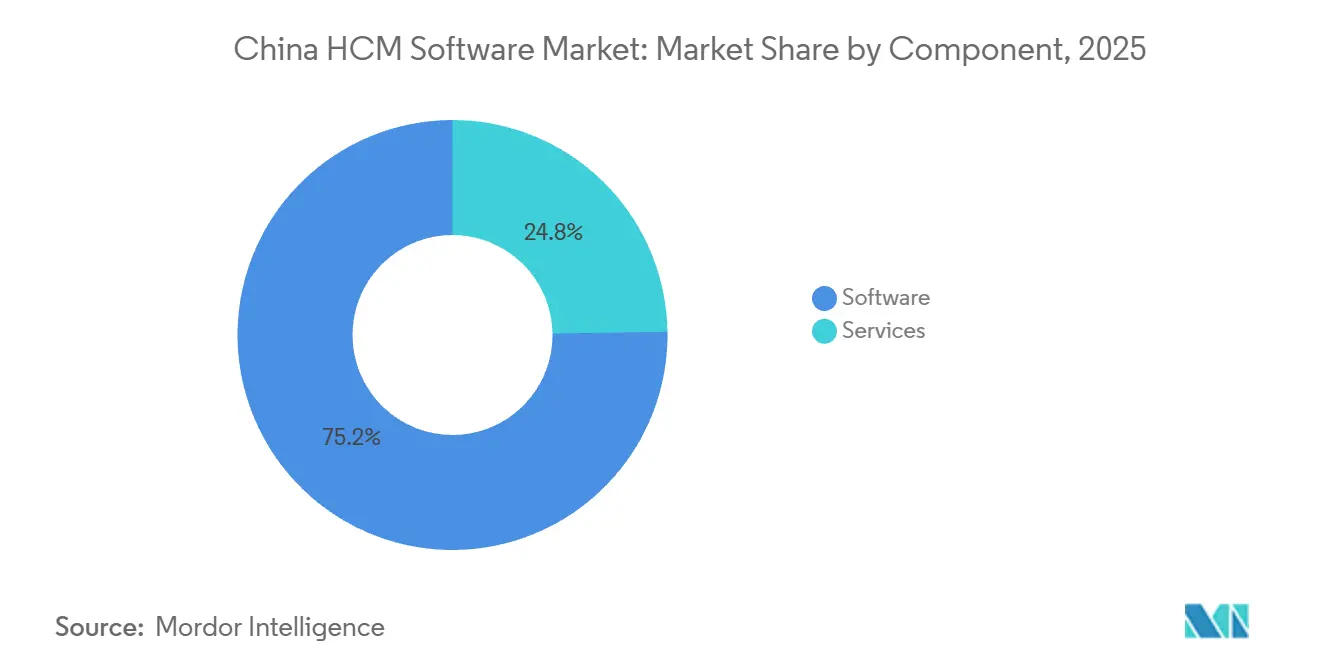
Software licenses retained 75.24% of 2025 revenue, underscoring the historical preference for capitalized core suites within the China HCM software market share. Yet services are projected to grow at a 9.62% CAGR through 2031 as enterprises commission conversational-agent training, privacy-by-design code reviews, and dual payroll-engine maintenance. Vendors now bundle managed services that monitor social-insurance rule changes across 31 provinces, converting one-time implementations into annuity revenue. Beisen’s services line rose 12% year-over-year during the first half of fiscal 2026 on the back of AI Family 2.0 rollouts. SMEs lean on vendor-run configuration workshops because they lack specialist IT staff, while SOEs require prolonged change-management support to migrate decades of personnel data.
The shift toward outcome-based pricing is visible as buyers tether fee pools to quantifiable KPIs such as onboarding speed or resignation-rate reduction. Over time, services will claim a larger slice of the China HCM software market size while software revenues migrate toward ratable cloud subscriptions. The strategic importance of services is further heightened by PIPL audits that compel phased deployments. Vendors that maintain in-house legal and security practices can charge premium day-rates, whereas smaller competitors often partner with boutique consultancies, reducing margin capture. Consequently, the services surge widens the performance gap between scaled incumbents and niche newcomers, a trend likely to persist throughout the forecast period.
By Deployment Mode: Cloud Gains on Policy Tailwinds
Cloud captured 62.82% of spending in 2025 and is on track for a 9.18% CAGR, reinforcing its centrality to the China HCM software market. Mandatory cloud-first procurement in the 2026 Government Work Report redirects agency budgets to SaaS providers that provide domestic hosting. Alibaba Cloud and Huawei Cloud achieved top-tier security certification, easing public-sector onboarding hurdles. Private enterprises see parallel benefits: multi-tenant updates deliver AI enhancements monthly rather than quarterly, sharpening competitive edge. Hybrid remains a temporary bridge for firms saddled with on-premises ERP, but dual-stack costs are accelerating full migration roadmaps.
As municipal subsidy programs reimburse only subscription fees, not on-prem hardware, SMEs flock to the cloud to minimize capex. The resulting uptick in user seats improves vendor data lakes that train HR AI models, creating a feedback loop that further differentiates cloud from on-prem alternatives. By 2031, policy pull and feature push together are set to consolidate more than three-quarters of the China HCM software market size under pure-cloud deployments.
By Organization Size: SMEs Accelerate on Municipal Subsidies
Large enterprises held 72.46% of 2025 revenue, yet municipal digitalization vouchers are driving a 9.54% CAGR for SME spending across the China HCM software market. Yangzhou alone issued cloud licenses to 1,200 small firms, slashing first-year costs and compressing evaluation cycles. SMEs select lightweight bundles focused on payroll and attendance, avoiding complex talent suites that demand specialist HR staff. Vendor churn, however, is elevated: a 2025 study found 28% of SMEs switched suppliers within three years as price and usability expectations evolve.
Large enterprises prioritize AI-native analytics that map succession pipelines amid the phased increase in the retirement age, paying premium rates for bespoke integrations. Their willingness to co-create features gives vendors valuable reference logos but extends deployment cycles. Over the forecast, SMEs will remain the fastest-growing cohort, but large-enterprise contracts will continue to anchor absolute spending, collectively sustaining the China HCM software market share mix.
By Application: Talent Management Leads on Succession Urgency
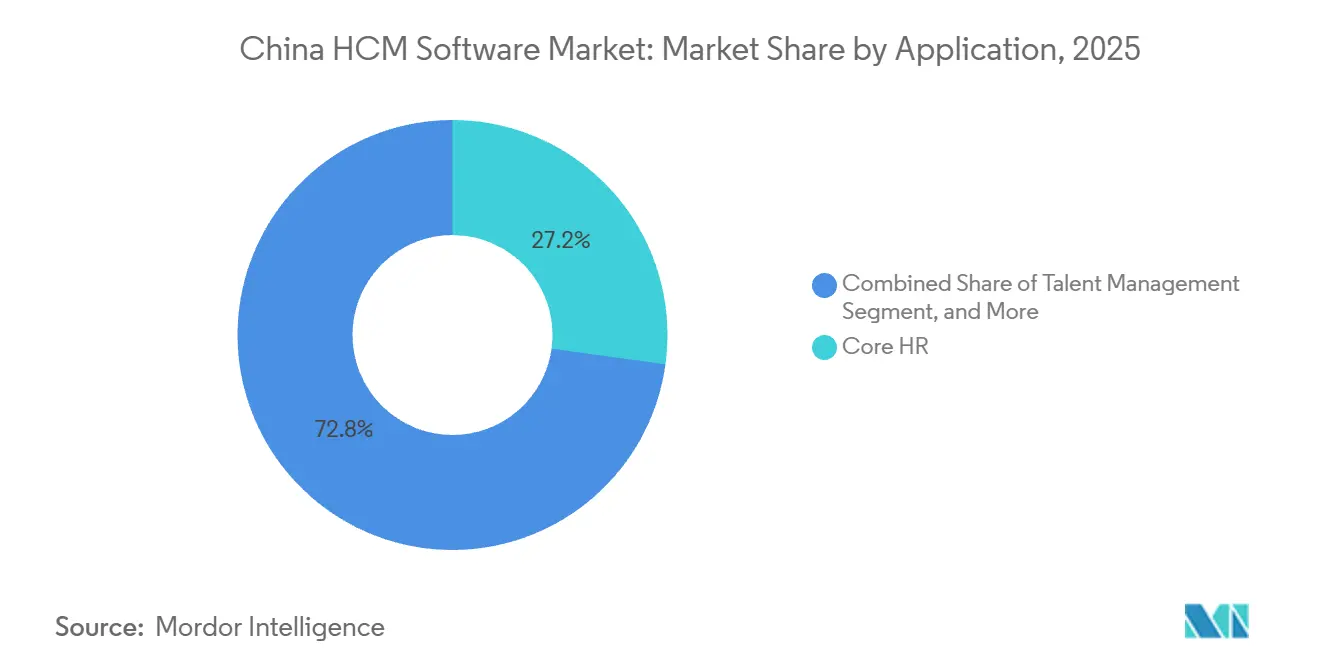
Core HR modules generated 27.18% of application revenue in 2025, yet talent management is expanding at a 9.88% CAGR, reflecting demographic pressure on succession pipelines inside the China HCM software market. AI screening and internal-mobility mapping reduce vacancy days, providing a clear ROI. Workforce-management tools that schedule gig staff underpin compliance with 2025 over-age worker protections, driving adoption in retail and logistics. Learning-management demand jumped after Beisen bought KuXueYuan, weaving micro-learning into broader talent suites.
Payroll engines face price compression as provincial rule engines become commoditized, moving differentiation to accuracy SLAs rather than features. Nonetheless, payroll remains a gateway sale, especially for SMEs entering digital HR for the first time. Convergence of learning, workforce planning, and performance data will blur module lines, allowing vendors to upsell adjacent tools and deepen wallet share across the China HCM software market.

By End-User Industry: Retail and E-Commerce Outpace Manufacturing
Industrial manufacturing held 29.74% of 2025 spending due to large headcounts and integration with shop-floor systems, but retail and e-commerce are projected to grow at a 9.71% CAGR, reflecting the surge in flexible labor arrangements. BFSI integrates HCM with core banking for real-time compliance dashboards, while healthcare pilots AI shift-optimization that cuts overtime by 18% in Shenzhen hospitals.[4] Government agencies ramp purchases under Xinchuang mandates, trading foreign suites for domestic certified stacks.
IT and telecoms players invest in learning suites to accelerate cloud and cybersecurity skill building, absorbing price premiums for AI-guided content personalization. Logistics and hospitality lag in advanced analytics adoption, but provide a stable demand for payroll and attendance modules. Segment diversity cushions cyclical shocks in any single vertical, supporting steady aggregate expansion of the China HCM software market.
Geography Analysis
Tier-1 cities such as Beijing, Shanghai, Guangzhou, and Shenzhen anchor the China HCM software market with early-adopter corporations that insist on full-suite, AI-enabled deployments. Coastal provinces, including Guangdong, Jiangsu, and Zhejiang, are gaining momentum as exporters adopt multicurrency payroll to manage Belt-and-Road staff, a trend that benefits vendors offering cross-border compliance engines. Tier-2 urban centers are accelerating because municipal vouchers lower initial outlays; Yangzhou’s 2025 initiative stands as a model for similar programs in Suzhou and Ningbo.
Tier-3 cities and inland provinces remain under-penetrated due to budget constraints and patchy internet infrastructure, yet these regions embody white-space potential for vendors that deliver mobile-first, low-code platforms. Northern provinces harbor concentrated SOE clusters that must swap foreign IT for Xinchuang-approved stacks by 2027, guaranteeing order flow even in slower-growth locales. Implementation complexity rises where provincial social-insurance rules diverge, notably in Xinjiang and Tibet, compelling vendors to run separate payroll engines and elongating project timelines.
Western expansion is spurred by central investment and poverty-alleviation mandates that bundle digitalization grants with infrastructure projects. Free-trade zones in Shanghai and Hainan catalyze demand for expatriate-management modules, while the inland relocation of manufacturing to Chongqing and Sichuan creates new clusters of users who need integrated workforce-execution links. Overall, geography shapes a two-speed trajectory inside the China HCM software market: innovation radiates from coastal hubs, and volume growth emerges from subsidized inland rollouts.
Competitive Landscape
The China HCM software market exhibits moderate fragmentation, with domestic champions Beisen, Yonyou, and Kingdee controlling most government and SOE budgets due to Xinchuang credentials. Beisen posted RMB 516 million (USD 71.8 million) in first-half fiscal 2026 revenue, up 18.2% year-over-year, illustrating scale leverage in AI R&D IR.BEISEN.COM. Yonyou recorded CNY 9.182 billion (USD 1.28 billion) for 2025, bolstered by 30% overseas expansion that diversifies risk.
Strategic themes center on embedding large-language models: Beisen’s AI Family 2.0 and Kingdee’s Cosmic AI automate onboarding, appraisal, and query handling. Foreign incumbents SAP, Oracle, and Workday retain niches in foreign-invested enterprises by championing global payroll consistency; Workday’s seven-year renewal at MGM China exemplifies the local-hosting pivots required to remain compliant. Emerging disruptors LiTang iRenShi and Panwei Jucailin target central SOEs with AI-heavy, cost-competitive suites, prompting incumbents to speed up feature rollouts.[5]
Vendor advantage increasingly depends on pre-packaged ERP adapters and province-specific payroll code libraries. Yonyou and Kingdee enjoy a structural edge given their ERP roots, whereas international rivals rely on API marketplaces that still demand custom mapping for each tax change. Consolidation is expected as compliance costs rise: smaller players lacking certification capital are likely takeover candidates, nudging the China HCM software market toward higher concentration over time.
China HCM Software Industry Leaders
-
Beisen Cloud Computing Co., Ltd.
-
Yonyou Network Technology Co., Ltd.
-
Kingdee International Software Group Company Limited
-
CDP Holdings Co., Ltd.
-
Dayforce, Inc.
- *Disclaimer: Major Players sorted in no particular order
Recent Industry Developments
- April 2026: Yonyou disclosed full-year 2025 revenue of CNY 9.182 billion (USD 1.28 billion), with AI-related contract signings reaching CNY 1.67 billion (USD 232 million) and overseas revenue up 30%.
- November 2025: Beisen reported first-half fiscal 2026 revenue of RMB 516 million (USD 71.8 million), a 18.2% rise year-over-year, driven by AI Family 2.0 wins.
- November 2025: Workday renewed a seven-year HCM contract with MGM China, adding in-country data hosting to meet Personal Information Protection Law mandates.
- June 2025: China announced the launch of a pilot in some 30 cities to integrate human resources (HR) services with the manufacturing sector.
China HCM Software Market Report Scope
The China HCM Software market comprises software platforms and associated services that manage, automate, and optimize workforce-related functions across enterprises and organizations operating in China. The market includes cloud-based and on-premises HCM applications that support the complete employee lifecycle, including workforce planning, recruitment, onboarding, payroll, compensation and benefits administration, time and attendance tracking, talent management, learning and development, employee engagement, performance management, succession planning, and workforce analytics.
The China HCM Software Market Report is Segmented by Component (Software, and Services), Deployment Mode (Cloud, On-Premises, and Hybrid), Organization Size (Large Enterprises, and Small and Medium Enterprises), Application (Core HR, Talent Management, Workforce Management, Payroll Management, and Learning and Development), End-User Industry (IT and Telecommunications, BFSI, Industrial Manufacturing, Healthcare and Lifesciences, Retail and E-commerce, Government and Public Sector, and Other End-User Industries). The Market Forecasts are Provided in Terms of Value (USD).
| Software |
| Services |
| Cloud |
| On-Premises |
| Hybrid |
| Large Enterprises |
| Small and Medium Enterprises |
| Core HR |
| Talent Management |
| Workforce Management |
| Payroll Management |
| Learning and Development |
| IT and Telecommunications |
| BFSI |
| Industrial Manufacturing |
| Healthcare and Lifesciences |
| Retail and E-commerce |
| Government and Public Sector |
| Other End-User Industries |
| By Component | Software |
| Services | |
| By Deployment Mode | Cloud |
| On-Premises | |
| Hybrid | |
| By Organization Size | Large Enterprises |
| Small and Medium Enterprises | |
| By Application | Core HR |
| Talent Management | |
| Workforce Management | |
| Payroll Management | |
| Learning and Development | |
| By End-User Industry | IT and Telecommunications |
| BFSI | |
| Industrial Manufacturing | |
| Healthcare and Lifesciences | |
| Retail and E-commerce | |
| Government and Public Sector | |
| Other End-User Industries |
Key Questions Answered in the Report
How large will the China HCM software market be by 2031?
The China HCM software market size is forecast to reach USD 5.18 billion by 2031, expanding at an 8.84% CAGR between 2026 and 2031 (Mordor Intelligence).
Which deployment mode is growing fastest?
Cloud deployments are projected to rise at a 9.18% CAGR through 2031 thanks to government cloud-first mandates and SME subsidy programs (Mordor Intelligence).
What segment shows the quickest application growth?
Talent management is expected to grow the quickest, advancing at a 9.88% CAGR as firms invest in AI-driven succession planning (Mordor Intelligence).
Why are services outpacing software license growth?
Services benefit from demand for AI customization, privacy-by-design reviews, and multi-province payroll maintenance, leading to a 9.62% CAGR through 2031 (Mordor Intelligence).
Which end-user industries are most attractive for new vendors?
Retail and e-commerce represent the fastest growth vertical at 9.71% CAGR, offering opportunities for scheduling and gig-worker compliance modules (Mordor Intelligence).