
AI-driven Nudges Market Size and Share
Market Overview
| Study Period | 2019 - 2030 |
|---|---|
| Market Size (2025) | USD 5.06 Billion |
| Market Size (2030) | USD 12.26 Billion |
| Growth Rate (2025 - 2030) | 19.38 % |
| Fastest Growing Market | Asia Pacific |
| Largest Market | North America |
| Market Concentration | Medium |
Major Players *Disclaimer: Major Players sorted in no particular order Image © Mordor Intelligence. Reuse requires attribution under CC BY 4.0. | |
AI-driven Nudges Market Analysis by Mordor Intelligence
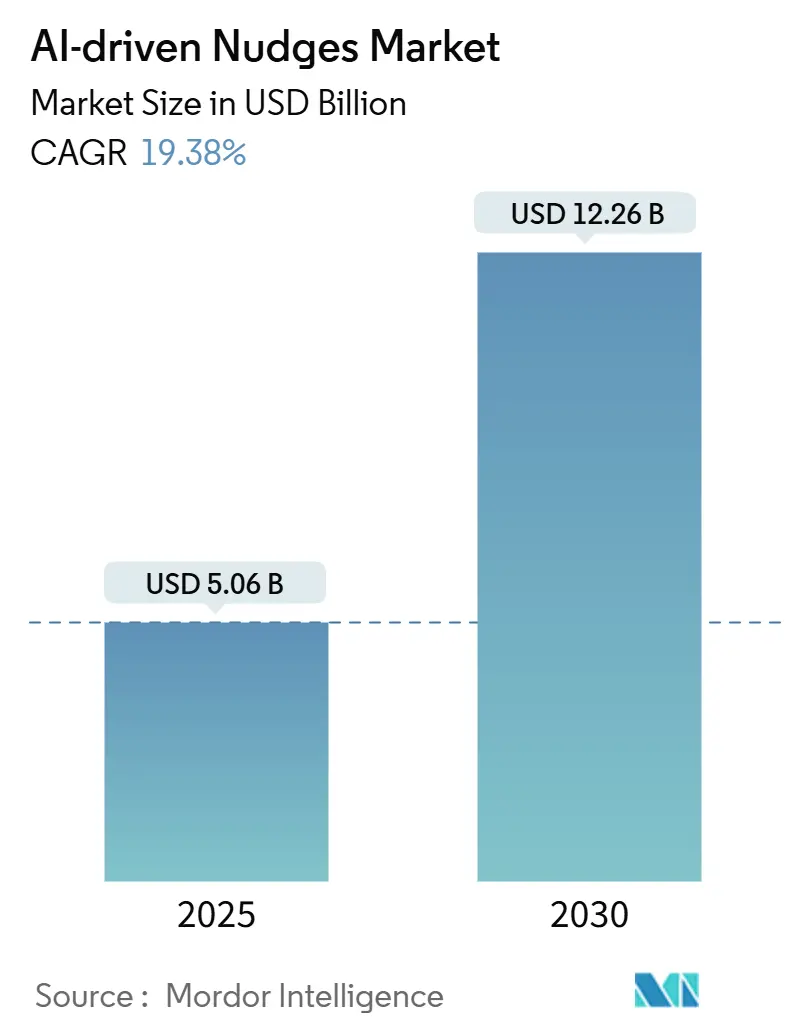
The AI-driven nudges market size is projected to reach USD 5.06 billion in 2025 and is expected to grow to USD 12.26 billion by 2030, representing a 19.38% CAGR during the forecast period. Persistent growth relies on the integration of behavioral economics with large-scale machine-learning pipelines, enabling organizations to deliver precisely timed, context-aware prompts that guide user choices. Mobile-first customer journeys, real-time customer data platforms, and maturing language model agents collectively elevate intervention accuracy, while cloud scalability lowers the threshold for enterprise adoption. Simultaneously, heightened ROI scrutiny fuels a decisive pivot from blanket outreach toward hyper-personalized nudging workflows that document measurable, habit-forming outcomes. Rising privacy safeguards and consumer demand for transparency compel vendors to integrate ethical design and algorithmic explainability into their product roadmaps, but the commercial rollout of generative AI agents capable of affect-sensing dialogue keeps the medium-term outlook vibrant.
Key Report Takeaways
- By application, mobile-app engagement led with 38.73% AI-driven nudges market share in 2024, whereas employee wellness and productivity is projected to post the fastest 20.38% CAGR through 2030.
- By deployment model, cloud-based solutions accounted for 72.83% of the AI-driven nudges market size in 2024, while hybrid deployments are forecast to grow at a 21.33% CAGR due to data-sovereignty demands.
- By end-user industry, retail and e-commerce captured 29.73% of 2024 revenue in the AI-driven nudges market, but healthcare and wellness is poised to surge at a 19.77% CAGR to 2030.
- By nudge technique, personalization algorithms commanded 44.83% share in 2024 in the AI-driven nudges market, yet gamification mechanics is expected to be the fastest-rising technique at a 20.56% CAGR.
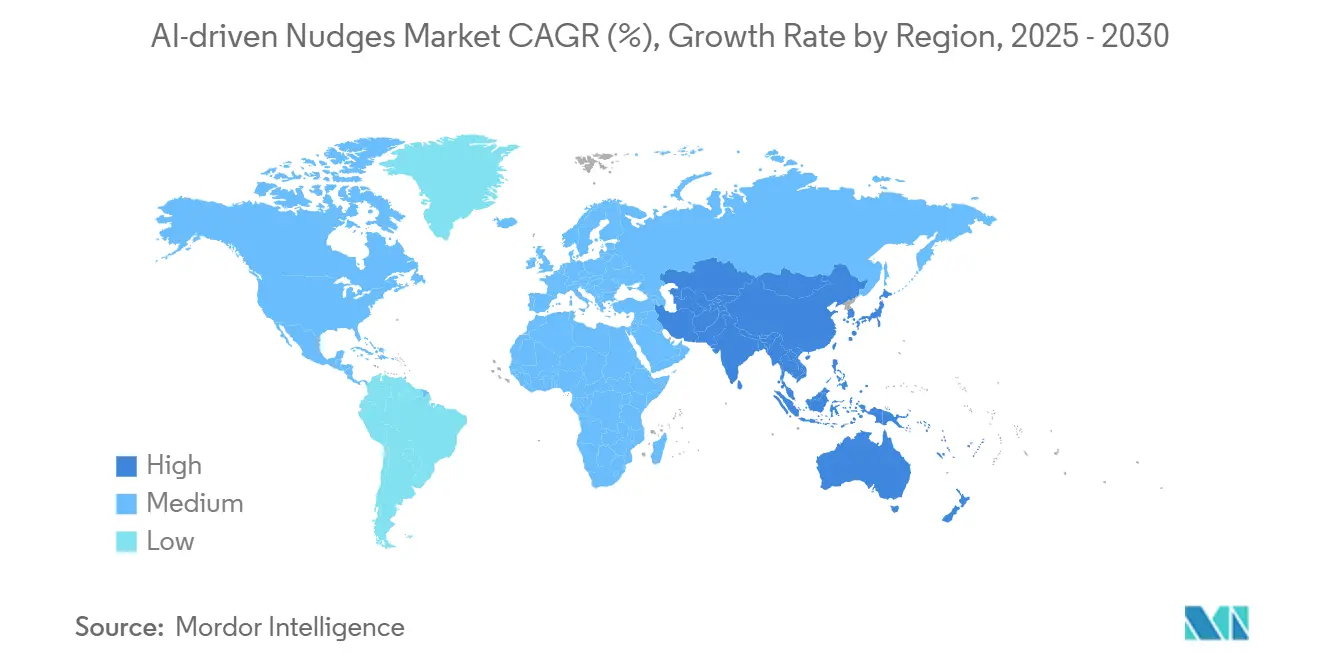
- By geography, North America retained 36.93% share in 2024 in the AI-driven nudges market, whereas Asia-Pacific is projected to be the most dynamic region at a 20.88% CAGR
Note: Market size and forecast figures in this report are generated using Mordor Intelligence’s proprietary estimation framework, updated with the latest available data and insights as of January 2026.
Market Trends and Insights
Drivers Impact Analysis of AI-driven Nudges Market*
| Driver | (~) % Impact on CAGR Forecast | Geographic Relevance | Impact Timeline |
|---|---|---|---|
| Explosion of first-party data enabling granular behavioral segmentation | +3.2% | Global, with early gains in North America and Europe | Medium term (2-4 years) |
| Rapid adoption of real-time customer-data platforms (CDPs) by B2C brands | +2.8% | North America and EU core, spill-over to APAC | Short term (≤ 2 years) |
| Rising ROI pressure driving shift from blanket outreach to hyper-personalized nudging | +2.1% | Global | Short term (≤ 2 years) |
| Integration of nudging APIs into leading CRM suites | +1.9% | North America and EU, expanding to APAC | Medium term (2-4 years) |
| Growing use of AI-nudges in digital therapeutics for chronic-disease self-management | +1.7% | Global, with regulatory leadership in EU and North America | Long term (≥ 4 years) |
| Commercialization of large-language-model agents capable of affective persuasion | +2.3% | Global | Medium term (2-4 years) |
| Source: Mordor Intelligence | |||
Explosion of First-Party Data Enabling Granular Behavioral Segmentation
Enterprises racing to replace vanishing third-party cookies are investing in event-stream architectures that capture hundreds of behavioral variables per user, empowering segmentation models to trigger sub-second nudges during micro-moments with conversion lift above 40%. Financial institutions report 23% average growth in savings balances when transaction-level insights feed personalized prompts. Edge computing pushes scoring logic to client devices, slicing latency and ensuring interventions arrive before decision windows close. As schema-less data lakes mature, marketing teams refine cohort definitions from demographics to intent-rich clusters, reinforcing the AI-driven nudges market momentum across banking, retail, and media verticals.
Rapid Adoption of Real-Time Customer-Data Platforms by B2C Brands
CDP deployment counts have multiplied 3.4-fold since 2024, largely because unified profiles make channel-agnostic nudging orchestration feasible.[1]Salesforce, “Salesforce Announces AI-Driven Customer Engagement Platform,” salesforce.com Predictive journey engines now look three to five steps ahead, enabling preventive interventions that curb churn before it surfaces. Clients leveraging such tooling have notched 67% higher lifetime value than peers using standard audience segmentation. CDP vendors are embedding nudge-fatigue throttles that modulate cadence based on receptiveness scores, sustaining engagement and curbing opt-outs.
Rising ROI Pressure Driving Shift to Hyper-Personalized Nudging
Macroeconomic caution channels budget scrutiny toward tactics with traceable payback, and AI-driven nudges frequently slash acquisition costs by 45% while doubling conversion efficiency relative to broad digital ads. Marketers increasingly tie success to persistence metrics, habit formation, cross-sell frequency, rather than immediate clicks. Incremental-impact models dissect the cumulative lift of each nudge along multi-touch journeys, revealing optimal intervention sequences that maximize compounded value, particularly in subscription-based businesses where usage depth correlates directly to retention.
Integration of Nudging APIs into Leading CRM Suites
Embedding behavioral logic into mainstream CRM workspaces cures earlier integration headaches. Salesforce Einstein surfaced drag-and-drop nudge templates linked to lifecycle stages and engagement thresholds.[2]Salesforce Developer Documentation, “Einstein AI Nudging APIs,” salesforce.com Adobe Experience Cloud mirrors the concept across email, web, and mobile, cutting deployment cycles to weeks. RESTful APIs knit analytics engines with engagement pipelines, forming closed-loop systems that continuously learn from behavioral feedback while shielding non-technical marketers from algorithmic intricacies.
Restraints Impact Analysis of AI-driven Nudges Market*
| Restraint | (~) % Impact on CAGR Forecast | Geographic Relevance | Impact Timeline |
|---|---|---|---|
| Increasing consumer push-back on manipulative UX practices | -1.8% | Global, with heightened sensitivity in EU and North America | Short term (≤ 2 years) |
| Stricter data-privacy regulations raising compliance costs | -2.1% | EU core, expanding to North America and APAC | Medium term (2-4 years) |
| Organizational talent gap in behavioral science and data engineering | -1.4% | Global | Long term (≥ 4 years) |
| Algorithmic bias leading to reputational and legal risks | -1.2% | Global, with regulatory focus in EU and North America | Medium term (2-4 years) |
| Source: Mordor Intelligence | |||
Increasing Consumer Push-Back on Manipulative UX Practices
Grass-roots “digital autonomy” campaigns pressure platforms to reveal when behavioral engineering is active, prompting leading vendors to add disclosure dashboards that allow users to dial intervention intensity. Several EU jurisdictions now recognize a “right to non-manipulation,” placing bright-line limits on default and framing tactics. Financial-product nudges pushing high-fee offerings triggered class-action suits that accelerated internal policy reviews. Providers now weigh short-term conversion gains against potential backlash, which can erode marginal lift and slow AI-driven nudges market growth trajectories in privacy-sensitive segments.
Stricter Data-Privacy Regulations Raising Compliance Costs
CPRA, LGPD, and GDPR extensions all demand explicit consent for behavioral profiling, and consent revocation must propagate through downstream analytic models within defined deletion windows.[3]California Attorney General’s Office, “CPRA Implementation Guidelines for Behavioral Profiling,” oag.ca.gov Vendors allocate up to 20% of total project cost to privacy tooling, from consent orchestration to differential-privacy masking, dampening profit margins for smaller entrants. Privacy limitations also shrink behavioral variable pools, mildly reducing algorithmic precision until synthetic data pipelines mature.
*Our forecasts treat driver/restraint impacts as directional, not additive. The impact forecasts reflect baseline growth, mix effects, and variable interactions.
AI-driven Nudges Market Segment Analysis
By Application:
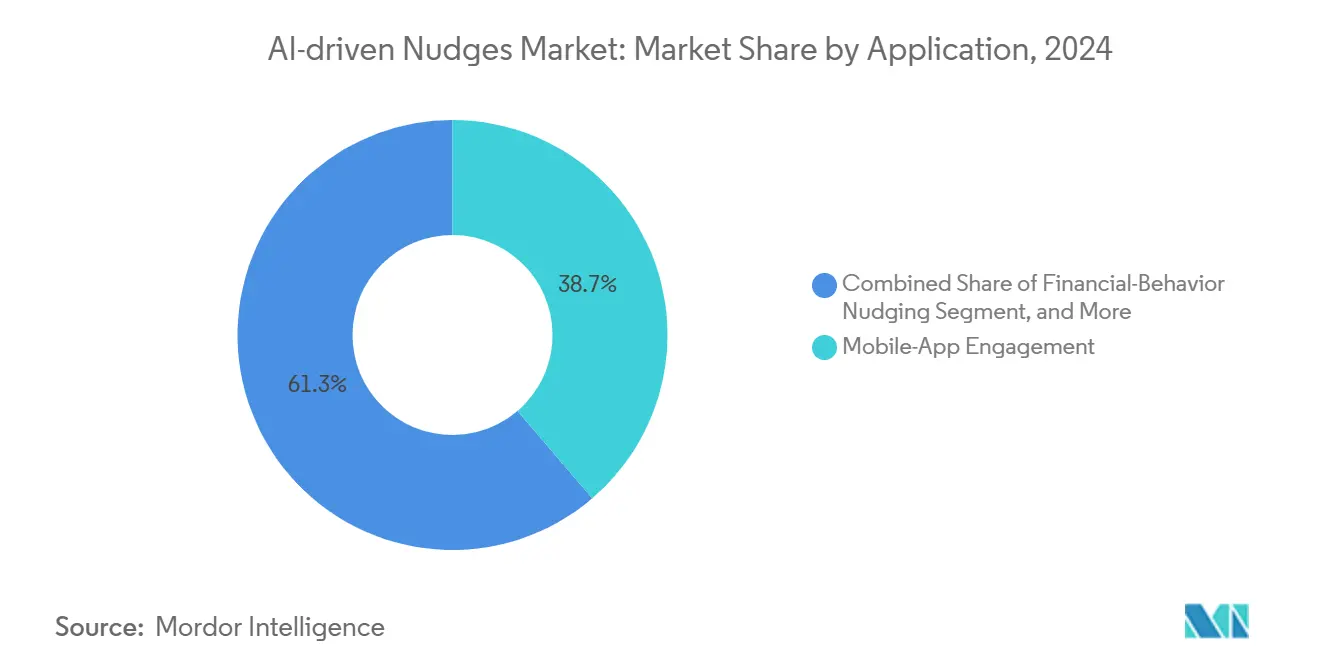
Mobile-App Engagement Drives Market LeadershipMobile-app engagement accounted for 38.73% of the AI-driven nudges market in 2024, owing to rich sensor inputs and persistent session data that enable micro-moment interventions with 28% average conversion uplift. The segment’s proximity to users’ daily routines, combined with push-notification channels, yields high responsiveness, which stabilizes revenue streams for platform providers. In-app nudges that integrate location, time of day, and purchase history prompt immediate behavioral change, offering brands a frictionless route to outcome-based engagement goals.
Employee wellness and productivity applications, projected to grow at a 20.38% CAGR, harness quantified-self telemetry and corporate health-benefit incentives to encourage healthy habits, from micro-break reminders to posture corrections. Vendors package mental-wellness nudges into enterprise subscription plans, aligning with hybrid-work trends and strengthening retention. The rapid scaling of digital therapeutics further cements healthcare-adjacent use cases, giving the AI-driven nudges market size added runway through 2030.



By Deployment Model:
Cloud Dominance with Hybrid AccelerationCloud services retained 72.83% share of 2024 revenue because scalable GPU clusters and managed data pipelines drastically shorten go-to-market timelines, making SaaS the default consumption model for mid-market buyers. Pay-as-you-grow economics sync well with campaign experimentation cycles, allowing small teams to iterate algorithm variants without capital expenditure. However, financial and health institutions with strict residency mandates increasingly adopt hybrid architectures to process sensitive behavioral features on-premise while pushing non-identifiable metadata into the cloud for model refinement.
Hybrid deployments, rising at a 21.33% CAGR, reflect enterprise preference for latency-optimized edge nodes paired with centralized orchestration. Micro-services push inference to branch servers, lowering reaction times for just-in-time nudges essential in commerce and gaming. Regulatory audits also reward transparent data separation, reinforcing hybrid traction and broadening the AI-driven nudges industry footprint in compliance-heavy regions.
By End-User Industry:
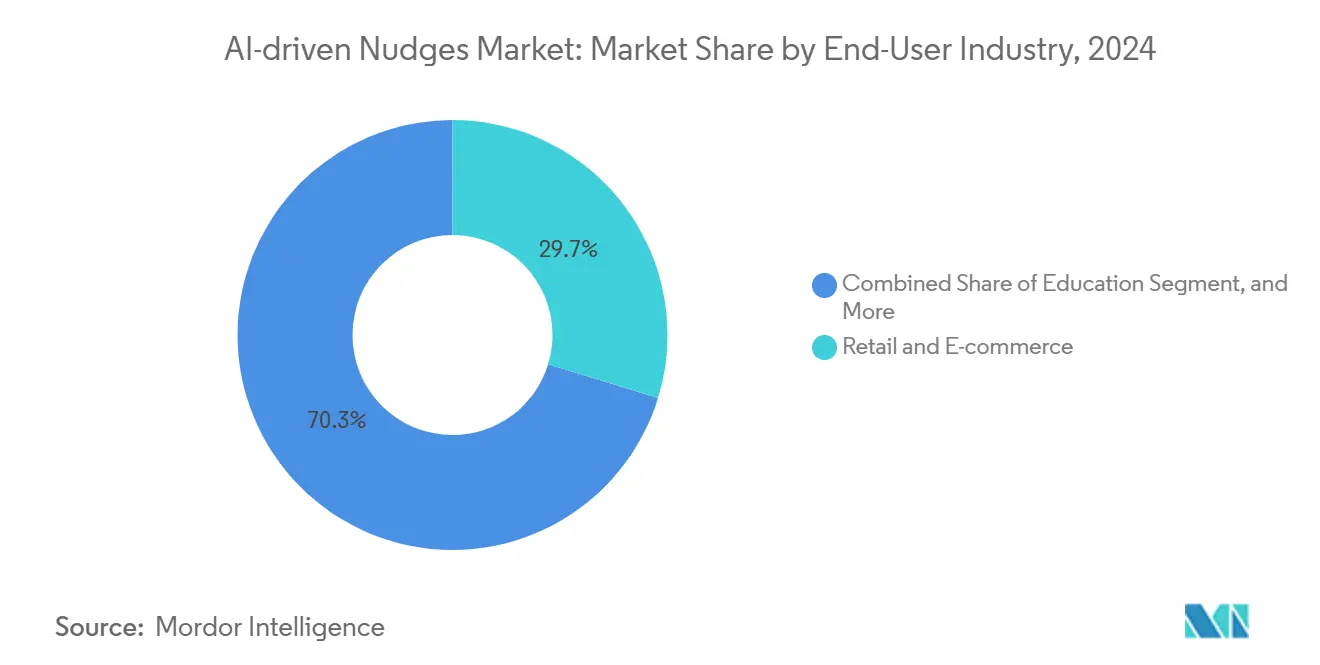
Retail Leadership with Healthcare AccelerationRetail and e-commerce players, controlling 29.73% of 2024 revenue, leverage behavioral prompts to reduce cart abandonment and promote basket-size growth, sometimes exceeding 28% incremental sales lift. Real-time urgency cues, adaptive discounts, and social-proof widgets dynamically respond to browsing signals, making nudging a mainstay of digital merchandising strategies. Meanwhile, healthcare and wellness use cases are expanding at a 19.77% CAGR thanks to chronic-disease management apps that gamify adherence and lifestyle modification, backed by growing payer reimbursement for digital therapeutic outcomes.
BFSI institutions embed savings and fraud-prevention nudges in mobile banking flows, translating behavioral insights into tangible financial health benefits and operational savings. Government agencies pilot tax-compliance reminders tuned to taxpayer disposition, while universities adopt nudging to boost course-completion rates, reflecting the diverse reach of the AI-driven nudges market.
By Nudge Technique:
Personalization Algorithms Lead InnovationPersonalization algorithms contributed 44.83% of 2024 revenue as they form the logic core that tailors every intervention to individual context. Modern deep learner ensembles evaluate preference vectors, predicted emotional state, and fatigue thresholds in milliseconds, ensuring high acceptance rates. The AI-driven nudges market size tied to gamification mechanics, forecast to grow at 20.56% CAGR, relies on adaptive difficulty curves, point systems, and peer leaderboards that trigger dopamine responses without overshooting frustration points.
Default framing and social-proof cues remain essential for regulated domains requiring subtler influence, whereas multi-technique orchestration stacks choose and blend interventions on the fly. Such combinatorial strategies boost sustained behavior change in complex journeys like health programs or financial planning, reinforcing vendor differentiation in an increasingly crowded competitive arena.
Geography Analysis
North America AI-driven Nudges Market
North America held 36.93% of 2024 revenue, bolstered by mature venture funding, a deep behavioral-design talent pool, and privacy frameworks that balance innovation with consumer protection.[4]Federal Reserve Bank of New York, “Behavioral Economics in Financial Technology,” federalreserve.gov Silicon Valley’s data infrastructure affords millisecond feedback loops essential for context-aware nudging, while New York’s fintech cluster pioneers transaction-driven prompts that encourage budgeting and saving. Regulatory sandboxes in select U.S. states let vendors A/B-test affective-computing modules, accelerating feedback cycles without compromising oversight.
APAC AI-driven Nudges Market
Asia-Pacific is projected to post a 20.88% CAGR, propelled by mobile-first economies and ambitious government programs that embed behavioral prompts in public-service apps. China intertwines nudges with social-credit scoring for civic compliance, India targets financial inclusion through payment-app reminders, and Japan addresses elderly care via medication-timing alerts. Rapid 5G rollout in South Korea gifts platforms ultra-low-latency links, enabling context shifts within multi-player gaming environments and livestream shopping.
Europe AI-driven Nudges Market
Europe advances under an ethics-first paradigm anchored by the forthcoming AI Act, which calls for algorithmic transparency and user override capabilities. Germany experiments with workforce safety nudges on factory floors, while the UK’s financial-wellness prompts safeguard consumers from high-risk lending. Academic-industry partnerships across the Netherlands and France seed startups specialized in data minimization and federated learning, offering compliant pathways to sustain the AI-driven nudges market across the continent.

Competitive Landscape
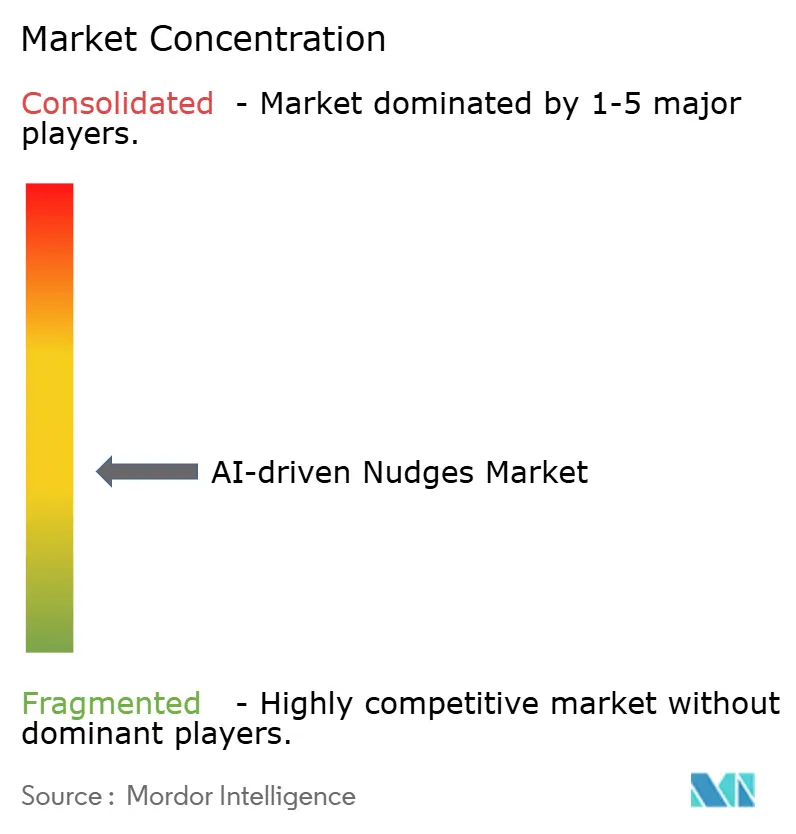
The AI-driven nudges market features moderate fragmentation: top technology giants wield data-infrastructure moats, yet niche vendors court vertical depth and regulatory nuance. Google and Meta deploy mature behavioral-targeting engines across ad networks and social platforms, steering consumer decisions beyond advertising into lifestyle guidance. Microsoft extends nudging to productivity software, nudging workers toward break hygiene or focus modes, while Amazon harnesses clickstream telemetry to refine purchase nudges that elevate average order value.
Mid-sized specialists, Braze, CleverTap, MoEngage, differentiate via turnkey mobile SDKs, GDPR-ready consent modules, and verticalized playbooks that enable marketers to craft campaigns without data-science know-how. Adobe’s recent Nudge.ai acquisition folds behavioral analytics into its Experience Cloud, cementing its standing in enterprise journey orchestration. Salesforce aligns with academic labs to underwrite ethical-design benchmarks, ensuring CRM-native nudging APIs reflect transparent logic.
Patent activity underscores an arms race: behavioral-AI filings surged 340% year-on-year, concentrating around real-time decision engines, affect-sensing models, and federated-learning reinforcement loops. Competitive intensity now hinges on demonstrable outcome lift, ethical safeguards, and cross-jurisdiction privacy alignment rather than sheer feature count.
AI-driven Nudges Industry Leaders
Google LLC
Meta Platforms, Inc.
Amazon.com, Inc.
Microsoft Corporation
Adobe Inc.
- *Disclaimer: Major Players sorted in no particular order
AI-driven Nudges Market Companies Covered in this Report
- Google LLC
- Meta Platforms, Inc.
- Amazon.com, Inc.
- Microsoft Corporation
- Adobe Inc.
- Salesforce, Inc.
- IBM Corporation
- Oracle Corporation
- SAP SE
- Intuit Inc.
- BetterUp, Inc.
- Braze, Inc.
- Pendo.io, Inc.
- CleverTap Private Limited
- MoEngage, Inc.
- Amplitude, Inc.
- Mixpanel, Inc.
- Airship Group, Inc.
- Qstream, Inc.
- Headspace Health, Inc.
- Duolingo, Inc.
- Swrve New Media Limited
- Squirrel AI Learning Co., Ltd.

Recent Industry Developments in AI-driven Nudges Market
- October 2025: Microsoft committed USD 2.3 billion to behavioral-AI laboratories in Seattle and Cambridge, focusing on ethical nudging frameworks.
- September 2025: Meta unveiled the Behavioral Wellness Platform inside Instagram and Facebook to curb digital-addiction patterns.
- August 2025: Adobe acquired Nudge.ai for USD 1.8 billion to bake real-time nudging into Experience Cloud.
- July 2025: Salesforce formed a partnership with Stanford’s Behavioral Design Lab, allocating USD 50 million for sector-specific nudging templates.


Global AI-driven Nudges Market Report Scope
| Mobile-App Engagement |
| E-commerce Conversion Optimization |
| Employee Wellness and Productivity |
| Financial-Behavior Nudging |
| Public-Policy and Civic-Engagement Nudging |
| Other Applications |
| Cloud-Based |
| On-Premise |
| Hybrid |
| Banking, Financial Services and Insurance (BFSI) |
| Retail and E-commerce |
| Healthcare and Wellness |
| Government and Public Sector |
| Education |
| Media, Entertainment and Telecom |
| Other End-User Industries |
| Personalization Algorithms |
| Gamification Mechanics |
| Social-Proof and Peer-Comparison Cues |
| Default and Framing Nudges |
| Other Techniques |
| North America | United States | |
| Canada | ||
| Mexico | ||
| South America | Brazil | |
| Argentina | ||
| Rest of South America | ||
| Europe | Germany | |
| United Kingdom | ||
| France | ||
| Italy | ||
| Spain | ||
| Rest of Europe | ||
| Asia-Pacific | China | |
| Japan | ||
| India | ||
| South Korea | ||
| ASEAN | ||
| Rest of Asia-Pacific | ||
| Middle East and Africa | Middle East | Saudi Arabia |
| United Arab Emirates | ||
| Turkey | ||
| Rest of Middle East | ||
| Africa | South Africa | |
| Nigeria | ||
| Rest of Africa | ||
| By Application | Mobile-App Engagement | ||
| E-commerce Conversion Optimization | |||
| Employee Wellness and Productivity | |||
| Financial-Behavior Nudging | |||
| Public-Policy and Civic-Engagement Nudging | |||
| Other Applications | |||
| By Deployment Model | Cloud-Based | ||
| On-Premise | |||
| Hybrid | |||
| By End-User Industry | Banking, Financial Services and Insurance (BFSI) | ||
| Retail and E-commerce | |||
| Healthcare and Wellness | |||
| Government and Public Sector | |||
| Education | |||
| Media, Entertainment and Telecom | |||
| Other End-User Industries | |||
| By Nudge Technique | Personalization Algorithms | ||
| Gamification Mechanics | |||
| Social-Proof and Peer-Comparison Cues | |||
| Default and Framing Nudges | |||
| Other Techniques | |||
| By Geography | North America | United States | |
| Canada | |||
| Mexico | |||
| South America | Brazil | ||
| Argentina | |||
| Rest of South America | |||
| Europe | Germany | ||
| United Kingdom | |||
| France | |||
| Italy | |||
| Spain | |||
| Rest of Europe | |||
| Asia-Pacific | China | ||
| Japan | |||
| India | |||
| South Korea | |||
| ASEAN | |||
| Rest of Asia-Pacific | |||
| Middle East and Africa | Middle East | Saudi Arabia | |
| United Arab Emirates | |||
| Turkey | |||
| Rest of Middle East | |||
| Africa | South Africa | ||
| Nigeria | |||
| Rest of Africa | |||


Key Questions Answered in the Report
What is the 2025 value of the AI-driven nudges market?
The AI-driven nudges market is valued at USD 5.06 billion in 2025.
How fast is revenue expected to grow through 2030?
Market revenue is slated to expand to USD 12.26 billion by 2030, reflecting a 19.38% CAGR.
Which application currently generates the largest share of spend?
Mobile-app engagement accounts for 38.73% of 2024 revenue.
Which geographic region will grow the quickest to 2030?
Asia-Pacific is projected to register a 20.88% CAGR, making it the fastest-growing region.
Which nudge technique is seeing the fastest adoption?
Gamification mechanics hold the highest growth outlook at a 20.56% CAGR through 2030.
Page last updated on:





