
Germany Green IT Software Market Size and Share
Market Overview
| Study Period | 2020 - 2031 |
|---|---|
| Forecast Data Period | 2026 - 2031 |
| Base Year Market Size (2025) | USD 1.65 Billion |
| Market Size (2026) | USD 1.85 Billion |
| Market Size (2031) | USD 3.69 Billion |
| Growth Rate (2026 - 2031) | 14.81 % |
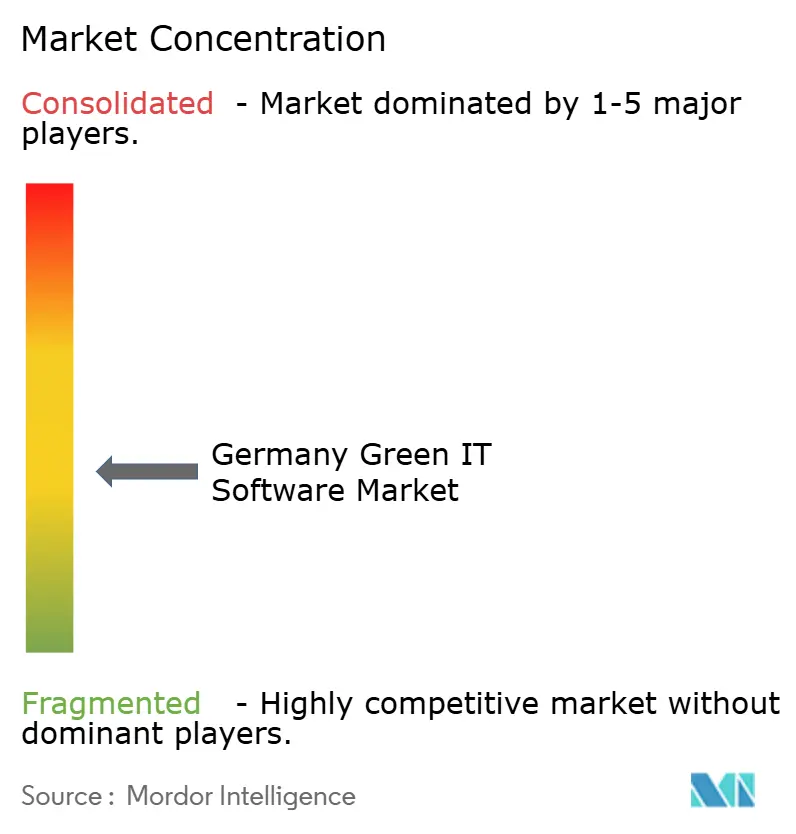
| Market Concentration | Medium |
Major Players *Disclaimer: Major Players sorted in no particular order Image © Mordor Intelligence. Reuse requires attribution under CC BY 4.0. | |
Germany Green IT Software Market Analysis by Mordor Intelligence
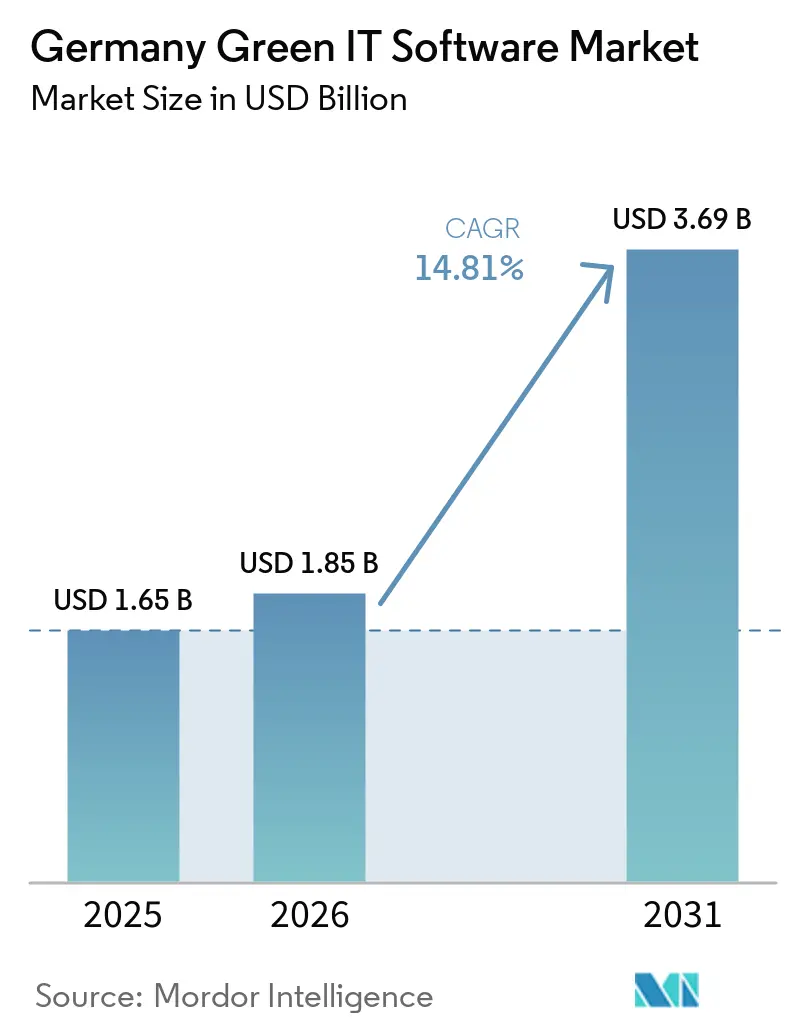
The Germany green IT software market is expected to grow from USD 1.65 billion in 2025 to USD 1.85 billion in 2026, and reach USD 3.69 billion by 2031, growing at a CAGR of 14.81% over 2026-2031. Growth is being shaped by Germany’s CSRD implementation schedule, which brings the first reporting wave into 2026 for large enterprises and extends the compliance base to many more companies by 2028. That shift is moving sustainability software from a voluntary reporting tool into a formal system that finance, procurement, operations, and IT teams need to run together. Industrial electricity prices remained well above pre-crisis levels in 2025, so companies are using software to track consumption, manage procurement exposure, and connect savings with decarbonization spending. The National Data Center Strategy and tighter energy rules for data centers are also pushing demand beyond disclosure into resource optimization, IT asset tracking, and verified transition planning. In this setting, the German green IT software market favors vendors that can connect with established ERP and IT service environments, while still leaving room for local specialists that offer German-language support and ESRS-ready workflows.
Key Report Takeaways
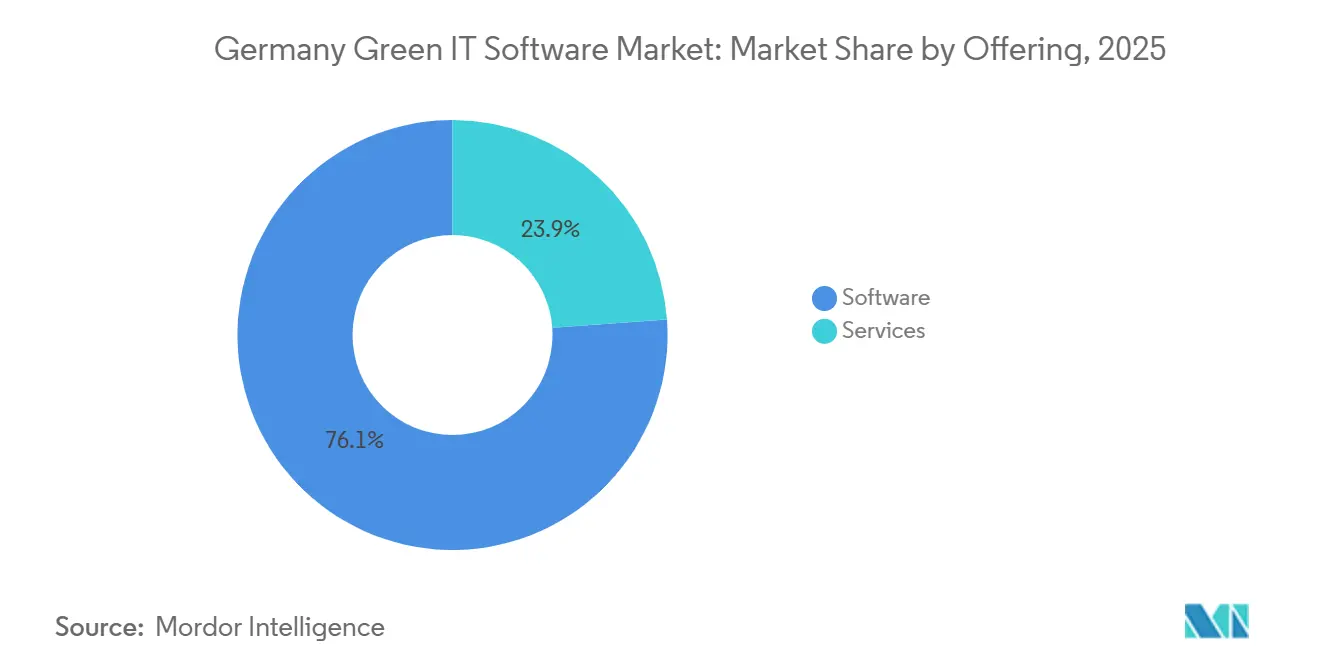
- By offering, software held 76.14% of the Germany green IT software market share in 2025, while services are projected to expand at a 14.93% CAGR through 2031.
- By deployment, cloud-based delivery accounted for 64.17% share in 2025, while hybrid deployment is projected to grow at a 15.02% CAGR through 2031.
- By enterprise size, large enterprises held 69.12% share of the Germany green IT software market in 2025, while SMEs are projected to expand at a 15.13% CAGR through 2031.
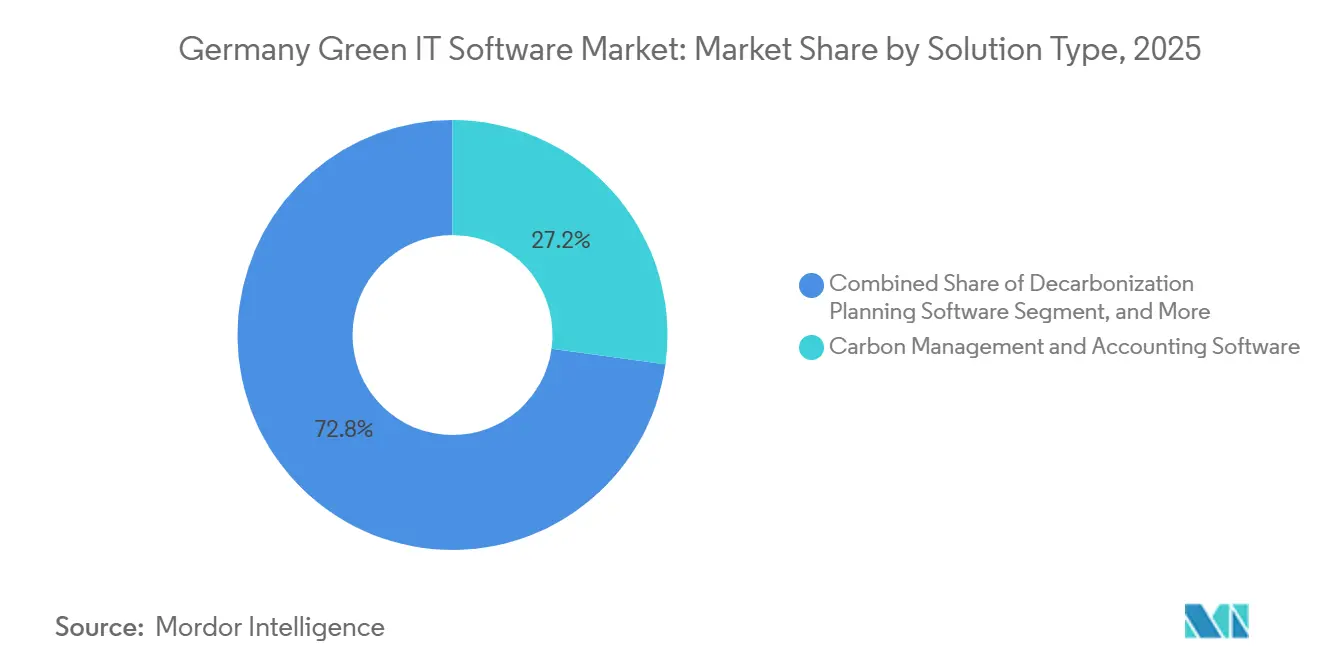
- By solution type, carbon management and accounting software accounted for 27.18% share in 2025, while decarbonization planning software is projected to grow at a 15.24% CAGR through 2031.
- By end user, IT and telecom accounted for 22.13% share in 2025, while energy and utilities are projected to expand at a 15.31% CAGR through 2031.
Note: Market size and forecast figures in this report are generated using Mordor Intelligence’s proprietary estimation framework, updated with the latest available data and insights as of January 2026.
Germany Green IT Software Market Trends and Insights
Drivers Impact Analysis*
| Driver | (~) % Impact on CAGR Forecast | Geographic Relevance | Impact Timeline |
|---|---|---|---|
| Regulatory Pressure from Corporate Sustainability Reporting | +3.2% | National, concentrated in DAX 40 and large-cap German enterprises in Frankfurt, Munich, and Hamburg | Short term (≤ 2 years) |
| Rising ESG Reporting Burden Across German Enterprises | +2.8% | National, with early adoption in Rhine-Ruhr industrial corridor and Baden-Württemberg manufacturing clusters | Short term (≤ 2 years) |
| Energy Cost Pressure Accelerating Software-Led Optimization | +2.4% | National, acute in energy-intensive sectors of North Rhine-Westphalia, Saxony, and Bavaria | Medium term (2-4 years) |
| Data Center Decarbonization Programs Across Large IT Users | +2.0% | National, concentrated in major data center hubs, Frankfurt, Berlin, and Munich | Medium term (2-4 years) |
| IT Asset Lifecycle Tracking for Scope 3 Reduction | +1.7% | National, with early gains in IT and telecom enterprises operating large distributed hardware fleets | Medium term (2-4 years) |
| AI-Based Energy Orchestration in Hybrid Workloads | +1.4% | National, with spillover to the broader DACH region | Long term (≥ 4 years) |
| Source: Mordor Intelligence | |||
Regulatory Pressure from Corporate Sustainability Reporting
Germany’s CSRD transposition path is moving the Germany green IT software market toward a more structured buying cycle, as the first major reporting wave reaches large companies in 2026. The initial group covers around 240 German enterprises with more than 1,000 employees, and the obligation then extends, in later waves, to a much broader base, reaching around 15,000 companies by 2028. The original ESRS framework carried up to 1,100 data points across 82 disclosures, and the EU Omnibus I package approved in December 2025 is reducing that requirement to an estimated 400–500 data points through a delegated revision.[1] That adjustment is not lowering software demand, because companies still need auditable data flows and now want tools that can adapt as the final reporting architecture becomes clearer. Supplier data collection is also drawing many mid‑market firms into procurement even when they do not file directly, because first‑wave customers still need verified Scope 3 inputs from them. SAP’s 2026 Sustainability Control Tower updates show how incumbent vendors are trying to capture this compliance‑led demand by expanding ESRS metric coverage and introducing AI‑based audit-readiness features.[2]
Rising ESG Reporting Burden across German Enterprises
The German green IT software market is also supported by the fact that Germany enterprises are dealing with multiple reporting frameworks simultaneously, not just one. Large financial institutions face ESG risk disclosures under banking rules, while manufacturers must also handle EU Taxonomy alignment and supply chain due diligence requirements. That overlap is diminishing the usefulness of single‑purpose tools and pushing buyers toward platforms that can manage reporting, data governance, and audit preparation from a single operating layer. Plan A built its position on German‑language workflows, local regulatory tracking, and live updates for CSRD and ESRS changes, and the company said it has served more than 1,500 DACH enterprises while remaining profitable since 2024. SAP said in May 2026 that new sustainability AI agents, including a Footprint Optimization Agent, would be generally available by the end of 2026 and could reduce scenario simulation time from 1 day to 20 minutes. As reporting fatigue rises, buyers are showing less tolerance for fragmented tools and more interest in integrated platforms that can support CSRD, EU Taxonomy, GRI, and banking‑related disclosure needs together.
Energy Cost Pressure Accelerating Software-Led Optimization
Elevated power costs are giving the Germany green IT software market a second demand engine beyond pure disclosure work. German industrial electricity prices averaged 10.04 euro cents/kWh in September 2025, equivalent to USD 10.94 cents/kWh, and remained 57% above the 6.39 euro cents/kWh recorded 5 years earlier. The industrial electricity support scheme, launched in January 2026, set a 5 euro cents/kWh target price for 50% of eligible consumption for companies in 91 sectors, and required companies to direct at least 50% of the support received into decarbonization projects. That condition matters because it ties financial relief to the same spending categories that energy management and optimization software support. A survey from the first quarter of 2025 showed record Power Purchase Agreement uptake among German industrial companies, suggesting a shift from passive energy buying to active monitoring and portfolio management. The practical result is a split buyer base, where asset‑heavy manufacturers focus on real‑time operational efficiency while service‑led firms in BFSI and telecom focus more on Scope 2 procurement reporting and contract‑backed emissions accounting.[3]
Data Center Decarbonization Programs Across Large IT Users
Data center policy is expanding the Germany green IT software market from reporting software to operational control software. Germany’s National Data Center Strategy, adopted on March 18, 2026, commits the country to doubling computing capacity and quadrupling AI and high‑performance computing infrastructure by 2030, while also requiring 100% renewable electricity for data centers from 2027 and waste heat recovery for new facilities from July 2026. A draft amendment to the Energy Efficiency Act published in April 2026 raised the general energy management system threshold for many businesses, while maintaining strict certified management requirements for data centers. The European Commission also moved toward a common EU rating system for data centers based on performance indicators such as PUE and WUE, which adds another reporting layer above domestic obligations. A peer‑reviewed study on German data center emissions found that aggressive renewable procurement and operational optimization can cut greenhouse gas emissions by up to 70%, but net‑zero still requires progress on Scope 3 hardware lifecycle impacts. That combination is increasing the value of software that connects facility efficiency, renewable sourcing, and hardware asset tracking into a single, verifiable system.[4]
Restraints Impact Analysis*
| Restraint | (~) % Impact on CAGR Forecast | Geographic Relevance | Impact Timeline |
|---|---|---|---|
| Integration Complexity with Legacy ERP and ITSM Stacks | -1.9% | National, concentrated among Mittelstand enterprises in North Rhine-Westphalia and Baden-Württemberg with long-standing SAP ECC or IS-U deployments | Medium term (2-4 years) |
| Fragmented Sustainability Data Across Business Units | -1.4% | National, with acute impact in diversified industrial conglomerates with complex cross-Bundesland legal entity structures | Medium term (2-4 years) |
| Budget Competition with Core Security and Cloud Programs | -1.1% | National, with highest pressure in SMEs in Saxony and Brandenburg where IT budget constraints are most acute | Short term (≤ 2 years) |
| Limited Internal Carbon Accounting Maturity in Mid-Market Firms | -0.8% | National, concentrated in mid-market manufacturing firms with fewer than 1,000 employees and no dedicated sustainability function | Long term (≥ 4 years) |
| Source: Mordor Intelligence | |||
Integration Complexity with Legacy ERP And ITSM Stacks
Legacy architecture remains a meaningful drag on deployment speed across the Germany green IT software market. Many German enterprises still run SAP ECC, SAP IS‑U, or heavily customized sector‑specific environments, so green IT platforms often face difficult extraction, mapping, and reconciliation work before they can produce reliable outputs. This problem is becoming sharper because audit‑ready sustainability reporting requires asset, procurement, operational, and finance data to align at a much deeper level than many existing system landscapes were built to support. Mittelstand companies are facing an added burden because major core‑system migrations are already underway, which reduces internal capacity for parallel software onboarding. FairEnergie GmbH’s June 2026 decision to replace SAP IS‑U with a cloud‑based platform built on SAP S/4HANA Utilities shows how utility companies are already using internal resources on foundational change programs that run well into 2027. Vendors that can offer prebuilt connectors to SAP and ServiceNow therefore have an advantage, as they can shorten implementation timelines and reduce the amount of custom integration work buyers must fund.
Fragmented Sustainability Data Across Business Units
Fragmented data structures are limiting how quickly large organizations can turn green IT software into production systems. German corporate groups often operate through holding entities, GmbH subsidiaries, and cross‑border ventures, and each unit may store emissions, supplier, and operational data in different formats and systems. The double materiality requirement adds another layer because reporting boundaries for financial consolidation do not always align with environmental impact boundaries, creating a recurring mapping problem in program design. The issue is most difficult in diversified groups spanning manufacturing, logistics, and financial services, because each business line may use different activity data methods and Scope 3 boundaries. Fragmentation increases customization work, slows sign-off across business units, and increases the likelihood that projects remain in pilot mode longer than expected. This keeps demand intact but slows revenue conversion for vendors targeting large enterprise accounts without a strong data harmonization layer.
*Our forecasts treat driver/restraint impacts as directional, not additive. The impact forecasts reflect baseline growth, mix effects, and variable interactions.
Segment Analysis
By Offering: Software Platforms Anchor Revenue While Services Keep Scaling
Software accounted for 76.14% of the Germany green IT software market share in 2025, making it the leading revenue category in this segment. That position was tied to enterprise licensing for carbon management, ESG reporting, and decarbonization planning tools that were already being added inside SAP‑ and Microsoft‑centered IT estates. German enterprises have often preferred to extend existing platform agreements rather than introduce standalone tools, because that reduces vendor count, shortens security reviews, and keeps procurement inside known commercial structures. This pattern has helped incumbent vendors defend their base, since sustainability functionality can be sold as a feature expansion within broader ERP or cloud contracts. It also means the German green IT software market has seen software revenue build first around installed‑system leverage rather than around entirely new platform replacement cycles.
Services are projected to grow at a 14.93% CAGR from 2026 to 2031, making them the faster‑moving part of the offering mix even though they remain on a smaller base. That growth reflects a simple operational reality: software alone does not create audit‑ready ESRS output when governance structures, materiality assessments, stakeholder workflows, and data remediation still need to be designed around it. Large organizations also need support to map sustainability metrics to financial entities, operational sites, and supplier relationships before reporting can be trusted. New sustainability AI agents, which are expected to become generally available by the end of 2026, may reduce routine service work while creating additional implementation work for partners who configure and govern those tools. Vendors that align their data structures with ISO 14001‑style management processes are also likely to stay better positioned when manufacturing buyers screen software providers against existing environmental management practices.
By Deployment: Hybrid Architecture Reflects German Data Control Priorities
Cloud‑based deployment held 64.17% of the Germany green IT software market in 2025, while hybrid deployment is projected to grow at a 15.02% CAGR through 2031. Cloud delivery has remained attractive because it allows faster rollout, easier feature updates, and quicker adjustment when CSRD and ESRS requirements change. At the same time, the market is not moving toward a simple public cloud model, since many buyers still need stronger control over where sensitive supplier, emissions, and operational data is stored. Surveys show that 73% of German enterprises operate hybrid IT architectures, which supports the view that mixed environments are already standard rather than transitional. Requirements tied to data sovereignty, NIS‑2, and BSI C5 preferences have therefore made hybrid deployment a practical middle path for organizations that want software speed without fully giving up local control.
Hybrid demand is also being reinforced by buyer behavior in the mid‑market. German SMEs are increasingly reshoring sustainability‑sensitive workloads to German or EU‑hosted environments while still using public cloud layers for reporting, dashboards, or external collaboration. That pattern works well for Scope 3 data collection, because supplier information often carries commercial sensitivity that companies do not want to place into a fully open architecture. On‑premise deployment still keeps a role in KRITIS‑related enterprises, defense‑linked supply chains, and regulated financial settings where full cloud migration remains constrained. For this reason, the Germany green IT software market is rewarding vendors that can move data across several environments with clear governance rather than vendors that push one hosting model only. Over time, interoperability, certification readiness, and smooth integration are likely to matter more in deployment decisions than hosting scale alone
By Enterprise Size: Large Enterprises Lead Today While SMEs Accelerate Faste
Large enterprises held 69.12% of the Germany green IT software market in 2025, keeping this group at the center of revenue generation. Their leading position came from direct Wave 1 reporting obligations, larger program budgets, and the operational need to run sustainability software across multi‑entity structures, shared service centers, and complex supplier networks. Siemens showed the scale of this readiness in 2025, when it invested EUR 6.6 billion (USD 7.2 billion) in R&D and reported that 52% of eligible revenue aligned with EU Taxonomy environmental criteria. Companies at that end of the market are not treating green IT software as a narrow compliance line item, because it also supports procurement visibility, product data, internal controls, and transition planning. This has kept large enterprise demand concentrated in broader transformation budgets rather than in single-department purchases.
SMEs are projected to grow at a 15.13% CAGR from 2026 to 2031, making them the faster‑growing enterprise‑size segment. A major reason is indirect pressure from large customers that need structured Scope 3 data and can no longer rely on spreadsheet‑based responses from smaller suppliers. The later compliance runway, now pointing to 2028–2029, has not reduced SME interest, because it gives companies time to evaluate software before reporting pressure becomes immediate. A 2026 survey found that 90% of German SMEs said they were ready for the upcoming regulation, and 81% said they used AI tools weekly or daily. That reading suggests a wider base of digital preparedness than many procurement models previously assumed. Within the Germany green IT software industry, this is shifting attention toward mid‑market products that are lighter to deploy but still strong enough to satisfy customer questionnaires and future reporting obligations.
By Solution Type: Carbon Accounting Leads The Base While Planning Tools Expand Fastest
Carbon management and accounting software held 27.18% of the Germany green IT software market in 2025, while decarbonization planning software is projected to grow at a 15.24% CAGR through 2031. Carbon accounting leads because it is the first required layer, as no company can complete an ESRS E1 disclosure without a verified inventory across Scope 1, Scope 2, and Scope 3 emissions. Once that baseline is in place, spending naturally shifts toward transition planning, as companies need target pathways, scenario tools, and evidence that planned reductions can be measured and governed. This is why the market is shifting from simple measurement toward a broader control stack that includes planning, reporting, and operational follow‑through. ESG reporting and sustainability data management platforms sit above the accounting layer and enable a single data model to feed CSRD, EU Taxonomy, GRI, and banking‑related reporting structures. Buyers are therefore placing more weight on system breadth and audit logic than on disclosure templates alone.
Energy and resource optimization tools represent the operational side of this structure, because they connect real‑time consumption data from plants, buildings, and data centers with enterprise sustainability systems. That function is becoming more valuable as energy management certifications and efficiency rules move from internal good practice into formal compliance frameworks. Supplier‑facing primary data layers are increasingly connected to multiple carbon accounting platforms, demonstrating that modular integration is becoming the norm. In the German green IT software industry, this approach supports vendors that can combine supplier data collection, accounting logic, and reporting output without forcing customers to rebuild surrounding workflows. It is also changing the competition within the category, because buyers now compare data quality, ecosystem depth, and integration reach simultaneously. For that reason, the fastest growth is moving toward planning and orchestration layers, even though accounting still anchors current spending.

By End User: IT And Telecom Holds The Lead While Energy And Utilities Gains Speed
IT and telecom accounted for 22.13% of the Germany green IT software market in 2025, while energy and utilities are projected to expand at a 15.31% CAGR through 2031. IT and telecom led because these companies are both software buyers for their own reporting needs and infrastructure operators whose data center footprints are directly tied to efficiency and renewable power requirements. Utilities are emerging as the faster‑growing user group because they face several pressures at once, including SAP migration needs, grid modernization work, formal reporting requirements, and stricter energy management obligations. New distributed energy resource solutions launched in 2026 show how vendors are pushing deeper into operational energy coordination rather than staying only in disclosure software. This matters in Germany because utilities and municipal energy providers often need software that can connect commercial reporting, distributed infrastructure, and regulated operating environments. As a result, the market is seeing energy and telecom demand grow from both compliance and system‑control needs.
BFSI organizations form a separate demand pattern because their reporting boundaries are shaped more by financial risk and portfolio disclosure than by plant‑level operational emissions. Manufacturing buyers, by contrast, often need equipment‑level data capture, supplier mapping, and integration with production systems, which makes their software priorities more operational from the start. Healthcare, government, retail, construction, and other sectors are also expanding their customer base, even though each group enters the market with different internal ownership and data maturity. New agentic manufacturing capabilities tied to industrial automation and cloud analytics highlight how operational sustainability monitoring is being integrated more closely with production systems. That breadth of demand means no single end‑user template defines buying behavior across the market. Instead, the Germany green IT software market is expanding across several buyer profiles that combine disclosure, energy control, supplier data, and regulated system management in different ways.
Geography Analysis
The Germany green IT software market stood at USD 1.85 billion in 2026 and is forecast to reach USD 3.69 billion by 2031 at a 14.81% CAGR, showing how regulation and operating economics are shaping one national market. Germany entered the reporting cycle with a clear CSRD timetable for large enterprises, so vendors have been able to align sales efforts with real filing deadlines rather than uncertain policy discussions. The country also carried unusually strong pressure from industrial energy costs in 2025, which made the business case for measurement, optimization, and reporting software easier to defend in board‑level discussions. Data center policy has added another demand layer because Germany combines a large enterprise base with one of Europe’s most important digital infrastructure footprints. Together, those factors have kept Germany near the front of European expansion plans for both global software platforms and regionally focused specialists.
Regional concentration inside Germany shapes where demand forms first and where deployments become more complex. North Rhine‑Westphalia remains a major demand center because the Rhine‑Ruhr corridor combines energy‑intensive industry, utilities, logistics activity, and large supplier networks that all need better emissions and energy data. Bavaria and Baden‑Württemberg have a different demand profile, as automotive and mechanical engineering companies there often have deeper multi‑tier supplier reporting needs and stronger product carbon footprint requirements. Frankfurt am Main matters for two reasons: it is both Germany’s financial center and the country’s densest data center cluster, bringing compliance‑led and infrastructure‑led software demand into the same city. Berlin also matters because it supports a visible specialist vendor base, including companies such as Plan A and Carbmee, which gives the local market more direct access to regulatory‑native software offerings and ecosystem partnerships.
Germany’s position inside the EU creates a policy feedback loop that will continue to shape the local market. As common EU‑level reporting and data center performance frameworks become clearer, software purchased in Germany can also serve as a template for regional rollouts across broader European group structures. That creates an opportunity for vendors already established in Germany, but it also reduces the long‑term protection that comes from local regulatory specialization alone. At the same time, the ongoing preference for hybrid architecture in German enterprises suggests that sovereign hosting, audit readiness, and integration discipline will stay important even as software standards become more European in scope. For that reason, the Germany green IT software market is likely to remain a high‑priority geography not just because of its size, but because it combines early compliance demand, heavy industrial use cases, and dense enterprise IT infrastructure in one national setting.
Competitive Landscape
The Germany green IT software market has a clear 2‑tier structure. Large enterprise platform vendors such as SAP SE, IBM Corporation, Microsoft Corporation, ServiceNow Inc., and Salesforce Inc. compete by embedding sustainability capabilities into software stacks that German enterprises already use for ERP, cloud operations, and internal workflows. That model gives them a strong position because buyers can add sustainability functions without opening a full platform replacement process. SAP has particular leverage in Germany because of its home‑market presence and broad enterprise penetration, and its May 2026 sustainability AI agent launch was designed to pull more workflow value directly into the platform layer. A second tier of specialists, including Plan A, Quentic GmbH, EcoVadis SAS, Sweep SAS, and Persefoni AI, competes more on ESRS‑native data logic, depth of German‑language support, and focused regulatory workflows. Makersite GmbH’s acquisition of Siemens’ SiGREEN platform in June 2026 showed that consolidation is starting to build around product carbon footprint and Scope 3 supply chain capabilities.
Several open spaces remain inside the competitive field. The Mittelstand is still not fully served, because hyperscale platforms can be too expensive for smaller deployments, while many specialists lack the partner coverage needed for efficient implementation across secondary German cities. BFSI is another open area because the sector often needs software that can serve both financial risk disclosure and corporate sustainability reporting, and many vendors are stronger on one side than the other. A third gap lies between green IT software, CMDB systems, and IT service management workflows, where per‑device Scope 3 data still needs smoother, more auditable integration into enterprise systems. Vendors that can close that gap inside SAP or ServiceNow environments should be able to shorten deployment cycles and reduce customer hesitation. This is important because the Germany green IT software market is being won less by broad marketing claims and more by how quickly vendors can connect reporting logic to operational data without heavy customization.
Specialist consolidation is also accelerating. Persefoni secured a USD 23 million Series C extension in March 2025 and later formed a strategic partnership with Diligent in October 2025, with Diligent moving its carbon accounting clients onto Persefoni’s platform and taking an equity position. EcoVadis expanded its Carbon Data Network in April 2026, which strengthened its role as a supplier‑facing data layer connected to multiple carbon management tools. ServiceNow’s February 2025 acquisition of Quality 360 showed that adjacent industrial workflow capabilities are also being added to strengthen manufacturing‑oriented digital operations. Overall, no single company appears to dominate the Germany green IT software market, and competition remains spread across global platforms, local specialists, and firms expanding through targeted partnerships or acquisitions.
Germany Green IT Software Industry Leaders
-
SAP SE
-
IBM Corporation
-
Microsoft Corporation
-
Schneider Electric SE
-
ServiceNow, Inc.
- *Disclaimer: Major Players sorted in no particular order
Recent Industry Developments
- June 2026: Makersite GmbH announced the acquisition of SiGREEN, Siemens AG’s product carbon footprint and supply chain data exchange platform, effective June 1, 2026. The acquisition consolidates product carbon footprint and Scope 3 supply chain capabilities under a specialized product lifecycle intelligence platform, marking a significant capability expansion for Makersite and a portfolio rationalization for Siemens in its green IT software assets.
- May 2026: SAP announced that new sustainability AI agents, including the Sustainability Regulatory Readiness Agent and the Footprint Optimization Agent, will be made generally available by the end of 2026. The agents reduce scenario simulation time from 1 day to 20 minutes and automate the translation of materiality assessments into ESRS-aligned disclosure scopes, directly accelerating Wave 1 CSRD reporting workflows.
- April 2026: Schneider Electric SE unveiled next-generation agentic manufacturing capabilities powered by Microsoft Azure AI at Hannover Messe 2026, integrating its EcoStruxure Automation Expert platform with Azure cloud and AI services for end-to-end sustainability monitoring across industrial operations. The collaboration targets open-standards automation in manufacturing environments with direct green IT implications for energy tracking and emissions management.
- April 2026: EcoVadis SAS expanded its Carbon Data Network by adding Carbmee GmbH as a strategic partner, complementing existing partnerships with Sweep SAS, Normative, and Watershed. The network positions EcoVadis as a supplier-facing Scope 3 primary data layer feeding multiple carbon accounting platforms simultaneously.
Germany Green IT Software Market Report Scope
The Germany Green IT Software market refers to platforms and services that enable organizations within Germany to integrate sustainability into IT operations by managing carbon emissions, optimizing energy and resource usage, and ensuring compliance with ESG frameworks. These solutions include carbon management and accounting, ESG reporting, sustainability data management, decarbonization planning, and energy optimization tools. By embedding sustainability intelligence into IT workflows, these platforms help German enterprises reduce environmental impact, improve operational efficiency, and align with national and EU-level decarbonization and compliance goals. The market’s primary objective is to provide transparency, automate sustainability reporting, and support the transition toward greener, more resilient digital infrastructure across industries.
The Germany Green IT Software market report is segmented by Offering (Software, and Services), Deployment (Cloud-Based, On-Premise, and Hybrid), Enterprise Size (Large Enterprises, and Small and Medium Enterprises), Solution Type (Carbon Management and Accounting Software, ESG Reporting and Compliance Software, Sustainability Data Management Platforms, Decarbonization Planning Software, and Energy and Resource Optimization Software), and End User (IT and Telecom, BFSI, Manufacturing, Energy and Utilities, Retail and E-Commerce, Government, Healthcare, Construction and Infrastructure, and Other End-User Industries). The Market Forecasts are Provided in Terms of Value (USD).
| Software |
| Services |
| Cloud-Based |
| On-Premise |
| Hybrid |
| Large Enterprises |
| Small and Medium Enterprises |
| Carbon Management Accounting Software |
| ESG Reporting Compliance Software |
| Sustainability Data Management Platforms |
| Decarbonization Planning Software |
| Energy Resource Optimization Software |
| IT Telecom |
| BFSI |
| Manufacturing |
| Energy Utilities |
| Retail E-Commerce |
| Government |
| Healthcare |
| Construction Infrastructure |
| Other End-User Industries |
| By Offering | Software |
| Services | |
| By Deployment | Cloud-Based |
| On-Premise | |
| Hybrid | |
| By Enterprise Size | Large Enterprises |
| Small and Medium Enterprises | |
| By Solution Type | Carbon Management Accounting Software |
| ESG Reporting Compliance Software | |
| Sustainability Data Management Platforms | |
| Decarbonization Planning Software | |
| Energy Resource Optimization Software | |
| By End User | IT Telecom |
| BFSI | |
| Manufacturing | |
| Energy Utilities | |
| Retail E-Commerce | |
| Government | |
| Healthcare | |
| Construction Infrastructure | |
| Other End-User Industries |
Key Questions Answered in the Report
What is the size of the Germany green IT software market in 2026?
The Germany green IT software market stands at USD 1.85 billion in 2026 and is forecast to reach USD 3.69 billion by 2031 at a 14.81% CAGR.
What is driving demand for green IT software in Germany?
The main demand drivers are CSRD and ESRS reporting obligations, elevated industrial power costs, and stricter data center sustainability requirements that push companies to improve both reporting and operational control.
Which offering segment generates the most revenue in Germany?
Software led the offering mix with 76.14% share in 2025, while services are expected to grow faster at a 14.93% CAGR through 2031 as companies need implementation and governance support.
Which deployment model is growing the fastest?
Hybrid deployment is projected to expand at a 15.02% CAGR through 2031, while cloud-based deployment held the largest 2025 share at 64.17%.
Which business size group is adopting fastest?
Large enterprises still lead current demand with 69.12% share in 2025, but SMEs are the faster-growing group with a projected 15.13% CAGR through 2031.
Which end-user vertical shows the strongest momentum?
IT and telecom held the largest 2025 share at 22.13%, while energy and utilities is forecast to grow the fastest at a 15.31% CAGR because of overlapping reporting, grid, and efficiency requirements.