
France Green IT Software Market Size and Share
Market Overview
| Study Period | 2020 - 2031 |
|---|---|
| Forecast Data Period | 2026 - 2031 |
| Base Year Market Size (2025) | USD 0.98 Billion |
| Market Size (2026) | USD 1.12 Billion |
| Market Size (2031) | USD 2.42 Billion |
| Growth Rate (2026 - 2031) | 16.66 % |
| Market Concentration | Medium |
Major Players *Disclaimer: Major Players sorted in no particular order Image © Mordor Intelligence. Reuse requires attribution under CC BY 4.0. | |
France Green IT Software Market Analysis by Mordor Intelligence
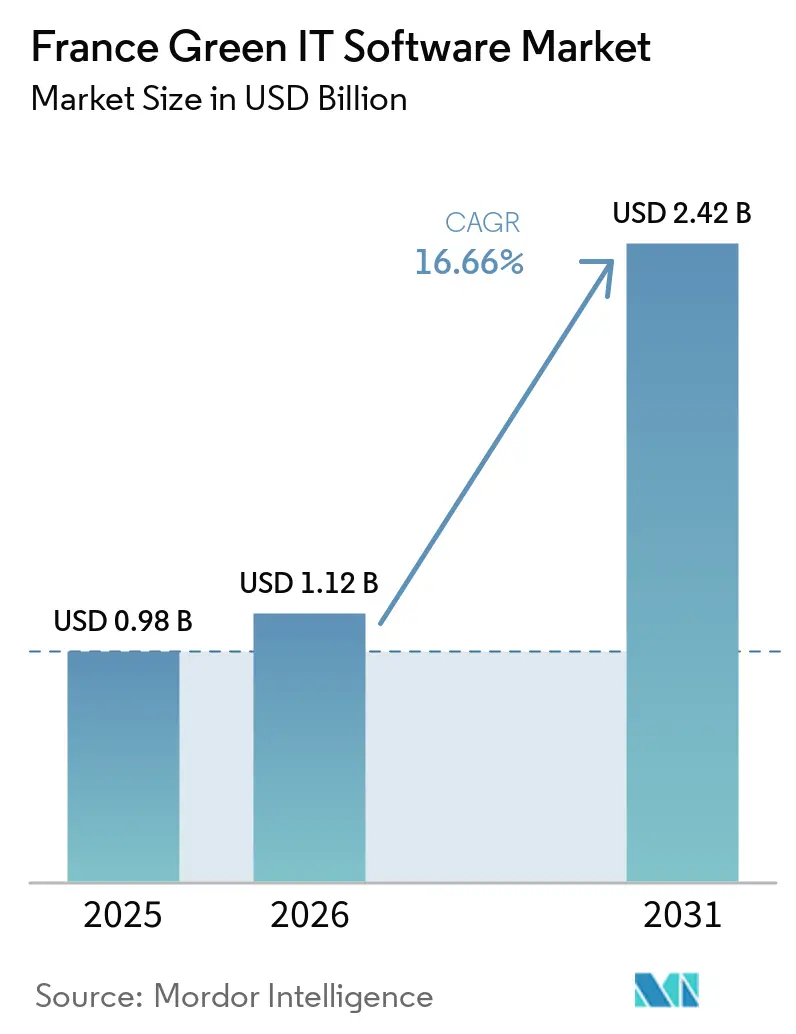
The France green IT software market is expected to grow from USD 0.98 billion in 2025 to USD 1.12 billion in 2026, and reach USD 2.42 billion by 2031, at a CAGR of 16.66% over 2026-2031. Growth is being supported by France’s early move on sustainability reporting rules, which pushed large companies to review carbon accounting and ESG reporting systems sooner than many peers in Europe. The overlap among the DPEF framework, EU Taxonomy Article 8 disclosures, and the Décret Tertiaire also sustains demand, as green software spending is tied to several reporting and energy management needs. The France green IT software market is also benefiting from the growing visibility of the digital sector’s environmental burden, especially the footprint of data centers and devices. Competitive activity remains active across global enterprise vendors and French specialists, with larger platforms using installed ERP, CRM, and reporting relationships, while local providers compete on language, local methods, and simpler onboarding. The Omnibus I changes created some uncertainty for mid-sized buyers in 2026, but supply chain disclosure pressure, telecom reporting obligations, and enterprise procurement requirements still support a durable demand base for the French green IT software market.
Key Report Takeaways
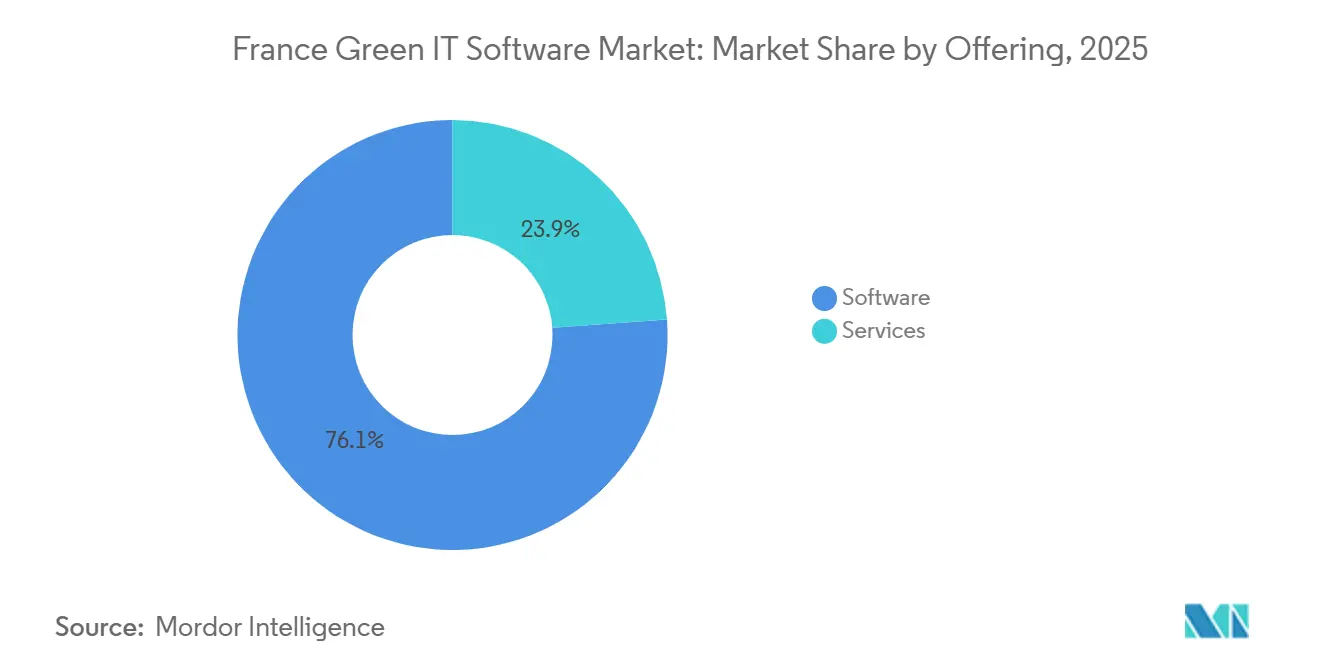
- By offering, software held 76.14% of the France green IT software market share in 2025, while services are projected to expand at a 16.91% CAGR through 2031.
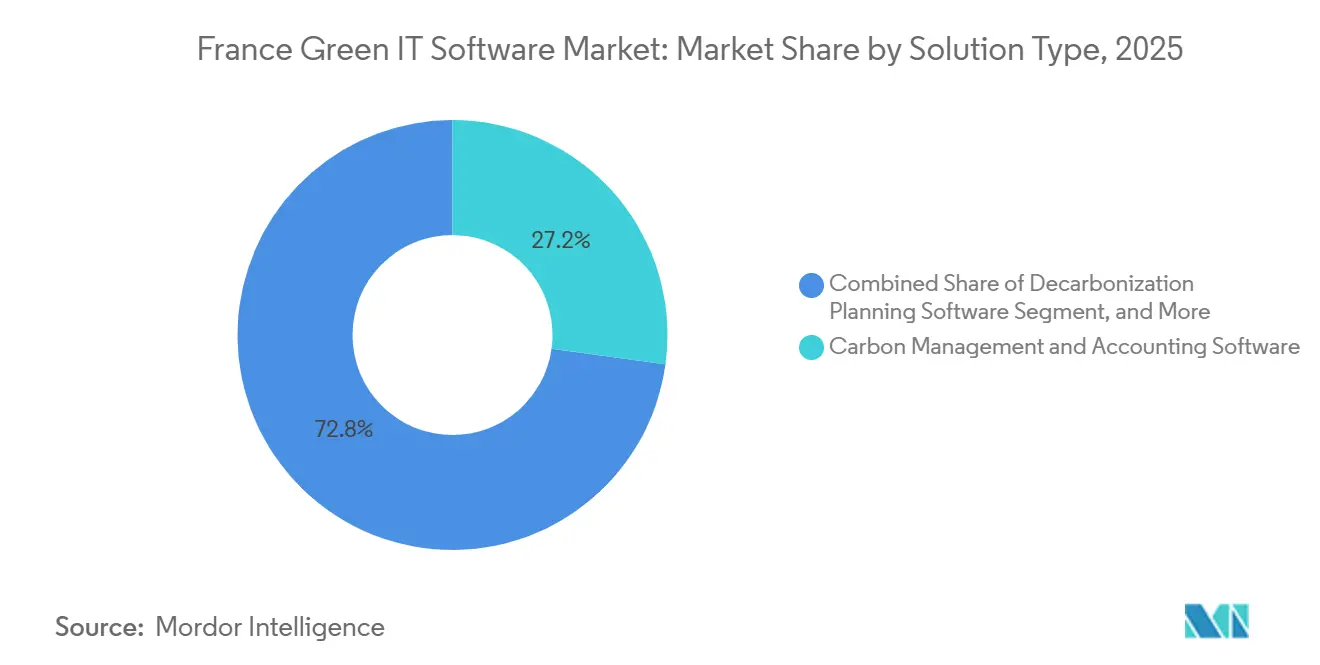
- By solution type, carbon management and accounting software accounted for 27.18% of the France green IT software market size in 2025, while decarbonization planning software is projected to grow at a 17.24% CAGR through 2031.
- By deployment, cloud-based delivery captured 64.17% of the market in 2025, while hybrid deployment is expected to expand at a 17.02% CAGR through 2031.
- By enterprise size, large enterprises held 69.12% share in 2025, while SMEs are projected to record the highest CAGR at 17.13% through 2031.
- By end user, IT and telecom led with 22.13% share in 2025, while energy and utilities are expected to expand at a 17.31% CAGR through 2031.
Note: Market size and forecast figures in this report are generated using Mordor Intelligence’s proprietary estimation framework, updated with the latest available data and insights as of January 2026.
France Green IT Software Market Trends and Insights
Drivers Impact Analysis*
| Driver | (~) % Impact on CAGR Forecast | Geographic Relevance | Impact Timeline |
|---|---|---|---|
| Strengthening EU and France Decarbonization Disclosure Pressure | +3.5% | National, with early compliance activity concentrated in Paris Île-de-France, Lyon, and Bordeaux | Short term (≤ 2 years) |
| Rising Corporate Demand for IT Emissions Visibility | +3.2% | National, with highest intensity among CAC 40 and SBF 120 companies | Short term (≤ 2 years) |
| Expansion Of Cloud Cost and Energy Optimization Use Cases | +2.8% | National, with early adoption in Paris Île-de-France cloud and data center corridors | Medium term (2-4 years) |
| Sustainability Procurement Requirements From Enterprise Buyers | +2.5% | National, with spill-over to EU supply chains | Medium term (2-4 years) |
| Automation of ESG Reporting Across IT Asset Portfolios | +2.3% | National, cross-sector enterprise adoption | Medium term (2-4 years) |
| AI-Driven Workload Optimization for Data Center Efficiency | +1.9% | National, with early gains concentrated in Paris-region hyperscale facilities | Long term (≥ 4 years) |
| Source: Mordor Intelligence | |||
Strengthening EU and France Decarbonization Disclosure Pressure
France moved ahead of many other European countries in implementing CSRD-related obligations, which gave local enterprises less time to delay platform selection and data preparation for sustainability reporting.[1] Large listed companies had already begun filing under the new framework in 2025, and other large companies are reporting in 2026 for the financial year 2025, which kept software demand tied to emissions accounting, ESRS mapping, and assurance-ready records. The Omnibus I Directive narrowed the mandatory scope to companies above the new employee and turnover thresholds, and that change reduced part of the direct mid-market pipeline in the short term. Even so, the France green IT software market still benefits when in-scope companies push sustainability data requests into their supplier base through procurement and compliance reviews. Oversight from the AMF and the need for audit-grade disclosures continue to favor software that can trace data quality, support controls, and prepare records for third-party assurance.
Rising Corporate Demand For IT Emissions Visibility
The France green IT software market is gaining from a basic measurement need, because the environmental weight of digital operations is now harder for enterprises to ignore. The ADEME and ARCEP study showed that the French digital sector accounted for 4.4% of the national carbon footprint, or 29.5 MtCO₂e, with data centers contributing 46% and terminals 50% of that total.[2] Electricity use at data centers connected to the public transmission network reached almost 1 TWh in 2025, up from 0.8 TWh in 2024, underscoring the need for closer monitoring of infrastructure use and stronger reporting controls. ARCEP’s 2025 environmental survey also showed that Orange, Bouygues Telecom, SFR, and Iliad recorded aggregate scope 2 emissions of 397,000 tCO₂e, a 4.2% year-on-year increase even as national emissions declined, reinforcing the case for sector-specific tracking tools. France’s low-carbon grid keeps domestic electricity emissions comparatively low, but that pushes many companies to focus more closely on imported digital use, overseas hosting exposure, and broader scope 3 accounting within the France green IT software market.
Expansion of Cloud Cost and Energy Optimization Use Cases
The link between energy efficiency, data center expansion, and cloud operating costs is also shaping the France green IT software market. French data center electricity demand could rise to 12 to 20 TWh by 2030 and up to 28 TWh by 2035 under current growth paths, which keeps energy management and optimization software relevant well beyond reporting needs.[3] That pressure is amplified by the Décret Tertiaire, which requires major energy reductions in tertiary buildings and makes energy tracking mandatory for covered facilities. As a result, enterprises are increasingly seeking tools that can integrate cloud consumption, asset utilization, and reporting workflows into a single system. The same data set that helps control infrastructure costs can also improve emissions tracking, internal target setting, and evidence for compliance programs. This is why the France green IT software market is moving beyond static reporting tools and toward platforms that link operational data with carbon and energy outcomes.
Sustainability Procurement Requirements From Enterprise Buyers
Enterprise procurement has become a practical growth channel for the France green IT software market, especially for suppliers that need to answer sustainability questionnaires from larger customers. Many CAC 40 companies have integrated EcoVadis scorecards and similar assessments into supplier qualification, thereby extending sustainability reporting pressure beyond the direct regulatory scope. EcoVadis reported in May 2026 that more than USD 2.5 trillion in global spend was governed through its sustainability intelligence platform and that more than 175,000 companies had been rated across 180+ countries. That procurement cascade matters because a supplier that receives repeated requests for emissions and sustainability data often needs dedicated software long before it is directly required by law. The result is that the France green IT software market is expanding through buyer mandates, supplier onboarding pressure, and multi-tier supply chain reporting needs, not only through direct reporting rules.[4]
Restraints Impact Analysis*
| Restraint | (~) % Impact on CAGR Forecast | Geographic Relevance | Impact Timeline |
|---|---|---|---|
| Fragmented IT and Facilities Data Across Legacy Environments | -2.5% | National, with concentration in manufacturing and industrial regions such as Nord, Hauts-de-France, and Grand Est | Medium term (2-4 years) |
| Integration Complexity With Existing ITSM, ERP, and Cloud Stacks | -2.0% | National, particularly among large enterprises with heterogeneous IT estates | Medium term (2-4 years) |
| Limited Internal Carbon Accounting Maturity in Mid-Market Firms | -1.8% | National, with greatest impact in SME-dense regions such as Nouvelle-Aquitaine and Occitanie | Long term (≥ 4 years) |
| Budget Prioritization Toward Core Cybersecurity and Cloud Projects | -1.5% | National, cross-sector | Short term (≤ 2 years) |
| Source: Mordor Intelligence | |||
Fragmented IT and Facilities Data Across Legacy Environments
A persistent constraint in the France green IT software market is that many companies still do not have clean, asset-level data across IT equipment, facilities, and hosting environments. ESRS E1 reporting needs detailed inputs for servers, network hardware, devices, and energy use, but legacy IT service management systems were not built for that level of environmental measurement. ARCEP’s 2025 environmental survey showed that equipment-level granularity remains difficult, even for large telecommunications operators already accustomed to structured reporting. ADEME updated its methodological framework for hosted IT and cloud services in 2025, yet adoption remains uneven across smaller operators and private environments. This means software value can fall short when inventories are incomplete, energy meters are inconsistent, and the underlying data structure is weaker than the reporting requirement.
Integration Complexity With Existing ITSM, ERP, and Cloud Stacks
The France green IT software market also faces a practical barrier in the form of long and costly system integration work. A useful sustainability data model usually depends on links across cloud billing records, procurement systems, finance tools, HR platforms, IT asset databases, and facility meters. SAP’s Green Ledger approach demonstrates the appeal of aligning carbon and financial records within a single architecture, but deployment still depends on data harmonization and internal process changes across large organizations. IBM and ServiceNow expanded their collaboration in June 2026 to unlock enterprise data for AI and operational workflows, which reflected the wider market need to modernize legacy application layers and make disconnected data usable. In large French groups with mixed on-premise and cloud estates, no single vendor can solve every connector, workflow, and governance issue through native integrations alone, which slows implementation and lengthens buying cycles.
*Our forecasts treat driver/restraint impacts as directional, not additive. The impact forecasts reflect baseline growth, mix effects, and variable interactions.
Segment Analysis
By Offering: Software Anchors Revenue While Services Scale With Enterprise Adoption
Software accounted for 76.14% of revenue in 2025, indicating that subscription platforms remain the core spending category in the France green IT software market. Carbon accounting, ESG reporting, sustainability data management, and energy optimization are primarily delivered through SaaS models that enable vendors to centrally update reporting rules and reduce client maintenance work. That model is useful in France, where reporting obligations continue to change, and enterprises want fewer manual adjustments each time disclosure expectations shift. The France green IT software industry therefore keeps leaning toward software first, because recurring platforms can absorb regulatory updates more efficiently than one-off internal builds.
Services are still important because implementation, advisory work, and managed reporting support are often needed before software can produce reliable results. Services are projected to grow at a 16.91% CAGR through 2031, making them the fastest-growing segment of the France green IT software market. Many companies still lack internal sustainability specialists who can structure emissions boundaries, align methods, and prepare audit-ready workflows. Schneider Electric’s advisory network, which exceeded 4,000 consultants in its 2026 Impact 2030 update, shows the scale of support that large enterprise customers are seeking around these deployments. Smaller specialist firms are also finding room in this segment because mid-sized French clients often prefer local guidance tied to national reporting practices and practical onboarding.
By Deployment: Cloud-Based Platforms Lead While Hybrid Gains On Data Control Needs
Cloud-based deployment captured 64.17% of the France green IT software market size in 2025, which confirms that vendor-managed delivery is the preferred model for many enterprise buyers. The main advantage is not only convenience, but also the ability to handle continuous updates in ESRS rules, taxonomy disclosures, and reporting templates without long internal upgrade cycles. For many enterprises, the SaaS approach also shortens implementation and reduces the burden on already stretched IT teams. This keeps cloud delivery at the center of the France green IT software market even as reporting needs become more complex.
Hybrid deployment is projected to grow at a 17.02% CAGR through 2031, mainly because regulated sectors need more control over where sustainability data is processed and stored. Banking, insurance, government, and healthcare users often want domestic or tightly governed infrastructure for sensitive operational and reporting data. This demand is sustaining hybrid architectures that mix cloud flexibility with local control requirements. On-prem deployments still exist in industrial and defense-linked settings, but their role is gradually narrowing as vendors focus more on cloud- and hybrid-based product paths. Sovereign and private cloud arrangements from providers such as OVHcloud are also helping bridge the gap between compliance concerns and the convenience of external hosting.
By Enterprise Size: Large Enterprises Lead Spending While SMEs Accelerate
Large enterprises held a 69.12% share in 2025, reflecting their status as the first major buyers in the France green IT software market during the earliest CSRD reporting waves. These companies already run large ERP, CRM, and reporting environments, so sustainability modules can often be added through existing vendor relationships rather than built from scratch. That creates larger contract values and faster cross-sell opportunities for established platform vendors. It also means enterprise demand has been concentrated among organizations with the budget, staffing, and compliance pressure to move first.
SMEs are projected to grow at a 17.13% CAGR through 2031, making them the fastest-expanding segment of the France green IT software market. This shift is not being driven solely by regulation, as many smaller firms are moving in response to customer procurement demands and supplier disclosure requests. The France green IT software industry is seeing this effect most clearly where CAC 40 buyers push sustainability requirements into tier-1 and tier-2 supply chains. Platforms built for smaller companies are lowering the barrier with simpler onboarding, pre-built templates, and lighter reporting workflows. Greenly’s focus on companies with 20 to 2,000 employees, and its March 2024 Series B of EUR 48 million (USD 51.94 million), illustrate how vendor investment is following that SME opportunity.
By Solution Type: Carbon Accounting Leads While Planning Tools Move into Execution
Carbon management and accounting software accounted for 27.18% of the market share in 2025, making it the largest solution type in the France green IT software market. This leadership is logical because emissions calculation forms the foundation for ESRS E1 compliance, scope 1, 2, and 3 reporting, and broader climate disclosure workflows. ESG reporting and compliance tools remain close behind, as companies need structured outputs aligned with formal frameworks and audit requirements. Sustainability data management platforms are also gaining importance, since they connect operational sources with reporting records and help maintain traceability across multiple systems.
Decarbonization planning software is projected to grow at a 17.24% CAGR through 2031, showing that buyers are shifting from measurement toward action. This segment is becoming more relevant as companies look to translate emissions baselines into capital plans, supplier initiatives, and operational targets. Workiva’s May 2026 addition of an AI-powered intelligence module illustrates how reporting tools are evolving into continuous, interactive platforms. Energy and resource optimization software also plays a key role, since the French market is not only about disclosure but also about reducing power use and documenting compliance with energy-related obligations. The result is a broader solution mix in which carbon accounting still anchors budgets, while planning and optimization tools steadily gain strategic relevance.

By End User: IT And Telecom Holds The Largest Share While Energy and Utilities Grows Fastest
IT and telecom held 22.13% share in 2025, making it the leading end-user group in the France green IT software market. The sector has a direct need for these tools because it manages networks, data centers, connected equipment, and device fleets that carry measurable environmental impact. ARCEP’s 2025 survey showed that the four major French telecom operators recorded aggregate scope 2 emissions of 397,000 tCO₂e, which underlined the sector’s need for accurate infrastructure-level tracking. As a result, this group often serves as both a software buyer and a practical test case for the methods these platforms must support.
Energy and utilities is projected to grow at a 17.31% CAGR through 2031, making it the fastest-growing end-user segment in the France green IT software market size outlook. Stronger demand is coming from this vertical due to taxonomy alignment, REPowerEU targets, and domestic transition plans, which increase the need for documented emissions and energy data. BFSI is also a major user group, as climate reporting and governance expectations remain high for financial institutions. Manufacturing demand is rising as product-level emissions tracking becomes more important across the value chain and feeds back into enterprise data systems. Government and healthcare remain smaller segments today, but both are expanding as public reporting and controlled data environments create room for specialized deployments.
Geography Analysis
France’s position in Europe is supported by a 16.66% CAGR through 2031, which places the France green IT software market on a faster growth path than several more mature Western European peers. France moved earlier on disclosure-led adoption because it implemented CSRD-related obligations ahead of many neighboring markets, creating a head start in procurement and systems preparation. Germany still leads in absolute regional revenue because of its larger industrial base and wider set of reporting-heavy corporate groups. The United Kingdom also remains a strong market due to its listed company disclosure practices and the weight of its financial services sector. Even so, the France green IT software market is expanding from a favorable point where regulation, enterprise scale, and supply chain pressure are all moving in the same direction.
A major structural difference for France is its low-carbon electricity system, which recorded 19.6 gCO₂e/kWh in 2025 and nearly 95% of generation from low-carbon sources. That reduces the relative importance of domestic scope 2 electricity sourcing compared with countries where grid emissions remain much higher. It also shifts more software demand toward value-chain accounting, imported digital usage, and efficiency-led optimization rather than simple renewable-power substitution. Data centers connected to the public transmission network consumed almost 1 TWh in 2025, and national demand projections point to a much larger load over time, keeping energy management software relevant in the France green IT software market.
Paris Île-de-France remains the main concentration point because it hosts many CAC 40 headquarters, major buyers, and local offices of global software vendors. Lyon, Toulouse, and Bordeaux are also becoming more active as regional business groups build stronger sustainability reporting programs. France also stands out for the number of domestic platforms active in this space, including Sweep, Greenly, EcoVadis, and Enableon SAS. Compared with the Netherlands and Nordic markets, France combines a strong compliance push with a local vendor base that competes well in language-specific and mid-market use cases. Southern Europe still offers a broader expansion opportunity for French vendors looking to bring CSRD-linked capabilities into less mature markets over time.
Competitive Landscape
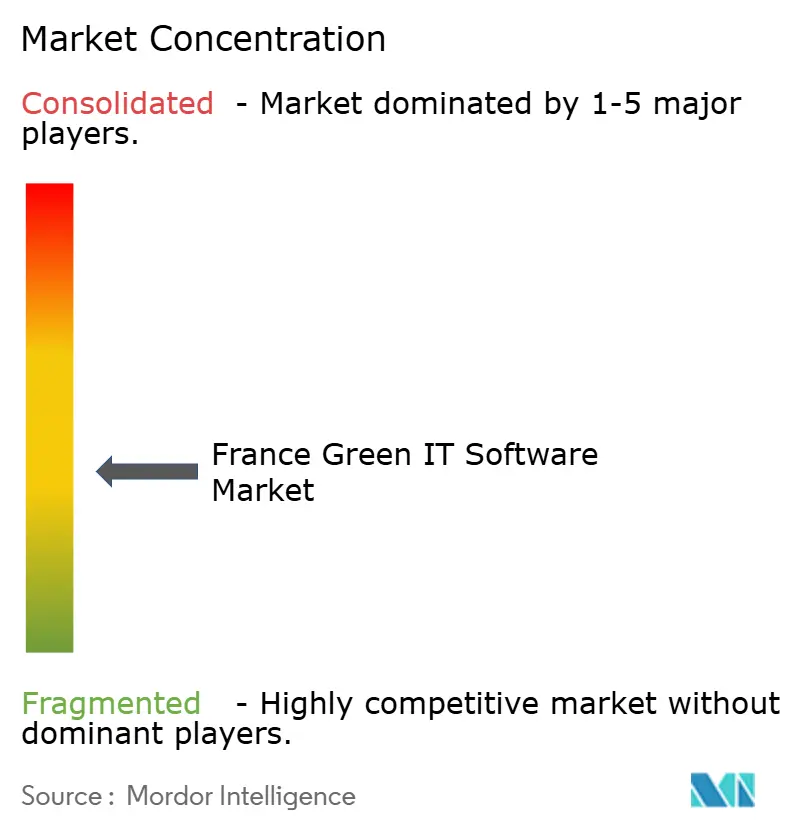
The France green IT software market remains moderately fragmented, especially in the mid-market, while large platform vendors with existing customer relationships more shape the enterprise tier. SAP, Microsoft, IBM, Salesforce, and Workiva benefit from installed bases in ERP, CRM, finance, and IT management systems, which gives them a clear route to cross-sell sustainability modules. This structure creates high switching costs for large companies, because sustainability features can be added inside platforms they already use for core operations. At the same time, it leaves room for local specialists to respond more quickly to French-language needs, domestic methods, and lighter deployment models. The result is a competitive field where scale matters, but local fit still has real value in the France green IT software market.
French challengers continue to defend positions in supply chain sustainability, carbon accounting, and SME-focused workflows. EcoVadis remains especially visible because its assessment model is deeply tied to enterprise procurement practices, and the company reported USD 2.5 trillion in governed spend in May 2026. In April 2026, EcoVadis partnered with Google Cloud to strengthen AI-enabled supplier assessment and sustainability intelligence capabilities, which showed a clear push toward broader platform depth. Greenly also remains relevant in the SME segment, where ease of use, ADEME-aligned methods, and simpler onboarding can matter more than broad enterprise functionality.
Larger incumbents are also widening their role through adjacent capabilities. Schneider Electric expanded Resource Advisor+ in early 2026 as a more unified platform across emissions, energy, supply chain sustainability, climate risk, and reporting, supported by a sizable advisory network. IBM and ServiceNow expanded their collaboration in June 2026 around enterprise data readiness, which matters because disconnected system estates often slow the realization of sustainability software value. The main white space still sits in mid-market decarbonization planning, where many companies want a practical link between emissions accounting, supplier action, and investment planning but do not need the full complexity of large enterprise suites. That balance between global scale and local specialization will keep shaping competition in the France green IT software market over the forecast period.
France Green IT Software Industry Leaders
-
Microsoft Corporation
-
Salesforce, Inc.
-
SAP SE
-
Schneider Electric SE
-
IBM Corporation
- *Disclaimer: Major Players sorted in no particular order
Recent Industry Developments
- June 2026: IBM and ServiceNow announced an expanded collaboration to address legacy application modernization and enterprise AI data readiness, combining IBM's AI and automation capabilities with ServiceNow's AI platform to unlock enterprise data for sustainability and operational workflows. Joint solutions are expected to be available in the second half of 2026.
- April 2026: EcoVadis entered a partnership with Google Cloud, adopting Gemini Enterprise's agentic AI platform to enhance internal operations and client sustainability intelligence workflows, with the collaboration focused on accelerating AI-assisted supplier assessment and decarbonization planning capabilities at scale.
- February 2026: The EU Omnibus I Directive (EU 2026/470) was published in the Official Journal on 26 February 2026 and entered into force on 18 March 2026, narrowing mandatory CSRD scope to companies with more than 1,000 employees and EUR 450 million in net turnover, with France given until 19 March 2027 to transpose the changes into national law.
- October 2025: EcoVadis received the Microsoft Local Partner Award FY25 in the AI Transformation - Scale category, recognizing its multi-year collaboration with Azure Machine Learning and its application of natural language processing to improve scalability and traceability of supplier sustainability assessments.
France Green IT Software Market Report Scope
The France Green IT Software market refers to platforms and services that enable French enterprises to integrate sustainability into IT operations by managing carbon emissions, optimizing energy and resource consumption, and ensuring compliance with ESG frameworks. These solutions include carbon management and accounting, ESG reporting and compliance, sustainability data management, decarbonization planning, and energy optimization software. By embedding sustainability intelligence into IT workflows, these platforms help organizations across France reduce environmental impact, enhance operational efficiency, and align with EU-level climate commitments and national decarbonization goals. The market’s primary objective is to provide transparency, automate sustainability reporting, and support the transition toward greener, more resilient digital infrastructure across diverse industries.
The France Green IT Software market report is segmented by Offering (Software, and Services), Deployment (Cloud-Based, On-Premise, and Hybrid), Enterprise Size (Large Enterprises, and Small and Medium Enterprises), Solution Type (Carbon Management and Accounting Software, ESG Reporting and Compliance Software, Sustainability Data Management Platforms, Decarbonization Planning Software, and Energy and Resource Optimization Software), End User (IT and Telecom, BFSI, Manufacturing, Energy and Utilities, Retail and E-Commerce, Government, Healthcare, Construction and Infrastructure, and Other End-User Industries). The Market Forecasts are Provided in Terms of Value (USD).
| Software |
| Services |
| Cloud-Based |
| On-Premise |
| Hybrid |
| Large Enterprises |
| Small and Medium Enterprises |
| Carbon Management and Accounting Software |
| ESG Reporting and Compliance Software |
| Sustainability Data Management Platforms |
| Decarbonization Planning Software |
| Energy and Resource Optimization Software |
| IT and Telecom |
| BFSI |
| Manufacturing |
| Energy and Utilities |
| Retail and E-Commerce |
| Government |
| Healthcare |
| Construction and Infrastructure |
| Other End-User Industries |
| By Offering | Software |
| Services | |
| By Deployment | Cloud-Based |
| On-Premise | |
| Hybrid | |
| By Enterprise Size | Large Enterprises |
| Small and Medium Enterprises | |
| By Solution Type | Carbon Management and Accounting Software |
| ESG Reporting and Compliance Software | |
| Sustainability Data Management Platforms | |
| Decarbonization Planning Software | |
| Energy and Resource Optimization Software | |
| By End User | IT and Telecom |
| BFSI | |
| Manufacturing | |
| Energy and Utilities | |
| Retail and E-Commerce | |
| Government | |
| Healthcare | |
| Construction and Infrastructure | |
| Other End-User Industries |
Key Questions Answered in the Report
What is the current and forecast value of the France green IT software market?
The France green IT software market size stood at USD 0.98 billion in 2025, reached USD 1.12 billion in 2026, and is forecast to reach USD 2.42 billion by 2031 at a 16.66% CAGR.
What is driving software demand in France for green IT platforms?
Early CSRD-related compliance activity, DPEF obligations, EU Taxonomy reporting, and the Décret Tertiaire are all supporting enterprise demand for carbon accounting, ESG reporting, and energy optimization tools.
Which offering segment leads revenue in France?
Software led with a 76.14% share in 2025, reflecting the strong role of SaaS-based carbon accounting and sustainability data platforms across large enterprises.
Which deployment model is growing the fastest?
Hybrid deployment is projected to grow at a 17.02% CAGR through 2031, mainly because regulated sectors want stronger control over data processing and residency.
Which enterprise group is expanding fastest in France?
SMEs are projected to grow at a 17.13% CAGR through 2031 as procurement pressure from large buyers and easier onboarding by specialist vendors widen adoption.
Which end-user segment is likely to grow the fastest?
Energy and utilities is expected to expand at a 17.31% CAGR through 2031, supported by taxonomy alignment, transition targets, and the need for better operational emissions data.