
CAD/CAM GPU Market Size and Share
Market Overview
| Study Period | 2020 - 2031 |
|---|---|
| Market Size (2026) | USD 3.48 Billion |
| Market Size (2031) | USD 8.02 Billion |
| Growth Rate (2026 - 2031) | 18.17 % |
| Fastest Growing Market | Asia-Pacific |
| Largest Market | North America |
| Market Concentration | High |
Major Players *Disclaimer: Major Players sorted in no particular order Image © Mordor Intelligence. Reuse requires attribution under CC BY 4.0. | |
CAD/CAM GPU Market Analysis by Mordor Intelligence
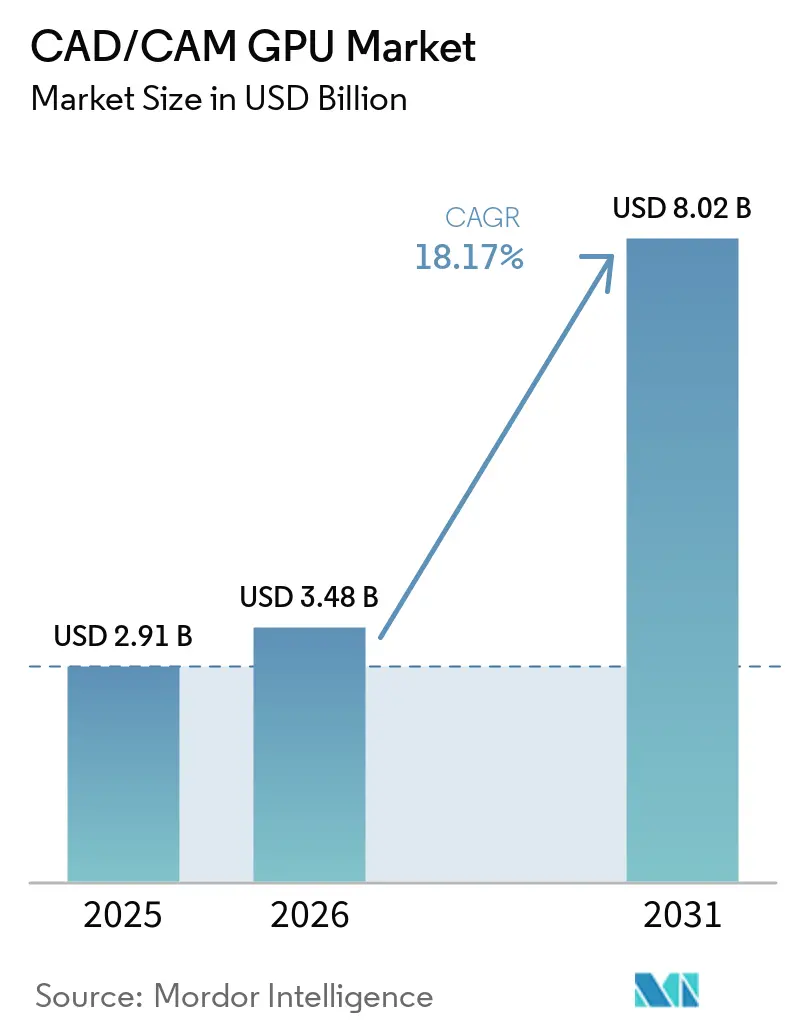
The CAD/CAM GPU market size is projected to be USD 2.91 billion in 2025, USD 3.48 billion in 2026, and reach USD 8.02 billion by 2031, growing at a CAGR of 18.17% from 2026 to 2031. The CAD/CAM GPU market is expanding because engineering and manufacturing teams now use GPU computing across design iteration, simulation coordination, and fabrication planning instead of limiting it to visualization alone. The CAD/CAM GPU market is also being shaped by AI-assisted generative design, real-time digital twin deployment, and hybrid workstation and cloud setups that change how compute resources are assigned across programs and plants. Software-led changes are widening demand because newer design and simulation workflows increasingly depend on modern GPU capability, which supports steadier upgrade demand even when buyers do not refresh every system at once. Supply tightness and higher professional GPU costs are pushing buyers to compare certified discrete cards with lower-cost integrated options, which is widening the addressable base while also stretching approval cycles for premium purchases. Competition in the Computer-Aided Design / Computer-Aided Manufacturing (CAD/CAM) GPU market, therefore, centers on software compatibility, memory capacity, deployment flexibility, and ecosystem depth, while opportunities remain strongest in simulation-heavy manufacturing, factory digital twins, and AI-enabled engineering workflows.
Key Report Takeaways
- By GPU product type, desktop professional and workstation discrete GPUs held 56.77% of revenue in 2025, while integrated and unified-memory GPUs are projected to expand at an 18.66% CAGR through 2031.
- By GPU Platform/Architecture, NVIDIA GPU Platform accounted for 77.33% of revenue in 2025, while the Intel GPU platform is projected to record the fastest 19.21% CAGR through 2031.
- By application, computer-aided design and 3D modeling held 38.18% of revenue in 2025, while rendering, visualization, and digital twins are projected to advance at an 18.91% CAGR through 2031.
- By end user, industrial machinery and heavy equipment accounted for 22.86% of revenue in 2025, while electronics and semiconductor is projected to grow at an 18.33% CAGR through 2031.
- By geography, North America held 35.16% of the CAD/CAM GPU market size in 2025, while Asia-Pacific is projected to expand at a 19.04% CAGR through 2031.
Note: Market size and forecast figures in this report are generated using Mordor Intelligence’s proprietary estimation framework, updated with the latest available data and insights as of January 2026.
Global CAD/CAM GPU Market Trends and Insights
Drivers Impact Analysis*
| Driver | (~) % Impact on CAGR Forecast | Geographic Relevance | Impact Timeline |
|---|---|---|---|
| Rising Demand for Real-Time CAD and CAM Workflows | +4.5% | Global | Short term (≤ 2 years) |
| Expansion of AI-Assisted Generative Design and Rendering | +3.8% | North America and Europe | Medium term (2-4 years) |
| Growth in Digital Twin and Simulation-Heavy Engineering Programs | +3.2% | Global, with APAC acceleration | Medium term (2-4 years) |
| Wider Adoption of Hybrid On-Premises and Cloud-Based Design Environments | +2.4% | North America and Europe | Medium term (2-4 years) |
| Increasing GPU Use in High-Mix, Low-Volume Manufacturing Workflows | +1.8% | Asia-Pacific and North America | Long term (≥ 4 years) |
| Rising Need for Remote Collaborative Visualization and Review | +1.5% | Global | Medium term (2-4 years) |
| Source: Mordor Intelligence | |||
Rising Demand For Real-Time CAD And CAM Workflows
The CAD/CAM GPU market is being lifted by the growing need for real-time responsiveness in professional design and manufacturing software. Large assemblies, multi-viewport work, and simulation-linked design reviews now place more pressure on GPU memory and parallel compute than on CPU speed alone. NVIDIA launched the RTX PRO Blackwell workstation lineup in March 2025, including the RTX PRO 6000 Workstation Edition with 96GB of GDDR7 memory, which shows how vendor roadmaps are targeting heavier professional workloads. This matters for the CAD/CAM GPU market because design teams increasingly expect smooth handling of complex models, simulation output, and review tasks inside the same workstation session. It also shortens the practical life of older hardware, because new workflow demands can expose memory and throughput limits before normal replacement cycles end. As a result, workstation vendors are aligning product launches with professional GPU upgrades rather than treating graphics as a secondary system component.
Expansion Of AI-Assisted Generative Design And Rendering
The CAD/CAM GPU market is also being supported by the spread of AI-assisted design and rendering tools across engineering workflows. New professional cards are adding AI-focused acceleration in a way that improves modeling, rendering, and design iteration inside compact and full-size systems. NVIDIA introduced the RTX PRO 2000 Blackwell in August 2025 and reported up to 1.4x faster CAD performance and 1.6x faster 3D modeling than its prior generation, which shows how AI-enabled gains are moving into mainstream workstation tiers.[1]NVIDIA Corporation, “NVIDIA Blackwell Architecture Powers AI Acceleration in Compact Workstations,” NVIDIA Blog, blogs.nvidia.com AMD also positioned the Radeon AI PRO R9700 with 32GB of GDDR6 and 128 AI accelerators for workstation deployments in July 2025, which widened the set of options for engineering studios seeking AI-ready graphics hardware.[2]AMD, “AMD Radeon AI PRO R9700 to Be Available in Workstation,” AMD Blog, amd.com This shift is important for the CAD/CAM GPU market because rendering and design tasks that once required offloading can now be completed faster on a single workstation. It also raises the baseline for memory bandwidth and local AI processing in professional systems, which strengthens replacement demand across established engineering teams.
Growth In Digital Twin And Simulation-Heavy Engineering Programs
The CAD/CAM GPU market is gaining from the wider use of digital twins and simulation-led engineering programs across manufacturing environments. These programs require continuous visualization, scenario testing, and model updates, which increases the need for high-memory GPU compute over time. PepsiCo said in 2025 that its collaboration with Siemens and NVIDIA delivered a 20% throughput increase, a 10-15% reduction in capital expenditure, and early identification of up to 90% of potential issues before physical modification, which shows why digital twin investments now attract operational budgets as well as design budgets.[3]PepsiCo, Inc., “PepsiCo Announces Industry-First AI and Digital Twin Collaboration with Siemens and NVIDIA,” PepsiCo Newsroom, pepsico.com NVIDIA also announced in June 2025 an industrial AI cloud in Germany with 10,000 GPUs and early participation from BMW Group, Cadence, and Siemens, which confirms that digital twin demand is moving across regions and industrial verticals. The CAD/CAM GPU market benefits because these deployments create a recurring need for both local workstation performance and larger shared compute environments. They also tie hardware demand more closely to software platform adoption and production planning cycles, which makes GPU spending less episodic than in older visualization-led buying patterns.
Wider Adoption Of Hybrid On-Premises And Cloud-Based Design Environments
The CAD/CAM GPU market is being broadened by hybrid design environments that combine local workstations with cloud GPU capacity. This model allows teams to keep latency-sensitive design operations on-premises while shifting rendering, simulation bursts, and shared review tasks to external compute resources. Google Cloud made its G4 virtual machines with NVIDIA RTX 6000 Blackwell GPUs generally available in 2026, and it also enabled Omniverse deployment through the marketplace, which reflects how professional GPU access is expanding without full hardware procurement cycles. That change matters for the CAD/CAM GPU market because firms that could not justify top-end workstation fleets can now access higher-grade graphics resources when needed. It also supports wider use of professional visualization and simulation tools across service firms, project-based teams, and geographically distributed engineering groups. Over time, hybrid adoption is likely to support both workstation demand and server-grade professional GPU sales rather than replacing one with the other.
Restraints Impact Analysis*
| Restraint | (~) % Impact on CAGR Forecast | Geographic Relevance | Impact Timeline |
|---|---|---|---|
| High Total Cost of Ownership of Professional-Grade GPUs | -2.1% | Global | Short term (≤ 2 years) |
| Driver Certification and Software Compatibility Constraints | -1.6% | Global | Medium term (2-4 years) |
| Supply Chain Volatility in Advanced Nodes, Memory, and Interconnects | -1.2% | Global | Short term (≤ 2 years) |
| Power, Thermal, and Form-Factor Limits in Dense Workstations | -0.8% | North America and Europe | Medium term (2-4 years) |
| Source: Mordor Intelligence | |||
High Total Cost Of Ownership Of Professional-Grade GPUs
The CAD/CAM GPU market still faces a clear adoption limit in the total cost of ownership tied to professional systems. The cost is not limited to the graphics card, because buyers also need certified drivers, workstation validation, power delivery, cooling support, and, in some cases, broader infrastructure changes. NVIDIA positioned the RTX PRO 6000 Blackwell Workstation Edition at the top end of the stack with a 96GB frame buffer and workstation-class performance, which highlights why premium deployments can become expensive even before integration costs are counted. AMD also launched the Radeon PRO W7400 in August 2025 as a lower-power entry option, which shows that suppliers recognize the need for cost-controlled alternatives in compact professional systems. Even so, performance trade-offs can limit the appeal of lower-cost options in production-critical engineering work. This leaves the CAD/CAM GPU market with a split demand pattern, where large enterprises can absorb premium system costs while smaller firms stretch refresh cycles or reduce configuration levels.
Driver Certification And Software Compatibility Constraints
The CAD/CAM GPU market is also held back by the slow and careful validation process required for certified engineering deployments. Professional users often cannot treat a new GPU as a simple hardware swap, because driver versions and application compatibility must be checked across each software environment. AMD’s PRO Edition 26.Q1 release in 2026 focused on maintaining ISV certifications and expanding compatibility for workstation users, which shows how much weight the market places on stable certified software stacks. This issue matters because design teams in regulated and mission-critical settings cannot risk broken workflows after a driver change or operating system update. It also slows platform entry for newer vendors, because performance alone does not remove trust barriers in production use. For the CAD/CAM GPU market, certification remains a practical gate that shapes adoption speed, refresh timing, and vendor choice across the most demanding user groups.
*Our forecasts treat driver/restraint impacts as directional, not additive. The impact forecasts reflect baseline growth, mix effects, and variable interactions.
Segment Analysis
By GPU Product Type: Discrete Workstations Hold The Core Base While Integrated Designs Expand Reach
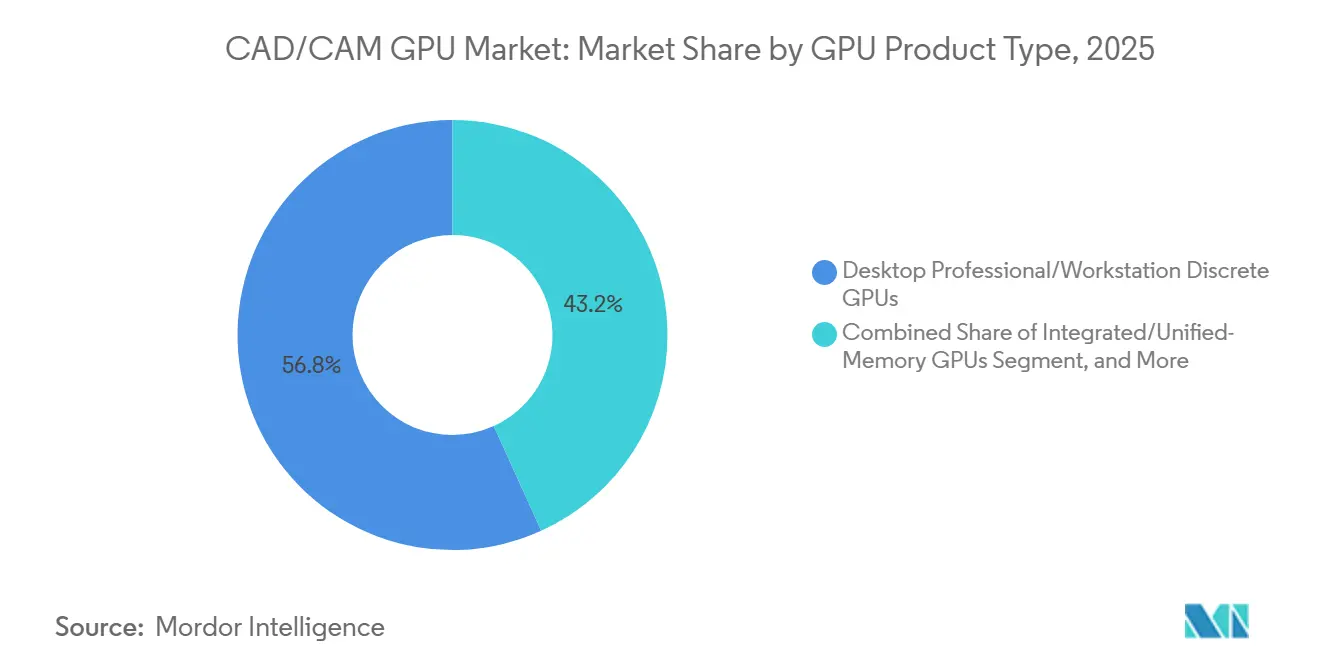
Desktop professional and workstation discrete GPUs held 56.77% of revenue in 2025, which kept them as the largest product group in the CAD/CAM GPU market. That lead came from strong demand in large-assembly CAD, multi-physics simulation, and high-fidelity rendering, where higher VRAM capacity and stable certification remain essential. These systems are still the default choice in tier-one engineering environments that manage dense models, multiple active views, and simulation-heavy project reviews. They also remain central in the CAD/CAM GPU industry, where uptime, application stability, and predictable certified behavior matter more than entry cost. Mobile professional and workstation discrete GPUs form the next layer of demand, because they support field engineering, client-site work, and distributed project teams that still need certified graphics performance.
Integrated and unified-memory GPUs are projected to grow at an 18.66% CAGR from 2026 to 2031, making them the fastest-expanding product type in the CAD/CAM GPU market. Their growth reflects improving capability in mainstream 2D drafting and lighter 3D work, where a separate, discrete card is no longer required in every professional setup. The product mix is therefore splitting into premium discrete systems for complex simulation and more efficient integrated platforms for smaller firms, education users, and entry-level professional workflows. AMD’s Radeon PRO W7400, introduced for compact workstation environments at 55W, also shows how vendors are trying to serve constrained form factors without leaving the professional segment entirely. Other professional GPU configurations, including virtualized and server-linked setups, remain smaller in share but are growing in importance as cloud-delivered workstation models become more common across the CAD/CAM GPU market.



By GPU Platform / Architecture: NVIDIA Keeps Scale While Intel And AMD Push Into Openings
The NVIDIA platform held 77.33% of revenue in 2025, which gave it the leading position in the CAD/CAM GPU market share at the platform level. That position reflects not only hardware strength, but also the scale of CUDA-based workflows, Omniverse alignment, and broad certification coverage across widely used engineering software. In practical terms, the platform remains deeply embedded in procurement standards for many large enterprises, which raises switching costs even when performance gaps narrow. This has helped NVIDIA keep the strongest installed base in the CAD/CAM GPU market, especially in design environments that place high value on long-term software support. The same position also allows NVIDIA to influence upgrade timing through both hardware launches and ecosystem expansion.
The Intel GPU platform is projected to record the fastest 19.21% CAGR from 2026 to 2031, which points to a gradual opening at the value and mainstream professional tiers. Intel’s rise is linked to growing confidence in its professional graphics stack and a strategy that targets cost-sensitive workstation use cases first. AMD remains a credible alternative where buyers want strong visualization capability without accepting the highest premium, and its Radeon AI PRO R9700 added a clearer AI-ready option to that discussion in 2025. The CAD/CAM GPU industry is therefore becoming more competitive below the top tier, even if platform leadership still sits firmly with NVIDIA. Other platform options remain limited in professional CAD and CAM use, but they are being watched in virtual workstation and AI-in-design environments where software stacks may evolve faster.
By Application: CAD And 3D Modeling Stay Foundational While Digital Twins Accelerate
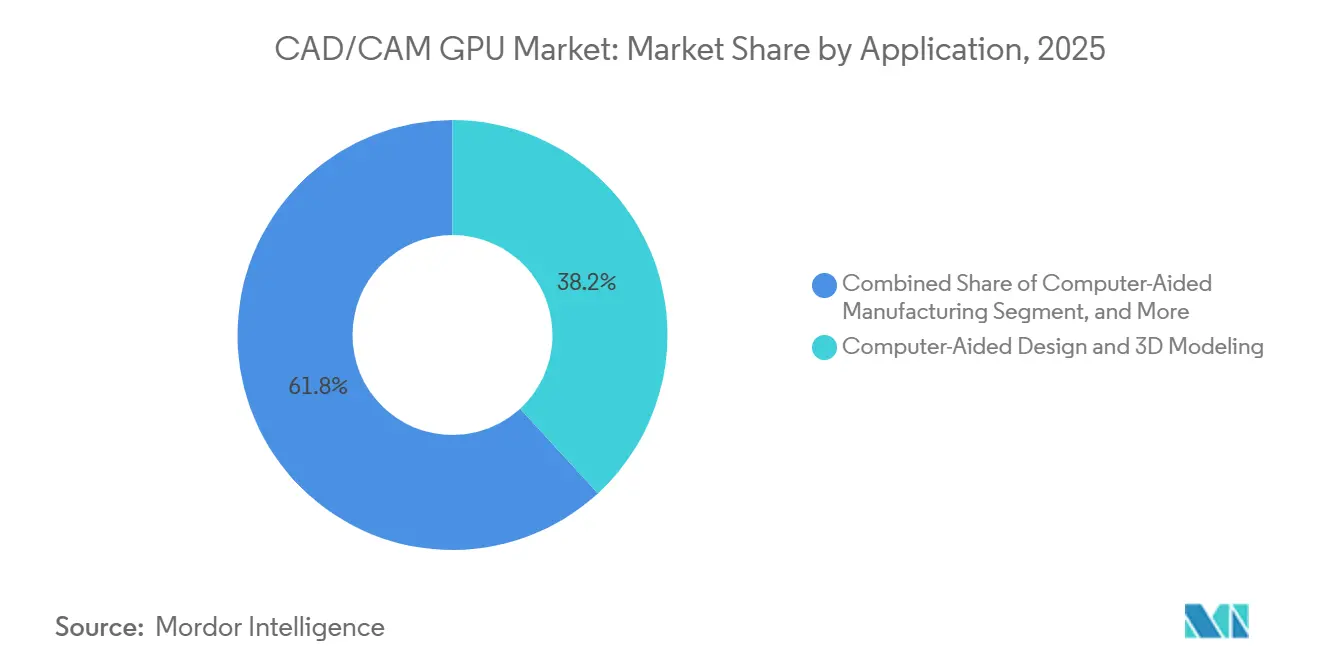
Computer-aided design and 3D modeling held 38.18% of revenue in 2025, which made it the largest application area in the CAD/CAM GPU market. This reflects the fact that most professional GPU deployments still begin with core design work before extending into simulation, rendering, and factory-oriented use cases. The segment remains structurally strong because model complexity continues to rise, and because smooth visual interaction has become essential to design productivity rather than a secondary feature. It also supports adjacent demand, since application needs in simulation, collaboration, and review often build on the same installed graphics base. In that sense, CAD and 3D modeling remain the anchor workload that stabilizes the CAD/CAM GPU market through changing software cycles.
Rendering, visualization, and digital twins are projected to grow at an 18.91% CAGR from 2026 to 2031, making them the fastest-growing application in the CAD/CAM GPU market. Their momentum comes from factory planning, process validation, and real-time simulation needs that require both graphics output and continuous compute intensity. NVIDIA expanded its Omniverse Blueprint for AI factory digital twins in 2025, and BMW Group and PepsiCo were identified as users for production planning and validation use cases. PepsiCo’s separate 2025 update on its Siemens and NVIDIA collaboration also showed that digital twin use is now tied to measurable operational results rather than stand-alone visualization projects. Computer-aided manufacturing and computer-aided engineering remain large adjacent application groups, because toolpath simulation, process verification, CFD, FEA, and structural analysis continue to demand higher memory and stable graphics throughput inside the CAD/CAM GPU market.
By End User: Heavy Industry Provides Scale While Semiconductor Demand Builds Speed
Industrial machinery and heavy equipment held 22.86% of revenue in 2025, which made it the largest end-user group in the CAD/CAM GPU market size. This segment depends on workstation graphics for structural simulation, complex toolpath work, and collaborative design review in settings where physical prototyping is expensive and time-consuming. Automotive remained another large user base, with GPU workstations tied to surfacing, virtual testing, and production planning workflows. Aerospace and defense also retained an important role, because many programs still require certified on-premises environments for security and compliance reasons. Architecture, engineering, and construction continued to build demand as BIM, visual review, and project simulation became more detailed and compute intensive across large design programs.
Electronics and semiconductors are projected to grow at an 18.33% CAGR from 2026 to 2031, which makes them the fastest-expanding end-user group in the CAD/CAM GPU market. Growth here reflects the rising use of digital twins, process modeling, and accelerated design iteration in fab and chip-related environments. The broader pattern is that semiconductor-linked users increasingly treat simulation and virtual validation as a necessary part of operational efficiency rather than an optional engineering layer. That change supports both high-end workstation demand and larger shared GPU infrastructure, especially where production interruptions carry major cost. Other users, including research, healthcare, dental design, and academic simulation, still represent smaller shares, but they add a meaningful secondary demand layer to the CAD/CAM GPU market as certified workflows spread.
Geography Analysis
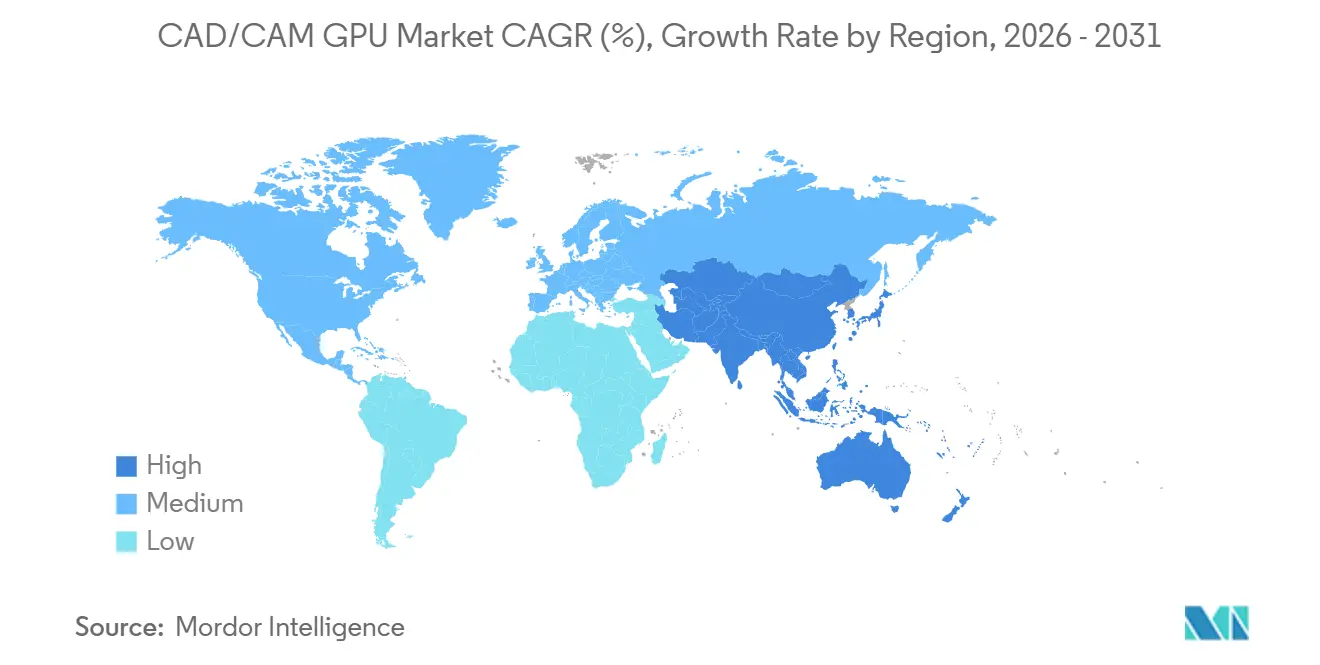
North America held 35.16% of revenue in 2025, which gave it the leading position in the CAD/CAM GPU market share by geography. The region benefits from the close concentration of aerospace contractors, automotive design operations, semiconductor facilities, and defense engineering programs across the United States, Canada, and Mexico. That combination supports steady demand for certified workstation systems, especially in sectors that cannot rely fully on remote or shared compute environments. The CAD/CAM GPU market in North America also gains from early software adoption, larger enterprise IT budgets, and a stronger base of organizations willing to deploy AI-assisted engineering tools at scale.
Europe maintained a meaningful position in the CAD/CAM GPU market in 2025, with Germany, the United Kingdom, France, and Italy acting as the main centers of regional demand. Germany remains especially important because of its manufacturing depth, established engineering software base, and concentration of companies that rely on CAD-intensive industrial workflows. NVIDIA announced in June 2025 that it would build an industrial AI cloud in Germany with 10,000 GPUs and early participation from BMW Group, Cadence, and Siemens, which highlights the region’s role in industrial digital transformation. The rest of Europe forms a secondary tier of demand that follows Industry 4.0 investment cycles, especially in the Nordics, Benelux, and Central and Eastern Europe.
Asia-Pacific is projected to grow at a 19.04% CAGR from 2026 to 2031, which makes it the fastest-growing regional segment in the CAD/CAM GPU market size. The region draws support from South Korea’s semiconductor base, Japan’s precision manufacturing strength, India’s engineering services expansion, China’s industrial design scale, and Southeast Asia’s rising role in advanced assembly. Japan’s local workstation ecosystem remains active, and TSUKUMO launched Intel Xeon 600-based workstation models in May 2026 for simulation-heavy and AI-intensive professional workloads. That release reflects continuing demand for professional systems from domestic engineering users who still depend on local hardware channels. South America and the Middle East and Africa remain smaller markets, but project-led demand in infrastructure, construction, and design services is gradually creating new procurement cycles. Over time, the CAD/CAM GPU market in these regions is likely to deepen where certified visualization, BIM, and simulation workflows become part of standard engineering delivery.

Competitive Landscape
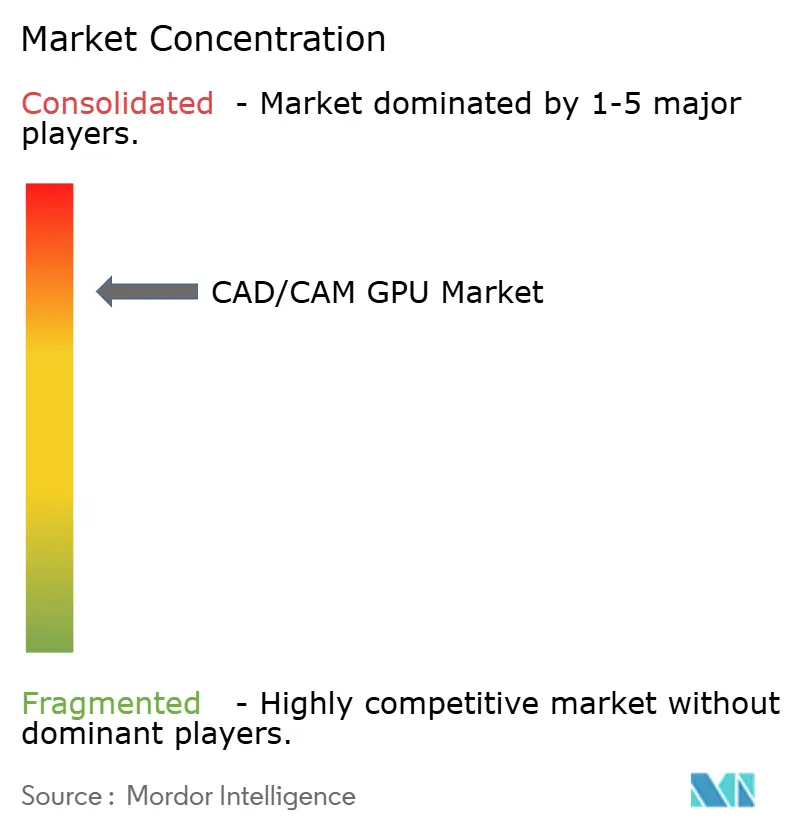
The CAD/CAM GPU market remains highly concentrated at the silicon and platform level, with NVIDIA holding the strongest position through performance, software depth, and certification breadth. Its advantage extends beyond hardware, because buyers often evaluate CUDA-linked workflows, Omniverse readiness, and application support together rather than treating the GPU as a stand-alone component. This gives the CAD/CAM GPU market a structure where platform choice can influence software flexibility, deployment models, and future upgrade paths. NVIDIA’s March 2025 Blackwell RTX PRO launch is a clear example, because it refreshed the workstation stack from compact to flagship tiers and reinforced the company’s premium position in professional graphics.
AMD and Intel are shaping competition differently in the CAD/CAM GPU market. AMD is focusing on cases where engineering teams want strong workstation performance and local AI capability without accepting the highest price bands, and the Radeon AI PRO R9700 launch in 2025 supported that strategy. Intel is building more gradually, with a stronger opening in value-oriented and mainstream professional tiers where cost sensitivity is higher and platform lock-in may be weaker. This means competitive pressure is growing most clearly in the midrange, even if leadership at the top tier remains difficult to dislodge. The CAD/CAM GPU market is therefore competitive in targeted workflow segments, but still concentrated in overall platform influence.
The broader value chain adds another layer to competition in the CAD/CAM GPU market, because workstation OEMs, board partners, and cloud infrastructure providers all shape practical buyer choice. Lenovo’s May 2026 ThinkStation P4 announcement, which combined AMD Ryzen PRO 9000 processors with the NVIDIA RTX PRO 6000 Blackwell Workstation Edition and multiple ISV certifications, shows how OEM integration can strengthen premium market positioning. Google Cloud’s 2026 rollout of G4 VMs with NVIDIA RTX 6000 Blackwell GPUs shows how cloud providers are becoming an important route to professional graphics access for design teams. At the board partner level, competition is more fragmented and is based more on regional reach, form factor variety, and warranty support than on core silicon differences. Openings remain in lower-power certified systems, specialized vertical compliance, and hybrid workstation delivery models. Even so, the CAD/CAM GPU market still favors suppliers that can combine hardware scale, stable software support, and close alignment with engineering application vendors.
CAD/CAM GPU Industry Leaders
NVIDIA Corporation
Advanced Micro Devices, Inc.
Intel Corporation
ARM Limited
Matrox Electronic Systems Ltd.
- *Disclaimer: Major Players sorted in no particular order

Recent Industry Developments
- May 2026: Lenovo announced the ThinkStation P4 professional desktop workstation, combining AMD Ryzen PRO 9000 processors with the NVIDIA RTX PRO 6000 Blackwell Workstation Edition (96 GB GDDR7), receiving ISV certifications from Autodesk, Siemens, Dassault Systèmes, PTC, and Bentley Systems; global availability was targeted for June 2026, making the ThinkStation P4 the first flagship workstation to pair Ryzen PRO 9000 and Blackwell in a certified professional configuration.
- May 2026: TSUKUMO (Yamada Holdings subsidiary, Japan) launched workstation models featuring Intel Xeon 600 processors with professional GPU configurations; a multi-GPU model followed on May 27, 2026, targeting simulation-heavy and AI-intensive professional workflows in the Japanese market.
- April 2026: AMD released AMD Software: PRO Edition 26.Q1 for Windows, a quarterly driver update maintaining ISV certifications and expanding compatibility for Radeon AI PRO R9000 series GPUs across Windows 11 and Windows 10 professional workstation environments.
- October 2025: NVIDIA and US manufacturing and robotics industry leaders, including Siemens, expanded the Mega NVIDIA Omniverse Blueprint for simulating multi-robot fleets within factory digital twin environments; Siemens Xcelerator became the first platform to develop digital twin software supporting the Mega Omniverse Blueprint, targeting engineers designing and operating AI-enabled factory environments at scale.


Global CAD/CAM GPU Market Report Scope
The CAD/CAM GPU Market refers to the market for graphics processing units used to accelerate computer-aided design and computer-aided manufacturing workloads. It includes GPUs that support 2D/3D modeling, rendering, simulation, visualization, and other compute-heavy design tasks in professional engineering environments.
The CAD/CAM GPU Market Report is Segmented by GPU Product Type (Desktop Professional/Workstation Discrete GPUs, Mobile Professional/Workstation Discrete GPUs, and Integrated/Unified-Memory GPUs), GPU Platform / Architecture (NVIDIA GPU Platform, AMD GPU Platform, and Intel GPU Platform), Application (Computer-Aided Design and 3D Modeling, Computer-Aided Manufacturing, Computer-Aided Engineering and Simulation, and Rendering, Visualization, and Digital Twins), End User (Automotive, Aerospace and Defense, Industrial Machinery and Heavy Equipment, Electronics and Semiconductor, and Architecture, Engineering, and Construction), Geography (North America, Europe, Asia-Pacific, South America, and Middle East and Africa). The Market Forecasts are Provided in Terms of Value (USD).
| Desktop Professional/Workstation Discrete GPUs |
| Mobile Professional/Workstation Discrete GPUs |
| Integrated/Unified-Memory GPUs |
| Other Professional GPU Configurations |
| NVIDIA GPU Platform |
| AMD GPU Platform |
| Intel GPU Platform |
| Other GPU Platforms |
| Computer-Aided Design and 3D Modeling |
| Computer-Aided Manufacturing |
| Computer-Aided Engineering and Simulation |
| Rendering, Visualization, and Digital Twins |
| Other Advanced Design Workloads |
| Automotive |
| Aerospace and Defense |
| Industrial Machinery and Heavy Equipment |
| Electronics and Semiconductor |
| Architecture, Engineering, and Construction |
| Other End Users (Education, Academia, and Research Institutions; Healthcare, Medical Devices, and Dental) |
| North America | United States |
| Canada | |
| Mexico | |
| Europe | Germany |
| United Kingdom | |
| France | |
| Italy | |
| Rest of Europe | |
| Asia-Pacific | China |
| Japan | |
| South Korea | |
| India | |
| Southeast Asia | |
| Rest of Asia-Pacific | |
| South America | |
| Middle East and Africa |
| By GPU Product Type | Desktop Professional/Workstation Discrete GPUs | |
| Mobile Professional/Workstation Discrete GPUs | ||
| Integrated/Unified-Memory GPUs | ||
| Other Professional GPU Configurations | ||
| By GPU Platform / Architecture | NVIDIA GPU Platform | |
| AMD GPU Platform | ||
| Intel GPU Platform | ||
| Other GPU Platforms | ||
| By Application | Computer-Aided Design and 3D Modeling | |
| Computer-Aided Manufacturing | ||
| Computer-Aided Engineering and Simulation | ||
| Rendering, Visualization, and Digital Twins | ||
| Other Advanced Design Workloads | ||
| By End User | Automotive | |
| Aerospace and Defense | ||
| Industrial Machinery and Heavy Equipment | ||
| Electronics and Semiconductor | ||
| Architecture, Engineering, and Construction | ||
| Other End Users (Education, Academia, and Research Institutions; Healthcare, Medical Devices, and Dental) | ||
| By Geography | North America | United States |
| Canada | ||
| Mexico | ||
| Europe | Germany | |
| United Kingdom | ||
| France | ||
| Italy | ||
| Rest of Europe | ||
| Asia-Pacific | China | |
| Japan | ||
| South Korea | ||
| India | ||
| Southeast Asia | ||
| Rest of Asia-Pacific | ||
| South America | ||
| Middle East and Africa | ||


Key Questions Answered in the Report
What is the current and projected value of the CAD/CAM GPU space?
The CAD/CAM GPU market size stood at USD 3.48 billion in 2026 and is forecast to reach USD 8.02 billion by 2031, growing at a CAGR of 18.17% over 2026-2031.
Which product type leads GPU demand in design and manufacturing workflows?
Desktop professional and workstation discrete GPUs led with 56.77% of revenue in 2025 because large assemblies, simulation tasks, and certified workflows still depend on higher VRAM and stable performance.
Which application is expanding the fastest in professional GPU use?
Rendering, visualization, and digital twins are growing the fastest at an 18.91% CAGR through 2031, supported by factory simulation, process validation, and real-time engineering review needs.
Which end-user group is creating the strongest future growth?
Electronics and semiconductor is the fastest-growing end-user group at an 18.33% CAGR through 2031 as fabs and chip-related operations expand digital twin and accelerated design workflows.
Which region leads today, and which one is growing fastest?
North America led with 35.16% of revenue in 2025, while Asia-Pacific is projected to grow fastest at a 19.04% CAGR through 2031 because of semiconductor, automotive, and engineering services demand.
Why does NVIDIA remain so influential in this space?
NVIDIA held 77.33% of platform revenue in 2025 and continues to benefit from a broad software ecosystem, deep certification coverage, and strong workstation and cloud deployment support.
Page last updated on:





