
Broiler Feed Additives Market Size and Share
Market Overview
| Study Period | 2021 - 2031 |
|---|---|
| Market Size (2026) | USD 11.64 Billion |
| Market Size (2031) | USD 15.15 Billion |
| Growth Rate (2026 - 2031) | 5.42 % |
| Fastest Growing Market | North America |
| Largest Market | Asia-Pacific |
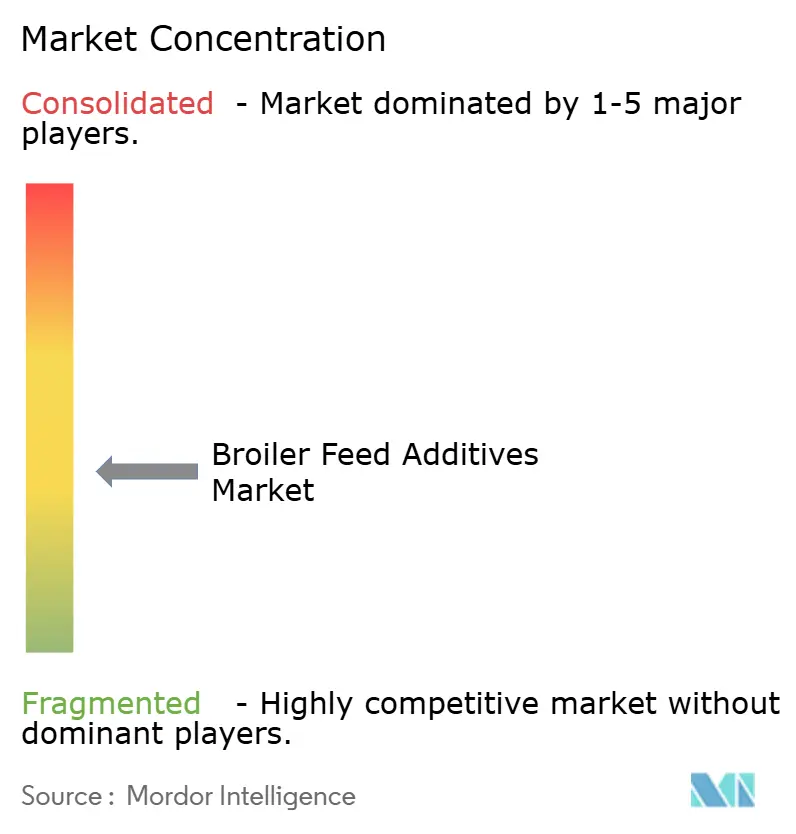
| Market Concentration | Medium |
Major Players *Disclaimer: Major Players sorted in no particular order Image © Mordor Intelligence. Reuse requires attribution under CC BY 4.0. | |
Broiler Feed Additives Market Analysis by Mordor Intelligence
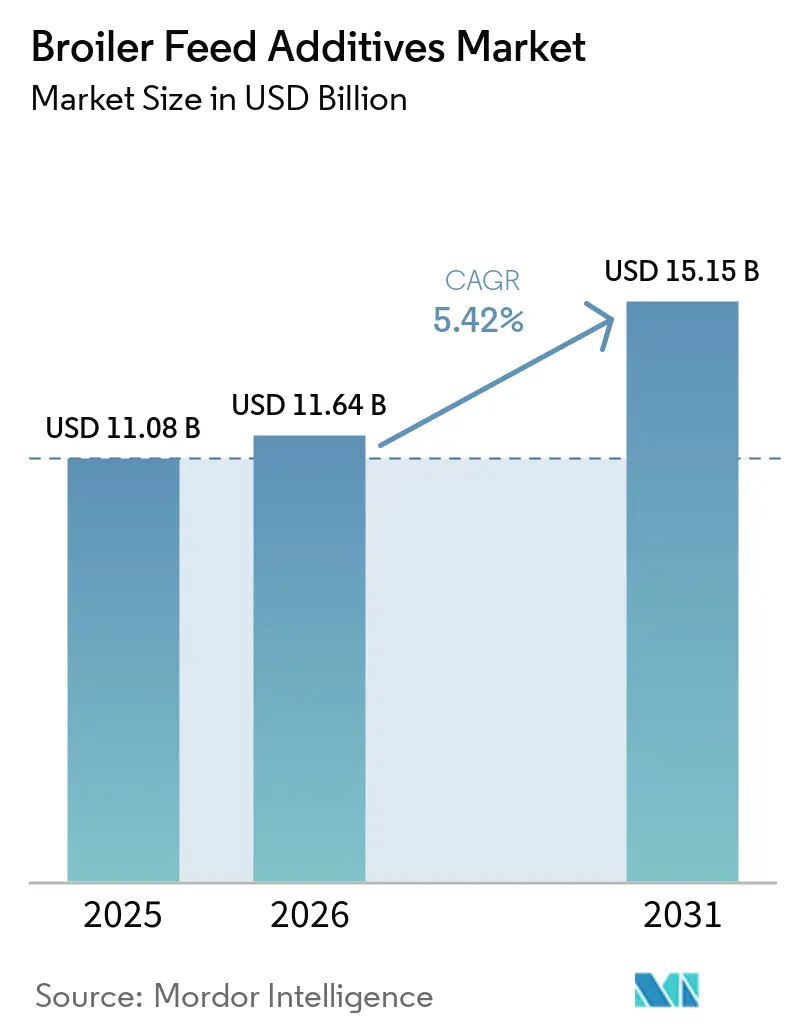
The Broiler feed additives market size is projected to grow from USD 11.08 billion in 2025 to USD 11.64 billion in 2026 and is forecast to reach USD 15.15 billion by 2031 at 5.42% CAGR over 2026-2031. The broiler feed additives market is moving toward more targeted nutrition programs as producers replace broad, routine inputs with additives that improve feed conversion, gut health, carcass quality, and flock-level consistency. Global broiler feed production reached 400.4 million metric tons in 2025 as per Alltech Agri-Food Outlook, keeping additive demand closely tied to commercial poultry feed output and supporting steady volume expansion in the broiler feed additives market. Regulatory pressure on medically important antibiotic use, wider adoption of antibiotic-free programs, and stronger disease control needs are pushing producers to use more probiotics, enzymes, organic acids, amino acids, and related functional products in the broiler feed additives market. At the same time, the forecast still faces supply and approval risks because amino acids and vitamins rely on concentrated production hubs, and novel microbial products must clear detailed regulatory review before wider commercialization. Competition in the broiler feed additives market remains active as major suppliers combine portfolio expansion, acquisitions, diagnostic tools, and feed platform partnerships to deepen customer ties and defend margins in a more performance-driven environment.
Key Report Takeaways
- By type, amino acids were the largest additive type and accounted for 22.1%, while probiotics are projected to be the fastest-growing segment at a 6.6% CAGR over 2026-2031.
- By form, dry formulations were the largest segment, accounted for 79.7% in 2025, while liquid formulations are projected to be the fastest-growing segment at a 6.1% CAGR over 2026-2031.
- By broiler production phase, grower feed accounted for 42.3% of the broiler feed additives market share in 2025, while starter feed is the fastest segment at 5.9% CAGR over 2026-2031.
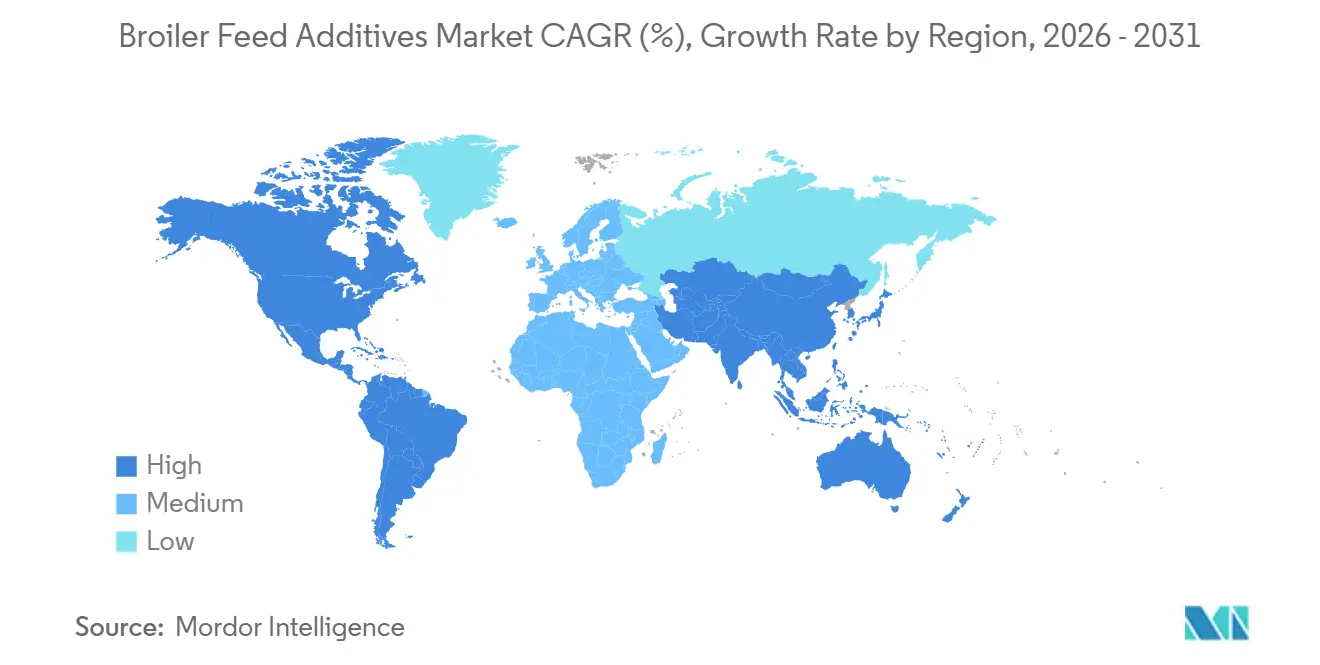
- By geography, Asia-Pacific accounted for 34.1% of the broiler feed additives market share in 2025, while North America is anticipated to be the fastest-growing segment at 6.3% CAGR over 2026-2031.
Note: Market size and forecast figures in this report are generated using Mordor Intelligence’s proprietary estimation framework, updated with the latest available data and insights as of January 2026.
Market Trends and Insights
Drivers Impact Analysis of Broiler Feed Additives Market*
| Driver | (~) % Impact on CAGR Forecast | Geographic Relevance | Impact Timeline |
|---|---|---|---|
| Antibiotic-free broiler programs accelerate eubiotic adoption | +1.3% | Global, with the strongest demand pull in North America and Europe where restrictions and buyer requirements are more advanced | Short term (≤ 2 years) |
| Feed conversion ratio optimization under feed-cost pressure | +1.2% | Global, with especially high commercial relevance in Asia-Pacific and South America where feed economics are closely tracked | Short term (≤ 2 years) |
| Amino-acid-enabled low-protein formulations gain traction | +0.7% | Strongest in North America and Europe, with gradual spillover into Asia-Pacific | Medium term (2-4 years) |
| Enteric disease and mycotoxin control raise additive intensity | +0.8% | Especially relevant in Asia-Pacific, South America, and Africa where disease pressure and storage risk remain high | Short term (≤ 2 years) |
| Pelleting-stable precision additives widen commercial use | +0.5% | Strongest in large integrated feed systems in Asia-Pacific, North America, and Europe | Medium term (2-4 years) |
| Carcass yield and footpad outcome optimization drive premium blends | +0.4% | Most relevant in Europe and North America where welfare scoring and processor quality metrics affect returns | Medium term (2-4 years) |
| Source: Mordor Intelligence | |||
Antibiotic-Free Broiler Programs Accelerate Eubiotic Adoption
The broiler feed additives market is seeing faster adoption of eubiotics as antibiotic rules tighten and more producers maintain no-antibiotics-ever programs. The Food and Drug Administration (FDA) issued Guidance for Industry 273 in February 2026, requiring drug sponsors to add duration limits to medically important antibiotics that lacked them in food-producing animals[1]Source: Center for Infectious Disease Research and Policy, “FDA Issues New Guidance on Antibiotic Use in Food-Producing Animals,” CIDRAP, cidrap.umn.edu. The report, published by the United States Poultry & Egg Association (USPOULTRY) in 2025 using data through 2024, emphasizes the ongoing decline in the use of medically important antibiotics in broiler production. This trend demonstrates advancements in antibiotic stewardship within commercial poultry operations. As a result, alternatives such as probiotics, organic acids, phytogenics, and feed enzymes are gaining significance for improving gut health, nutrient utilization, and production performance. Suppliers offering flexible portfolios that cater to both conventional and reduced-antibiotic systems are well-positioned to meet market demand.
Feed Conversion Ratio Optimization Under Feed-Cost Pressure
The use of feed additives for broilers continues to be driven by the need to improve feed conversion ratios, as feed remains the largest cost component in broiler production. Evonik Industries AG states that poultry nutrition programs center on improving nutrient use and flock performance, which keeps amino acids and enzymes closely tied to return-on-investment decisions at the farm level. A 2025 study in Frontiers in Animal Science found that a protease, phytase, and xylanase combination improved body weight, feed conversion ratio, ileal digestibility, and gut morphology in broilers under commercial conditions[2]Source: Frontiers Editorial Office, “Enteric Health, Necrotic Enteritis, and Gut Additive Strategies in Broiler Production,” Frontiers in Nutrition, frontiersin.org. This evidence supports a move away from single-product optimization toward stacked additive programs that deliver measurable economic gains across the flock. The broiler feed additives market, therefore, gains not only from higher inclusion rates but also from a richer product mix with better pricing power for suppliers.
Amino-Acid-Enabled Low-Protein Formulations Gain Traction
There is increased support for the broader use of amino-acid-supplemented low-protein diets in commercial poultry feed. Methionine, lysine, threonine, and tryptophan remain standard inputs in broiler nutrition, enabling formulators to balance performance while more precisely managing crude protein levels. This matters when soybean meal and other protein inputs stay volatile, because producers can protect margins by improving amino acid precision rather than simply raising total protein. The approach has developed faster in North America and Europe, where formulation models and nutrient analytics are more mature, but its economic logic is becoming clearer in the Asia-Pacific as well. That keeps amino acids at the center of the broiler feed additives market, even when newer biological categories receive more commercial attention.
Enteric Disease and Mycotoxin Control Raise Additive Intensity
Rising enteric disease pressure and recurring mycotoxin exposure are driving the increased use of preventive and performance-support additives in broiler production systems. A 2026 research published in Springer Nature's Poultry Science and Animal Husbandry emphasized that nutritional interventions, including probiotics, prebiotics, synbiotics, enzymes, organic acids, and phytogenic feed additives, are being increasingly utilized to manage necrotic enteritis. DSM-Firmenich AG launched SciTell Microbiome Analytics in 2026 to connect microbiome profiling with nutritional interventions in poultry production, which shows how suppliers are moving toward more targeted health management. In warm, humid feed systems, producers also face recurring contamination risks, which raise demand for detoxifiers, preservatives, and gut-support products used together rather than alone. That bundled approach lifts value per customer and supports further expansion of the broiler feed additives market in regions where disease management remains closely linked to feed strategy.
Restraints Impact Analysis of Broiler Feed Additives Market*
| Restraint | (~) % Impact on CAGR Forecast | Geographic Relevance | Impact Timeline |
|---|---|---|---|
| Inconsistent field response across diet matrices and flock conditions | -0.5% | Global, with the highest drag in Asia-Pacific and South America where raw material variation is more pronounced | Long term (≥ 4 years) |
| Concentrated vitamin and amino-acid supply base raises sourcing risk | -0.7% | Most acute in North America and Europe where import dependence is high for several key inputs | Medium term (2-4 years) |
| Regulatory proof burden slows novel microbial and phytogenic launches | -0.6% | Strongest in Europe and North America where safety and efficacy review is more demanding | Long term (≥ 4 years) |
| Cost-sensitive producers retain legacy additive programs in some systems | -0.4% | Most visible in Asia-Pacific, Africa, and South America where immediate return per metric ton is closely scrutinized | Medium term (2-4 years) |
| Source: Mordor Intelligence | |||
Concentrated Vitamin and Amino-acid Supply Base Raises Sourcing Risk
The broiler feed additives market is exposed to sourcing risk because several core inputs depend on a narrow production base. This matters most for vitamins and amino acids, where price movements and supply disruptions can quickly shift premix economics and force reformulation. Adisseo announced a worldwide price increase for SmartLine methionine effective May 1, 2026, and linked it to sustained raw material, energy, manufacturing, and logistics cost increases[3]Source: Adisseo, “Adisseo Raises SmartLine Methionine Prices as Global Cost Pressures Intensify,” Feed Business MEA, feedbusinessmea.com. For producers and feed formulators, the problem is not only cost inflation but also the risk of supply gaps that interrupt established inclusion programs. This creates a practical ceiling on how quickly premium programs can scale in the broiler feed additives market when they rely heavily on imported active ingredients.
Regulatory Proof Burden Slows Novel Microbial and Phytogenic Launches
The broiler feed additives market also faces delays when newer microbial and phytogenic products move through lengthy approval pathways. The European Food Safety Authority (EFSA) review process remains detailed, and even positive opinions still require formal authorization steps before broad commercial use can follow. Phileo by Lesaffre received a positive EFSA opinion for Microsaf in June 2025, and the final European Commission authorization was subsequently granted in December 2025. Similar proof requirements in highly regulated markets favor suppliers with stronger scientific and regulatory resources, while smaller innovators take longer to scale. That slows category expansion in the broiler feed additives market, even when technical performance is promising.
*Our forecasts treat driver/restraint impacts as directional, not additive. The impact forecasts reflect baseline growth, mix effects, and variable interactions.
Broiler Feed Additives Market Segment Analysis
By Additive:
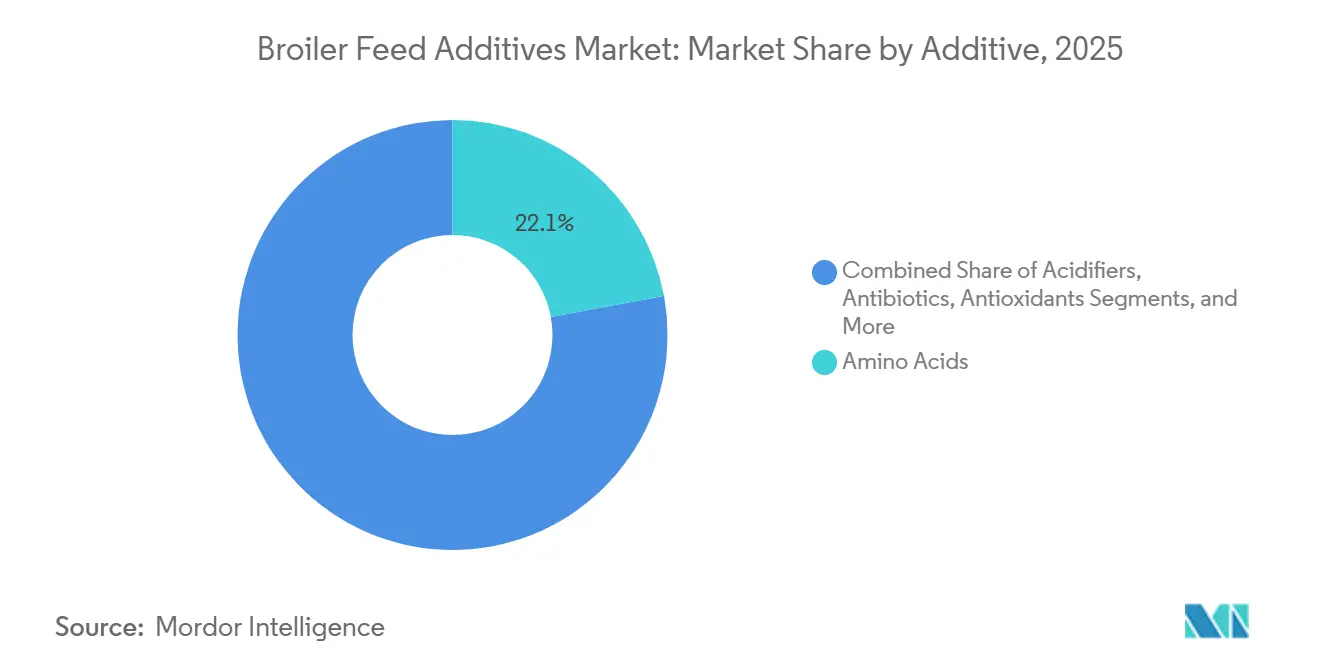
Amino Acids Anchor Foundation Nutrition, Probiotics Signal a New Performance ParadigmAmino acids were the largest additive type, and accounted for 22.1% of the broiler feed additives market share in 2025. Their position reflects the basic role of lysine, methionine, threonine, and tryptophan in protein synthesis, growth performance, and carcass quality across commercial broiler feeding programs. Methionine remains especially important because it is the first-limiting amino acid in many corn and soybean meal diets, which keeps its use close to universal in intensive broiler systems. Enzymes also play a significant role in the broiler feed additives market, as phytase, carbohydrase, and protease products help producers extract greater value from feed ingredients under cost pressure. Vitamins, acidifiers, minerals, antioxidants, and antibiotics play stable or residual roles depending on local regulations, dietary structure, and production model.
Probiotics are projected to be the fastest-growing additive category in the broiler feed additives market, with a 6.6% CAGR over 2026-2031. This growth reflects stronger demand for non-antibiotic gut health tools and better strain-level positioning in commercial poultry nutrition. Novonesis completed the acquisition of DSM-Firmenich AG’s share in the Feed Enzyme Alliance in 2025 for USD 1.62 billion (EUR 1.5 billion), thereby strengthening its reach across enzyme and probiotic applications. In 2026, the company also agreed to acquire a production facility in Rayong, Thailand, for USD 50 million, expanding supply capacity closer to Asian demand centers. Within the broiler feed additives industry, phytogenics, prebiotics, yeast derivatives, mycotoxin detoxifiers, and pigments remain smaller but important categories because they support gut health, stress response, feed safety, and product quality in targeted production systems.



By Form:
Dry Formats Hold Structural Lead While Liquid Delivery Gains Functional PrecisionDry formulations were the largest format, accounted for a 79.7% of the broiler feed additives market in 2025. This position reflects the high share of pelleted and mash compound feed in commercial broiler production, where dry premixes and coated inputs fit established mill processes. Dry delivery remains central for amino acids, vitamins, minerals, binders, acidifiers, antioxidants, and a large share of enzyme use because these products integrate well into standard feed manufacturing. The broiler feed additives market continues to favor dry products, as suppliers can maintain stability through conditioning, pelleting, and storage without significant activity losses. That is why improvements in thermostability and microencapsulation matter so much for expanding the usable range of biological products in mainstream feed lines.
Liquid formulations are the fastest-growing format in the broiler feed additives market, with a 6.1% CAGR over 2026-2031. Their growth comes from water-based delivery, post-pelleting application, and the need for more flexible dosing during health or performance challenges at the flock level. EASY BIO acquired BioMatrix in 2025 and added coating technology that enables broader use of protected, precision-applied additives in poultry and livestock systems. Liquid acidifiers, probiotics, and selected vitamins gain traction where producers already use drinking water as an intervention point during stress periods or disease pressure. Within the broiler feed additives industry, this makes liquid delivery more important in systems that want quicker flock-level adjustments than fixed feed formulations can provide.
By Broiler Production Phase:
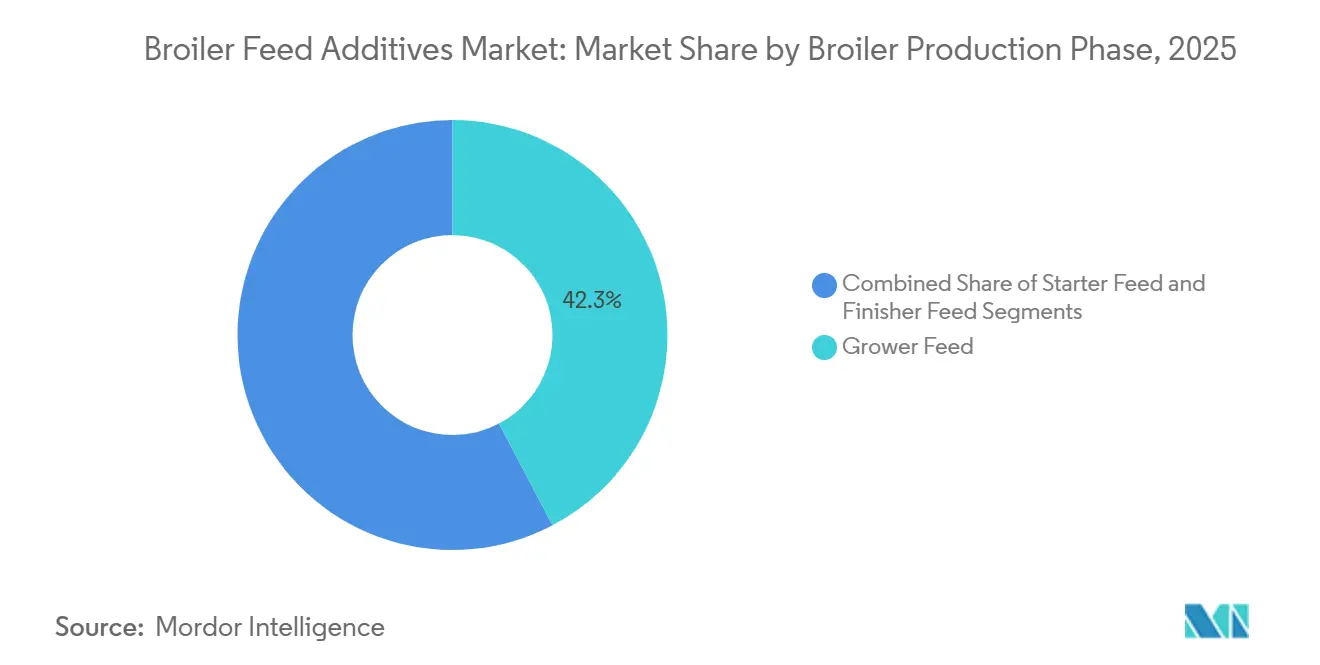
Grower Phase Commands Volume, Starter Phase Leads Functional InnovationGrower feed was the largest production phase in the broiler feed additives market, and held 42.3% share in 2025. The grower period covers the phase with the highest cumulative feed intake per bird, which makes additive spending in this window more visible in both cost and performance terms. Enzymes, amino acids, and gut-health inputs remain highly relevant in grower diets because feed conversion sensitivity is high during this stage. The broiler feed additives market, therefore, sees strong commercial weight in grower feed even when newer functional concepts first appear in other phases. Finisher diets remain important, but their additive logic is often narrower, focusing more on yield, pigmentation, or carcass presentation near slaughter.
Starter feed was the fastest production phase and is anticipated to grow at 5.9% CAGR over 2026-2031. Early gut development has become more important because producers increasingly view the first days of life as the base for later feed efficiency and disease resilience. It is also raising interest in starter-specific programs that use multi-strain probiotics, prebiotics, phytogenic blends, and organic acids from the first feeding days. The industry is responding with phase-specific products that meet the needs of integrated producers seeking more precise nutritional control throughout the full rearing cycle.
Geography Analysis
APAC Broiler Feed Additives Market
Asia-Pacific accounted for 34.1% of the broiler feed additives market in 2025 and remained the largest regional base entering 2026. As per Alltech's Agri-Food Outlook, China’s total commercial broiler feed output reached 101.0 million metric tons in 2025, while India reached 20.3 million metric tons, and Indonesia’s output was 8.7 million metric tons. The broiler feed additives market in Asia-Pacific benefits from the ongoing shift from on-farm mixing to more commercial feed systems that adopt more consistent additive programs. That shift supports greater demand for amino acids, enzymes, vitamins, and probiotics across large integrated poultry operations and is gradually formalizing mid-scale producers. Supplier interest in the region also remained visible when Novonesis agreed in 2026 to acquire a production facility in Rayong, Thailand.
North America Broiler Feed Additives Market
North America is anticipated to be the fastest-growing region in the broiler feed additives market, with a 6.3% CAGR over 2026-2031. The region’s growth is tied to premiumization in nutrition programs, especially where integrators operate under no-antibiotics-ever or reduced-antibiotic commitments. The Food and Drug Administration (FDA) guidance issued in February 2026 supported tighter antibiotic stewardship in food-producing animals, which is anticipated to keep demand favorable for eubiotics and functional nutrition tools. The Archer Daniels Midland Company and Alltech, Inc. feed joint venture launched in the first quarter of 2026 and added scale to the regional supply platform for premix and additive solutions. In this part of the broiler feed additives market, growth comes less from flock expansion and more from higher additive value per bird and more specialized customer requirements.
EMEA and South America Broiler Feed Additives Market
South America remains a strong growth geography for the broiler feed additives market, as Brazil combines large domestic poultry output with export discipline. According to the Brazilian Association of Animal Protein (ABPA), Brazil produced 15.3 million metric tons of chicken meat in 2025 and exported 5.3 million metric tons, valued at USD 9.8 billion, which shows the scale of the country’s commercial poultry chain. Europe remains mature, but innovation remains active because its long-standing ban on antibiotic growth promoters, welfare rules, and detailed additive approvals keep technical requirements high. Germany’s broiler feed production reached 4.1 million metric tons in 2025, according to the Alltech Agri-Food Outlook, which confirmed steady underlying feed demand in a regulated European setting. The Middle East and Africa are smaller in absolute size, but the broiler feed additives market there is expanding from a lower base as commercial feed adoption rises in countries such as Saudi Arabia, Turkey, South Africa, Egypt, and Nigeria.

Competitive Landscape
The broiler feed additives market shows moderate concentration in 2025, as a relatively small group of multinational suppliers holds strong positions in amino acids, enzymes, vitamins, and probiotics. DSM-Firmenich AG, Evonik Industries AG, Bluestar Adisseo Company, Cargill, Incorporated, and BASF SE remain central participants because they combine scale, manufacturing depth, formulation expertise, and technical support capabilities. The industry continues to present growth opportunities, driven by factors such as product performance, regulatory access, and service models. Competition is transitioning from a focus on ingredient supply to comprehensive solution models that combine additives with formulation support, diagnostics, or processing expertise. This evolution favors larger players with greater scale while also creating entry opportunities for firms specializing in unique strains, coating technologies, or monitoring tools.
Strategic moves in 2025 and 2026 show how large suppliers are strengthening category depth and regional reach in the broiler feed additives market. Novonesis completed the purchase of DSM-Firmenich AG’s share in the Feed Enzyme Alliance in 2025 for USD 1.6 billion (EUR 1.5 billion), thereby expanding its position in enzyme and probiotic solutions. The company then added Southeast Asian manufacturing capacity in 2026 through the Rayong facility agreement, improving supply proximity for a fast-growing demand region. Evonik also strengthened its regulatory position when the European Commission authorized its guanidinoacetic acid preparation for poultry use in 2026. These moves show that the broiler feed additives market rewards suppliers that can pair science-backed products with approvals, manufacturing depth, and geographic expansion.
The broiler feed additives market is witnessing a growing emphasis on services and differentiated technologies complementing core ingredient portfolios. For instance, Cargill, Incorporated increased the capacity of its Engerwitzdorf micronutrition facility by 50% in 2025, enhancing its capabilities in customized nutrition and premix solutions. Similarly, Phibro Animal Health Corporation launched the VERRATAIN sustainability platform in 2026 in collaboration with VAXA Technologies, highlighting efforts to align nutrition with supply chain sustainability goals. Additionally, companies are expanding their offerings to include technical support, feed safety, and formulation services, moving beyond standalone ingredients to integrated solution offerings. These trends underscore the increasing importance of scale, technical expertise, and service capabilities as key competitive differentiators in the market.
Broiler Feed Additives Industry Leaders
DSM-Firmenich AG
Evonik Industries AG
Bluestar Adisseo Company
Cargill, Incorporated
BASF SE
- *Disclaimer: Major Players sorted in no particular order
Broiler Feed Additives Market Companies Covered in this Report
- DSM-Firmenich AG
- Evonik Industries AG
- Bluestar Adisseo Company
- Cargill, Incorporated
- BASF SE
- Archer Daniels Midland Company
- Nutreco N.V. (SHV Holdings N.V.)
- Novus International, Inc. (Mitsui & Co., Ltd.)
- Kemin Industries, Inc.
- International Flavors & Fragrances Inc.
- Novonesis A/S
- Alltech, Inc.
- Elanco Animal Health Incorporated
- Phibro Animal Health Corporation
- Lesaffre

Recent Industry Developments in Broiler Feed Additives Market
- May 2026: Phibro Animal Health Corporation launched the VERRATAIN Verified Sustainability Solutions brand through a strategic partnership with VAXA Technologies, introducing low-carbon microalgae-based feed materials designed to reduce emissions across animal protein supply chains, including commercial broiler production.
- May 2026: The European Commission issued Implementing Regulation (EU) 2026/1019, authorizing Evonik Industries AG's guanidinoacetic acid preparation as a zootechnical feed additive for chickens for fattening, chickens reared for laying and reproduction, and turkeys for fattening and reproduction, adding a differentiated energy-metabolism additive to the European Union-authorized broiler additive portfolio.
- April 2026: DSM-Firmenich AG launched SciTell Microbiome Analytics, a non-invasive, DNA-sequencing-based diagnostic service for commercial broiler gut health with reduced antibiotic use in the European region. The service links microbiome profiling to nutritional interventions, including eubiotics, enabling precision feed formulation under reduced antibiotic use programs. The launch reflects DSM-Firmenich AG's strategy to anchor producer relationships through data services ahead of its announced strategic review of the Animal Nutrition and Health division.


Global Broiler Feed Additives Market Report Scope
Broiler feed additives are nutritional and functional substances added to feed or water for chickens raised for meat to improve growth, feed efficiency, gut health, feed stability, and carcass quality. The Broiler Feed Additives Market Report is Segmented by Additive (Acidifiers, Amino Acids, Antibiotics, Antioxidants, Binders, Enzymes, Flavors and Sweeteners, Minerals, Mycotoxin Detoxifiers, Phytogenics, Pigments, Prebiotics, Probiotics, Vitamins, and Yeast), by Form (Dry and Liquid), by Broiler Production Phase (Starter Feed, Grower Feed, and Finisher Feed), and by Geography (North America, South America, Europe, Asia-Pacific, Middle East, and Africa). The Market Forecasts are Provided in Terms of Value (USD) and Volume (Metric Tons).
| Acidifiers | Lactic Acid |
| Propionic Acid | |
| Fumaric Acid | |
| Other Acidifiers | |
| Antibiotics | Tetracyclines |
| Penicillins | |
| Tylosin | |
| Bacitracin | |
| Other Antibiotics | |
| Antioxidants | Butylated Hydroxyanisole (BHA) |
| Butylated Hydroxytoluene (BHT) | |
| Ethoxyquin | |
| Propyl Gallate | |
| Tocopherols | |
| Citric Acid | |
| Other Antioxidants | |
| Amino Acids | Lysine |
| Tryptophan | |
| Methionine | |
| Threonine | |
| Other Amino Acids | |
| Binders | Natural Binders |
| Synthetic Binders | |
| Enzymes | Carbohydrases |
| Phytases | |
| Other Enzymes | |
| Flavors & Sweeteners | Flavors |
| Sweeteners | |
| Minerals | Macrominerals |
| Microminerals | |
| Mycotoxin Detoxifiers | Binders |
| Biotransformers | |
| Phytogenics | Herbs & Spices |
| Essential Oil | |
| Other Phytogenics | |
| Pigments | Carotenoids |
| Curcumin & Spirulina | |
| Prebiotics | Inulin |
| Fructo Oligosaccharides | |
| Galacto Oligosaccharides | |
| Xylo Oligosaccharides | |
| Lactulose | |
| Mannan Oligosaccharides | |
| Other Prebiotics | |
| Probiotics | Lactobacilli |
| Bifidobacteria | |
| Streptococcus | |
| Pediococcus | |
| Enterococcus | |
| Other Probiotics | |
| Vitamins | Vitamin A |
| Vitamin B | |
| Vitamin C | |
| Vitamin E | |
| Other Vitamins | |
| Yeast | Live Yeast |
| Spent Yeast | |
| Torula Dried Yeast | |
| Selenium Yeast | |
| Whey Yeast | |
| Yeast Derivatives |
| Dry |
| Liquid |
| Starter Feed |
| Grower Feed |
| Finisher Feed |
| North America | United States |
| Canada | |
| Mexico | |
| Rest of North America | |
| South America | Brazil |
| Argentina | |
| Rest of South America | |
| Europe | Germany |
| France | |
| United Kingdom | |
| Spain | |
| Italy | |
| Russia | |
| Rest of Europe | |
| Asia-Pacific | China |
| India | |
| Japan | |
| Thailand | |
| Indonesia | |
| Australia | |
| Rest of Asia-Pacific | |
| Middle East | Saudi Arabia |
| Turkey | |
| Iran | |
| Rest of Middle East | |
| Africa | South Africa |
| Egypt | |
| Rest of Africa |
| By Additive | Acidifiers | Lactic Acid |
| Propionic Acid | ||
| Fumaric Acid | ||
| Other Acidifiers | ||
| Antibiotics | Tetracyclines | |
| Penicillins | ||
| Tylosin | ||
| Bacitracin | ||
| Other Antibiotics | ||
| Antioxidants | Butylated Hydroxyanisole (BHA) | |
| Butylated Hydroxytoluene (BHT) | ||
| Ethoxyquin | ||
| Propyl Gallate | ||
| Tocopherols | ||
| Citric Acid | ||
| Other Antioxidants | ||
| Amino Acids | Lysine | |
| Tryptophan | ||
| Methionine | ||
| Threonine | ||
| Other Amino Acids | ||
| Binders | Natural Binders | |
| Synthetic Binders | ||
| Enzymes | Carbohydrases | |
| Phytases | ||
| Other Enzymes | ||
| Flavors & Sweeteners | Flavors | |
| Sweeteners | ||
| Minerals | Macrominerals | |
| Microminerals | ||
| Mycotoxin Detoxifiers | Binders | |
| Biotransformers | ||
| Phytogenics | Herbs & Spices | |
| Essential Oil | ||
| Other Phytogenics | ||
| Pigments | Carotenoids | |
| Curcumin & Spirulina | ||
| Prebiotics | Inulin | |
| Fructo Oligosaccharides | ||
| Galacto Oligosaccharides | ||
| Xylo Oligosaccharides | ||
| Lactulose | ||
| Mannan Oligosaccharides | ||
| Other Prebiotics | ||
| Probiotics | Lactobacilli | |
| Bifidobacteria | ||
| Streptococcus | ||
| Pediococcus | ||
| Enterococcus | ||
| Other Probiotics | ||
| Vitamins | Vitamin A | |
| Vitamin B | ||
| Vitamin C | ||
| Vitamin E | ||
| Other Vitamins | ||
| Yeast | Live Yeast | |
| Spent Yeast | ||
| Torula Dried Yeast | ||
| Selenium Yeast | ||
| Whey Yeast | ||
| Yeast Derivatives | ||
| By Form | Dry | |
| Liquid | ||
| By Broiler Production Phase | Starter Feed | |
| Grower Feed | ||
| Finisher Feed | ||
| By Geography | North America | United States |
| Canada | ||
| Mexico | ||
| Rest of North America | ||
| South America | Brazil | |
| Argentina | ||
| Rest of South America | ||
| Europe | Germany | |
| France | ||
| United Kingdom | ||
| Spain | ||
| Italy | ||
| Russia | ||
| Rest of Europe | ||
| Asia-Pacific | China | |
| India | ||
| Japan | ||
| Thailand | ||
| Indonesia | ||
| Australia | ||
| Rest of Asia-Pacific | ||
| Middle East | Saudi Arabia | |
| Turkey | ||
| Iran | ||
| Rest of Middle East | ||
| Africa | South Africa | |
| Egypt | ||
| Rest of Africa | ||


Key Questions Answered in the Report
How much is the broiler feed additives market projected to be worth in 2031 compared with 2026
The broiler feed additives market is projected to increase from USD 11.64 billion in 2026 to USD 15.15 billion by 2031.
Which additive type holds the largest position in broiler nutrition
Amino acids were the largest additive type in 2025 with 22.1% share because they remain essential to commercial broiler diet formulation.
Which product format is expanding the fastest in broiler feed programs
Liquid formulations are the fastest format with 6.1% CAGR over 2026-2031 as producers use water-based dosing and post-pelleting application more often.
Why are probiotics gaining more attention in broiler production
Probiotics are the fastest-growing additive category at 6.6% CAGR over 2026-2031 as producers look for non-antibiotic gut health support and more targeted flock management.
Which region is growing the fastest for broiler feed inputs
North America is the fastest regional segment at 6.3% CAGR over 2026-2031 because functional additive spending per bird is rising under tighter antibiotic stewardship and premium production programs.
Which production phase attracts the highest growth in the broiler feed additives market
Starter feed is growing the fastest at 5.9% CAGR over 2026-2031 as early gut development receives more attention.
Page last updated on:


 Your data is secure and never sold or shared.


