
Brazil Forklift Rental Market Size and Share
Market Overview
| Study Period | 2019 - 2031 |
|---|---|
| Forecast Data Period | 2026 - 2031 |
| Base Year Market Size (2025) | USD 1.73 Billion |
| Market Size (2026) | USD 1.94 Billion |
| Market Size (2031) | USD 3.45 Billion |
| Growth Rate (2026 - 2031) | 12.21 % |
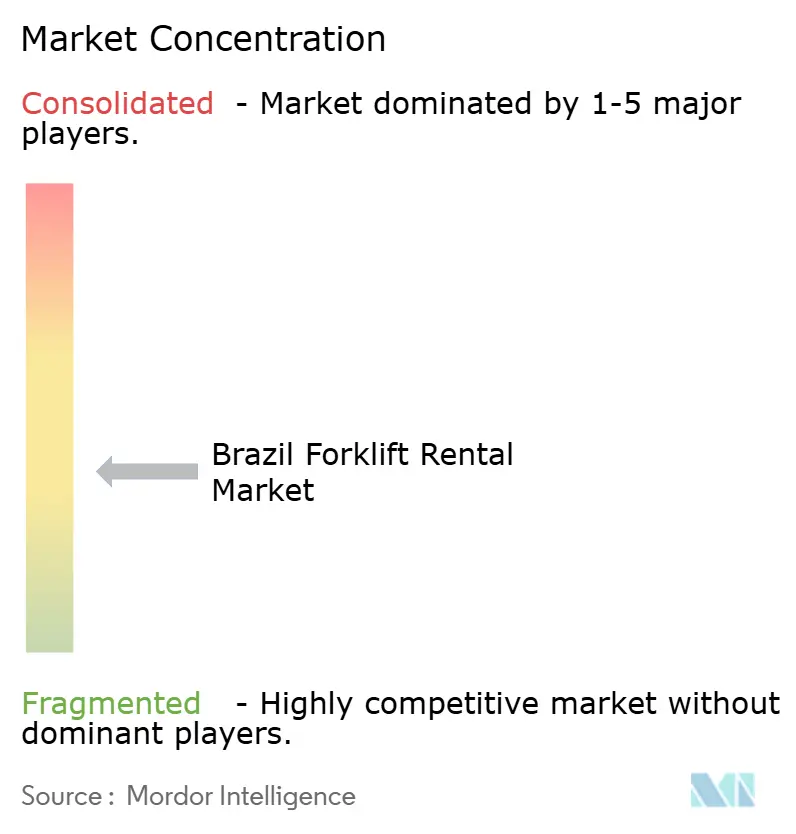
| Market Concentration | Medium |
Major Players *Disclaimer: Major Players sorted in no particular order Image © Mordor Intelligence. Reuse requires attribution under CC BY 4.0. | |
Brazil Forklift Rental Market Analysis by Mordor Intelligence
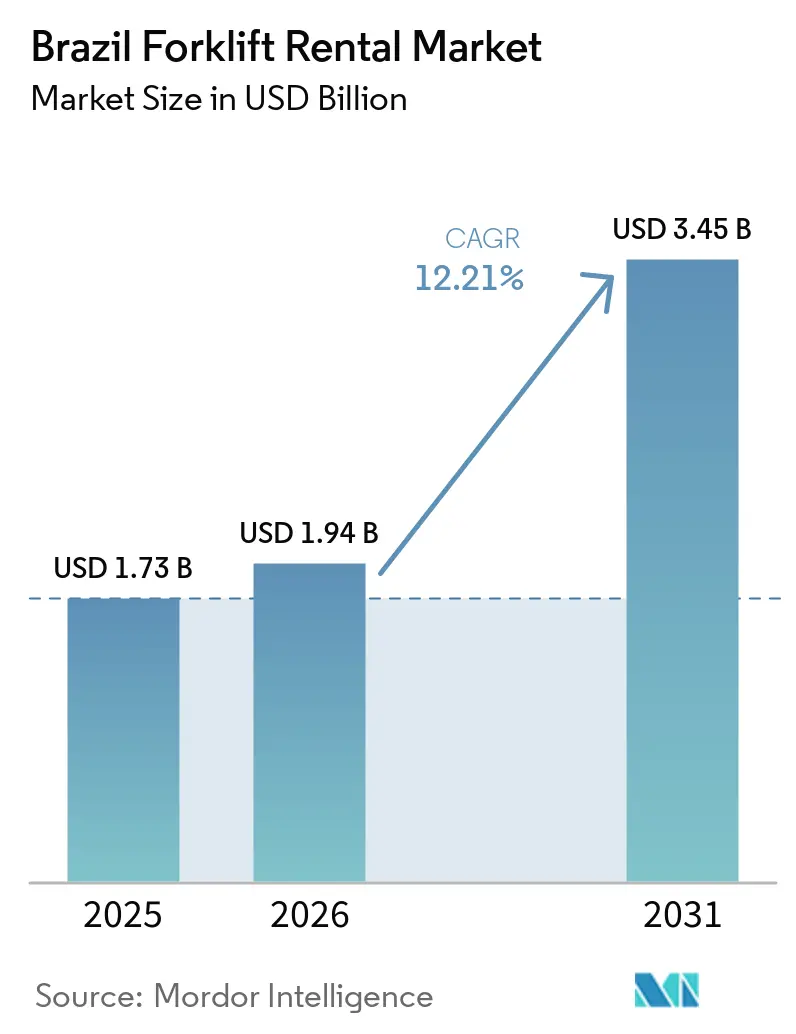
The Brazil forklift rental market size was valued at USD 1.73 billion in 2025 and is expected to grow to USD 1.94 billion in 2026, and is projected to reach USD 3.45 billion by 2031 at a 12.21% CAGR over 2026-2031. A rapid shift toward renting instead of owning equipment is unfolding as SELIC-linked loan costs approach 15%, doubling the share of leasing in capital-goods sales over the past decade. Operators prefer contracts that wrap telematics, on-site service, and lithium-ion batteries into one invoice, turning forklifts into an operating-expense line item rather than a capital purchase. E-commerce fulfillment and agribusiness exports concentrate activity in São Paulo, Rio de Janeiro, and Mato Grosso, where land constraints and seasonal surges demand flexible fleets. Leading rental houses counter cost pressures by shortening asset cycles, embedding analytics to guard residual values, and negotiating bulk orders with global OEMs to secure factory warranties.
Key Report Takeaways
- By load capacity, forklifts rated below 3.5 tons held the highest share of 47.27% of the Brazilian forklift rental market size in 2025 and recorded the fastest 13.23% CAGR to 2031.
- By rental duration, mid-term agreements spanning 1–12 months captured 54.32% of 2025 revenue, while short-term spot contracts are expanding at a 13.27% CAGR through 2031.
- By power source, internal combustion engines commanded 66.53% Brazil forklift rental market share in 2025, but electric models are advancing at a 13.29% CAGR during the forecast.
- By truck class, Class V machines led with 38.81% of 2025 volume, yet compact Class I units post the quickest 14.33% CAGR through 2031.
- By end-use, warehousing and logistics dominated with 61.27% of spending in 2025 and will continue as the fastest-growing vertical at a 14.36% CAGR to 2031.
Note: Market size and forecast figures in this report are generated using Mordor Intelligence’s proprietary estimation framework, updated with the latest available data and insights as of January 2026.
Future direction is shaped by developments occurring across multiple countries and regions, with Brazil contributing to the overall trajectory. The outlook on worldwide forklift rental market reflects how these are expected to evolve collectively.
Brazil Forklift Rental Market Trends and Insights
Drivers Impact Analysis*
| Driver | (~) % Impact on CAGR Forecast | Geographic Relevance | Impact Timeline |
|---|---|---|---|
| E-Commerce-Fueled Warehousing Expansion | +3.2% | São Paulo, Rio de Janeiro, Campinas; spillover to Curitiba, Belo Horizonte | Medium term (2-4 years) |
| Agribusiness Export Boom Boosting Logistics Nodes | +2.5% | Mato Grosso, Paraná, Rio Grande do Sul; Arco Norte ports (Santarém, Itaqui) | Long term (≥ 4 years) |
| Federal PAC-3 Infrastructure Spending Uptick | +1.8% | National, concentrated in Arco Norte and Corredor Sul-Sudeste | Medium term (2-4 years) |
| OEM Service-Bundled Rental Models Gaining Traction | +1.5% | São Paulo, Santos port zone, Rio de Janeiro industrial clusters | Short term (≤ 2 years) |
| 24/7 Port of Santos Modernization Spikes Short-Term Demand | +1.4% | Santos, Guarujá, Cubatão; secondary impact in São Paulo metropolitan area | Short term (≤ 2 years) |
| R&D Tax Incentives For Rental Fleets | +0.9% | National, early uptake in São Paulo, Rio de Janeiro, Minas Gerais | Long term (≥ 4 years) |
| Source: Mordor Intelligence | |||
E-Commerce-Fueled Warehousing Expansion
By 2025, Mercado Libre significantly expanded its domestic footprint, achieving substantial growth compared to its size in 2020. Meanwhile, Shopee also experienced notable expansion, capturing a dominant share of the leased space during Q3 2025 [1]. Vacancy in São Paulo and Rio de Janeiro logistics parks fell to 8.5% in Q3 2025, the tightest rate in over a decade, and rents advanced 11.5% for the year, well above the global average decline of 4.6%. Tenants now pre-lease half-built facilities and favor rental contracts that include rapid battery swaps, telematics, and 24/7 on-site service to protect service-level agreements. The Nuvemshop/Opinion Box E-Consumer 2026 study pegs national e-commerce revenue at BRL 260 billion (USD 48 billion), sustaining multi-shift operations that magnify the payoff from lithium-ion forklifts able to charge opportunistically during breaks. As structural demand rises, the Brazilian forklift rental market supplies agile fleets that match warehouse commissioning timetables and avert capital lock-in.
Agribusiness Export Boom Boosting Logistics Nodes
Brazil’s 2024/25 grain harvest is projected at 322.47 million tons, an 8.3% year-on-year jump, requiring BRL 4.5 billion (USD 833 million) in logistics outlays to curb congestion [2]. Financing terms under Plano Safra 2025/2026 increased warehouse capacity ceilings to 12,000 tons and stretched credit to 10 years at 8.5-10%, encouraging cooperatives to invest in larger, more mechanized storage. Road duplications on BR-163 and BR-386 shorten haul times, bunching load cycles, and lifting peak-season utilization across the Brazilian forklift rental market. New cargo terminals in Porto Velho and Santarém reroute flows toward the Arco Norte, where flexible rental agreements cover container handlers and yard trucks during export surges. Leasing’s slice of machinery sales has already doubled to 30% in the past decade, and volatile commodity pricing cements rentals as a hedge against ownership risk.
Federal PAC-3 Infrastructure Spending Uptick
The BRL 94.2 billion (approximately USD 18.51 billion) earmarked for rail development through 2026 funnels equipment demand to project sites and future terminals, amplifying rental volume in regions historically underserved by logistics networks[3]. Flagship projects such as the Transnordestina line depend on forklifts for permanent cargo handling and interim construction needs. These projects, bankrolled by regional development funds exempt from Brazil’s fiscal cap, sustain contracting momentum even under macro-prudential tightening. For rental providers, the phased nature of worksites aligns perfectly with shorter amortisation horizons, making fleet rotation of construction machinery between construction and operations commercially attractive. Resulting asset churn feeds the secondary market, enabling providers to cascade older units into price-sensitive segments without compromising profitability.
OEM Service-Bundled Rental Models Gaining Traction
Jungheinrich Brazil pairs NR-11 operator training with forklift rentals, reducing customer churn linked to annual recertification. Konecranes equipped two reachstackers delivered to Eudmarco in 2024 with TRUCONNECT telematics, a blueprint rental houses now emulate for predictive maintenance. Toyota’s USD 2.2 billion commitment to hybrid-vehicle production through 2030 signals deeper OEM roots, opening pathways for lease-plus-service bundles that wrap batteries, software, and factory technicians. Such arrangements lift uptime and slash hidden downtime costs that can eclipse daily rental fees, adding stickiness across the Brazilian forklift rental market.
Restraints Impact Analysis*
| Restraint | (~) % Impact on CAGR Forecast | Geographic Relevance | Impact Timeline |
|---|---|---|---|
| High SELIC-Linked Financing Costs | -2.1% | National, acute in capital-intensive sectors (construction, mining) | Short term (≤ 2 years) |
| Influx of Low-Priced Used Imports | -1.3% | São Paulo, Rio de Janeiro, Santos port zone | Medium term (2-4 years) |
| Volatile Electricity Tariffs Slow E-Forklift Uptake | -0.8% | Industrial clusters in São Paulo, Minas Gerais, Rio Grande do Sul | Medium term (2-4 years) |
| Union-Mandated Operator Certification Bottlenecks | -0.6% | National, concentrated in unionized warehousing and port sectors | Long term (≥ 4 years) |
| Source: Mordor Intelligence | |||
High SELIC-Linked Financing Costs
The central bank has raised the SELIC rate, and market expectations point to further tightening by year-end. This shift is increasing the financing burden associated with forklift ownership, making outright purchases less attractive for companies that rely on credit to acquire equipment. At the same time, capital-goods production growth is expected to slow significantly, limiting cash availability for machinery purchases and making fleet expansion decisions more cautious. In response, producers are reintroducing consortia models that pool buyer funds to reduce reliance on traditional bank financing, while contractors are shifting to shorter rental arrangements to preserve liquidity and maintain operational flexibility. Exchange rate uncertainty is adding further volatility, discouraging long-term equipment purchases and driving more activity into the Brazil forklift rental market.
Influx of Low-Priced Used Imports
Capital goods import volumes have risen sharply over the past few years, with Chinese forklifts entering the market at significantly lower prices than comparable new units. These low-cost inflows are placing sustained pressure on residual values, forcing rental fleets to reassess asset holding periods, shorten replacement cycles, and absorb faster depreciation. A weaker real is further improving the price competitiveness of imported equipment, reinforcing the import-driven cycle and increasing pressure on domestic players. At the same time, local manufacturers facing margin compression are reducing production, which is tightening domestic supply and limiting purchasing options for fleet operators. Fleet managers must balance the need to retain enough late-model units to comply with applicable safety and operating standards with the risk of overpaying for assets that may lose value quickly in an increasingly crowded secondary market.
*Our forecasts treat driver/restraint impacts as directional, not additive. The impact forecasts reflect baseline growth, mix effects, and variable interactions.
Segment Analysis
By Load Capacity: Light Units Dominate Multi-Shift Warehouses
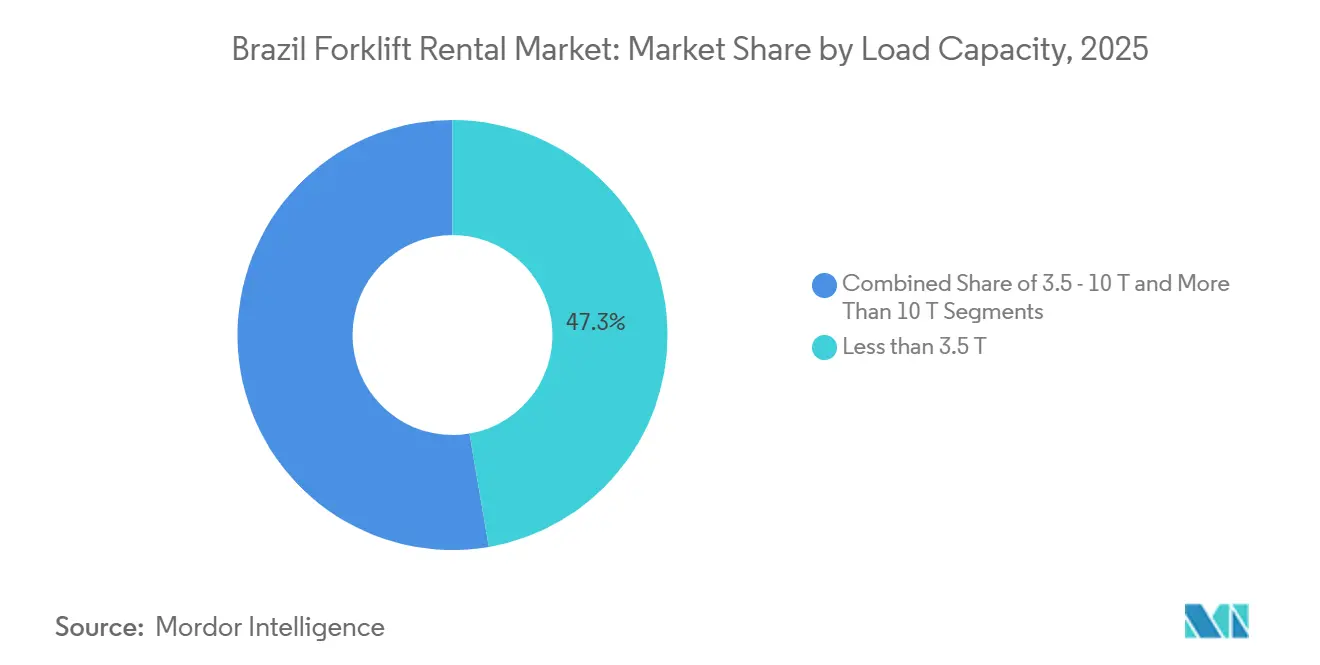
Forklifts rated below 3.5 tons captured 47.27% of the 2025 rental value, and this slice of the Brazilian forklift rental market size is projected to rise at a 13.23% CAGR through 2031. Compact trucks navigate 2.5-meter aisles common in e-commerce hubs run by Mercado Libre and Shopee, conserving space in warehouses now topping 12-meter clear heights. Lithium-ion batteries trim unit weight by 30-50%, letting sub-3.5-tons models lift heavier loads without breaching 6-ton floor limits demanded in Class A facilities.
Mid-capacity (3.6-10 ton) forklifts thrive in ports and intermodal yards where DP World’s Santos expansion will deploy 40 transfer vehicles by 2028. Heavy units above 10 tons serve mining and metals, and Vale’s plan to field 90 autonomous haul trucks by 2028 signals rising telemetry standards that rental fleets must support. The Brazil forklift rental market share for heavy trucks stays modest, yet premium day rates offset lower volumes when providers bundle sensors and predictive maintenance.

By Rental Duration: Spot Contracts Surge Amid Seasonal Peaks
Mid-term contracts spanning 1–12 months held 54.32% of 2025 revenue, but sub-30-day spot hires are growing fastest at 13.27% CAGR. Grain harvests reaching 322.47 million tons bunch equipment needs into 8-12 week windows, pushing cooperatives to rent extra forklifts rather than buying idle capacity. Port of Santos upgrades add phased construction slots that require temporary lift fleets, a pattern mirrored in Novo PAC job sites statewide.
Telematics now features even in one-week contracts, safeguarding against misuse and enabling usage-based billing. Logistics developers, offering up to six months of rent-free periods, synchronize mid-term forklift rentals with warehouse handover dates. Elevated interest rates keep ownership unattractive, so the Brazil forklift rental market wraps flexible extensions into master agreements to preserve client options.
By Power Source: Electric Units Gain Despite Grid Volatility
Internal-combustion forklifts held 66.53% of 2025 rental value, yet electric units will rise at a 13.29% CAGR through 2031 as LiFePO₄ batteries clock 2,000-4,000 cycles and charge in under three hours. NR-11 bars diesel units from enclosed cold stores, steering tenants toward zero-emission options despite electricity tariff swings.
Hangcha’s XC series, popular in 2025, proves 8-hour runtimes on 220-volt outlets, shrinking capex on chargers. Hybrid and hydrogen prototypes remain niche, but Port of Santos’ plans for green-hydrogen trials may spark early-stage demand. Long-run total cost of ownership already favors lithium over lead-acid, reinforcing electric adoption across the Brazilian forklift rental market.
By Truck Class: Class I Compact Units Lead Automation Wave
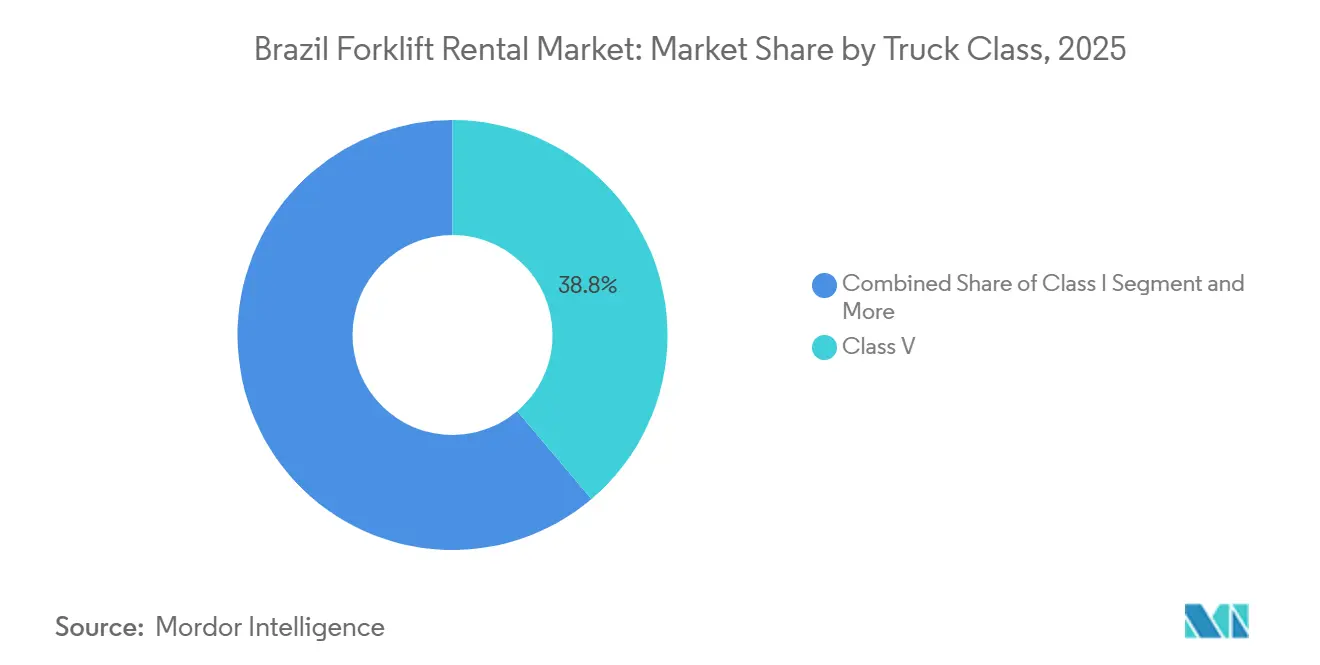
Class V trucks led with 38.81% of 2025 volume thanks to outdoor versatility, yet Class I electric riders will grow 14.33% annually as vertical racking spreads. Triple-A facilities in São Paulo demand reach trucks that pick at 12 meters, a task diesel units cannot match indoors under emissions caps.
Port of Santos’ private 5G network tests connected Class V machines feeding live status to a Digital Twin, while warehouse clients ask for geofencing on Class I fleets to limit aisle over-speed. Rental companies fuse NR-11 recertification services into Class I bundles, converting a compliance headache into a value-added feature. Such wraps strengthen retention in the competitive Brazil forklift rental market.
By End-Use Industry: Warehousing Leads, Aerospace Emerges
Warehousing and logistics absorbed 61.27% of 2025 spending and will continue as the fastest-rising vertical at a 14.36% CAGR, anchored by e-commerce throughput that doubled Shopee’s package-handling capacity in 2025. Construction gains a lift from Novo PAC road and rail outlays with a significant investment, ordering forklifts for staging rebar, aggregates, and precast modules.
Cold-chain operators like Emergent Cold LatAm add blast-freezer sites that need low-temperature forklifts, while aerospace demand edges up as 120 regional airports slated by 2026 require ground-support lifts. Automotive usage cools under high SELIC rates, but tax credits for hybrid assembly temper the slide. These cross-currents keep the Brazilian forklift rental market diversified across cycles.
Geography Analysis
São Paulo and Rio de Janeiro anchor the Brazil forklift rental market. Prologis is expected to report a moderate vacancy environment and forecast strong rent growth for the year, reflecting resilient demand for logistics space in the country’s core consumption and distribution corridors. The Port of Santos, a major port complex set to expand significantly after receiving federal approval, is expected to generate layered demand for reach stackers during berth works and for internal transfer vehicles as throughput increases. Mercado Libre and Shopee are expected to lease substantial logistics space, with activity concentrated around Campinas, Guarulhos, and ABC Paulista, reinforcing the role of e-commerce and third-party logistics in driving forklift rental demand.
Mato Grosso, Paraná, and Rio Grande do Sul are expected to drive seasonal peaks linked to an exceptionally large harvest. The duplication of key freight corridors is expected to reduce haul times, compress loading windows, and increase short-term rental intensity across grain-producing regions. Plano Safra financing, which offers longer repayment terms at comparatively favorable interest rates, supports silo expansions that require additional forklifts for grain turning and container stuffing. Arco Norte port upgrades in Porto Velho and Santarém are realigning export flows, encouraging rental companies to position fleets in river-ocean interface zones and respond faster to shifting agribusiness logistics requirements.
Pará is emerging on the mining map as Vale partners with Caterpillar and Sotreq to deploy a large autonomous truck fleet over the coming years, creating demand for telemetry-enabled support vehicles. Minas Gerais benefits from Caterpillar’s Sete Lagoas plant for quick parts supply, while Curitiba supports automotive clusters awaiting rate relief to restart volume growth. Across these nodes, the Brazil forklift rental market supports nationwide depots by cycling assets between agribusiness peaks and port expansions, thereby stabilizing utilization and improving fleet productivity across regional demand cycles.
Analysis of the forklift rental market by Mordor Intelligence spans multiple other regional evaluations across North America, supported by country-level insights for United States, Indonesia, Saudi Arabia, South Korea, and United Arab Emirates, wherein local market conditions keep varying from one country to another.
Competitive Landscape
Global OEMs—Toyota Material Handling, KION, Hyster-Yale, Caterpillar—sell through dealers, but regional firms such as Movicarga, Baloc, Stemp Empilhadeiras, Moviservi, and Loxam Degraus capture share through rapid field service and flexible billing. Caterpillar’s five factories and 6,000-strong workforce secure parts pipelines yet do not guarantee rental control, leaving room for independents that specialize in electric fleets with lithium-ion packs.
Technology now sorts contenders. Konecranes’ TRUCONNECT reachstackers delivered in 2024 illustrate how remote diagnostics lower unplanned downtime, a must-have copied by rental rivals deploying fleet-management dashboards. Port of Santos’ forthcoming 5G and Digital Twin ecosystem sets a benchmark for data-rich forklifts; providers lacking CAN bus access or API integration risk exclusion from preferred vendor lists.
NR-11 compliance turns into a revenue stream: Jungheinrich bundles annual operator recertification, load-capacity labeling, and emissions audits into lease deals that lock clients for full contract cycles. Elevated SELIC rates favor the field toward well-capitalized groups that refinance fleets below benchmark rates, but asset-light entrants align with OEMs for back-to-back leases, limiting balance-sheet exposure while riding the Brazil forklift rental market upcycle.
Brazil Forklift Rental Industry Leaders
-
Toyota Material Handling
-
KION Group
-
Hyster-Yale
-
Caterpillar, Inc.
-
Movicarga
- *Disclaimer: Major Players sorted in no particular order
Recent Industry Developments
- April 2026: Global material handling brand UN Forklift used the INTERMODAL Brazil 2026 exhibition in São Paulo to relaunch a major expansion campaign in South America. The company debuted a specialized lineup of heavy internal combustion (IC) and zero-emission electric forklifts configured for harsh tropical operating conditions and high-throughput Brazilian ports.
- April 2025: CSI Remarketing Locação de Equipamentos LTDA. a wholly owned subsidiary of CSI Leasing, Inc. (“CSI”), acquired Somov Rental LTDA. Somov Rental, headquartered in São Paulo, specializes in renting and maintaining forklifts manufactured by Hyster-Yale.
Brazil Forklift Rental Market Report Scope
The scope of the report includes Load Capacity (Less Than 3.5 T, 3.6 to 10 T, and More Than 10 T), Rental Duration (Short-term/Spot, Mid-term, and Long-term Lease), Power Source (Electric, Internal Combustion (Diesel/LPG), and Hybrid / Hydrogen Fuel-cell), Class (Class I, Class II, Class III, Class IV, and Class V), and End-Use Industry (Warehousing and Logistics, Construction, Automotive, Food and Beverage, Aerospace and Defense, and Others (Retail, Pharma, etc.)).
| Less Than 3.5 T |
| 3.6 - 10 T |
| More Than 10 T |
| Short-term / Spot (less than 1 month) |
| Mid-term (1 - 12 months) |
| Long-term Lease (3 - 5 years) |
| Electric |
| Internal Combustion (Diesel/LPG) |
| Hybrid |
| Class I |
| Class II |
| Class III |
| Class IV |
| Class V |
| Warehousing & Logistics |
| Construction |
| Automotive |
| Food & Beverage |
| Aerospace & Defense |
| Others (Retail, Pharma, etc.) |
| By Load Capacity | Less Than 3.5 T |
| 3.6 - 10 T | |
| More Than 10 T | |
| By Rental Duration | Short-term / Spot (less than 1 month) |
| Mid-term (1 - 12 months) | |
| Long-term Lease (3 - 5 years) | |
| By Power Source | Electric |
| Internal Combustion (Diesel/LPG) | |
| Hybrid | |
| By Truck Class | Class I |
| Class II | |
| Class III | |
| Class IV | |
| Class V | |
| By End-use Industry | Warehousing & Logistics |
| Construction | |
| Automotive | |
| Food & Beverage | |
| Aerospace & Defense | |
| Others (Retail, Pharma, etc.) |
Key Questions Answered in the Report
How large will the Brazil forklift rental market be by 2031?
It is forecast to reach USD 3.45 billion by 2031, up from USD 1.94 billion in 2026.
Which sector rents the most forklifts in Brazil?
Warehousing and logistics accounted for 61.27% of 2025 spending and are expanding at a 14.36% CAGR.
What is driving electric forklift adoption in Brazil?
NR-11 indoor emissions rules, lithium-ion batteries that charge in 1-3 hours, and total cost of ownership advantages over five-year horizons.
Where is regional demand growing fastest?
Agricultural corridors in Mato Grosso and new port nodes in the Arco Norte are posting the steepest seasonal surges.
How are high interest rates affecting rental decisions?
A 15% SELIC rate inflates ownership costs, making rentals a cash-flow-friendly alternative for equipment users.
What technology features are becoming standard in rental contracts?
Telematics for remote diagnostics, geofencing, and usage-based billing are now commonplace, even on spot contracts.