
United States Forklift Rental Market Size and Share
Market Overview
| Study Period | 2019 - 2031 |
|---|---|
| Forecast Data Period | 2026 - 2031 |
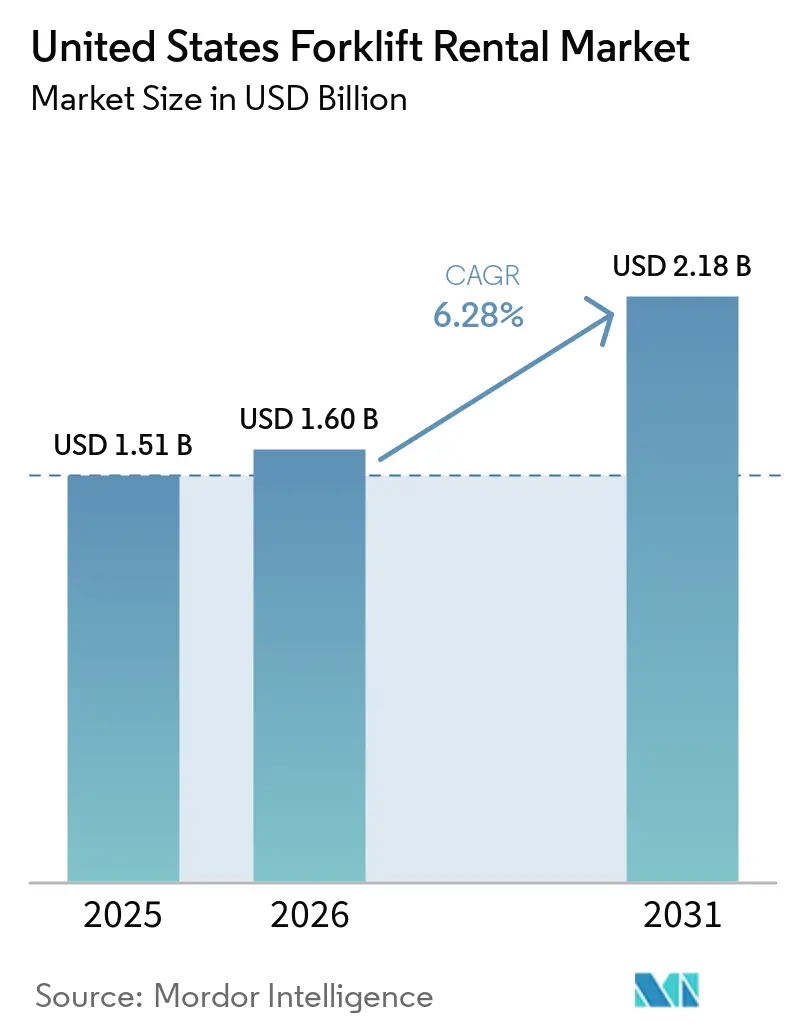
| Base Year Market Size (2025) | USD 1.51 Billion |
| Market Size (2026) | USD 1.60 Billion |
| Market Size (2031) | USD 2.18 Billion |
| Growth Rate (2026 - 2031) | 6.28 % |
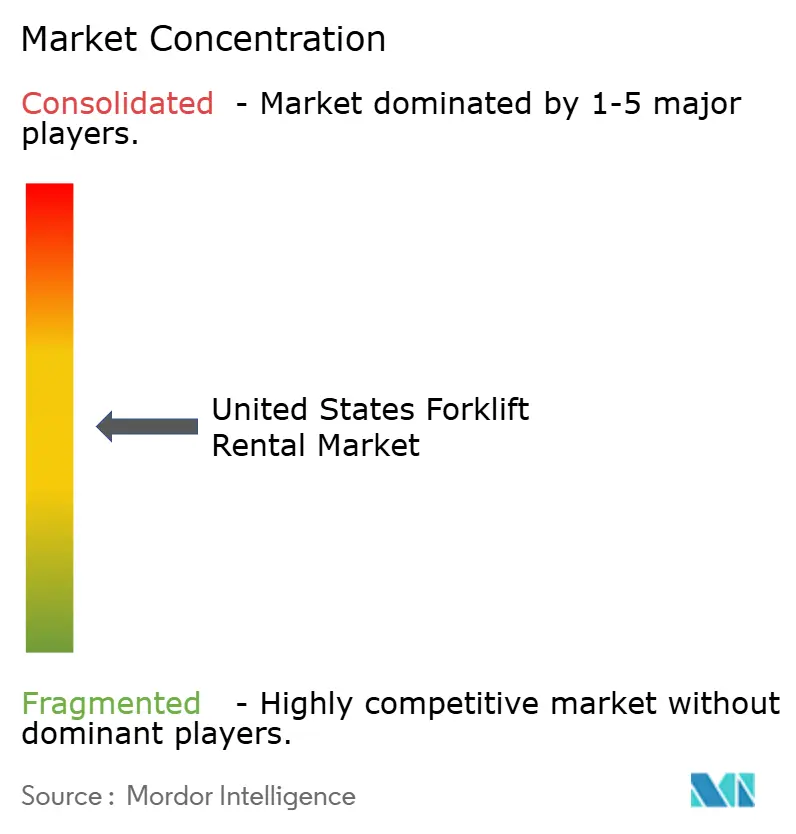
| Market Concentration | Medium |
Major Players *Disclaimer: Major Players sorted in no particular order Image © Mordor Intelligence. Reuse requires attribution under CC BY 4.0. | |
United States Forklift Rental Market Analysis by Mordor Intelligence
The United States forklift rental market size was valued at USD 1.51 billion in 2025 and estimated to grow from USD 1.60 billion in 2026 to reach USD 2.18 billion by 2031, at a CAGR of 6.28% during the forecast period (2026-2031). Enterprises are increasingly opting for rentals over outright ownership due to rising borrowing costs, regulatory pressures to electrify material-handling fleets, and the need for operational agility. This shift is expected to significantly increase rental penetration in forklift deployments. California's zero-emission forklift mandate is accelerating the transition to lithium-ion equipment. However, this shift faces challenges as constrained battery supplies are extending lead times. E-commerce warehousing expansions in states like Texas, Georgia, California, and Washington are bolstering demand for short-cycle contracts during peak seasons. Additionally, telematics-enabled pay-per-use agreements are bridging the cost divide between rentals and financed purchases by consolidating maintenance and uptime guarantees into a single invoice.
Key Report Takeaways
- By end-use industry, warehousing and logistics led with 49.14% share in 2025, while the e-commerce slice is projected to grow fastest at an 11.26% CAGR to 2031.
- By power source, electric forklifts commanded 55.12% of the United States forklift rental market share in 2025, and the segment is forecast to expand at a 10.73% CAGR to 2031.
- By rental duration, short-term contracts captured 51.87% revenue share in 2025, whereas mid-term rentals are poised for the fastest growth at a 9.04% CAGR between 2026 and 2031.
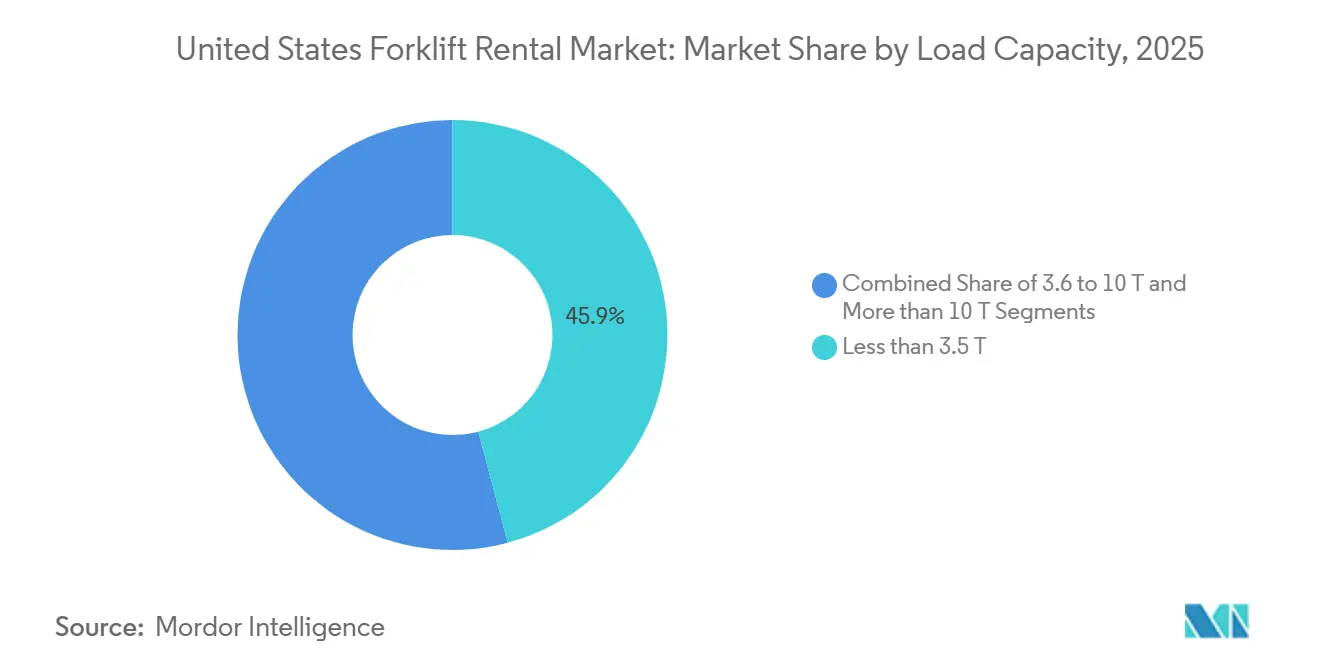
- By load capacity, forklifts under 3.5 tons accounted for 45.87% of the United States forklift rental market size in 2025 and are expected to grow at an 8.52% CAGR during the forecast window.
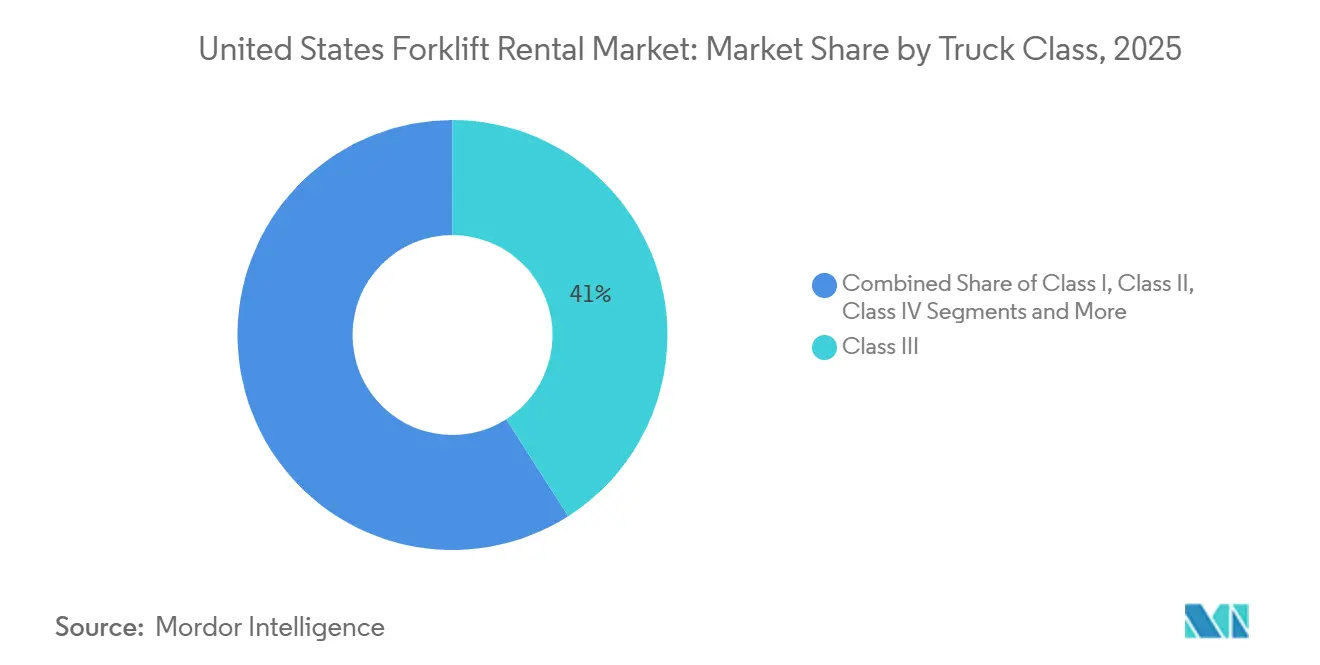
- By truck class, Class III electric motor hand/rider trucks held 40.96% share in 2025, yet Class I electric rider trucks will post the highest CAGR at 9.42% through 2031.
- By geography, the South region led with 30.08% revenue share in 2025, while the West region is projected to record the fastest growth at an 8.85% CAGR to 2031.
Note: Market size and forecast figures in this report are generated using Mordor Intelligence’s proprietary estimation framework, updated with the latest available data and insights as of January 2026.
Global valuation is built by aggregating outputs from multiple countries and regions, with United states being one of the contributors. Our global forklift rental market size represents that cumulative total.
United States Forklift Rental Market Trends and Insights
Drivers Impact Analysis*
| Driver | (~) % Impact on CAGR Forecast | Geographic Relevance | Impact Timeline |
|---|---|---|---|
| E-Commerce Warehousing Surge | +2.1% | National, concentrated in West and South regions | Medium term (2–4 years) |
| CAPEX-Lite Preference in High-Rate Era | +1.8% | National, particularly affecting small-to-medium enterprises | Short term (≤ 2 years) |
| EPA/CARB Rules Driving Electric Rentals | +1.4% | California-led, expanding to Northeast states | Long term (≥ 4 years) |
| OEM Fleet-as-a-Service Uptake | +0.9% | National, with early adoption in industrial corridors | Medium term (2–4 years) |
| Telematics-Based Pay-Per-Use Rentals | +0.6% | National, concentrated in tech-forward metropolitan areas | Long term (≥ 4 years) |
| Micro-Fulfillment Centers Fueling Demand | +0.8% | Urban centers, particularly West Coast and Northeast | Short term (≤ 2 years) |
| Source: Mordor Intelligence | |||
Explosive E-commerce Warehousing Demand
Amazon recently opened several new fulfillment centers across the U.S., with each center requiring dozens of rental forklifts during peak installation and ramp-up phases. Walmart invested significantly in automation upgrades for its high-tech customer fulfillment centers, driving short-term forklift demand during extended buildout periods. Quick-commerce giants Gopuff and DoorDash established micro-warehouses, relying on compact Class III pallet jacks rented for short-term periods. This demand pattern does not align with ownership economics. Texas logistics corridors added substantial new warehouse space, while Georgia also contributed significantly, reinforcing the South's leadership in the U.S. forklift rental market. Ongoing construction of fulfillment centers across the country provides a stable foundation for rental fleet utilization.
CAPEX-lite Preference Amid Higher Interest Rates
The Federal Reserve kept its policy rate in the 3.5%-3.75% band through early 2026, inflating equipment-financing costs [1]“Federal Funds Rate Data,”, Federal Reserve Board, federalreserve.gov. Sunbelt Rentals reported an increase in mid-term contract revenue, highlighting a notable shift among customers moving away from direct purchases. Meanwhile, Alta Equipment observed tighter margins on new forklift sales, underscoring the growing allure of rentals. Financing an electric forklift over a long-term period results in a monthly payment that is lower compared to rental rates, which are higher but include maintenance and unscheduled swap-outs. This narrows the economic gap when downtime risk is considered. These conditions favor the United States forklift rental market as CFOs prioritize balance-sheet flexibility.
Stricter U.S. EPA/CARB Emission Rules Accelerating Electric Rentals
California mandates that a portion of new forklifts must be zero-emission initially, increasing to full compliance for larger fleets within a few years [2]“Zero-Emission Forklift Regulation,”, California Air Resources Board, arb.ca.gov. In response to this transition, Sunbelt strategically positioned a significant number of all-electric Bobcat T7X loaders in California. States like Oregon, Washington, and New York are considering similar regulations, indicating a potential nationwide adoption in the future. Electric forklifts already hold a substantial market share and are expected to grow rapidly, supported by declining lithium-ion battery costs. With this regulatory momentum, the U.S. forklift rental market is well-positioned for sustained growth.
OEM Fleet-as-a-Service Programs Boosting Rental Penetration
Original equipment manufacturers increasingly offer fleet-as-a-service models that blur traditional rental boundaries, with Toyota Material Handling's Energy Solutions program providing comprehensive electric fleet transitions, including consulting services and UL-certified battery combinations[3]“T-Matics Telematics Platform,”, Toyota Material Handling, toyotaforklift.com. These programs address operator concerns about adopting electric forklifts by bundling equipment, maintenance, and energy management into a single contract. Caterpillar's continued strategic relationship with Mitsubishi Logisnext ensures Cat lift truck support through over 600 dealer locations worldwide, demonstrating OEM commitment to service-based revenue models. The integration of telematics data with fleet management systems enables predictive maintenance and usage optimization, creating value propositions that extend beyond traditional rental arrangements. This evolution positions OEMs as fleet partners rather than equipment suppliers, fundamentally altering competitive dynamics in the rental sector.
Restraints Impact Analysis*
| Restraint | (~) % Impact on CAGR Forecast | Geographic Relevance | Impact Timeline |
|---|---|---|---|
| Maintenance Liability Concerns | -0.8% | National, particularly affecting first-time rental users | Short term (≤ 2 years) |
| Construction Project Delays | -1.2% | National, with regional variations based on infrastructure spending | Medium term (2–4 years) |
| Lithium-Ion Battery Supply Crunch | -0.6% | National, with supply chain concentration risks | Short term (≤ 2 years) |
| AMR/AGV Cannibalizing Light Forklifts | -0.4% | Industrial corridors, particularly in automated facilities | Long term (≥ 4 years) |
| Source: Mordor Intelligence | |||
Perceived Maintenance Liability and Damage Charges
Despite providers embedding waivers in base rates, many small contractors cite uncertainty as a rental deterrent, leading them to overestimate damage fees. Adding insurance can significantly increase daily rates, diminishing the savings compared to purchasing a used unit. With regional fleets often underutilized, it's evident that friction costs are capping the potential of the U.S. forklift rental market. While firms are introducing pre-rental photo audits and telematics to monitor operator misuse, first-time renters still face educational gaps.
Cyclical Construction Project Delays
Non-residential starts in the South declined as forklift orders tied to commercial construction slowed. Weather challenges, permitting delays, and labor shortages frequently disrupt schedules, leaving units idle on yard lots and reducing fleet utilization. Although indicators suggest a near-term recovery, these brief fluctuations continue to cloud revenue predictability in the United States forklift rental industry.
*Our forecasts treat driver/restraint impacts as directional, not additive. The impact forecasts reflect baseline growth, mix effects, and variable interactions.
Segment Analysis
By Load Capacity: Compact Units Drive Market Penetration
Less-than-3.5-ton forklifts captured 45.87% of the United States forklift rental market share in 2025 and are forecast to grow at an 8.52% CAGR through 2031. Dense urban fulfillment nodes rely on these compact electric pallet jacks and stackers to navigate 30-foot aisles without compromising throughput. During holiday peaks, Amazon and Walmart frequently utilize such units, often opting for short-term contracts. While manufacturers of heavier goods traditionally relied on mid-range equipment, this segment is projected to grow more slowly as the push for automation reduces the need for repetitive lifting.
Rental duration patterns shift with equipment capacity: smaller models dominate short-term rentals, whereas larger units are increasingly leased for longer periods, especially in construction and steel handling. Systems like Toyota’s T-Matics and Crown’s InfoLink empower lessors to monitor equipment utilization, reducing unplanned downtime and extending asset life. Even in the heavy equipment segment, there's a noticeable shift towards electric. Recently, Port Newark ordered large battery units to align with regional air-quality regulations.



By Rental Duration: Short-term Flexibility Meets Mid-term Growth
Short-term rentals accounted for 51.87% of the United States forklift rental market in 2025, driven by seasonal retail, agricultural, and event logistics needs. Yet mid-term contracts spanning 1 to 12 months will advance at a 9.04% CAGR as micro-fulfillment buildouts, data center construction, and 90- to 180-day commissioning activities proliferate. Once the bots took over, Kroger’s Ocado-powered customer fulfillment centers no longer needed forklifts, a shift evident during the automated grid’s installation.
United Rentals has introduced a “flex lease” that allows customers to convert short-term rentals into extended agreements. This comes with retroactive rate adjustments, providing a hedge against forecast uncertainties and ensuring United Rentals a steady stream of revenue. Alta Equipment made a strategic move by reducing its fleet, underscoring that volume growth isn't always organic; sometimes, a disciplined capital rotation can lead to a reduced supply. During peak seasons, short-term users opt for damage waivers at a high rate, while mid-term clients prefer a bundled service that integrates insurance into their monthly billing.
By Power Source: Electric Dominance Accelerates
Electric forklifts held 55.12% share of the United States forklift rental market in 2025 and are projected to expand at a 10.73% CAGR, more than tripling the growth of internal-combustion rivals. California's mandate, along with declining lithium-ion battery prices, spurred both compliance and cost parity. While internal-combustion forklifts remain essential for outdoor tasks and lumber yards, their growth is limited to a modest pace, constrained by rising diesel costs and a plateauing LPG network coverage.
Lithium-ion batteries have become dominant, accounting for a significant share of new electric deliveries. This growth is driven by opportunity charging, which eliminates the need for mid-shift swaps, resulting in substantial labor savings for each multi-shift unit. Hydrogen fuel cell models have seen widespread deployments in the U.S. However, their usage is primarily concentrated in high-throughput cold-storage facilities, where the speed of refueling offsets the higher hydrogen costs. Additionally, telematics has transformed rental billing by aligning it with the battery's state of charge. This approach has improved pricing accuracy and significantly boosted margins for lessors.
By Truck Class: Class III Warehouse Applications Lead
Class III electric motor hand/rider trucks accounted for 40.96% of the market in 2025. Yet, Class I rider trucks will post the strongest 9.42% CAGR through 2031 as lithium-ion advances unlock multi-shift endurance without swaps. Class II narrow-aisle trucks hold a niche in tall-rack warehouses and cold storage, benefiting from the growth in the pharmaceutical cold chain.
Class IV internal-combustion cushion-tire forklifts maintain a significant share, thriving in manufacturing and outdoor construction where rapid refueling remains essential. However, tightening regulations are challenging the viability of diesel. Meanwhile, Class V pneumatic-tire models are experiencing slower growth as telehandlers and container handlers increasingly handle outdoor lifts. Jungheinrich’s autonomous EAC 212a highlights that automation is no longer confined to indoor applications, signaling potential disruptions to traditional demand patterns.
By End-use Industry: Warehousing Dominance with E-commerce Acceleration
Warehousing and Logistics led with 49.14% share of the United States forklift rental market in 2025, and the E-Commerce slice alone is expected to surge at an 11.26% CAGR to 2031. Amazon's new sites, Walmart's automation initiatives, and a host of third-party logistics operators consistently peak, best managed by rented fleets. Following closely, construction holds a significant share but is grappling with modest growth, hindered by cyclical permitting delays.
Automotive manufacturing is benefiting from domestic battery-plant construction, leading to a temporary surge in mid-term rentals. The Food and Beverage sector is witnessing steady growth, driven by expansions in fresh-food micro-fulfillment and cold storage. Aerospace and Defense, maintaining a smaller share, is focusing on heavy-lift rentals at assembly plants. While rental penetration is highest in e-commerce, it remains lower in the automotive and aerospace sectors, where the risk of downtime makes owned backups a justified choice.
Geography Analysis
The South’s leadership hinges on diversified industrial demand, robust port throughput, and a favorable tax environment that attracts corporate relocations. The region captures 30.08% of the market share, while the western region is the fastest-growing, with an 8.85% CAGR. Texas and Florida experienced significant growth in warehouse construction, resulting in stable lift truck utilization. A steady presence of automotive, petrochemical, and aerospace facilities ensures consistent rental activity, even amidst fluctuations in individual sectors.
California's forklift emission regulations, combined with the concentration of import gateways in Los Angeles and Long Beach, drive growth in the West. Warehouse vacancies in the Inland Empire have decreased significantly, spurring a wave of speculative construction that quickly converts to rental agreements. In Silicon Valley, tech companies are testing autonomous forklifts, emphasizing the need for rental partners skilled in servicing advanced navigation and safety systems.
Markets in the Northeast and Midwest show steady, moderate growth. New Jersey and Pennsylvania's dense populations support ongoing retail fulfillment needs, while Ohio and Michigan's automotive centers sustain a consistent demand for Class IV and specialized heavy electric vehicles. Additionally, funding for bridge repairs over the Ohio River and upgrades to rail hubs in Chicago ensures continued demand for rough-terrain unit rentals.
Coverage of the forklift rental market by Mordor Intelligence spans a wide geographic footprint, with regional analysis available for North America, alongside detailed country-level intelligence for Brazil, Indonesia, Saudi Arabia, South Korea, and United Arab Emirates, each shaped by local operating conditions.
Competitive Landscape
Market structure is moderately fragmented. United Rentals, Sunbelt Rentals, and Herc Rentals hold a significant share, leveraging national depots, purchasing power, and technology platforms. The fragmented nature of the remaining market creates opportunities for regional players and specialty providers to serve niche applications and local markets where scale advantages are less pronounced.
Regional independents remain agile by focusing on service responsiveness and niche equipment—such as freezer-rated electrics or explosion-proof models—where scale offers limited advantage. OEM-linked lessors, including Toyota, Raymond, and Crown branches, reinforce customer loyalty by bundling parts availability, maintenance, and operator training. Digital entrants like BigRentz aggregate surplus fleet inventory through online marketplaces, though their share remains below 2%.
Technological differentiation centers on telematics, predictive maintenance, and customer-facing apps that streamline rental cycles and billing. Electrification readiness is a critical battleground: fleets with high proportions of lithium-ion units secure priority contracts in California and the Northeast, where emission compliance is non-negotiable. Integration with warehouse management systems and AMR/AGV platforms is emerging as the next competitive frontier.
United States Forklift Rental Industry Leaders
United Rentals
Sunbelt Rentals (Ashtead Group)
Herc Rentals
Toyota Material Handling USA
Crown Equipment Corp.
- *Disclaimer: Major Players sorted in no particular order

Recent Industry Developments
- October 2025: Noblelift North America has unveiled its Alpha Series pneumatic forklifts, marking the debut of a forklift platform tailored for both lithium-ion and LPG power options. Boasting a robust steel chassis and mast, the Alpha Series features axles that Noblelift claims rival those of internal combustion trucks, and comes equipped with an onboard charger, ideal for rental fleet applications.
- February 2025: Herc Holdings completed its USD 5.3 billion acquisition of H&E Equipment Services, including USD 1.5 billion in debt, creating the third-largest rental company in North America with combined annual revenue of approximately USD 5.2 billion.


United States Forklift Rental Market Report Scope
The United States forklift rental market report is segmented by load capacity (less than 3. 5 t, 3. 6 to 10 t, and more than 10 t), rental duration (short-term/spot, mid-term, and long-term lease), power source (electric, internal combustion, and hybrid), truck class (class i, class ii, class iii, class iv, and class v), end-use industry (warehousing and logistics, construction, automotive, food and beverage, and aerospace and defense, and others), and geography. The market forecasts are provided in terms of value (USD).
| Less than 3.5 T |
| 3.6 to 10 T |
| More than 10 T |
| Short-term/Spot (Less than 1 month) |
| Mid-term (1 to 12 months) |
| Long-term Lease (3 to 5 years) |
| Electric |
| Internal Combustion (Diesel/LPG) |
| Hybrid |
| Class I |
| Class II |
| Class III |
| Class IV |
| Class V |
| Warehousing and Logistics |
| Construction |
| Automotive |
| Food and Beverage |
| Aerospace and Defense |
| Others (Retail, Pharma, etc.) |
| Northeast |
| Midwest |
| South |
| West |
| By Load Capacity | Less than 3.5 T |
| 3.6 to 10 T | |
| More than 10 T | |
| By Rental Duration | Short-term/Spot (Less than 1 month) |
| Mid-term (1 to 12 months) | |
| Long-term Lease (3 to 5 years) | |
| By Power Source | Electric |
| Internal Combustion (Diesel/LPG) | |
| Hybrid | |
| By Truck Class | Class I |
| Class II | |
| Class III | |
| Class IV | |
| Class V | |
| By End-use Industry | Warehousing and Logistics |
| Construction | |
| Automotive | |
| Food and Beverage | |
| Aerospace and Defense | |
| Others (Retail, Pharma, etc.) | |
| By Region (U.S.) | Northeast |
| Midwest | |
| South | |
| West |


Key Questions Answered in the Report
How large is the United States forklift rental market in 2026?
The market is valued at USD 1.60 billion in 2026, moving toward USD 2.18 billion by 2031 at a 6.28% CAGR.
Which segment grows fastest in the United States forklift rental market?
The E-Commerce slice of Warehousing and Logistics is projected to expand at an 11.26% CAGR through 2031.
Why are electric forklifts gaining share?
California’s zero-emission mandates, falling lithium-ion battery prices, and lower lifetime operating costs are propelling electric models to 55.12% share in 2025 and double-digit growth to 2031.
Which companies hold the largest market positions?
United Rentals, Sunbelt Rentals and Herc Rentals collectively control about one-third of U.S. forklift rental revenue.
Page last updated on:





