
Brazil Construction Equipment Market Size and Share
Market Overview
| Study Period | 2019 - 2031 |
|---|---|
| Forecast Data Period | 2026 - 2031 |
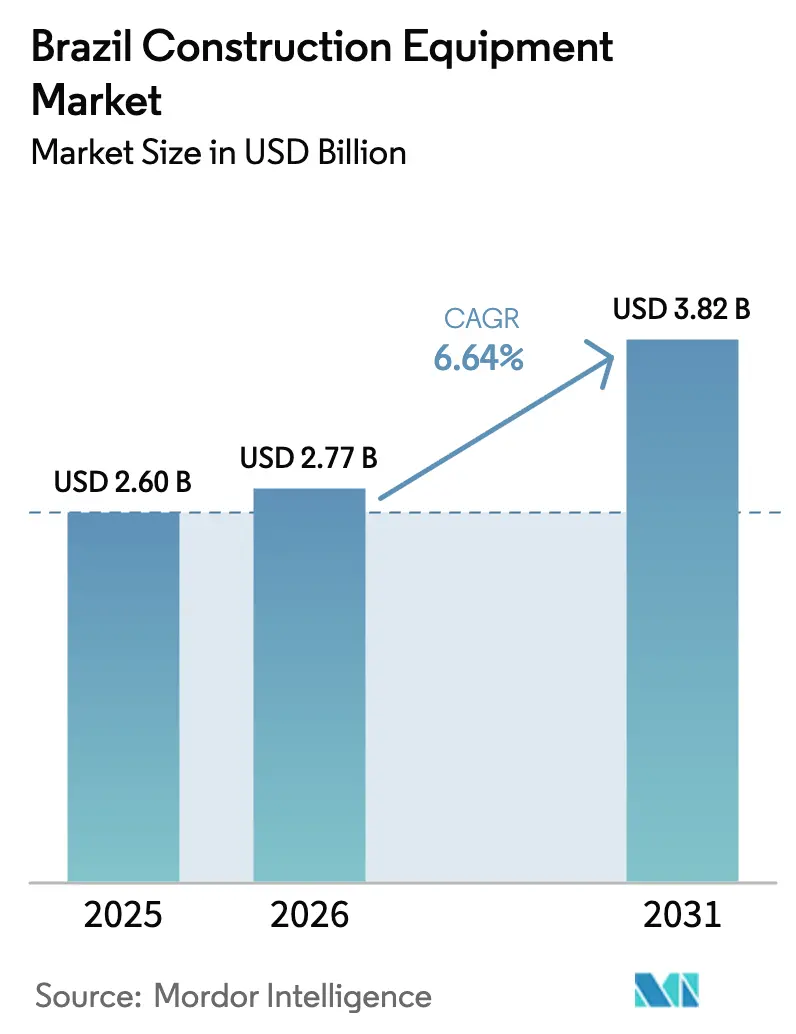
| Base Year Market Size (2025) | USD 2.60 Billion |
| Market Size (2026) | USD 2.77 Billion |
| Market Size (2031) | USD 3.82 Billion |
| Growth Rate (2026 - 2031) | 6.64 % |
| Market Concentration | Medium |
Major Players *Disclaimer: Major Players sorted in no particular order Image © Mordor Intelligence. Reuse requires attribution under CC BY 4.0. | |
Brazil Construction Equipment Market Analysis by Mordor Intelligence
The Brazil construction equipment market size is projected to expand from USD 2.60 billion in 2025 and USD 2.77 billion in 2026 to USD 3.82 billion by 2031, registering a CAGR of 6.64% between 2026 and 2031. Fleet evolution in the Brazilian construction equipment market is shifting toward infrastructure-grade earthmoving and material-handling assets as the federal PAC-3 program revives stalled highway and sanitation projects, while green-hydrogen mega-sites anchor long-cycle demand in the Northeast. While excavators continue to be the primary revenue drivers, telescopic handlers are gaining momentum, fueled by modular social housing projects and large-scale renewable energy hubs. Battery-electric platforms, still niche, are gaining visibility after mining majors began field trials of zero-emission haul trucks in Pará and Minas Gerais, signaling an eventual powertrain transition that OEMs cannot ignore. Competitive stakes are rising as Chinese assemblers deepen completely-knocked-down (CKD) footprints in Minas Gerais, eroding price points that global incumbents defend through autonomy, telematics, and hybrid-electric differentiation.
Key Report Takeaways
- By machinery type, excavators led with 40.15% of Brazil's construction equipment market share in 2025, while telescopic handlers are forecast to post the fastest 7.45% CAGR through 2031.
- By propulsion, internal-combustion platforms accounted for 92.33% of the Brazilian construction equipment market size in 2025, and battery-electric units are advancing at a 14.05% CAGR to 2031.
- By end-user, infrastructure and public works held 48.56% revenue in 2025; energy projects are projected to expand at a 9.01% CAGR to 2031.
- By application, road building and paving is growing at a 9.63% CAGR between 2026 and 2031, outpacing earthmoving’s established base of 59.13% in 2025 revenue.
- By region, the North region is the fastest-growing cluster at a 7.94% CAGR to 2031, while the Southeast retains 54.28% of 2025 demand.
Note: Market size and forecast figures in this report are generated using Mordor Intelligence’s proprietary estimation framework, updated with the latest available data and insights as of 2026.
Brazil Construction Equipment Market Trends and Insights
Drivers Impact Analysis*
| Driver | (~) % Impact on CAGR | Geographic Relevance | Impact Timeline |
|---|---|---|---|
| PAC-3 Infrastructure Revival | +1.2% | National (Southeast/South focus) | Medium term (2-4 years) |
| Minha Casa Minha Vida Housing | +1.0% | National (São Paulo, Rio, Brasília) | Short term (≤ 2 years) |
| Mining Royalty Earmarks | +0.9% | North/Central-West (spill-over to SE) | Medium term (2-4 years) |
| Utility-Scale Green-Hydrogen Hubs | +0.8% | Northeast and Southeast | Long term (≥ 4 years) |
| Chinese OEM CKD Expansion | +0.7% | Northeast and Southeast | Medium term (2-4 years) |
| 5G-Enabled Remote-Operation | +0.3% | North (Pará/Amazonas pilots) | Long term (≥ 4 years) |
| Source: Mordor Intelligence | |||
Federal PAC-3 Infrastructure Pipeline Revival
Under the Growth Acceleration Program's third cycle, Brazil has allocated significant funding for civil-works spending by 2026. However, by late 2025, only a small portion of the initial projects were completed, primarily due to budget freezes that delayed contract awards. As a result, contractors find themselves in a constant state of flux: they rent excavators and graders during funding delays but swiftly transition to purchasing fleets once financing is confirmed. In response, equipment vendors have started bundling services like telematics and rental buy-back clauses. They've also introduced flexible payment schedules aligned with the PAC-3 tranche releases, ensuring revenue protection even amidst shifting tender calendars. The most significant potential lies in highway and railway projects, which are expected to receive substantial allocations for 2025–2026 [1]“Infrastructure 2025,” National Confederation of Industry, cni.com.br. However, whether this momentum translates to sustained growth hinges on the federal government's ability to shorten permitting lead times, a process that has historically extended project timelines by several years.
Minha Casa Minha Vida" Phase-IV Social-Housing Push"
In 2024, government guarantees spurred significant housing contracts, with ambitions for further growth by 2027, dominating the nation's housing launches. The program's focus on repetitive, low-rise footprints has shifted site logistics, prioritizing backhoe loaders, mini excavators, and skid steers over traditional tower cranes. Mills Estruturas, with control over a substantial number of rental units across the country, has emerged as the primary beneficiary of these orders, underscoring the growing trend of a rental-first procurement model at urban job sites. While short-term demand appears strong, any tightening of subsidy tranches could lead to a swift reduction in unit shipments, highlighting the critical need for OEMs to maintain working-capital agility.
New Mining Royalty Earmarks for Roadworks (2025-2029)
Brazil's miners are set to make significant investments into capital programs by 2029, with a notable portion allocated specifically for haul roads and logistics spurs. These investments aim to circumvent the congested export corridors. Notably, Vale has earmarked a substantial amount for its 2025 capital expenditures, directing much of this towards remote routes tailored for autonomous truck platoons [2]“Investment Plan 2025,” Vale SA, vale.com. As a result, there's been a noticeable uptick in demand for heavy-duty graders, high-tonnage dump trucks, and continuous-duty compactors. Given that private miners are self-financing these corridors, they enjoy shorter lead times compared to public-sector projects. This efficiency not only accelerates the development process but also establishes a reliable revenue stream in the North and Central-West regions. Furthermore, suppliers are capitalizing on this environment, using it as a testing ground for dual-fuel haul trucks. These innovative trucks, which combine diesel with ethanol, manage to reduce haulage costs.
Rapid Expansion of Utility-Scale Green-Hydrogen Hubs
Fortescue, Solatio, and a World Bank-backed consortium have mega-projects in Pecém, requiring extensive earthworks before the arrival of electrolyzers. In a bid to meet their Scope 1 and 2 reduction commitments, developers are increasingly turning to hybrid or battery-electric excavators. This shift has prompted OEMs to prioritize positioning their premium, low-volume green fleets in Ceará and Piauí. Given that environmental permitting can take years, the anticipated growth will only be realized once these projects move from the feasibility stage to obtaining necessary clearances.
Restraints Impact Analysis*
| Restraint | (~) % Impact on CAGR Forecast | Geographic Relevance | Impact Timeline |
|---|---|---|---|
| SELIC Rates Dampening CAPEX | -0.9% | National, acute in Central-West and Northeast | Short term (≤ 2 years) |
| Shift Toward Equipment Rental | -0.6% | National, strongest in Southeast and South | Short term (≤ 2 years) |
| Logistics Bottlenecks at Ports | -0.5% | Southeast and South, affecting national supply | Medium term (2-4 years) |
| Import Duties on Tier-4 Engines | -0.4% | National, higher on imported premium brands | Medium term (2-4 years) |
| Source: Mordor Intelligence | |||
High SELIC Rates Dampening SME Capex
In January 2025, the benchmark rate was high, with expectations of further increases by March. As a result, small builders are hesitant to engage in long-term debt structures, which now come at significantly higher financing costs compared to 2023. This tightening in the macro environment is steering SME contractors in Mato Grosso and Pernambuco towards opting for secondhand or rental fleets. This shift is expected to negatively impact forecasted growth. Meanwhile, OEM captive-finance arms are attempting to navigate this landscape by cross-subsidizing interest or deferring principal payments until project milestones are met. However, despite these efforts, the uptake has been tepid, primarily due to ongoing rate volatility.
Accelerating Shift Toward Equipment Rental
Mills Estruturas, having acquired Armac, now boasts the largest multi-brand fleet in the country. They provide backhoes and boom lifts on flexible contracts, ensuring contractors maintain cash flow during project lotteries. In São Paulo's high-rise sites, rental penetration has grown significantly and is now extending to regional roadworks. This trend is reducing OEM unit sales, despite a surge in utilization. To counteract thinner margins on new machines, manufacturers are increasingly wooing rental consolidators. They're offering volume rebates and integrating telematics that highlight preventive maintenance, thus creating a steady annuity from parts and services.
*Our forecasts treat driver/restraint impacts as directional, not additive. The impact forecasts reflect baseline growth, mix effects, and variable interactions.
Segment Analysis
By Machinery Type: Excavators Anchor Demand, Telescopic Handlers Surge
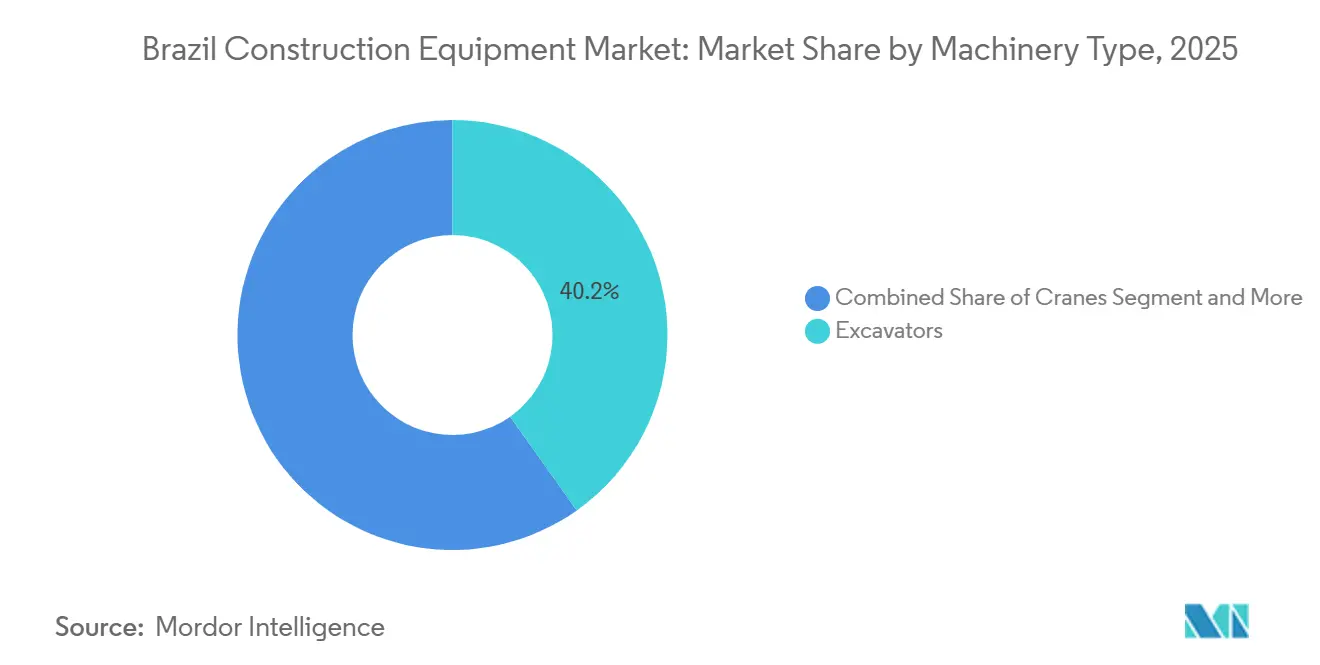
Excavators captured 40.15% of Brazil's construction equipment market share in 2025 on the back of multi-year highway and mining dig programs that need 20-ton to 50-ton hydraulic units at scale. Komatsu’s plan to nationalize the PC500LC-10M0 large excavator at Suzano underlines OEM faith in earthmoving’s staying power. Telescopic handlers are forecast to grow at a 7.45% CAGR, well above the overall Brazil construction equipment market size trajectory, as modular housing and large solar fields require rapid vertical reach in space-constrained footprints.
Wheel-loader demand dipped in 2024 as contractors favored mini excavators for tight urban plots, yet graders and compactors rallied in the Amazon-bound BR-163 upgrade. Niche lines such as heavy-lift lattice cranes remain tied to delayed high-rise pipelines in São Paulo and Rio de Janeiro, limiting volumes until financing costs recede. Across categories, price pressure intensifies where Chinese CKD imports overlap, while premium lift and reach segments retain double-digit margins because fewer domestic production lines compete.



By Propulsion: Internal Combustion Dominates, Battery-Electric Gains Momentum
Internal-combustion platforms held 92.33% of 2025 demand in the Brazilian construction equipment market, leveraging a dense diesel network and ethanol blending flexibility. Battery-electric units, now seeded in Vale’s zero-emission haul-truck pilots, will post a 14.05% CAGR through 2031, raising the Brazil construction equipment market size for high-voltage components and fast-charge depots. Hybrid-electric loaders bridge range anxiety while Stage V norms remain voluntary, drawing in city contractors facing local air-quality mandates in São Paulo.
XCMG’s delivery of several pure-electric dump trucks validates the Chinese OEM's ambition to leapfrog combustion incumbents, while Volvo CE’s Brazilian upgrade fund earmarks assembly space for hybrid excavators. Uptake, however, still hinges on lithium-ion cost curves and grid upgrades beyond coastal metros, especially in the Amazon corridor, where diesel logistics outcompete scarce charging.
By End-User Industry: Infrastructure Leads, Energy Projects Accelerate
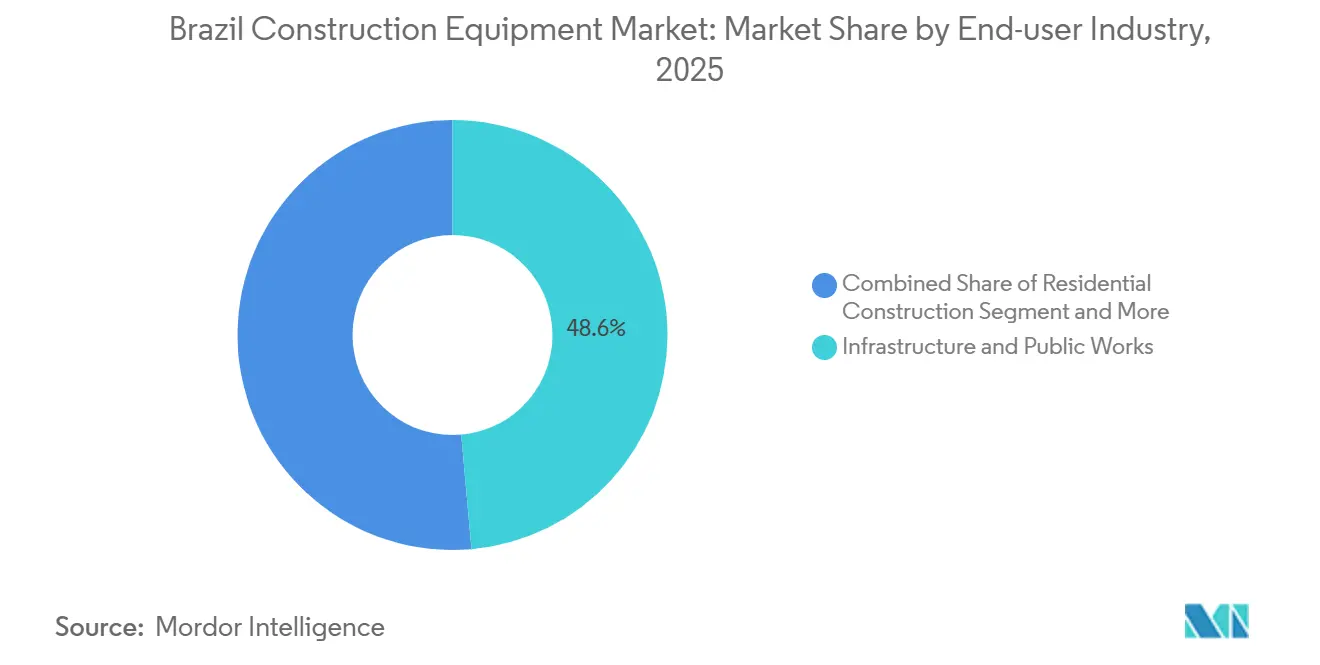
Accelerated tender pipelines for highways and rail spurs under the PAC-3 initiative led infrastructure and public works to account for 48.56% of the 2025 revenue. Energy developments will grow at a 9.01% CAGR, outpacing the broader Brazil construction equipment market, spurred by Petrobras offshore upgrades and a 15-GW onshore wind queue that needs cranes, dozers, and all-terrain transporters. Residential starts surged under Minha Casa Minha Vida, yet now decelerate alongside fiscal scrutiny and elevated mortgage rates, steering OEM attention toward civil and energy megaprojects with deeper pockets and predictable drawdowns.
Mining steadies baseline demand for ultra-class excavators and 150-ton haulers as Vale, CSN, and Anglo American maintain significant capital envelopes focused on low-strip, high-grade deposits. Commercial real estate lags, with occupancy rates yet to reclaim pre-pandemic benchmarks, curtailing tower-crane bookings beyond a few marquee CBD sites.
By Application: Earthmoving Dominates, Road Building Surges
Earthmoving claimed 59.13% of 2025 equipment volume, mirroring Brazil’s vast cut-and-fill obligations across plateau and rainforest terrains. Road-building and paving applications will grow at 9.63% through 2031, eclipsing earthmoving’s base growth as BR-163 and mineral-royalty corridors mobilize graders, pavers, and soil compactors at scale. Material-handling orders follow e-commerce warehouse booms and modular housing logistics, while demolition stays a São Paulo and Rio niche anchored to brownfield redevelopment.
Tunnel-boring and underground works pick up marginally alongside metro extensions but remain CAPEX-heavy slots suited to a handful of specialized OEMs. Attachment suppliers ride each wave by bundling breakers, augers, and grapple kits that elevate per-unit invoice values without large capital outlays.
Geography Analysis
In the Brazilian construction equipment market, the Southeast captured 54.28% of the 2025 demand, driven by its proximity to Santos port, a dense dealer network, and ongoing metro extension projects. This region's strategic advantages have positioned it as a dominant player in the market. Meanwhile, the North region is set to experience significant growth, with a projected CAGR of 7.94%. This growth is fueled by infrastructure upgrades to BR-163 and mining-led logistics activities, which are increasing the demand for graders and 50-ton excavators, particularly in Pará and Amazonas. These developments highlight the region's growing importance in the construction equipment market.
The Northeast is emerging as a key area of focus, leveraging the hydrogen boom to drive demand for construction equipment. Multi-billion-dollar hydrogen hubs in Pecém and Parnaíba are expected to attract cranes and heavy dozers between 2026 and 2031. This surge in activity underscores the region's potential as a hub for renewable energy infrastructure. In contrast, the Central-West region's spending is concentrated on widening grain corridors rather than large-scale civil construction projects. This focus has moderated growth in the region, with order books reflecting nominal growth rates. Despite this, the region remains an essential contributor to the overall market dynamics.
The South faces challenges stemming from a slowdown in the real estate sector, which is tied to persistently high SELIC rates. This has created a drag on the region's construction equipment demand. However, OEMs that proactively establish parts depots in strategic locations such as Belém, Manaus, and Fortaleza are well-positioned to outperform competitors. By addressing logistical challenges, these OEMs can maintain a competitive edge in the market.
Regulatory Landscape
Brazilian construction equipment compliance in 2024-2026 tightened around safety, traceability, and on-road circulation, influencing OEM specifications and import readiness. CONTRAN Resolution No. 1017/2024 requires agricultural and construction tractors to be registered in RENAVAM or RENAGRO when circulating on public roads, increasing documentation and fleet-administration requirements for contractors that redeploy equipment between sites.
In 2026, labor and technical rules added further compliance layers. The Ministry of Labor and Employment (MTE) Portaria No. 203 (February 6, 2026) extended the deadline to February 11, 2027 for mandatory climate-controlled cabins on new self-propelled construction machines covered under NR 18 (including pavers, asphalt feeders, and pavement milling machines). The timeline delays immediate capex pressure, but it keeps roadbuilding portfolios aligned to the requirement. Separately, NR 18 updates (Portaria MTE No. 836/2026) took effect on June 29, 2026, adding site protection requirements, including peripheral fall protection and multidirectional scaffolding. For imported lifting and concreting assets, INMETRO Portaria No. 142/2026 (July 11, 2026) mandates IoT remote monitoring modules for imported concrete pump trucks, tower cranes, and mobile cranes from September 1, 2026, referencing ABNT NBR 15603-2. This raises the importance of telematics-ready configurations and verified conformity routes.
Value Chain Analysis
The Brazil construction equipment value chain spans global and local component sourcing (powertrains, hydraulics, undercarriages, structures, and electronics) through domestic assembly or import, distribution, financing, and aftermarket support. A notable feature is the expanding use of local assembly and CKD footprints alongside incumbent OEM plants, which can shorten lead times and help suppliers align with procurement practices tied to federal infrastructure spending. Demand volatility associated with PAC-3 tranche timing has also pushed OEMs and distributors to bundle telematics, service packages, and rental buy-back clauses, shifting more margin capture toward lifecycle services rather than one-time unit sales.
Downstream operations are shaped by logistics and compliance. Moving oversized equipment within Brazil depends heavily on road transport with specialized trailers and AET (Autorizacao Especial de Transito) permits, which constrains delivery planning into the North and other interior corridors. Import pathways and final delivery are further influenced by regulatory and standards requirements, including the 2026 INMETRO IoT monitoring rules for certain imported cranes and concrete pump trucks, as well as the 2024-2026 road circulation and NR 18 safety obligations. As a result, dealer workshops, documentation services, and certified installation and calibration partners take on greater importance. Rentals and multi-brand fleet owners remain pivotal buyers, consolidating procurement while driving higher utilization that supports parts sales, remanufacturing, and field-service demand.
Competitive Landscape
Global majors Caterpillar, Komatsu, Volvo CE, CNH Industrial, and Deere together command a notable share of the Brazilian construction equipment market, yet Chinese entrants are eroding boundaries via CKD economics. XCMG’s Pouso Alegre plant already ships several units annually and now adds an electric-truck wing, while SANY and LiuGong layer USD-scale tranches that neutralize import levies and amplify payment flexibility [3]“Pouso Alegre Plant Milestone Report,” XCMG Brasil, xcmg.com.
Incumbents strike back with autonomy and hybrid portfolios: Komatsu investing to localize the WA380-6 loader, will double engineering headcount to tailor fuel-tolerant hydraulics; Caterpillar inks a yearly Vale pact for dual-fuel, autonomy-ready fleets, locking in parts annuities and software subscriptions.
Specialists like Dynapac and Astec defend compaction and asphalt niches through rapid service SLAs where scale is less decisive. Technology adoption cleaves the field: Tier-1 miners and energy EPCs demand 5G-ready, analytics-driven fleets, while SME builders still chase the lowest acquisition cost. Regulatory drift toward municipal emission caps will likely hasten a split, with premium OEMs dominating high-utilization, high-spec segments and CKD assemblers sweeping budget urban and rural jobs.
Brazil Construction Equipment Industry Leaders
Caterpillar Inc.
Komatsu Ltd.
Volvo Construction Equipment (Volvo CE)
Deere and Company
CNH Industrial N.V. (Case CE and New Holland)
- *Disclaimer: Major Players sorted in no particular order


Market Opportunities and Future Outlook
The near-term opportunity concentrates in large, funded civil works where project pipelines and contractor investment plans translate into sustained fleet mobilization, especially for earthmoving, compaction, and roadbuilding lines used across highways, rail corridors, and urban transit. In 2026, major infrastructure companies in Brazil planned to invest more than BRL 50 billion (around USD 10 billion), supporting equipment demand beyond smaller, interest-rate-sensitive builders. Rail is a distinct pocket of equipment intensity: the government-led freight railway portfolio cited at about BRL 147 billion (around USD 30 billion) includes eight upcoming concession contract auctions, which favors excavators, dozers, graders, and specialized lifting and material-handling equipment across multi-year workfronts.
Urban mobility and logistics-linked construction add additional addressable demand, particularly in the Southeast where contractor density and service coverage are highest. Sao Paulo Metro recorded a 2026 budget increase for line expansions, including Line 15-Silver and Line 17-Gold, with total project investment referenced at BRL 5.9 billion, sustaining orders for compact earthmoving, lifting, and concrete placement equipment in constrained metro worksites. On the private side, programs and projects that shorten procurement cycles, including miner-funded corridors in the North and Central-West and developer-led hydrogen hub earthworks in the Northeast, create space for OEMs and rental majors to place high-uptime fleets, digital monitoring, and low-emission configurations that fit site rules and owner ESG requirements.
Recent Industry Developments
- June 2026: Volvo Construction Equipment launched new generation L150 and L180 wheel loaders produced at the Pederneiras, Sao Paulo facility. The launch strengthens Brazil's local manufacturing footprint and enhances supply-chain resilience for fleet modernization.
- June 2026: Caterpillar launched WDS 2.0 (Water Delivery System) intelligent control system for off-highway water trucks, commercialized by Sotreq. The technology adds innovative fleet management capability for Brazil projects and the integration supports efficient water logistics on large infrastructure sites.
- June 2026: Komatsu launched the WA320-8M1 Sugarcane Application wheel loader for biomass and sugarcane bagasse handling. The product specialization expands Komatsu presence in agro industrial sectors linked to bioenergy and regional supply chains.


Research Methodology Framework and Report Scope
Market Definition and Coverage
For this report, the market covers the value of construction equipment sold into Brazil for construction and civil works activity, counted at the equipment level in USD for a consistent view across machine types and use cases.
Scope exclusions: The sizing excludes aftermarket service labor, standalone spare parts, and financing or insurance revenues linked to equipment purchases.
Segmentation Overview
- By Machinery Type
- Excavators
- Wheel Loaders and Backhoes
- Cranes
- Motor Graders
- Telescopic Handlers
- Others (Compactors, Pavers, etc.)
- By Propulsion
- Internal-Combustion Engine
- Hybrid-Electric
- Battery-Electric
- By End-user Industry
- Infrastructure and Public Works
- Residential Construction
- Commercial Real-Estate
- Mining and Quarrying
- Energy Projects (Oil, Gas and Renewables)
- By Application
- Earthmoving
- Material Handling
- Road Building and Paving
- Demolition and Recycling
- Tunnelling and Underground Works
- By Region
- North Region
- Northeast Region
- Central-West Region
- Southeast Region
- South Region
Data Sources, Market Sizing, and Validation
Desk Research
Desk research is used to set the base structure of the model, so the math is anchored to Brazil specific construction activity and equipment demand signals. We start by mapping equipment demand drivers to public macro series and sector indicators, and then we align the time series to the report base year.
The sources used include public and official references such as IBGE construction and industrial statistics, Brazil Ministry of Development, Industry, Trade and Services trade datasets, Central Bank of Brazil indicators, and infrastructure pipeline disclosures from public agencies. Association publications such as Sobratema updates on equipment sales trends are also used, along with company filings, investor presentations, and reputable local trade press to interpret mix shifts like rental penetration and electrification interest. Where needed, paid subscriptions are used selectively for company financials, patent lookups, and shipment level import export checks. This desk research list is illustrative only, and many other sources were also reviewed for data collection, cross-checking, and clarification.
Primary Interviews and Surveys
Primary work is used to validate what the desk indicators cannot fully explain, especially pricing, channel mix, and the timing of replacement versus new project demand. We spoke with stakeholders across OEM and distribution, rental oriented channels, and large end users, and feedback was taken across Brazil with coverage of major construction hubs and infrastructure-led states so gaps could be closed and assumptions could be adjusted.
Distribution of primary research fieldwork respondents
| Company type | Respondent position |
|---|---|
| Top tier: 39% | CXOs: 16% |
| Mid tier: 45% | Functional/Unit leaders: 24% |
| Smaller Players: 16% | Managers: 60% |
Market-Sizing & Forecasting
Sizing starts with a top-down build where construction and infrastructure activity in Brazil is translated into equipment demand pools through penetration and replacement logic, and then expressed as value using typical price bands by machine class. When the model is put together this way, the moving parts stay visible and can be explained, checked, and updated without relying on hard to access data.
Key inputs include indicators such as infrastructure tender awards and concession pipelines, housing and commercial building momentum, equipment import patterns and local assembly signals, rental fleet expansion and utilization trends, and the expected replacement cycle based on operating intensity. To keep results realistic, we corroborate the totals using selective bottom-up approximations like supplier and channel checks, sampled unit volumes multiplied by average selling prices, and sanity checks against known market mix shifts.
Forecasts are built using scenario analysis supported by short-cycle indicators (credit conditions, public works pacing, and project starts) and then refined with primary feedback on price progression, lead times, and inventory behavior. Where bottom-up visibility is weak in smaller regions or informal channels, gaps are handled through conservative share assumptions that are pressure-tested during interviews and adjusted only when multiple signals point the same way.
Data Validation & Update Cycle
Outputs are validated by checking internal consistency across units, pricing, and mix, and then comparing results against independent demand signals like trade flows, association trend notes, and construction activity changes. Any large variance triggers an analyst review of assumptions, followed by re-contact with selected respondents if the change cannot be explained by seasonality, currency moves, or one-off project timing.
Before sign-off, the model goes through multi-step reviews so arithmetic, logic, and narrative drivers match each other. Reports are refreshed annually, and interim updates are made when material events occur, such as a sharp credit shift or a major public investment re-phasing. Right before delivery, a final pass is done so clients receive the most current market view available at that time.
Mordor Intelligence's Brazil Construction Equipment Market Size Versus Other Published Estimates
Published market sizes for Brazil construction equipment can differ even when they sound similar, because each publisher may count different revenue lines and use different price and volume logic. The spread usually comes from what is treated as equipment revenue versus related services, and from whether pricing is tracked as real transaction levels or kept as broad list-price averages.
By tracking import-share movements, refreshing Brazil-specific average selling prices and currency timing, and then cross-checking replacement cycles against project starts, Mordor Intelligence keeps the estimate tied to equipment sales value rather than adjacent service revenue that can inflate totals.
Benchmark comparison
| Source | Market Size | Gaps in Research Methodology |
|---|---|---|
| Mordor Intelligence | USD 2.77 B (2026) | |
| Industry Association A | USD 2.35 B (2026) | Often leans on unit sales direction and a narrower set of machine categories, and it can apply conservative average pricing that undercounts higher-horsepower and specialized equipment. |
| Trade Journal B | USD 3.10 B (2026) | May blend equipment sales with rental and service-related revenues, and it can use broad pricing uplift assumptions that do not fully reflect discounting and mix changes across channels. |
The comparison shows that the biggest differences usually come from category boundaries and how prices are converted into value for the same year. When the scope is kept strictly to equipment sales and the pricing and mix checks are repeated across multiple signals, the resulting market size stays more traceable and easier to replicate for planning.


Key Questions Answered in the Report
How large will the Brazil construction equipment market be in 2031?
The market is forecast to reach USD 3.82 billion by 2031, up from USD 2.77 billion in 2026.
Which machinery category holds the biggest share of demand?
Excavators lead with 40.15% of 2025 revenue because they serve diverse earthmoving tasks across infrastructure and mining sites.
What is the fastest-growing equipment category?
Telescopic handlers are projected to grow at a 7.45% CAGR through 2031 as modular housing and renewable-energy projects expand.
Which region will grow fastest by 2031?
The North is set to advance at a 7.94% CAGR, supported by BR-163 upgrades and mining-driven roadworks that need graders and compactors.
Are battery-electric machines gaining traction?
Yes, pilots with pure-electric haul trucks and hybrid excavators are accelerating, driving a 14.05% CAGR for battery-electric units through 2031.
Page last updated on:




