
Electric Forklift Market Size and Share
Market Overview
| Study Period | 2019 - 2031 |
|---|---|
| Market Size (2026) | USD 52.54 Billion |
| Market Size (2031) | USD 67.44 Billion |
| Growth Rate (2026 - 2031) | 5.12 % |
| Fastest Growing Market | South America |
| Largest Market | Asia-Pacific |
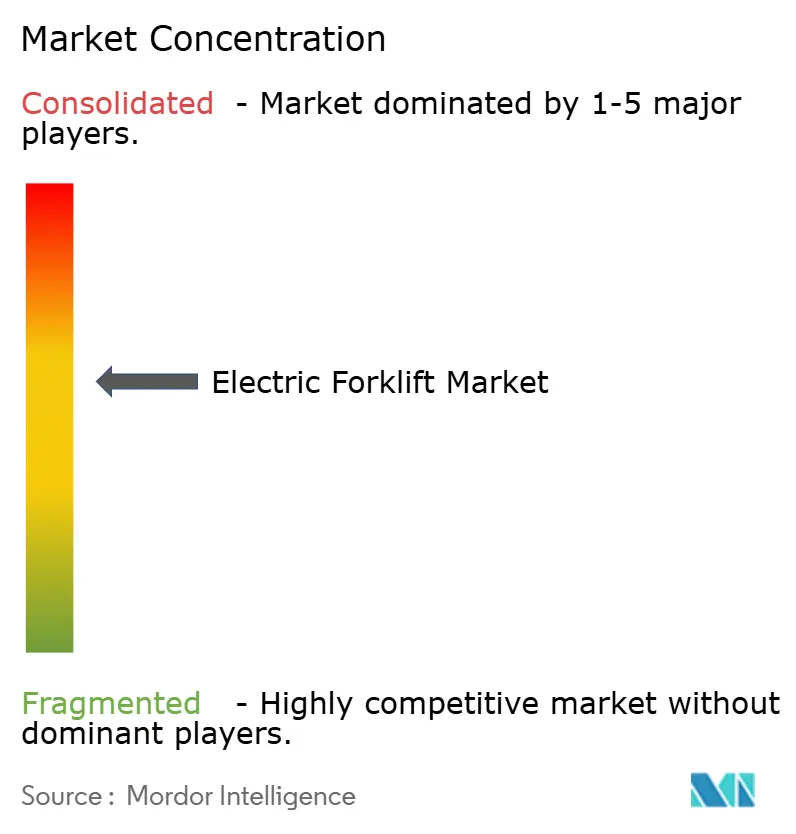
| Market Concentration | Medium |
Major Players *Disclaimer: Major Players sorted in no particular order Image © Mordor Intelligence. Reuse requires attribution under CC BY 4.0. | |
Electric Forklift Market Analysis by Mordor Intelligence
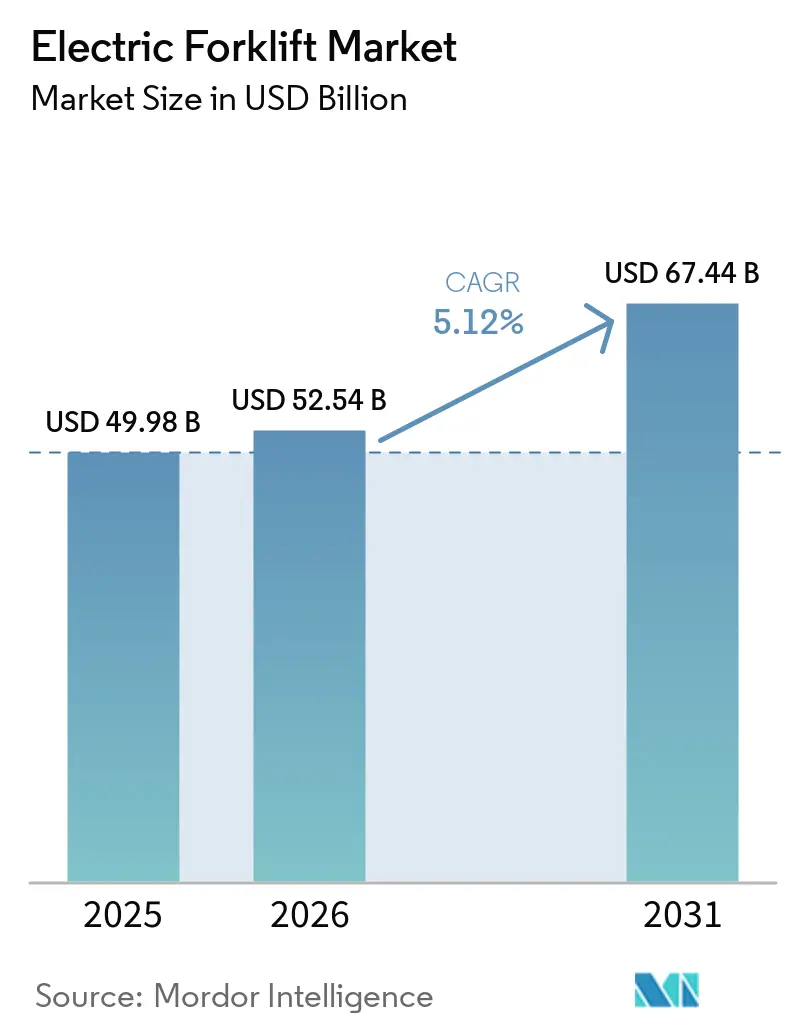
The electric forklift market was valued at USD 49.98 billion in 2025 and is projected to grow from USD 52.54 billion in 2026 to USD 67.44 billion by 2031, at a CAGR of 5.12% during the forecast period (2026–2031). Regulatory deadlines for zero-emission equipment, falling lithium-ion battery costs, and rising e-commerce fulfillment investments are reinforcing the structural shift away from diesel and LPG power-trains. California’s phased prohibition on new internal-combustion forklifts, effective January 2025, is accelerating fleet electrification in North America. Warehouse operators are prioritizing total cost of ownership over upfront price, encouraged by battery-as-a-service financing and AI-enabled fleet management platforms.
Key Report Takeaways
- By powertrain type, electric variants held 71.27% of the electric forklift market share in 2025 and are forecasted to grow at an 11.79% CAGR to 2031.
- By vehicle class, Class III captured 41.37% share of the electric forklift market size in 2025, while Class II is advancing at a 9.28% CAGR through 2031.
- By load capacity, units below 5 tons accounted for 47.19% of the electric forklift market share in 2025; the 5-15 ton bracket is projected to expand at an 8.21% CAGR over 2026-2031.
- By end-use industry, logistics and warehousing led with 39.21% of the electric forklift market share in 2025, and food & beverage cold-chain operations are rising fastest at a 10.61% CAGR to 2031.
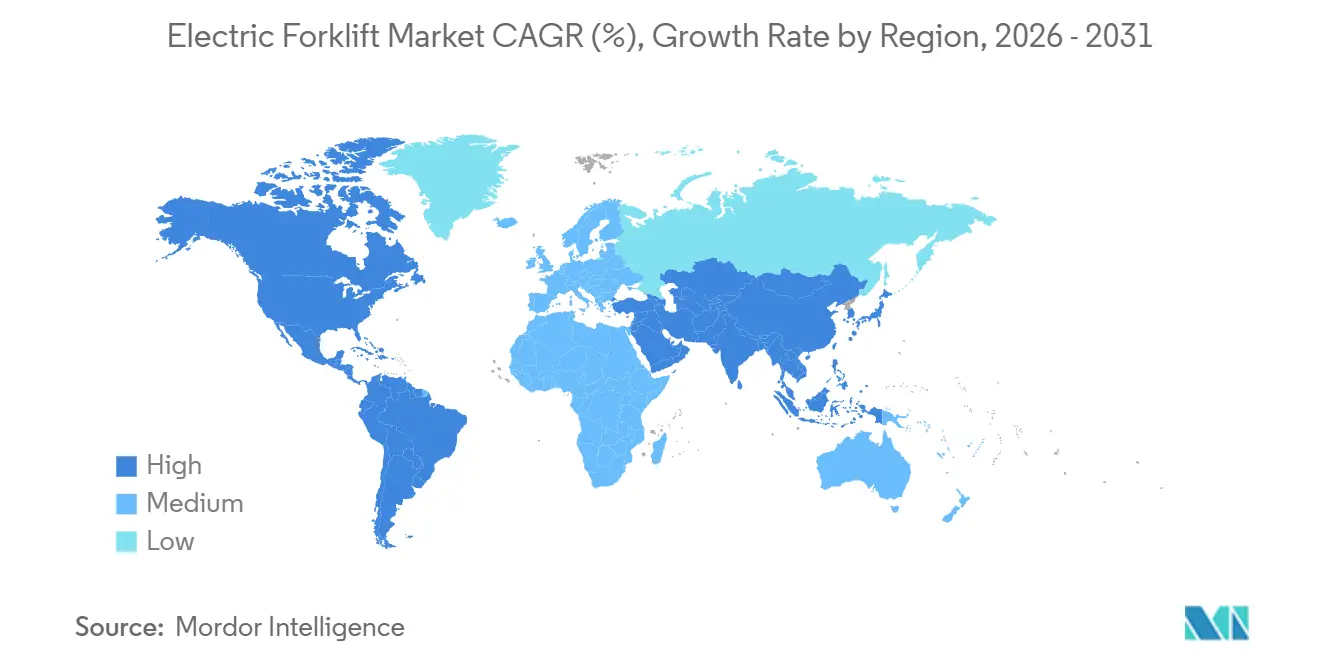
- By geography, Asia-Pacific commanded 43.29% of the electric forklift market share in 2025, whereas South America is expected to post the highest regional CAGR of 8.72% through 2031.
Note: Market size and forecast figures in this report are generated using Mordor Intelligence’s proprietary estimation framework, updated with the latest available data and insights as of January 2026.
Market Trends and Insights
Drivers Impact Analysis of Electric Forklift Market*
| Driver | (~) % Impact on CAGR Forecast | Geographic Relevance | Impact Timeline |
|---|---|---|---|
| E-Com Warehouse Boom | +1.8% | Global, with concentration in North America and Asia-Pacific | Short term (≤ 2 years) |
| Zero-Emission MHE Mandates | +1.5% | North America and EU core, expanding to Asia-Pacific | Medium term (2-4 years) |
| Falling Li-Ion Battery Costs | +1.2% | Global | Medium term (2-4 years) |
| OEM Battery-as-a-Service (BaaS) | +0.9% | North America and EU, pilot programs in Asia-Pacific | Long term (≥ 4 years) |
| Solid-State Battery Roadmap (2027+) | +0.6% | Global, led by Japan & South Korea | Long term (≥ 4 years) |
| AI Predictive Maintenance for TCO | +0.4% | North America and EU, expanding to Asia-Pacific | Medium term (2-4 years) |
| Source: Mordor Intelligence | |||
Rapid E-commerce-Driven Warehouse Expansion
Same-day fulfillment commitments require high-throughput, zero-emission equipment that can operate continuously inside enclosed facilities. Walmart’s 2026 Louisiana distribution center investment exemplifies the scale of automation spending that is tilting procurement toward compact lithium-ion forklifts[1]. Multi-story urban warehouses across Japan, Singapore, and Western Europe employ narrow-aisle trucks to maximize cubic capacity, amplifying demand for maneuverable electric models. Fleet operators value the absence of diesel exhaust, lower noise, and the ability to recharge during micro-breaks without leaving the building. These operational gains, combined with rising land costs that force vertical construction, anchor the e-commerce driver’s positive impact on market growth.
Mandates on Zero-Emission Material-Handling Equipment
California’s Zero-Emission Forklift Regulation bans new diesel and LPG units in phases beginning in 2026[2]. Parallel measures in the European Union require digital battery passports from February 2027, embedding lifecycle carbon data that now influences resale pricing and lease terms. Provincial air-quality rules in China likewise restrict diesel use in industrial parks, nudging domestic fleets toward battery power. As compliance deadlines tighten, operators with large internal-combustion fleets face accelerated depreciation and have begun swapping equipment ahead of schedule to avoid penalties. This regulatory certainty de-risks capital allocation for OEMs expanding electric lines and justifies premium pricing on compliant models.
Declining Li-Ion Battery Cost Curve
Continued cost deflation in lithium-ion chemistry has brought electric forklifts to cost parity over their lifetimes with internal-combustion peers. Lower cobalt content and rising adoption of lithium iron phosphate are central to this trend. Chinese manufacturers leverage vertical integration to pass savings directly to customers, compressing incumbents' margins while broadening the addressable buyer base. Battery-as-a-service contracts reinterpret capital expenditure as a predictable operating fee, appealing to cash-constrained small and medium enterprises. The downward cost curve, therefore, broadens geographic and segment penetration while spurring adjacent innovations such as modular rapid chargers.
OEM Battery-As-A-Service (Baas) Models
Subscription models decouple the battery from the chassis, lowering the sticker price and shifting performance risk back to the manufacturer. Early adopters in Southeast Asia secure uptime guarantees that align with just-in-time manufacturing schedules, improving operational resilience. Such models thrive in volatile electricity markets; providers absorb price swings by optimizing when and how batteries are charged. Wider acceptance of this driver accelerates the second-hand market for refurbished packs, reinforcing the circular-economy narrative that regulators promote. Over time, OEMs offering battery services gain recurring revenue streams that buffer cyclicality in equipment sales.
Restraints Impact Analysis of Electric Forklift Market*
| Restraint | (~) % Impact on CAGR Forecast | Geographic Relevance | Impact Timeline |
|---|---|---|---|
| High Cost Vs. ICE Alternatives | -1.2% | Global, acute in price-sensitive emerging markets | Short term (≤ 2 years) |
| Grid-Capacity Constraints | -0.8% | North America, Europe, aging industrial zones in APAC | Medium term (2-4 years) |
| Battery Recycling Bottlenecks | -0.5% | Global, regulatory pressure in EU and North America | Medium term (2-4 years) |
| Hydrogen Refuelling Infra Gaps | -0.3% | Global, pilot deployments in Japan, Germany, California | Long term (≥ 4 years) |
| Source: Mordor Intelligence | |||
High Upfront Cost vs. ICE Alternatives
The purchase premium remains a hurdle for smaller operators that lack access to concessional finance or leasing programs. Even though lifetime economics favor electrics, the payback horizon can stretch beyond planning cycles typical in price-sensitive regions. Battery-as-a-service alleviates, but does not eliminate, this barrier, as monthly fees still exceed diesel fuel costs in markets with subsidized petroleum. The restraint’s influence will moderate as pack prices fall and financiers develop residual-value models based on real-time battery health data.
Grid-Capacity Constraints at Brownfield Sites
Legacy warehouses seldom possess sufficient electrical headroom to support dozens of rapid chargers. Upgrading transformers and switchgear involves costly permits, project management, and downtime, which operators weigh against the simplicity of diesel refueling. Interim tactics like battery swapping or staggered charging schedules help, but add logistical layers. Public-private partnerships that subsidize on-site solar or energy storage systems could relieve this bottleneck, but policy coordination varies widely across jurisdictions.
*Our forecasts treat driver/restraint impacts as directional, not additive. The impact forecasts reflect baseline growth, mix effects, and variable interactions.
Electric Forklift Market Segment Analysis
By Powertrain Type:
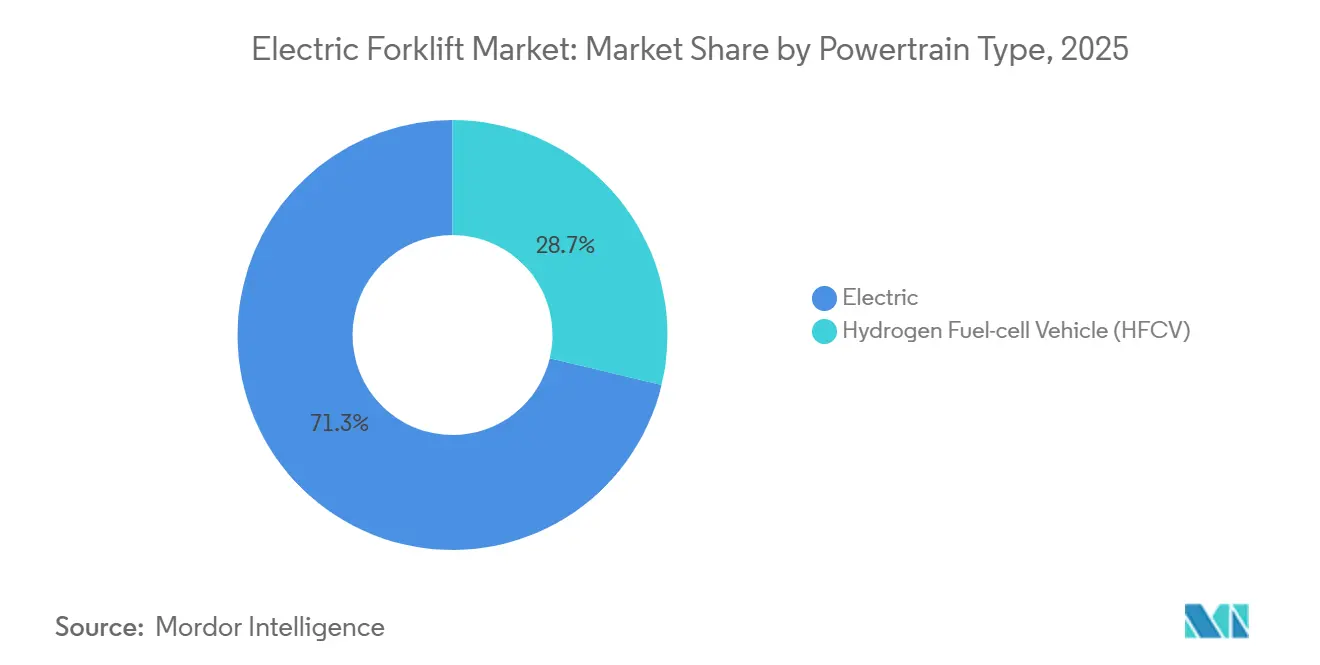
Electrification Consolidates LeadershipElectric variants accounted for 71.27% of the electric forklift market share in 2025 and are projected to post the fastest CAGR of 11.79% through 2031. Growing lithium-ion adoption has diminished the appeal of lead-acid units, as operators value rapid charging and lower maintenance. Legislative tailwinds, notably California’s 2025 sales prohibition on new diesel trucks, propel electric penetration in heavy-duty fleets. OEMs deploy vertically integrated battery assemblies that tighten quality control and unlock software features such as dynamic voltage management. End users view hydrogen tests primarily as risk-hedging pilots until infrastructure scales up.
Advances in lithium-iron-phosphate chemistry reinforce the dominance of battery power-trains by enhancing thermal safety and cost stability. Forklift models now integrate battery health analytics that recommend optimal charge windows, lengthening pack life and curbing electricity bills. Fleet managers integrate these analytics into warehouse-management dashboards, aligning forklift availability with robotic picking schedules. Conversely, fuel-cell programs depend on cross-industry hydrogen demand to underwrite the construction of refueling hubs, a scenario that remains uncertain. As a result, electrics consolidate share while hydrogen remains an aspirational complement rather than a substitute.
By Vehicle Class:
Narrow-Aisle Trucks AccelerateClass III pallet trucks led with 41.37% of the electric forklift market share in 2025, whereas Class II narrow-aisle trucks are on pace for a 9.28% CAGR through 2031. High-density urban warehouses rely on narrow-aisle units that maneuver in sub-two-meter corridors, optimizing storage per square foot. Retailers and third-party logistics providers outfit these models with collision-avoidance sensors that protect both personnel and fragile goods. Voice-picking integration further enhances throughput by allowing operators to control lifts without dismounting.
The growth trajectory of Class II trucks reflects the proliferation of automated storage and retrieval systems, which demand precise vertical positioning across multi-level racking. Battery-electric drivetrains supply the micro-torque control necessary for such precision while maintaining low acoustic signatures in noise-sensitive urban depots. Class I counterbalance trucks remain relevant for heavier loads but tend to have longer replacement cycles due to their capital intensity. Continuous improvement in compact battery designs could blur class boundaries, enabling emerging hybrid categories that combine pallet-truck agility with mid-lift capability.
By Load Capacity:
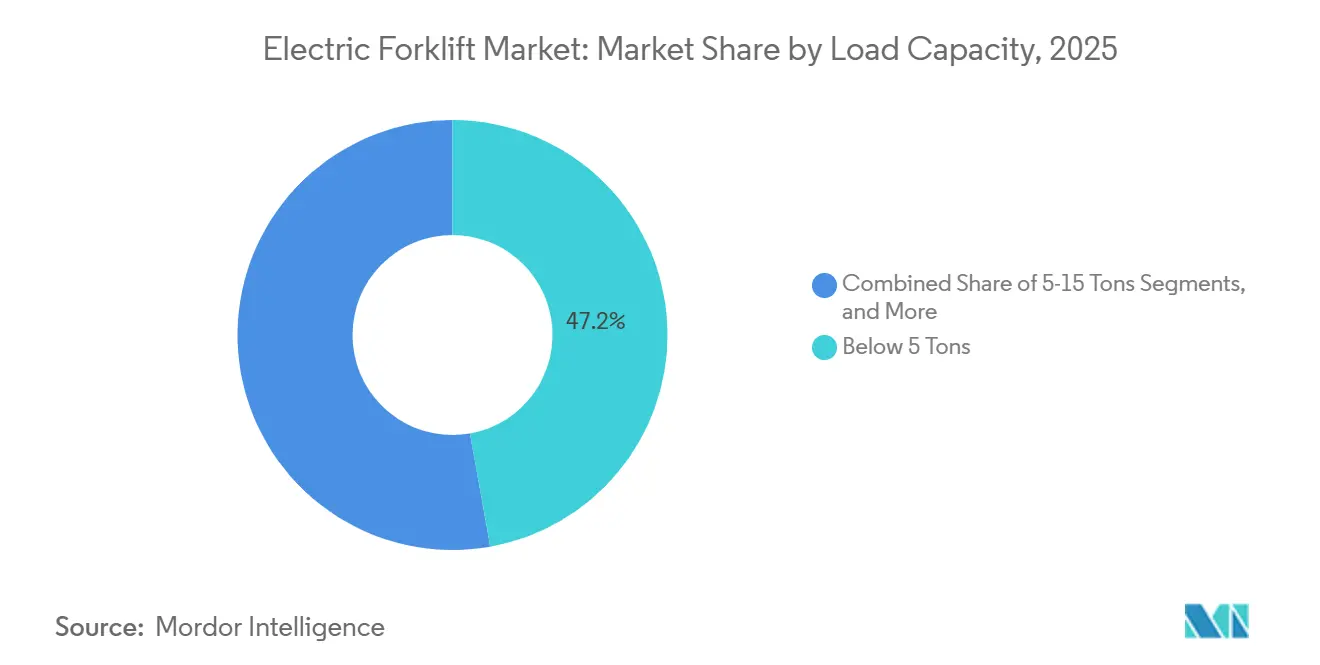
Mid-Range Demand IntensifiesForklifts rated below 5 tons claimed 47.19% of the electric forklift market share in 2025, but the 5-15 ton segment is forecast to register an 8.21% CAGR up to 2031. Automation rollouts in food and beverage fulfillment often require mid-range capacities to shuttle palletized goods to high-bay racking. Lithium-ion packs deliver consistent voltage under such cyclical heavy loads, preventing productivity dips toward the end of a shift. The rising adoption of automated guided vehicles has prompted operators to standardize on dock heights and pallet formats for 5-15 ton forklifts, streamlining cross-docking flows.
Battery leasing further boosts uptake by aligning equipment costs with throughput-linked revenue models. Above-15 ton units remain niche, constrained by battery-weight penalties that erode usable payload on outdoor surfaces. Technological spillovers from commercial truck battery research could eventually narrow this gap, but in the forecast horizon, mid-range electric forklifts represent the sweet spot between capability and cost.

By End-Use Industry:
Cold-Chain Electrification Leads GrowthLogistics and warehousing accounted for 39.21% of the electric forklift market share in 2025, yet food & beverage cold-chain operations are projected to enjoy a brisk 10.61% CAGR through 2031. Refrigerated facilities require zero tailpipe emissions to preserve air quality and prevent hydrocarbon contamination of perishables. Lithium-ion batteries outperform lead-acid in sub-zero conditions by retaining capacity without auxiliary heaters, an advantage that accelerates fleet transition.
Retail chains that emphasize carbon-neutral pledges increasingly require electric equipment in vendor contracts, nudging suppliers toward rapid adoption. Manufacturing plants switch selectively, prioritizing indoor production lines where ventilation constraints penalize diesel exhaust. Construction sites and outdoor infrastructure projects remain anchored to internal-combustion models for now, constrained by rugged terrain and the ease of mobile fueling.
Geography Analysis
APAC Electric Forklift Market
Asia-Pacific retained 43.29% of the electric forklift market share in 2025, buoyed by China’s factory automation drive and India’s Grade-A warehouse boom. Provincial pollution limits tighten the noose on diesel forklifts, prompting Chinese OEMs to scale lithium-iron-phosphate output and deliver lower-priced equipment that outflanks imports. India’s logistics real estate investors embed fast-charging infrastructure in new builds, viewing electrified fleets as a competitive differentiator for e-commerce clients. Governments in Japan and South Korea subsidize automation to offset labor shortages, hastening the adoption of narrow-aisle electrics. Despite rapid growth, grid upgrades still lag warehouse expansion, making on-site solar plus storage a favored mitigation strategy.
South America Electric Forklift Market
South America is forecast to post an 8.72% CAGR through 2031, underpinned by Brazil’s e-commerce fulfillment race and Argentina’s export-oriented cold-chain overhaul. Brazilian distribution centers in São Paulo retrofit charging bays alongside automated conveyors, allowing seamless overnight replenishment. Argentine agrifood exporters integrate electric forklifts to meet international buyers’ sustainability audits, unlocking premium market access. Financing obstacles persist, but battery leasing packaged with maintenance softens upfront cost hurdles. Local assemblers are exploring the import of knock-down kits to sidestep currency volatility and shorten lead times.
North America and EMEA Electric Forklift Market
North America and Europe exhibit mature electrification driven by regulatory enforcement and corporate decarbonization goals. California’s sales ban on new diesel forklifts compels accelerated fleet renewal, and utilities offer demand-response credits for warehouses that schedule off-peak charging. The EU’s battery passport framework catalyzes transparent supply chains, rewarding OEMs that track mineral provenance and recyclability. Warehouse operators deploy AI dashboards that align forklift dispatch with labor rosters, squeezing extra cycles from each battery pack. In the Middle East and Africa, nascent electrification pilots concentrate in Gulf free-trade zones and South African ports, where rental programs reduce capital exposure and familiarize users with lithium-ion technology.
Competitive Landscape
Toyota Industries Corporation, KION Group AG, Jungheinrich AG, Crown Equipment Corporation, and Hyster-Yale Inc. collectively account for a moderate share, leaving ample room for agile challengers. Chinese entrants, notably BYD and Hangcha, wield cost leverage through vertically integrated battery lines and increasingly global dealer networks. Western incumbents defend their turf by bundling telematics, predictive maintenance, and battery-as-a-service into value-based contracts that lock in customers for multi-year terms. Patent filings indicate a pivot toward solid-state battery exploration.
Strategic partnerships shape differentiation. Jungheinrich’s AI collaboration focuses on battery health forecasting, while KION invests in software overlays that aggregate forklift and conveyor data. Crown and Raymond refine operator-assistance features that reduce accidental impacts, lowering insurance costs and warehouse damage. Regional customization also intensifies competition: Godrej tailors tropicalized cooling systems for South Asian climates, and EP Equipment develops ultra-compact models for Southeast Asian micro-fulfillment centers.
Capital allocation trends favor electrification R&D and localized pack assembly. Toyota Material Handling Europe’s in-house cell program shortens supply chains and protects margins against commodity swings. Meanwhile, Hyster-Yale pilots fuel-cell forklifts for high-throughput beverage bottlers, hedging its bets on the long-term viability of hydrogen. As sustainability disclosures gain prominence among investors, OEMs with transparent battery sourcing and recycling pathways strengthen brand equity and negotiate premium lease rates.
Electric Forklift Industry Leaders
-
Toyota Industries Corporation
-
KION Group AG
-
Jungheinrich AG
-
Crown Equipment Corporation
-
Hyster-Yale Inc.
- *Disclaimer: Major Players sorted in no particular order
Electric Forklift Market Companies Covered in this Report
- Toyota Industries Corporation
- KION Group AG
- Jungheinrich AG
- Hyster-Yale Inc.
- Crown Equipment Corporation
- Mitsubishi Logisnext Co.Ltd.
- Hangcha Group Co.Ltd.
- Anhui Heli Co.Ltd.
- Komatsu Ltd.
- Clark Material-Handling Company
- Doosan Corporation
- UniCarriers Corporation
- Hyundai Construction Equipment North America Inc.
- Lonking Holdings Limited
- EP Equipment
- Godrej & Boyce Mfg.Co.Ltd.
- BYD Motors Inc.
- Noblelift Intelligent Equipment Co., Ltd.
- Carer Electric Forklift
Recent Industry Developments in Electric Forklift Market
- July 2026: HELI launched its G3 Series 12–18 t lithium-electric forklifts at HELI Industrial Park, featuring dual-motor drive, enhanced torque, and precision hydraulic control for heavy-duty operations.
- June 2026: Hyster launched the E2.2–3.5XN2 cushion tire electric lift truck series, with a 2,000–3,000 kg capacity range, updated ergonomics, expanded power options, and improved service access.
- June 2026: General Heavy Marine (GHM) introduced the SANY electric forklift range in South Africa, targeting businesses looking to improve efficiency, reduce operating costs, and lower their environmental footprint.
- April 2026: Linde Material Handling launched the Ei series of three- and four-wheel electric counterbalance forklifts, featuring enhanced ergonomics to improve operator comfort, usability, and productivity across material-handling applications.
Global Electric Forklift Market Report Scope
The Electric Forklift market is analyzed across power-train type, vehicle class, load capacity, end-user industry, and geography.
By Powertrain Type, the market is segmented into Electric (Lead-acid and Li-ion) and Hydrogen Fuel-cell Vehicle. By Vehicle Class, the market is segmented into Class I (Electric Rider Trucks), Class II (Electric Narrow Aisle Trucks), and Class III (Electric Pallet Trucks). By Load Capacity, the market is segmented into below 5 Tons, 5 - 15 Tons, and above 15 Tons. By End-use Industry, the market is segmented into Manufacturing, Logistics and Warehousing, Construction and Infrastructure, Retail and Wholesale, and Food and Beverage Companies. By Geography, the market is segmented into North America (United States, Canada, and Rest of North America), South America (Brazil, Argentina, and Rest of South America), Europe (Germany, United Kingdom, France, Italy, Spain, and Rest of Europe), Asia-Pacific (China, India, Japan, South Korea, and Rest of Asia-Pacific), and Middle East and Africa (United Arab Emirates, Saudi Arabia, Turkey, South Africa, and Rest of Middle East and Africa).
Market forecasts are provided in terms of Value (USD) and Volume (Units).
Segmentation Overview
| Electric | Lead-acid |
| Li-ion | |
| Hydrogen Fuel-cell Vehicle (HFCV) |
| Class I (Electric Rider Trucks) |
| Class II (Electric Narrow-Aisle) |
| Class III (Electric Pallet) |
| Below 5 Tons |
| 5 - 15 Tons |
| Above 15 Tons |
| Manufacturing |
| Logistics and Warehousing |
| Construction and Infrastructure |
| Retail and Wholesale |
| Food and Beverage Cold-Chain |
| North America | United States |
| Canada | |
| Rest of North America | |
| South America | Brazil |
| Argentina | |
| Rest of South America | |
| Europe | Germany |
| United Kingdom | |
| France | |
| Italy | |
| Spain | |
| Rest of Europe | |
| Asia-Pacific | China |
| India | |
| Japan | |
| South Korea | |
| Rest of Asia-Pacific | |
| Middle East and Africa | United Arab Emirates |
| Saudi Arabia | |
| Turkey | |
| South Africa | |
| Rest of Middle East and Africa |
| By Powertrain Type | Electric | Lead-acid |
| Li-ion | ||
| Hydrogen Fuel-cell Vehicle (HFCV) | ||
| By Vehicle Class | Class I (Electric Rider Trucks) | |
| Class II (Electric Narrow-Aisle) | ||
| Class III (Electric Pallet) | ||
| By Load Capacity | Below 5 Tons | |
| 5 - 15 Tons | ||
| Above 15 Tons | ||
| By End-use Industry | Manufacturing | |
| Logistics and Warehousing | ||
| Construction and Infrastructure | ||
| Retail and Wholesale | ||
| Food and Beverage Cold-Chain | ||
| By Geography | North America | United States |
| Canada | ||
| Rest of North America | ||
| South America | Brazil | |
| Argentina | ||
| Rest of South America | ||
| Europe | Germany | |
| United Kingdom | ||
| France | ||
| Italy | ||
| Spain | ||
| Rest of Europe | ||
| Asia-Pacific | China | |
| India | ||
| Japan | ||
| South Korea | ||
| Rest of Asia-Pacific | ||
| Middle East and Africa | United Arab Emirates | |
| Saudi Arabia | ||
| Turkey | ||
| South Africa | ||
| Rest of Middle East and Africa | ||
Key Questions Answered in the Report
What is the projected value of the electric forklift market by 2031?
The electric forklift market size is forecasted to reach USD 67.44 billion by 2031, reflecting a 5.12% CAGR from 2026 to 2031.
Which region leads current market share for electric forklifts?
Asia-Pacific commanded 43.29% share in 2025, supported by automation investments in China and warehouse expansion in India.
Which power-train type is growing fastest within the market?
Hydrogen fuel-cell forklifts are expected to post the quickest 11.79% CAGR through 2031, although they start from a small base.
Which vehicle class dominates unit shipments?
Class III pallet trucks held 41.37% of electric forklift market share in 2025 thanks to their versatility in horizontal transport.