
Market Overview
| Study Period | 2021 - 2031 |
|---|---|
| Forecast Data Period | 2026 - 2031 |
| Base Year Market Size (2025) | USD 2.30 Billion |
| Market Size (2026) | USD 2.45 Billion |
| Market Size (2031) | USD 3.51 Billion |
| Growth Rate (2026 - 2031) | 7.46 % |
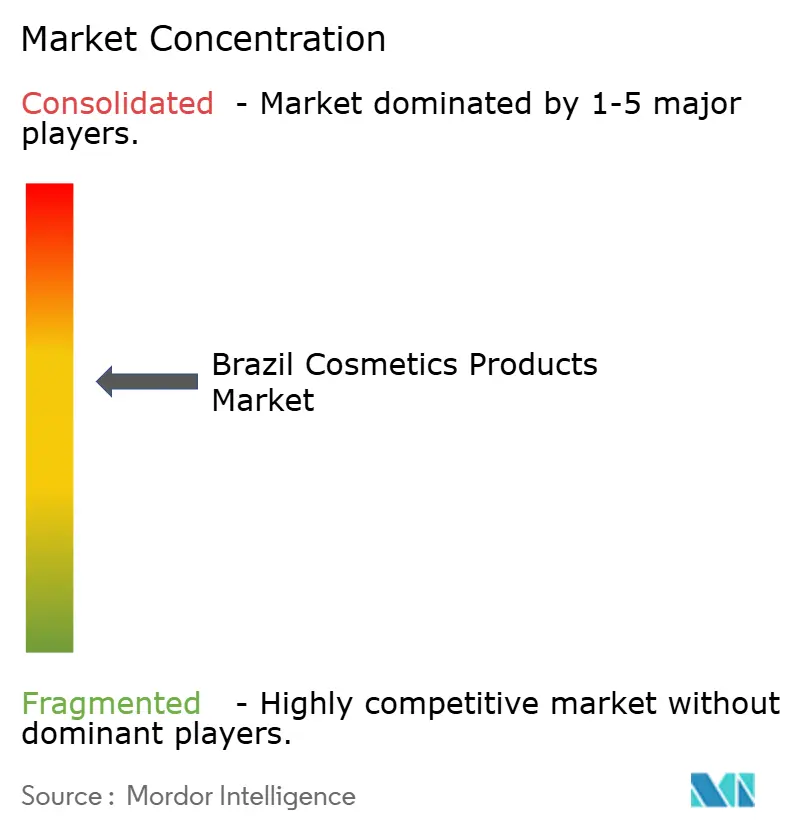
| Market Concentration | Medium |
Major Players *Disclaimer: Major Players sorted in no particular order Image © Mordor Intelligence. Reuse requires attribution under CC BY 4.0. | |
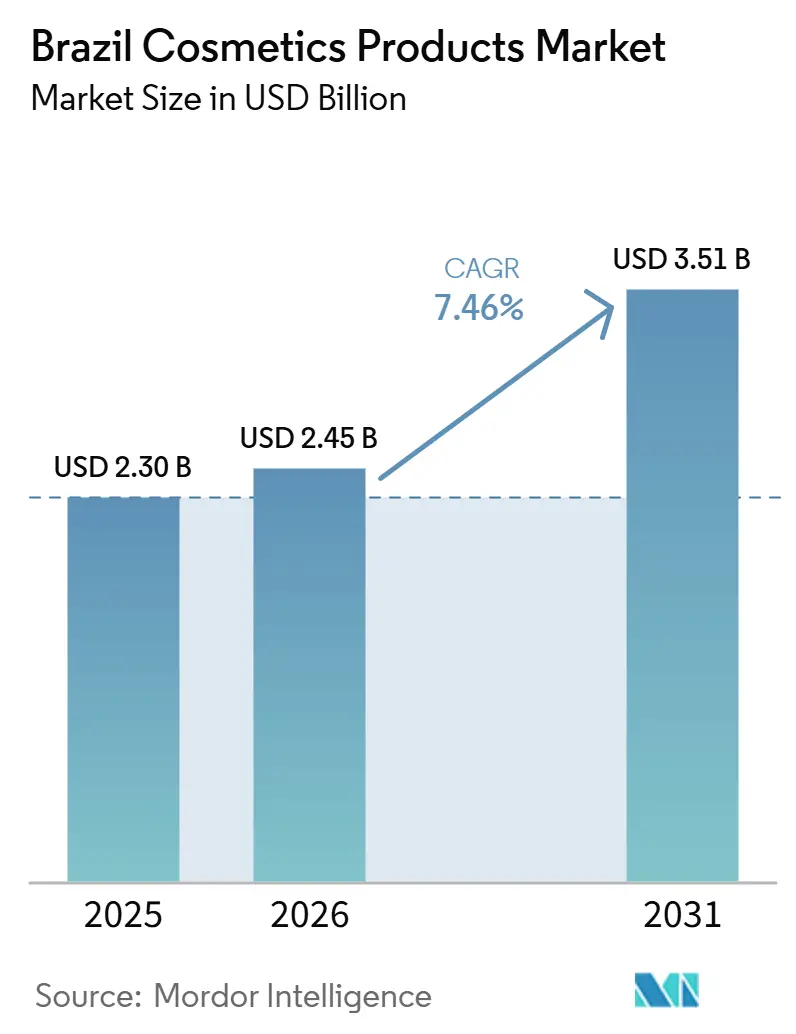
Brazil Cosmetics Products Market Analysis by Mordor Intelligence
The Brazil cosmetics products market size is expected to grow from USD 2.3 billion in 2025 to USD 2.5 billion in 2026 and is forecast to reach USD 3.5 billion by 2031 at 7.5% CAGR over 2026-2031. Brazil remains one of the world’s largest beauty economies, supporting steady product launches, investments in local manufacturing, and broad retail reach across physical and digital channels. The Brazil cosmetics products market is shifting from volume-led expansion to value-led growth, as premium positioning and stronger online access help brands increase spending per purchase rather than depend only on wider adoption. Brands are also localizing product development, as Brazil’s climate conditions, daily usage patterns, and broad consumer base favor formulas that perform well in heat, humidity, and high UV exposure. The Brazil cosmetics products market also benefits from domestic production strategies, which help leading brands manage import costs and shorten launch cycles under ANVISA’s updated framework[1]. While compliance requirements, import barriers, and counterfeit activity continue to affect execution, the category continues to attract investment in channel expansion, portfolio upgrades, and local capacity, supported by structurally resilient demand.
Key Report Takeaways
- By product type, Facial Cosmetics led with 35.71% share of the Brazil cosmetics products market size in 2025, while Eye Cosmetics posted the fastest projected CAGR at 6.96% through 2031.
- By category, the mass segment held 59.62% of the Brazil cosmetics products market share in 2025, while premium recorded the highest projected CAGR at 7.01% through 2031.
- By ingredient type, Conventional and Synthetic ingredients accounted for 65.13% share in 2025, while Natural and Organic formulations are forecast to expand at a 7.51% CAGR through 2031.
- By distribution channel, Specialty Stores retained the largest share at 38.13% in 2025, while Online Retail Stores are projected to grow fastest at 7.29% CAGR through 2031.
Note: Market size and forecast figures in this report are generated using Mordor Intelligence’s proprietary estimation framework, updated with the latest available data and insights as of 2026.
Brazil Cosmetics Products Market Trends and Insights
Drivers Impact Analysis*
| Driver | (~) % Impact on CAGR Forecast | Geographic Relevance | Impact Timeline |
|---|---|---|---|
| Premiumization of Mass Beauty | 1.80% | Southeast (São Paulo, Rio de Janeiro) core; spill-over to South and expanding Northeast | Medium term (2–4 years) |
| Social Commerce, Influencer Marketing, and Digital-First Brands | 1.60% | National, the highest concentration in Southeast and South; e-commerce penetrates secondary cities | Short to medium term (≤ 3 years) |
| Retail Media and Marketplace Growth | 0.90% | National, with early gains in São Paulo, Curitiba, and Belo Horizonte | Short term (≤ 2 years) |
| Demand for Natural, Vegan, and Sustainable Beauty Products | 1.10% | National; strongest in South and Southeast among high-income and younger consumers | Medium to long term (2–5 years) |
| Climate-Specific Demand for Adapted Cosmetic Formulations | 0.70% | Brazil-wide; intensity highest in humid coastal and equatorial regions (North, Northeast coast, Southeast) | Long term (≥ 4 years) |
| Product Innovation Using AI and Advanced Technology | 0.60% | Southeast-led, with digital diffusion across national e-commerce channels | Medium term (2–4 years) |
| Source: Mordor Intelligence | |||
Premiumization of mass beauty through masstige convergence
Brazil cosmetics products market is being propelled by the premiumization of mass beauty through masstige convergence, as consumers increasingly seek premium-quality formulations, sustainability, and dermatological benefits at accessible prices. According to the Brazilian Association of the Cosmetic, Toiletry and Fragrance Industry, Brazil remained the world's third-largest cosmetics, toiletries, and fragrance market in 2024 and ranked fourth globally for new product launches, while exports reached a record USD 884 million, highlighting a strong innovation ecosystem. This environment has encouraged companies to democratize premium beauty. In March 2025, Natura &Co expanded its premium skincare portfolio with new Chronos formulations featuring advanced bioactive ingredients sourced from Brazilian biodiversity, targeting consumers trading up within affordable price points. Meanwhile, Grupo Boticário continued expanding premium fragrance and dermocosmetic offerings across its brands during 2025, strengthening masstige positioning. In 2026, Natura reported successful restructuring while continuing investments in innovation and brand premiumization, reinforcing confidence in higher-value product categories despite a softer domestic beauty market.
Social commerce, influencer-led discovery, and creator-led brands
Social commerce, influencer-led discovery, and creator-led brands are accelerating growth in Brazil cosmetics products market by transforming how consumers discover, evaluate, and purchase beauty products. According to the Brazilian Association of the Cosmetic, Toiletry and Fragrance Industry (ABIHPEC), Brazil remained the world's third-largest beauty and personal care market and the fourth-largest globally for cosmetic product launches in 2024, reflecting a highly digital and innovation-oriented consumer base. Brazil's high social media penetration has enabled beauty brands to integrate creator-led marketing with e-commerce, shortening the path from product discovery to purchase. In January 2025, L'Oréal Groupe launched the Big Bang Beauty Tech Innovation Program in Brazil to collaborate with startups developing AI, social commerce, creator economy, and retail technologies, strengthening digital consumer engagement across Latin America. In 2025, Coty Inc. expanded its TikTok Shop strategy into Latin America by partnering with creators to drive beauty product discovery and livestream commerce, a model increasingly adopted in Brazil. These initiatives are fostering creator-led purchasing behavior, improving brand visibility, and driving cosmetic sales through digitally enabled consumer journeys.
Demand for natural, vegan, and sustainable cosmetics
Consumer preference for clean-beauty formulations is reshaping ingredient sourcing and manufacturing strategies in Brazil. The Amazonian biodiversity corridor gives Brazilian brands a credible origin story that European and Asian competitors cannot replicate, particularly for actives such as cupuaçu butter, Brazil nut oil, and andiroba oil. Simple Organic, expected to operate as SIMPLE after its full acquisition by Hypera Pharma in late 2025, was planned to launch Brazil's first clean formula combining exosomes, PDRN, and plant-derived peptides in November 2025. This launch would mark its entry into regenerative skincare with a formulation that excludes parabens, silicones, PEGs, and animal-derived inputs. Hypera Pharma's expected move to democratize SIMPLE's clean positioning through lower price points in 2026 signals an industrywide bet that Brazil's natural-cosmetics consumer base will expand significantly once the cost barrier declines. B.O.B. Cosmetics, a waterless and plastic-free brand that caps synthetic ingredients at 5% per formula, is expected to close 2025 with approximately RMB 30 million in revenue and expand its US digital channel to approximately 10% of total revenue. Compliance factors, including ANVISA RDC 639/2022 for children's cosmetics and RDC 907/2024's labeling transparency requirements, are effectively accelerating natural-ingredient disclosure and creating reputational pressure on conventional synthetic formulations[2].
Climate-specific demand for sun protection, oil control, and long-wear products
Brazil’s climate profile, year-round high UV indices, humidity levels exceeding 80% in coastal and equatorial regions, and rapidly expanding urban heat-island effects in São Paulo and Rio de Janeiro are driving demand for cosmetics that international brands optimized for temperate markets cannot adequately address. Search interest for “waterproof foundation” doubled in Brazil between 2020 and 2025, while skincare-infused hybrid foundations with SPF and niacinamide account for an estimated 15-20% of new product launches in the transfer-resistant makeup category. L’Oréal’s dedicated UFRJ Research and Innovation Center, active since 2017, develops products specifically for Brazil’s skin diversity and climate extremes, and products validated there frequently reach global markets. This dynamic reinforces the market: domestic innovation improves formulation quality for local consumers, while global research and development investment further supports Brazil’s product pipeline. The eye cosmetics category remains particularly exposed to this driver. Long-wear mascaras and heat-stable eyeshadow formulations are growing the fastest, as existing product architectures often fail Brazilian consumers by midday in tropical conditions.
Restraints Impact Analysis*
| Restraint | (~) % Impact on CAGR Forecast | Geographic Relevance | Impact Timeline |
|---|---|---|---|
| High Import Duties on Finished Cosmetic Goods | -0.80% | National; disproportionate impact on Southeast, where premium-import demand is concentrated | Medium to long term (ongoing) |
| Price Sensitivity and Promotional Dependency in the Mass Segment | -0.50% | National; sharpest in the Northeast and North, where disposable income per capita is lower | Short to medium term (≤ 3 years) |
| ANVISA Compliance Burden for Foreign and Emerging Brands | -0.40% | National; heaviest for Grade 2 product categories and international entrants | Short to medium term (≤ 3 years) |
| Counterfeit, Grey-Market, and Parallel Import Activity | -0.30% | Concentrated in Southeast (São Paulo Rua 25 de Março corridor) and Baixada Fluminense; digital platforms with national reach | Short term (≤ 2 years) |
| Source: Mordor Intelligence | |||
High import duties compress premium cosmetics accessibility
Brazil's layered import duty structure for HS 3304 (beauty and make-up preparations) ranks among the steepest globally for finished cosmetics. It does more than increase prices; it systematically distorts competitive dynamics. According to the U.S. Department of Commerce, the MFN import duty rate for HS 3304 is 18% on CIF value, compounded by IPI excise taxes, ICMS state VAT of 17-25%, and PIS/COFINS social contributions of 11.75%. For specific subcategories, such as nutrient creams and toners under NCM 33049910, the II rate reaches 16.2%, while the IPI reaches 14.3%, according to official Brazil tariff schedules. The effective landed cost premium for imported premium cosmetics frequently exceeds 60% of the ex-works price. This cost structure explains why L'Oréal manufactures 95% of the products it sells in Brazil locally and actively sources Brazilian raw materials. The restraint particularly affects mid-tier international brands that lack the volume scale to justify local manufacturing but compete directly with fully locally manufactured domestic products. EU-Mercosur trade agreement discussions offer a potential medium-term reprieve, with ABIHPEC citing trade reform as positive for the sector's future competitiveness.
ANVISA compliance burden for claims, labeling, and regularization
Brazil’s regulatory framework for cosmetics is undergoing a significant structural revision under ANVISA RDC 907/2024, which is scheduled to take effect in 2025. The regulation modernizes product classification through a risk-tiered system: Grade 1 products, which are low-risk and require notification only, and Grade 2 products, which are high-risk and require full pre-market registration. It also tightens labeling requirements by mandating INCI ingredient lists in Portuguese, batch numbers, and shelf-life dates, according to ANVISA and Maven Regulatory Services. In addition, RDC 894/2024, adopted in August 2024, introduced mandatory Good Practices of Cosmetovigilance[3]. This rule requires all companies holding product authorizations to implement post-market adverse-event monitoring systems, according to ANVISA RDC 894/2024. For foreign brands, the compliance burden is structural. ANVISA prohibits direct submissions, requiring companies to appoint a legally established Brazilian partner entity that assumes full regulatory and importation responsibility. Under the revised rules scheduled to take effect in June 2025, ANVISA will automatically reject applications with incomplete documentation, reducing tolerance for procedural errors. Children’s cosmetics, classified as Grade 2 products, face the highest level of scrutiny under RDC 639/2022 and the new framework, creating particularly steep barriers for international brands targeting Brazil’s growing demand for children’s cosmetics. Law No. 15,154/2025, which exempts artisanal cosmetic products from registration and subjects them to simplified rules, creates an additional competitive variable, as informal small-batch producers gain regulatory parity in Grade 1 categories.
*Our forecasts treat driver/restraint impacts as directional, not additive. The impact forecasts reflect baseline growth, mix effects, and variable interactions.
Segment Analysis
By Product Type: Eye Cosmetics Gain Momentum in a Facial-Dominant Market
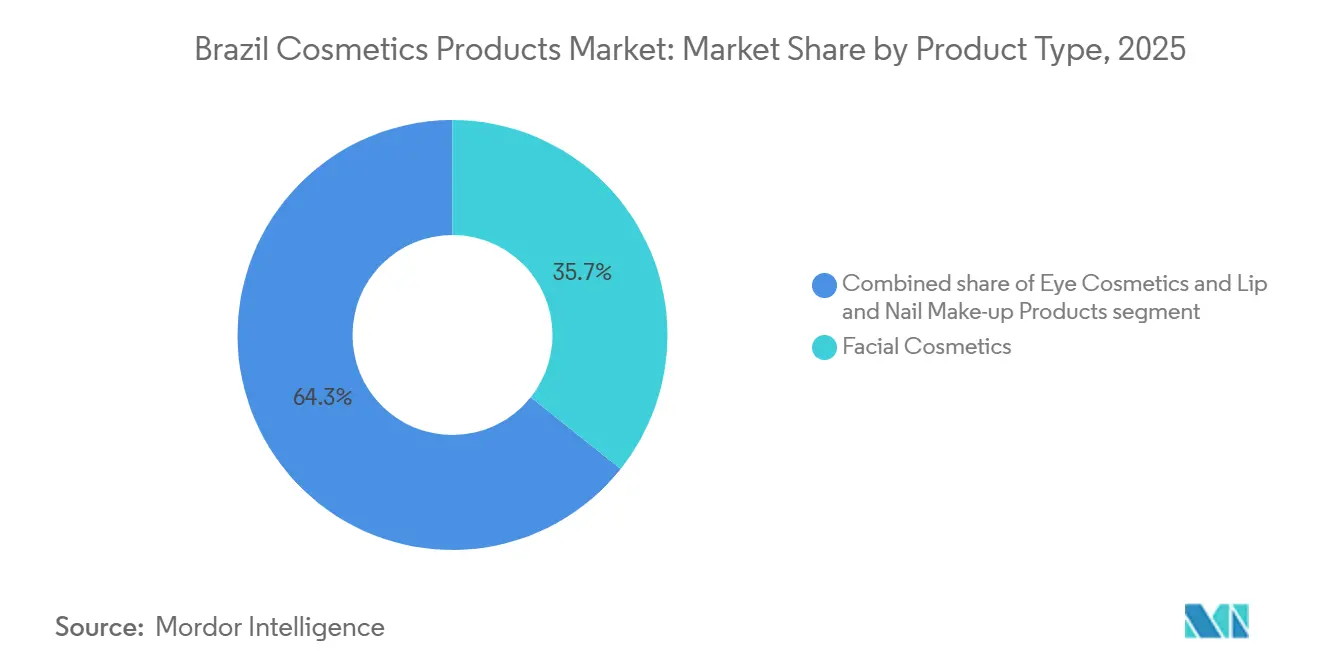
Facial cosmetics are projected to account for the largest product type share, at 35.71% in 2025. Foundations, face powders, and blush are expected to anchor this leadership, supported by Brazil’s high frequency of daily makeup use and its diverse skin-tone base, where most of the population identifies as Black or mixed-race. Brazil’s strong complexion-focused beauty culture, along with demand for inclusive shade portfolios highlighted by IBGE demographics and ABIHPEC’s emphasis on product innovation, is expected to sustain the category’s leadership. In April 2025, Natura is expected to expand its UNA complexion range with additional foundation shades and skin-benefit formulations, reinforcing demand for premium facial makeup.
Eye cosmetics are projected to be the fastest-growing product type, registering a CAGR of 6.96% during 2026–2031. Rising social media beauty trends, influencer-led tutorials, and demand for long-lasting eye makeup suited to Brazil’s humid climate are expected to support this growth. ABIHPEC identifies Brazil as one of the world’s leading markets for beauty product launches, encouraging continuous innovation in color cosmetics. In January 2026, L'Oréal Paris Brazil is expected to introduce new Panorama mascara variants with extended-wear and volumizing technology. Waterproof and high-performance eye products are also expected to continue gaining traction among younger consumers seeking expressive makeup looks.

By Category: Mass Dominance Coexists with Premium's Structural Acceleration
The mass category is expected to dominate with a 59.62% share in 2025, supported by Brazil's extensive supermarket, pharmacy, and direct-selling networks, which make affordable cosmetics widely accessible across urban and rural regions. According to ABIHPEC, Brazil remains one of the world's largest personal care and beauty markets, with broad distribution supporting volume sales. In March 2025, Grupo Boticário is expected to expand its Quem Disse, Berenice? affordable makeup portfolio with new multifunctional complexion and lip products, strengthening its mass-market proposition through accessible pricing and omnichannel availability.
The premium segment, although smaller in absolute share, is forecast to grow at a CAGR of 7.01% during 2026–2031. Rising consumer demand for high-performance formulations, luxury experiences, and dermatologist-inspired beauty products drives this growth. ABIHPEC identifies premiumization and innovation as major growth pillars in Brazil cosmetics products industry, supported by increasing investments in science-backed products. In February 2026, Shiseido is expected to expand its prestige portfolio in Brazil with new Clé de Peau Beauté skincare and makeup offerings, reflecting consumers' growing willingness to spend on premium beauty solutions that offer advanced efficacy and exclusive brand positioning.
By Ingredient Type: Conventional Synthetic Ingredients Retain Share as Clean Beauty Scales
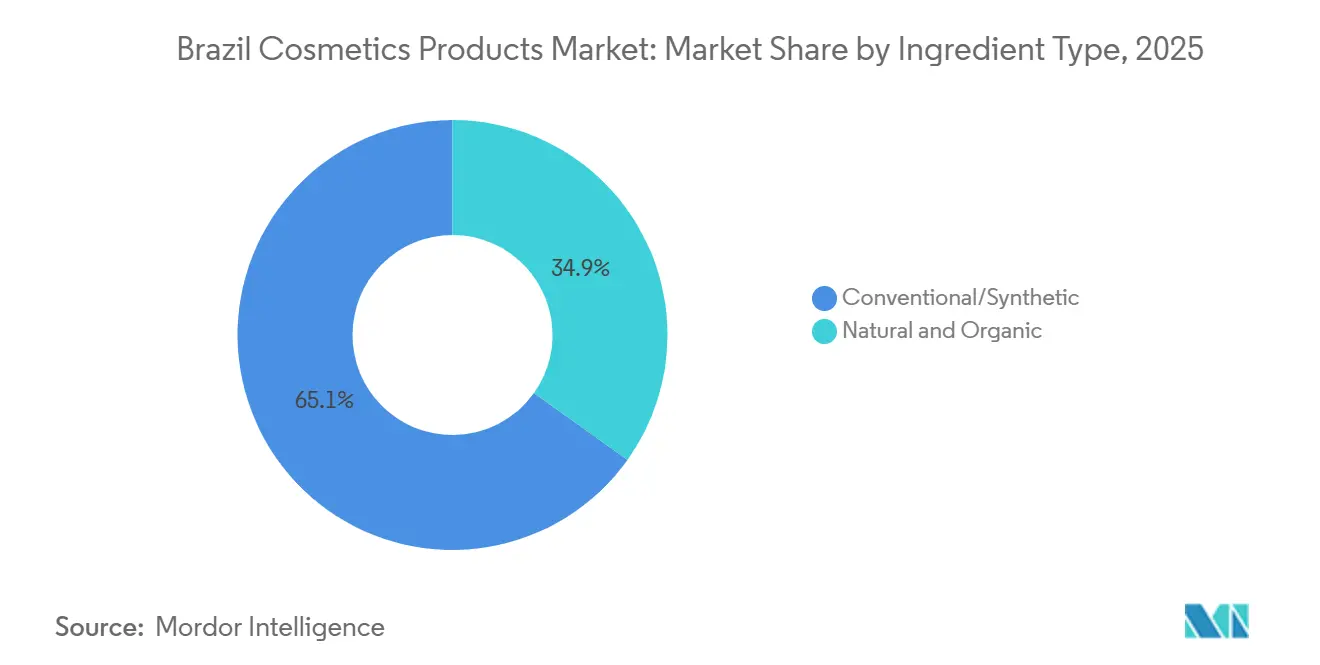
Conventional/synthetic ingredients are expected to hold 65.13% of the market in 2025, supported by their superior product stability, consistent performance, wider color range, and cost-effective manufacturing for large-scale production. ANVISA's regulatory framework requires cosmetics to meet stringent safety, labeling, and quality standards, which encourages manufacturers to use well-established synthetic ingredients to ensure formulation consistency. In September 2025, Maybelline New York Brazil is expected to expand its Super Stay makeup range with enhanced long-wear formulations, reinforcing demand for high-performance conventional cosmetics.
The natural and organic formulation segment is projected to record the fastest CAGR of 7.51% during 2026–2031, driven by rising consumer preference for clean-label, plant-based, and environmentally responsible beauty products. The launch of Brazil's first Clean Beauty Award at Bio Brazil Fair & Naturaltech 2025 is expected to reflect the industry's growing focus on sustainable formulations and ingredient transparency. In 2026, Natura is expected to expand selected Ekos product lines with bio-based Amazonian ingredients and refillable packaging, further strengthening consumer adoption of natural cosmetic formulations.
By Distribution Channel: Digital Commerce Displaces Supermarkets, Specialty Stores Anchor Premiumisation
Specialty stores (health and beauty stores) are expected to retain the largest distribution channel share, at 38.13% in 2025, supported by consumer preference for personalized beauty consultations, product demonstrations, and immediate product availability. According to ABIHPEC, Brazil's well-developed beauty retail ecosystem continues to strengthen consumer engagement through experiential shopping and broad product assortments. In August 2025, Sephora Brazil is expected to expand its exclusive makeup portfolio with new launches from Rare Beauty, reinforcing specialty stores as the preferred destination for premium and trend-driven cosmetic purchases.
Online retail stores are projected to be the fastest-growing distribution channel, registering a CAGR of 7.29% during 2026–2031. Growth is driven by increasing smartphone penetration, digital payment adoption, and social commerce integration. The Brazilian Electronic Commerce Association (ABComm) continues to report sustained growth in the country's e-commerce market, supported by rising online consumer confidence and improved logistics. In April 2026, Natura is expected to enhance its digital commerce platform by integrating AI-powered personalized product recommendations and virtual beauty consultation features, accelerating online cosmetic purchases and strengthening direct-to-consumer engagement.
Geography Analysis
Brazil is the world’s third-largest beauty market and accounts for approximately 2% of GDP, according to ABIHPEC. This scale makes regional dynamics as important as national averages for the country’s cosmetics industry. The Southeast, which includes São Paulo and Rio de Janeiro, records the highest per-capita cosmetics spending and remains the primary launchpad for premium and luxury cosmetics introductions. Louis Vuitton, Dolce & Gabbana, and Valentino used São Paulo and Rio de Janeiro venues for their 2025 Brazil market activations, according to Valor Internacional, reinforcing the Southeast’s role as the country’s aspirational gateway. However, e-commerce has reshaped this regional dynamic. During the pandemic, online channels expanded luxury cosmetics consumption beyond the Rio–São Paulo axis, and this shift has continued, increasing the premium market relevance of secondary cities in Minas Gerais, Paraná, and Santa Catarina.
The South region, comprising Paraná, Santa Catarina, and Rio Grande do Sul, holds strong commercial significance for cosmetics due to its higher average household income compared to the national median and its concentration of natural and clean-beauty brand development. Grupo Boticário’s manufacturing base in Paraná, B.O.B. Cosmetics’ factory in São Paulo state, and Kohll Beauty’s announced manufacturing facility in Brusque, Santa Catarina, highlight the dominance of the South-Southeast industrial corridor in cosmetics production. The region’s moderate subtropical climate, rather than a tropical climate, drives distinct product preferences, particularly for longer-wear formulations. It has also supported a sophisticated specialty retail culture, which now anchors Grupo Boticário’s store expansion strategy.
The Northeast and North regions represent the next growth frontier for the Brazil cosmetics products market. These regions combine strong consumer engagement with beauty culture, a consistent feature across Brazilian demographics, with lower per-capita income levels that currently limit premium category penetration. The Northeast’s tropical and semi-arid climate creates specific demand for heat-stable cosmetics, transfer-resistant formulas, and high-SPF integrated color products, presenting a product opportunity linked to climate adaptation. Direct selling remains an important channel in underserved cities across the North and Northeast, where Natura and Avon’s consultant networks provide market access that physical retail cannot yet replicate at scale. Natura’s Q1 2026 results noted pressure from macroeconomic headwinds and a declining consultant headcount in its primary Brazil market, suggesting that the direct-selling model requires continuous reinvestment as younger consumers shift their channel preferences toward e-commerce.
Competitive Landscape
The Brazil cosmetics products market is moderately concentrated at the top. However, it remains competitive because leadership in the broader beauty space does not automatically translate into dominance across color cosmetics. Natura &Co and Grupo Boticário together are expected to hold a majority share of the broader beauty and personal care space in 2025, indicating leadership but not a closed market structure. The rest of the field includes multinational groups, direct-selling brands, and a growing base of digital-native domestic labels that can scale quickly in selected niches. As a result, the Brazil cosmetics products market continues to reward focused execution across category strategy, channel mix, and price architecture rather than scale alone.
Localization remains a clear strategic priority, as local manufacturing helps brands offset import barriers, manage compliance requirements, and respond faster to evolving consumer demand. L’Oréal’s substantial local production footprint in Brazil reflects this approach and demonstrates how major groups are reducing exposure to the cost of imported finished products. Channel diversification is another key strategy. Grupo Boticário combines stores, salon links, and digital fulfillment tools, such as Clique & Retire, to create a more connected route to market. Portfolio repositioning also remains important, as illustrated by Natura’s planned Avon relaunch in March 2026, which aims to target younger and more digitally connected consumers.
The Brazil cosmetics products market also offers whitespace in eye cosmetics, where growth remains strong and local innovation still has room to expand beyond core facial lines. Accessible clean beauty represents another open opportunity, especially as larger companies move sustainability-led brands toward broader price accessibility. Capacity expansion also remains part of the long-term strategy. Grupo Boticário’s planned Pouso Alegre facility reflects confidence in future demand and the value of supply chain scale. At the same time, enforcement remains critical because counterfeit activity and fraudulent authorizations can weaken consumer trust and pressure legitimate operators. Therefore, competitive success in the Brazil cosmetics products market will depend on balancing localization, omnichannel reach, brand relevance, and compliance discipline rather than relying on a single advantage.
Brazil Cosmetics Products Industry Leaders
-
Unilever plc
-
L'Oréal S.A.
-
Beirsdorf AG
-
Grupo Boticário
-
Natura & Co Holding S.A.
- *Disclaimer: Major Players sorted in no particular order
Recent Industry Developments
- March 2026: Natura completed the relaunch of the Avon brand in Brazil and Mexico, targeting younger, digitally connected consumers; the company entered 2026 with a streamlined corporate structure after four consecutive years of margin improvement, achieving a recurring EBITDA margin of 14.6% for 2025.
- December 2026: Hypera Pharma acquired Simple Organic; the brand rebranded as SIMPLE and adopted a lower price positioning strategy aimed at democratizing clean beauty across the mass-premium consumer segment, entering 2026 with a repositioned product architecture and wider retail distribution.
- October 2025: Louis Vuitton launched its makeup line in Brazil, which featured eyeshadow palettes and lipsticks, reinforcing Brazil's ascent as a Tier 1 luxury beauty launch destination alongside L'Oréal's Valentino Born in Roma fragrance, which became the largest luxury fragrance launch in H1 2025 in Brazil by both units sold and revenue.
Brazil Cosmetics Products Market Report Scope
Cosmetic products are substances applied to the human body for cleansing, beautifying, or altering appearance without affecting the body's structure or functions. The Brazil Cosmetics Products Market is Segmented by Product Type, Category, Ingredient Type, and Distribution Channel. By Product Type, the market is segmented into Facial Cosmetics, Eye Cosmetics, and Lip and Nail Make-Up Products. By Category, the market is segmented into Premium and Mass. By Ingredient Type, the market is segmented into Natural and Organic and Conventional/Synthetic. By Distribution Channel, the market is segmented into Health and Beauty Stores, Supermarkets/Hypermarkets, Online Retail Stores, and Other Channels. The Market Forecasts are Provided in Terms of Value (USD).
Product Type
| Facial Cosmetics |
| Eye Cosmetics |
| Lip and Nail Make-up Products |
Category
| Premium |
| Mass |
Ingredient Type
| Natural and Organic |
| Conventional/Synthetic |
Distribution Channel
| Health & Beauty Stores |
| Supermarkets/Hypermarkets |
| Online Retail Stores |
| Other Channels |
| Product Type | Facial Cosmetics |
| Eye Cosmetics | |
| Lip and Nail Make-up Products | |
| Category | Premium |
| Mass | |
| Ingredient Type | Natural and Organic |
| Conventional/Synthetic | |
| Distribution Channel | Health & Beauty Stores |
| Supermarkets/Hypermarkets | |
| Online Retail Stores | |
| Other Channels |
Key Questions Answered in the Report
How large is the Brazil cosmetics products market in 2026?
The Brazil cosmetics products market is valued at USD 2.45 billion in 2026 and is projected to reach USD 3.51 billion by 2031 at a 7.46% CAGR.
Which product type is leading cosmetic demand in Brazil?
Facial Cosmetics led in 2025 with a 35.71% share, while Eye Cosmetics is forecast to grow fastest through 2031 at 6.96% CAGR.
Why are premium beauty brands gaining traction in Brazil?
Premium growth is being supported by stronger digital reach, better local assortments, and consumer willingness to trade up within mass-premium price bands.
Which sales channel is expanding the fastest in the market?
Online Retail Stores are the fastest-growing channel with a projected 7.29% CAGR, although Specialty Stores still held the largest 2025 share at 38.13%.