
Bosnia And Herzegovina Telecom MNO Market Size and Share
Market Overview
| Study Period | 2019 - 2030 |
|---|---|
| Forecast Data Period | 2025 - 2030 |
| Historical Data Period | 2019 - 2023 |
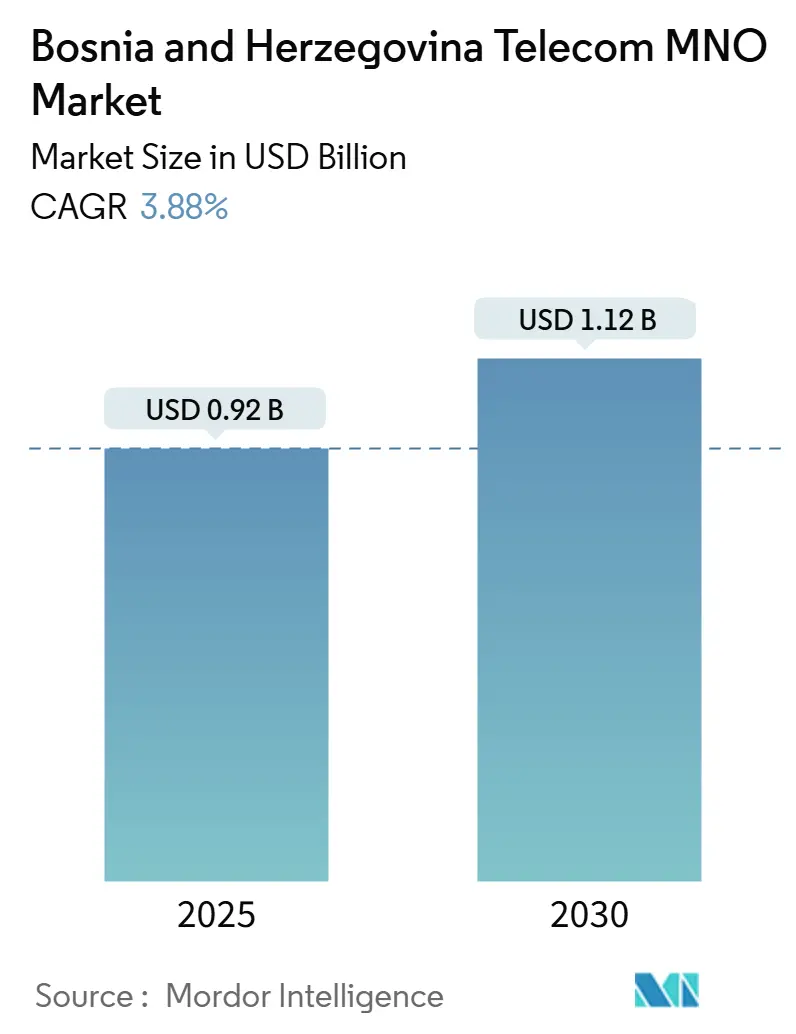
| Market Size (2025) | USD 0.92 Billion |
| Market Size (2030) | USD 1.12 Billion |
| Growth Rate (2025 - 2030) | 3.88 % |
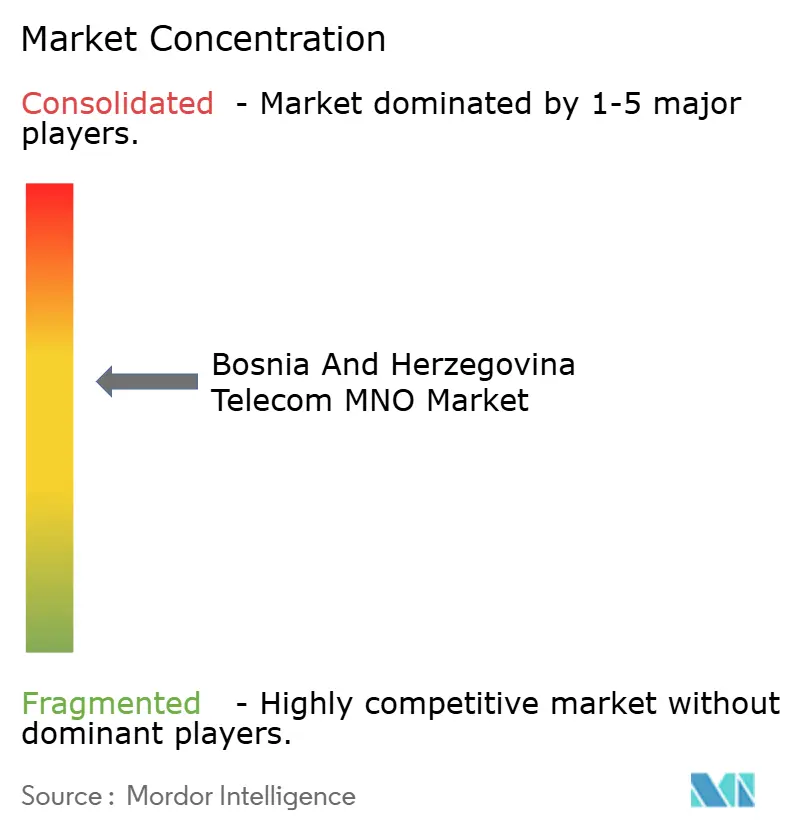
| Market Concentration | Medium |
Major Players *Disclaimer: Major Players sorted in no particular order Image © Mordor Intelligence. Reuse requires attribution under CC BY 4.0. | |
Bosnia And Herzegovina Telecom MNO Market Analysis by Mordor Intelligence
The Bosnia And Herzegovina Telecom MNO Market size is estimated at USD 0.92 billion in 2025, and is expected to reach USD 1.12 billion by 2030, at a CAGR of 3.88% during the forecast period (2025-2030). In terms of subscriber volume, the market is expected to grow from 3.9 million subscribers in 2025 to 4.30 million subscribers by 2030, at a CAGR of 2.26% during the forecast period (2025-2030).
Sustained momentum comes from network modernization, EU-funded digital programs, and growing demand for high-speed data services. Operators deploy capital mainly into 4G densification and fiber-to-the-home (FTTH) roll-outs, creating the foundation for forthcoming 5G launches. Consumer adoption of video-centric mobile apps, enterprise cloud uptake, and IoT-enabled logistics each add incremental revenue streams. Competitive intensity remains moderate: three mobile network operators (MNOs) command a combined 100% share, yet service differentiation based on network quality and bundled offerings continues to open niche growth avenues.
Key Report Takeaways
- By service type, voice services led with 37.23% of Bosnia Herzegovina telecom market share in 2024, while data services are advancing at a 4.12% CAGR to 2030.
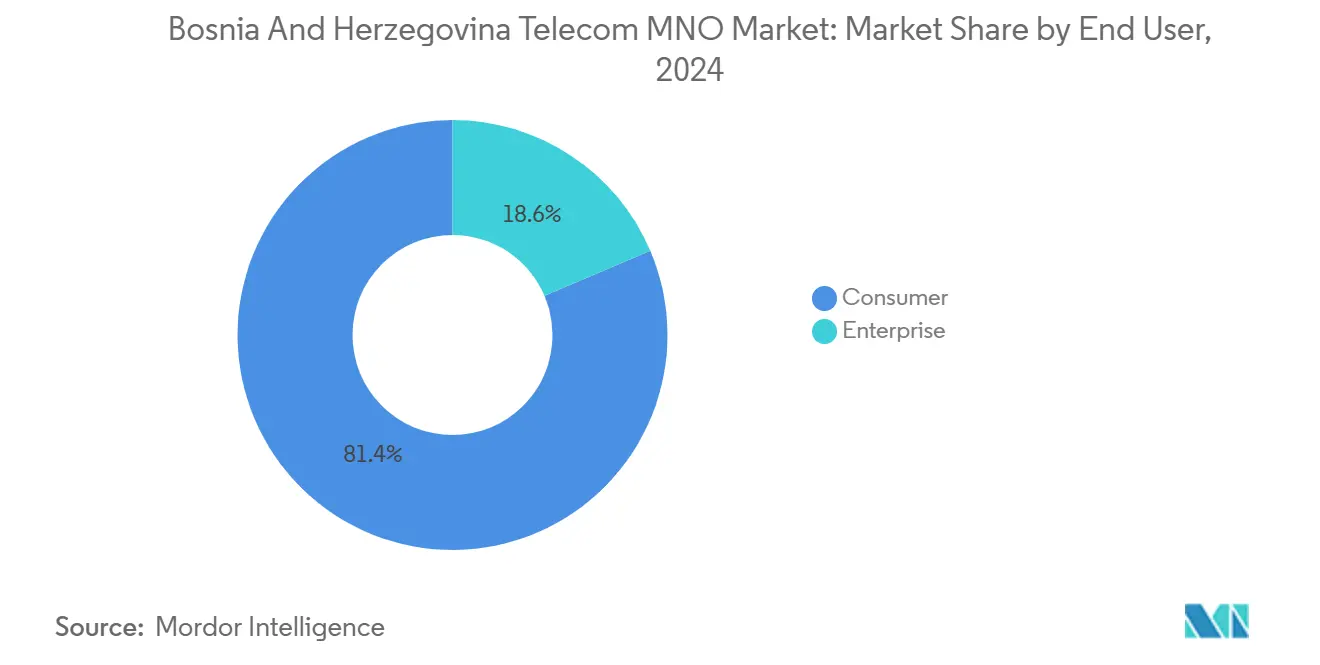
- By end user, consumer connections accounted for 81.41% share of the Bosnia Herzegovina telecom market size in 2024 and enterprise services are projected to expand at a 4.43% CAGR through 2030.
Bosnia And Herzegovina Telecom MNO Market Trends and Insights
Drivers Impact Analysis*
| DRIVER | (~) % Impact on CAGR Forecast | Geographic Relevance | Impact Timeline |
|---|---|---|---|
| Soaring mobile-data demand from video streaming | +1.2% | Urban clusters (Sarajevo, Banja Luka) | Short term (≤ 2 years) |
| Regulatory roadmap for 5G spectrum by 2026 | +0.8% | Nationwide | Medium term (2-4 years) |
| Accelerated FTTH roll-outs | +0.9% | Rural municipalities | Medium term (2-4 years) |
| Cross-border e-commerce driving IoT SIM uptake | +0.6% | Trade corridors | Long term (≥ 4 years) |
| EU-funded public digitalization (IPA III) | +0.7% | Government entities | Medium term (2-4 years) |
| Cloud-gaming demand for low-latency slices | +0.4% | Major cities | Long term (≥ 4 years) |
| Source: Mordor Intelligence | |||
Soaring Mobile-Data Demand from Video Streaming
Smartphone adoption nears saturation and video accounts for over two-thirds of mobile traffic, lifting monthly data usage and enabling tiered pricing strategies. Daily internet use among 16-74-year-olds hit 71.4% in 2025.[1]European Commission, “ICT Statistics for Enlargement Countries,” ec.europa.eu Operators focus on 4G densification to sustain quality of service, while content-delivery partners unlock incremental advertising revenue.
Regulatory Roadmap for 5G Spectrum by 2026
The Regulatory Agency for Communications (RAK) published an auction timeline that aligns with EU harmonization. Pilot tests by HT Eronet achieved 2.1 Gb/s over 3.5 GHz, showing technical readiness.[2] HT Eronet, “5G Trial Achieves 2.1 Gb/s,” hteronet.baCertainty around licensing lets operators front-load radio-access upgrades while monetizing 4G in the interim.
Accelerated FTTH Roll-outs
BH Telecom lifted annual capex by 12% to BAM 53 million in 2024 to extend fiber broadband, targeting underserved villages. Fiber backhaul supports both fixed subscriptions and future 5G transport, raising average broadband speeds—and, by extension, ARPU—nationwide.
Cross-Border E-commerce Driving IoT SIM Uptake
Western Balkan logistics firms embed M2M modules to track fleets crossing EU borders, a trend financed through the EU4Business program that allocated USD 8.75 million to tech-enabled SMEs. Operators bundle connectivity with analytics dashboards, expanding enterprise revenue beyond standard data links.
Restraints Impact Analysis*
| RESTRAINT | (~) % Impact on CAGR Forecast | Geographic Relevance | Impact Timeline |
|---|---|---|---|
| Limited consumer purchasing power | -0.8% | Rural areas | Short term (≤ 2 years) |
| Political gridlock delaying 5G auction | -0.5% | National | Medium term (2-4 years) |
| High deployment costs in mountainous terrain | -0.6% | Remote regions | Long term (≥ 4 years) |
| Fragmented regulatory authority across entities | -0.4% | National | Medium term (2-4 years) |
| Source: Mordor Intelligence | |||
Limited Consumer Purchasing Power
Household budgets remain tight, capping ARPU growth despite rising data usage. OECD benchmarking notes gaps in wage expansion across the Western Balkans.[3]OECD, “Western Balkans Competitiveness Outlook 2024,” oecd.org Operators fight churn with prepaid bundles and handset-financing schemes tailored to price-sensitive users.
Political Gridlock Delaying 5G Auction
Entity-level governance complicates policy execution, risking a slippage in the 2026 spectrum auction. Prolonged uncertainty could push back large-scale 5G roll-outs and postpone new revenue streams. Operators therefore squeeze additional efficiency from existing 4G assets while lobbying for streamlined decision-making.
*Our forecasts treat driver/restraint impacts as directional, not additive. The impact forecasts reflect baseline growth, mix effects, and variable interactions.
Segment Analysis
By Service Type: Data Services - Premium Connectivity Gains Momentum
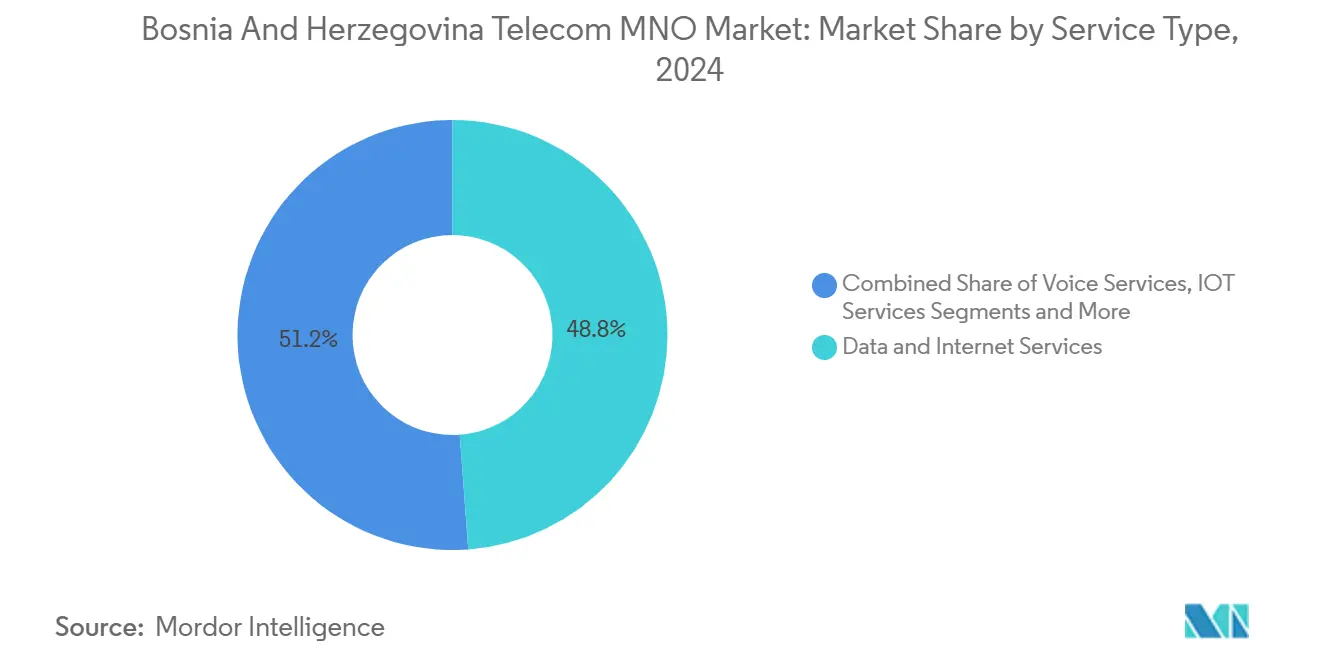
Data services captured 48.84% Bosnia Herzegovina telecom market size in 2024 and are expanding at 4.12% CAGR to 2030. Mobile broadband supplies primary internet for 2.73 million users, while FTTH lines topped 908,000. Average download speed on Telemach’s fiber network reached 63.3 Mb/s. Tiered plans tied to video, cloud gaming, and smart-home add-ons lift blended ARPU.
Backward-compatible 5G-ready gear is being layered onto dense 4G grids, allowing operators to switch traffic seamlessly once spectrum is issued. Enterprise VPNs and dedicated internet access sell at premium price points, strengthening margins for incumbents.



By End User: Consumer Segment - Digital Lifestyle Shapes Demand
Consumer subscriptions formed 81.41% of Bosnia Herzegovina telecom market in 2024, yet growth slows to a 3.76% CAGR as penetration nears saturation. Daily social, streaming, and mobile-banking activities heighten the need for reliable data. Western Balkans roaming without surcharges boosts perceived value during cross-border travel.
Operators migrate prepaid customers into hybrid bundle models, enhancing predictability of revenue while upselling streaming add-ons. Digital self-care apps reduce support costs and sharpen customer experience.
Second-order effects include rising device financing demand and the spread of e-commerce, which in turn prompt higher data pack upgrades. Despite muted income growth, consumers show readiness to pay modest premiums for quality connectivity.
Geography Analysis
Bosnia Herzegovina’s topography dictates telecom roll-out economics. Urban agglomerations like Sarajevo, Banja Luka, and Mostar enjoy near-universal 4G, contributing a disproportionate share of Bosnia Herzegovina telecom market revenue. Rural coverage gaps persist in mountainous northeast and southeastern cantons where low population density stretches payback periods.
EU cohesion funding and operator capex address this disparity through subsidized FTTH corridors and microwave backhaul links, raising national internet penetration to 86.7% in 2025. Satellite entrants, led by Starlink’s 2025 launch, promise competitive redundancy for hard-to-reach villages.
Cross-border corridors that channel trade to Croatia and Serbia are another focal point. Continuous coverage facilitates IoT-enabled fleet tracking, benefiting logistics operators and boosting M2M SIM activations. Geographic revenue concentration gradually dilutes as subsidy-supported infrastructure projects unlock latent rural demand.
Competitive Landscape
Market power rests with three full-service MNOs. BH Telecom retains 45% Bosnia Herzegovina telecom market share, leveraging its nationwide fiber backbone and state-owned status for regulatory goodwill. m:tel’s 41% share draws on parent Telekom Srbija’s scale advantages, allowing price-aggressive bundles. HT Eronet ranks third at 14% but differentiates via superior download speeds and early 5G trials.
Competition shifts from territorial expansion to network-quality one-upmanship. BH Telecom hiked EBITDA 10% in the first nine months of 2024 on the back of data-heavy bundles. HT Eronet migrated its billing to an agile Red Hat stack, cutting time-to-market for new offers. m:tel invests in content, bundling IPTV with mobile, and pilots NB-IoT for smart metering.
Bosnia And Herzegovina Telecom MNO Industry Leaders
BH Telecom
m:tel (Telekom Srpske)
HT Eronet (HT Mostar)
- *Disclaimer: Major Players sorted in no particular order

Recent Industry Developments
- January 2025: BH Telecom announced plans to acquire Telemach operations in three countries, signaling regional consolidation.
- June 2024: Novotel d.o.o. secured approval to become the fourth mobile operator, leveraging m:tel infrastructure.
- April 2024: EBRD, EU, and GIZ launched a USD 50 million “Go Digital” program, bolstering SME demand for advanced connectivity.
- March 2024: UNDP and the British Embassy rolled out a USD 5 million digital-government initiative spanning four years.


Bosnia And Herzegovina Telecom MNO Market Report Scope
| Voice Services |
| Data and Internet Services |
| Messaging Services |
| IoT and M2M Services |
| OTT and PayTV Services |
| Other Services (VAS, Roaming and International Services, Enterprise and Wholesale Services, etc.) |
| Enterprises |
| Consumer |
| Service Type | Voice Services |
| Data and Internet Services | |
| Messaging Services | |
| IoT and M2M Services | |
| OTT and PayTV Services | |
| Other Services (VAS, Roaming and International Services, Enterprise and Wholesale Services, etc.) | |
| End-user | Enterprises |
| Consumer |


Key Questions Answered in the Report
How are rural connectivity gaps being addressed?
Operators are extending FTTH, while satellite entrants such as Starlink plan commercial service in 2025 to cover hard-to-reach areas.
What is driving enterprise demand for telecom services?
EU-funded digitalization grants and mandatory e-government upgrades are pushing enterprises toward cloud, IoT, and managed connectivity.
Which operator has the largest subscriber base?
BH Telecom leads with 45% Bosnia Herzegovina telecom market share, supported by an extensive fiber backbone.
When will 5G be commercially available across Bosnia and Herzegovina
The regulator aims to auction spectrum by 2026, so initial 5G services are likely to appear in major cities shortly after.
Page last updated on:





